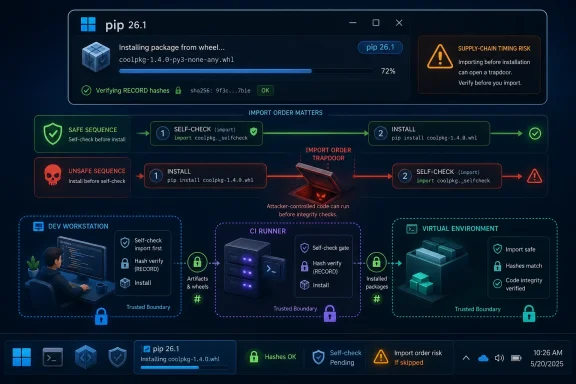
CVE-2026-6357 is a medium-severity flaw disclosed in April 2026 in pip before version 26.1, where pip’s post-install self-update check could import newly installed Python modules after wheel installation and potentially execute attacker-controlled code in a local install scenario. That description sounds narrow, and in one sense it is. But the interesting part is not that pip had a bug; it is that a performance optimization in one of the world’s most heavily used developer tools created a small but real supply-chain trapdoor. For Windows developers and administrators, the lesson is blunt: package managers are not passive plumbing anymore.
The vulnerability sits in a deceptively ordinary corner of pip: the notice that tells users when a newer version of pip is available. To keep the command-line tool fast, pip had deferred some imports until the end of a command invocation. That is a reasonable engineering choice in isolation, especially for a tool that is run constantly in local shells, CI jobs, build containers, and developer scripts.
The problem is that “the end” came after installation work had already happened. If pip installed or overwrote modules that the self-check later imported, that late import could cross a trust boundary the user did not know existed. In practical terms, code that arrived during the install could influence a check that many users would never think of as part of the package installation path.
That is why CVE-2026-6357 is better understood as a sequencing vulnerability than as a dramatic new exploitation class. The fix in pip 26.1 changes the order: pip performs the self-check work before the installation can alter what might be imported, while still delaying the user-facing notice until the end. It is a tidy patch, but it also admits the uncomfortable truth. In package management, when a tool imports code can matter almost as much as what it imports.
An attacker would still need to get a user or process to install a malicious or carefully crafted wheel in a context where pip’s own modules or well-known imported names could be overwritten or shadowed. That is a very different risk from an unauthenticated network service flaw. It is closer to the unpleasant territory sysadmins already know: poisoned dependencies, compromised internal packages, typosquatting, and build scripts that run with more trust than they deserve.
Yet dismissing the issue because it requires an install action would miss the modern software supply-chain reality. Installing packages is not an exceptional event in Python environments. It is the workflow. Developers do it locally; build systems do it automatically; notebooks do it casually; deployment pipelines do it repeatedly. A bug that fires during installation lives exactly where trust is most frequently delegated.
The dangerous mental model is the one that treats
Microsoft’s presence still matters for WindowsForum readers because Microsoft’s security catalog is how many enterprise teams ingest vulnerability intelligence. A CVE appearing in the MSRC ecosystem can show up in dashboards, compliance reports, vulnerability management exports, and patch conversations even when the affected component is open source and cross-platform. For Windows shops, that often turns an upstream Python packaging issue into a local operational question: where do we have pip, which version is present, and who owns remediation?
That question is harder than it looks. Python may arrive through the Microsoft Store, winget, the official Python installer, Visual Studio workloads, Anaconda, embedded application runtimes, developer toolchains, GitHub Actions runners, containers, WSL distributions, and internal golden images. In other words, “update pip” is not a single action in a Windows estate. It is an inventory problem wearing a command-line mask.
The Microsoft framing also risks a subtle misunderstanding. The KB disclaimer says the information is provided as-is; the CVE tells you what changed; neither tells you whether your developers install untrusted wheels, whether your CI system pins hashes, whether internal mirrors enforce review, or whether laptops have unmanaged Python installations. The vulnerability record is the start of the analysis, not the conclusion.
For years, Python packaging has been pulled between two opposing instincts. One instinct says pip should remain boring, minimal, and compatible. The other says modern supply-chain attacks require package managers to participate actively in risk reduction. pip 26.1 leans toward the second instinct, but carefully.
Dependency cooldowns are a good example. They let users avoid packages uploaded too recently, giving registries and researchers time to detect compromise. That is not a silver bullet, because it can also delay legitimate security fixes. But it acknowledges a reality that defenders have learned the hard way: the freshest dependency is not always the safest dependency.
Lock-file support points in the same direction. Reproducible installs are not just a convenience for developers who hate “works on my machine” failures. They are also an audit tool. If a Windows build agent installs the same dependency graph today that it installed yesterday, defenders have a better shot at spotting the moment something changes.
CVE-2026-6357 fits this broader trend because it shows that package-manager hardening is not only about blocking malicious packages. It is also about reducing surprising behavior inside the tool itself. The fix does not ask users to memorize a new flag. It changes the default sequence so that pip’s own internal check no longer imports from a freshly modified environment.
That fragmentation changes the response to CVE-2026-6357. On a clean Linux server, an administrator may know exactly which system package owns pip. On a Windows workstation,
Virtual environments help, but they do not eliminate the issue. A project may create a fresh venv and immediately bootstrap dependencies using whatever pip version is bundled or seeded by the environment tool. Containers help too, but only if the base image is refreshed and the build process is not blindly reinstalling older tooling. CI runners are safer when ephemeral, but ephemeral does not mean immune if every run repeats the same unsafe dependency pattern.
For Windows administrators, the practical answer starts with visibility. Developer endpoints should be treated as part of the software supply chain, not as informal personal workspaces. If a machine can build, sign, package, or deploy software, its Python toolchain deserves the same inventory discipline as browsers, VPN clients, and endpoint agents.
That is why “users should review package contents prior to installation” is technically sound but operationally incomplete. Very few organizations can manually inspect every wheel their developers install. Even fewer can inspect transitive dependencies with enough context to detect a deliberate attempt to abuse installer behavior. Humans need policy, automation, and defaults that assume review will be partial.
The best defensive posture is layered. Use virtual environments so one project cannot casually contaminate another. Prefer pinned dependencies and hashes for production builds. Route installs through a controlled mirror when possible. Keep pip itself updated, because the installer is part of the attack surface. Separate developer experimentation from release engineering.
There is also a cultural point here. Python’s ease of installation is one of its great strengths, particularly on Windows where setup friction historically pushed developers away. But convenience becomes risk when every tutorial, README, and Stack Overflow answer begins with a command that downloads and executes from the internet without much scrutiny. CVE-2026-6357 is small enough to patch quickly, but large enough to remind us that developer convenience has security semantics.
But the broader lesson is harder for enterprises. You cannot solve package-manager risk by waiting for every CVE and then scrambling. The vulnerable pattern here emerged from a performance optimization, not from an obviously reckless feature. That means mature teams need to think about tool behavior, dependency provenance, and build isolation before the next advisory lands.
There is an uncomfortable symmetry in pip 26.1. The release fixes a bug where late imports could be dangerous, while also adding features that help users slow or stabilize dependency intake. Both moves point to the same conclusion: modern package management is no longer just dependency resolution. It is policy enforcement, risk timing, and execution control.
For Windows shops, this is where security and developer experience collide. Lock everything down too aggressively, and developers route around the system. Leave everything open, and your build chain becomes an unmonitored execution platform. The useful middle ground is not a blanket ban on PyPI; it is a managed path that gives developers speed while making dangerous surprises less likely.
This creates a familiar security maintenance squeeze. The fixed pip release may not be available or appropriate for every legacy Python environment. Some teams will need to backport, rely on vendor packaging, isolate affected environments, or accelerate interpreter upgrades. None of those options is as simple as running one upgrade command across the fleet.
Windows environments are especially likely to contain long-lived Python installs hidden inside build scripts, scheduled tasks, test harnesses, and application directories. The risk is not only the developer laptop with a visible terminal. It is the automation server nobody wants to touch because the last person who understood its dependencies left two years ago.
That is why the response should be version-aware rather than slogan-driven. Find pip versions before 26.1. Determine which interpreters they belong to. Identify whether those environments install packages from untrusted or semi-trusted sources. Then decide whether to upgrade pip, upgrade Python, freeze the environment, or isolate it from risky install paths.
The first pass should be discovery. Administrators should look for pip executables, Python launchers, virtual environments, Conda installations, WSL distributions, and CI images. The goal is not to produce a perfect map on day one. It is to stop pretending that one asset-management entry called “Python” tells the whole story.
The second pass should be ownership. Developer-managed environments are not automatically bad, but unmanaged production build inputs are. If an environment participates in release engineering, it should have a documented update path and a reproducible dependency strategy. If it is purely experimental, it should not be allowed to sign, publish, or deploy artifacts without passing through a controlled process.
The third pass should be policy. Hash-checking mode, internal package mirrors, dependency scanning, lock files, and cooldown windows are not interchangeable controls. They answer different failure modes. CVE-2026-6357 happens to be about pip’s own import ordering, but the next Python packaging advisory may involve archive parsing, metadata handling, dependency confusion, or build backend execution.
The bug is also a useful test of security maturity. A mature organization can answer which pip versions it runs, where they are used, and whether they touch sensitive build paths. An immature one argues about whether a medium CVSS score is worth caring about because it cannot answer the inventory question.
Here is the concrete read for WindowsForum readers:
 A Small Import Order Bug Exposes a Big Assumption
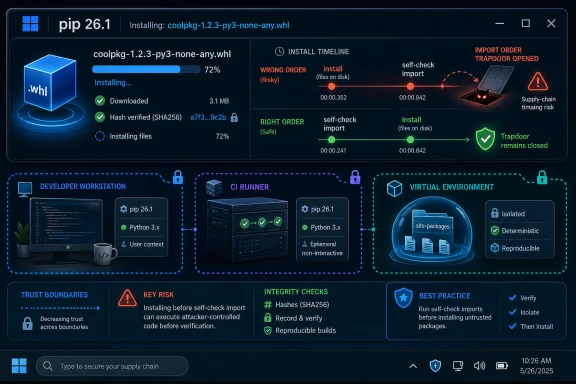
The vulnerability sits in a deceptively ordinary corner of pip: the notice that tells users when a newer version of pip is available. To keep the command-line tool fast, pip had deferred some imports until the end of a command invocation. That is a reasonable engineering choice in isolation, especially for a tool that is run constantly in local shells, CI jobs, build containers, and developer scripts.The problem is that “the end” came after installation work had already happened. If pip installed or overwrote modules that the self-check later imported, that late import could cross a trust boundary the user did not know existed. In practical terms, code that arrived during the install could influence a check that many users would never think of as part of the package installation path.
That is why CVE-2026-6357 is better understood as a sequencing vulnerability than as a dramatic new exploitation class. The fix in pip 26.1 changes the order: pip performs the self-check work before the installation can alter what might be imported, while still delaying the user-facing notice until the end. It is a tidy patch, but it also admits the uncomfortable truth. In package management, when a tool imports code can matter almost as much as what it imports.
The Exploit Story Is Constrained, Not Imaginary
This is not a remote worm, and it is not a reason to panic-uninstall Python from every workstation. The CVSS 4.0 score attached to the CVE is 5.3, with local attack vector, high privileges required, active user interaction, and no availability impact. That profile matters because it keeps the bug in proportion.An attacker would still need to get a user or process to install a malicious or carefully crafted wheel in a context where pip’s own modules or well-known imported names could be overwritten or shadowed. That is a very different risk from an unauthenticated network service flaw. It is closer to the unpleasant territory sysadmins already know: poisoned dependencies, compromised internal packages, typosquatting, and build scripts that run with more trust than they deserve.
Yet dismissing the issue because it requires an install action would miss the modern software supply-chain reality. Installing packages is not an exceptional event in Python environments. It is the workflow. Developers do it locally; build systems do it automatically; notebooks do it casually; deployment pipelines do it repeatedly. A bug that fires during installation lives exactly where trust is most frequently delegated.
The dangerous mental model is the one that treats
pip install as a file-copying operation. pip resolves, downloads, unpacks, builds, executes metadata flows, manages environments, consults indexes, and imports its own code along the way. CVE-2026-6357 is a reminder that the installer itself has an execution surface, and that surface changes as the environment changes beneath it.Microsoft’s Listing Is a Signal, Not the Center of Gravity
The user-visible source here is Microsoft’s Security Update Guide entry, complete with the familiar Microsoft Knowledge Base disclaimer. That does not mean this is a Windows-only bug or a Microsoft-originated flaw. pip is maintained by the Python packaging community, and the CVE record identifies pip prior to 26.1 as affected.Microsoft’s presence still matters for WindowsForum readers because Microsoft’s security catalog is how many enterprise teams ingest vulnerability intelligence. A CVE appearing in the MSRC ecosystem can show up in dashboards, compliance reports, vulnerability management exports, and patch conversations even when the affected component is open source and cross-platform. For Windows shops, that often turns an upstream Python packaging issue into a local operational question: where do we have pip, which version is present, and who owns remediation?
That question is harder than it looks. Python may arrive through the Microsoft Store, winget, the official Python installer, Visual Studio workloads, Anaconda, embedded application runtimes, developer toolchains, GitHub Actions runners, containers, WSL distributions, and internal golden images. In other words, “update pip” is not a single action in a Windows estate. It is an inventory problem wearing a command-line mask.
The Microsoft framing also risks a subtle misunderstanding. The KB disclaimer says the information is provided as-is; the CVE tells you what changed; neither tells you whether your developers install untrusted wheels, whether your CI system pins hashes, whether internal mirrors enforce review, or whether laptops have unmanaged Python installations. The vulnerability record is the start of the analysis, not the conclusion.
pip 26.1 Quietly Moves Security Into Workflow Design
pip 26.1 did more than fix CVE-2026-6357. The release also added experimental support for installing from standardizedpylock.toml lock files, introduced dependency cooldown support through --uploaded-prior-to, fixed another archive-handling CVE, upgraded vendored urllib3, and dropped Python 3.9 support. That cluster of changes is more revealing than any single patch note.For years, Python packaging has been pulled between two opposing instincts. One instinct says pip should remain boring, minimal, and compatible. The other says modern supply-chain attacks require package managers to participate actively in risk reduction. pip 26.1 leans toward the second instinct, but carefully.
Dependency cooldowns are a good example. They let users avoid packages uploaded too recently, giving registries and researchers time to detect compromise. That is not a silver bullet, because it can also delay legitimate security fixes. But it acknowledges a reality that defenders have learned the hard way: the freshest dependency is not always the safest dependency.
Lock-file support points in the same direction. Reproducible installs are not just a convenience for developers who hate “works on my machine” failures. They are also an audit tool. If a Windows build agent installs the same dependency graph today that it installed yesterday, defenders have a better shot at spotting the moment something changes.
CVE-2026-6357 fits this broader trend because it shows that package-manager hardening is not only about blocking malicious packages. It is also about reducing surprising behavior inside the tool itself. The fix does not ask users to memorize a new flag. It changes the default sequence so that pip’s own internal check no longer imports from a freshly modified environment.
Windows Developers Live in the Blast Radius of Convenience
Windows has become a better Python platform than it used to be, but it is also a fragmented one. A developer may have Python from the Store, another copy from python.org, a Visual Studio-managed interpreter, a Conda environment, WSL Ubuntu, and a project-local virtual environment. Each can have a different pip. Each can be invoked accidentally by PATH order, launcher behavior, IDE settings, or shell history.That fragmentation changes the response to CVE-2026-6357. On a clean Linux server, an administrator may know exactly which system package owns pip. On a Windows workstation,
py -m pip --version, python -m pip --version, pip --version, and an IDE-integrated terminal can point to different places. The operational risk is not simply that pip is outdated; it is that teams may not know which pip they are updating.Virtual environments help, but they do not eliminate the issue. A project may create a fresh venv and immediately bootstrap dependencies using whatever pip version is bundled or seeded by the environment tool. Containers help too, but only if the base image is refreshed and the build process is not blindly reinstalling older tooling. CI runners are safer when ephemeral, but ephemeral does not mean immune if every run repeats the same unsafe dependency pattern.
For Windows administrators, the practical answer starts with visibility. Developer endpoints should be treated as part of the software supply chain, not as informal personal workspaces. If a machine can build, sign, package, or deploy software, its Python toolchain deserves the same inventory discipline as browsers, VPN clients, and endpoint agents.
The Real Risk Is Trusting the Install Moment Too Much
Security teams often focus on what happens before installation: whether a package name is legitimate, whether the index is trusted, whether a hash matches, whether a dependency is pinned. CVE-2026-6357 points to the next layer down. Even after a wheel is selected, the mechanics of installation can create opportunities for code to execute or influence the tool.That is why “users should review package contents prior to installation” is technically sound but operationally incomplete. Very few organizations can manually inspect every wheel their developers install. Even fewer can inspect transitive dependencies with enough context to detect a deliberate attempt to abuse installer behavior. Humans need policy, automation, and defaults that assume review will be partial.
The best defensive posture is layered. Use virtual environments so one project cannot casually contaminate another. Prefer pinned dependencies and hashes for production builds. Route installs through a controlled mirror when possible. Keep pip itself updated, because the installer is part of the attack surface. Separate developer experimentation from release engineering.
There is also a cultural point here. Python’s ease of installation is one of its great strengths, particularly on Windows where setup friction historically pushed developers away. But convenience becomes risk when every tutorial, README, and Stack Overflow answer begins with a command that downloads and executes from the internet without much scrutiny. CVE-2026-6357 is small enough to patch quickly, but large enough to remind us that developer convenience has security semantics.
The Patch Is Simple Because the Lesson Is Not
The actual code-level fix is elegant: do the self-version check’s necessary work before the install phase can change importable modules, then emit the notification later. That preserves the user experience while closing the window that made newly installed code relevant to the self-check. It is the kind of patch maintainers prefer because it removes a class of surprise rather than bolting on a warning.But the broader lesson is harder for enterprises. You cannot solve package-manager risk by waiting for every CVE and then scrambling. The vulnerable pattern here emerged from a performance optimization, not from an obviously reckless feature. That means mature teams need to think about tool behavior, dependency provenance, and build isolation before the next advisory lands.
There is an uncomfortable symmetry in pip 26.1. The release fixes a bug where late imports could be dangerous, while also adding features that help users slow or stabilize dependency intake. Both moves point to the same conclusion: modern package management is no longer just dependency resolution. It is policy enforcement, risk timing, and execution control.
For Windows shops, this is where security and developer experience collide. Lock everything down too aggressively, and developers route around the system. Leave everything open, and your build chain becomes an unmonitored execution platform. The useful middle ground is not a blanket ban on PyPI; it is a managed path that gives developers speed while making dangerous surprises less likely.
The Release Boundary Will Catch Some Teams Off Guard
pip 26.1 now targets Python 3.10 and newer, which complicates remediation for environments still pinned to Python 3.9 or older. That is not a small footnote. Many enterprises move slowly because applications, vendor SDKs, scientific stacks, or internal automation remain tied to older interpreter versions long after upstream projects have moved on.This creates a familiar security maintenance squeeze. The fixed pip release may not be available or appropriate for every legacy Python environment. Some teams will need to backport, rely on vendor packaging, isolate affected environments, or accelerate interpreter upgrades. None of those options is as simple as running one upgrade command across the fleet.
Windows environments are especially likely to contain long-lived Python installs hidden inside build scripts, scheduled tasks, test harnesses, and application directories. The risk is not only the developer laptop with a visible terminal. It is the automation server nobody wants to touch because the last person who understood its dependencies left two years ago.
That is why the response should be version-aware rather than slogan-driven. Find pip versions before 26.1. Determine which interpreters they belong to. Identify whether those environments install packages from untrusted or semi-trusted sources. Then decide whether to upgrade pip, upgrade Python, freeze the environment, or isolate it from risky install paths.
The Windows Admin’s Job Is to Turn a CVE Into an Inventory
Most vulnerability advisories are written as if affected software exists in neat rows. Real Windows environments are messier. A single workstation may hold multiple Python installations, multiple user-level site-packages directories, and build tooling installed by IDEs or package managers outside central IT’s normal patch channel.The first pass should be discovery. Administrators should look for pip executables, Python launchers, virtual environments, Conda installations, WSL distributions, and CI images. The goal is not to produce a perfect map on day one. It is to stop pretending that one asset-management entry called “Python” tells the whole story.
The second pass should be ownership. Developer-managed environments are not automatically bad, but unmanaged production build inputs are. If an environment participates in release engineering, it should have a documented update path and a reproducible dependency strategy. If it is purely experimental, it should not be allowed to sign, publish, or deploy artifacts without passing through a controlled process.
The third pass should be policy. Hash-checking mode, internal package mirrors, dependency scanning, lock files, and cooldown windows are not interchangeable controls. They answer different failure modes. CVE-2026-6357 happens to be about pip’s own import ordering, but the next Python packaging advisory may involve archive parsing, metadata handling, dependency confusion, or build backend execution.
The Practical Reading of CVE-2026-6357 Is Narrow but Not Small
CVE-2026-6357 should not send anyone into breach-response theatrics by itself. There is no public evidence in the core advisory language that this was broadly exploited, and its exploitation conditions are constrained. But it should move teams that have been casual about Python tooling into a more deliberate posture.The bug is also a useful test of security maturity. A mature organization can answer which pip versions it runs, where they are used, and whether they touch sensitive build paths. An immature one argues about whether a medium CVSS score is worth caring about because it cannot answer the inventory question.
Here is the concrete read for WindowsForum readers:
- Upgrade pip to version 26.1 or later wherever the environment supports it, especially on developer machines and build systems that install wheels from external or semi-trusted sources.
- Treat Python 3.9-era environments as a separate remediation problem, because pip 26.1 targets Python 3.10 and newer.
- Run pip through the interpreter you intend to manage, such as
py -m pipor the full path to the project’s Python executable, rather than assumingpipon PATH is the right one. - Prefer virtual environments, pinned dependencies, hashes, and controlled package indexes for build and production workflows.
- Use the incident as a prompt to inventory Python tooling across Windows endpoints, CI runners, containers, WSL instances, and application-bundled runtimes.
References
- Primary source: MSRC
Published: 2026-05-22T01:42:29-07:00
Security Update Guide - Microsoft Security Response Center
 msrc.microsoft.com
- Related coverage: datacomm.com
CVE-2026-6357 pip self-update functionality can import newly installed modules after wheel installation - DataComm Networks Incorporated
Information published.www.datacomm.com - Related coverage: thewindowsupdate.com