

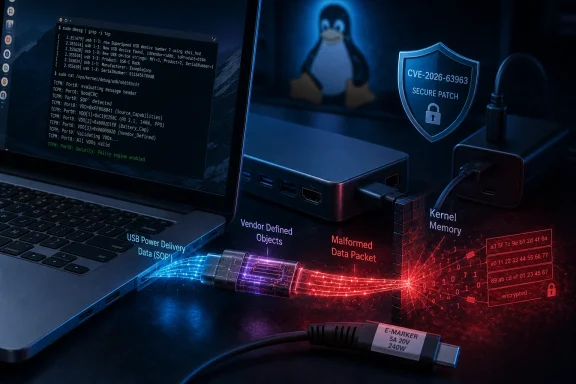
CVE-2026-63963 is a newly published Linux kernel information-disclosure vulnerability in the USB Type-C Power Delivery stack, and it is a reminder that the devices connected to a modern USB-C port are not merely passive peripherals. The flaw affects the TCPM implementation used by Linux to manage USB Type-C and USB Power Delivery negotiation: a malicious or malfunctioning USB-C device, cable, dock, charger, or intermediary controller could report an invalid number of Vendor Defined Objects during a Discover Identity response, causing the kernel to index beyond static arrays and potentially disclose memory contents. The upstream fix is now available in Linux 6.12.93, 6.18.35, 7.0.12, and the mainline 7.1 release, but the practical security question for users is whether their installed distribution kernel has incorporated the relevant stable update.
USB-C was designed to make connectivity simpler, but its underlying protocol stack is dramatically more capable than the older USB Type-A era. A single USB-C connector can handle charging, conventional USB data, DisplayPort video output, Thunderbolt or USB4 tunneling, dock connectivity, alternate modes, and cable capability detection. Before any of that works reliably, the devices at each end of the cable need to exchange a substantial amount of metadata.
That means a USB-C port is an active communications boundary even before the operating system mounts a USB storage device or recognizes a conventional HID accessory. A laptop may query a cable or dock while establishing a power contract, selecting a high-speed data path, or deciding whether a particular alternate mode is safe to enter.
The affected code resides in the Linux kernel file responsible for TCPM behavior. This is not a general USB mass-storage flaw, a browser vulnerability, or a defect in the Windows USB stack. It is specifically tied to Linux systems whose Type-C controller and platform configuration use the TCPM code path.
Those VDOs may communicate identity information, certification status, product information, cable characteristics, and device-type-specific details. They matter because the operating system needs trustworthy information before it can make decisions about power delivery, high-speed signaling, USB4 paths, or alternate-mode behavior.
The essential security lesson is straightforward: even when a protocol has formal limits, kernel code must validate every length and count field supplied by an external device. CVE-2026-63963 addresses a case in which the incoming VDO count was treated too trustingly.
This is an out-of-bounds read-style condition rather than a documented arbitrary-write primitive. The distinction matters: a read beyond intended memory bounds can disclose adjacent data, while a write beyond bounds can alter memory and often presents a more direct route to control-flow compromise. Still, kernel memory disclosure is never trivial, particularly because it may weaken assumptions about memory confidentiality or reveal information useful in chaining attacks.
A correctly designed parser needs both protocol awareness and defensive bounds enforcement. It should not rely solely on a peer complying with the USB Power Delivery specification, because hostile hardware, corrupted firmware, defective adapters, protocol fuzzers, and unexpected interoperability cases can all generate malformed messages.
This vulnerability illustrates a recurring systems-security principle: the fact that a message is expected does not make its contents safe. Every field crossing from hardware or firmware into privileged kernel code needs to be treated as attacker-controlled until it has been validated.
That does not mean every Linux machine running an older kernel is equally exposed. TCPM is relevant only where the hardware, driver stack, firmware behavior, and configuration result in the affected Type-C Power Delivery management code being active. But the broad version range means organizations should not dismiss the CVE merely because their fleet uses a long-term support kernel.
The eventual score will depend on details such as attack complexity, required user interaction, local versus adjacent attack vectors, and realistic confidentiality impact. In practical terms, the vulnerability is best described as a physical or directly connected hardware attack-surface issue involving privileged kernel parsing, with likely consequences centered on information disclosure.
This is necessary for the USB-C ecosystem to work safely at higher power and performance levels. A system needs to know whether a cable can support a given charging current or high-speed data mode. Yet the same flexibility means cable metadata is input received from external electronics, not a fact the host should assume is accurate.
For an attacker, these devices create multiple opportunities to present malformed protocol behavior. CVE-2026-63963 does not imply that ordinary branded docks or chargers are malicious, nor does it establish a widespread real-world exploit campaign. It does show why organizations should regard untrusted USB-C infrastructure with the same caution they apply to unknown USB storage and network devices.
The vulnerable handlers apparently received a count derived from that external message and used it while consuming the identity VDOs. If the count exceeded the range expected by the static arrays holding or interpreting those entries, the kernel could read outside the intended bounds.
That distinction is technically important because cables have their own identity and capability data. A security fix that covers both handlers closes the same class of validation gap across both identity-discovery paths rather than assuming that only the primary connected device can deliver problematic metadata.
Even so, kernel data disclosure can be meaningful. Modern operating systems use memory-layout randomization and other mitigations to make exploitation harder. If an attacker can disclose useful addresses or sensitive nearby contents, that may reduce the effectiveness of defenses intended to prevent more serious attacks.
If the Linux installation uses an affected TCPM-backed Type-C controller, the Linux environment needs its own patched kernel. The presence of the vulnerability should not be used to infer a parallel flaw in Windows, because the code path and kernel implementation are different.
Therefore, CVE-2026-63963 is generally more relevant to native Linux machines, Linux laptops, embedded systems, and Linux-based appliances than to ordinary WSL use. Organizations using specialized USB passthrough or custom virtualization arrangements should still evaluate their architecture rather than assuming that every virtual Linux environment is unaffected.
Windows users also benefit from keeping firmware current. System firmware, dock firmware, and Thunderbolt or USB4 controller updates can address separate reliability and security issues even though they are not substitutes for the Linux kernel patch associated with this CVE.
The safest operational posture is to update both sides where possible: the host’s operating system and kernel, as well as the firmware for the platform and major USB-C accessories.
Security teams should combine kernel inventory with hardware context. The relevant question is not merely “Which machines run Linux 6.x?” but “Which machines run a vulnerable kernel and expose a Type-C controller governed by TCPM to potentially untrusted accessories?”
A reasonable enterprise triage order is:
However, if a Linux endpoint experiences unusual behavior immediately after connecting an unknown USB-C accessory, organizations should preserve the device, record the accessory identity, collect relevant kernel logs, and evaluate whether the system needs broader forensic review. This is sensible USB incident hygiene, not a claim that the CVE reliably leaves obvious traces.
CVE-2026-63963 is a targeted Linux kernel flaw with a clear remediation path, not a reason to abandon USB-C or treat every cable as hostile. Its importance lies in what it reveals about modern computing: ports now negotiate power, identity, and capabilities through complex protocol exchanges before users ever see a desktop notification. Keeping Linux kernels current, using trusted USB-C accessories, and treating peripheral metadata as untrusted input are practical steps that will remain valuable long after this particular VDO-count validation bug has been patched.
 Background
USB-C was designed to make connectivity simpler, but its underlying protocol stack is dramatically more capable than the older USB Type-A era. A single USB-C connector can handle charging, conventional USB data, DisplayPort video output, Thunderbolt or USB4 tunneling, dock connectivity, alternate modes, and cable capability detection. Before any of that works reliably, the devices at each end of the cable need to exchange a substantial amount of metadata.USB-C Is a Negotiated Interface
The USB Type-C Configuration Channel, commonly known as CC, is responsible for more than detecting which way a plug was inserted. In Power Delivery-capable systems, it carries protocol traffic used to establish power roles, negotiate voltages and currents, determine data roles, identify cables, and coordinate advanced capabilities such as USB4 and DisplayPort Alternate Mode.That means a USB-C port is an active communications boundary even before the operating system mounts a USB storage device or recognizes a conventional HID accessory. A laptop may query a cable or dock while establishing a power contract, selecting a high-speed data path, or deciding whether a particular alternate mode is safe to enter.
Where TCPM Fits
Linux’s Type-C Port Manager, or TCPM, provides a framework for managing USB Type-C connections and USB Power Delivery policy. It sits above Type-C port controller hardware and helps translate protocol-level events into actions such as selecting a charging role, requesting power, discovering identities, evaluating cable properties, and enabling data or display modes.The affected code resides in the Linux kernel file responsible for TCPM behavior. This is not a general USB mass-storage flaw, a browser vulnerability, or a defect in the Windows USB stack. It is specifically tied to Linux systems whose Type-C controller and platform configuration use the TCPM code path.
Discover Identity and Vendor Defined Objects
The vulnerable flow concerns a USB Power Delivery operation called Discover Identity. In simplified terms, a host or port partner sends a structured Vendor Defined Message, or VDM, asking the connected device or cable to identify itself and describe relevant capabilities. The response can include multiple 32-bit Vendor Defined Objects, known as VDOs.Those VDOs may communicate identity information, certification status, product information, cable characteristics, and device-type-specific details. They matter because the operating system needs trustworthy information before it can make decisions about power delivery, high-speed signaling, USB4 paths, or alternate-mode behavior.
The essential security lesson is straightforward: even when a protocol has formal limits, kernel code must validate every length and count field supplied by an external device. CVE-2026-63963 addresses a case in which the incoming VDO count was treated too trustingly.
What CVE-2026-63963 Fixes
The vulnerability description identifies two relevant functions:svdm_consume_identity() and svdm_consume_identity_sop_prime(). These are handlers used to process Discover Identity acknowledgments for a connected partner and, separately, for a cable plug reached through the SOP’ messaging path.The Core Validation Failure
The count passed to the identity-consumption handlers came from the connected device. According to the published kernel advisory, that device-controlled count could cause indexing beyond static arrays, potentially leaking data.This is an out-of-bounds read-style condition rather than a documented arbitrary-write primitive. The distinction matters: a read beyond intended memory bounds can disclose adjacent data, while a write beyond bounds can alter memory and often presents a more direct route to control-flow compromise. Still, kernel memory disclosure is never trivial, particularly because it may weaken assumptions about memory confidentiality or reveal information useful in chaining attacks.
Why “Static Arrays” Matters
Static arrays have a fixed, compile-time size. They are common in kernel parsers where a protocol defines a known set of possible data objects or object positions. If software accepts a count from an untrusted peer without confirming that the count fits the array’s bounds, loops or indexing expressions can reach entries that do not belong to the intended data structure.A correctly designed parser needs both protocol awareness and defensive bounds enforcement. It should not rely solely on a peer complying with the USB Power Delivery specification, because hostile hardware, corrupted firmware, defective adapters, protocol fuzzers, and unexpected interoperability cases can all generate malformed messages.
ACK Handlers Are a Key Boundary
The issue appears in Discover Identity ACK handlers. An ACK is normally the expected positive response to a query, and that can make it easy to think of it as benign protocol traffic. In security terms, however, an acknowledgment containing device-supplied data is still untrusted input.This vulnerability illustrates a recurring systems-security principle: the fact that a message is expected does not make its contents safe. Every field crossing from hardware or firmware into privileged kernel code needs to be treated as attacker-controlled until it has been validated.
Affected Linux Kernel Versions
The published CVE record lists the issue as affecting Linux kernels beginning with version 4.12, subject to whether the running platform actually uses the relevant TCPM path. The fixed versions are Linux 6.12.93, Linux 6.18.35, Linux 7.0.12, and Linux 7.1 or later in the upstream mainline series.Fixed Stable Branches
For administrators and distribution maintainers, the version thresholds are the most actionable part of the advisory:- Linux 6.12 users should update to 6.12.93 or a later 6.12 stable build.
- Linux 6.18 users should update to 6.18.35 or a later 6.18 stable build.
- Linux 7.0 users should update to 7.0.12 or a later 7.0 stable build.
- Linux 7.1 and later include the upstream correction.
The Long Support Tail
The affected-code history reaches back to Linux 4.12, which emphasizes the long lifespan of low-level USB subsystem code. Security fixes in mature kernel components often apply to code paths that have been stable for years, not necessarily to recently introduced features.That does not mean every Linux machine running an older kernel is equally exposed. TCPM is relevant only where the hardware, driver stack, firmware behavior, and configuration result in the affected Type-C Power Delivery management code being active. But the broad version range means organizations should not dismiss the CVE merely because their fleet uses a long-term support kernel.
CVSS Is Not Yet Assigned
As of July 21, 2026, the National Vulnerability Database record has been published but does not yet include a NIST CVSS assessment. That absence should not be interpreted as evidence that the flaw is low severity or harmless; it means the scoring process is incomplete.The eventual score will depend on details such as attack complexity, required user interaction, local versus adjacent attack vectors, and realistic confidentiality impact. In practical terms, the vulnerability is best described as a physical or directly connected hardware attack-surface issue involving privileged kernel parsing, with likely consequences centered on information disclosure.
The USB-C Attack Surface Is Broader Than It Looks
Most people think of USB security in terms of flash drives, keyboards, network adapters, or malicious charging cables. USB-C Power Delivery expands the attack surface below those familiar device classes by allowing policy and identity traffic to occur through the connector’s management channels.Cables Are Active Participants
An electronically marked USB-C cable can contain an e-marker chip that reports characteristics such as current capability, data speed support, and other properties relevant to safe operation. Active cables and sophisticated docks can have even richer behavior.This is necessary for the USB-C ecosystem to work safely at higher power and performance levels. A system needs to know whether a cable can support a given charging current or high-speed data mode. Yet the same flexibility means cable metadata is input received from external electronics, not a fact the host should assume is accurate.
Docks and Chargers Are Not Just Accessories
A modern USB-C dock can include a Power Delivery controller, USB hub, Ethernet controller, display circuitry, storage interfaces, firmware update logic, and sometimes a dedicated embedded operating environment. A charger may also contain a programmable PD controller capable of participating in protocol negotiation.For an attacker, these devices create multiple opportunities to present malformed protocol behavior. CVE-2026-63963 does not imply that ordinary branded docks or chargers are malicious, nor does it establish a widespread real-world exploit campaign. It does show why organizations should regard untrusted USB-C infrastructure with the same caution they apply to unknown USB storage and network devices.
Physical Access Still Has Value
A vulnerability requiring a connected device may look less urgent than a remotely exploitable network flaw. That is often true, but physical-access bugs remain important in several real settings:- Shared offices and hot-desking environments can expose users to unfamiliar chargers, docking stations, and conference-room adapters.
- Travel scenarios increase the temptation to use public charging stations or borrowed USB-C accessories.
- Labs, factories, and repair operations routinely connect prototype hardware, test fixtures, and third-party cables.
- High-security environments may treat any untrusted peripheral connection as a meaningful intrusion path.
- Evil-maid scenarios remain relevant where an attacker can briefly access an unattended laptop.
Technical Anatomy of the Vulnerability
The issue is best understood as a mismatch between the protocol parser’s expectations and the untrusted count value delivered by the peer. Discover Identity responses carry a message header that indicates how many data objects are present, and the receiving driver must translate that count into safe accesses to its internal structures.From Message Header to Array Index
A USB Power Delivery message includes a number-of-data-objects field. In the Discover Identity case, the response generally contains the structured VDM header followed by identity-related VDOs. Those objects have defined meanings and ordering rules based on whether the responder is a device, cable, dual-role product, or another Type-C participant.The vulnerable handlers apparently received a count derived from that external message and used it while consuming the identity VDOs. If the count exceeded the range expected by the static arrays holding or interpreting those entries, the kernel could read outside the intended bounds.
SOP and SOP’ Are Different Paths
USB Power Delivery distinguishes among message routes. SOP typically addresses the directly connected port partner, while SOP’ reaches a cable plug through the cable’s electronics. The separatesvdm_consume_identity_sop_prime() handler reflects the fact that cable discovery is not identical to partner discovery.That distinction is technically important because cables have their own identity and capability data. A security fix that covers both handlers closes the same class of validation gap across both identity-discovery paths rather than assuming that only the primary connected device can deliver problematic metadata.
Information Disclosure Is a Serious Primitive
The advisory says the flaw “could leak data,” which is appropriately cautious language. It does not claim reliable remote code execution, privilege escalation, or a full kernel-memory dump. Exploitability depends on exactly what data becomes reachable, how the code later handles it, whether the resulting values can be observed by an attacker, and how a particular Type-C controller implements the protocol exchange.Even so, kernel data disclosure can be meaningful. Modern operating systems use memory-layout randomization and other mitigations to make exploitation harder. If an attacker can disclose useful addresses or sensitive nearby contents, that may reduce the effectiveness of defenses intended to prevent more serious attacks.
Validation Must Be Layered
A robust fix should not be thought of as one check that permanently solves all malformed Power Delivery messages. Good protocol hardening applies validation at multiple layers:- Message framing must ensure that the advertised number of objects is plausible.
- Command-specific parsing must ensure that the object count matches valid Discover Identity layouts.
- Array access must independently enforce internal bounds.
- Unexpected extra data should be rejected or ignored safely, depending on protocol rules.
- Error paths must avoid retaining partially parsed or inconsistent identity state.
Why This Matters to Windows Users
CVE-2026-63963 is a Linux kernel vulnerability, so standard Windows installations are not directly affected through the Windows USB Type-C stack. That said, WindowsForum readers often use dual-boot systems, Windows Subsystem for Linux, Hyper-V labs, USB-C docking setups, and Linux-based appliances alongside Windows PCs.Dual-Boot Systems Need Separate Patching
A laptop running Windows 11 and a Linux distribution in dual boot should be treated as two separate operating-system security domains. Updating Windows does not update the Linux kernel installed on the other partition, and applying a Linux distribution kernel update does not alter the Windows Type-C stack.If the Linux installation uses an affected TCPM-backed Type-C controller, the Linux environment needs its own patched kernel. The presence of the vulnerability should not be used to infer a parallel flaw in Windows, because the code path and kernel implementation are different.
WSL Is Not the Same as Native Linux Hardware
Windows Subsystem for Linux runs Linux workloads using a Microsoft-managed kernel environment, but typical WSL configurations do not expose a notebook’s native USB-C Power Delivery controller directly to Linux guests in the same way as a bare-metal Linux installation. USB device forwarding, virtualized hardware, and storage or networking interfaces are not equivalent to assigning direct TCPM responsibility to WSL.Therefore, CVE-2026-63963 is generally more relevant to native Linux machines, Linux laptops, embedded systems, and Linux-based appliances than to ordinary WSL use. Organizations using specialized USB passthrough or custom virtualization arrangements should still evaluate their architecture rather than assuming that every virtual Linux environment is unaffected.
USB-C Hygiene Is Cross-Platform
The broader lesson applies everywhere. Users should be cautious about unknown docks, chargers, and cables—especially when connecting systems that are unlocked, carrying sensitive data, or used in managed enterprise environments.Windows users also benefit from keeping firmware current. System firmware, dock firmware, and Thunderbolt or USB4 controller updates can address separate reliability and security issues even though they are not substitutes for the Linux kernel patch associated with this CVE.
Patching and Mitigation Guidance
The preferred remediation is to install a kernel build that contains the fix. Because this is a kernel-level vulnerability, configuration workarounds should be viewed as temporary risk reduction, not equivalent protection.How Linux Users Should Respond
For individual users, the practical response is uncomplicated:- Check the running kernel version with the distribution’s normal tools, such as
uname -r. - Install available security and kernel updates from the distribution’s supported repository.
- Reboot into the newly installed kernel, because installing a kernel package does not secure the currently running kernel.
- Confirm the active kernel version after reboot.
- Avoid unknown USB-C accessories until the system is patched, especially high-function docks, chargers, and electronically marked cables from untrusted sources.
Temporary Exposure Reduction
Where a patched kernel cannot be deployed immediately, organizations can reduce exposure through operational controls:- Restrict access to USB-C ports on systems handling sensitive workloads.
- Use organization-issued chargers, docks, and cables rather than shared or unknown accessories.
- Disable or physically secure unused ports where hardware and policy permit.
- Avoid connecting unverified Type-C hardware during travel or in public spaces.
- Separate testing hardware from production endpoints when evaluating new docks, cables, or embedded devices.
Do Not Confuse Firmware Updates With Kernel Fixes
USB-C docks and laptop firmware often receive updates, and administrators should apply them when supported. However, updating a dock does not correct the Linux kernel’s parser. Likewise, a kernel update does not guarantee that a malfunctioning dock’s firmware will begin behaving correctly.The safest operational posture is to update both sides where possible: the host’s operating system and kernel, as well as the firmware for the platform and major USB-C accessories.
Enterprise Impact and Asset Management
For enterprises, the biggest challenge is not understanding the bug in isolation. It is identifying which systems are both running an affected Linux kernel and using the TCPM Type-C path in a meaningful way.Inventory Is More Important Than Assumptions
A server fleet without USB-C Power Delivery hardware may have little practical exposure even if its source-derived kernel version falls in an affected range. By contrast, a fleet of Linux laptops, developer workstations, conference-room systems, kiosks, industrial tablets, and edge devices may depend heavily on USB-C power and docking.Security teams should combine kernel inventory with hardware context. The relevant question is not merely “Which machines run Linux 6.x?” but “Which machines run a vulnerable kernel and expose a Type-C controller governed by TCPM to potentially untrusted accessories?”
Managed Endpoint Considerations
Endpoint management products often report kernel versions, installed packages, and compliance state. That is enough to prioritize patch deployment, but not always enough to determine hardware exposure. Device models, USB controller drivers, docking policies, and user workflows should inform risk ranking.A reasonable enterprise triage order is:
- Mobile Linux endpoints used outside controlled facilities.
- Developer and engineering systems that connect prototypes or third-party hardware.
- Shared workstations and conference-room equipment with frequent dock turnover.
- Embedded and appliance-style systems with exposed service ports.
- Fixed infrastructure systems with no accessible Type-C Power Delivery function.
Incident-Response Implications
There is no public indication in the published record that CVE-2026-63963 has been exploited in the wild. Security teams should avoid overstating the threat or treating every USB-C reliability issue as evidence of compromise.However, if a Linux endpoint experiences unusual behavior immediately after connecting an unknown USB-C accessory, organizations should preserve the device, record the accessory identity, collect relevant kernel logs, and evaluate whether the system needs broader forensic review. This is sensible USB incident hygiene, not a claim that the CVE reliably leaves obvious traces.
Strengths and Opportunities
The handling of CVE-2026-63963 also highlights several positives in the Linux security and USB-C ecosystems.Fast Availability Across Stable Branches
The fix has been backported to multiple maintained stable kernel lines rather than remaining available only in future mainline code. That gives distributions and appliance vendors a clear path to remediation without requiring a major kernel-series jump.A Narrow, Understandable Remediation
The reported correction addresses a specific parser-hardening gap: validation of the VDO count before identity handlers consume device-provided data. Focused patches are generally easier to review, backport, test, and deploy than broad subsystem redesigns.Better Hardware-Input Discipline
This CVE reinforces a useful engineering standard: treat every peripheral-provided length, count, and identifier as untrusted input. That mindset benefits not only Type-C Power Delivery handling but also USB, PCIe, Bluetooth, storage, display, and network-device subsystems.Opportunities for Testing
The case creates valuable opportunities for maintainers and hardware vendors:- Protocol fuzzing can target malformed structured VDM responses and edge-case object counts.
- Regression tests can verify both SOP and SOP’ identity-discovery paths.
- Static analysis can identify other device-controlled counts used near fixed-size kernel arrays.
- Hardware qualification can include intentionally malformed Power Delivery exchanges, not just standards-compliant interoperability testing.
Risks and Concerns
The published fix closes one defect, but several broader risks remain relevant to organizations that depend heavily on USB-C.Patch Lag Across Distributions
Linux distributions often backport fixes on different schedules. Consumer-focused rolling distributions may deliver a corrected kernel quickly, while long-lived enterprise or appliance deployments may require vendor validation and delayed maintenance windows.Hardware Diversity Complicates Testing
USB-C behavior varies across port-controller chips, BIOS or UEFI firmware, docks, cable types, power adapters, and laptop designs. A patch may be small, but validating it across a diverse hardware fleet still requires care, especially for organizations relying on USB4 displays, high-power charging, or specialized industrial Type-C equipment.Information Leaks Can Be Underestimated
A memory disclosure flaw is sometimes categorized as less severe than code execution, but that can be misleading. Leaked kernel information may support later exploitation, reveal sensitive runtime state, or become significant when combined with another vulnerability.Physical Attacks Remain Operationally Difficult to Detect
A malicious USB-C device may resemble a harmless charger, cable, or dock. That makes procurement controls, accessory inventories, and user awareness important, particularly for high-value endpoints.Overreaction Can Create Its Own Costs
Disabling USB-C functionality broadly may disrupt charging, displays, docking, and data transfer without proportionate benefit. Security teams should apply controls based on exposure and threat model rather than responding with blanket restrictions that impede legitimate work.What to Watch Next
The immediate next step is distribution-level patch adoption. Users should watch for security advisories from their Linux vendor that explicitly reference CVE-2026-63963 or identify the equivalent TCPM fix in the package changelog.CVSS and Further Analysis
The NVD record currently lacks a CVSS score and vector. When a score is assigned, it may help organizations map the flaw into automated vulnerability-management workflows, but it should not replace technical judgment about physical access, USB-C usage patterns, and the likelihood of device-controlled malformed messages reaching the affected driver.Backports Beyond the Listed Releases
The upstream fixed versions establish the baseline, but enterprise vendors may ship patched kernels carrying customized release identifiers. Administrators should verify the vendor’s advisory status rather than assuming that a version string alone is definitive.Potential Follow-On Hardening
The specific issue may prompt broader review of USB Power Delivery parsing logic. The most valuable follow-on work would examine other fields where message-header counts, object positions, VDO layouts, or cable-provided capability data cross into static or bounded kernel structures.USB4 and Higher-Performance Type-C Deployments
As USB4, high-bandwidth display workflows, and higher-power charging become routine, Type-C policy code will become more central to daily computing. That does not make the technology unsafe; it does mean that the security quality of low-level negotiation code deserves the same attention long given to network stacks and storage drivers.CVE-2026-63963 is a targeted Linux kernel flaw with a clear remediation path, not a reason to abandon USB-C or treat every cable as hostile. Its importance lies in what it reveals about modern computing: ports now negotiate power, identity, and capabilities through complex protocol exchanges before users ever see a desktop notification. Keeping Linux kernels current, using trusted USB-C accessories, and treating peripheral metadata as untrusted input are practical steps that will remain valuable long after this particular VDO-count validation bug has been patched.
References
- Primary source: NVD / Linux Kernel
Published: 2026-07-21T01:03:48-07:00
NVD - CVE-2026-63963
 nvd.nist.gov
- Security advisory: MSRC
Published: 2026-07-21T01:03:48-07:00
Original feed URL
Security Update Guide - Microsoft Security Response Center
 msrc.microsoft.com
