

CVE-2026-63978 is a newly published Linux kernel vulnerability in the networking handshake subsystem that turns an apparently small cleanup bug into a far more consequential lifecycle and concurrency problem. The issue affects the code responsible for handing kernel-initiated TLS handshake work to a userspace agent inside a network namespace, and its fix corrects three intertwined failures: pending requests were not drained during namespace teardown, cancellation could corrupt a linked list while that drain was running, and a request could be freed while still being traversed. Although the exposed component is specialized rather than broadly used across every Linux installation, the assigned CVSS 3.1 score of 9.8 Critical makes this a patch-priority issue for organizations operating kernel TLS consumers, network namespaces, containers, or Linux environments hosted through Windows technologies such as WSL and Hyper-V.
The vulnerability is formally described as a flaw in the Linux kernel’s
At the center of CVE-2026-63978 is a failure to correctly transfer pending handshake requests to a temporary list during namespace exit. A reversed call to the kernel list helper
That first defect creates a resource-lifetime problem. Pending requests retain references to a socket file and to the associated
The final patch is therefore not a one-line repair. It changes list ownership, blocks competing removal while a namespace drain is underway, avoids poisoned list links after removal, and takes an additional reference to preserve object lifetime throughout the drain. That layered remediation is important because it demonstrates that the true vulnerability is not simply “a list was spliced backwards.” It is a failure to establish clear ownership during a concurrent shutdown sequence.
The risk is concentrated where three conditions intersect:
Kernel TLS, commonly called kTLS, altered part of that arrangement by allowing the kernel to process TLS record-layer encryption and decryption after a session has been established. This can reduce copies, improve integration with networking offloads, and support specialized kernel consumers. But the TLS handshake itself remains complex: it involves certificate handling, key exchanges, authentication policy, protocol version negotiation, and potentially interaction with hardware or keyrings.
The Linux handshake API was designed to bridge that gap. Rather than embed a full TLS handshake implementation inside the kernel, it lets a kernel-side consumer request work from a userspace handshake agent. The request is conveyed through Generic Netlink, a flexible Linux mechanism for structured communication between the kernel and userspace processes.
This model has several advantages:
In a simple single-threaded model, the solution would be straightforward: remove every request from the queue, complete it with an error, and release each reference. In a real kernel, however, a cancellation may arrive at the same time. A request can be located through a hash table while the namespace-exit path has already moved the same request to a temporary drain list. Socket destruction can happen after the last reference drops. Each of these operations must be synchronized without deadlocking, double-completing a request, or dereferencing freed memory.
CVE-2026-63978 sits precisely in that difficult space.
In the vulnerable code, the local scratch list was empty. The intended operation was to move
The significance of
The correct drain does not simply free a request directly. It routes the request through
By skipping the drain entirely, the vulnerable code did more than fail to free a list node. It bypassed the mechanism intended to resolve the request coherently. A kernel consumer awaiting success or failure could be left with cleanup obligations that never execute through the expected path.
For developers, this is a familiar kernel lesson: lifecycle correctness is often encoded in completion functions rather than in allocation and deallocation alone. Calling the right cleanup function is as important as reaching the right list entry.
After a request is moved into the local drain list, its list-link fields remain non-empty. From the perspective of a concurrent cancellation path, the request still appears linked. That is technically true, but it is linked to the stack-local list now owned by the namespace-exit routine, not to the original namespace queue.
The problem is that the namespace-exit drain routine has already taken control of that request. If cancellation removes the node from the scratch list while the drain loop is walking it, the list can be corrupted. If the timing is slightly different and the drain loop has already removed the entry using a helper that poisons its pointers, the cancellation path can operate on poisoned links instead.
Neither outcome is acceptable in kernel code. List corruption can lead to crashes, memory safety failures, unpredictable behavior, or—in the worst cases—conditions that a determined attacker may be able to steer toward privilege escalation or code execution. A high CVSS score reflects the potential severity of a remotely reachable or unprivileged interaction chain, but it does not itself establish a public exploit or guarantee that every deployment is practically exploitable.
Whether that influence reaches this precise handshake path depends on the service design. But the broader principle is clear: in multi-tenant systems, teardown paths should be treated as part of the attack surface. Attackers often seek races not because shutdown code is common, but because it receives less testing under adversarial timing.
First, the patch corrects the list splice direction so the namespace’s pending requests are moved to the local scratch list and can be drained. Second, it marks the namespace as being drained and makes pending-request removal refuse to act when that state is active. Third, it adjusts the list deletion behavior and adds a reference pin to the request’s file object.
The
The critical synchronization addition is a check for
That may sound counterintuitive. The request is physically visible in the temporary list, so why report it as absent? Because logical ownership has already transferred. The exit path has taken responsibility for completing the request. The cancellation path must not treat physical linkage as permission to modify the list.
This distinction—between an object’s physical location and its logical owner—is central to safe concurrent programming. The request has moved from “pending work available for normal cancellation” to “work owned by namespace shutdown.”
The patch preserves that behavior. Blocking list removal does not mean cancellation becomes irrelevant; it means cancellation can no longer interfere with the drain list’s structural integrity. The existing completion bit remains responsible for arbitrating which path delivers the callback.
That division of responsibilities is sound:
Why
The patch also uses
In this case, leaving poisoned links could create a hazardous state for code that observes or rechecks the request after it has been removed. The change makes the node’s post-removal state safer and more consistent with the concurrent cancellation logic.
The result is not merely cosmetic defensive coding. It prevents the cancellation path from encountering list poison after the exit path has removed the entry, reducing the chance that a late observer turns a cleanup race into memory corruption.
That is a classic use-after-free scenario. A traversal routine believes it owns an entry and will process it shortly, but another path releases the final resource reference and causes the object to disappear underneath it.
The cancellation path continues to participate in completion arbitration. If it wins or otherwise drops a reference according to its normal behavior, the request’s lifetime can end. The drain loop would then retain only a stale pointer.
This is why the patch explicitly pins each request’s file under the namespace lock before releasing the list for draining. The exit path takes an additional reference while it has exclusive list ownership. After the drain loop has finished processing a request, it drops that temporary pin.
In simplified form, the repaired sequence is:
The same record identifies fixed points in maintained branches, including Linux 6.12.93 and Linux 7.0.12, with the upstream fix incorporated by Linux 7.1. Administrators should treat these values as indicators of where the correction landed upstream rather than as substitutes for their distribution’s advisory.
The correct question is not simply, “Is the kernel version greater than 6.12.93?” It is, “Does the installed vendor kernel package include the CVE-2026-63978 fix?”
For example, a distribution may package a kernel based on a long-term branch and append its own release metadata. Its security advisory, package changelog, or source patch list is the authoritative way to establish remediation status.
A short-lived workload can create sockets, initiate work, hit a timeout, and terminate quickly. Orchestration systems can concurrently stop a pod, tear down its network namespace, kill a helper process, and replace the workload. These ordinary operations create exactly the kind of interleaving that shutdown-race bugs require.
The affected architecture may appear in specialized environments such as:
Security teams should therefore evaluate the risk in terms of tenant boundaries. A container escape is not implied by the CVE description, and no public exploit should be assumed solely from a severity score. Still, any kernel race involving potential use-after-free behavior deserves careful review where untrusted code runs on shared Linux hosts.
WSL 2 runs Linux distributions using a real Linux kernel in a lightweight virtual machine. That makes WSL fundamentally different from a compatibility layer that merely translates Linux calls into Windows behavior. If Microsoft’s supplied WSL kernel or a custom WSL kernel includes the affected code and a workload uses the handshake subsystem, then the Linux guest environment is the relevant remediation boundary.
However, advanced WSL users may run Docker engines, Kubernetes distributions, VPN tooling, network labs, custom kernels, or service meshes. These deployments deserve inventory and patch review, particularly when they host untrusted repositories, development containers, or externally reachable services.
An organization can be fully current on Windows updates and still operate vulnerable Linux guests. Patch management must track the layers separately:
The highest-priority systems are those that combine current vulnerable kernel lines with network namespace churn and a plausible use of kernel-initiated TLS handshakes. Systems that run custom networking stacks, storage clients with TLS integration, cloud networking agents, or experimental kernel TLS services should be examined first.
At minimum, post-update testing should cover:
Kernel and systems developers can improve resilience by expanding stress testing around:
Likewise, adding the draining flag without the temporary file reference would still leave an opportunity for a request to be freed while the local drain list references it. The patch components are interdependent, and each is required to maintain correctness.
This is a strong argument for using signed, vendor-provided kernel updates whenever possible. Manual source modifications should be reserved for teams capable of reviewing the full patch series, running concurrency-focused tests, and maintaining the result over time.
Organizations should monitor their Linux vendor’s kernel advisories, especially for long-term-support branches and cloud-tuned kernels. Managed Kubernetes services, cloud images, and WSL kernel distributions may publish their own timelines, and those timelines may not align exactly with upstream stable releases.
CVE-2026-63978 illustrates why kernel security work often defies simple labels. The original error was a reversed list operation, but the real challenge involved teardown ownership, cancellation semantics, linked-list state, and reference-counted object lifetime—all occurring concurrently. For most end users, it will remain a largely invisible correction inside Linux networking internals. For container platforms, custom-kernel operators, cloud infrastructure teams, and Windows administrators hosting advanced Linux workloads through WSL or Hyper-V, it is a timely reminder that reliable isolation depends on meticulous cleanup in the paths nobody notices until they fail.
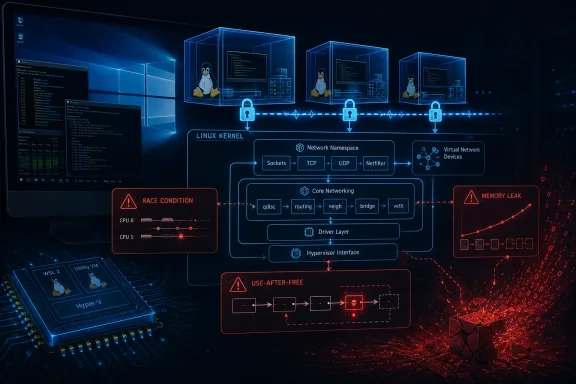 Overview
The vulnerability is formally described as a flaw in the Linux kernel’s net/handshake subsystem, specifically in the handling of pending handshake requests when a network namespace is destroyed. Linux network namespaces are a foundational isolation mechanism: containers, sandboxed services, Kubernetes workloads, and certain virtualized networking arrangements use them to provide each workload with its own view of interfaces, routes, firewall state, and sockets.At the center of CVE-2026-63978 is a failure to correctly transfer pending handshake requests to a temporary list during namespace exit. A reversed call to the kernel list helper
list_splice_init() meant the code moved an empty local list into the namespace-owned list rather than moving the namespace’s actual pending requests into the local list. The cleanup loop therefore saw no work and exited, leaving pending requests behind.That first defect creates a resource-lifetime problem. Pending requests retain references to a socket file and to the associated
handshake_req allocation, so failing to destroy them during namespace teardown can leak objects and leave cleanup incomplete. The corrective change then exposed a second class of bug: a race between the teardown drain path and a concurrent request-cancellation path.The final patch is therefore not a one-line repair. It changes list ownership, blocks competing removal while a namespace drain is underway, avoids poisoned list links after removal, and takes an additional reference to preserve object lifetime throughout the drain. That layered remediation is important because it demonstrates that the true vulnerability is not simply “a list was spliced backwards.” It is a failure to establish clear ownership during a concurrent shutdown sequence.
Why this CVE deserves attention
The affected feature is not the conventional TLS stack used by every browser, web server, or SSH client. Instead, it supports a newer architecture in which an in-kernel consumer can request that a userspace handshake agent establish TLS on its behalf. That narrower scope should prevent unnecessary panic among desktop users, but it does not remove the need for disciplined patching.The risk is concentrated where three conditions intersect:
- A system uses a Linux kernel with the handshake subsystem present and vulnerable.
- A kernel component submits TLS handshake work through that subsystem.
- A network namespace can be torn down while requests remain pending or while timeout-driven cancellation is occurring.
Background
Linux has long separated its core networking implementation from higher-level protocols and services. The kernel handles TCP, routing, packet filtering, socket lifecycle management, and a large share of transport behavior, while userspace ordinarily manages application-specific protocol negotiation. TLS has historically fit that division: userspace libraries such as OpenSSL, GnuTLS, or rustls conduct the handshake, then applications exchange encrypted traffic.Kernel TLS, commonly called kTLS, altered part of that arrangement by allowing the kernel to process TLS record-layer encryption and decryption after a session has been established. This can reduce copies, improve integration with networking offloads, and support specialized kernel consumers. But the TLS handshake itself remains complex: it involves certificate handling, key exchanges, authentication policy, protocol version negotiation, and potentially interaction with hardware or keyrings.
The Linux handshake API was designed to bridge that gap. Rather than embed a full TLS handshake implementation inside the kernel, it lets a kernel-side consumer request work from a userspace handshake agent. The request is conveyed through Generic Netlink, a flexible Linux mechanism for structured communication between the kernel and userspace processes.
The userspace-agent model
Under this design, a kernel consumer requests a client-side TLS handshake for an open socket. A userspace agent listening in the same network namespace receives a notification that work is waiting. The agent accepts a queued request, receives access to the socket through a file descriptor, performs the handshake, configures TLS state where appropriate, and reports the result back to the kernel.This model has several advantages:
- It avoids placing a complete TLS handshake implementation and its certificate-management complexity in kernel space.
- It enables a specialized userspace process to own policy decisions such as certificate selection and peer authentication.
- It gives kernel consumers a common interface instead of requiring each subsystem to invent its own TLS offload path.
- It keeps the kernel’s role focused on request coordination, socket ownership, and record-layer support.
Why namespaces complicate cleanup
A network namespace is not merely a label attached to a process. It represents a separate networking context whose destruction triggers extensive cleanup across sockets, routes, interfaces, protocol state, and namespace-scoped services. Namespace exit is inherently sensitive because objects can still be active when teardown begins.In a simple single-threaded model, the solution would be straightforward: remove every request from the queue, complete it with an error, and release each reference. In a real kernel, however, a cancellation may arrive at the same time. A request can be located through a hash table while the namespace-exit path has already moved the same request to a temporary drain list. Socket destruction can happen after the last reference drops. Each of these operations must be synchronized without deadlocking, double-completing a request, or dereferencing freed memory.
CVE-2026-63978 sits precisely in that difficult space.
The Initial Cleanup Failure
The first defect was a reversal oflist_splice_init() arguments in the namespace exit routine. Linux linked-list helpers are compact and efficient, but their argument ordering matters. In the documented form, list_splice_init(list, head) transfers the entries from list into head and reinitializes the source list.In the vulnerable code, the local scratch list was empty. The intended operation was to move
hn->hn_requests, the namespace’s collection of pending handshake requests, into that local list so it could be safely drained outside the primary queue. Instead, the reversed arguments moved the empty local list into hn->hn_requests.What the reversed splice actually did
The effect was deceptively quiet:- The namespace-owned pending-request list was overwritten with the empty local list.
- The local scratch list remained empty.
- The subsequent cleanup loop iterated over zero entries.
- Requests that were pending before namespace exit were never processed through the normal completion path.
The significance of handshake_complete()
The correct drain does not simply free a request directly. It routes the request through handshake_complete(), the subsystem’s normal completion path. That matters because completion can invoke the consumer’s callback, update request state, release the socket reference held for the pending handshake, and enforce one-time completion semantics.By skipping the drain entirely, the vulnerable code did more than fail to free a list node. It bypassed the mechanism intended to resolve the request coherently. A kernel consumer awaiting success or failure could be left with cleanup obligations that never execute through the expected path.
For developers, this is a familiar kernel lesson: lifecycle correctness is often encoded in completion functions rather than in allocation and deallocation alone. Calling the right cleanup function is as important as reaching the right list entry.
The Race Exposed by the Obvious Fix
Correcting the splice direction would move pending requests into the local scratch list as intended. But the CVE description explains that doing only that would expose a race involving concurrent cancellation. This is where the vulnerability becomes materially more serious than an ordinary resource leak.After a request is moved into the local drain list, its list-link fields remain non-empty. From the perspective of a concurrent cancellation path, the request still appears linked. That is technically true, but it is linked to the stack-local list now owned by the namespace-exit routine, not to the original namespace queue.
Competing ownership of the same request
A concurrenthandshake_req_cancel() can locate a request through an rhashtable. It then attempts to remove the request from the pending list. If it observes that the request’s list node is non-empty, it may call the internal pending-removal logic.The problem is that the namespace-exit drain routine has already taken control of that request. If cancellation removes the node from the scratch list while the drain loop is walking it, the list can be corrupted. If the timing is slightly different and the drain loop has already removed the entry using a helper that poisons its pointers, the cancellation path can operate on poisoned links instead.
Neither outcome is acceptable in kernel code. List corruption can lead to crashes, memory safety failures, unpredictable behavior, or—in the worst cases—conditions that a determined attacker may be able to steer toward privilege escalation or code execution. A high CVSS score reflects the potential severity of a remotely reachable or unprivileged interaction chain, but it does not itself establish a public exploit or guarantee that every deployment is practically exploitable.
A shutdown race is still a security race
It is tempting to categorize namespace teardown as an obscure administrative event rather than an attacker-controlled condition. That would be a mistake in container-rich environments. Container orchestrators routinely create and destroy namespaces. A local tenant or compromised workload may influence network activity, provoke timeouts, trigger socket lifecycle transitions, or cause workloads to restart.Whether that influence reaches this precise handshake path depends on the service design. But the broader principle is clear: in multi-tenant systems, teardown paths should be treated as part of the attack surface. Attackers often seek races not because shutdown code is common, but because it receives less testing under adversarial timing.
How the Patch Establishes Ownership
The remediation uses several coordinated safeguards. Each solves a separate ownership or lifetime hazard, and together they convert an ambiguous concurrent state into a controlled sequence.First, the patch corrects the list splice direction so the namespace’s pending requests are moved to the local scratch list and can be drained. Second, it marks the namespace as being drained and makes pending-request removal refuse to act when that state is active. Third, it adjusts the list deletion behavior and adds a reference pin to the request’s file object.
The NET_DRAINING guard
The critical synchronization addition is a check for HANDSHAKE_F_NET_DRAINING under the handshake namespace lock. When teardown is in progress, the pending-removal helper reports that the request was not found rather than attempting to unlink it from the list.That may sound counterintuitive. The request is physically visible in the temporary list, so why report it as absent? Because logical ownership has already transferred. The exit path has taken responsibility for completing the request. The cancellation path must not treat physical linkage as permission to modify the list.
This distinction—between an object’s physical location and its logical owner—is central to safe concurrent programming. The request has moved from “pending work available for normal cancellation” to “work owned by namespace shutdown.”
One completion callback, not two
The subsystem already includes a one-time completion gate using an atomic test-and-set operation onHANDSHAKE_F_REQ_COMPLETED. That gate decides whether the drain path or the cancellation path gets to invoke the consumer’s completion callback.The patch preserves that behavior. Blocking list removal does not mean cancellation becomes irrelevant; it means cancellation can no longer interfere with the drain list’s structural integrity. The existing completion bit remains responsible for arbitrating which path delivers the callback.
That division of responsibilities is sound:
- The draining flag protects queue ownership and list structure.
- The completion bit protects callback uniqueness and request completion semantics.
- The extra file reference protects object lifetime during traversal.
Why list_del_init() matters
The patch also uses list_del_init() during the drain rather than list_del(). The difference is subtle but important. A normal deletion may leave poisoned pointers behind as a debugging aid, helping detect accidental reuse. Reinitializing the list node instead leaves it in a known empty-list state.In this case, leaving poisoned links could create a hazardous state for code that observes or rechecks the request after it has been removed. The change makes the node’s post-removal state safer and more consistent with the concurrent cancellation logic.
The result is not merely cosmetic defensive coding. It prevents the cancellation path from encountering list poison after the exit path has removed the entry, reducing the chance that a late observer turns a cleanup race into memory corruption.
The Lifetime Problem Behind the List Problem
The most revealing portion of the CVE description is the final issue: even after a draining guard prevents concurrent removal, cancellation can still drop the request’shr_file reference. If that was the final reference, destruction of the socket could free the request while it remains linked into the namespace-exit routine’s local drain list.That is a classic use-after-free scenario. A traversal routine believes it owns an entry and will process it shortly, but another path releases the final resource reference and causes the object to disappear underneath it.
Why list integrity alone was insufficient
A common mistake in concurrency fixes is to stop after preventing simultaneous mutation of a container. Here, makingremove_pending() return false during a drain protects the linked list, but it does not automatically preserve the object stored in that list.The cancellation path continues to participate in completion arbitration. If it wins or otherwise drops a reference according to its normal behavior, the request’s lifetime can end. The drain loop would then retain only a stale pointer.
This is why the patch explicitly pins each request’s file under the namespace lock before releasing the list for draining. The exit path takes an additional reference while it has exclusive list ownership. After the drain loop has finished processing a request, it drops that temporary pin.
The reference-counting principle
Reference counting in the kernel is not just a memory-management technique. It is an ownership contract. Before a thread accesses an object outside the lock or context that guaranteed its existence, it must hold its own valid reference.In simplified form, the repaired sequence is:
- Acquire the namespace lock and declare the namespace to be draining.
- Transfer the pending list to a local scratch list.
- Take an extra file reference for every request that the drain loop now owns.
- Release the lock and process each request through the normal completion path.
- Drop the temporary drain reference after processing each request.
Affected Versions and Patch Interpretation
According to the published vulnerability record, the affected Linux code begins with Linux kernel version 6.4. Versions earlier than 6.4 are listed as unaffected because the handshake facility at issue was not present in those releases.The same record identifies fixed points in maintained branches, including Linux 6.12.93 and Linux 7.0.12, with the upstream fix incorporated by Linux 7.1. Administrators should treat these values as indicators of where the correction landed upstream rather than as substitutes for their distribution’s advisory.
Why distribution version numbers can be misleading
Enterprise Linux distributions commonly backport security fixes without moving to the exact upstream kernel version named in a CVE record. A system may report an older-looking base version while including the relevant patch in its vendor-maintained build. Conversely, a custom kernel may carry a newer version string while omitting a backport or local fix.The correct question is not simply, “Is the kernel version greater than 6.12.93?” It is, “Does the installed vendor kernel package include the CVE-2026-63978 fix?”
For example, a distribution may package a kernel based on a long-term branch and append its own release metadata. Its security advisory, package changelog, or source patch list is the authoritative way to establish remediation status.
A practical verification sequence
Administrators should use a deliberate verification process rather than rely on assumptions:- Identify the running kernel with the system’s normal kernel-version command.
- Identify the distribution package build rather than recording only the upstream version string.
- Check the vendor security advisory or errata for CVE-2026-63978 and the associated package release.
- Install the updated kernel package through the supported package-management channel.
- Reboot or otherwise switch to the updated kernel, because a package installation alone does not replace the active kernel.
- Confirm the post-restart kernel build and validate that critical networking and container workloads operate normally.
Why It Matters to Containers and Cloud Workloads
Network namespaces are core infrastructure for modern Linux isolation. Docker-style containers, Kubernetes pods, systemd sandboxing, network testing frameworks, and numerous cloud platforms use namespaces directly or indirectly. The handshake API is not automatically engaged merely because containers exist, but containers increase the frequency and complexity of namespace lifecycles.A short-lived workload can create sockets, initiate work, hit a timeout, and terminate quickly. Orchestration systems can concurrently stop a pod, tear down its network namespace, kill a helper process, and replace the workload. These ordinary operations create exactly the kind of interleaving that shutdown-race bugs require.
The TLS agent deployment factor
The handshake subsystem expects a userspace agent in each network namespace where an in-kernel consumer needs TLS handshake services. Therefore, exposure is most plausible on systems that have intentionally deployed this model.The affected architecture may appear in specialized environments such as:
- Kernel-resident RPC or storage clients that use TLS.
- Services using kernel TLS capabilities and delegated userspace handshake handling.
- Network appliances or cloud stacks that build a namespace-specific TLS control plane.
- Experimental or early-adopter deployments integrating the handshake API with service isolation.
Multi-tenant implications
In a shared environment, the distinction between a bug and a vulnerability depends on who can influence its preconditions. A local workload that can trigger timeout behavior, create or destroy namespaces, or interact with an exposed kernel consumer may have more leverage than a conventional unprivileged process.Security teams should therefore evaluate the risk in terms of tenant boundaries. A container escape is not implied by the CVE description, and no public exploit should be assumed solely from a severity score. Still, any kernel race involving potential use-after-free behavior deserves careful review where untrusted code runs on shared Linux hosts.
Relevance for Windows, WSL, and Hyper-V Users
For WindowsForum readers, CVE-2026-63978 is primarily relevant through Linux workloads hosted on Windows rather than through the Windows kernel itself. The flaw is in Linux kernel networking code, not in Windows networking, Windows Server containers, or the core Windows TLS stack.WSL 2 runs Linux distributions using a real Linux kernel in a lightweight virtual machine. That makes WSL fundamentally different from a compatibility layer that merely translates Linux calls into Windows behavior. If Microsoft’s supplied WSL kernel or a custom WSL kernel includes the affected code and a workload uses the handshake subsystem, then the Linux guest environment is the relevant remediation boundary.
WSL 2 is not a blanket exposure claim
Most WSL users are unlikely to intentionally deploy a namespace-scoped userspace TLS handshake agent for an in-kernel consumer. Developers using Ubuntu, Debian, Fedora, or another distribution in WSL for compilers, scripting, web development, or command-line administration should not assume the CVE is actively exploitable in their setup.However, advanced WSL users may run Docker engines, Kubernetes distributions, VPN tooling, network labs, custom kernels, or service meshes. These deployments deserve inventory and patch review, particularly when they host untrusted repositories, development containers, or externally reachable services.
Hyper-V and Linux virtual machines
The same reasoning applies to Linux virtual machines running under Hyper-V, Azure Stack HCI, Windows Server virtualization infrastructure, or desktop Hyper-V. Hyper-V isolates the guest from the Windows host, but it does not eliminate the guest’s responsibility to patch its own Linux kernel.An organization can be fully current on Windows updates and still operate vulnerable Linux guests. Patch management must track the layers separately:
- Windows host updates remediate Windows and Hyper-V host issues.
- Linux guest updates remediate Linux kernel and distribution issues.
- Container image updates remediate userspace components but do not replace the host or guest kernel.
- Managed cloud images require verification because provider image cadence may differ from upstream kernel release timing.
Enterprise Response Priorities
Enterprise teams should begin with exposure mapping, not indiscriminate operational disruption. The vulnerability record’s critical score supports urgent triage, but the affected subsystem’s specialized nature means organizations can prioritize systems based on actual use.The highest-priority systems are those that combine current vulnerable kernel lines with network namespace churn and a plausible use of kernel-initiated TLS handshakes. Systems that run custom networking stacks, storage clients with TLS integration, cloud networking agents, or experimental kernel TLS services should be examined first.
Inventory questions that matter
Security and platform teams should ask the following:- Does the fleet run Linux kernels derived from version 6.4 or later?
- Which systems use vendor kernels that have not yet documented CVE-2026-63978 remediation?
- Are custom kernels, self-built cloud images, or long-lived appliance kernels in use?
- Is the Linux handshake module built, loaded, or otherwise available on affected hosts?
- Do any workloads use a TLS handshake agent communicating through the handshake Generic Netlink family?
- Are namespaces created and destroyed at high frequency by containers, pods, test platforms, or sandbox services?
- Do untrusted users, tenants, CI jobs, or customer workloads share hosts with these services?
Patch, test, and reboot discipline
Kernel updates require more operational care than ordinary library updates. Organizations should validate the update in a representative staging environment, especially if the same hosts run storage, network acceleration, eBPF tooling, container runtimes, or third-party kernel modules.At minimum, post-update testing should cover:
- Container creation and teardown.
- Network namespace creation and deletion.
- Workload restart behavior under load.
- TLS-dependent application traffic.
- Relevant RPC, storage, or service-mesh components.
- Monitoring for kernel warnings, crashes, memory growth, and unexpected socket errors.
Strengths and Opportunities
The handling of CVE-2026-63978 also reveals several positive characteristics of the Linux security and maintenance model.- The vulnerability description documents the full causal chain rather than hiding behind a generic label. Administrators and developers can see that the issue involves cleanup failure, list corruption, and lifetime management rather than a single isolated defect.
- The patch addresses the race holistically. It corrects the wrong list operation, establishes a drain-state guard, preserves one-time completion behavior, improves post-removal list state, and pins references during traversal.
- The design keeps TLS handshake complexity in userspace. That architecture limits how much certificate and negotiation logic must reside in privileged kernel code, even if it introduces a demanding coordination boundary.
- The affected path is comparatively specialized. This limits likely exposure compared with vulnerabilities in ubiquitous TCP, filesystem, memory-management, or device-driver paths.
- The upstream record identifies maintained-branch fix points. That gives distribution maintainers and custom-kernel builders a concrete basis for backports and verification.
An opportunity to improve shutdown testing
The CVE is also a reminder that teardown testing should be adversarial. Developers often test successful creation, successful request completion, and clean shutdown as separate cases. The difficult failures occur when those events overlap.Kernel and systems developers can improve resilience by expanding stress testing around:
- Cancellation arriving during list migration.
- Namespace destruction with requests still queued.
- Last-reference release while cleanup traversal is active.
- Completion racing timeout and consumer teardown.
- Repeated create-destroy loops under memory pressure and network delay.
Risks and Concerns
Despite the specialized scope, CVE-2026-63978 carries several risks that administrators should keep in view.- A resource leak can become a memory-safety problem when a straightforward fix changes execution order. Teams backporting patches must take the complete remediation, not a partial correction.
- Namespace teardown is common in containerized systems. Even if the handshake path is uncommon, high namespace churn can amplify the value of careful exposure analysis.
- A high CVSS score does not prove universal exploitability. It should drive urgency and investigation, but security teams should avoid overstating the likely risk to ordinary desktops or typical web-server deployments.
- Vendor advisories may lag upstream publication. A newly published CVE can appear in upstream records before every commercial distribution has completed assessment, released packages, or documented backports.
- Custom and embedded kernels are the hardest environments to assess. These systems may remain on a vulnerable code base for long periods, particularly when update workflows require vendor recertification or field maintenance.
- Windows-based Linux hosting can create ownership gaps. A Windows team may assume Linux guests are an application-team concern, while Linux teams may assume the virtualization platform updates the guest kernel automatically.
The danger of partial remediation
The biggest technical concern is partial patching. An administrator or downstream maintainer who sees the reversedlist_splice_init() call might be tempted to correct only the argument order. That would successfully start draining requests, but it would also expose the cancellation race described in the CVE.Likewise, adding the draining flag without the temporary file reference would still leave an opportunity for a request to be freed while the local drain list references it. The patch components are interdependent, and each is required to maintain correctness.
This is a strong argument for using signed, vendor-provided kernel updates whenever possible. Manual source modifications should be reserved for teams capable of reviewing the full patch series, running concurrency-focused tests, and maintaining the result over time.
What to Watch Next
The immediate development to watch is distribution-specific remediation. The CVE record was published on July 19, 2026, and enrichment is still incomplete: the National Vulnerability Database has not yet supplied its own CVSS assessment. Kernel.org’s assigned CVSS 3.1 vector rates the issue Critical, but vendor assessments may provide more precise guidance about affected packages, exploit prerequisites, and practical mitigations.Organizations should monitor their Linux vendor’s kernel advisories, especially for long-term-support branches and cloud-tuned kernels. Managed Kubernetes services, cloud images, and WSL kernel distributions may publish their own timelines, and those timelines may not align exactly with upstream stable releases.
Signals worth monitoring
The following developments will help clarify operational urgency:- Vendor package releases that explicitly list CVE-2026-63978 as fixed.
- Backport notices showing which enterprise kernel streams received the complete patch.
- Public exploit analysis that demonstrates whether the race can be reached from a realistic unprivileged or remote workload.
- Subsystem adoption reports showing which kernel consumers actively use the handshake API in production.
- Regression reports related to namespace exit, TLS agents, RPC clients, or socket cleanup after patch deployment.
- Cloud and WSL kernel release notes confirming whether their supported kernels incorporate the fix.
CVE-2026-63978 illustrates why kernel security work often defies simple labels. The original error was a reversed list operation, but the real challenge involved teardown ownership, cancellation semantics, linked-list state, and reference-counted object lifetime—all occurring concurrently. For most end users, it will remain a largely invisible correction inside Linux networking internals. For container platforms, custom-kernel operators, cloud infrastructure teams, and Windows administrators hosting advanced Linux workloads through WSL or Hyper-V, it is a timely reminder that reliable isolation depends on meticulous cleanup in the paths nobody notices until they fail.
References
- Primary source: NVD / Linux Kernel
Published: 2026-07-21T01:04:58-07:00
NVD - CVE-2026-63978
 nvd.nist.gov
- Security advisory: MSRC
Published: 2026-07-21T01:04:58-07:00
Original feed URL
Security Update Guide - Microsoft Security Response Center
 msrc.microsoft.com
