

CVE-2026-64038 is a newly published Linux kernel vulnerability affecting the
CVE-2026-64038 was published to the CVE List on July 19, 2026, with the National Vulnerability Database record appearing the same day. At publication, the record had no NVD-assigned CVSS v3, CVSS v4, or CWE classification. That absence should not be mistaken for an indication that the issue is harmless; it means only that formal enrichment had not yet been completed.
The vulnerability is described as resolved in the Linux kernel’s
That is the textbook definition of a use-after-free condition. In kernel space, such flaws can lead to crashes, corruption of unrelated memory, unexpected behavior, or—depending on reachability, system configuration, and the surrounding memory state—potential security impact.
The fault is therefore not about an incorrect temperature reading. It is about an asynchronous worker outliving the object it expects to use.
The lm90 driver is one of the older and broader hwmon drivers. Although named after National Semiconductor’s LM90 temperature sensor, it supports an extended family of related chips from multiple vendors. These devices generally measure a local temperature and one or more remote diode-connected temperatures, such as the thermal state of a CPU, GPU-adjacent component, memory module, power stage, or other board-level device.
Common capabilities in this device family include:
CVE-2026-64038 illustrates a recurring truth in kernel engineering: resource lifetime is a system-wide property, not a local implementation detail. A worker function can be correct in isolation and still become dangerous if a removal path invalidates the objects it needs before the worker is guaranteed to stop.
Linux drivers commonly use device-managed resource handling, often referred to as “devm” or devres. Rather than manually releasing every resource in each error path and removal routine, a driver can register resources and cleanup actions with the device-management framework. When the device is detached or initialization fails, the kernel invokes the matching cleanup operations automatically.
However, the ordering only works if the registration sequence accurately models the real lifetime dependencies.
In the vulnerable lm90 path, an action intended to cancel the driver’s deferred alert and reporting work was registered during initialization before the driver registered its hwmon device. During a cleanup event, the later hwmon registration was therefore undone first. The hwmon device could be freed while the delayed work remained eligible to run.
The advantage is clear: the interrupt handler stays short and avoids doing operations that may sleep or take longer than is safe in interrupt context. The risk is that the work now has an independent lifetime.
A driver author must account for at least four questions:
That pointer represents the hwmon device registered with the Linux hardware-monitoring core. Once the device is unregistered and freed, retaining the pointer is unsafe. Any later access becomes a use-after-free.
In this case, the relevant object was not a generic heap allocation visible only within the driver. It was a hwmon device registered with a subsystem and used as part of the driver’s public kernel-facing interface. That makes cleanup ordering especially sensitive.
The worker did not need to perform a complicated sequence to trigger the problem. It only needed to run after the hwmon device was gone and before the cancellation path had fully drained or prevented that work.
If a late initialization step fails, the driver must unwind partially created state. This is often where ordering bugs surface because a device may have registered some public-facing resources before completing every later step. A normal production deployment may rarely hit the path, but atypical hardware behavior, I2C communication errors, platform configuration mistakes, injected faults, virtualization peculiarities, or driver-development testing can make it reachable.
That explains the second part of the fix: adding a shutdown flag. The flag acts as a lifetime barrier in the driver’s logic, telling relevant paths that the device is no longer operational and that workers must not be re-armed.
The added shutdown flag addresses that broader class of failure. During teardown, the driver sets the state indicating shutdown is in progress. Paths that would ordinarily queue alert or report work can check the flag and decline to schedule it.
That version information requires careful interpretation. Linux distributions frequently backport security and stability fixes while retaining an older-looking base version. A system reporting a kernel version such as 6.6 or 6.12 is not automatically vulnerable, and a system reporting an apparently older version is not automatically unpatched.
Administrators should therefore treat the upstream versions as a first filter, not as a final patch-status verdict.
Still, a downstream maintainer must pick up the stable release or separately backport the patch. Systems using customized, vendor-frozen, real-time, or appliance-specific kernels require direct validation rather than assumptions.
That said, low visibility is not the same as no impact. Users who actively load and unload hardware-monitoring modules, experiment with I2C devices, use external sensor boards, work with development hardware, or troubleshoot unstable thermal readings can encounter the relevant driver lifecycle paths more often than a conventional desktop user.
This distinction matters because uninstalling a graphical monitoring utility does not fix the kernel bug. Conversely, updating the kernel generally does not require any change to user-space monitoring software.
The lm90 family is more likely to appear where a motherboard, accessory controller, external monitoring board, or specialized sensor topology exposes a compatible I2C/SMBus device. Users should avoid concluding that every machine with a temperature readout is affected.
There is no broadly useful configuration workaround that replaces patching. Disabling the lm90 module may reduce exposure on systems that do not need it, but it can also remove thermal telemetry and may be inappropriate for devices that depend on the sensor for monitoring or policy decisions.
Temperature monitoring is not cosmetic in these environments. It can feed alerting, maintenance workflows, thermal policy, hardware replacement decisions, and operational visibility.
A system could appear stable for months before a device-unbind event, a transient I2C issue, a service operation, a hot-plug cycle, or an unusual boot-time failure triggers the vulnerable teardown sequence.
This creates a familiar challenge: an upstream CVE may be resolved quickly, while downstream visibility remains incomplete. Infrastructure teams should identify products that use Linux-based baseboard management controllers, out-of-band management software, custom sensor boards, or platform-controller firmware.
The host is usually the more relevant layer. If a physical server’s Linux host kernel loads the affected lm90 driver, the host’s stability remains the concern even if guest operating systems do not directly see the sensor.
That means organizations should not treat this CVE as a reason to deploy a Windows cumulative update, alter Windows Defender policy, or change ordinary Windows endpoint configuration.
For most consumer WSL installations, direct hardware access to motherboard temperature sensors is limited and the lm90 driver is unlikely to be a practical concern. But specialized WSL configurations, USB or I2C passthrough scenarios, developer systems connected to embedded boards, and custom kernels deserve a more careful review.
That includes:
This balanced view is important for maintenance planning. It supports timely remediation while preserving attention for vulnerabilities with demonstrated broad exposure or active exploitation.
In operational technology and embedded environments, monitoring data may also be used by higher-level control or alarm systems. Any mitigation that disables a sensor driver should be evaluated against the risk of losing thermal visibility.
Administrators should monitor the advisories for their actual platforms rather than relying only on mainline version numbers. A Red Hat-derived kernel, Ubuntu kernel, Debian kernel, Android-derived embedded kernel, router firmware image, or proprietary appliance build may carry the same upstream fix under entirely different version labeling.
Particular attention should go to drivers that combine the following elements:
The patch itself is a strong indication that maintainers identified the relevant lifetime relationship. Continued regression testing will determine whether the revised shutdown flag and worker ordering cover all practical re-entry paths.
CVE-2026-64038 is not a reason for panic, but it is a solid example of why kernel maintenance deserves disciplined attention even when the vulnerable component is “only” a temperature-sensor driver. The fix addresses a real asynchronous lifetime bug in the Linux lm90 hwmon driver, stable releases have incorporated the correction, and the immediate priority is to verify downstream kernel status on systems that actually use the driver. For Windows users, native Windows remains outside the affected code path; the meaningful question is whether WSL, Linux VMs, appliances, servers, embedded controllers, or vendor-managed hardware in the surrounding environment rely on an unpatched Linux kernel.
lm90 hardware-monitoring driver, and it is a reminder that even a small temperature-sensor driver can become a kernel-stability and security concern when teardown logic is ordered incorrectly. The flaw is a use-after-free race: during device removal, driver unload, or a failed initialization sequence, deferred alert-handling work may still run after the Linux hwmon device it references has already been freed. The upstream fix changes the shutdown sequence so pending work is stopped before the hwmon device disappears, while adding a shutdown state that prevents work from being scheduled again. For WindowsForum readers, the issue matters primarily to Linux servers, embedded systems, appliances, development boards, and potentially WSL deployments using an affected kernel—not to standard native Windows hardware monitoring.
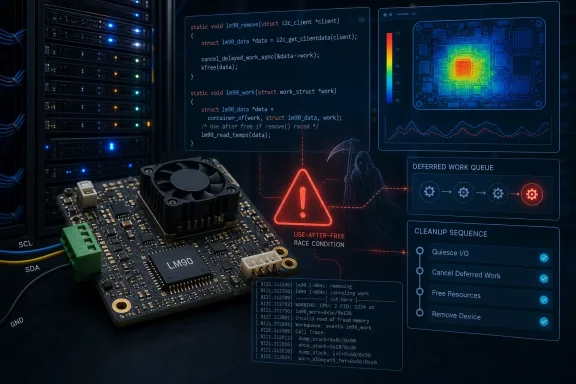 Overview
CVE-2026-64038 was published to the CVE List on July 19, 2026, with the National Vulnerability Database record appearing the same day. At publication, the record had no NVD-assigned CVSS v3, CVSS v4, or CWE classification. That absence should not be mistaken for an indication that the issue is harmless; it means only that formal enrichment had not yet been completed.The vulnerability is described as resolved in the Linux kernel’s
drivers/hwmon/lm90.c file. The affected code supports the LM90 family of digital temperature-monitoring chips and a substantial collection of compatible devices used in servers, embedded controllers, industrial systems, network hardware, development boards, and some laptop or desktop designs.The core issue in one sentence
A delayed kernel worker can access a hwmon device pointer after that device has been unregistered and freed.That is the textbook definition of a use-after-free condition. In kernel space, such flaws can lead to crashes, corruption of unrelated memory, unexpected behavior, or—depending on reachability, system configuration, and the surrounding memory state—potential security impact.
Why a sensor driver has a CVE
The lm90 driver is not merely a passive reader of temperature registers. It integrates with the Linux hardware-monitoring framework, exposes values to user space through sysfs, may process alert conditions, and can schedule deferred work. Once a driver has interrupt paths, delayed work queues, state machines, and dynamically registered devices, its teardown logic becomes as important as its normal data-collection path.The fault is therefore not about an incorrect temperature reading. It is about an asynchronous worker outliving the object it expects to use.
Background
The Linux hwmon subsystem provides a standardized way for drivers to expose hardware telemetry such as temperatures, voltages, fan speeds, power measurements, currents, alarms, and sensor thresholds. Tools includinglm-sensors, system-management agents, monitoring dashboards, thermal daemons, and enterprise observability platforms often obtain their information through this subsystem.The lm90 driver is one of the older and broader hwmon drivers. Although named after National Semiconductor’s LM90 temperature sensor, it supports an extended family of related chips from multiple vendors. These devices generally measure a local temperature and one or more remote diode-connected temperatures, such as the thermal state of a CPU, GPU-adjacent component, memory module, power stage, or other board-level device.
What LM90-class chips do
LM90-compatible components are typically connected through I2C or SMBus. The driver polls sensor registers, translates raw values into Linux hwmon attributes, maintains cached readings, and may respond to hardware alert signals when configured to do so.Common capabilities in this device family include:
- Local temperature sensing, which measures the sensor chip’s own temperature.
- Remote temperature sensing, which measures a diode-connected transistor or dedicated remote thermal input.
- Threshold and critical-limit handling, allowing alerts when readings exceed configured values.
- Configurable conversion rates, which determine how frequently the device samples temperature.
- Alarm reporting, which lets the operating system record and expose fault conditions.
A mature driver is not an immune driver
The lm90 driver has existed in Linux for many years, and mature code often benefits from field exposure and sustained maintenance. However, age does not eliminate race conditions. In fact, long-lived driver code can accumulate assumptions that were harmless under earlier configurations but become exposed as device-management patterns, hot-plug behavior, sanitizer coverage, and kernel concurrency evolve.CVE-2026-64038 illustrates a recurring truth in kernel engineering: resource lifetime is a system-wide property, not a local implementation detail. A worker function can be correct in isolation and still become dangerous if a removal path invalidates the objects it needs before the worker is guaranteed to stop.
Understanding the Race Condition
The vulnerability centers on the relationship between managed device resources, delayed work, and the hwmon device object registered by the driver.Linux drivers commonly use device-managed resource handling, often referred to as “devm” or devres. Rather than manually releasing every resource in each error path and removal routine, a driver can register resources and cleanup actions with the device-management framework. When the device is detached or initialization fails, the kernel invokes the matching cleanup operations automatically.
Managed cleanup runs in reverse order
The crucial detail is that managed cleanup actions run in reverse registration order. This is generally useful: a driver allocates or registers resources in dependency order, then releases them in the opposite order so dependent objects disappear before the resources beneath them.However, the ordering only works if the registration sequence accurately models the real lifetime dependencies.
In the vulnerable lm90 path, an action intended to cancel the driver’s deferred alert and reporting work was registered during initialization before the driver registered its hwmon device. During a cleanup event, the later hwmon registration was therefore undone first. The hwmon device could be freed while the delayed work remained eligible to run.
The vulnerable sequence
At a high level, the problematic removal or probe-failure sequence looked like this:- The lm90 driver initialized internal state and registered a managed cleanup action for its delayed workers.
- The driver registered a hwmon device used to expose readings and alarms.
- A failure occurred later in probing, or the device was unbound.
- Managed cleanup unwound in reverse order.
- The hwmon device was unregistered and freed.
- Before deferred work cancellation occurred, an alert or reporting worker ran.
- The worker attempted to use the previously freed hwmon device pointer.
Why delayed work complicates teardown
Delayed work is a Linux mechanism for scheduling a function to run later, either immediately through a work queue or after a specified delay. It is widely used in drivers because hardware events often need processing outside interrupt context. A temperature alert may arrive in an interrupt handler, after which the driver schedules a worker to read status registers, update cached alarms, notify the hwmon layer, or reconfigure the sensor.The advantage is clear: the interrupt handler stays short and avoids doing operations that may sleep or take longer than is safe in interrupt context. The risk is that the work now has an independent lifetime.
A driver author must account for at least four questions:
- Is new work still allowed to be queued?
- Is work already queued but not running?
- Is work currently executing on another CPU?
- Are the data structures used by that work still valid?
The Technical Root Cause
The disclosed description identifies two relevant worker paths:lm90_alert_work() and lm90_report_alarms(). These eventually reach lm90_update_alarms(), where the driver can dereference data->hwmon_dev.That pointer represents the hwmon device registered with the Linux hardware-monitoring core. Once the device is unregistered and freed, retaining the pointer is unsafe. Any later access becomes a use-after-free.
The dereference after release
Use-after-free vulnerabilities arise when software frees an object but another execution path still holds a pointer or reference to that object. The pointer itself is not automatically invalidated across every CPU, work queue, callback, or data structure that might retain it.In this case, the relevant object was not a generic heap allocation visible only within the driver. It was a hwmon device registered with a subsystem and used as part of the driver’s public kernel-facing interface. That makes cleanup ordering especially sensitive.
The worker did not need to perform a complicated sequence to trigger the problem. It only needed to run after the hwmon device was gone and before the cancellation path had fully drained or prevented that work.
Probe failure is part of the threat model
It is easy to focus solely on module removal when analyzing driver teardown. But the CVE explicitly includes probe failure. During driver probing, the kernel discovers hardware, initializes registers, allocates or registers resources, sets up optional interrupt handling, and exposes the device to subsystems such as hwmon.If a late initialization step fails, the driver must unwind partially created state. This is often where ordering bugs surface because a device may have registered some public-facing resources before completing every later step. A normal production deployment may rarely hit the path, but atypical hardware behavior, I2C communication errors, platform configuration mistakes, injected faults, virtualization peculiarities, or driver-development testing can make it reachable.
Interrupts make the timing sharper
The presence of alert work means hardware interrupts are a significant part of the lifecycle. An interrupt can arrive near the same moment a device is being removed or a probe is failing. If the interrupt handler schedules work during teardown, simply cancelling the currently queued work is not sufficient; the driver must also stop future scheduling.That explains the second part of the fix: adding a shutdown flag. The flag acts as a lifetime barrier in the driver’s logic, telling relevant paths that the device is no longer operational and that workers must not be re-armed.
How the Upstream Fix Changes the Lifecycle
The repair is conceptually straightforward but important: cancel the relevant workers as a distinct step after the hwmon device has been registered and before the interrupt handler is registered. The cleanup ordering then produces the desired behavior during removal and probe failure.The intended shutdown order
The corrected design aims to ensure the following operational order:- Interrupt sources are disabled or no longer allowed to schedule new work.
- Pending delayed work is cancelled and any currently running work is allowed to finish safely.
- The hwmon device is unregistered and released.
- Remaining driver resources are cleaned up.
Why “cancel” is not always enough
A naïve fix could have moved only a cancellation call. But race-resistant teardown needs to address rearming. A worker can schedule itself again, an interrupt path can queue another worker, or a late event can arrive after an initial cancellation.The added shutdown flag addresses that broader class of failure. During teardown, the driver sets the state indicating shutdown is in progress. Paths that would ordinarily queue alert or report work can check the flag and decline to schedule it.
A better lifecycle contract
The patch effectively makes the driver’s lifecycle explicit:- Active state: The sensor can process alerts, schedule report work, and expose values.
- Shutdown state: New background work is forbidden.
- Draining state: Existing work is cancelled or completed while dependencies remain alive.
- Released state: The hwmon device and other resources can safely be destroyed.
Affected Kernel Versions and Fix Availability
The current CVE record identifies Linux kernels beginning with version 6.0 as affected in the semver-oriented portion of the entry. It identifies fixes in Linux 6.18.34, Linux 7.0.11, and the Linux 7.1 development line, subject to the exact source revision and stable backport represented by a distribution kernel.That version information requires careful interpretation. Linux distributions frequently backport security and stability fixes while retaining an older-looking base version. A system reporting a kernel version such as 6.6 or 6.12 is not automatically vulnerable, and a system reporting an apparently older version is not automatically unpatched.
Upstream version labels are not distribution status
Enterprise Linux, Ubuntu LTS, Debian stable, SUSE Linux Enterprise, Oracle Linux, Amazon Linux, appliance vendors, and embedded distributions may all apply kernel fixes differently. Their kernel package version includes a distribution-specific release suffix that is often more useful than the upstream major and minor number alone.Administrators should therefore treat the upstream versions as a first filter, not as a final patch-status verdict.
What to check on a Linux system
A practical assessment should combine package status and hardware exposure:- Check the running kernel version with
uname -r. - Check the distribution’s security advisory or changelog for CVE-2026-64038 or the lm90 fix.
- Determine whether the lm90 module is loaded with
lsmod | grep lm90. - Inspect hwmon device names and I2C bindings where appropriate, recognizing that a compatible device may not be labeled “LM90.”
- Inventory embedded systems and appliances separately, because they may use vendor kernels with long support cycles.
- Reboot after a kernel update when the updated kernel is intended to protect the running environment.
The importance of the stable backports
The presence of fixes in stable kernel releases is positive. It indicates that the issue was considered suitable for backporting rather than being left exclusively to a future mainline release. Stable availability helps organizations that cannot rapidly move to a new major kernel line.Still, a downstream maintainer must pick up the stable release or separately backport the patch. Systems using customized, vendor-frozen, real-time, or appliance-specific kernels require direct validation rather than assumptions.
Consumer Linux Impact
For a typical consumer Linux desktop or laptop, CVE-2026-64038 is likely to be a low-visibility issue. Many systems will not use the lm90 driver at all, and many that do may not frequently exercise the removal or failed-probe conditions needed to expose the race.That said, low visibility is not the same as no impact. Users who actively load and unload hardware-monitoring modules, experiment with I2C devices, use external sensor boards, work with development hardware, or troubleshoot unstable thermal readings can encounter the relevant driver lifecycle paths more often than a conventional desktop user.
Desktop monitoring tools are downstream consumers
Applications that display temperatures, fan data, or board telemetry are not the direct cause of the flaw. They consume values exported by the hwmon subsystem. The vulnerable condition is inside the kernel driver’s internal alert and teardown handling.This distinction matters because uninstalling a graphical monitoring utility does not fix the kernel bug. Conversely, updating the kernel generally does not require any change to user-space monitoring software.
Gaming and enthusiast systems
On enthusiast PCs, temperature telemetry is a normal part of performance tuning, overclocking, fan-curve management, and hardware diagnostics. However, CPU package temperature reporting on mainstream x86 systems often comes from other drivers rather than lm90.The lm90 family is more likely to appear where a motherboard, accessory controller, external monitoring board, or specialized sensor topology exposes a compatible I2C/SMBus device. Users should avoid concluding that every machine with a temperature readout is affected.
Practical consumer response
For users on a rolling-release distribution, installing current kernel updates is generally the right response. For users on a stable desktop distribution, the better approach is to install the vendor-provided kernel update once it is available and verify the system has rebooted into it.There is no broadly useful configuration workaround that replaces patching. Disabling the lm90 module may reduce exposure on systems that do not need it, but it can also remove thermal telemetry and may be inappropriate for devices that depend on the sensor for monitoring or policy decisions.
Enterprise and Infrastructure Impact
The enterprise implications are more meaningful because LM90-compatible sensors are common in the kinds of systems that operate continuously and depend on reliable telemetry: servers, storage systems, network appliances, industrial controllers, rack-management devices, and custom embedded platforms.Temperature monitoring is not cosmetic in these environments. It can feed alerting, maintenance workflows, thermal policy, hardware replacement decisions, and operational visibility.
Availability is the immediate concern
The most immediate expected consequence of a successful race is an availability failure such as a kernel warning, fault, oops, or system crash. The exact result depends on timing and memory reuse, which is why use-after-free defects can be difficult to reproduce and diagnose.A system could appear stable for months before a device-unbind event, a transient I2C issue, a service operation, a hot-plug cycle, or an unusual boot-time failure triggers the vulnerable teardown sequence.
Remote management and appliance exposure
Many appliances use Linux internally while presenting a proprietary management interface. Network operators may not have shell access, may not know which drivers are active, and may receive security fixes only through vendor firmware bundles.This creates a familiar challenge: an upstream CVE may be resolved quickly, while downstream visibility remains incomplete. Infrastructure teams should identify products that use Linux-based baseboard management controllers, out-of-band management software, custom sensor boards, or platform-controller firmware.
Fleet management requires evidence, not guesswork
Enterprise patch programs should distinguish between:- Systems that run Linux but do not load the lm90 driver.
- Systems that load the driver but have a downstream backport.
- Systems running an affected driver without the fix.
- Appliances or embedded products for which component visibility is incomplete.
Virtualization does not eliminate all relevance
A virtual machine usually does not have direct access to a physical LM90-compatible sensor. However, virtualization hosts, management appliances, PCIe pass-through configurations, and emulated or forwarded I2C arrangements can complicate that generalization.The host is usually the more relevant layer. If a physical server’s Linux host kernel loads the affected lm90 driver, the host’s stability remains the concern even if guest operating systems do not directly see the sensor.
Windows and WSL Considerations
CVE-2026-64038 is a Linux kernel issue, not a native Windows kernel vulnerability. Standard Windows 10, Windows 11, Windows Server, and native Windows hardware-monitoring stacks do not use Linux’sdrivers/hwmon/lm90.c implementation.That means organizations should not treat this CVE as a reason to deploy a Windows cumulative update, alter Windows Defender policy, or change ordinary Windows endpoint configuration.
WSL is the relevant Windows-adjacent case
Windows Subsystem for Linux changes the analysis because WSL 2 runs a real Linux kernel in a managed virtualized environment. The practical exposure depends on the kernel build in use, whether the lm90 driver is present and loaded, and whether the Linux environment can access a relevant I2C/SMBus sensor path.For most consumer WSL installations, direct hardware access to motherboard temperature sensors is limited and the lm90 driver is unlikely to be a practical concern. But specialized WSL configurations, USB or I2C passthrough scenarios, developer systems connected to embedded boards, and custom kernels deserve a more careful review.
Windows administrators should avoid overreaction
A Windows fleet with no Linux subsystem, no Linux appliance component, and no relevant embedded management hardware is not directly affected by this kernel driver CVE. The productive action is not to patch Windows blindly; it is to identify Linux components in the broader estate.That includes:
- WSL 2 developer workstations using custom or updated kernels.
- Linux-based network and storage appliances managed from Windows consoles.
- Embedded devices connected to Windows engineering environments.
- Server management controllers and vendor utilities that run Linux internally.
- CI/CD runners or development VMs hosted on Windows but running Linux guests.
Why CVSS Is Not Yet the Whole Story
At the time of publication, the NVD entry lists no CVSS score. Security teams often rely on numeric scoring to drive prioritization, but an unscored CVE should prompt analysis rather than postponement.Severity depends on reachability
The technical condition is a kernel use-after-free. That sounds serious because kernel memory bugs can have severe consequences. Yet the operational severity depends on several factors:- Whether the affected driver is built and loaded.
- Whether the system uses a compatible physical sensor.
- Whether the relevant alert or delayed-work paths are active.
- Whether an attacker can induce device removal, unbinding, probe failure, or timing conditions.
- Whether the most plausible impact is denial of service, information exposure, or something more serious.
- Whether local privileges or physical access are required.
Treat uncertainty responsibly
The correct posture is measured. The flaw is real, it occurs in kernel space, and patched kernels should be adopted through normal security maintenance. At the same time, organizations should not inflate a driver-lifecycle race into an Internet-wide emergency without evidence that it is remotely reachable or readily exploitable.This balanced view is important for maintenance planning. It supports timely remediation while preserving attention for vulnerabilities with demonstrated broad exposure or active exploitation.
Strengths and Opportunities
The handling of CVE-2026-64038 also highlights several strengths in the Linux kernel ecosystem.- The issue has a focused upstream correction. The fix directly addresses both unsafe cleanup ordering and the possibility of work being re-armed during shutdown.
- Stable-kernel backports are available. Fixes were incorporated into maintained stable release lines, improving the odds that distributions and vendors can consume the repair without adopting a major new kernel.
- The vulnerability description is unusually actionable. It identifies the affected driver, the relevant lifecycle functions, the invalid pointer access, and the intended cleanup ordering.
- The remediation improves reliability beyond the CVE scenario. More disciplined worker shutdown reduces the chance of intermittent bugs that might otherwise be dismissed as random hardware or I2C failures.
- The issue reinforces reusable driver-design lessons. Other drivers using deferred work, managed resources, interrupts, and dynamically registered subsystem devices can review their own teardown sequences.
A useful audit pattern for maintainers
Driver maintainers can use this incident as a checklist when reviewing similar code:- Identify every asynchronous execution path: interrupts, timers, work queues, tasklets, threaded handlers, and callbacks.
- Identify every object those paths dereference.
- Verify that all producers of new work are disabled before consumers are freed.
- Cancel and flush outstanding asynchronous work before releasing dependent objects.
- Confirm that error-unwind paths obey the same ordering as normal removal paths.
- Test with fault injection, debug options, and memory-safety tools where possible.
Risks and Concerns
The CVE is modestly scoped in code location but still carries several practical concerns.- Kernel use-after-free bugs are inherently nondeterministic. A race may produce a clean crash in one run, silent corruption in another, and no visible symptom in many others.
- Device-managed cleanup can create false confidence. Automatic cleanup reduces boilerplate, but it does not automatically infer the correct dependency order between asynchronous work and registered subsystem objects.
- Embedded products may lag behind upstream fixes. Appliances and controllers often use customized kernels that remain deployed long after stable Linux releases incorporate a patch.
- Hardware inventory is incomplete in many environments. Administrators may know the server model but not the actual sensor chips, driver modules, or vendor kernel patches in use.
- Temporary mitigations can reduce observability. Disabling a monitoring driver can suppress the vulnerable path but may also remove valuable thermal data and alerts.
- A missing CVSS score can delay action. Teams that automatically prioritize only scored vulnerabilities may overlook a kernel bug until a vendor advisory or exploitation report forces attention.
The unintended consequence of disabling telemetry
It may be tempting to blacklist the lm90 module everywhere until patch status is known. That is not universally safe. Temperature telemetry can help identify cooling failures, overloaded racks, failing fans, blocked airflow, or components approaching critical limits.In operational technology and embedded environments, monitoring data may also be used by higher-level control or alarm systems. Any mitigation that disables a sensor driver should be evaluated against the risk of losing thermal visibility.
What to Watch Next
The next development to watch is formal vulnerability enrichment. NVD may add CVSS vectors, a CWE classification, and further configuration detail after its assessment process completes. Those additions may clarify whether the issue is categorized primarily as a use-after-free weakness, a race condition, or both.Distribution advisories will determine real-world patch timing
The most useful operational updates will come from Linux distribution maintainers and device vendors. They will identify the package builds containing the correction, specify affected product streams, and explain whether a reboot is required.Administrators should monitor the advisories for their actual platforms rather than relying only on mainline version numbers. A Red Hat-derived kernel, Ubuntu kernel, Debian kernel, Android-derived embedded kernel, router firmware image, or proprietary appliance build may carry the same upstream fix under entirely different version labeling.
Potential follow-on auditing
The lm90 fix may also encourage maintainers to inspect nearby driver patterns. The underlying failure mode is not unique to temperature sensors: any kernel driver that registers deferred cleanup, later registers a subsystem device, and allows asynchronous work to reference that device can create a similar inversion.Particular attention should go to drivers that combine the following elements:
- Managed resource cleanup.
- Delayed or queued work.
- Interrupt-triggered state changes.
- Sysfs, hwmon, input, LED, networking, media, or industrial-I/O device registration.
- Complex probe failure paths.
- Runtime power-management transitions or hot-unplug support.
Validation in hardened builds
Organizations with kernel test infrastructure should watch for whether the fix is exercised under Kernel AddressSanitizer, lock dependency checking, fault injection, and stress testing around driver bind/unbind operations. Use-after-free conditions are often easiest to catch with memory debugging enabled, but prevention also depends on testing adverse timing conditions.The patch itself is a strong indication that maintainers identified the relevant lifetime relationship. Continued regression testing will determine whether the revised shutdown flag and worker ordering cover all practical re-entry paths.
CVE-2026-64038 is not a reason for panic, but it is a solid example of why kernel maintenance deserves disciplined attention even when the vulnerable component is “only” a temperature-sensor driver. The fix addresses a real asynchronous lifetime bug in the Linux lm90 hwmon driver, stable releases have incorporated the correction, and the immediate priority is to verify downstream kernel status on systems that actually use the driver. For Windows users, native Windows remains outside the affected code path; the meaningful question is whether WSL, Linux VMs, appliances, servers, embedded controllers, or vendor-managed hardware in the surrounding environment rely on an unpatched Linux kernel.
References
- Primary source: NVD / Linux Kernel
Published: 2026-07-21T01:01:22-07:00
NVD - CVE-2026-64038
 nvd.nist.gov
- Security advisory: MSRC
Published: 2026-07-21T01:01:22-07:00
Original feed URL
Security Update Guide - Microsoft Security Response Center
 msrc.microsoft.com
- Related coverage: dri.freedesktop.org

Kernel driver lm90 — The Linux Kernel documentation
dri.freedesktop.org
- Related coverage: linux.googlesource.com
