

CVE-2026-64206 is a newly published Linux kernel Bluetooth vulnerability that deserves attention not because it resembles a conventional remote-code-execution flaw, but because it exposes a dangerous teardown deadlock in the L2CAP connection path. The bug can leave Bluetooth connection cleanup waiting indefinitely when a queued receive worker and connection shutdown contend for the same mutex. For Windows users, the issue does not affect the native Windows Bluetooth stack, but it is relevant anywhere Windows is used to run or manage Linux: WSL 2 environments, Linux virtual machines, container hosts with Bluetooth passthrough, developer workstations, edge appliances, and mixed Windows/Linux fleets. The fix is small, targeted, and already incorporated into upstream and stable kernel work, yet the operational lesson is broader: asynchronous work cancellation and lock ordering remain a major source of reliability and security failures in kernel networking code.
Bluetooth on Linux is implemented through a layered protocol stack, much like conventional networking. At the lower levels, the Host Controller Interface communicates with the radio hardware; above it sit transport and protocol layers including L2CAP, RFCOMM, HIDP, BNEP, and newer Bluetooth Low Energy services. L2CAP, short for Logical Link Control and Adaptation Protocol, is a core building block because it multiplexes logical channels across a Bluetooth connection and supports higher-level services.
The vulnerability is located in the Linux Bluetooth L2CAP implementation, specifically the connection management code in
The trade-off is that deferred work introduces lifecycle complexity. Once a connection is being deleted, the kernel must ensure that no pending worker can continue accessing connection state after it is freed or otherwise invalidated. The standard answer is to cancel or flush that work before final cleanup. However, the exact order of cancellation and locking is critical.
The newly published CVE record identifies fixes in stable branches and indicates that corrected upstream code is present by Linux 7.2-rc3, with stable fixes listed for the relevant maintained series. The practical question is therefore not whether a system’s kernel looks modern, but whether its vendor has incorporated this specific Bluetooth L2CAP fix.
The teardown path waits for the worker. The worker waits for the lock held by teardown. The connection becomes stuck.
This ordering aligns
The patch does not redesign L2CAP, change Bluetooth protocol semantics, or disable deferred receive processing. It corrects the synchronization order in a narrow area of connection deletion.
A local or nearby attacker who can drive a kernel subsystem into a stuck state may be able to deny a service, block device connectivity, degrade system responsiveness, or create conditions that require manual intervention. In a Bluetooth stack, the immediate symptom could be a stalled connection cleanup event, but consequences can extend to applications and services that depend on the Bluetooth device or its associated kernel workqueues.
This distinction is important for accurate risk communication. CVE-2026-64206 should not be described as a proven remote system takeover or assumed full kernel crash. The published description identifies a circular locking condition during connection teardown. Its known core effect is denial of forward progress in that path.
For defenders, the safer response is to assess practical exposure: Is Bluetooth enabled? Is the affected Linux kernel in use? Can untrusted or uncontrolled Bluetooth devices interact with the host? Is the host running a workload where temporary Bluetooth or system-service loss is unacceptable?
That guarantee becomes hazardous if the caller holds a lock that the worker must acquire to complete.
Meanwhile, the deletion path uses synchronous cancellation to ensure the worker cannot keep operating during teardown. Both goals are individually correct:
Lockdep cannot prove that every warning is reachable in production under all workloads, and it can sometimes report complex relationships that demand human review. In this case, the issue was reportedly discovered by static analysis and manually reviewed against the current kernel tree. That combination is significant: automated analysis found the suspicious pattern, and maintainers validated that the control-flow and locking relationship represented a genuine problem.
That said, Windows users increasingly operate Linux kernels locally and indirectly. The scope must be assessed according to where the kernel runs rather than according to the logo on the desktop.
A deadlock during teardown may be more likely to matter in such environments because connection lifecycle events happen often. That does not establish a broadly weaponized attack path, but it raises the value of applying vendor-provided updates promptly.
Those systems can have unusually long patch cycles. They may also use vendor-customized kernels where upstream fixes take time to appear. Operators should treat this CVE as a reason to inventory Bluetooth-enabled Linux endpoints rather than assuming that “server” automatically means “not relevant.”
This is a reminder that container security conversations often focus heavily on user-space packages. Kernel CVEs remain host-level concerns, and a container runtime cannot patch a kernel synchronization flaw by updating an application image.
The relevance appears when Windows serves as the control plane, development platform, or virtualization host for Linux.
The analysis changes if a user has configured USB device sharing, custom kernel builds, specialized Bluetooth passthrough, development hardware, or experimental integrations that make Bluetooth devices accessible inside the Linux environment. In those cases, users should verify the kernel build supplied with or selected for WSL 2 and determine whether the relevant stable fix has been included.
For developers, the practical issue is often custom kernels. Teams testing Bluetooth drivers, embedded systems, BlueZ changes, mobile integrations, or wireless peripherals may compile their own kernels or use recent release candidates. These environments are exactly where lockdep warnings and lifecycle bugs are more likely to surface during stress testing.
The key operational message is simple: a Windows endpoint-management console may be the place from which remediation is coordinated, but the affected component lives beneath Linux.
That is enough to define reasonable exposure conditions without exaggerating what has been publicly demonstrated.
Administrators should avoid equating “Bluetooth package installed” with “actively exposed.” Inventory should distinguish between the kernel feature being compiled in, a Bluetooth controller being present, the radio being enabled, the Bluetooth service running, and untrusted peers being able to create or influence connections.
Wireless links are inherently volatile. That makes teardown correctness especially important. A wired network session can also disappear abruptly, but Bluetooth peripherals add power-saving behavior, mobility, radio interference, device sleep, and frequent consumer-grade reconnection patterns that make lifecycle edge cases common.
Organizations should therefore avoid two opposite mistakes:
CVE-2026-64206 lists corrected stable endpoints including Linux 6.18.39 and Linux 7.1.4, while the upstream original-fix designation is associated with Linux 7.2-rc3. These version references should be read as evidence that the fix has moved through multiple maintenance streams, not as a universal mandate that every system must jump to a release-candidate kernel.
The authoritative answer for a managed system comes from the distribution’s security advisory, package changelog, or vendor support documentation. In a custom-kernel environment, the answer comes from the source tree and the presence of the fix itself.
Manual backporting is appropriate for kernel developers, embedded vendors, and organizations with established kernel engineering practices. Everyone else should use the distribution’s supported update channel where possible.
A measured response should be proportional to exposure while still treating the issue as a legitimate kernel availability defect.
Security teams should classify systems into practical groups:
Monitoring should focus on symptoms and change correlation. If Bluetooth-related instability appears after a deployment, suspend/resume pattern, firmware update, or pairing rollout, teams should examine kernel logs and compare the active kernel against the vendor’s fixed build.
For incident responders, that means recovery documentation should clearly distinguish between a BlueZ daemon issue and a kernel synchronization issue. Restarting userspace is low risk, but it is not a guaranteed remedy for a blocked kernel path.
The consumer audience that should pay closer attention includes Linux dual-boot users, people running Linux directly on laptops, enthusiasts with Bluetooth-enabled home servers, users experimenting with WSL 2 hardware passthrough, and developers who compile kernels or test wireless accessories.
For example, updating a Linux distribution inside a virtual machine may be necessary even if the Windows 11 host is completely current. Likewise, a NAS, router, single-board computer, or media device can need a vendor firmware update even if it is administered from a Windows browser or desktop utility.
Disabling Bluetooth may not be practical for accessibility devices, keyboards, mice, audio equipment, industrial sensors, or IoT workflows. In those situations, prioritize a tested vendor update rather than making the device unusable for an extended period.
Code review checklists can explicitly require lock-order analysis around
The better response is risk-based: update affected kernels, segment or limit untrusted pairing where appropriate, maintain reliable inventory, and keep emergency recovery procedures realistic.
Security teams should also watch whether major Linux vendors identify particular supported kernels, appliance lines, or Bluetooth configurations as requiring expedited action. The upstream fix tells maintainers what must change; downstream advisories tell customers which packaged builds contain that change.
CVE-2026-64206 is a concise example of how a single ordering error can turn correct-looking kernel cleanup operations into an availability flaw: teardown holds a mutex, synchronous cancellation waits for a worker, and that worker needs the same mutex to finish. The repair—cancel first, lock second—is simple, but its significance is not. Linux users and Windows administrators responsible for Linux workloads should treat the CVE as a targeted kernel-maintenance task, verify actual Bluetooth exposure, obtain the appropriate vendor backport, and remember that dependable wireless connectivity depends as much on safe teardown paths as it does on the protocols that carry data.
 Background
Bluetooth on Linux is implemented through a layered protocol stack, much like conventional networking. At the lower levels, the Host Controller Interface communicates with the radio hardware; above it sit transport and protocol layers including L2CAP, RFCOMM, HIDP, BNEP, and newer Bluetooth Low Energy services. L2CAP, short for Logical Link Control and Adaptation Protocol, is a core building block because it multiplexes logical channels across a Bluetooth connection and supports higher-level services.The vulnerability is located in the Linux Bluetooth L2CAP implementation, specifically the connection management code in
net/bluetooth/l2cap_core.c. The affected logic is involved in tearing down an L2CAP connection while deferred receive processing may still be scheduled. That is a normal and necessary pattern in the kernel: packet reception may queue work for later execution rather than performing every operation immediately in an interrupt or softirq-related context.Why deferred work exists
Kernel workqueues allow code to defer tasks to worker threads that can sleep, allocate memory, acquire mutexes, and perform operations unsuitable for atomic contexts. Bluetooth stacks benefit from this model because incoming data may require ordering, connection-state checks, packet queue management, and coordination with userspace-facing sockets.The trade-off is that deferred work introduces lifecycle complexity. Once a connection is being deleted, the kernel must ensure that no pending worker can continue accessing connection state after it is freed or otherwise invalidated. The standard answer is to cancel or flush that work before final cleanup. However, the exact order of cancellation and locking is critical.
A long-lived code path
According to the published affected-version information, this issue reaches back to Linux kernel version 3.16, with an older affected development history beginning around the 3.15 era. That does not mean every distribution release from the past decade is presently exposed in the same way; distributions frequently backport selected fixes while preserving an older kernel version number. It does mean administrators should not rely on a release label alone when assessing risk.The newly published CVE record identifies fixes in stable branches and indicates that corrected upstream code is present by Linux 7.2-rc3, with stable fixes listed for the relevant maintained series. The practical question is therefore not whether a system’s kernel looks modern, but whether its vendor has incorporated this specific Bluetooth L2CAP fix.
The Vulnerability in Plain English
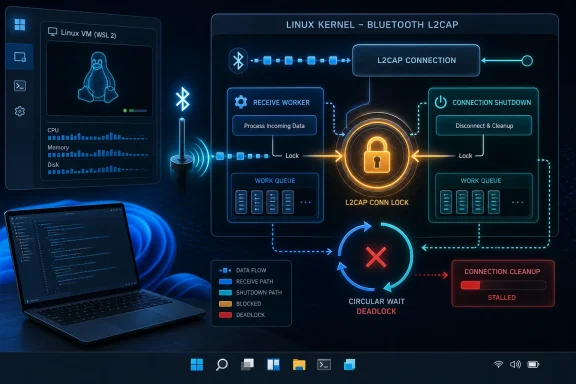
CVE-2026-64206 is fundamentally a deadlock vulnerability. During connection teardown, one code path holds a connection mutex and waits for a queued receive worker to finish. At the same time, that receive worker may already be running or may start running and try to acquire the exact same mutex. Neither side can make progress.The teardown path waits for the worker. The worker waits for the lock held by teardown. The connection becomes stuck.
The problematic sequence
The vulnerable order can be understood in four steps:- An L2CAP connection receives data or reaches a state that causes
pending_rx_workto be placed on a workqueue. - A separate event begins deletion of that connection through the L2CAP teardown path.
- Teardown acquires
conn->lockand then callscancel_work_sync()for the pending receive work. - The work function,
process_pending_rx(), attempts to acquireconn->lock, while the teardown code waits for the work function to end.
What the patch changes
The fix changes the ordering: the kernel now cancels the pending receive work before it takesconn->lock. Once the cancellation operation has completed, connection teardown can safely obtain the mutex and purge the pending receive queue.This ordering aligns
pending_rx_work with the existing cleanup approach used for other delayed work items in the same teardown function. That consistency matters. Connection cleanup is easiest to reason about when asynchronous activity is drained first and state is then locked, inspected, and destroyed in a controlled sequence.The patch does not redesign L2CAP, change Bluetooth protocol semantics, or disable deferred receive processing. It corrects the synchronization order in a narrow area of connection deletion.
Why a Deadlock Receives a CVE
Security practitioners often associate CVEs with memory corruption, authentication bypass, data disclosure, or code execution. Those categories unquestionably dominate urgent patching decisions. Yet a reliably triggerable kernel deadlock can still qualify as a security vulnerability because availability is a security property.A local or nearby attacker who can drive a kernel subsystem into a stuck state may be able to deny a service, block device connectivity, degrade system responsiveness, or create conditions that require manual intervention. In a Bluetooth stack, the immediate symptom could be a stalled connection cleanup event, but consequences can extend to applications and services that depend on the Bluetooth device or its associated kernel workqueues.
Availability failures are not harmless
A deadlock in a narrow subsystem is not automatically a full machine freeze. The actual impact depends on which locks, worker threads, connections, and recovery mechanisms are involved. In many cases, a single Bluetooth connection may hang while the rest of the system remains usable. In other cases, repeated triggers, blocked resource release, or interaction with broader subsystem paths can make an availability problem much more disruptive.This distinction is important for accurate risk communication. CVE-2026-64206 should not be described as a proven remote system takeover or assumed full kernel crash. The published description identifies a circular locking condition during connection teardown. Its known core effect is denial of forward progress in that path.
CVSS is not yet assigned
As of July 22, 2026, the National Vulnerability Database record shows no completed NVD CVSS assessment for CVE-2026-64206. That absence should not be interpreted as a declaration that the bug is low severity or non-exploitable. It simply means the enrichment and scoring process has not yet produced an official NVD vector.For defenders, the safer response is to assess practical exposure: Is Bluetooth enabled? Is the affected Linux kernel in use? Can untrusted or uncontrolled Bluetooth devices interact with the host? Is the host running a workload where temporary Bluetooth or system-service loss is unacceptable?
The Technical Locking Failure
The important kernel primitive in this CVE iscancel_work_sync(). Unlike a non-blocking cancellation request, the synchronous form ensures that queued work is cancelled or, if already running, waits until that work has completed. It is a powerful cleanup mechanism precisely because it establishes a strong lifetime guarantee before memory or state is reclaimed.That guarantee becomes hazardous if the caller holds a lock that the worker must acquire to complete.
Mutual exclusion versus completion waiting
A mutex protects shared connection state. In this case,conn->lock serializes access to the L2CAP connection object and related queue operations. The receive worker needs that mutex before it can safely process pending received data.Meanwhile, the deletion path uses synchronous cancellation to ensure the worker cannot keep operating during teardown. Both goals are individually correct:
- The teardown path must prevent late worker execution.
- The worker must lock the connection before touching shared state.
- The connection object must remain coherent while queues are cleared.
Why lockdep matters
Linux includes lock dependency validation, commonly known as lockdep, to detect potential locking cycles while kernels are tested with appropriate debugging options. The warning associated with this issue identified the worker-side lock acquisition and the teardown-side wait relationship as a deadlock condition.Lockdep cannot prove that every warning is reachable in production under all workloads, and it can sometimes report complex relationships that demand human review. In this case, the issue was reportedly discovered by static analysis and manually reviewed against the current kernel tree. That combination is significant: automated analysis found the suspicious pattern, and maintainers validated that the control-flow and locking relationship represented a genuine problem.
The correct teardown model
A safe simplified model looks like this:- Stop new relevant asynchronous work from progressing where necessary.
- Synchronously cancel or flush queued work without holding a lock that the worker needs.
- Acquire the connection lock.
- Purge pending queues and update connection state.
- Complete resource release.
Scope: Which Systems Are Actually Affected?
The CVE affects the Linux kernel’s Bluetooth L2CAP implementation, not Bluetooth in general and not every operating system that supports Bluetooth. Native Windows Bluetooth code does not use the Linux kernel file or L2CAP teardown routine named in the advisory. A Windows 11 PC using its standard Microsoft Bluetooth stack is therefore not directly vulnerable to CVE-2026-64206.That said, Windows users increasingly operate Linux kernels locally and indirectly. The scope must be assessed according to where the kernel runs rather than according to the logo on the desktop.
Linux desktops, laptops, and workstations
A Linux workstation with Bluetooth enabled is the clearest affected scenario. Laptop users frequently pair headphones, mice, keyboards, phones, development boards, and smart devices. Connection churn is routine: devices go out of range, suspend and resume occur, radios are toggled, and peripherals reconnect.A deadlock during teardown may be more likely to matter in such environments because connection lifecycle events happen often. That does not establish a broadly weaponized attack path, but it raises the value of applying vendor-provided updates promptly.
Servers and edge devices
Many data-center servers ship without Bluetooth hardware enabled, and many production Linux images omit Bluetooth services entirely. Their direct exposure can be low. Edge gateways, kiosks, retail terminals, industrial systems, automotive environments, point-of-sale equipment, and embedded Linux devices are different: Bluetooth may be a core operational feature or a maintenance interface.Those systems can have unusually long patch cycles. They may also use vendor-customized kernels where upstream fixes take time to appear. Operators should treat this CVE as a reason to inventory Bluetooth-enabled Linux endpoints rather than assuming that “server” automatically means “not relevant.”
Virtual machines and containers
A Linux virtual machine is only exposed if it runs an affected kernel and has Bluetooth functionality available to that guest, whether through passthrough, virtual hardware, a USB adapter, or specialized host integration. Containers share the host kernel, so a container image alone does not determine exposure. If the host kernel is affected and Bluetooth capabilities are exposed into containerized workloads, the host’s patch status is decisive.This is a reminder that container security conversations often focus heavily on user-space packages. Kernel CVEs remain host-level concerns, and a container runtime cannot patch a kernel synchronization flaw by updating an application image.
What This Means for Windows Users
WindowsForum readers should separate the native Windows question from the cross-platform operations question. On a conventional Windows computer, this CVE is not a reason to change Bluetooth settings, remove a paired device, or expect a Microsoft Patch Tuesday update. The code under discussion exists in the Linux kernel.The relevance appears when Windows serves as the control plane, development platform, or virtualization host for Linux.
WSL 2 considerations
Windows Subsystem for Linux version 2 uses a real Linux kernel in a lightweight virtualized environment. However, ordinary WSL 2 installations do not automatically expose a host Bluetooth adapter directly to the Linux guest in the way a traditional Linux laptop does. In the standard configuration, WSL 2 is therefore unlikely to present the most obvious exposure path for this CVE.The analysis changes if a user has configured USB device sharing, custom kernel builds, specialized Bluetooth passthrough, development hardware, or experimental integrations that make Bluetooth devices accessible inside the Linux environment. In those cases, users should verify the kernel build supplied with or selected for WSL 2 and determine whether the relevant stable fix has been included.
Hyper-V, VMware, and developer labs
Windows hosts running Linux guests under Hyper-V, VMware Workstation, VirtualBox, or enterprise virtualization platforms should assess each guest independently. A guest’s susceptibility depends on its own active kernel and whether it can access Bluetooth hardware or a Bluetooth-oriented workload. The Windows host itself is not made vulnerable merely by hosting the guest.For developers, the practical issue is often custom kernels. Teams testing Bluetooth drivers, embedded systems, BlueZ changes, mobile integrations, or wireless peripherals may compile their own kernels or use recent release candidates. These environments are exactly where lockdep warnings and lifecycle bugs are more likely to surface during stress testing.
Windows-managed Linux fleets
Organizations commonly use Windows administration tools, Microsoft Endpoint management products, PowerShell remoting, Azure-hosted services, and cross-platform device-management systems to oversee Linux endpoints. Those tools can help find systems needing updates, but they do not change the technical remediation: the Linux kernel must be updated through the distribution, appliance vendor, or controlled kernel deployment process.The key operational message is simple: a Windows endpoint-management console may be the place from which remediation is coordinated, but the affected component lives beneath Linux.
Exposure and Triggering Conditions
The CVE description provides a grounded proof-of-concept framework rather than a complete public exploitation recipe. It identifies the event chain that matters: pending receive work is queued, connection deletion begins, and the worker attempts to acquire the same connection mutex held by teardown.That is enough to define reasonable exposure conditions without exaggerating what has been publicly demonstrated.
Bluetooth activity is necessary
A system generally needs an active Bluetooth L2CAP connection lifecycle for this code to be exercised. If Bluetooth is disabled at firmware, kernel, service, policy, or hardware level, the affected path is far less relevant. If the Bluetooth stack is present but unused, practical exposure is lower than on a device continuously accepting peripherals or exchanging data.Administrators should avoid equating “Bluetooth package installed” with “actively exposed.” Inventory should distinguish between the kernel feature being compiled in, a Bluetooth controller being present, the radio being enabled, the Bluetooth service running, and untrusted peers being able to create or influence connections.
Connection teardown is the critical moment
The race appears during disconnection and cleanup rather than routine packet receipt alone. Potential triggers may include a peer disconnecting unexpectedly, connection errors, device range changes, deliberate pairing or unpairing behavior, controller resets, power-state transitions, or application-driven closure.Wireless links are inherently volatile. That makes teardown correctness especially important. A wired network session can also disappear abruptly, but Bluetooth peripherals add power-saving behavior, mobility, radio interference, device sleep, and frequent consumer-grade reconnection patterns that make lifecycle edge cases common.
Attackability remains a separate question
A vulnerability can be reachable without being straightforward to exploit. The public record establishes the deadlock condition and a reproduction-oriented proof of concept. It does not, by itself, establish that any nearby unauthenticated device can deterministically force a severe system-wide outage across every Bluetooth configuration.Organizations should therefore avoid two opposite mistakes:
- Do not dismiss the issue because it is “only a deadlock.”
- Do not portray it as confirmed remote code execution or a universal Bluetooth takeover.
Patch Status and Version Interpretation
Kernel vulnerability records often list Git commits, upstream versions, stable backports, and affected ranges. That detail is technically useful but can confuse administrators accustomed to straightforward application version numbers.CVE-2026-64206 lists corrected stable endpoints including Linux 6.18.39 and Linux 7.1.4, while the upstream original-fix designation is associated with Linux 7.2-rc3. These version references should be read as evidence that the fix has moved through multiple maintenance streams, not as a universal mandate that every system must jump to a release-candidate kernel.
Distribution backports are normal
Enterprise Linux distributions and long-term-support distributions may retain a kernel version string that appears older than an upstream fixed release while backporting the exact patch. Conversely, a self-built kernel could identify as a newer base version but omit a downstream correction or use a divergent patch set.The authoritative answer for a managed system comes from the distribution’s security advisory, package changelog, or vendor support documentation. In a custom-kernel environment, the answer comes from the source tree and the presence of the fix itself.
Do not use version arithmetic alone
A useful triage approach is:- Identify the active kernel, not merely installed but unused kernel packages.
- Determine whether Bluetooth is enabled and operational on that host.
- Check the vendor’s security update information for CVE-2026-64206.
- Install the vendor-provided kernel update or integrate the stable patch into a controlled custom kernel.
- Reboot into the corrected kernel, then validate the running version and service behavior.
Why stable backports are preferable
For most users, selecting a vendor-maintained stable kernel is safer than manually applying a one-line patch. The synchronization change is small, but kernel patching requires source provenance, configuration consistency, module compatibility, bootloader awareness, signing considerations, and regression testing.Manual backporting is appropriate for kernel developers, embedded vendors, and organizations with established kernel engineering practices. Everyone else should use the distribution’s supported update channel where possible.
Enterprise Impact and Response Planning
The enterprise impact of CVE-2026-64206 depends less on desktop operating-system brand and more on hardware roles and Bluetooth policy. A locked-down server estate with no Bluetooth radios will have a very different priority from a warehouse fleet of Linux handhelds, Windows-managed kiosk devices, or edge gateways that pair with sensors.A measured response should be proportional to exposure while still treating the issue as a legitimate kernel availability defect.
Inventory Bluetooth as a capability
Asset inventories frequently record operating system version and kernel release but omit whether Bluetooth is physically present, enabled, or business-critical. This CVE illustrates why that omission matters. A Bluetooth adapter hidden inside a laptop dock, embedded board, industrial gateway, or USB expansion device can turn a theoretically irrelevant kernel component into an active attack surface.Security teams should classify systems into practical groups:
- No Bluetooth hardware or Bluetooth disabled by policy: Patch in the normal kernel cadence, subject to standard fleet policy.
- Bluetooth present but limited to trusted peripherals: Prioritize the vendor fix in the next maintenance cycle and monitor for operational symptoms.
- Bluetooth exposed to untrusted, public, or frequently changing devices: Expedite the fixed kernel and consider temporary radio restrictions if patching is delayed.
- Embedded or operational-technology devices: Coordinate with the vendor because untested kernel replacement may carry its own availability risk.
Operational monitoring
A deadlock may surface as stalled Bluetooth disconnects, hung peripheral sessions, delayed device cleanup, blocked workqueue activity, kernel lock warnings in debugging configurations, or service-level complaints such as devices that cannot reconnect cleanly. Production systems will not necessarily emit a clear “CVE-2026-64206” log entry.Monitoring should focus on symptoms and change correlation. If Bluetooth-related instability appears after a deployment, suspend/resume pattern, firmware update, or pairing rollout, teams should examine kernel logs and compare the active kernel against the vendor’s fixed build.
Incident response boundaries
If a system is suspected of hitting the deadlock, simply restarting a Bluetooth userspace service may not resolve a kernel worker and mutex deadlock. Depending on the exact state, resetting the Bluetooth adapter, unloading and reloading modules, or rebooting may be necessary. These actions should be tested in advance on systems where Bluetooth is business-critical.For incident responders, that means recovery documentation should clearly distinguish between a BlueZ daemon issue and a kernel synchronization issue. Restarting userspace is low risk, but it is not a guaranteed remedy for a blocked kernel path.
Consumer Impact: Practical, Not Panic-Worthy
For consumers running a standard Windows installation, CVE-2026-64206 is primarily informational. The affected code is not part of the Windows Bluetooth kernel stack. There is no indication that pairing Bluetooth headphones with a Windows PC invokes this Linux L2CAP teardown bug.The consumer audience that should pay closer attention includes Linux dual-boot users, people running Linux directly on laptops, enthusiasts with Bluetooth-enabled home servers, users experimenting with WSL 2 hardware passthrough, and developers who compile kernels or test wireless accessories.
Update the system that owns the kernel
A common source of confusion is updating a Windows host while overlooking a Linux guest, or updating a Linux container image while overlooking the container host. The remediation belongs at the layer that actually runs the affected Linux kernel.For example, updating a Linux distribution inside a virtual machine may be necessary even if the Windows 11 host is completely current. Likewise, a NAS, router, single-board computer, or media device can need a vendor firmware update even if it is administered from a Windows browser or desktop utility.
Sensible temporary precautions
When a prompt patch is unavailable, users with a legitimate Bluetooth exposure can reduce risk by disabling Bluetooth when it is not needed, avoiding pairings with unknown devices, and minimizing untrusted device access. These steps are mitigations, not substitutes for a corrected kernel.Disabling Bluetooth may not be practical for accessibility devices, keyboards, mice, audio equipment, industrial sensors, or IoT workflows. In those situations, prioritize a tested vendor update rather than making the device unusable for an extended period.
Strengths and Opportunities
The handling of CVE-2026-64206 demonstrates several positive aspects of the Linux security and maintenance process.- The defect has a narrowly scoped fix. Reordering cancellation before mutex acquisition addresses the defined deadlock without broad protocol redesign or disruptive feature removal.
- The issue was detected before a more dramatic outcome was required. Static analysis and lock validation can reveal lifecycle flaws even when they have not yet produced a widely reported production incident.
- The correction follows an established local pattern. Matching the ordering already used for comparable delayed work items reduces conceptual inconsistency within the teardown routine.
- Stable maintenance branches received backports. This gives downstream distributions a practical path to remediation without requiring every user to adopt the newest upstream kernel series.
- The public record is technically specific. The identification of the queueing path, cancellation path, worker function, mutex, and queue-purge ordering gives maintainers enough information to verify patch presence and assess related code.
A lesson for kernel developers
The broader opportunity is preventive engineering. Every workqueue lifecycle should be reviewed with the question: “Could this worker need a lock that teardown holds while synchronously waiting for it?” That question applies not only to Bluetooth, but also to storage, graphics, networking, USB, audio, device drivers, and subsystem-specific state machines.Code review checklists can explicitly require lock-order analysis around
cancel_work_sync(), flush_work(), delayed-work cancellation, task completion waits, and reference-count release. Such checks are inexpensive compared with diagnosing a rare production hang.Risks and Concerns
The fix is straightforward, but the remediation landscape still contains practical risks that administrators and users should understand.- No official NVD severity score is available yet. Organizations that rely entirely on CVSS-driven automation may under-prioritize the issue until enrichment is completed.
- Bluetooth visibility is often poor. Many asset-management systems cannot easily identify whether a Linux endpoint has a live Bluetooth adapter, active service, or untrusted pairing exposure.
- Kernel version strings can be misleading. A distribution may be fixed with a backport despite an old-looking version, while custom kernels may require source-level confirmation.
- Recovery can be disruptive. A kernel deadlock may require more than restarting a Bluetooth service, particularly on appliances where radio resets or reboots interrupt business processes.
- Temporary Bluetooth disablement can affect accessibility and operations. Security mitigations must not casually break essential input devices, medical-adjacent peripherals, logistics sensors, or assistive technologies.
- The affected code is mature and long-lived. The historical reach of the flaw underscores that code stability and code age are not the same thing; old synchronization paths can remain vulnerable until analysis exposes a specific interleaving.
Avoiding overcorrection
It would be counterproductive for organizations to ban Bluetooth across every Linux asset in response to a single availability vulnerability. Bluetooth may be indispensable in many environments, and blanket deactivation can push users toward unmanaged workarounds.The better response is risk-based: update affected kernels, segment or limit untrusted pairing where appropriate, maintain reliable inventory, and keep emergency recovery procedures realistic.
What to Watch Next
The next developments to watch are distribution advisories, downstream package releases, and any further analysis of practical triggering reliability. As of July 22, 2026, the vulnerability record is newly published and lacks an NVD CVSS assessment, so additional classification details may emerge as the record is enriched.Security teams should also watch whether major Linux vendors identify particular supported kernels, appliance lines, or Bluetooth configurations as requiring expedited action. The upstream fix tells maintainers what must change; downstream advisories tell customers which packaged builds contain that change.
Questions that may receive clearer answers
Several operational questions remain important:- How readily can connection churn from a remote or paired Bluetooth peer trigger the problematic timing on common configurations?
- Does the deadlock remain confined to a single L2CAP connection in ordinary deployments, or can repeated activity create wider Bluetooth service disruption?
- Which long-term-support kernels have received vendor backports beyond the stable versions already identified?
- Are embedded device vendors shipping fixed firmware promptly, particularly for products without transparent kernel changelogs?
- Will the NVD eventually assign a vector that helps automated governance systems prioritize the issue?
A practical verification checklist
After a kernel update, administrators should verify more than package installation:- Confirm that the host has rebooted into the intended kernel build.
- Check that Bluetooth services and paired devices behave normally after the reboot.
- Exercise expected connection and disconnection workflows in a controlled way.
- Review kernel logs for new Bluetooth or locking-related regressions.
- Document the update in the asset and vulnerability-management system, including exceptions for devices awaiting vendor firmware.
CVE-2026-64206 is a concise example of how a single ordering error can turn correct-looking kernel cleanup operations into an availability flaw: teardown holds a mutex, synchronous cancellation waits for a worker, and that worker needs the same mutex to finish. The repair—cancel first, lock second—is simple, but its significance is not. Linux users and Windows administrators responsible for Linux workloads should treat the CVE as a targeted kernel-maintenance task, verify actual Bluetooth exposure, obtain the appropriate vendor backport, and remember that dependable wireless connectivity depends as much on safe teardown paths as it does on the protocols that carry data.
References
- Primary source: NVD / Linux Kernel
Published: 2026-07-22T01:01:57-07:00
NVD - CVE-2026-64206
 nvd.nist.gov
- Security advisory: MSRC
Published: 2026-07-22T01:01:57-07:00
Original feed URL
Security Update Guide - Microsoft Security Response Center
 msrc.microsoft.com
