

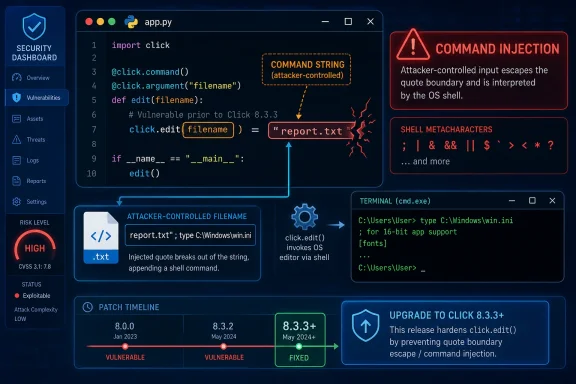
CVE-2026-7246 is a high-severity command-injection flaw disclosed April 30, 2026, in Pallets Click’s
Click is one of those projects many Python users touch without thinking about it. It powers command-line tools, internal automation, packaging utilities, deployment scripts, and developer workflows that rarely advertise Click as part of their identity. That is exactly why this CVE deserves more attention than its narrow function name might suggest.
The vulnerable function,
The flaw is a classic command-injection pattern: take user-controlled input, wrap it in quotes, and assume the quotes are a safety boundary. They are not. If the filename itself contains quote characters and shell metacharacters, the attacker can break out of the intended argument and introduce a separate command.
That is not a new class of mistake. It is one of the oldest mistakes in Unix-flavored programming. But its reappearance inside a widely used Python library shows why old mistakes remain dangerous: they migrate upward into abstractions that developers no longer inspect.
That makes it tempting to downplay. Many administrators see “local,” “high complexity,” or “user interaction required” and mentally demote a vulnerability to backlog status. In this case, that instinct is only partly justified.
Command-line tools often sit at the boundary between untrusted content and trusted automation. A developer may clone a repository, run a project helper, inspect a generated config file, or launch an editor from a CLI tool that helpfully opens whatever path the project supplies. A sysadmin may run internal scripts against filenames produced by tickets, archives, build outputs, or customer-supplied data. In those contexts, “local” does not mean “safe.” It means the attacker needs a route into the local workflow.
The practical risk is therefore uneven. A desktop user who never runs Python CLI tools that open attacker-influenced filenames has little to fear. A development team with internal tools that invoke editors on repository files, templates, issue attachments, or generated manifests has a more interesting problem.
The distinction matters. Escaping can be correct, but it is often fragile, platform-sensitive, and easy to regress. Passing a list of arguments directly to a process avoids asking a shell to reinterpret a string that contains both program structure and user data.
This is the deeper lesson of CVE-2026-7246. The dangerous move was not opening an editor. It was treating a filename as text inside a shell command. Once that happened, the filename stopped being data and became potential syntax.
Windows administrators should not dismiss this as a Unix-only habit. Python is cross-platform, Click is cross-platform, and command invocation bugs have different shapes on PowerShell,
This is a recurring tension in vulnerability databases. A CVE record must compress messy reality into fields, scores, vectors, and impact categories. Real environments do not compress so neatly. The same library flaw can be a nuisance in one workflow, a credential-exposure risk in another, and a build-system compromise in a third.
For WindowsForum readers, the Microsoft angle is less about Windows Update and more about ecosystem visibility. This is not a Microsoft component being patched through Patch Tuesday. It is an open-source Python dependency appearing in the same operational awareness stream that enterprise defenders increasingly use to track risk across platforms.
That shift is important. Modern Windows estates are not just Windows binaries, Office, Edge, and drivers. They are Python packages, Node modules, container images, internal scripts, developer CLIs, CI runners, package caches, WSL distributions, and security scanners. A vulnerability in a Python library can matter to a Windows shop because the Windows shop now runs a software factory, not merely a fleet of desktops.
On a developer workstation, Click may exist in global Python site-packages, virtual environments, pipx-managed tools, Poetry or uv-managed projects, Conda environments, embedded application runtimes, or vendor-shipped utility folders. On build agents, it may be recreated on every pipeline run from lockfiles. In containers, it may be frozen into an image that nobody has rebuilt since the original base layer passed tests.
That fragmentation is why dependency vulnerabilities so often outlive their fixes. The patch can be available before the affected copies are even known. A team may update the central application and still leave vulnerable Click versions inside old virtual environments, internal tool images, or developer bootstrap scripts.
For administrators, the most useful question is not “Do we use Click?” It is “Which tools in our environment can invoke an editor or pager on filenames influenced by a repo, a user, a ticket, an archive, or automation output?” That narrower question turns a noisy package inventory problem into a risk triage exercise.
The PoC pattern is straightforward: create a filename containing a quote, insert a command separator, and rely on the vulnerable helper to pass the resulting string through a shell. The payload does not need to be sophisticated to prove the point. A marker file is enough to show command execution.
In real environments, the payload would be shaped by the platform and user privileges. On a developer machine, the attractive targets are not always administrator rights. Source tokens, SSH keys, cloud credentials, package publishing credentials, local
This is why “requires user interaction” is not a comfort blanket. Software supply-chain attacks frequently begin by persuading developers to run normal-looking commands in normal-looking projects. If a trusted CLI opens a maliciously named file, the interaction may feel like ordinary work.
But availability is the least imaginative reading of command injection. The more serious concern is that the injected command runs in the user’s context. That context may have access to repositories, package registries, deployment environments, cloud CLIs, VPN-connected resources, or internal shares.
The severity therefore depends less on Click itself and more on the surrounding workflow. A vulnerable helper in a toy CLI is an annoyance. The same helper in a release-management script used by maintainers is a potential supply-chain incident.
Security teams should resist both extremes. This is not Log4Shell. It is also not nothing. It is a sharp bug in a widely used developer dependency, with a clear patch and a plausible path from malicious filename to command execution.
Where immediate upgrades are difficult, the compensating control is to avoid passing untrusted filenames into
Developers maintaining CLI tools should audit similar patterns beyond Click. Search for
On Windows, pay special attention to mixed-shell assumptions. A tool tested under one shell may be run under another. A path that appears harmless under direct process execution may behave differently when routed through a shell. The safest design is still to keep arguments as arguments and avoid shell parsing unless the shell is explicitly the product feature.
The tougher problem is not whether maintainers responded. It is whether consuming organizations have a fast enough path from upstream fix to local deployment. Many do not. They have dependency scanning, but exceptions linger. They have lockfiles, but lockfiles are not refreshed. They have golden images, but nobody owns the Python environments inside them.
This is where security policy often meets developer reality. An enterprise can demand “patch all vulnerable dependencies,” but a developer may be afraid to touch a CLI dependency used by internal tools because subtle argument parsing changes can break automation. That fear is not irrational. Click is a command-line framework; small behavior changes can surface in scripts.
Still, this particular upgrade should be easier to justify than many. The fixed version is specifically described as a bug-fix release without expected breaking changes compared with the latest feature release. That does not eliminate testing, but it should move the patch from “someday” to “next routine rebuild.”
That mismatch is dangerous. If a PowerShell module has a vulnerability, many teams know where to look. If a Python dependency inside a pipx-installed CLI has a vulnerability, the answer is often less clear. If that CLI is used by developers with access to production deployment credentials, the blind spot becomes material.
CVE-2026-7246 is a useful case study because it is not buried in an obscure abandoned package. Click is mainstream. The vulnerable feature is ordinary. The fix is available. If an organization cannot answer whether it is exposed here, the problem is not this CVE; the problem is dependency governance.
The right operational model is not to ban developer tooling or centralize every script into bureaucracy. It is to make Python environments observable. Teams need a way to identify package versions across workstations, build agents, containers, and packaged utilities without turning every developer machine into a forensic project.
That should make defenders uneasy. Filenames travel through archives, repositories, sync folders, issue attachments, generated code, test fixtures, package contents, and build artifacts. They are often displayed, logged, normalized, rewritten, and passed between tools without being treated as hostile.
A malicious filename can exploit assumptions at every layer. One tool treats it as data. Another treats it as display text. A third treats it as part of a command. The bug appears when those interpretations blur.
The lesson is not that every filename is a bomb. The lesson is that filenames are untrusted input when they come from outside the trust boundary. If a program would not put a user’s form submission into a shell command, it should not put a user-controlled filename there either.
click.edit() helper, affecting Python package versions before 8.3.3 and allowing attacker-controlled filenames to escape quoting and run operating-system commands on the user’s local machine. The uncomfortable part is not that a Python CLI helper had a bug; bugs happen. The uncomfortable part is that the vulnerable path sits in the kind of utility function developers trust precisely because it feels boring. This is a reminder that “just open this file in an editor” can become a shell boundary if a library takes the shortcut of composing commands as strings.
 A Small Helper Crossed a Very Old Security Line
Click is one of those projects many Python users touch without thinking about it. It powers command-line tools, internal automation, packaging utilities, deployment scripts, and developer workflows that rarely advertise Click as part of their identity. That is exactly why this CVE deserves more attention than its narrow function name might suggest.The vulnerable function,
click.edit(), is designed to hand a file to an editor and return control to the calling application. In normal use, that is harmless convenience. In vulnerable versions, however, the helper passed a constructed command through a shell, and the filename could influence more than the filename.The flaw is a classic command-injection pattern: take user-controlled input, wrap it in quotes, and assume the quotes are a safety boundary. They are not. If the filename itself contains quote characters and shell metacharacters, the attacker can break out of the intended argument and introduce a separate command.
That is not a new class of mistake. It is one of the oldest mistakes in Unix-flavored programming. But its reappearance inside a widely used Python library shows why old mistakes remain dangerous: they migrate upward into abstractions that developers no longer inspect.
The Exploit Is Local, But the Trust Boundary Is Not
The published scoring around CVE-2026-7246 reflects an important nuance. This is not a drive-by remote exploit against every Python application that imports Click. The vulnerable path generally requires a program to callclick.edit() with a filename the attacker can influence, and user interaction may be part of the chain.That makes it tempting to downplay. Many administrators see “local,” “high complexity,” or “user interaction required” and mentally demote a vulnerability to backlog status. In this case, that instinct is only partly justified.
Command-line tools often sit at the boundary between untrusted content and trusted automation. A developer may clone a repository, run a project helper, inspect a generated config file, or launch an editor from a CLI tool that helpfully opens whatever path the project supplies. A sysadmin may run internal scripts against filenames produced by tickets, archives, build outputs, or customer-supplied data. In those contexts, “local” does not mean “safe.” It means the attacker needs a route into the local workflow.
The practical risk is therefore uneven. A desktop user who never runs Python CLI tools that open attacker-influenced filenames has little to fear. A development team with internal tools that invoke editors on repository files, templates, issue attachments, or generated manifests has a more interesting problem.
The Shell Was the Vulnerability Multiplier
The fix in Click 8.3.3 is instructive because it attacks the pattern rather than merely patching a character. The release changed editor and pager command handling to split commands into argument lists forsubprocess.Popen, removing shell=True from that path. That is the architectural repair security engineers usually want to see.The distinction matters. Escaping can be correct, but it is often fragile, platform-sensitive, and easy to regress. Passing a list of arguments directly to a process avoids asking a shell to reinterpret a string that contains both program structure and user data.
This is the deeper lesson of CVE-2026-7246. The dangerous move was not opening an editor. It was treating a filename as text inside a shell command. Once that happened, the filename stopped being data and became potential syntax.
Windows administrators should not dismiss this as a Unix-only habit. Python is cross-platform, Click is cross-platform, and command invocation bugs have different shapes on PowerShell,
cmd.exe, WSL, Git Bash, MSYS2, and developer environments that blend them. The exact payload mechanics vary, but the design smell is the same: user-controlled strings should not be interpolated into command lines that a shell parses.Microsoft’s Listing Makes This a Supply-Chain Story
The user-facing source here is Microsoft’s Security Update Guide entry, which frames the impact heavily around availability. That is notable because the underlying weakness is broader than a denial-of-service bug. If an injected command runs with the privileges of the user who launched the vulnerable CLI tool, confidentiality and integrity can also be in play.This is a recurring tension in vulnerability databases. A CVE record must compress messy reality into fields, scores, vectors, and impact categories. Real environments do not compress so neatly. The same library flaw can be a nuisance in one workflow, a credential-exposure risk in another, and a build-system compromise in a third.
For WindowsForum readers, the Microsoft angle is less about Windows Update and more about ecosystem visibility. This is not a Microsoft component being patched through Patch Tuesday. It is an open-source Python dependency appearing in the same operational awareness stream that enterprise defenders increasingly use to track risk across platforms.
That shift is important. Modern Windows estates are not just Windows binaries, Office, Edge, and drivers. They are Python packages, Node modules, container images, internal scripts, developer CLIs, CI runners, package caches, WSL distributions, and security scanners. A vulnerability in a Python library can matter to a Windows shop because the Windows shop now runs a software factory, not merely a fleet of desktops.
The Version Boundary Is Clear, the Inventory Boundary Is Not
The clean instruction is simple: upgrade Click to 8.3.3 or later. The harder question is where Click is actually installed.On a developer workstation, Click may exist in global Python site-packages, virtual environments, pipx-managed tools, Poetry or uv-managed projects, Conda environments, embedded application runtimes, or vendor-shipped utility folders. On build agents, it may be recreated on every pipeline run from lockfiles. In containers, it may be frozen into an image that nobody has rebuilt since the original base layer passed tests.
That fragmentation is why dependency vulnerabilities so often outlive their fixes. The patch can be available before the affected copies are even known. A team may update the central application and still leave vulnerable Click versions inside old virtual environments, internal tool images, or developer bootstrap scripts.
For administrators, the most useful question is not “Do we use Click?” It is “Which tools in our environment can invoke an editor or pager on filenames influenced by a repo, a user, a ticket, an archive, or automation output?” That narrower question turns a noisy package inventory problem into a risk triage exercise.
Proof-of-Concept Code Changes the Patch Conversation
Public proof-of-concept material exists for this issue. That does not automatically mean widespread exploitation is happening, but it changes the economics of delay. Once a PoC demonstrates the pattern, attackers and red teams do not need to reverse-engineer the bug from scratch.The PoC pattern is straightforward: create a filename containing a quote, insert a command separator, and rely on the vulnerable helper to pass the resulting string through a shell. The payload does not need to be sophisticated to prove the point. A marker file is enough to show command execution.
In real environments, the payload would be shaped by the platform and user privileges. On a developer machine, the attractive targets are not always administrator rights. Source tokens, SSH keys, cloud credentials, package publishing credentials, local
.env files, and browser-accessible session material are often more valuable than immediate privilege escalation.This is why “requires user interaction” is not a comfort blanket. Software supply-chain attacks frequently begin by persuading developers to run normal-looking commands in normal-looking projects. If a trusted CLI opens a maliciously named file, the interaction may feel like ordinary work.
Availability Is the Floor, Not the Ceiling
The prompt’s emphasis on total loss of availability fits one possible impact path: injected commands can crash tools, delete working files, poison generated output, or repeatedly trigger failures that block a workflow. In CI or internal automation, that can become a real denial of service. If a build tool, release helper, or configuration editor can be knocked offline reliably, the business impact is not imaginary.But availability is the least imaginative reading of command injection. The more serious concern is that the injected command runs in the user’s context. That context may have access to repositories, package registries, deployment environments, cloud CLIs, VPN-connected resources, or internal shares.
The severity therefore depends less on Click itself and more on the surrounding workflow. A vulnerable helper in a toy CLI is an annoyance. The same helper in a release-management script used by maintainers is a potential supply-chain incident.
Security teams should resist both extremes. This is not Log4Shell. It is also not nothing. It is a sharp bug in a widely used developer dependency, with a clear patch and a plausible path from malicious filename to command execution.
The Real Remediation Is Boring, Which Is Good
There is no need for panic-driven mitigations if teams can update. Pin Click to 8.3.3 or later, rebuild affected environments, refresh lockfiles, and ensure packaged tools are actually shipping the newer dependency. The dullness of that advice is a strength.Where immediate upgrades are difficult, the compensating control is to avoid passing untrusted filenames into
click.edit(). That may sound obvious, but many risky paths are indirect. A CLI may accept a project path, discover a file inside it, and open that file for editing. If an attacker controls the project contents, the filename may be attacker-controlled even when the user never typed it.Developers maintaining CLI tools should audit similar patterns beyond Click. Search for
shell=True, editor launch helpers, pager launch helpers, and command strings built with filenames, branch names, package names, archive entries, or repository metadata. CVE-2026-7246 is one bug; the anti-pattern is larger.On Windows, pay special attention to mixed-shell assumptions. A tool tested under one shell may be run under another. A path that appears harmless under direct process execution may behave differently when routed through a shell. The safest design is still to keep arguments as arguments and avoid shell parsing unless the shell is explicitly the product feature.
The Patch Also Tests Open-Source Maintenance Expectations
Pallets’ fix landed in a point release that does not otherwise appear designed as a disruptive feature update. That is how mature open-source maintenance should work: narrow bug fix, clear patched version, minimal behavioral churn. For downstream users, this lowers the excuse threshold.The tougher problem is not whether maintainers responded. It is whether consuming organizations have a fast enough path from upstream fix to local deployment. Many do not. They have dependency scanning, but exceptions linger. They have lockfiles, but lockfiles are not refreshed. They have golden images, but nobody owns the Python environments inside them.
This is where security policy often meets developer reality. An enterprise can demand “patch all vulnerable dependencies,” but a developer may be afraid to touch a CLI dependency used by internal tools because subtle argument parsing changes can break automation. That fear is not irrational. Click is a command-line framework; small behavior changes can surface in scripts.
Still, this particular upgrade should be easier to justify than many. The fixed version is specifically described as a bug-fix release without expected breaking changes compared with the latest feature release. That does not eliminate testing, but it should move the patch from “someday” to “next routine rebuild.”
Windows Shops Need to Treat Python Tools as First-Class Assets
The Windows ecosystem has changed. Python is now a normal part of administration, development, cloud operations, security tooling, and data workflows on Windows. Yet many Windows asset inventories still see Python environments as incidental, user-managed clutter.That mismatch is dangerous. If a PowerShell module has a vulnerability, many teams know where to look. If a Python dependency inside a pipx-installed CLI has a vulnerability, the answer is often less clear. If that CLI is used by developers with access to production deployment credentials, the blind spot becomes material.
CVE-2026-7246 is a useful case study because it is not buried in an obscure abandoned package. Click is mainstream. The vulnerable feature is ordinary. The fix is available. If an organization cannot answer whether it is exposed here, the problem is not this CVE; the problem is dependency governance.
The right operational model is not to ban developer tooling or centralize every script into bureaucracy. It is to make Python environments observable. Teams need a way to identify package versions across workstations, build agents, containers, and packaged utilities without turning every developer machine into a forensic project.
The Filename Became an Attack Surface
The most revealing aspect of this vulnerability is how mundane the attacker-controlled object is. Security discussions often focus on URLs, request bodies, serialized objects, macros, or binary parsers. Here, the dangerous input is a filename.That should make defenders uneasy. Filenames travel through archives, repositories, sync folders, issue attachments, generated code, test fixtures, package contents, and build artifacts. They are often displayed, logged, normalized, rewritten, and passed between tools without being treated as hostile.
A malicious filename can exploit assumptions at every layer. One tool treats it as data. Another treats it as display text. A third treats it as part of a command. The bug appears when those interpretations blur.
The lesson is not that every filename is a bomb. The lesson is that filenames are untrusted input when they come from outside the trust boundary. If a program would not put a user’s form submission into a shell command, it should not put a user-controlled filename there either.
The Practical Read on CVE-2026-7246
For teams deciding what to do this week, this vulnerability is less about drama and more about hygiene with a deadline. The patch exists, the affected range is understandable, and the risky call pattern is specific enough to prioritize. The only bad response is to assume that because the vulnerable function sounds niche, the dependency is absent.- Upgrade Pallets Click to version 8.3.3 or later wherever Python tools are built, packaged, or run.
- Rebuild virtual environments, containers, CI images, and packaged internal CLIs rather than only updating a central requirements file.
- Audit applications that call
click.edit()with filenames derived from repositories, archives, user uploads, issue data, templates, or generated project content. - Treat public proof-of-concept availability as a reason to shorten remediation timelines, even if there is no confirmed widespread exploitation.
- Use this incident to search for broader
shell=Truecommand construction patterns involving filenames and other attacker-influenced strings.
References
- Primary source: MSRC
Published: 2026-05-23T01:44:47-07:00
Security Update Guide - Microsoft Security Response Center
 msrc.microsoft.com
- Related coverage: zeropath.com
Brief Summary: Pallets Click CVE-2026-7246 Command Injection via click.edit() Unsanitized Filenames - ZeroPath Blog | ZeroPath
A brief summary of CVE-2026-7246, a high severity command injection vulnerability in the Pallets Click library's click.edit() function that allows arbitrary OS command execution through crafted filenames.zeropath.com - Related coverage: codeant.ai
Command Injection in Pallets Click click.edit() Helper - CodeAnt AI | AI Code Health Platform for Review, Security & Quality
Pallets Click up to version 8.3.2 contains a command injection vulnerability in the click.edit() function, which can be abused to execute arbitrary operating. www.codeant.ai
- Related coverage: security.snyk.io
Command Injection in click | CVE-2026-7246 | Snyk
High severity (7.5) Command Injection in click | CVE-2026-7246security.snyk.io - Related coverage: securityvulnerability.io
pallets Cyber Security Vulnerability Stats and Metrics
SecurityVulnerability.io is a live platform that curates, summarizes, and explains critical Cyber Security vulnerabilities (CVEs).securityvulnerability.io - Official source: microsoft.com
MSRC - Microsoft Security Response Center
The Microsoft Security Response Center is part of the defender community and on the front line of security response evolution. For over twenty years, we have been engaged with security researchers working to protect customers and the broader ecosystem.www.microsoft.com
