

Hitachi Energy’s MACH HiDraw versions 9.22 and earlier are affected by CVE-2026-7310, a locally exploitable heap-based buffer overflow in the product’s XML parser that CISA republished on June 4, 2026, after Hitachi Energy’s May 26 advisory. The flaw is not the sort of remote, wormable bug that sends defenders sprinting to unplug substations. It is more uncomfortable than that: a medium-severity vulnerability in engineering-adjacent software used around critical infrastructure, where “local access” and “authenticated user” do not always mean “low risk.” The practical lesson is that industrial security still depends on boring controls—file handling, workstation hygiene, account discipline, and upgrade planning—long after the headline CVSS score has faded.
CVE-2026-7310 is, on paper, a moderate vulnerability. Hitachi Energy and CISA describe it as a heap-based buffer overflow in MACH HiDraw’s XML parser, triggered through a specially crafted XML file by an authenticated malicious user with local access. The possible outcomes include application crashes, denial of service, memory corruption, and potential arbitrary code execution.
That chain of conditions matters. An attacker needs local access, authentication, and user interaction. The CVSS 3.1 score is 5.5, and the CVSS 4.0 score is 4.4, both in the medium range. This is not a “drop a packet on the open Internet and own the plant” advisory.
But industrial security is not scored only by exploit elegance. MACH HiDraw sits in the ecosystem of control-system engineering and visualization around Hitachi Energy’s MACH platform, a product family associated with high-voltage direct current and power automation environments. When software in that orbit mishandles a project file format, defenders should think less about mass exploitation and more about trusted workflows: engineering files, shared project repositories, removable media, contractor laptops, and jump hosts that move between business and operational networks.
That is where a medium vulnerability becomes operationally interesting. The attacker does not need the entire facility to be Internet-exposed if the attack path is a file that someone is expected to open.
That mental model is dangerous. A parser is code that takes untrusted structure and turns it into memory operations. If the parser has a heap-based buffer overflow, a malformed file can push the application into corruption, crash, or potentially attacker-controlled execution. The file may look like a project artifact, but the vulnerable application experiences it as input to a complex state machine.
In enterprise IT, file-based attacks are familiar. Office macros, malicious PDFs, weaponized archives, and poisoned developer dependencies have trained defenders to distrust documents. In operational technology environments, the equivalent danger is often hidden in files that are part of routine engineering work. A project file, drawing export, configuration bundle, or vendor-provided package may pass through email, ticketing systems, shared folders, USB drives, and remote support sessions before landing on an engineering workstation.
That makes the advisory’s “user interaction required” condition both reassuring and insufficient. Yes, exploitation requires someone or something to open the crafted XML file. No, that does not make it irrelevant. The whole point of engineering software is that people open complex files created elsewhere.
Local access can come through a compromised engineering workstation. It can come from a contractor account. It can come from remote access software that was installed years ago and never fully inventoried. It can come from a shared machine in a control room, a maintenance laptop, or a removable drive introduced during a commissioning or service visit. The boundary between “outside attacker” and “local user” is messier in plants than it is in diagrams.
The advisory’s requirement for low privileges also deserves attention. A vulnerability that requires administrator rights is often a post-compromise nuisance. A vulnerability reachable by a lower-privileged authenticated user is more useful. It gives an attacker a way to move from a constrained account into disruption or possibly code execution inside a more sensitive application context.
That does not mean every MACH HiDraw deployment is one bad XML file away from catastrophe. It does mean defenders should not dismiss the issue because the vector is local. In environments where operational workstations are shared, long-lived, intermittently patched, and connected to sensitive project data, “local” is still a meaningful attack surface.
That sentence should be familiar to anyone who has patched industrial systems. In consumer software, “fixed in the next version” usually means clicking update. In enterprise SaaS, it may mean waiting for the vendor’s deployment window. In industrial environments, an upgrade can require compatibility checks, project validation, regression testing, change-control approval, outage planning, vendor coordination, and documentation updates.
The result is a gap between security availability and security adoption. Version 9.23 may exist, but a production environment may still be pinned to an older release because the software is tied to a specific project lifecycle. The further the system sits from ordinary IT management tooling, the more likely patching becomes a project rather than a task.
That is why the right response is not simply “upgrade immediately” or “ignore because medium.” It is to find every installed copy, identify whether it handles untrusted or externally supplied XML files, determine who can log in locally, and map the operational consequence of a crash. If the application outage affects only an offline engineering workstation, the urgency differs from an environment where the tool is used in active operational support.
Industrial organizations have spent years improving segmentation, and CISA again recommends minimizing exposure, placing control-system networks behind firewalls, isolating them from business networks, and using secured remote-access methods when remote access is unavoidable. Those controls are necessary, but they are not sufficient for file-triggered vulnerabilities. A firewall does not inspect the trust relationship between an engineer and a project file.
The more relevant questions are practical and slightly uncomfortable. Who can send files to engineering staff? Are XML files and project bundles scanned before use? Are contractor-supplied files staged in a controlled environment before touching operational workstations? Are engineering applications run under least-privilege accounts? Are file shares between IT and OT tightly governed, or have they become informal bridges?
This is where WindowsForum readers should pay attention. Many OT environments still depend heavily on Windows endpoints, Windows file shares, Active Directory identities, remote desktop workflows, antivirus exclusions, and removable-media policies. A flaw in an industrial application’s parser is also a Windows endpoint hygiene problem when that parser runs on Windows workstations used by engineers.
The boring controls matter. Application allow-listing, endpoint detection, constrained user accounts, controlled folders, removable-media scanning, and isolated staging machines are not glamorous. They are exactly the sort of controls that make a local file parser vulnerability harder to turn into a meaningful incident.
The advisory does not say exploitation has been observed in the wild. It does not describe a public proof of concept. It does not claim remote exploitability. It does not place the vulnerability in CISA’s Known Exploited Vulnerabilities catalog based on the material provided here.
That said, CISA republication has value. Industrial advisories often live on vendor pages that only customers and specialists track closely. By republishing them through the ICS advisory channel, CISA puts the issue into the workflow of asset owners, managed security providers, government partners, and security teams that monitor federal feeds.
Visibility is not the same as severity, but it changes response behavior. A medium vendor advisory may sit unnoticed in an inbox. A CISA ICS advisory is more likely to become a ticket, a risk-register entry, or a question in the next OT security meeting.
Engineering and configuration tools are often needed at the worst possible time. During maintenance, commissioning, incident response, or unexpected equipment behavior, losing access to a key application can slow recovery. If an attacker can reliably crash the tool by planting or delivering a crafted file, the effect may be operational friction rather than Hollywood sabotage.
That is not trivial. In OT, availability is not a slogan; it is the first principle. A tool outage that delays diagnosis or forces engineers onto fallback processes can create risk even without direct manipulation of control equipment. The vulnerability’s CVSS vector reflects high availability impact, and that is the right place for defenders to focus.
Confidentiality and integrity impacts are rated lower, but they are not irrelevant. If memory corruption can be shaped into code execution, then the application context becomes part of the attack. From there, the next steps depend on workstation privileges, network reachability, stored credentials, project access, and monitoring. The exploit may begin in a file parser, but the blast radius is determined by local architecture.
It is easy to roll one’s eyes at that language because it appears in so many advisories. It is also easy to forget that many incidents still exploit exactly these weak points. The industry keeps repeating the advice because the advice keeps being relevant.
For this specific vulnerability, the most direct mitigations are not abstract. Limit who can log into machines running affected MACH HiDraw versions. Treat XML and project files as untrusted unless their origin and integrity are known. Stage externally supplied files away from production-connected engineering workstations. Ensure endpoint protection is active where compatible. Back up project data. Document a recovery path if HiDraw becomes unavailable.
None of that replaces the vendor fix. But it buys time for organizations that cannot move to version 9.23 overnight. In OT, compensating controls are often the bridge between disclosure and deployment.
That creates a coordination problem. OT engineers understand the application and the project impact. IT administrators understand endpoint controls, identity, logging, and software deployment. Security teams understand threat paths and compensating controls. None of those groups can handle the advisory alone.
The first question is inventory. If the organization cannot quickly determine where MACH HiDraw is installed and which versions are present, then CVE-2026-7310 is also an asset-management failure. The second question is ownership. If nobody knows who can approve the 9.23 upgrade, the patch exists only in theory.
The third question is whether Windows hardening assumptions hold in the OT enclave. Are users local administrators because the application historically required it? Are antivirus exclusions broader than necessary? Are engineering folders writable by too many accounts? Are remote access paths logged and reviewed? A medium parser flaw becomes more dangerous when it lands on an overprivileged workstation.
The fix is clear enough: upgrade to MACH HiDraw 9.23. The deployment path is less clear because Hitachi Energy points customers to account teams for upgrade planning. That is a reasonable vendor stance for project-specific industrial software, but it complicates risk management. A CISO wants a date. An OT manager wants assurance that the upgrade will not break workflows or invalidate assumptions. Both are right.
The worst outcome is paralysis disguised as caution. “We need to assess” can become “we will revisit next quarter,” especially for a medium-severity issue. But the opposite failure is also real. Forcing an untested upgrade into a sensitive engineering environment can create its own availability risk.
The better model is a two-track response. Start compensating controls immediately, especially around file handling and access restriction. In parallel, open the vendor upgrade path, request compatibility guidance, and schedule validation. Treat the medium score as a reason to be measured, not as a reason to be slow.
The missing dimension is workflow trust. In an engineering environment, opening a file is not unusual behavior; it is the job. Authenticated local users are not rare; they are the workforce and its support ecosystem. High complexity may deter opportunistic attackers, but targeted adversaries tend to be patient, especially when the target is critical infrastructure.
The advisory applies to sectors including dams, energy, and transportation systems, with worldwide deployment. Those sector labels do not mean every affected workstation is safety-critical. They do mean the technology lives in environments where disruption has a different weight than it does on an ordinary office desktop.
The right interpretation is not panic. It is context-aware prioritization. A medium bug in a lab copy of HiDraw used for training is one thing. The same bug on a production-support workstation with access to live project files, remote support tooling, and privileged credentials is another.
Security teams should identify affected versions, with special attention to MACH HiDraw 9.22 and earlier. Administrators should determine where XML files handled by HiDraw originate and whether those paths include email, shared drives, vendor portals, removable media, or contractor submissions. OT owners should define what happens if the application crashes during normal operations, maintenance, or recovery work.
Identity teams should review who can log into affected machines and whether those users have more privilege than necessary. Endpoint teams should verify that affected systems are monitored, backed up, and protected as far as vendor compatibility allows. Network teams should revisit whether engineering workstations have unnecessary reachability into business networks or the Internet.
Most importantly, organizations should talk to Hitachi Energy or their product provider about version 9.23 rather than waiting for the next audit cycle. The advisory’s project-specific upgrade language is a reason to start the conversation early.
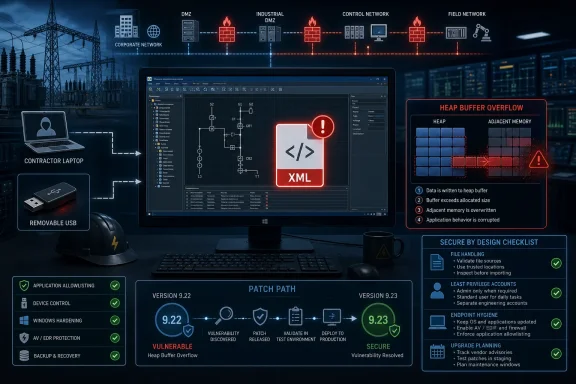 A Medium CVSS Score Can Still Land in a Hard Place
CVE-2026-7310 is, on paper, a moderate vulnerability. Hitachi Energy and CISA describe it as a heap-based buffer overflow in MACH HiDraw’s XML parser, triggered through a specially crafted XML file by an authenticated malicious user with local access. The possible outcomes include application crashes, denial of service, memory corruption, and potential arbitrary code execution.That chain of conditions matters. An attacker needs local access, authentication, and user interaction. The CVSS 3.1 score is 5.5, and the CVSS 4.0 score is 4.4, both in the medium range. This is not a “drop a packet on the open Internet and own the plant” advisory.
But industrial security is not scored only by exploit elegance. MACH HiDraw sits in the ecosystem of control-system engineering and visualization around Hitachi Energy’s MACH platform, a product family associated with high-voltage direct current and power automation environments. When software in that orbit mishandles a project file format, defenders should think less about mass exploitation and more about trusted workflows: engineering files, shared project repositories, removable media, contractor laptops, and jump hosts that move between business and operational networks.
That is where a medium vulnerability becomes operationally interesting. The attacker does not need the entire facility to be Internet-exposed if the attack path is a file that someone is expected to open.
The Parser Is the Attack Surface Everyone Pretends Is Just Plumbing
The vulnerability lives in XML parsing, which is almost a genre unto itself in security advisories. XML is old, ubiquitous, and deeply embedded in configuration, project, drawing, and exchange formats. In many engineering environments, XML is not treated as an executable threat surface; it is treated as documentation with angle brackets.That mental model is dangerous. A parser is code that takes untrusted structure and turns it into memory operations. If the parser has a heap-based buffer overflow, a malformed file can push the application into corruption, crash, or potentially attacker-controlled execution. The file may look like a project artifact, but the vulnerable application experiences it as input to a complex state machine.
In enterprise IT, file-based attacks are familiar. Office macros, malicious PDFs, weaponized archives, and poisoned developer dependencies have trained defenders to distrust documents. In operational technology environments, the equivalent danger is often hidden in files that are part of routine engineering work. A project file, drawing export, configuration bundle, or vendor-provided package may pass through email, ticketing systems, shared folders, USB drives, and remote support sessions before landing on an engineering workstation.
That makes the advisory’s “user interaction required” condition both reassuring and insufficient. Yes, exploitation requires someone or something to open the crafted XML file. No, that does not make it irrelevant. The whole point of engineering software is that people open complex files created elsewhere.
Local Access Is Not a Comfort Blanket in Operational Technology
Security advisories often use “local” as a calming word. In conventional enterprise risk triage, local-only bugs are usually less urgent than remote network flaws, because an attacker must already have a foothold. In OT, that assumption is too neat.Local access can come through a compromised engineering workstation. It can come from a contractor account. It can come from remote access software that was installed years ago and never fully inventoried. It can come from a shared machine in a control room, a maintenance laptop, or a removable drive introduced during a commissioning or service visit. The boundary between “outside attacker” and “local user” is messier in plants than it is in diagrams.
The advisory’s requirement for low privileges also deserves attention. A vulnerability that requires administrator rights is often a post-compromise nuisance. A vulnerability reachable by a lower-privileged authenticated user is more useful. It gives an attacker a way to move from a constrained account into disruption or possibly code execution inside a more sensitive application context.
That does not mean every MACH HiDraw deployment is one bad XML file away from catastrophe. It does mean defenders should not dismiss the issue because the vector is local. In environments where operational workstations are shared, long-lived, intermittently patched, and connected to sensitive project data, “local” is still a meaningful attack surface.
The Fix Exists, but the Upgrade Is the Hard Part
Hitachi Energy says the issue is fixed in MACH HiDraw version 9.23. That is the clean part of the story. The messy part is the vendor’s own caveat: because implementations vary by project, customers are told to contact their local account team for upgrade information.That sentence should be familiar to anyone who has patched industrial systems. In consumer software, “fixed in the next version” usually means clicking update. In enterprise SaaS, it may mean waiting for the vendor’s deployment window. In industrial environments, an upgrade can require compatibility checks, project validation, regression testing, change-control approval, outage planning, vendor coordination, and documentation updates.
The result is a gap between security availability and security adoption. Version 9.23 may exist, but a production environment may still be pinned to an older release because the software is tied to a specific project lifecycle. The further the system sits from ordinary IT management tooling, the more likely patching becomes a project rather than a task.
That is why the right response is not simply “upgrade immediately” or “ignore because medium.” It is to find every installed copy, identify whether it handles untrusted or externally supplied XML files, determine who can log in locally, and map the operational consequence of a crash. If the application outage affects only an offline engineering workstation, the urgency differs from an environment where the tool is used in active operational support.
The Real Exposure Is the File Supply Chain
The most important phrase in the advisory may be “specially crafted XML file.” That points defenders toward the file supply chain rather than the network perimeter alone.Industrial organizations have spent years improving segmentation, and CISA again recommends minimizing exposure, placing control-system networks behind firewalls, isolating them from business networks, and using secured remote-access methods when remote access is unavoidable. Those controls are necessary, but they are not sufficient for file-triggered vulnerabilities. A firewall does not inspect the trust relationship between an engineer and a project file.
The more relevant questions are practical and slightly uncomfortable. Who can send files to engineering staff? Are XML files and project bundles scanned before use? Are contractor-supplied files staged in a controlled environment before touching operational workstations? Are engineering applications run under least-privilege accounts? Are file shares between IT and OT tightly governed, or have they become informal bridges?
This is where WindowsForum readers should pay attention. Many OT environments still depend heavily on Windows endpoints, Windows file shares, Active Directory identities, remote desktop workflows, antivirus exclusions, and removable-media policies. A flaw in an industrial application’s parser is also a Windows endpoint hygiene problem when that parser runs on Windows workstations used by engineers.
The boring controls matter. Application allow-listing, endpoint detection, constrained user accounts, controlled folders, removable-media scanning, and isolated staging machines are not glamorous. They are exactly the sort of controls that make a local file parser vulnerability harder to turn into a meaningful incident.
CISA’s Republication Is a Signal, Not a New Discovery
CISA’s advisory is a republication of Hitachi Energy’s PSIRT advisory, not a separate technical teardown. The agency explicitly frames the notice as a conversion of the vendor’s Common Security Advisory Framework material and provides it as-is to increase visibility. That matters because readers should not overinterpret the CISA page as evidence of active exploitation or new government analysis.The advisory does not say exploitation has been observed in the wild. It does not describe a public proof of concept. It does not claim remote exploitability. It does not place the vulnerability in CISA’s Known Exploited Vulnerabilities catalog based on the material provided here.
That said, CISA republication has value. Industrial advisories often live on vendor pages that only customers and specialists track closely. By republishing them through the ICS advisory channel, CISA puts the issue into the workflow of asset owners, managed security providers, government partners, and security teams that monitor federal feeds.
Visibility is not the same as severity, but it changes response behavior. A medium vendor advisory may sit unnoticed in an inbox. A CISA ICS advisory is more likely to become a ticket, a risk-register entry, or a question in the next OT security meeting.
The Denial-of-Service Angle Is Not a Footnote
Arbitrary code execution gets the attention, but denial of service may be the more realistic concern. The advisory says exploitation could result in application outages and crashes. In many environments, crashing an engineering application is less dramatic than compromising a controller, but it can still matter.Engineering and configuration tools are often needed at the worst possible time. During maintenance, commissioning, incident response, or unexpected equipment behavior, losing access to a key application can slow recovery. If an attacker can reliably crash the tool by planting or delivering a crafted file, the effect may be operational friction rather than Hollywood sabotage.
That is not trivial. In OT, availability is not a slogan; it is the first principle. A tool outage that delays diagnosis or forces engineers onto fallback processes can create risk even without direct manipulation of control equipment. The vulnerability’s CVSS vector reflects high availability impact, and that is the right place for defenders to focus.
Confidentiality and integrity impacts are rated lower, but they are not irrelevant. If memory corruption can be shaped into code execution, then the application context becomes part of the attack. From there, the next steps depend on workstation privileges, network reachability, stored credentials, project access, and monitoring. The exploit may begin in a file parser, but the blast radius is determined by local architecture.
The Vendor’s Mitigation Advice Is Familiar Because It Is Still Unfinished Business
Hitachi Energy’s general mitigations read like the standard OT security catechism: physically protect systems, prevent direct Internet exposure, separate control networks from other networks using firewalls, expose only the minimum necessary ports, avoid Internet surfing and email on control-system machines, scan portable computers and removable media, and enforce proper password policies.It is easy to roll one’s eyes at that language because it appears in so many advisories. It is also easy to forget that many incidents still exploit exactly these weak points. The industry keeps repeating the advice because the advice keeps being relevant.
For this specific vulnerability, the most direct mitigations are not abstract. Limit who can log into machines running affected MACH HiDraw versions. Treat XML and project files as untrusted unless their origin and integrity are known. Stage externally supplied files away from production-connected engineering workstations. Ensure endpoint protection is active where compatible. Back up project data. Document a recovery path if HiDraw becomes unavailable.
None of that replaces the vendor fix. But it buys time for organizations that cannot move to version 9.23 overnight. In OT, compensating controls are often the bridge between disclosure and deployment.
Windows Administrators Are in the Blast Radius Even When the Product Is Industrial
This is not a Windows vulnerability, but Windows administrators may still own much of the risk surface. Industrial engineering applications frequently run on Windows machines joined to corporate or OT domains, accessed over RDP, protected by enterprise endpoint agents, and backed up by conventional IT tooling. The application may be specialized, but the operating environment is often familiar.That creates a coordination problem. OT engineers understand the application and the project impact. IT administrators understand endpoint controls, identity, logging, and software deployment. Security teams understand threat paths and compensating controls. None of those groups can handle the advisory alone.
The first question is inventory. If the organization cannot quickly determine where MACH HiDraw is installed and which versions are present, then CVE-2026-7310 is also an asset-management failure. The second question is ownership. If nobody knows who can approve the 9.23 upgrade, the patch exists only in theory.
The third question is whether Windows hardening assumptions hold in the OT enclave. Are users local administrators because the application historically required it? Are antivirus exclusions broader than necessary? Are engineering folders writable by too many accounts? Are remote access paths logged and reviewed? A medium parser flaw becomes more dangerous when it lands on an overprivileged workstation.
The Advisory Shows Why OT Patch Management Still Resists Enterprise Timelines
Enterprise security teams often think in vulnerability-management clocks: disclosure date, SLA, patch deadline, exception, escalation. OT teams think in operating windows, safety cases, vendor support matrices, and change freezes. CVE-2026-7310 sits directly in that tension.The fix is clear enough: upgrade to MACH HiDraw 9.23. The deployment path is less clear because Hitachi Energy points customers to account teams for upgrade planning. That is a reasonable vendor stance for project-specific industrial software, but it complicates risk management. A CISO wants a date. An OT manager wants assurance that the upgrade will not break workflows or invalidate assumptions. Both are right.
The worst outcome is paralysis disguised as caution. “We need to assess” can become “we will revisit next quarter,” especially for a medium-severity issue. But the opposite failure is also real. Forcing an untested upgrade into a sensitive engineering environment can create its own availability risk.
The better model is a two-track response. Start compensating controls immediately, especially around file handling and access restriction. In parallel, open the vendor upgrade path, request compatibility guidance, and schedule validation. Treat the medium score as a reason to be measured, not as a reason to be slow.
The Score Understates the Human Workflow
CVSS is useful, but it flattens context. CVE-2026-7310 earns its medium rating because the attack requires local access, low privileges, high complexity, and user interaction. That is technically fair. It is also only part of the story.The missing dimension is workflow trust. In an engineering environment, opening a file is not unusual behavior; it is the job. Authenticated local users are not rare; they are the workforce and its support ecosystem. High complexity may deter opportunistic attackers, but targeted adversaries tend to be patient, especially when the target is critical infrastructure.
The advisory applies to sectors including dams, energy, and transportation systems, with worldwide deployment. Those sector labels do not mean every affected workstation is safety-critical. They do mean the technology lives in environments where disruption has a different weight than it does on an ordinary office desktop.
The right interpretation is not panic. It is context-aware prioritization. A medium bug in a lab copy of HiDraw used for training is one thing. The same bug on a production-support workstation with access to live project files, remote support tooling, and privileged credentials is another.
The Practical Work Starts Before the Patch Window
The most useful response to this advisory is not a debate about whether 5.5 is high enough to matter. It is a short operational campaign.Security teams should identify affected versions, with special attention to MACH HiDraw 9.22 and earlier. Administrators should determine where XML files handled by HiDraw originate and whether those paths include email, shared drives, vendor portals, removable media, or contractor submissions. OT owners should define what happens if the application crashes during normal operations, maintenance, or recovery work.
Identity teams should review who can log into affected machines and whether those users have more privilege than necessary. Endpoint teams should verify that affected systems are monitored, backed up, and protected as far as vendor compatibility allows. Network teams should revisit whether engineering workstations have unnecessary reachability into business networks or the Internet.
Most importantly, organizations should talk to Hitachi Energy or their product provider about version 9.23 rather than waiting for the next audit cycle. The advisory’s project-specific upgrade language is a reason to start the conversation early.
The Small XML Bug Is Really a Test of OT Discipline
This advisory leaves defenders with a compact set of actions that are more operational than dramatic. The organizations that handle it well will be the ones that already know where engineering tools live, who uses them, and how untrusted files move through the environment.- Organizations running MACH HiDraw 9.22 or earlier should treat CVE-2026-7310 as applicable until they verify otherwise through inventory or vendor confirmation.
- The fixed version is MACH HiDraw 9.23, but project-specific constraints mean many customers will need coordinated upgrade planning rather than a blind install.
- The most plausible near-term risk is a malicious or malformed XML file causing application instability, with potential code execution depending on exploitability and local system conditions.
- File-handling controls matter as much as network perimeter controls because the vulnerability is triggered through local interaction with crafted input.
- Windows endpoint hygiene, least privilege, removable-media scanning, and controlled remote access can materially reduce the exploit path while patch planning proceeds.
- A medium severity rating should guide proportional response, not justify ignoring software that sits close to critical infrastructure workflows.
References
- Primary source: CISA
Published: 2026-06-04T12:00:00+00:00

Hitachi Energy MACH HiDraw | CISA
www.cisa.gov
- Related coverage: stack.watch
Hitachi Security Vulnerabilities in 2026
 stack.watch
- Related coverage: hitachi.com
hitachi-sec-2026-122: Multiple Vulnerabilities in Hitachi Command Suite, Hitachi Automation Director, Hitachi Configuration Manager, Hitachi Infrastructure Analytics Advisor and Hitachi Ops Center
Multiple vulnerabilities have been found in Hitachi Command Suite, Hitachi Automation Director, Hitachi Configuration Manager, Hitachi Infrastructure Analytics Advisor and Hitachi Ops Center.www.hitachi.com - Related coverage: cve.org
- Related coverage: euskadi.eus
Múltiples vulnerabilidades en RTU500 de Hitachi Energy - Gobierno Vasco - Euskadi.eus
Hitachi Energy PSIRT ha informado sobre 4 vulnerabilidades: 3 de severidad alta y 1 de severidad media. La explotación de estas vulnerabilidades podría llevar a la exposición de información de administración de usuarios de bajo valor y la interrupción...www.euskadi.eus - Related coverage: johnsoncontrols.com
- Related coverage: hitachienergy.com
Print
Petroleum oil refinery engineer worker in oil and gas industrial with personal safety equipment PPE to inspection follow checklist by tablet. Classic Energy business concept.www.hitachienergy.com
