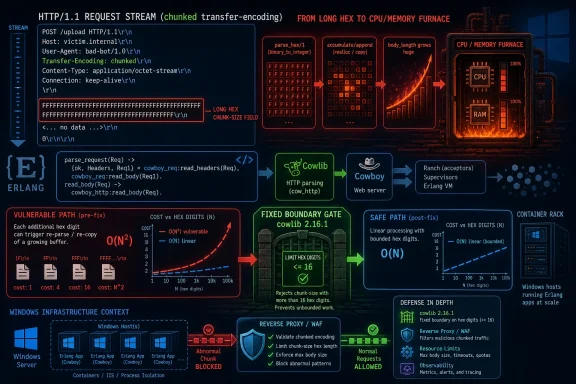
CVE-2026-7790 is a high-severity denial-of-service flaw published in May 2026 in ninenines cowlib, affecting versions from 0.6.0 before 2.16.1, where oversized HTTP chunk-size fields can force excessive CPU and memory use in exposed Erlang-based services. The bug is not a Windows vulnerability in the traditional Patch Tuesday sense, even though it appears in Microsoft’s Security Update Guide. That distinction matters, because the operational burden falls less on Windows Update and more on software inventory, dependency management, and the boring work of finding where a small library sits inside larger systems. The real lesson is that modern infrastructure can still be knocked sideways by a parser doing exactly what it was coded to do, only for far too long.
The Microsoft Security Response Center entry gives CVE-2026-7790 the unmistakable gravity of a Microsoft-tracked vulnerability, but the affected component is cowlib, an Erlang library associated with HTTP handling in the Cowboy ecosystem. That makes this a supply-chain advisory rather than a conventional Windows servicing event. Administrators looking for a cumulative update that magically resolves the issue on every server are likely to be disappointed.
This is the kind of vulnerability that blurs the boundary between “Microsoft security news” and “open-source dependency hygiene.” Microsoft tracks many third-party and ecosystem issues because Windows estates are full of software that speaks HTTP, ships bundled runtimes, or runs services developers installed years ago and then forgot. The operating system may host the workload, but the vulnerable code may live several abstraction layers above it.
That is why the disclaimer text attached to the advisory feels both routine and oddly fitting. The legal boilerplate says the information is provided as-is, but the practical version is harsher: the vendor can tell you a component is vulnerable, but it cannot know every place you embedded it. In 2026, that is the uncomfortable center of enterprise patching.
The headline also tempts overreaction. This is not a remote code execution bug, not a privilege escalation, and not a wormable Windows service flaw. But treating denial of service as “just availability” is a luxury few production teams still have, especially when web-facing systems, authentication gateways, APIs, telemetry collectors, and internal control planes are expected to remain reachable under hostile internet conditions.
The vulnerable behavior is that the parser accepted an unbounded number of hexadecimal digits in that chunk-size field. Each new digit required the parser to update an accumulated length value using the familiar base-16 calculation: multiply the current length by 16, then add the next digit. That sounds harmless until the attacker stops behaving like a protocol peer and starts behaving like an algorithmic stress test.
As the number grows, the internal integer can become large enough that each multiplication is no longer a tiny constant-time operation. The advisory describes the result as O(N²) CPU work and O(N) memory for N hex digits. In plainer terms, doubling the number of malicious digits can more than double the amount of work the server has to do.
There is a further twist in the drip-fed case. If the attacker sends the input slowly and the parser restarts length processing after partial reads, the cost can rise even further, reportedly to O(N³). That is the kind of asymmetry denial-of-service attackers love: a client spends little bandwidth and little effort, while the server burns compute recovering the same ground again and again.
This is not a buffer overflow in the old cinematic sense. There is no need to smash a stack frame or hijack an instruction pointer. The parser remains inside the rules of its own implementation, but the rules allow an adversary to turn a text field into a CPU furnace.
For many WindowsForum readers, the obvious question is whether this matters in a Windows environment. The answer is yes, but indirectly. A Windows Server box running IIS is not automatically affected because cowlib exists somewhere in the open-source world. A Windows-hosted application, bundled service, developer tool, appliance management stack, or containerized workload that includes a vulnerable cowlib version may be.
That indirectness is exactly what makes these advisories operationally annoying. Traditional patch management is built around product names and KB numbers. Dependency vulnerabilities are built around package names, transitive imports, and build artifacts. One model asks, “Did we install the May update?” The other asks, “Which of our deployed services include this library, and which code path exposes it to untrusted traffic?”
The second question is harder, but it is now the more common one. Modern applications are rarely a single vendor binary sitting neatly in Program Files. They are build pipelines, package managers, containers, private forks, language runtimes, and framework defaults. A small parser bug in an Erlang library can become an availability risk for a Windows shop if that shop runs the affected software on Windows, in WSL, in containers, or behind Windows-managed infrastructure.
This is why software bills of materials, dependency scanners, and runtime inventory keep returning in security conversations despite the eye-rolling they sometimes provoke. Nobody enjoys turning vulnerability management into library archaeology. But when the vulnerable unit is a module inside a package inside an application, archaeology is the job.
The fixed version is cowlib 2.16.1. The affected range is broad, beginning with 0.6.0 and extending to versions before 2.16.1. That span matters because cowlib is mature enough to have accumulated years of use in systems that may not be aggressively maintained.
The advisory also notes a mitigation for Cowboy deployments: reducing
This is a classic case where the patch is smaller than the deployment problem. Updating one dependency in source control may take minutes. Proving that every production instance, container image, release branch, customer appliance, and internal tool has moved to the safe version can take days or weeks.
That gap is where incidents happen. Attackers do not need your mainline branch to be vulnerable if an old service is still exposed through a forgotten port or a legacy API endpoint. Security teams should assume the interesting question is not whether developers know how to update cowlib, but whether the organization can find every place cowlib is actually running.
CVE-2026-7790 is a useful corrective because it shows how denial of service has evolved from crude packet floods into protocol-aware resource exhaustion. An attacker may not need massive bandwidth if the target’s parser magnifies a small request into expensive computation. That changes the economics of disruption.
For public services, availability is often part of security. An authentication endpoint that can be exhausted may block legitimate users. An API gateway under parser pressure may degrade dependent applications. An internal service that becomes unreachable during an incident can slow response, recovery, and monitoring just when reliability matters most.
For Windows administrators, this matters even when the vulnerable component is not shipped by Microsoft. Windows environments increasingly run cross-platform services, developer platforms, observability stacks, and third-party appliances. If those services are internet-facing or reachable from semi-trusted networks, availability flaws become part of the Windows operations story.
The practical response is to stop treating DoS-only CVEs as automatically low priority. Severity should be tied to exposure and role. A vulnerable library buried in a lab-only tool is one thing. The same library in a front-door API service is another.
CVE-2026-7790 belongs to that world. The attacker does not need credentials. The advisory describes an unauthenticated remote attacker sending an HTTP/1.1 request with chunked transfer encoding and a very long hex string. The vulnerable system does the rest.
That should make engineers wary of assuming that standards compliance is automatically safe. A protocol may allow a broad range of syntactically valid inputs, but production implementations need sane operational boundaries. “Valid” and “reasonable” are not synonyms.
The fix’s digit cap embodies that principle. No legitimate service needs an infinitely long hexadecimal chunk-size field. Even very large chunks can be represented with a modest number of hex digits. Accepting endless digits is not generosity; it is an attack surface.
This is one reason mature network-facing software increasingly includes explicit limits everywhere: header sizes, body sizes, field counts, nesting depth, frame sizes, decompression ratios, request duration, and read rates. These are not mere tuning knobs. They are security controls.
Slow-client attacks have a long history. The basic strategy is to hold server resources open while sending data at a pace that is technically active but operationally abusive. CVE-2026-7790 adds a computational angle: partial reads can cause repeated work if state is not preserved efficiently.
This distinction matters for defenses. A reverse proxy or load balancer that buffers requests may change exploitability. A server with strict read timeouts and body limits may reduce the attack window. A service directly exposed to the internet with permissive timeouts may be far more attractive.
Administrators should therefore resist the urge to classify the issue only by package version. Version tells you whether the vulnerable code exists. Network architecture tells you whether an attacker can reach it in a useful way. Runtime limits tell you how much damage one connection can inflict before being cut off.
That is also why patching and configuration should move together. Updating cowlib is the durable fix. Reviewing request limits, timeout behavior, and proxy buffering is how teams reduce their odds of being punished by the next parser bug.
That work starts with inventory. Look for applications built with Erlang or Elixir, services using Cowboy, and packages that depend on cowlib. Check container images as well as traditional server installs. Developers may have deployed services through CI/CD systems that bypass the older asset lists security teams still rely on.
The next step is exposure mapping. A vulnerable internal service reachable only from a restricted management VLAN is not the same risk as a public API endpoint accepting arbitrary HTTP requests from the internet. But internal does not mean safe, especially in environments where compromised workstations, VPN users, build agents, or partner integrations can reach application ports.
Then comes upgrade verification. It is not enough for a dependency manifest to say the fixed version is allowed. The deployed artifact must actually contain cowlib 2.16.1 or later. In containerized environments, that means rebuilding and redeploying images, not just changing a lockfile.
Finally, teams should look at traffic controls. Web application firewalls, reverse proxies, and load balancers may be able to enforce maximum header and body parsing limits, request duration limits, and abnormal chunked-transfer rejection policies. These controls should be tested carefully because HTTP behavior varies across clients and middleware, but the goal is straightforward: do not let arbitrary clients feed unbounded protocol fields into application parsers.
For defenders, each stop on that route adds visibility but also ambiguity. A Microsoft listing may imply relevance to Microsoft customers without implying Microsoft ownership of the code. A CVSS score may communicate severity without communicating whether your specific deployment is exposed. A feed headline may compress nuance into urgency.
This is not a complaint about over-reporting. Visibility is good. The alternative is worse. But administrators need to read these advisories like routing slips, not verdicts. The question is always, “Where does this vulnerability enter my environment?”
That habit is especially important for Windows-heavy shops that also run open-source stacks. The old mental split between “Microsoft patching” and “Linux/open-source patching” no longer maps cleanly onto reality. A Windows server may host a container built from a Linux base image. A developer workstation may run an Erlang service under WSL. A commercial Windows product may embed open-source components its customers never see.
CVE-2026-7790 does not require panic. It does require translation. The advisory tells you what is vulnerable; your inventory tells you whether that matters.
The organizations most troubled will be the ones where application ownership is unclear. A service created for a project two years ago may still be running. A vendor appliance may include a vulnerable component but expose no easy package inventory. A container image may have been forked, modified, and forgotten.
This is where vulnerability management becomes organizational rather than technical. Someone must own the service. Someone must own the runtime. Someone must own the upgrade path. Without that, even a small parser fix can stall.
There is also a developer education angle. The flaw is a reminder that input limits belong at the lowest reasonable layer. Application developers should not assume that protocol libraries will always reject pathological inputs on their behalf. Library maintainers should not assume that callers will wrap every parser with perfect limits.
The safer pattern is defense in depth. The library caps unreasonable fields. The application caps body sizes. The proxy caps request duration. The platform caps resource usage. No single layer has to be perfect if each layer refuses to be infinite.
 Microsoft’s Listing Makes This Look Bigger Than Windows
The Microsoft Security Response Center entry gives CVE-2026-7790 the unmistakable gravity of a Microsoft-tracked vulnerability, but the affected component is cowlib, an Erlang library associated with HTTP handling in the Cowboy ecosystem. That makes this a supply-chain advisory rather than a conventional Windows servicing event. Administrators looking for a cumulative update that magically resolves the issue on every server are likely to be disappointed.This is the kind of vulnerability that blurs the boundary between “Microsoft security news” and “open-source dependency hygiene.” Microsoft tracks many third-party and ecosystem issues because Windows estates are full of software that speaks HTTP, ships bundled runtimes, or runs services developers installed years ago and then forgot. The operating system may host the workload, but the vulnerable code may live several abstraction layers above it.
That is why the disclaimer text attached to the advisory feels both routine and oddly fitting. The legal boilerplate says the information is provided as-is, but the practical version is harsher: the vendor can tell you a component is vulnerable, but it cannot know every place you embedded it. In 2026, that is the uncomfortable center of enterprise patching.
The headline also tempts overreaction. This is not a remote code execution bug, not a privilege escalation, and not a wormable Windows service flaw. But treating denial of service as “just availability” is a luxury few production teams still have, especially when web-facing systems, authentication gateways, APIs, telemetry collectors, and internal control planes are expected to remain reachable under hostile internet conditions.
The Bug Is Small, but the Math Is Ugly
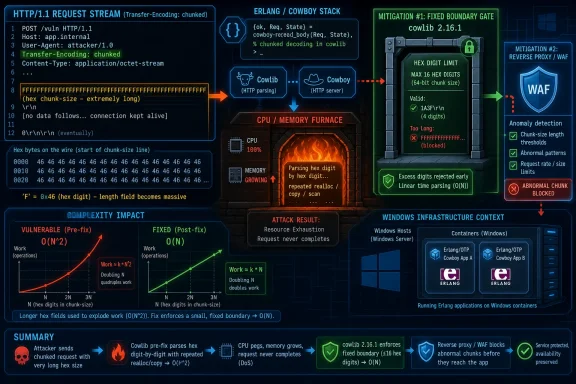
At the heart of CVE-2026-7790 is the chunked transfer-encoding parser in cowlib’scow_http_te module. HTTP/1.1 chunked transfer encoding allows a sender to stream a message body in chunks, each preceded by a chunk-size field written in hexadecimal. A normal parser reads the size, consumes that much data, and continues until it reaches the terminating chunk.The vulnerable behavior is that the parser accepted an unbounded number of hexadecimal digits in that chunk-size field. Each new digit required the parser to update an accumulated length value using the familiar base-16 calculation: multiply the current length by 16, then add the next digit. That sounds harmless until the attacker stops behaving like a protocol peer and starts behaving like an algorithmic stress test.
As the number grows, the internal integer can become large enough that each multiplication is no longer a tiny constant-time operation. The advisory describes the result as O(N²) CPU work and O(N) memory for N hex digits. In plainer terms, doubling the number of malicious digits can more than double the amount of work the server has to do.
There is a further twist in the drip-fed case. If the attacker sends the input slowly and the parser restarts length processing after partial reads, the cost can rise even further, reportedly to O(N³). That is the kind of asymmetry denial-of-service attackers love: a client spends little bandwidth and little effort, while the server burns compute recovering the same ground again and again.
This is not a buffer overflow in the old cinematic sense. There is no need to smash a stack frame or hijack an instruction pointer. The parser remains inside the rules of its own implementation, but the rules allow an adversary to turn a text field into a CPU furnace.
HTTP’s Old Corners Still Define Today’s Risk
Chunked transfer encoding is not exotic. It is part of ordinary HTTP/1.1 behavior and remains widely encountered behind load balancers, reverse proxies, application servers, and service meshes. The fact that the exploit path starts withTransfer-Encoding: chunked should make defenders think less about niche Erlang deployments and more about where protocol parsing actually happens in their estate.For many WindowsForum readers, the obvious question is whether this matters in a Windows environment. The answer is yes, but indirectly. A Windows Server box running IIS is not automatically affected because cowlib exists somewhere in the open-source world. A Windows-hosted application, bundled service, developer tool, appliance management stack, or containerized workload that includes a vulnerable cowlib version may be.
That indirectness is exactly what makes these advisories operationally annoying. Traditional patch management is built around product names and KB numbers. Dependency vulnerabilities are built around package names, transitive imports, and build artifacts. One model asks, “Did we install the May update?” The other asks, “Which of our deployed services include this library, and which code path exposes it to untrusted traffic?”
The second question is harder, but it is now the more common one. Modern applications are rarely a single vendor binary sitting neatly in Program Files. They are build pipelines, package managers, containers, private forks, language runtimes, and framework defaults. A small parser bug in an Erlang library can become an availability risk for a Windows shop if that shop runs the affected software on Windows, in WSL, in containers, or behind Windows-managed infrastructure.
This is why software bills of materials, dependency scanners, and runtime inventory keep returning in security conversations despite the eye-rolling they sometimes provoke. Nobody enjoys turning vulnerability management into library archaeology. But when the vulnerable unit is a module inside a package inside an application, archaeology is the job.
The Fix Is a Boundary, Not a Miracle
The upstream cowlib fix is conceptually simple: limit the length of chunk-size digits. The patch changes the parsing path so that only a bounded number of hexadecimal characters are accepted before the parser stops treating the input as a valid chunk length. That is not a flashy cryptographic redesign or a sprawling refactor; it is the old security engineering virtue of drawing a line.The fixed version is cowlib 2.16.1. The affected range is broad, beginning with 0.6.0 and extending to versions before 2.16.1. That span matters because cowlib is mature enough to have accumulated years of use in systems that may not be aggressively maintained.
The advisory also notes a mitigation for Cowboy deployments: reducing
initial_stream_flow_size can limit the amount of chunked body data parsed in a single read. That may reduce impact in some configurations, but it is not the same as eliminating the vulnerable parser behavior. Mitigations that lower the ceiling are useful while teams chase upgrades; they should not become permanent substitutes for taking the fixed library.This is a classic case where the patch is smaller than the deployment problem. Updating one dependency in source control may take minutes. Proving that every production instance, container image, release branch, customer appliance, and internal tool has moved to the safe version can take days or weeks.
That gap is where incidents happen. Attackers do not need your mainline branch to be vulnerable if an old service is still exposed through a forgotten port or a legacy API endpoint. Security teams should assume the interesting question is not whether developers know how to update cowlib, but whether the organization can find every place cowlib is actually running.
Availability Bugs Deserve More Respect
The security industry still tends to rank vulnerabilities emotionally. Remote code execution gets panic. Privilege escalation gets urgency. Information disclosure gets legal anxiety. Denial of service gets a shrug, at least until the affected service is the one customers, employees, or automated systems need right now.CVE-2026-7790 is a useful corrective because it shows how denial of service has evolved from crude packet floods into protocol-aware resource exhaustion. An attacker may not need massive bandwidth if the target’s parser magnifies a small request into expensive computation. That changes the economics of disruption.
For public services, availability is often part of security. An authentication endpoint that can be exhausted may block legitimate users. An API gateway under parser pressure may degrade dependent applications. An internal service that becomes unreachable during an incident can slow response, recovery, and monitoring just when reliability matters most.
For Windows administrators, this matters even when the vulnerable component is not shipped by Microsoft. Windows environments increasingly run cross-platform services, developer platforms, observability stacks, and third-party appliances. If those services are internet-facing or reachable from semi-trusted networks, availability flaws become part of the Windows operations story.
The practical response is to stop treating DoS-only CVEs as automatically low priority. Severity should be tied to exposure and role. A vulnerable library buried in a lab-only tool is one thing. The same library in a front-door API service is another.
The Parser Is the Perimeter Now
Security teams used to draw the perimeter at the firewall. Then they drew it at identity. Now, in many production systems, the perimeter is also a parser: HTTP parsers, JSON parsers, TLS parsers, compression parsers, image parsers, archive parsers, and every little state machine that turns untrusted bytes into structured meaning.CVE-2026-7790 belongs to that world. The attacker does not need credentials. The advisory describes an unauthenticated remote attacker sending an HTTP/1.1 request with chunked transfer encoding and a very long hex string. The vulnerable system does the rest.
That should make engineers wary of assuming that standards compliance is automatically safe. A protocol may allow a broad range of syntactically valid inputs, but production implementations need sane operational boundaries. “Valid” and “reasonable” are not synonyms.
The fix’s digit cap embodies that principle. No legitimate service needs an infinitely long hexadecimal chunk-size field. Even very large chunks can be represented with a modest number of hex digits. Accepting endless digits is not generosity; it is an attack surface.
This is one reason mature network-facing software increasingly includes explicit limits everywhere: header sizes, body sizes, field counts, nesting depth, frame sizes, decompression ratios, request duration, and read rates. These are not mere tuning knobs. They are security controls.
Slow Inputs Turn Efficiency Bugs Into Weapons
The drip-fed input behavior is the most interesting part of the advisory because it links algorithmic complexity to transport behavior. A parser that is tolerable when it receives a complete buffer may become pathological when the same data arrives in fragments. That is a reminder that network code is not just parsing strings; it is parsing strings over time.Slow-client attacks have a long history. The basic strategy is to hold server resources open while sending data at a pace that is technically active but operationally abusive. CVE-2026-7790 adds a computational angle: partial reads can cause repeated work if state is not preserved efficiently.
This distinction matters for defenses. A reverse proxy or load balancer that buffers requests may change exploitability. A server with strict read timeouts and body limits may reduce the attack window. A service directly exposed to the internet with permissive timeouts may be far more attractive.
Administrators should therefore resist the urge to classify the issue only by package version. Version tells you whether the vulnerable code exists. Network architecture tells you whether an attacker can reach it in a useful way. Runtime limits tell you how much damage one connection can inflict before being cut off.
That is also why patching and configuration should move together. Updating cowlib is the durable fix. Reviewing request limits, timeout behavior, and proxy buffering is how teams reduce their odds of being punished by the next parser bug.
The Windows Angle Is Dependency Exposure, Not Windows Update
The presence of this CVE in Microsoft’s ecosystem can easily be misread as a Windows flaw. It is better understood as a Windows estate problem. If your organization runs affected Erlang/Cowboy software on Windows, or operates Windows-managed infrastructure that fronts such software, you have work to do.That work starts with inventory. Look for applications built with Erlang or Elixir, services using Cowboy, and packages that depend on cowlib. Check container images as well as traditional server installs. Developers may have deployed services through CI/CD systems that bypass the older asset lists security teams still rely on.
The next step is exposure mapping. A vulnerable internal service reachable only from a restricted management VLAN is not the same risk as a public API endpoint accepting arbitrary HTTP requests from the internet. But internal does not mean safe, especially in environments where compromised workstations, VPN users, build agents, or partner integrations can reach application ports.
Then comes upgrade verification. It is not enough for a dependency manifest to say the fixed version is allowed. The deployed artifact must actually contain cowlib 2.16.1 or later. In containerized environments, that means rebuilding and redeploying images, not just changing a lockfile.
Finally, teams should look at traffic controls. Web application firewalls, reverse proxies, and load balancers may be able to enforce maximum header and body parsing limits, request duration limits, and abnormal chunked-transfer rejection policies. These controls should be tested carefully because HTTP behavior varies across clients and middleware, but the goal is straightforward: do not let arbitrary clients feed unbounded protocol fields into application parsers.
Vendor Advisories Are Now Routing Slips
One reason CVE-2026-7790 is worth writing about is that it shows how vulnerability information travels now. The original technical issue sits in an open-source library. The CVE is handled through an ecosystem CNA. NVD records it. OSV tracks it. Microsoft’s Security Update Guide surfaces it. Security feeds pick it up and repackage it.For defenders, each stop on that route adds visibility but also ambiguity. A Microsoft listing may imply relevance to Microsoft customers without implying Microsoft ownership of the code. A CVSS score may communicate severity without communicating whether your specific deployment is exposed. A feed headline may compress nuance into urgency.
This is not a complaint about over-reporting. Visibility is good. The alternative is worse. But administrators need to read these advisories like routing slips, not verdicts. The question is always, “Where does this vulnerability enter my environment?”
That habit is especially important for Windows-heavy shops that also run open-source stacks. The old mental split between “Microsoft patching” and “Linux/open-source patching” no longer maps cleanly onto reality. A Windows server may host a container built from a Linux base image. A developer workstation may run an Erlang service under WSL. A commercial Windows product may embed open-source components its customers never see.
CVE-2026-7790 does not require panic. It does require translation. The advisory tells you what is vulnerable; your inventory tells you whether that matters.
The Fix Window Belongs to the Teams That Can Find Their Code
The organizations least troubled by this flaw will not necessarily be the ones with the biggest security budgets. They will be the ones with the best dependency visibility. If a team can quickly answer which services use cowlib, which versions are deployed, and which endpoints are exposed, this becomes a contained maintenance task.The organizations most troubled will be the ones where application ownership is unclear. A service created for a project two years ago may still be running. A vendor appliance may include a vulnerable component but expose no easy package inventory. A container image may have been forked, modified, and forgotten.
This is where vulnerability management becomes organizational rather than technical. Someone must own the service. Someone must own the runtime. Someone must own the upgrade path. Without that, even a small parser fix can stall.
There is also a developer education angle. The flaw is a reminder that input limits belong at the lowest reasonable layer. Application developers should not assume that protocol libraries will always reject pathological inputs on their behalf. Library maintainers should not assume that callers will wrap every parser with perfect limits.
The safer pattern is defense in depth. The library caps unreasonable fields. The application caps body sizes. The proxy caps request duration. The platform caps resource usage. No single layer has to be perfect if each layer refuses to be infinite.
The Concrete Work Starts Before the Scanner Turns Red
CVE-2026-7790 is easy to summarize and harder to operationalize. Its blast radius depends on how cowlib is used, whether chunked HTTP requests reach the affected parser, and how quickly organizations can move to the fixed release. The following points are the practical core for WindowsForum readers tracking this advisory:- Services using cowlib versions from 0.6.0 before 2.16.1 should be treated as potentially vulnerable until the deployed artifact is verified, not merely the source repository.
- Publicly reachable HTTP/1.1 endpoints deserve priority because the described attack requires no authentication and can be attempted remotely with crafted chunked requests.
- Cowboy deployments may reduce exposure by lowering
initial_stream_flow_size, but that mitigation should be viewed as temporary risk reduction rather than a replacement for upgrading. - Reverse proxies, load balancers, and WAFs should be reviewed for request-size, read-timeout, and abnormal chunked-transfer handling because network controls can limit parser abuse.
- Windows administrators should search beyond Windows Update and KB status, since the vulnerable component is an application dependency that may live inside containers, developer services, third-party products, or self-hosted tools.
- Denial-of-service vulnerabilities should be prioritized according to service role and exposure, not dismissed simply because they do not grant code execution.
References
- Primary source: MSRC
Published: 2026-05-26T01:38:25-07:00
Security Update Guide - Microsoft Security Response Center
 msrc.microsoft.com
- Related coverage: sentinelone.com
CVE-2026-41952: Acronis Privilege Escalation Vulnerability
CVE-2026-41952 is a privilege escalation vulnerability in Acronis products. Learn about its impact, affected versions, and mitigation methods.www.sentinelone.com