

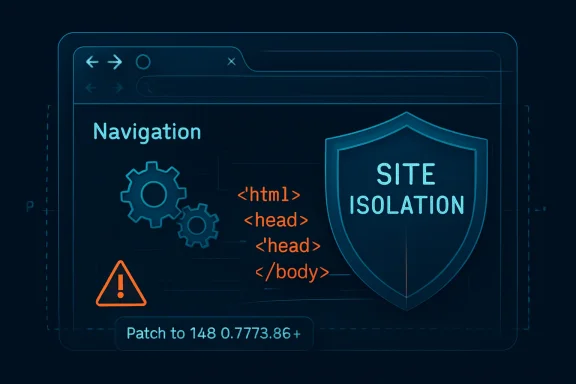
Google and Microsoft disclosed CVE-2026-7959 on May 6, 2026, after Chrome 148 reached the stable desktop channel, fixing a medium-severity Chromium Navigation flaw that could let an attacker who had already compromised Chrome’s renderer bypass site isolation with a crafted HTML page. That wording sounds almost deliberately underwhelming: a bypass after a compromise, a medium rating, a low CVSS score, and no public exploit claim. But for Windows admins, the interesting part is not the score. It is the way this bug sits exactly where modern browser security now lives: in the seams between the renderer, navigation, sandboxing, and the promise that one bad page should not become a bridge to everything else.
CVE-2026-7959 is not the kind of vulnerability that usually gets mainstream attention. It is not described as remote code execution on its own, not marked critical by Chromium, and not listed by the National Vulnerability Database with a finished NIST CVSS assessment at the time of publication. CISA’s enrichment gives it a CVSS 3.1 score of 3.1, which is technically “low,” because exploitation requires user interaction, high attack complexity, and a renderer process that is already compromised.
That last condition is the trap. “Already compromised renderer” can make a bug sound like a footnote, because the attacker has supposedly won the hard part. In Chromium’s security model, though, renderer compromise is not supposed to be the end of the story. It is supposed to be a contained failure.
Modern Chrome and Microsoft Edge are built around the assumption that hostile web content will eventually find a way to execute inside a renderer. The browser’s job is to make that a cramped prison, not a beachhead. Site isolation is one of the key walls in that prison, and a vulnerability that lets an attacker bypass it is therefore less boring than its isolated score suggests.
This is why CVE-2026-7959 deserves attention from IT teams even if it does not deserve panic. It is a reminder that browser security is no longer just about blocking the first exploit. It is about preserving the layered collapse sequence so that one failure does not drag the rest of the browser with it.
The broader Chrome 148 update is large. Reporting around the release described more than 100 security fixes, including several critical vulnerabilities elsewhere in the browser stack. In that crowd, CVE-2026-7959 can look like a supporting actor rather than the headline.
But that is precisely why it is worth isolating. The browser vulnerability stories that dominate dashboards are usually memory corruption bugs in V8, Blink, WebRTC, GPU handling, or media components. CVE-2026-7959 instead lands in Navigation, the machinery responsible for deciding what a page is, where it is going, which process should host it, and what security boundaries should apply along the way.
Navigation bugs are uncomfortable because they often live in logic rather than raw memory safety. They are failures of state, timing, policy, or identity. A browser can have a sandbox, site isolation, same-origin checks, and process boundaries, but the navigation system still has to connect those mechanisms to a messy web where pages redirect, open popups, embed frames, trigger downloads, bounce through authentication flows, and mutate their own histories.
That makes Navigation a deceptively sensitive component. It is not glamorous, but it is where many of the browser’s promises are translated into decisions.
For ordinary users, site isolation is invisible. For attackers, it is an obstacle. For administrators, it is one of the reasons a managed desktop fleet can tolerate the fact that users spend half their workday inside a general-purpose code execution engine pointed at the public internet.
CVE-2026-7959 matters because it is described as allowing a site isolation bypass after renderer compromise. That means the bug is not the initial pry bar; it is a potential passage through a wall that should still hold after the pry bar has been used. The distinction matters for risk scoring, but it should not trick defenders into dismissing the issue outright.
Browser exploit chains are built in stages. A renderer bug might get code running in the wrong place. A sandbox escape might move that code closer to the operating system. A site isolation bypass can help an attacker reach data or contexts that should have remained outside the compromised renderer’s line of sight.
That does not make every such bug catastrophic. It does make these vulnerabilities strategically important. In the architecture of a modern browser, containment is not a bonus feature; it is the thing that keeps routine web bugs from becoming enterprise incidents.
That score is defensible. CVSS is not supposed to measure vibes, and it is not supposed to reward hypothetical exploit chains without evidence. If a vulnerability requires a renderer compromise first, then the individual bug is not equivalent to a one-click remote code execution flaw.
The problem is that operational risk rarely arrives as a single CVE in a vacuum. Browser attackers do not need every step in a chain to be critical. They need compatible steps, and the steps that preserve access, defeat compartmentalization, or reveal cross-site data can be valuable precisely because they come after the flashier first-stage exploit.
This is where patch prioritization becomes an art rather than a spreadsheet exercise. A low-scored browser isolation bug in a major stable-channel update should not outrank an exploited kernel zero-day. But it also should not sit untouched because a scanner prints “low” in green. In browser security, context is a multiplier.
There is also the issue of timing. Google’s bug details are restricted, the Chromium issue requires permission, and NVD enrichment was still incomplete when the entry appeared. That leaves defenders making decisions on partial information, which is the normal state of browser patching. The absence of a public proof of concept is good news, but it is not a reason to run old browser builds.
This is one of the underrated consequences of the Chromium monoculture. The web platform benefits from shared engineering, rapid fixes, and a huge amount of security investment concentrated in one codebase. Enterprises benefit because Chrome and Edge behave similarly enough that policy, testing, and web compatibility are easier than they were in the old browser wars.
But the security downside is equally obvious. When Chromium ships a navigation or rendering bug, the blast radius crosses vendor logos. Chrome, Edge, Brave, Opera, Vivaldi, and other Chromium-derived browsers may need attention, even if the disclosure that crosses an admin’s desk starts with Google.
For Windows shops, Edge deserves special handling because it is both a user-facing browser and a Windows-adjacent platform component. It is installed broadly, updated through Microsoft’s channels, and often trusted by enterprises that block or discourage third-party browsers. That trust should not become complacency. Edge’s Chromium foundation means browser vulnerability management has to follow Chromium’s tempo, not just Windows Patch Tuesday.
This is why MSRC entries for Chromium CVEs can feel strange. They are not traditional Windows vulnerabilities, but they are Windows fleet vulnerabilities in every practical sense. If the browser is present, reachable, and allowed to render arbitrary web content, it belongs in the same operational conversation as the rest of the endpoint attack surface.
The renderer is where web content lives. It parses HTML, runs JavaScript, lays out pages, handles complex media, and interacts with enormous APIs. Browser vendors have spent years trying to make renderer compromise survivable because they know the renderer is exposed to the most hostile input on the average PC.
So when a vulnerability assumes renderer compromise, defenders should read it as “this bug may be useful in combination with another browser bug,” not “this bug is irrelevant.” Exploit chains are modular. A memory corruption flaw might get the attacker into a renderer, and a logic bug in navigation or isolation might let the attacker reach data that the renderer should not be able to see.
That does not mean CVE-2026-7959 is known to be chained in the wild. There is no need to inflate it into a zero-day story without evidence. But it does mean that the prerequisite is aligned with how real browser exploitation works. It is a second act, not a non sequitur.
The right enterprise posture is therefore boring but firm: treat this as part of the Chrome 148 security baseline. Do not build an emergency war room around CVE-2026-7959 alone, but do not let “medium” or “low” become an excuse for slow browser hygiene.
A crafted HTML page can exploit that complexity without looking like malware in the old sense. It may not need a binary payload at first. It may instead manipulate frame relationships, redirects, window openings, or document transitions in ways that produce an inconsistent security state.
That is why “inappropriate implementation in Navigation” is both vague and suggestive. It tells us little about the exact bug, but it points toward a class of problems where the browser made the wrong decision about what should be allowed during or after a navigation event. In a browser with site isolation, that wrong decision can matter.
These bugs are hard to discuss publicly because the details often double as exploitation guidance. Google’s restriction of the Chromium issue is therefore expected. The trade-off is that administrators have to make do with sparse language and version numbers.
That sparse language should push teams toward process rather than speculation. The correct question is not whether every admin can understand the exploit primitive. The correct question is whether the organization can identify affected browsers, push fixed versions, and verify uptake quickly enough that browser advisories do not become lingering exposure.
That matters because many security programs still lean heavily on CPE matching. Asset inventories, scanners, dashboards, and compliance workflows often reduce real software state to structured product identifiers. When those identifiers lag or model reality imperfectly, the dashboard can lie by omission.
Chromium makes this especially awkward. The vulnerability may be born in Chromium, fixed in Chrome, tracked by Microsoft for Edge, packaged differently on Linux distributions, and consumed through embedded browser components or downstream Chromium-based products. A CPE for Google Chrome is necessary, but it is not sufficient for understanding exposure across an enterprise.
Ubuntu’s treatment of the issue illustrates another wrinkle. Its Chromium package status can show “not affected” for supported releases because Ubuntu’s chromium-browser package is effectively a path to the Chromium snap rather than a traditional distro-maintained browser package. That is correct in Ubuntu’s packaging context, but it is not the same as saying Chromium code everywhere is irrelevant.
The lesson is blunt: vulnerability metadata is a starting point, not an inventory. If your organization discovers browser exposure only through CPE matching, you are already depending on someone else’s model of your environment. For browsers, the better source of truth is actual installed version telemetry.
Consumer Chrome updates are easy to talk about because the browser mostly updates itself. Enterprise Chrome and Edge are more complicated. Update policies, relaunch deferrals, virtual desktop images, kiosk systems, application compatibility holdbacks, and change-control rituals can all stretch “rolls out over coming days” into a much longer exposure window.
That is particularly true in Windows environments where the browser is always open. A browser can download an update and still remain on the old vulnerable code path until the user relaunches it. The little “update available” indicator is not a patch deployment guarantee.
Admins should care less about whether the update package exists and more about whether the running browser process is actually new. Endpoint management tools can report installed versions, but they do not always tell you whether stale processes are still alive. In a world where the browser is the workspace, relaunch management is patch management.
This is one reason Microsoft Edge’s enterprise controls matter. Edge policies can govern update behavior, target channels, and relaunch notifications. Chrome has comparable enterprise policy surfaces. The uncomfortable part is organizational, not technical: someone has to be willing to interrupt browser sessions when the security case warrants it.
CVE-2026-7959 arrived in the context of a stable Chrome release, not a neat Windows monthly bundle. Edge can update independently of Windows. Chrome definitely does. Other Chromium browsers may lag according to their own maintainers’ schedules.
That means browser patching has to live in a faster operational lane. It does not need to be chaotic, but it cannot wait for the same cycle as printer drivers and cumulative OS updates. The browser is too exposed, too frequently exploited, and too central to daily work.
The best organizations already understand this. They treat browsers more like cloud clients than legacy desktop applications. They monitor versions continuously, tolerate rapid minor updates, maintain pilot rings for breakage detection, and escalate when a security release includes exploitable primitives.
The laggards tend to discover the problem during incident response. They learn that the browser was “managed,” but update deferrals were long, relaunches were optional, and half the fleet lived several builds behind. CVE-2026-7959 is not a disaster scenario by itself. It is an opportunity to check whether your browser update muscle actually works before a worse Chromium advisory tests it.
For home users, the answer is simple: update Chrome or Edge and restart the browser. For managed environments, the answer is to ensure the stable channel advances, verify that Edge and Chrome are not pinned behind the fixed baseline, and look for long-running sessions that have not relaunched. For security teams, it is to make sure vulnerability scanners do not miss Chromium-derived browsers simply because they are not named “Google Chrome.”
There is also a training point here. Users are frequently told not to click suspicious links, and that advice remains useful. But browser exploit mitigation cannot depend on perfect human behavior. CVE-2026-7959 requires user interaction in the technical sense, yet the web is built on user interaction. Visiting a page is not an exotic act.
That is why patching the browser remains one of the highest-yield defensive moves available to endpoint teams. It is mundane, measurable, and far more reliable than hoping every employee can distinguish a malicious redirect chain from a legitimate login flow.
Memory safety still matters enormously. Critical bugs in V8, Blink, and media components are not going away. But as browsers harden, attackers look for ways to combine primitives and confuse policy. A logic error in how a navigation is handled can be as valuable as a raw crash if it opens the right door at the right moment.
This is also why defenders should resist the urge to rank browser bugs purely by headline severity. A critical code execution bug may be contained if sandboxing and isolation hold. A medium bypass bug may become more valuable when paired with another flaw. The point is not that every medium bug is secretly critical. The point is that browser security is compositional.
Chromium’s security architecture assumes partial failure. That is its strength. CVE-2026-7959 is a patch for one of the mechanisms that keeps partial failure from becoming wider compromise. In enterprise terms, that makes it part of resilience, not just remediation.
What they can act on is the patch window. The difference between a fleet that reaches the fixed browser baseline in 24 to 72 hours and one that takes three weeks is not academic. Browser bugs have a long shelf life in environments where updates are delayed, relaunches are deferred, and unmanaged derivatives are invisible.
A good browser patch program has a few recognizable traits. It has live version inventory. It can distinguish Chrome, Edge, and other Chromium browsers. It has update rings but not update paralysis. It can force or strongly prompt relaunches when security releases require them. It can explain exceptions rather than merely accumulate them.
CVE-2026-7959 is a useful test case because it should not require heroics. If an organization cannot move quickly on a medium Chromium stable-channel fix, it probably will not move cleanly when the next exploited zero-day lands. The time to find that out is now, not during a Friday-night emergency.
The concrete moves are therefore clear:
Source: NVD / Chromium Security Update Guide - Microsoft Security Response Center
 The Medium Bug That Points at a High-Value Boundary
CVE-2026-7959 is not the kind of vulnerability that usually gets mainstream attention. It is not described as remote code execution on its own, not marked critical by Chromium, and not listed by the National Vulnerability Database with a finished NIST CVSS assessment at the time of publication. CISA’s enrichment gives it a CVSS 3.1 score of 3.1, which is technically “low,” because exploitation requires user interaction, high attack complexity, and a renderer process that is already compromised.That last condition is the trap. “Already compromised renderer” can make a bug sound like a footnote, because the attacker has supposedly won the hard part. In Chromium’s security model, though, renderer compromise is not supposed to be the end of the story. It is supposed to be a contained failure.
Modern Chrome and Microsoft Edge are built around the assumption that hostile web content will eventually find a way to execute inside a renderer. The browser’s job is to make that a cramped prison, not a beachhead. Site isolation is one of the key walls in that prison, and a vulnerability that lets an attacker bypass it is therefore less boring than its isolated score suggests.
This is why CVE-2026-7959 deserves attention from IT teams even if it does not deserve panic. It is a reminder that browser security is no longer just about blocking the first exploit. It is about preserving the layered collapse sequence so that one failure does not drag the rest of the browser with it.
Chrome 148 Arrived as a Security Release Wearing a Feature Release Jacket
Chrome 148’s stable desktop promotion landed for Windows, macOS, and Linux in early May 2026, with version 148.0.7778.96 for Linux and 148.0.7778.96/97 for Windows and macOS. Google’s initial release post followed the familiar Chrome cadence: a stable-channel announcement, a promise of rollout over days or weeks, and a note that security details would be updated shortly. That delay is not unusual. Google often withholds full bug detail until a large share of users has received the fix.The broader Chrome 148 update is large. Reporting around the release described more than 100 security fixes, including several critical vulnerabilities elsewhere in the browser stack. In that crowd, CVE-2026-7959 can look like a supporting actor rather than the headline.
But that is precisely why it is worth isolating. The browser vulnerability stories that dominate dashboards are usually memory corruption bugs in V8, Blink, WebRTC, GPU handling, or media components. CVE-2026-7959 instead lands in Navigation, the machinery responsible for deciding what a page is, where it is going, which process should host it, and what security boundaries should apply along the way.
Navigation bugs are uncomfortable because they often live in logic rather than raw memory safety. They are failures of state, timing, policy, or identity. A browser can have a sandbox, site isolation, same-origin checks, and process boundaries, but the navigation system still has to connect those mechanisms to a messy web where pages redirect, open popups, embed frames, trigger downloads, bounce through authentication flows, and mutate their own histories.
That makes Navigation a deceptively sensitive component. It is not glamorous, but it is where many of the browser’s promises are translated into decisions.
Site Isolation Is the Browser’s Blast Door, Not a Decorative Feature
Site isolation was one of Chromium’s biggest architectural answers to the post-Spectre world. The basic idea is simple enough: content from different sites should be separated into different renderer processes so that a compromised renderer cannot freely inspect or interfere with pages from unrelated origins. In practice, it is an enormous engineering bargain, trading memory and process complexity for a stronger security boundary.For ordinary users, site isolation is invisible. For attackers, it is an obstacle. For administrators, it is one of the reasons a managed desktop fleet can tolerate the fact that users spend half their workday inside a general-purpose code execution engine pointed at the public internet.
CVE-2026-7959 matters because it is described as allowing a site isolation bypass after renderer compromise. That means the bug is not the initial pry bar; it is a potential passage through a wall that should still hold after the pry bar has been used. The distinction matters for risk scoring, but it should not trick defenders into dismissing the issue outright.
Browser exploit chains are built in stages. A renderer bug might get code running in the wrong place. A sandbox escape might move that code closer to the operating system. A site isolation bypass can help an attacker reach data or contexts that should have remained outside the compromised renderer’s line of sight.
That does not make every such bug catastrophic. It does make these vulnerabilities strategically important. In the architecture of a modern browser, containment is not a bonus feature; it is the thing that keeps routine web bugs from becoming enterprise incidents.
The CVSS Score Tells the Truth, But Not the Whole Truth
The CISA-ADP vector for CVE-2026-7959 marks the attack vector as network, attack complexity as high, privileges required as none, user interaction as required, scope unchanged, confidentiality impact low, and no integrity or availability impact. That is how we arrive at a low 3.1 base score. On paper, this is a narrow confidentiality issue under difficult exploitation conditions.That score is defensible. CVSS is not supposed to measure vibes, and it is not supposed to reward hypothetical exploit chains without evidence. If a vulnerability requires a renderer compromise first, then the individual bug is not equivalent to a one-click remote code execution flaw.
The problem is that operational risk rarely arrives as a single CVE in a vacuum. Browser attackers do not need every step in a chain to be critical. They need compatible steps, and the steps that preserve access, defeat compartmentalization, or reveal cross-site data can be valuable precisely because they come after the flashier first-stage exploit.
This is where patch prioritization becomes an art rather than a spreadsheet exercise. A low-scored browser isolation bug in a major stable-channel update should not outrank an exploited kernel zero-day. But it also should not sit untouched because a scanner prints “low” in green. In browser security, context is a multiplier.
There is also the issue of timing. Google’s bug details are restricted, the Chromium issue requires permission, and NVD enrichment was still incomplete when the entry appeared. That leaves defenders making decisions on partial information, which is the normal state of browser patching. The absence of a public proof of concept is good news, but it is not a reason to run old browser builds.
Microsoft Edge Inherits the Chrome Problem, and That Is by Design
The Microsoft angle is straightforward: Microsoft Edge is Chromium-based, and Microsoft tracks Chromium vulnerabilities through the MSRC Update Guide when they affect Edge. CVE-2026-7959 appears there because Edge inherits much of the same engine-level exposure, even when Microsoft’s browser ships through a different update mechanism and on a different enterprise management surface.This is one of the underrated consequences of the Chromium monoculture. The web platform benefits from shared engineering, rapid fixes, and a huge amount of security investment concentrated in one codebase. Enterprises benefit because Chrome and Edge behave similarly enough that policy, testing, and web compatibility are easier than they were in the old browser wars.
But the security downside is equally obvious. When Chromium ships a navigation or rendering bug, the blast radius crosses vendor logos. Chrome, Edge, Brave, Opera, Vivaldi, and other Chromium-derived browsers may need attention, even if the disclosure that crosses an admin’s desk starts with Google.
For Windows shops, Edge deserves special handling because it is both a user-facing browser and a Windows-adjacent platform component. It is installed broadly, updated through Microsoft’s channels, and often trusted by enterprises that block or discourage third-party browsers. That trust should not become complacency. Edge’s Chromium foundation means browser vulnerability management has to follow Chromium’s tempo, not just Windows Patch Tuesday.
This is why MSRC entries for Chromium CVEs can feel strange. They are not traditional Windows vulnerabilities, but they are Windows fleet vulnerabilities in every practical sense. If the browser is present, reachable, and allowed to render arbitrary web content, it belongs in the same operational conversation as the rest of the endpoint attack surface.
The Renderer Compromise Assumption Is Less Comforting Than It Sounds
Security advisories often contain phrases that flatten risk. “Requires user interaction” can mean anything from “the victim must install a suspicious driver” to “the victim must visit a malicious page.” “High complexity” can mean genuinely impractical, or it can mean the exploit is finicky until someone automates the finickiness. “Attacker must have compromised the renderer” sounds like a major prerequisite, but modern browser exploit development is explicitly built around that goal.The renderer is where web content lives. It parses HTML, runs JavaScript, lays out pages, handles complex media, and interacts with enormous APIs. Browser vendors have spent years trying to make renderer compromise survivable because they know the renderer is exposed to the most hostile input on the average PC.
So when a vulnerability assumes renderer compromise, defenders should read it as “this bug may be useful in combination with another browser bug,” not “this bug is irrelevant.” Exploit chains are modular. A memory corruption flaw might get the attacker into a renderer, and a logic bug in navigation or isolation might let the attacker reach data that the renderer should not be able to see.
That does not mean CVE-2026-7959 is known to be chained in the wild. There is no need to inflate it into a zero-day story without evidence. But it does mean that the prerequisite is aligned with how real browser exploitation works. It is a second act, not a non sequitur.
The right enterprise posture is therefore boring but firm: treat this as part of the Chrome 148 security baseline. Do not build an emergency war room around CVE-2026-7959 alone, but do not let “medium” or “low” become an excuse for slow browser hygiene.
Navigation Bugs Live Where the Web Is Weirdest
Navigation sounds like a simple act: a browser goes from one URL to another. In reality, browser navigation is a choreography of processes, frames, histories, redirects, policies, permissions, opener relationships, storage partitions, and cross-origin checks. It is one of the web platform’s most overloaded verbs.A crafted HTML page can exploit that complexity without looking like malware in the old sense. It may not need a binary payload at first. It may instead manipulate frame relationships, redirects, window openings, or document transitions in ways that produce an inconsistent security state.
That is why “inappropriate implementation in Navigation” is both vague and suggestive. It tells us little about the exact bug, but it points toward a class of problems where the browser made the wrong decision about what should be allowed during or after a navigation event. In a browser with site isolation, that wrong decision can matter.
These bugs are hard to discuss publicly because the details often double as exploitation guidance. Google’s restriction of the Chromium issue is therefore expected. The trade-off is that administrators have to make do with sparse language and version numbers.
That sparse language should push teams toward process rather than speculation. The correct question is not whether every admin can understand the exploit primitive. The correct question is whether the organization can identify affected browsers, push fixed versions, and verify uptake quickly enough that browser advisories do not become lingering exposure.
The CPE Oddity Is a Reminder That Vulnerability Data Is Messier Than the Product
The NVD change history for CVE-2026-7959 includes a CPE configuration that identifies Google Chrome versions before 148.0.7778.96 and lists operating-system contexts including Windows, Linux, and macOS. The entry also carries the familiar “Are we missing a CPE?” prompt, which appears across NVD records when affected product mapping may be incomplete or subject to refinement.That matters because many security programs still lean heavily on CPE matching. Asset inventories, scanners, dashboards, and compliance workflows often reduce real software state to structured product identifiers. When those identifiers lag or model reality imperfectly, the dashboard can lie by omission.
Chromium makes this especially awkward. The vulnerability may be born in Chromium, fixed in Chrome, tracked by Microsoft for Edge, packaged differently on Linux distributions, and consumed through embedded browser components or downstream Chromium-based products. A CPE for Google Chrome is necessary, but it is not sufficient for understanding exposure across an enterprise.
Ubuntu’s treatment of the issue illustrates another wrinkle. Its Chromium package status can show “not affected” for supported releases because Ubuntu’s chromium-browser package is effectively a path to the Chromium snap rather than a traditional distro-maintained browser package. That is correct in Ubuntu’s packaging context, but it is not the same as saying Chromium code everywhere is irrelevant.
The lesson is blunt: vulnerability metadata is a starting point, not an inventory. If your organization discovers browser exposure only through CPE matching, you are already depending on someone else’s model of your environment. For browsers, the better source of truth is actual installed version telemetry.
The Enterprise Fix Is Version Discipline, Not Heroics
For Chrome, the practical fix is to move to 148.0.7778.96 or later on Linux, and the corresponding 148.0.7778.96/97 builds on Windows and macOS. For Edge, admins should follow Microsoft’s Edge update channel and verify that the Chromium fix has landed in their deployed build. The key word is verify.Consumer Chrome updates are easy to talk about because the browser mostly updates itself. Enterprise Chrome and Edge are more complicated. Update policies, relaunch deferrals, virtual desktop images, kiosk systems, application compatibility holdbacks, and change-control rituals can all stretch “rolls out over coming days” into a much longer exposure window.
That is particularly true in Windows environments where the browser is always open. A browser can download an update and still remain on the old vulnerable code path until the user relaunches it. The little “update available” indicator is not a patch deployment guarantee.
Admins should care less about whether the update package exists and more about whether the running browser process is actually new. Endpoint management tools can report installed versions, but they do not always tell you whether stale processes are still alive. In a world where the browser is the workspace, relaunch management is patch management.
This is one reason Microsoft Edge’s enterprise controls matter. Edge policies can govern update behavior, target channels, and relaunch notifications. Chrome has comparable enterprise policy surfaces. The uncomfortable part is organizational, not technical: someone has to be willing to interrupt browser sessions when the security case warrants it.
Browser Patch Tuesday Happens Whenever Chromium Says It Happens
Windows administrators are trained around Patch Tuesday, and for good reason. A predictable monthly cadence helps enterprises test, stage, approve, and deploy fixes across large fleets. But browser security has never fully respected that calendar, and Chromium’s release rhythm makes the mismatch sharper.CVE-2026-7959 arrived in the context of a stable Chrome release, not a neat Windows monthly bundle. Edge can update independently of Windows. Chrome definitely does. Other Chromium browsers may lag according to their own maintainers’ schedules.
That means browser patching has to live in a faster operational lane. It does not need to be chaotic, but it cannot wait for the same cycle as printer drivers and cumulative OS updates. The browser is too exposed, too frequently exploited, and too central to daily work.
The best organizations already understand this. They treat browsers more like cloud clients than legacy desktop applications. They monitor versions continuously, tolerate rapid minor updates, maintain pilot rings for breakage detection, and escalate when a security release includes exploitable primitives.
The laggards tend to discover the problem during incident response. They learn that the browser was “managed,” but update deferrals were long, relaunches were optional, and half the fleet lived several builds behind. CVE-2026-7959 is not a disaster scenario by itself. It is an opportunity to check whether your browser update muscle actually works before a worse Chromium advisory tests it.
Medium Severity Is Still a Policy Event
The most dangerous habit in vulnerability management is confusing severity with decision. Severity informs the decision; it does not make it. A medium Chromium isolation bug in a massive stable release may be less urgent than an actively exploited critical flaw, but it still belongs in policy.For home users, the answer is simple: update Chrome or Edge and restart the browser. For managed environments, the answer is to ensure the stable channel advances, verify that Edge and Chrome are not pinned behind the fixed baseline, and look for long-running sessions that have not relaunched. For security teams, it is to make sure vulnerability scanners do not miss Chromium-derived browsers simply because they are not named “Google Chrome.”
There is also a training point here. Users are frequently told not to click suspicious links, and that advice remains useful. But browser exploit mitigation cannot depend on perfect human behavior. CVE-2026-7959 requires user interaction in the technical sense, yet the web is built on user interaction. Visiting a page is not an exotic act.
That is why patching the browser remains one of the highest-yield defensive moves available to endpoint teams. It is mundane, measurable, and far more reliable than hoping every employee can distinguish a malicious redirect chain from a legitimate login flow.
The Real Signal in CVE-2026-7959 Is Architectural
If CVE-2026-7959 were merely a one-off medium bug, it would not merit much discussion beyond “update your browser.” But its location in Navigation and its relationship to site isolation make it a useful signal about where browser security has gone. The decisive battles are increasingly fought at boundaries: process boundaries, origin boundaries, sandbox boundaries, permission boundaries, and identity boundaries.Memory safety still matters enormously. Critical bugs in V8, Blink, and media components are not going away. But as browsers harden, attackers look for ways to combine primitives and confuse policy. A logic error in how a navigation is handled can be as valuable as a raw crash if it opens the right door at the right moment.
This is also why defenders should resist the urge to rank browser bugs purely by headline severity. A critical code execution bug may be contained if sandboxing and isolation hold. A medium bypass bug may become more valuable when paired with another flaw. The point is not that every medium bug is secretly critical. The point is that browser security is compositional.
Chromium’s security architecture assumes partial failure. That is its strength. CVE-2026-7959 is a patch for one of the mechanisms that keeps partial failure from becoming wider compromise. In enterprise terms, that makes it part of resilience, not just remediation.
The Patch Window Is the Story Administrators Can Control
There is a temptation in vulnerability coverage to chase the unknowns. Was the bug found internally or externally? Is there a proof of concept? Could it be chained with one of the critical Chrome 148 vulnerabilities? Are attackers already reverse-engineering the patch? Those are fair questions, but most admins cannot act on them today.What they can act on is the patch window. The difference between a fleet that reaches the fixed browser baseline in 24 to 72 hours and one that takes three weeks is not academic. Browser bugs have a long shelf life in environments where updates are delayed, relaunches are deferred, and unmanaged derivatives are invisible.
A good browser patch program has a few recognizable traits. It has live version inventory. It can distinguish Chrome, Edge, and other Chromium browsers. It has update rings but not update paralysis. It can force or strongly prompt relaunches when security releases require them. It can explain exceptions rather than merely accumulate them.
CVE-2026-7959 is a useful test case because it should not require heroics. If an organization cannot move quickly on a medium Chromium stable-channel fix, it probably will not move cleanly when the next exploited zero-day lands. The time to find that out is now, not during a Friday-night emergency.
Chrome’s Quiet Fix Leaves Windows Teams With a Loud Reminder
The practical reading of this advisory is narrow, but the operational reading is broad. CVE-2026-7959 does not appear to be the scariest vulnerability in Chrome 148, and there is no public basis to treat it as actively exploited. Yet it touches one of the browser’s most important containment mechanisms, and it affects the Chromium foundation that many Windows users encounter through both Chrome and Edge.The concrete moves are therefore clear:
- Organizations should treat Chrome 148.0.7778.96 or later as the minimum acceptable baseline for affected Chrome desktop installations.
- Microsoft Edge administrators should verify the corresponding Edge build status through their normal Edge update and inventory channels rather than assuming Windows Update alone has handled it.
- Security teams should look beyond the CVSS 3.1 score and consider the bug’s role as a possible post-renderer-compromise isolation bypass.
- Vulnerability management programs should validate actual browser versions instead of relying only on CPE matching or generic product presence.
- Enterprises should shorten relaunch deferrals for browser security releases, because downloaded updates do not protect users who keep old browser processes alive.
- Chromium-derived browsers outside the standard managed stack should be identified, governed, or removed, because shared code means shared exposure.
Source: NVD / Chromium Security Update Guide - Microsoft Security Response Center
