

Google and Microsoft disclosed CVE-2026-7964 on May 6, 2026, a medium-severity Chromium FileSystem vulnerability fixed in Google Chrome before version 148.0.7778.96 and tracked by Microsoft because Chromium-based Edge inherits the same upstream browser risk. The flaw is not the flashiest item in the Chrome 148 security train, but it is the kind that should bother defenders more than its “medium” label suggests. It sits at the uncomfortable seam between web content, browser process isolation, and local file handling. In other words, it is a reminder that the browser is not merely an app on Windows anymore; it is a privileged operating environment that every enterprise has to treat like infrastructure.
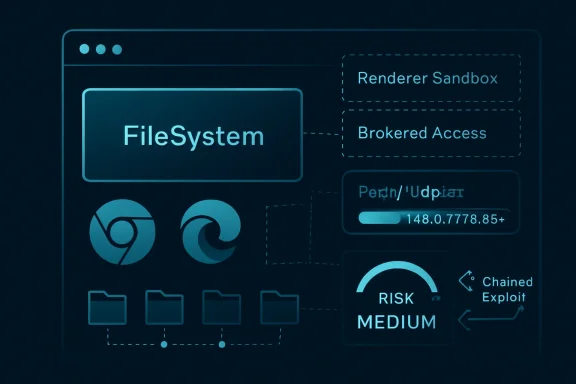
CVE-2026-7964 is described as insufficient validation of untrusted input in Chromium’s FileSystem component. The published description says a remote attacker, after compromising the renderer process, could use a crafted HTML page to perform arbitrary read and write operations. That dependency matters: this is not presented as a one-click full-system compromise by itself.
But “requires a compromised renderer” is not the comfort blanket it used to be. Chromium’s security model assumes the renderer is exposed to hostile web content, which is why the browser invests heavily in sandboxing, site isolation, privilege separation, and brokered access to operating system resources. A bug that becomes useful after renderer compromise is therefore part of a chain, not necessarily a dead end.
That is how modern browser exploitation usually works. Attackers do not need every bug to do everything. One flaw gets code running in a constrained place, another loosens a boundary, another turns a limited foothold into data access or persistence. CVE-2026-7964 belongs in that middle category: a component weakness that may matter most when paired with something louder.
The CVSS score assigned by CISA’s enrichment process lands at 4.2, with high attack complexity, user interaction required, and low confidentiality and integrity impact. That is a sober rating for the flaw as disclosed. It is also a useful example of why patch prioritization based purely on numerical severity can mislead teams that operate large browser fleets.
Browsers have spent years giving web applications richer local capabilities without turning the web into a free-for-all. That includes storage APIs, file pickers, sandboxed file handles, origin restrictions, permission prompts, and brokered operations that try to preserve the web’s security model while letting web apps behave more like native apps. Every one of those mechanisms depends on careful validation of who is asking, what they are asking for, and whether the request still makes sense after it crosses process boundaries.
That is why “insufficient validation of untrusted input” is bland phrasing for a serious class of mistake. The phrase means the component accepted something from a less-trusted context and failed to reject, normalize, constrain, or authenticate it properly. In a browser, the less-trusted context is often a renderer handling attacker-controlled HTML, JavaScript, and media.
When a FileSystem bug enables arbitrary read or write after renderer compromise, defenders should think less about the label and more about the primitive. Arbitrary read can expose data the attacker should not see. Arbitrary write can alter state, plant content, corrupt files, or reshape the next stage of an attack. Even if the reachable scope is constrained, these are useful capabilities in an exploit chain.
That context is important. If this vulnerability appeared alone in an out-of-band emergency release, it would attract more attention. Bundled into a release with dozens upon dozens of security fixes, it risks becoming just another CVE in an inventory feed.
For IT teams, that is the wrong way to read a Chrome update. Browser releases are now mini Patch Tuesdays with a different cadence, different ownership, and often less change-control ceremony. The fact that Chrome silently updates for many users is a blessing for consumers, but enterprises still need proof: version inventory, update latency metrics, exception handling, and verification for devices that are off-network or managed by third-party tools.
Chrome’s release channel also complicates perception. Early stable, stable, extended stable, platform-specific build numbers, and downstream Chromium consumers can make “are we fixed?” harder to answer than it should be. A Windows admin does not need poetry here; they need the installed browser version, the channel, and the date it last successfully updated.
This is one of the quieter consequences of the post-EdgeHTML era. Microsoft gained compatibility, speed, and a seat inside the Chromium ecosystem. It also accepted that a meaningful part of browser security would move on Google’s upstream timetable. When Chromium fixes land, Edge has to ingest, test, package, and distribute them at a tempo that matches the threat.
For Windows administrators, that means “we don’t use Chrome” is not a complete answer. Edge, embedded WebView2 runtimes, Electron applications, headless Chromium services, PDF generation pipelines, and kiosk browsers all create Chromium-shaped attack surfaces. Some update through Microsoft’s normal channels. Some update through application vendors. Some sit forgotten in containers or line-of-business packages until a scanner finds them two years later.
This is why CVE-2026-7964 should be read as a supply-chain hygiene story as much as a browser bug. Chromium is a shared substrate. A flaw in that substrate becomes everyone’s asset-management problem.
The renderer is where untrusted web content lives. It parses HTML, runs JavaScript, decodes media, paints pages, and handles an endless stream of attacker-controlled input. Chromium’s sandbox is designed around the assumption that renderer bugs will happen. The system tries to contain them.
So a post-renderer bug is not irrelevant. It is a test of whether containment holds. If a crafted page can first exploit a renderer memory corruption bug and then use a FileSystem validation flaw to read or write where it should not, the second bug may provide the reason the first bug matters.
That does not mean CVE-2026-7964 is known to be exploited in the wild, and there is no public indication in the provided advisory language that it is. It does mean defenders should stop treating chained browser vulnerabilities as exotic. The exploit market has long understood that multiple medium and high bugs can combine into something that behaves like a critical incident.
An arbitrary read primitive can help disclose secrets, tokens, local state, cached data, or other material useful for moving forward. An arbitrary write primitive can be even more valuable if it reaches configuration files, browser state, downloaded payloads, or data structures that influence later execution. The public CVSS enrichment says low confidentiality and integrity impact, so we should not overstate the disclosed blast radius. But the primitive remains meaningful.
The gap between severity labels and operational concern is especially sharp in browsers. A medium bug in a feature nobody exposes may be routine. A medium bug in a component that mediates access between hostile web content and local resources deserves faster handling. The difference is not only the score; it is where the bug sits in the architecture.
That is the lesson for vulnerability managers drowning in dashboards. CVSS is a starting point. Exploitability context, component location, asset exposure, and chainability determine urgency.
The obvious places include Chrome and Edge. The less obvious places include Teams-adjacent web components, WebView2-dependent business apps, Electron-based desktop tools, support utilities, password managers, messaging clients, developer tools, and automation systems that run headless browsers. Some of these components track Chromium closely. Others lag behind. A few are effectively abandonware with a modern UI.
This is where a medium FileSystem bug becomes a practical security story. A fully patched Chrome browser on a user’s desktop is good. A vulnerable Chromium runtime embedded in a workflow that renders untrusted customer HTML or uploaded documents is a different problem. It may not show up in the same browser-management console, but it may expose more dangerous input.
For Windows shops, WebView2 deserves special attention because it is both a platform feature and an application dependency. Keeping the Evergreen runtime current helps, but fixed-version deployments and packaged runtimes can create islands of stale Chromium. Those islands are where vulnerability management programs often discover that “browser patching” was too narrow a category.
Chrome’s automatic update machinery is mature, but policy can slow it down. Edge benefits from Microsoft’s management ecosystem, but enterprises can still defer, pin, or misconfigure updates. Linux distributions may package Chromium differently. macOS fleets may depend on MDM behavior, user privileges, or third-party management agents. The result is a browser estate that looks uniform on a slide and fragmented in telemetry.
CVE-2026-7964 is fixed before Chrome 148.0.7778.96. That makes the operational question simple: are all relevant Chromium-based browsers and runtimes at or beyond a fixed build? The harder question is how long it takes to know.
A mature response should not require a war room for every medium CVE. It should require a normal pipeline that moves browser updates quickly, flags failures, and reports exceptions. If that pipeline does not exist, this is a good week to build it.
That leaves defenders with advisory fragments: affected versions, component, weakness class, rough impact, and fixed release. It is not satisfying, but it is enough to act. The absence of a proof-of-concept is not evidence of safety; it is simply the normal disclosure posture of a major browser project.
This is also why the first few days after a browser release matter. Attackers can diff patches, inspect commits, and infer bug shape even when the tracker is locked. Defenders do not need to reverse engineer the flaw to beat that timeline. They need update velocity.
The most useful posture is boring: patch now, verify later, investigate exceptions. Browser CVEs are not the place to prove that every advisory deserves a custom risk memo before deployment.
The harder work is proving coverage. A good vulnerability program should identify Chrome, Edge, Brave, Opera, Vivaldi, Electron apps, WebView2 runtimes, headless Chromium packages, container images, and any server-side rendering tools that process untrusted content. That last category is often missed because it does not look like “a browser” to asset tools.
Defenders should also review where users or services render untrusted HTML. Email security tools, helpdesk platforms, document converters, PDF services, web previews, and internal scraping systems all expand the practical attack surface. If a service automatically loads hostile content, it deserves the same urgency as a user browsing the open web.
This is not an argument for panic. It is an argument for treating Chromium as a platform dependency. Platforms need lifecycle management, not occasional cleanup.
A single bug in FileSystem validation is manageable. A renderer bug plus a FileSystem bug plus a slow update ring plus an unmanaged embedded runtime is a story with a different ending. Enterprise security is full of these arithmetic problems, where nothing looks catastrophic until the pieces are placed in sequence.
The fix is not to classify every Chromium CVE as an emergency. The fix is to build an update culture that does not need emergency language to move quickly. Browsers face hostile input all day, every day. Their patch process should reflect that.
Source: NVD / Chromium Security Update Guide - Microsoft Security Response Center
 The Medium Bug That Describes the Modern Browser Problem
CVE-2026-7964 is described as insufficient validation of untrusted input in Chromium’s FileSystem component. The published description says a remote attacker, after compromising the renderer process, could use a crafted HTML page to perform arbitrary read and write operations. That dependency matters: this is not presented as a one-click full-system compromise by itself.But “requires a compromised renderer” is not the comfort blanket it used to be. Chromium’s security model assumes the renderer is exposed to hostile web content, which is why the browser invests heavily in sandboxing, site isolation, privilege separation, and brokered access to operating system resources. A bug that becomes useful after renderer compromise is therefore part of a chain, not necessarily a dead end.
That is how modern browser exploitation usually works. Attackers do not need every bug to do everything. One flaw gets code running in a constrained place, another loosens a boundary, another turns a limited foothold into data access or persistence. CVE-2026-7964 belongs in that middle category: a component weakness that may matter most when paired with something louder.
The CVSS score assigned by CISA’s enrichment process lands at 4.2, with high attack complexity, user interaction required, and low confidentiality and integrity impact. That is a sober rating for the flaw as disclosed. It is also a useful example of why patch prioritization based purely on numerical severity can mislead teams that operate large browser fleets.
FileSystem Is a Boundary, Not a Convenience Feature
The FileSystem component is not glamorous. It does not have the name recognition of V8, Blink, WebRTC, or Skia. Yet file access is exactly the sort of capability that defines the boundary between a web page and a machine.Browsers have spent years giving web applications richer local capabilities without turning the web into a free-for-all. That includes storage APIs, file pickers, sandboxed file handles, origin restrictions, permission prompts, and brokered operations that try to preserve the web’s security model while letting web apps behave more like native apps. Every one of those mechanisms depends on careful validation of who is asking, what they are asking for, and whether the request still makes sense after it crosses process boundaries.
That is why “insufficient validation of untrusted input” is bland phrasing for a serious class of mistake. The phrase means the component accepted something from a less-trusted context and failed to reject, normalize, constrain, or authenticate it properly. In a browser, the less-trusted context is often a renderer handling attacker-controlled HTML, JavaScript, and media.
When a FileSystem bug enables arbitrary read or write after renderer compromise, defenders should think less about the label and more about the primitive. Arbitrary read can expose data the attacker should not see. Arbitrary write can alter state, plant content, corrupt files, or reshape the next stage of an attack. Even if the reachable scope is constrained, these are useful capabilities in an exploit chain.
Chrome 148 Was a Security Release Masquerading as a Routine Update
Chrome 148’s desktop stable release brought the fix line to 148.0.7778.96 for Linux and 148.0.7778.96 or .97 for Windows and macOS. Public reporting and Google’s release material indicate the release contained a very large batch of security fixes, including critical vulnerabilities elsewhere in the browser. CVE-2026-7964 was one entry in that larger repair job.That context is important. If this vulnerability appeared alone in an out-of-band emergency release, it would attract more attention. Bundled into a release with dozens upon dozens of security fixes, it risks becoming just another CVE in an inventory feed.
For IT teams, that is the wrong way to read a Chrome update. Browser releases are now mini Patch Tuesdays with a different cadence, different ownership, and often less change-control ceremony. The fact that Chrome silently updates for many users is a blessing for consumers, but enterprises still need proof: version inventory, update latency metrics, exception handling, and verification for devices that are off-network or managed by third-party tools.
Chrome’s release channel also complicates perception. Early stable, stable, extended stable, platform-specific build numbers, and downstream Chromium consumers can make “are we fixed?” harder to answer than it should be. A Windows admin does not need poetry here; they need the installed browser version, the channel, and the date it last successfully updated.
Microsoft’s Role Is a Mirror of Chromium’s Supply Chain
The user-facing source for this CVE may be Google’s Chrome release, but Microsoft tracking it through MSRC is not a formality. Microsoft Edge is Chromium-based, and the modern Windows endpoint almost always includes Edge whether or not the organization standardizes on it. That makes Chromium security a Windows security concern.This is one of the quieter consequences of the post-EdgeHTML era. Microsoft gained compatibility, speed, and a seat inside the Chromium ecosystem. It also accepted that a meaningful part of browser security would move on Google’s upstream timetable. When Chromium fixes land, Edge has to ingest, test, package, and distribute them at a tempo that matches the threat.
For Windows administrators, that means “we don’t use Chrome” is not a complete answer. Edge, embedded WebView2 runtimes, Electron applications, headless Chromium services, PDF generation pipelines, and kiosk browsers all create Chromium-shaped attack surfaces. Some update through Microsoft’s normal channels. Some update through application vendors. Some sit forgotten in containers or line-of-business packages until a scanner finds them two years later.
This is why CVE-2026-7964 should be read as a supply-chain hygiene story as much as a browser bug. Chromium is a shared substrate. A flaw in that substrate becomes everyone’s asset-management problem.
The Renderer Compromise Requirement Is a Warning Label, Not a Dismissal
The most tempting sentence in the vulnerability description is the one that says the attacker must already have compromised the renderer process. That sounds like a prerequisite so large it neutralizes the bug. In practice, it describes the point at which many real-world exploit chains begin to become interesting.The renderer is where untrusted web content lives. It parses HTML, runs JavaScript, decodes media, paints pages, and handles an endless stream of attacker-controlled input. Chromium’s sandbox is designed around the assumption that renderer bugs will happen. The system tries to contain them.
So a post-renderer bug is not irrelevant. It is a test of whether containment holds. If a crafted page can first exploit a renderer memory corruption bug and then use a FileSystem validation flaw to read or write where it should not, the second bug may provide the reason the first bug matters.
That does not mean CVE-2026-7964 is known to be exploited in the wild, and there is no public indication in the provided advisory language that it is. It does mean defenders should stop treating chained browser vulnerabilities as exotic. The exploit market has long understood that multiple medium and high bugs can combine into something that behaves like a critical incident.
“Arbitrary Read/Write” Sounds Worse Than the Score Because It Often Is
Security scoring systems try to evaluate a vulnerability in isolation. Attackers rarely do. The phrase arbitrary read/write is one of those terms that deserves a pause because it describes capability, not just impact.An arbitrary read primitive can help disclose secrets, tokens, local state, cached data, or other material useful for moving forward. An arbitrary write primitive can be even more valuable if it reaches configuration files, browser state, downloaded payloads, or data structures that influence later execution. The public CVSS enrichment says low confidentiality and integrity impact, so we should not overstate the disclosed blast radius. But the primitive remains meaningful.
The gap between severity labels and operational concern is especially sharp in browsers. A medium bug in a feature nobody exposes may be routine. A medium bug in a component that mediates access between hostile web content and local resources deserves faster handling. The difference is not only the score; it is where the bug sits in the architecture.
That is the lesson for vulnerability managers drowning in dashboards. CVSS is a starting point. Exploitability context, component location, asset exposure, and chainability determine urgency.
The Enterprise Blind Spot Is Not Chrome; It Is Everything That Bundles Chromium
Most organizations know whether Chrome is installed on managed Windows endpoints. Fewer know every place Chromium exists. That second inventory is now the more important one.The obvious places include Chrome and Edge. The less obvious places include Teams-adjacent web components, WebView2-dependent business apps, Electron-based desktop tools, support utilities, password managers, messaging clients, developer tools, and automation systems that run headless browsers. Some of these components track Chromium closely. Others lag behind. A few are effectively abandonware with a modern UI.
This is where a medium FileSystem bug becomes a practical security story. A fully patched Chrome browser on a user’s desktop is good. A vulnerable Chromium runtime embedded in a workflow that renders untrusted customer HTML or uploaded documents is a different problem. It may not show up in the same browser-management console, but it may expose more dangerous input.
For Windows shops, WebView2 deserves special attention because it is both a platform feature and an application dependency. Keeping the Evergreen runtime current helps, but fixed-version deployments and packaged runtimes can create islands of stale Chromium. Those islands are where vulnerability management programs often discover that “browser patching” was too narrow a category.
Patch Cadence Has Become the Browser’s Real Security Feature
The browser wars used to be about standards, speed, and memory use. In enterprise security, the new browser war is about update latency. The safest browser is often the one your organization can actually patch, verify, and keep patched across laptops, virtual desktops, kiosks, servers, and embedded workflows.Chrome’s automatic update machinery is mature, but policy can slow it down. Edge benefits from Microsoft’s management ecosystem, but enterprises can still defer, pin, or misconfigure updates. Linux distributions may package Chromium differently. macOS fleets may depend on MDM behavior, user privileges, or third-party management agents. The result is a browser estate that looks uniform on a slide and fragmented in telemetry.
CVE-2026-7964 is fixed before Chrome 148.0.7778.96. That makes the operational question simple: are all relevant Chromium-based browsers and runtimes at or beyond a fixed build? The harder question is how long it takes to know.
A mature response should not require a war room for every medium CVE. It should require a normal pipeline that moves browser updates quickly, flags failures, and reports exceptions. If that pipeline does not exist, this is a good week to build it.
The Public Bug Details Are Restricted, and That Is Normal
The Chromium issue tracker entry for this vulnerability is access-restricted. That will frustrate researchers and admins who want technical detail, but it is standard practice for browser vulnerabilities while users are still updating. Publishing exploit-relevant details too early can turn a patch race into an attack race.That leaves defenders with advisory fragments: affected versions, component, weakness class, rough impact, and fixed release. It is not satisfying, but it is enough to act. The absence of a proof-of-concept is not evidence of safety; it is simply the normal disclosure posture of a major browser project.
This is also why the first few days after a browser release matter. Attackers can diff patches, inspect commits, and infer bug shape even when the tracker is locked. Defenders do not need to reverse engineer the flaw to beat that timeline. They need update velocity.
The most useful posture is boring: patch now, verify later, investigate exceptions. Browser CVEs are not the place to prove that every advisory deserves a custom risk memo before deployment.
Windows Admins Should Treat This as a Fleet-Control Drill
The concrete fix is straightforward for Chrome: move to 148.0.7778.96 or later on Linux, and the corresponding 148.0.7778.96 or .97 builds on Windows and macOS. For Edge, administrators should watch Microsoft’s Edge security release channel and MSRC tracking to ensure the Chromium fix is incorporated into the deployed version. For other Chromium consumers, the answer depends on the vendor’s update cadence.The harder work is proving coverage. A good vulnerability program should identify Chrome, Edge, Brave, Opera, Vivaldi, Electron apps, WebView2 runtimes, headless Chromium packages, container images, and any server-side rendering tools that process untrusted content. That last category is often missed because it does not look like “a browser” to asset tools.
Defenders should also review where users or services render untrusted HTML. Email security tools, helpdesk platforms, document converters, PDF services, web previews, and internal scraping systems all expand the practical attack surface. If a service automatically loads hostile content, it deserves the same urgency as a user browsing the open web.
This is not an argument for panic. It is an argument for treating Chromium as a platform dependency. Platforms need lifecycle management, not occasional cleanup.
A Medium CVE Becomes a Measure of Browser Discipline
CVE-2026-7964 will probably not be remembered as the defining Chrome vulnerability of 2026. It is too conditional, too quietly worded, and too overshadowed by higher-severity flaws in the same release. But it is valuable precisely because it shows how browser risk actually accumulates.A single bug in FileSystem validation is manageable. A renderer bug plus a FileSystem bug plus a slow update ring plus an unmanaged embedded runtime is a story with a different ending. Enterprise security is full of these arithmetic problems, where nothing looks catastrophic until the pieces are placed in sequence.
The fix is not to classify every Chromium CVE as an emergency. The fix is to build an update culture that does not need emergency language to move quickly. Browsers face hostile input all day, every day. Their patch process should reflect that.
The Patch Notes Tell Admins Where to Look Next
CVE-2026-7964 gives Windows and Chromium administrators a narrow action item, but the bigger value is in what it reveals about operational readiness. If your team cannot answer where Chromium exists, which versions are running, and how quickly fixes land, the risk is not one CVE. The risk is a recurring blind spot.- Chrome versions earlier than 148.0.7778.96 should be treated as vulnerable to CVE-2026-7964 and updated through the normal stable-channel mechanism.
- Microsoft Edge administrators should verify that their deployed Edge builds have incorporated the relevant Chromium security updates rather than assuming Chrome-only exposure.
- Vulnerability teams should inventory embedded Chromium runtimes, Electron applications, WebView2 deployments, and headless browser services alongside conventional desktop browsers.
- Systems that render untrusted HTML, uploaded files, previews, or customer-controlled web content deserve special attention because they turn browser bugs into server-side exposure.
- The medium severity rating should guide prioritization, but it should not override the practical reality that post-renderer bugs can be useful in exploit chains.
Source: NVD / Chromium Security Update Guide - Microsoft Security Response Center
