

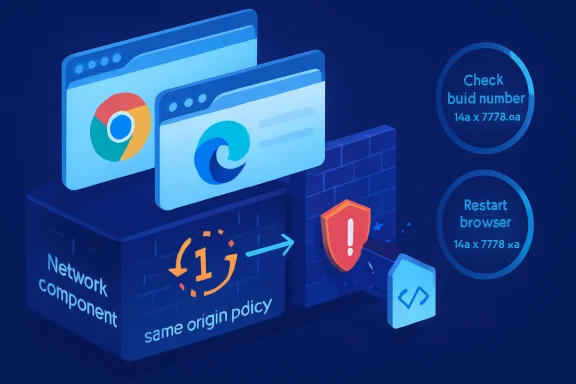
CVE-2026-7969 is a newly published Chromium vulnerability, released through the Chrome and Microsoft security ecosystems on May 6–7, 2026, affecting Google Chrome before 148.0.7778.96 and Microsoft Edge after Chromium ingestion until its corresponding 148.0.7778.xxx security update. It is not the scariest bug in Chrome 148, but it is one of the more instructive ones. The flaw sits in the browser’s Network component, requires a compromised renderer, and can be used to bypass same-origin policy through a crafted HTML page. That combination tells us something important: modern browser security is less about one bug handing over the kingdom and more about whether layered defenses fail in the right order.
On paper, CVE-2026-7969 looks almost modest. The CISA ADP score is 4.3, the severity is Medium, and the impact vector points to limited confidentiality exposure rather than code execution, persistence, or system takeover. There is also no public indication, as of the advisory publication, that this specific CVE is being exploited in the wild.
But “Medium” in browser-land does not mean “ignore.” Browser vulnerabilities are often valuable not because they finish an attack chain, but because they connect one stage to the next. A bug that lets an attacker bypass the same-origin policy after compromising the renderer is not a front-door break-in; it is the hallway key an attacker reaches for once already inside the building.
That distinction matters for WindowsForum readers because Chrome and Edge are no longer mere applications in the old desktop sense. They are runtime environments, identity brokers, PDF viewers, password managers, enterprise app portals, and privileged interpreters of hostile content. If the browser’s isolation promises weaken, the blast radius is not limited to “a web page behaved badly.”
The core issue is an integer overflow in Chromium’s Network component. Integer overflows are a familiar old class of bug, but in a browser they are rarely old-fashioned in their consequences. A small arithmetic mistake can become a permission mistake, a buffer-size mistake, or a state-tracking mistake, depending on where the bad value flows.
In this case, the public description says the attacker first needs to have compromised the renderer process. That prerequisite is meaningful. It means CVE-2026-7969 is not being described as a one-click remote code execution path by itself. It is a post-renderer-compromise escape from a web security boundary, and that makes it a chain component.
That bargain is constantly under pressure because the modern web is built on exceptions. Cross-origin resource sharing, iframes, service workers, redirects, cookies, tokens, local storage, private network access, and browser-side caching all create edge cases. Browser vendors spend an enormous amount of engineering effort defining which data may cross a boundary and under what condition.
A same-origin policy bypass is therefore not just “information disclosure” in the abstract. In the wrong chain, it can let an attacker read data they should not be able to read, observe authenticated responses, or interfere with origin assumptions that web applications rely on. That is especially relevant in enterprise environments where browser sessions are often already authenticated into Microsoft 365, internal dashboards, SSO portals, admin consoles, and SaaS tools.
The phrase “crafted HTML page” can make these advisories sound almost quaint. It should not. In a browser exploit context, a crafted page is the delivery format for a complex set of behaviors that may involve JavaScript, layout, network timing, memory pressure, sandbox assumptions, and feature interactions. The page is the stage, not the weapon.
The prerequisite of renderer compromise changes the risk calculus but does not erase it. Attackers who already have a renderer bug want ways to convert that foothold into data access, privilege boundary bypasses, or sandbox escapes. A network-layer integer overflow that affects origin enforcement is exactly the sort of secondary primitive that can turn an isolated browser bug into a more consequential incident.
That broader release context is important because administrators do not patch CVEs one by one in Chrome or Edge. They patch browser builds. If one Medium bug looks unexciting, the release train around it may still contain High and Critical fixes that change the urgency dramatically.
Google’s Chrome release process also routinely withholds detailed bug information until a substantial portion of users has updated. That policy can frustrate defenders who want exact technical clarity, but it reflects the grim reality of browser exploitation. Too much detail too soon can become a gift to exploit developers.
For IT teams, the practical interpretation is simple: treat the build number as the security boundary. Chrome before 148.0.7778.96 is in the vulnerable range for this CVE. Microsoft’s Security Update Guide lists Edge as addressed in the 148.0.7778.xxx line, because Edge consumes Chromium and ships its own branded build cadence.
That “xxx” matters. Microsoft is not telling customers to install Google Chrome; it is telling Edge customers that the Chromium-derived flaw is remediated in the relevant Edge security update stream. In managed Windows environments, Edge’s update channel, group policy configuration, and servicing status become as important as Chrome’s own About page.
Edge is Microsoft’s browser, but Chromium is part of its upstream reality. When Chromium fixes a bug in Network, Blink, V8, Skia, Mojo, or another shared component, Microsoft has to ingest, validate, package, and publish that fix for Edge users. The result is a security chain that crosses organizational boundaries but lands on Windows desktops as a Microsoft update obligation.
This is a different model from the old Internet Explorer era, where the browser was tightly coupled to the operating system and Patch Tuesday could dominate the servicing story. Edge’s Chromium base changed the rhythm. Browser fixes can arrive outside the traditional Windows cumulative update cadence, and administrators who still think only in monthly OS patch windows are operating with an outdated mental model.
That shift is usually a net security win. Chromium’s rapid release process means browser vulnerabilities can be patched quickly across multiple operating systems and downstream browsers. But it also creates visibility challenges: a CVE assigned by Chrome may appear in Microsoft’s guide with minimal Microsoft-specific detail, even though the exposure exists on Windows endpoints through Edge.
The article’s primary question — whether a CPE is missing — sits inside this supply-chain reality. The NVD entry’s configuration lists Google Chrome versions up to, but excluding, 148.0.7778.96 across Windows, Linux, and macOS platform CPEs. Microsoft’s advisory separately lists Microsoft Edge as affected and requiring action, but the NVD configuration shown in the user-provided details does not appear to enumerate an Edge application CPE.
That does not necessarily mean the vulnerability is absent from Edge. Microsoft’s own guidance says the opposite: Edge consumes Chromium and the latest Chromium-based Edge is no longer vulnerable. It means the machine-readable vulnerability metadata may lag, simplify, or represent the upstream CNA’s Chrome-centered view rather than every downstream Chromium consumer.
In the data supplied, NIST added a configuration tying vulnerable Google Chrome versions to operating system platforms. That is a common pattern for browser CVEs: the vulnerable application is Chrome, and the OS CPEs define applicable platforms. But Microsoft Edge is not just “Chrome on Windows.” It is a distinct product that incorporates Chromium and ships on its own versioning and update rails.
So yes, if the goal is to represent Microsoft Edge exposure directly in NVD’s affected software configurations, an Edge application CPE would be expected. The absence of one in the displayed NVD configuration means tools that rely only on NVD CPE matching could miss Edge, unless they also consume Microsoft’s Security Update Guide, vendor advisories, or browser-specific inventory data.
That is the dangerous part. A vulnerability manager may see Chrome flagged and Edge unflagged, then conclude the organization is safe because Chrome is not installed. On many Windows fleets, Edge is installed by default, used silently by WebView2-dependent apps, or permitted for specific business workflows even when another browser is the official standard.
CPE incompleteness is not unique to this CVE, and it is not always a sign of negligence. Chromium’s ecosystem is unusually messy: Chrome, Edge, Brave, Vivaldi, Opera, Electron apps, embedded WebViews, and other products may share some vulnerable code while differing in exposure, build timing, feature flags, and exploitability. A single upstream CVE does not always map cleanly to every downstream package.
Still, defenders do not get to ignore the mismatch. The right operational move is to treat Microsoft’s advisory as authoritative for Edge exposure and NVD as one useful feed among several. If your tooling does not correlate MSRC data with NVD and browser inventory, this is exactly the kind of Medium CVE that can expose the gap.
But browser exploit chains are built out of prerequisites. The renderer is the first cage: it executes hostile web content under constraints. The network service, browser process, GPU process, and storage systems form other cages and corridors. The attacker’s job is to move from one compartment to another without tripping the alarm or hitting a hard boundary.
A same-origin policy bypass after renderer compromise can be particularly useful because it changes what data the attacker can observe from inside the browser session. Even if the attacker cannot yet execute code outside the sandbox, they may be able to abuse authenticated context. That matters in a world where the browser is where identity lives.
Consider a corporate user with active sessions into mail, files, HR systems, ticketing, cloud consoles, and internal web apps. The value of the browser session may exceed the value of the local machine. A flaw that helps pierce origin boundaries can turn the user’s authenticated state into an asset for the attacker.
This is also why browser bugs often get patched aggressively even when individual CVSS scores look moderate. CVSS is useful, but it struggles to express chain value. A Medium CVE can be a crucial bridge when paired with a renderer RCE, UXSS bug, extension abuse, or malicious advertising delivery path.
The Network component is especially sensitive because it handles a messy boundary between untrusted input and internal browser state. URLs, headers, redirects, cookies, protocol framing, response sizes, compression, caching metadata, and policy enforcement all involve lengths, counters, offsets, and assumptions. If a value wraps, a check may pass when it should fail.
That does not mean every integer overflow in Network is catastrophic. Public advisories usually compress nuanced technical bugs into a few words, and without the restricted Chromium issue details, outsiders should avoid inventing exploit mechanics. What we can say is that the class of bug is compatible with boundary confusion, and the stated impact is same-origin policy bypass.
The CWE listed in the supplied NVD information, external control of an assumed-immutable web parameter, is interesting because it points less at raw memory corruption and more at trust assumptions. Somewhere, data that should not be attacker-controlled may have influenced a security-relevant decision. In the browser, those decisions often govern who is allowed to see what.
That is why the most useful lesson is not “integer overflow bad.” It is that web security depends on a long chain of assumptions staying true under hostile input. Attackers do not need every assumption to fail. They need one failure in the right place after another failure has already opened the path.
Edge can update through its own mechanisms, enterprise policies, WSUS-adjacent controls, Intune, Configuration Manager, or other endpoint tooling depending on how the fleet is managed. The details vary, but the principle does not: you need reliable visibility into the actual browser version running on endpoints. A Windows build number alone is not enough.
The same applies to Chrome. Automatic updates are excellent when they work, but enterprise controls can slow, pin, or defer versions. Kiosks, VDI images, lab machines, offline systems, golden images, and shared workstations are notorious for falling behind the happy-path update story.
The safest workflow is boring and mechanical. Inventory installed browsers. Confirm channel and version. Push or allow the fixed build. Validate after restart. Watch for machines that report the downloaded update but keep running an old process because the browser has not been relaunched.
That last point is often underestimated. Browsers are long-lived applications. Users with dozens of tabs, restored sessions, and uptime measured in weeks can sit on a vulnerable executable after the updater has staged a fix. Admins need policies and user communication that turn “update available” into “patched process actually running.”
User interaction is not a high bar for browser attacks. Visiting a web page is the browser’s job. Clicking a link, loading an ad, opening a document preview, or following an internal chat message may satisfy the requirement, depending on the exploit path.
Unchanged scope also deserves careful reading. In CVSS terms, the vulnerable component and impacted component remain within the same security authority. In real incident terms, reading cross-origin data from inside a user’s browser session can still be highly sensitive. The scope label is not a business impact label.
The lack of integrity and availability impact in the vector means the described vulnerability is not currently scored as a write primitive or crash weapon. That should shape prioritization, but it should not lead to complacency. Confidentiality-only browser bugs can still expose session-bound data that organizations consider crown-jewel information.
Security teams should therefore patch based on product exposure and release context, not solely on the CVE’s standalone score. Chrome 148’s broader security set, the Edge ingestion path, and the same-origin policy impact together make this a patch-now-in-normal-browser-cadence issue, not a wait-for-next-quarter item.
That concentration is not inherently bad. Browsers are among the most heavily sandboxed, fuzzed, and scrutinized pieces of software on the planet. Chrome and Edge are far safer platforms for hostile content than the plug-in-heavy browsers of the past.
But concentration changes the payoff for attackers. A successful browser chain can ride authenticated sessions, observe user workflows, and reach cloud services without needing classic malware persistence on disk. In some environments, compromising the browser session is a more direct route to business impact than compromising the operating system.
CVE-2026-7969 sits right on that fault line. It is not a panic button. It is not, based on public information, a standalone “remote takeover” event. But it is a reminder that origin isolation is one of the browser’s most valuable promises, and attackers only need occasional cracks to make chained exploitation worthwhile.
For defenders, this argues for treating browser updates as tier-one security maintenance. It also argues for defense in depth around the browser: phishing-resistant authentication, conditional access, session controls, least-privilege admin portals, endpoint detection that understands browser behavior, and rapid revocation workflows when suspicious session activity appears.
NVD, MSRC, Chrome release notes, security scanners, Linux distribution trackers, and third-party advisories each see part of the picture. None should be treated as the sole source of truth in a modern browser incident. The cleaner approach is correlation: vendor advisory for product impact, asset inventory for exposure, build numbers for remediation, and CVE feeds for tracking.
If Edge is present in your fleet, Microsoft’s advisory should trigger action regardless of whether the NVD CPE list visibly names Edge. If Chrome is present, Google’s fixed version should trigger action regardless of whether a scanner has caught up. If Chromium packages exist on Linux systems, distribution-specific packages matter because the version string may be patched or rebuilt differently.
This is where mature vulnerability programs separate themselves from checkbox programs. A checkbox program waits for a scanner plugin to light up. A mature program understands that browser CVEs move faster than metadata normalization and uses multiple signals to close the exposure window.
The irony is that CVE-2026-7969’s Medium score makes it a better test case than a screaming Critical zero-day. Criticals force attention. Mediums reveal whether your process can handle nuance. If your tools miss Edge here, they may miss it again when the next Chromium bug is more severe.
The reason to verify rather than assume is that browser updates have multiple states. The update may be available but not downloaded. It may be downloaded but not applied. It may be applied to disk but not active because the old process is still running. It may be blocked by policy, update service failure, packaging delay, or a user who has not closed the browser in a week.
Managed fleets should also check whether browser relaunch notifications are configured with enough urgency. Users dislike forced restarts, and admins dislike interrupting work, but browser exploit windows reward hesitation. A staged update that never becomes a running process is a comforting fiction.
There is also an application compatibility angle. Some organizations defer browser updates because line-of-business web apps are fragile. That tradeoff may have been understandable in the past, but it is increasingly difficult to defend when the browser is the enterprise front door. If an internal app cannot survive routine Chromium security updates, the app is now a security liability.
The practical compromise is ring-based deployment, not indefinite delay. Pilot quickly, expand quickly, and reserve broad holds for confirmed breakage. Browser updates are too frequent and too security-dense for every release to become a bespoke change-control ceremony.
CVE-2026-7969 will probably not be remembered as the defining Chrome bug of 2026, and that is precisely why it is useful. It shows how a Medium Chromium flaw can ripple into Edge, expose gaps in CPE-driven tooling, and remind defenders that the web’s most important boundary is only as strong as the update process behind it. The next browser emergency will arrive with a louder score and a shorter fuse; the organizations that handle this quiet one well will be better prepared when it does.
Source: NVD / Chromium Security Update Guide - Microsoft Security Response Center
 The Medium Bug That Explains the Modern Browser Threat Model
On paper, CVE-2026-7969 looks almost modest. The CISA ADP score is 4.3, the severity is Medium, and the impact vector points to limited confidentiality exposure rather than code execution, persistence, or system takeover. There is also no public indication, as of the advisory publication, that this specific CVE is being exploited in the wild.But “Medium” in browser-land does not mean “ignore.” Browser vulnerabilities are often valuable not because they finish an attack chain, but because they connect one stage to the next. A bug that lets an attacker bypass the same-origin policy after compromising the renderer is not a front-door break-in; it is the hallway key an attacker reaches for once already inside the building.
That distinction matters for WindowsForum readers because Chrome and Edge are no longer mere applications in the old desktop sense. They are runtime environments, identity brokers, PDF viewers, password managers, enterprise app portals, and privileged interpreters of hostile content. If the browser’s isolation promises weaken, the blast radius is not limited to “a web page behaved badly.”
The core issue is an integer overflow in Chromium’s Network component. Integer overflows are a familiar old class of bug, but in a browser they are rarely old-fashioned in their consequences. A small arithmetic mistake can become a permission mistake, a buffer-size mistake, or a state-tracking mistake, depending on where the bad value flows.
In this case, the public description says the attacker first needs to have compromised the renderer process. That prerequisite is meaningful. It means CVE-2026-7969 is not being described as a one-click remote code execution path by itself. It is a post-renderer-compromise escape from a web security boundary, and that makes it a chain component.
Same-Origin Policy Is the Wall Attackers Keep Trying to Climb
The same-origin policy is one of the web’s oldest and most important security bargains. It says, in simplified terms, that code from one origin should not freely read or manipulate sensitive data from another. Your banking session, your webmail, your corporate dashboard, and a malicious page opened in another tab are supposed to live behind logical partitions.That bargain is constantly under pressure because the modern web is built on exceptions. Cross-origin resource sharing, iframes, service workers, redirects, cookies, tokens, local storage, private network access, and browser-side caching all create edge cases. Browser vendors spend an enormous amount of engineering effort defining which data may cross a boundary and under what condition.
A same-origin policy bypass is therefore not just “information disclosure” in the abstract. In the wrong chain, it can let an attacker read data they should not be able to read, observe authenticated responses, or interfere with origin assumptions that web applications rely on. That is especially relevant in enterprise environments where browser sessions are often already authenticated into Microsoft 365, internal dashboards, SSO portals, admin consoles, and SaaS tools.
The phrase “crafted HTML page” can make these advisories sound almost quaint. It should not. In a browser exploit context, a crafted page is the delivery format for a complex set of behaviors that may involve JavaScript, layout, network timing, memory pressure, sandbox assumptions, and feature interactions. The page is the stage, not the weapon.
The prerequisite of renderer compromise changes the risk calculus but does not erase it. Attackers who already have a renderer bug want ways to convert that foothold into data access, privilege boundary bypasses, or sandbox escapes. A network-layer integer overflow that affects origin enforcement is exactly the sort of secondary primitive that can turn an isolated browser bug into a more consequential incident.
Chrome 148 Was Not a Routine Point Release
The timing also matters. Chrome 148 promoted to stable on May 5, 2026, with 148.0.7778.96 for Linux and 148.0.7778.96/97 for Windows and macOS. Reporting on the release describes a large security payload, with more than 100 vulnerabilities addressed and several critical flaws elsewhere in the browser stack. CVE-2026-7969 is only one tile in a much larger patch mosaic.That broader release context is important because administrators do not patch CVEs one by one in Chrome or Edge. They patch browser builds. If one Medium bug looks unexciting, the release train around it may still contain High and Critical fixes that change the urgency dramatically.
Google’s Chrome release process also routinely withholds detailed bug information until a substantial portion of users has updated. That policy can frustrate defenders who want exact technical clarity, but it reflects the grim reality of browser exploitation. Too much detail too soon can become a gift to exploit developers.
For IT teams, the practical interpretation is simple: treat the build number as the security boundary. Chrome before 148.0.7778.96 is in the vulnerable range for this CVE. Microsoft’s Security Update Guide lists Edge as addressed in the 148.0.7778.xxx line, because Edge consumes Chromium and ships its own branded build cadence.
That “xxx” matters. Microsoft is not telling customers to install Google Chrome; it is telling Edge customers that the Chromium-derived flaw is remediated in the relevant Edge security update stream. In managed Windows environments, Edge’s update channel, group policy configuration, and servicing status become as important as Chrome’s own About page.
Microsoft’s Advisory Is Really a Supply Chain Notice
Microsoft’s page for CVE-2026-7969 is terse by design. The key sentence is that the CVE was assigned by Chrome and that Microsoft Edge, being Chromium-based, ingests Chromium and addresses the vulnerability. That is not boilerplate; it is a concise description of how browser security now works.Edge is Microsoft’s browser, but Chromium is part of its upstream reality. When Chromium fixes a bug in Network, Blink, V8, Skia, Mojo, or another shared component, Microsoft has to ingest, validate, package, and publish that fix for Edge users. The result is a security chain that crosses organizational boundaries but lands on Windows desktops as a Microsoft update obligation.
This is a different model from the old Internet Explorer era, where the browser was tightly coupled to the operating system and Patch Tuesday could dominate the servicing story. Edge’s Chromium base changed the rhythm. Browser fixes can arrive outside the traditional Windows cumulative update cadence, and administrators who still think only in monthly OS patch windows are operating with an outdated mental model.
That shift is usually a net security win. Chromium’s rapid release process means browser vulnerabilities can be patched quickly across multiple operating systems and downstream browsers. But it also creates visibility challenges: a CVE assigned by Chrome may appear in Microsoft’s guide with minimal Microsoft-specific detail, even though the exposure exists on Windows endpoints through Edge.
The article’s primary question — whether a CPE is missing — sits inside this supply-chain reality. The NVD entry’s configuration lists Google Chrome versions up to, but excluding, 148.0.7778.96 across Windows, Linux, and macOS platform CPEs. Microsoft’s advisory separately lists Microsoft Edge as affected and requiring action, but the NVD configuration shown in the user-provided details does not appear to enumerate an Edge application CPE.
That does not necessarily mean the vulnerability is absent from Edge. Microsoft’s own guidance says the opposite: Edge consumes Chromium and the latest Chromium-based Edge is no longer vulnerable. It means the machine-readable vulnerability metadata may lag, simplify, or represent the upstream CNA’s Chrome-centered view rather than every downstream Chromium consumer.
The CPE Gap Is a Metadata Problem With Real Operational Consequences
CPEs are not glamorous, but they are the plumbing behind a lot of vulnerability management. Scanners, dashboards, SBOM tools, exposure management platforms, and compliance reports often depend on CPE matching to decide whether a product is affected. When the CPE model is incomplete or awkward, the dashboard lies by omission.In the data supplied, NIST added a configuration tying vulnerable Google Chrome versions to operating system platforms. That is a common pattern for browser CVEs: the vulnerable application is Chrome, and the OS CPEs define applicable platforms. But Microsoft Edge is not just “Chrome on Windows.” It is a distinct product that incorporates Chromium and ships on its own versioning and update rails.
So yes, if the goal is to represent Microsoft Edge exposure directly in NVD’s affected software configurations, an Edge application CPE would be expected. The absence of one in the displayed NVD configuration means tools that rely only on NVD CPE matching could miss Edge, unless they also consume Microsoft’s Security Update Guide, vendor advisories, or browser-specific inventory data.
That is the dangerous part. A vulnerability manager may see Chrome flagged and Edge unflagged, then conclude the organization is safe because Chrome is not installed. On many Windows fleets, Edge is installed by default, used silently by WebView2-dependent apps, or permitted for specific business workflows even when another browser is the official standard.
CPE incompleteness is not unique to this CVE, and it is not always a sign of negligence. Chromium’s ecosystem is unusually messy: Chrome, Edge, Brave, Vivaldi, Opera, Electron apps, embedded WebViews, and other products may share some vulnerable code while differing in exposure, build timing, feature flags, and exploitability. A single upstream CVE does not always map cleanly to every downstream package.
Still, defenders do not get to ignore the mismatch. The right operational move is to treat Microsoft’s advisory as authoritative for Edge exposure and NVD as one useful feed among several. If your tooling does not correlate MSRC data with NVD and browser inventory, this is exactly the kind of Medium CVE that can expose the gap.
Renderer Compromise Is a Prerequisite, Not a Comfort Blanket
The phrase “who had compromised the renderer process” will tempt some readers to downgrade the issue mentally. That is understandable. If an attacker already needs renderer compromise, CVE-2026-7969 is not the first domino.But browser exploit chains are built out of prerequisites. The renderer is the first cage: it executes hostile web content under constraints. The network service, browser process, GPU process, and storage systems form other cages and corridors. The attacker’s job is to move from one compartment to another without tripping the alarm or hitting a hard boundary.
A same-origin policy bypass after renderer compromise can be particularly useful because it changes what data the attacker can observe from inside the browser session. Even if the attacker cannot yet execute code outside the sandbox, they may be able to abuse authenticated context. That matters in a world where the browser is where identity lives.
Consider a corporate user with active sessions into mail, files, HR systems, ticketing, cloud consoles, and internal web apps. The value of the browser session may exceed the value of the local machine. A flaw that helps pierce origin boundaries can turn the user’s authenticated state into an asset for the attacker.
This is also why browser bugs often get patched aggressively even when individual CVSS scores look moderate. CVSS is useful, but it struggles to express chain value. A Medium CVE can be a crucial bridge when paired with a renderer RCE, UXSS bug, extension abuse, or malicious advertising delivery path.
Integer Overflow Remains the Boring Bug Class That Will Not Die
Integer overflow vulnerabilities are old enough to have their own fatigue cycle. Everyone knows they exist. Everyone knows bounds checks, safe arithmetic, fuzzing, sanitizers, and memory-safe languages reduce their frequency. And yet they continue to appear in high-value software because browsers are large, fast-moving, and full of legacy-adjacent complexity.The Network component is especially sensitive because it handles a messy boundary between untrusted input and internal browser state. URLs, headers, redirects, cookies, protocol framing, response sizes, compression, caching metadata, and policy enforcement all involve lengths, counters, offsets, and assumptions. If a value wraps, a check may pass when it should fail.
That does not mean every integer overflow in Network is catastrophic. Public advisories usually compress nuanced technical bugs into a few words, and without the restricted Chromium issue details, outsiders should avoid inventing exploit mechanics. What we can say is that the class of bug is compatible with boundary confusion, and the stated impact is same-origin policy bypass.
The CWE listed in the supplied NVD information, external control of an assumed-immutable web parameter, is interesting because it points less at raw memory corruption and more at trust assumptions. Somewhere, data that should not be attacker-controlled may have influenced a security-relevant decision. In the browser, those decisions often govern who is allowed to see what.
That is why the most useful lesson is not “integer overflow bad.” It is that web security depends on a long chain of assumptions staying true under hostile input. Attackers do not need every assumption to fail. They need one failure in the right place after another failure has already opened the path.
Edge Administrators Need Browser Telemetry, Not Just Windows Update Compliance
For Windows admins, the Edge angle is the operational center of gravity. Microsoft lists customer action as required, with Edge fixed in the 148.0.7778.xxx build line. If an organization’s vulnerability process treats Edge as “part of Windows” and assumes Windows Update compliance equals browser compliance, that process deserves scrutiny.Edge can update through its own mechanisms, enterprise policies, WSUS-adjacent controls, Intune, Configuration Manager, or other endpoint tooling depending on how the fleet is managed. The details vary, but the principle does not: you need reliable visibility into the actual browser version running on endpoints. A Windows build number alone is not enough.
The same applies to Chrome. Automatic updates are excellent when they work, but enterprise controls can slow, pin, or defer versions. Kiosks, VDI images, lab machines, offline systems, golden images, and shared workstations are notorious for falling behind the happy-path update story.
The safest workflow is boring and mechanical. Inventory installed browsers. Confirm channel and version. Push or allow the fixed build. Validate after restart. Watch for machines that report the downloaded update but keep running an old process because the browser has not been relaunched.
That last point is often underestimated. Browsers are long-lived applications. Users with dozens of tabs, restored sessions, and uptime measured in weeks can sit on a vulnerable executable after the updater has staged a fix. Admins need policies and user communication that turn “update available” into “patched process actually running.”
Vulnerability Scores Understate Cross-Browser Reality
The CVSS 3.1 vector supplied by CISA ADP is straightforward: network attack vector, low attack complexity, no privileges required, user interaction required, unchanged scope, low confidentiality impact, and no integrity or availability impact. That maps neatly to a Medium score. It also hides the strategic importance of the browser as an attack platform.User interaction is not a high bar for browser attacks. Visiting a web page is the browser’s job. Clicking a link, loading an ad, opening a document preview, or following an internal chat message may satisfy the requirement, depending on the exploit path.
Unchanged scope also deserves careful reading. In CVSS terms, the vulnerable component and impacted component remain within the same security authority. In real incident terms, reading cross-origin data from inside a user’s browser session can still be highly sensitive. The scope label is not a business impact label.
The lack of integrity and availability impact in the vector means the described vulnerability is not currently scored as a write primitive or crash weapon. That should shape prioritization, but it should not lead to complacency. Confidentiality-only browser bugs can still expose session-bound data that organizations consider crown-jewel information.
Security teams should therefore patch based on product exposure and release context, not solely on the CVE’s standalone score. Chrome 148’s broader security set, the Edge ingestion path, and the same-origin policy impact together make this a patch-now-in-normal-browser-cadence issue, not a wait-for-next-quarter item.
The Browser Has Become the Enterprise Perimeter by Accident
The industry spent years telling itself the perimeter had dissolved. Then it rebuilt a new one in the browser. Identity providers, SaaS dashboards, admin portals, cloud consoles, internal apps, password vaults, collaboration tools, and file-sharing systems all now concentrate inside a handful of browser processes.That concentration is not inherently bad. Browsers are among the most heavily sandboxed, fuzzed, and scrutinized pieces of software on the planet. Chrome and Edge are far safer platforms for hostile content than the plug-in-heavy browsers of the past.
But concentration changes the payoff for attackers. A successful browser chain can ride authenticated sessions, observe user workflows, and reach cloud services without needing classic malware persistence on disk. In some environments, compromising the browser session is a more direct route to business impact than compromising the operating system.
CVE-2026-7969 sits right on that fault line. It is not a panic button. It is not, based on public information, a standalone “remote takeover” event. But it is a reminder that origin isolation is one of the browser’s most valuable promises, and attackers only need occasional cracks to make chained exploitation worthwhile.
For defenders, this argues for treating browser updates as tier-one security maintenance. It also argues for defense in depth around the browser: phishing-resistant authentication, conditional access, session controls, least-privilege admin portals, endpoint detection that understands browser behavior, and rapid revocation workflows when suspicious session activity appears.
The Metadata Tail Should Not Wag the Patch Dog
The CPE issue is worth caring about precisely because it is not the same thing as the vulnerability. The bug is in Chromium’s Network component. The operational question is which shipped products include the vulnerable code and which fixed builds remove it. The metadata question is whether databases describe that reality accurately enough for machines to act on it.NVD, MSRC, Chrome release notes, security scanners, Linux distribution trackers, and third-party advisories each see part of the picture. None should be treated as the sole source of truth in a modern browser incident. The cleaner approach is correlation: vendor advisory for product impact, asset inventory for exposure, build numbers for remediation, and CVE feeds for tracking.
If Edge is present in your fleet, Microsoft’s advisory should trigger action regardless of whether the NVD CPE list visibly names Edge. If Chrome is present, Google’s fixed version should trigger action regardless of whether a scanner has caught up. If Chromium packages exist on Linux systems, distribution-specific packages matter because the version string may be patched or rebuilt differently.
This is where mature vulnerability programs separate themselves from checkbox programs. A checkbox program waits for a scanner plugin to light up. A mature program understands that browser CVEs move faster than metadata normalization and uses multiple signals to close the exposure window.
The irony is that CVE-2026-7969’s Medium score makes it a better test case than a screaming Critical zero-day. Criticals force attention. Mediums reveal whether your process can handle nuance. If your tools miss Edge here, they may miss it again when the next Chromium bug is more severe.
The Patch Window Is Shorter Than the Meeting Cycle
For most home users, the answer is simple: let Chrome and Edge update, then restart the browser. For enthusiasts and admins, the more useful answer is to verify the version. Chrome should be at least 148.0.7778.96 on the vulnerable desktop lines, while Edge should be in Microsoft’s 148.0.7778.xxx fixed build family.The reason to verify rather than assume is that browser updates have multiple states. The update may be available but not downloaded. It may be downloaded but not applied. It may be applied to disk but not active because the old process is still running. It may be blocked by policy, update service failure, packaging delay, or a user who has not closed the browser in a week.
Managed fleets should also check whether browser relaunch notifications are configured with enough urgency. Users dislike forced restarts, and admins dislike interrupting work, but browser exploit windows reward hesitation. A staged update that never becomes a running process is a comforting fiction.
There is also an application compatibility angle. Some organizations defer browser updates because line-of-business web apps are fragile. That tradeoff may have been understandable in the past, but it is increasingly difficult to defend when the browser is the enterprise front door. If an internal app cannot survive routine Chromium security updates, the app is now a security liability.
The practical compromise is ring-based deployment, not indefinite delay. Pilot quickly, expand quickly, and reserve broad holds for confirmed breakage. Browser updates are too frequent and too security-dense for every release to become a bespoke change-control ceremony.
What This One CVE Says About Your Patch Program
CVE-2026-7969 is a small story with a useful checklist hiding inside it. It tests whether organizations understand Chromium inheritance, whether scanners depend too heavily on CPE matching, and whether browser version telemetry is real rather than assumed.- Chrome desktop installations should be updated to 148.0.7778.96 or later on affected platforms.
- Microsoft Edge should be updated into the 148.0.7778.xxx fixed build line identified by Microsoft’s Security Update Guide.
- Vulnerability tools that flag Chrome but not Edge should be checked against MSRC data before teams conclude Edge is unaffected.
- The renderer-compromise prerequisite lowers standalone urgency but increases the bug’s relevance as part of an exploit chain.
- Same-origin policy bypasses deserve attention because authenticated browser sessions often contain the enterprise’s most valuable working data.
- Browser update compliance should be measured by the running browser version after relaunch, not merely by whether an updater has staged files.
CVE-2026-7969 will probably not be remembered as the defining Chrome bug of 2026, and that is precisely why it is useful. It shows how a Medium Chromium flaw can ripple into Edge, expose gaps in CPE-driven tooling, and remind defenders that the web’s most important boundary is only as strong as the update process behind it. The next browser emergency will arrive with a louder score and a shorter fuse; the organizations that handle this quiet one well will be better prepared when it does.
Source: NVD / Chromium Security Update Guide - Microsoft Security Response Center
