

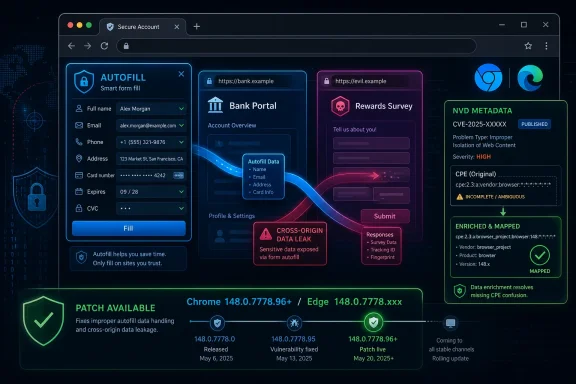
A Medium Chrome Bug Becomes a Microsoft Patch Story
CVE-2026-7986 is not the kind of vulnerability that usually gets executives rushing into incident bridges. It is rated medium, requires user interaction, and is described as an information disclosure issue rather than a remote-code-execution catastrophe. The attacker’s prize, according to the public description, is cross-origin data leakage through a crafted HTML page.
That sounds narrow, and it probably is. But browser security is full of narrow bugs that become operational headaches because the browser has become the operating system’s front door. Autofill is not a cosmetic convenience anymore; it is a policy-controlled feature sitting at the intersection of identity, credentials, payment data, enterprise forms, and the web’s same-origin boundary.
The phrase “insufficient policy enforcement” is doing a lot of work here. In Chromium language, it generally means that the code had a rule, but the rule was not consistently applied where it mattered. In this case, the vulnerable component is Autofill, and the affected result was leakage of cross-origin data, a violation of one of the browser’s oldest and most important security promises.
Microsoft’s involvement is not because this is a Windows bug in the traditional sense. It is because Microsoft Edge is built on Chromium, and Microsoft now inherits much of Chromium’s security calendar. The MSRC entry is, in effect, Microsoft telling administrators: if you track Edge through the Security Update Guide, this Chromium fix is part of your world too.
The CPE Confusion Was a Symptom, Not the Disease
The user-facing NVD page initially looked like so many CVE records do in the first hours of publication: useful description, partial scoring, and a configuration section that made readers wonder whether the vulnerability was fully mapped. The question “Are we missing a CPE here?” is not just a metadata gripe. In many vulnerability management systems, CPE matching is what turns an abstract CVE into a ticket, a dashboard item, a compliance exception, or a patch deadline.
NIST’s change history matters because it shows the enrichment catching up. The record gained a CPE configuration for Google Chrome versions up to, but excluding, 148.0.7778.96, with operating-system nodes for Windows, Linux, and macOS. That is the expected shape for a desktop Chrome vulnerability: the vulnerable application is Chrome, and the platforms identify where the affected application runs.
That does not mean every downstream scanner will instantly behave. Vulnerability management platforms cache NVD data, normalize CPEs differently, and may ingest vendor advisories on their own schedules. If a scanner still shows CVE-2026-7986 without a Chrome CPE, the problem may be lag rather than absence.
There is also a subtle trap here: Microsoft Edge does not always appear in NVD’s configuration data the same way Chrome does, because the CVE is assigned by Chrome and rooted in Chromium. Microsoft’s Security Update Guide separately documents Edge exposure and remediation. For administrators, the answer is not “wait until NVD perfectly mirrors every Chromium consumer.” The answer is to check the browser build installed on endpoints.
Autofill Is a Convenience Layer With Security Consequences
Autofill has always lived in an awkward place. Users experience it as a time-saver: names, addresses, emails, phone numbers, payment forms, and sometimes credentials appear where the browser thinks they belong. Security teams experience it as a policy surface, because the browser is making decisions about what information may be inserted into which document context.
The web’s same-origin policy is supposed to keep one site from reading data that belongs to another. The browser has spent decades refining that boundary, and modern sites still find ways to pressure it through embedded frames, redirects, pop-ups, postMessage mistakes, and carefully crafted DOM behavior. Autofill adds another layer because the browser is not merely rendering remote content; it is also deciding whether user-associated data should be made available to that content.
A leak through a crafted HTML page suggests an attacker could lure a user to a malicious page and cause the browser to expose data it should have withheld. The public record does not say that passwords or payment details were necessarily exposed, and we should not assume more than the advisory says. But the phrase “cross-origin data” is enough to justify treating the bug seriously, especially in managed environments where browsers are trusted with business identity and internal web apps.
The security severity being medium is therefore not a dismissal. It is a narrowing. Medium means the exploit path is constrained and the expected impact is limited, not that the bug is irrelevant.
Chrome 148 Was Already a Heavy Patch Train
CVE-2026-7986 arrived as part of Chrome 148’s stable-channel security update, not as a standalone emergency patch. Google promoted Chrome 148 to stable for Windows, macOS, and Linux on May 5, 2026, with versions 148.0.7778.96 for Linux and 148.0.7778.96 or 148.0.7778.97 for Windows and macOS. The rollout was described in the usual Chrome language: over the coming days and weeks.
That rolling language is normal, but it is also where risk hides. Chrome’s update system is among the better ones in consumer software, yet “automatic” is not the same as “instant.” Some endpoints update when the browser restarts. Some are pinned by enterprise policy. Some are blocked by packaging workflows. Some live inside VDI images that are updated on maintenance windows rather than on Google’s calendar.
Chrome 148 also reportedly fixed a large number of security issues, including critical flaws elsewhere in the browser stack. CVE-2026-7986 may not be the headline vulnerability in the release, but it shares the same practical answer: get to the fixed build. Security teams should resist the temptation to triage only the scariest CVE in a browser release, because browsers are not patched vulnerability by vulnerability. They are patched as builds.
That build-centric reality matters for Microsoft Edge as well. MSRC lists the affected product as Microsoft Edge based on Chromium and marks customer action as required, with the fixed build family shown as 148.0.7778.xxx. In plain English: Edge users need the Edge build that has consumed the Chromium fix.
Microsoft’s Edge Model Makes Chromium Everyone’s Problem
The Microsoft advisory is intentionally terse. It says the CVE was assigned by Chrome, that Edge consumes Chromium, and that the latest Edge build is no longer vulnerable. That is all true, and it is also a reminder of how much the Windows browser story has changed.
The old Internet Explorer security model was Microsoft from top to bottom. EdgeHTML briefly continued that lineage. Modern Edge is different: Microsoft owns the product, the update channel, the enterprise controls, and the Windows integration, but the core engine comes from Chromium. When Chromium ships a security fix, Microsoft must ingest it, validate it, package it, and document it for customers who live inside Microsoft’s ecosystem.
For IT pros, this creates a split-brain patch workflow. Google’s Chrome Releases blog is often the earliest plain-language signal for Chromium fixes. NVD provides the CVE and CPE mapping that scanners consume. MSRC provides the Microsoft-facing record that enterprise patch teams expect. None of those sources is sufficient alone in the first hours after disclosure.
This is why CVE-2026-7986 looks messier than its severity rating suggests. The vulnerability itself may be medium. The information supply chain around it is not.
NVD Scoring Still Lags the Operational Need
At publication time, NVD had not supplied its own CVSS 4.0 or 3.x base score, while CISA’s ADP enrichment listed a CVSS 3.1 score of 4.3. The vector is unsurprising for a medium browser information disclosure bug: network attack vector, low attack complexity, no privileges required, user interaction required, unchanged scope, low confidentiality impact, and no integrity or availability impact.
That score is useful, but it can also mislead if read too mechanically. A 4.3 in a browser is not equivalent to a 4.3 in an obscure optional service that nobody runs. Browsers are internet-facing by design, exposed to untrusted content constantly, and used by nearly everyone. The probability of encountering malicious HTML is not theoretical.
The better way to read CVSS here is as a statement about exploit consequence, not deployment urgency. A browser bug that leaks some cross-origin data may not justify emergency business interruption by itself. But if it is fixed in a major stable release that also includes more severe vulnerabilities, the rational enterprise action is still to advance the browser fleet.
CVSS is a triage tool. Browser build numbers are the control.
The Same-Origin Boundary Keeps Taking Friendly Fire
The same-origin policy remains one of the web’s fundamental safety rails. It is the idea that content from one origin should not freely read sensitive data from another origin. Without it, webmail, banking, admin consoles, single sign-on dashboards, and internal web apps would be structurally unsafe.
Modern browsers have layered many mechanisms on top of that foundation: site isolation, content security policy, cookie attributes, storage partitioning, permission prompts, sandboxing, and increasingly strict rules around embedded content. Yet the browser is also a compatibility machine, and compatibility is where clean security models go to suffer. Autofill, sync, federated login, password managers, payment flows, and legacy forms all need to work across a web that was never designed as neatly as security architects would like.
That is why “policy enforcement” bugs recur. The policy may be correct on paper, but one edge case in the feature implementation can create a gap. A form field might be misclassified. A frame relationship might be mishandled. A permission boundary might be checked before a transformation and not after it. The public CVE entry does not disclose which of these patterns applies here, and the Chromium issue tracker is restricted, as is common while users are still updating.
The important point is that this is not merely an Autofill bug. It is another reminder that browser security increasingly depends on countless small enforcement decisions being made correctly at web speed.
Enterprise Admins Should Patch the Browser, Not Debate the Adjective
“Medium” has a calming effect that can be useful or dangerous depending on the organization. In a mature patch program, medium severity might mean the fix goes through the normal browser update ring rather than an emergency overnight push. In a weaker program, medium can become a parking lot where browser updates wait until the next quarterly maintenance cycle.
That second approach is increasingly indefensible. Chrome and Edge are not ordinary applications. They parse hostile input all day, authenticate users into cloud services, and often mediate access to internal resources. Leaving a browser behind because a single CVE is “only” medium ignores the cumulative nature of browser patch releases.
The operational question should be simple: are managed Windows, macOS, and Linux desktops running Chrome or Edge builds that include the Chromium 148 fix? If the answer is no, the next question is why. A policy delay for testing may be reasonable. A forgotten update channel, stale golden image, or blocked restart is not.
Microsoft’s “customer action required” field is doing the necessary work here. Edge users should not assume Windows Update alone has solved everything unless their Edge update channel and management tooling confirm the fixed build. Chrome users should likewise verify the installed version rather than relying on the comforting idea of automatic updates.
The Scanner May Be Late, but the Browser Knows
CPE records are important because enterprises do not patch from blog posts alone. They patch from inventories, vulnerability scanners, ticketing systems, asset groups, and compliance dashboards. When CPE data is missing or delayed, the entire apparatus can under-report exposure.
But there is a hierarchy of truth in browser patching. The installed browser version is more concrete than the scanner’s interpretation of a CVE record. If Chrome is earlier than 148.0.7778.96, it is below the fixed version listed for this vulnerability. If Edge is below the corresponding 148.0.7778.xxx fixed family, it should be treated as requiring update according to Microsoft’s advisory.
This is especially important in mixed-browser environments. Many organizations standardize on Edge but still have Chrome installed for compatibility or developer workflows. Others deploy Chrome as the primary browser and leave Edge present because Windows includes it. Vulnerability management often sees both, but update ownership may be split between desktop engineering, endpoint management, security operations, and application packaging.
CVE-2026-7986 is therefore a useful test case. If the organization cannot quickly answer which Chromium-based browsers are installed, which versions they are running, and which update mechanism controls them, the real risk is not this specific Autofill bug. The real risk is that the browser fleet is not governable.
CISA’s 4.3 Score Is a Floor, Not a Strategy
The CISA ADP score of 4.3 is reasonable based on the public facts. The attack is remote, needs a user to interact with malicious content, and appears limited to confidentiality. There is no public indication in the advisory text of active exploitation, privilege escalation, arbitrary code execution, or system compromise.
That should shape the response. This is not a burn-it-down event. It does not call for panic, blanket browser bans, or breathless claims that every saved password has been stolen. The public evidence does not support that.
But a measured response is not the same as a passive one. Security teams should fold CVE-2026-7986 into the Chrome 148 and Edge 148 rollout, confirm update telemetry, and pay attention to browsers that lag outside policy. The right tone is boring urgency: no drama, no delay.
That is the patch-management discipline browsers demand. They are too exposed for complacency and too frequently updated for crisis theater.
The Autofill Bug Reveals the Real Patch Boundary
The most concrete lesson from CVE-2026-7986 is that Chromium is now a shared dependency with separate accountability layers. Google fixes the upstream browser engine. Microsoft consumes it for Edge. NVD and CISA enrich the CVE for scanners. Enterprises translate all of that into action on endpoints.
The result is a chain in which a small mismatch can create confusion. A missing CPE can hide exposure. A delayed Edge ingestion can create a temporary difference between Chrome and Edge. A scanner that keys only on one vendor advisory can miss another Chromium consumer. A user who never restarts the browser can remain exposed after the patch technically shipped.
That is not a reason to distrust the system. It is a reason to understand it. Browser security is no longer a monthly Patch Tuesday ritual with a neat boundary around Windows. It is a rolling supply chain, and the unit of safety is often the build number.
For WindowsForum readers, that is the part worth internalizing. This CVE is not just “a Chrome Autofill issue.” It is a reminder that Microsoft’s browser security posture is partially downstream of Chromium and partially dependent on your endpoint update plumbing.
The Practical Answer Hides in the Build Number
For administrators and power users, CVE-2026-7986 comes down to a short checklist, not a long argument. The nuance matters, but the action is refreshingly plain: confirm the installed browser build and close the gap.
- Google Chrome should be updated to 148.0.7778.96 or later on Linux and to 148.0.7778.96 or 148.0.7778.97 or later on Windows and macOS.
- Microsoft Edge based on Chromium should be updated into the 148.0.7778.xxx fixed build family documented by Microsoft.
- The NVD CPE configuration for Chrome appears to have been added for versions before 148.0.7778.96 across Windows, Linux, and macOS, so missing scanner results may reflect ingestion lag rather than absent vulnerability data.
- The public severity is medium, with a CVSS 3.1 score of 4.3 from CISA ADP, but browser exposure makes timely patching more important than the number alone suggests.
- The vulnerability requires user interaction and is described as allowing cross-origin data leakage through a crafted HTML page, so web filtering is not a substitute for updating the browser.
- Enterprise teams should verify actual installed versions across Chrome and Edge rather than assuming automatic update systems completed the rollout.
The forward-looking lesson is that Chromium CVEs will keep arriving as shared events rather than single-vendor stories, and Windows administrators who treat Edge, Chrome, scanners, and NVD as separate worlds will keep being surprised by small bugs with large operational shadows. CVE-2026-7986 is unlikely to be remembered as the defining browser vulnerability of 2026, but it is exactly the kind of routine, medium-severity flaw that exposes whether an organization’s browser patch process is real or merely assumed.
References
- Security Update Guide - Microsoft Security Response Center NVD / Chromium