

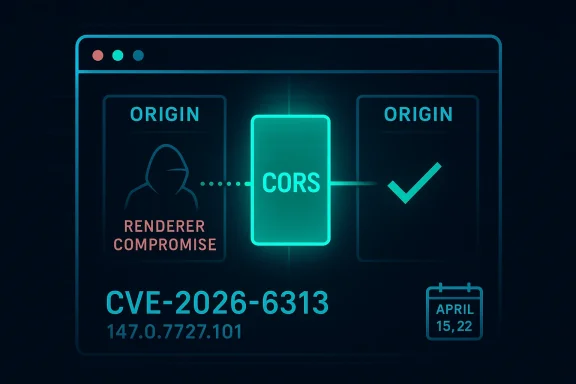
Insufficient policy enforcement in CORS is exactly the kind of Chromium bug that looks narrow on paper and broad in practice, because it sits at the intersection of renderer compromise, cross-origin data boundaries, and the browser’s trust model. Google has assigned CVE-2026-6313 to that issue, and Chrome stable builds prior to 147.0.7727.101 are identified as vulnerable, with the fix shipping in the April 15, 2026 desktop update. Microsoft’s Security Update Guide is tracking the same Chromium-originated issue for downstream visibility, which is a reminder that Chrome and Edge now share the same security heartbeat even when the branding differs.
Chromium’s security model depends on strict separation between origins, and CORS is one of the main mechanisms that enforces that separation in web applications. When the browser gets policy enforcement wrong, an attacker who already has a foothold in the renderer can sometimes turn that foothold into unauthorized access to data from another origin. That is why the CVE description focuses on a renderer-compromise scenario rather than a classic “drive-by remote exploit” narrative.
The phrasing matters. This is not the sort of bug that automatically hands an attacker full system control by itself. Instead, it weakens one of the browser’s core containment layers and can let an attacker leak cross-origin data through a crafted HTML page if they have already compromised the renderer process. In practical terms, that means the bug is highly relevant to post-exploitation abuse, sandbox escape chains, and targeted attacks that stack multiple weaknesses together.
Chrome’s April 15 stable release notes show that the fix arrived as part of a broader patch wave containing 31 security fixes, which is typical for modern browser servicing. Google also notes that bug details may remain restricted until most users are updated, a common practice when the security team wants to reduce the chance of exploit development during rollout. That means defenders often get the patch before they get the technical “why,” which is exactly how browser vendors prefer to move when the issue could be weaponized quickly.
For Microsoft customers, the CVE’s presence in the Microsoft Security Update Guide is a tracking signal rather than a second, separate Microsoft-created vulnerability. Edge inherits Chromium fixes downstream, so Microsoft documents the issue to help administrators determine when the affected build family has been updated. That makes CVE-2026-6313 relevant to any environment that relies on Chromium under the hood, not just Google Chrome users.
That distinction is important for defenders. A browser renderer compromise is already a serious event, but browser architecture assumes the renderer is the most exposed layer and tries to keep it boxed in. If a renderer attacker can pivot into cross-origin data leakage, then the security model’s containment is no longer doing enough work. In other words, the vulnerability doesn’t create the first foothold; it helps turn a foothold into meaningful reconnaissance or credential-adjacent exposure.
This is why the Chrome team labels the flaw High even though the published CISA ADP vector shows a relatively low numeric base score of 3.1 under CVSS 3.1 with AV:N/AC:H/PR:N/UI:R/S:U/C:L/I:N/A:N. The numbers are not contradictory; they are simply measuring different things from different perspectives. The vendor severity reflects the practical exploit chain value, while the advisory score reflects a more constrained generic model.
The update window matters because Chrome’s stable-channel rollout typically hits users in waves rather than a single synchronized moment. Google says the new build will roll out over the coming days and weeks, which is normal for a browser with hundreds of millions of endpoints. The practical result is that “fixed” and “fully deployed” are not the same thing, and that gap is where exposure can linger.
This release fits a familiar 2026 pattern: Google publishes the fix, the Chromium ecosystem absorbs it, and downstream vendors mirror the advisory so their own customer base can map the same CVE to their own products. Microsoft’s Security Update Guide is doing exactly that here, reinforcing the idea that browser patching is now an ecosystem event rather than a single-vendor event.
This is also why the same CVE can appear in Microsoft’s vulnerability portal even when the underlying issue belongs entirely to Chromium. The listing is a downstream mapping aid, not an indication that Microsoft authored the vulnerability. For admins, that mapping tells them when their Edge installations have crossed the safe version line and are no longer exposed to the Chromium bug.
Microsoft’s guidance is especially valuable in mixed fleets where users install multiple Chromium browsers or where enterprise software embeds Chromium through WebView2-style components. In those environments, a single CVE can affect more than one browser-facing surface. The vulnerability therefore behaves like a platform issue, not merely a browser product issue.
That is why policy enforcement flaws are disproportionately irritating to defenders. They often sit below the level of visible user impact, so they evade attention until a researcher proves that a boundary can be crossed. Then they become urgent because the browser’s own trust guarantees have been undermined in a way that does not always manifest as a crash.
That makes this a force multiplier bug rather than a standalone headline-grabber. Security teams should read it that way. The real danger is not just the direct data leak; it is the way the leak can feed a broader exploitation workflow.
This kind of issue is a good example of why patch queues need prioritization rather than simple chronological processing. A vulnerability that requires a prior renderer compromise might seem less urgent than an internet-facing remote code execution bug, but browser compromises are increasingly part of multi-stage intrusion paths. That makes the combination of browser ubiquity and post-compromise value especially concerning.
For managed environments, it is also wise to validate channel drift. Stable, Extended Stable, and internal packaging sometimes lag in different ways, and browser fleets are rarely as uniform as they appear in procurement documents. The same CVE can therefore remain live in pockets of the environment even after the “main” rollout is finished.
For rivals, the implication is that differentiation increasingly happens above the engine layer. Browsers compete on privacy controls, enterprise policy management, AI integration, synchronization, and user interface polish, but core engine security still comes from the same upstream codebase for a huge portion of the market. If Chromium stumbles, the whole downstream ecosystem has to react.
The upside is that the ecosystem has gotten better at reacting quickly. The downside is that defenders must now track version numbers, channel statuses, and vendor-specific rollout timing more carefully than they did in the pre-Chromium era. Shared code means shared exposure, even when the brands are different.
The broader pattern is unlikely to change. Chromium will continue to ship frequent security fixes, and Microsoft will continue to surface upstream CVEs in its own update guide so Edge administrators can track risk accurately. That means browser security operations in 2026 are increasingly about disciplined version hygiene, fast validation, and recognizing that even “policy” bugs can be operationally important.
Source: NVD / Chromium Security Update Guide - Microsoft Security Response Center
 Overview
Chromium’s security model depends on strict separation between origins, and CORS is one of the main mechanisms that enforces that separation in web applications. When the browser gets policy enforcement wrong, an attacker who already has a foothold in the renderer can sometimes turn that foothold into unauthorized access to data from another origin. That is why the CVE description focuses on a renderer-compromise scenario rather than a classic “drive-by remote exploit” narrative.The phrasing matters. This is not the sort of bug that automatically hands an attacker full system control by itself. Instead, it weakens one of the browser’s core containment layers and can let an attacker leak cross-origin data through a crafted HTML page if they have already compromised the renderer process. In practical terms, that means the bug is highly relevant to post-exploitation abuse, sandbox escape chains, and targeted attacks that stack multiple weaknesses together.
Chrome’s April 15 stable release notes show that the fix arrived as part of a broader patch wave containing 31 security fixes, which is typical for modern browser servicing. Google also notes that bug details may remain restricted until most users are updated, a common practice when the security team wants to reduce the chance of exploit development during rollout. That means defenders often get the patch before they get the technical “why,” which is exactly how browser vendors prefer to move when the issue could be weaponized quickly.
For Microsoft customers, the CVE’s presence in the Microsoft Security Update Guide is a tracking signal rather than a second, separate Microsoft-created vulnerability. Edge inherits Chromium fixes downstream, so Microsoft documents the issue to help administrators determine when the affected build family has been updated. That makes CVE-2026-6313 relevant to any environment that relies on Chromium under the hood, not just Google Chrome users.
What the CVE Actually Means
At a technical level, CORS is meant to stop one origin from reading another origin’s data unless the server explicitly allows it. When Chromium’s policy enforcement is insufficient, the browser may permit data access paths that should have been blocked. The key issue here is not that CORS disappears entirely, but that enforcement becomes incomplete in a way that can be abused by an attacker who is already inside the renderer boundary.That distinction is important for defenders. A browser renderer compromise is already a serious event, but browser architecture assumes the renderer is the most exposed layer and tries to keep it boxed in. If a renderer attacker can pivot into cross-origin data leakage, then the security model’s containment is no longer doing enough work. In other words, the vulnerability doesn’t create the first foothold; it helps turn a foothold into meaningful reconnaissance or credential-adjacent exposure.
Why “renderer process compromise” changes the risk story
Modern browser attacks often chain together vulnerabilities rather than relying on a single clean exploit. A renderer compromise may come from a JavaScript engine bug, a memory corruption flaw, or a logic error elsewhere in the browser stack. Once the attacker lands there, CORS policy failures can become a very efficient data exfiltration primitive because the browser itself is expected to police origin boundaries.This is why the Chrome team labels the flaw High even though the published CISA ADP vector shows a relatively low numeric base score of 3.1 under CVSS 3.1 with AV:N/AC:H/PR:N/UI:R/S:U/C:L/I:N/A:N. The numbers are not contradictory; they are simply measuring different things from different perspectives. The vendor severity reflects the practical exploit chain value, while the advisory score reflects a more constrained generic model.
- The bug lives in Chromium’s policy enforcement path.
- The attacker needs an existing renderer compromise.
- The likely impact is cross-origin data leakage, not direct code execution.
- The exploit value rises sharply if the browser is already in a chained attack scenario.
- The fix is therefore important even if the standalone CVSS number looks modest.
The broader security lesson
Browsers are less and less a single application and more and more a security platform. That means policy bugs are often as important as memory-safety bugs because they can unwind the assumptions that make sandboxing worthwhile. If the boundary between origins becomes porous, the attacker gains a shortcut that can be just as damaging as a crash-based exploit chain. That is the quiet danger of policy enforcement bugs: they don’t always look dramatic, but they can reshape what an attacker can do next.How Google Framed the Fix
Google’s April 15 update is the primary public signal that the issue has been addressed in Chrome stable. The release notes explicitly list CVE-2026-6313 as “Insufficient policy enforcement in CORS,” with the affected versions ending before 147.0.7727.101. That gives administrators a clean threshold for version-based verification once their deployment tools refresh inventory.The update window matters because Chrome’s stable-channel rollout typically hits users in waves rather than a single synchronized moment. Google says the new build will roll out over the coming days and weeks, which is normal for a browser with hundreds of millions of endpoints. The practical result is that “fixed” and “fully deployed” are not the same thing, and that gap is where exposure can linger.
Release engineering and security posture
Chrome’s release notes also make clear that some bug details can remain restricted while the majority of users update. That is a defensive choice, not secrecy for its own sake. In security engineering, delaying detail can reduce the odds that exploit developers get a head start while the patch is still propagating.This release fits a familiar 2026 pattern: Google publishes the fix, the Chromium ecosystem absorbs it, and downstream vendors mirror the advisory so their own customer base can map the same CVE to their own products. Microsoft’s Security Update Guide is doing exactly that here, reinforcing the idea that browser patching is now an ecosystem event rather than a single-vendor event.
- Chrome stable build: 147.0.7727.101/102 on Windows and Mac, 147.0.7727.101 on Linux.
- The fix is part of a 31-fix security update.
- The issue is labeled High by Chromium.
- Bug details may remain restricted during rollout.
Why the version number matters
For defenders, version thresholds are often more useful than exploit descriptions because they can be turned into policy. Once the affected build boundary is known, enterprise management tools can query fleet compliance directly. That turns a vulnerability advisory into a measurable operational task rather than an abstract risk statement.Microsoft’s Role in Tracking Chromium CVEs
Microsoft’s Security Update Guide lists Chromium CVEs like this one because Microsoft Edge is Chromium-based and inherits upstream security fixes. That is a crucial operational detail for organizations that standardize on Edge in Windows environments. They are not waiting for Microsoft to independently rediscover the bug; they are waiting for Microsoft to confirm that the upstream Chromium fix has been integrated into Edge’s servicing line.This is also why the same CVE can appear in Microsoft’s vulnerability portal even when the underlying issue belongs entirely to Chromium. The listing is a downstream mapping aid, not an indication that Microsoft authored the vulnerability. For admins, that mapping tells them when their Edge installations have crossed the safe version line and are no longer exposed to the Chromium bug.
Edge versus Chrome: same engine, different servicing
The practical implication is straightforward: if your organization uses Chrome, you watch Google’s stable channel; if you use Edge, you watch both Google’s Chromium lineage and Microsoft’s Edge release cadence. The security posture is shared, but the patch delivery mechanism is not identical. That extra layer of indirection is manageable, but only if IT teams actively reconcile both channels.Microsoft’s guidance is especially valuable in mixed fleets where users install multiple Chromium browsers or where enterprise software embeds Chromium through WebView2-style components. In those environments, a single CVE can affect more than one browser-facing surface. The vulnerability therefore behaves like a platform issue, not merely a browser product issue.
- Microsoft documents Chromium CVEs to signal downstream patch status.
- Edge inherits the fix path from Chromium.
- Security teams need to verify both browser version and channel.
- Enterprise fleets may carry multiple Chromium-based endpoints.
Enterprise verification in practice
In a managed Windows environment, this is the moment to check inventory, not merely read the advisory. The real question is whether the affected Edge channel has received the Chromium fix and whether devices have actually updated. Patching available is not the same as patching completed, and browser updates are notorious for lagging behind the security headline.Why CORS Bugs Matter More Than Their Labels Suggest
CORS bugs can look modest because they are often framed as data exposure rather than code execution. But in modern attack chains, information leakage is frequently the stepping stone that makes later stages practical. Once an attacker can read more than they should, they may gain tokens, session-derived state, application secrets, or enough internal context to mount a second-stage attack.That is why policy enforcement flaws are disproportionately irritating to defenders. They often sit below the level of visible user impact, so they evade attention until a researcher proves that a boundary can be crossed. Then they become urgent because the browser’s own trust guarantees have been undermined in a way that does not always manifest as a crash.
The attack chain perspective
If an attacker already has renderer-level code execution or equivalent control, their next objective is often to escape the renderer’s isolation or to harvest useful data from inside it. A CORS enforcement gap helps in the second category. It can turn same-origin restrictions into something softer and less reliable, especially when paired with crafted HTML and attacker-controlled content flow.That makes this a force multiplier bug rather than a standalone headline-grabber. Security teams should read it that way. The real danger is not just the direct data leak; it is the way the leak can feed a broader exploitation workflow.
- CORS is a browser boundary, not just a web developer convenience.
- Policy failures can expose tokens or private application data.
- The flaw is especially relevant after renderer compromise.
- Crafted HTML is often enough to operationalize the leak.
- The issue may not look dramatic in isolation, but it strengthens the attacker’s chain.
Why defenders should care anyway
A “High” Chromium severity should not be dismissed just because a generic CVSS score appears low. The severity label is often the better shorthand for exploitability in context. Vendors know their own architecture, and when they say a browser flaw is high-risk in a particular trust boundary, that assessment usually deserves more weight than a detached scoring model. In browser security, context is the whole game.Patch Management Implications
The immediate operational takeaway is that administrators should confirm Chromium-based browsers are on or beyond the fixed build. For Chrome, that means 147.0.7727.101 or later for the affected stable channel. For Edge, the same logic applies through Microsoft’s downstream update stream, with Microsoft’s Security Update Guide serving as the verification layer.This kind of issue is a good example of why patch queues need prioritization rather than simple chronological processing. A vulnerability that requires a prior renderer compromise might seem less urgent than an internet-facing remote code execution bug, but browser compromises are increasingly part of multi-stage intrusion paths. That makes the combination of browser ubiquity and post-compromise value especially concerning.
Practical triage steps
The safest approach is to treat the advisory as a version-control problem first and an incident-response problem second. That sounds mundane, but it is exactly how browser defense works in large fleets. You reduce risk by pushing the fixed build, then you review whether any telemetry indicates exploitation attempts or suspicious browsing behavior around the vulnerable window.For managed environments, it is also wise to validate channel drift. Stable, Extended Stable, and internal packaging sometimes lag in different ways, and browser fleets are rarely as uniform as they appear in procurement documents. The same CVE can therefore remain live in pockets of the environment even after the “main” rollout is finished.
- Confirm Chrome is at 147.0.7727.101 or later.
- Confirm Edge has ingested the Chromium fix.
- Audit both Stable and Extended Stable populations.
- Look for delayed rollouts in remote or offline devices.
- Review browser telemetry for suspicious post-compromise activity.
Consumer versus enterprise behavior
Consumers usually just need to update and move on. Enterprises, by contrast, have to verify distribution, policy compliance, and exception handling. That makes a browser CVE like this one disproportionately expensive in enterprise time, even if the underlying flaw is relatively small in code terms. The cost is not only the patch; it is the confidence-building work around the patch.Competitive and Ecosystem Impact
CVE-2026-6313 also illustrates how much of the browser market has converged around Chromium’s security cadence. Google still leads the browser project, but Microsoft and other Chromium consumers now move in lockstep whenever a core engine issue lands. That raises the security baseline for everyone, while also making upstream release quality more consequential than ever.For rivals, the implication is that differentiation increasingly happens above the engine layer. Browsers compete on privacy controls, enterprise policy management, AI integration, synchronization, and user interface polish, but core engine security still comes from the same upstream codebase for a huge portion of the market. If Chromium stumbles, the whole downstream ecosystem has to react.
What this means for browser strategy
This shared security model is efficient, but it also concentrates risk. One upstream policy bug can affect Google Chrome, Microsoft Edge, and any Chromium-based derivative that has not yet pulled the fix. That is a security strength in the sense of coordinated response, but it is also a dependency risk because the blast radius is inherently larger than a single-vendor stack.The upside is that the ecosystem has gotten better at reacting quickly. The downside is that defenders must now track version numbers, channel statuses, and vendor-specific rollout timing more carefully than they did in the pre-Chromium era. Shared code means shared exposure, even when the brands are different.
- Chromium fixes propagate across a large browser ecosystem.
- Security coordination is faster, but exposure is broader.
- Vendor differentiation shifts upward into features and policy tooling.
- Administrators have to follow multiple release channels.
- Browser security has become a supply-chain problem as much as a product problem.
The strategic lesson for the market
The market lesson is simple: browser vendors cannot treat upstream security as an afterthought, because it is now part of their product identity. When a Chromium flaw lands, downstream vendors inherit not just the patch, but the customer expectation that they will move quickly and communicate clearly. That expectation is now baseline, not bonus.Strengths and Opportunities
The strongest part of this security response is how clearly the ecosystem has identified the affected build boundary and pushed a fix into the stable channel. For defenders, that makes remediation easier to operationalize, and it gives both Chrome and Edge administrators a common language for verifying status. It also reinforces a healthier norm in browser security: patch first, detail later, and reduce the window for exploitation as much as possible.- The affected version is clearly defined.
- The fix is already in stable channels.
- Vendor severity is explicit and actionable.
- Microsoft’s tracking helps downstream visibility.
- The issue is easy to convert into version-based compliance checks.
- Chromium’s update model enables rapid ecosystem-wide correction.
- Browser security teams are treating policy bugs with appropriate seriousness.
Risks and Concerns
The main concern is that a renderer-compromise prerequisite does not make the bug harmless. In a modern intrusion chain, that prerequisite may already be satisfied by an unrelated flaw, so the CORS issue becomes the second or third step in a meaningful attack path. Another risk is rollout lag: the fix exists, but not every endpoint gets it at once, and attackers know how to target the lagging tail.- Renderer compromise can precede the CORS abuse.
- Staged rollouts create temporary exposure windows.
- Downstream products may lag upstream Chrome by hours or days.
- Mixed-browser fleets complicate patch verification.
- Generic scoring can understate chain value.
- Administrators may overlook “leak” bugs compared with crash bugs.
- Browser telemetry may miss subtle data exfiltration attempts.
Looking Ahead
The next thing to watch is how quickly the patched builds reach the long tail of devices, especially machines that sit behind layered enterprise update controls or spend long periods offline. It will also be worth watching whether incident responders begin correlating this CVE with suspicious renderer activity, because that would confirm the flaw’s value in chained exploitation rather than isolated abuse. A second point of interest is whether Google or downstream vendors publish more detail once the rollout is sufficiently broad.The broader pattern is unlikely to change. Chromium will continue to ship frequent security fixes, and Microsoft will continue to surface upstream CVEs in its own update guide so Edge administrators can track risk accurately. That means browser security operations in 2026 are increasingly about disciplined version hygiene, fast validation, and recognizing that even “policy” bugs can be operationally important.
- Watch for wider rollout of 147.0.7727.101 and later.
- Verify Edge’s downstream fix adoption.
- Monitor whether exploit detail becomes public after rollout.
- Check enterprise endpoints that update slowly or manually.
- Correlate browser logs with suspicious cross-origin access behavior.
Source: NVD / Chromium Security Update Guide - Microsoft Security Response Center
Last edited:
