

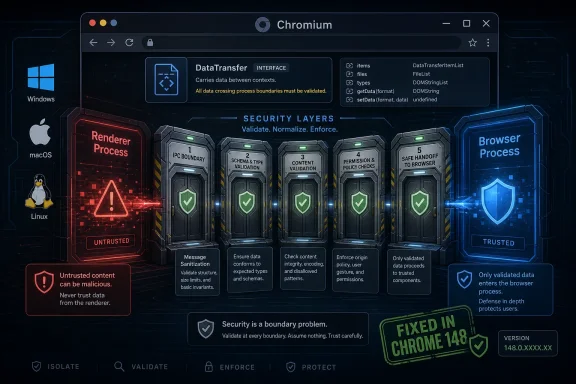
A Medium Bug With an Uncomfortable Shape
CVE-2026-7989 is officially framed as “insufficient data validation in DataTransfer,” with exploitation requiring a remote attacker to have already compromised the renderer process and to lure a user to a crafted HTML page. That wording is easy to underestimate. In ordinary patch-triage language, “medium,” “user interaction required,” and “high attack complexity” sound like reasons to let the automatic updater do its work in peace.
But Chromium bugs often deserve to be read as part of a chain, not as isolated chess pieces. A renderer compromise is not supposed to be the end of the story; it is supposed to be contained by the browser sandbox, process isolation, permission checks, and layers of type and data validation in the browser process and related components. When a vulnerability description says arbitrary read/write is possible after renderer compromise, it is pointing directly at the machinery that keeps a bad tab from becoming a bad workstation.
That is why this CVE matters to WindowsForum readers even if it does not carry the drama of an actively exploited zero-day. It sits in the gap between “the web page got control of a renderer” and “the attacker can use that foothold to do something more useful.” For defenders, that gap is not academic. It is where drive-by exploits either die in a sandbox or turn into incident tickets.
The patch arrived in the broader Chrome 148 stable release, which also fixed a large batch of vulnerabilities across the browser. CVE-2026-7989 was one of many, but its placement in DataTransfer makes it a useful lens for thinking about the browser as an operating-system-adjacent platform. The browser is no longer merely an app on Windows. It is the execution environment where users open documents, move data between apps, authorize accounts, and bridge local and cloud workflows.
DataTransfer Is a Small API With a Long Security Shadow
The DataTransfer interface sounds mundane because it is tied to actions users perform constantly: dragging, dropping, copying, pasting, and moving data between browser contexts. In web-platform terms, it exists to represent the data being transferred during drag-and-drop operations and clipboard-like interactions. In security terms, it is a boundary-crossing mechanism.
Boundary-crossing APIs are where browser engineering becomes messy. A web page wants to know what the user dragged. The operating system has its own clipboard and drag data formats. The browser has to translate between DOM objects, native platform objects, sandboxed renderer processes, browser-process validation, permissions, origins, and user gestures. Every translation step is an opportunity for a stale assumption.
The “insufficient data validation” phrase is generic, but in this context it suggests the browser accepted, trusted, transformed, or exposed DataTransfer-related state in a way it should not have. The attacker described in the advisory already controls the renderer, so the question is not whether a malicious web page can call a JavaScript API in a weird order. The question is whether a compromised renderer can feed malformed or unexpected DataTransfer data into a more privileged component and get memory access it should not have.
That is the pattern that keeps browser vendors awake. Renderers are intentionally treated as hostile. They parse JavaScript, HTML, CSS, images, fonts, WebAssembly, and media from the open internet. A renderer compromise is bad, but it is a known class of failure. The real test is whether the rest of the browser refuses to believe the renderer when it lies.
CVE-2026-7989 appears to be one of those trust failures. The public description does not say that it grants full system compromise. It does say arbitrary read/write was possible in the scenario described. For exploit developers, an arbitrary read/write primitive is rarely the final objective; it is the lever used to bend control flow, corrupt state, escape assumptions, or pair with another bug.
The Renderer Compromise Requirement Is a Warning, Not a Comfort Blanket
The most important phrase in the CVE text is “who had compromised the renderer process.” Some readers will translate that as “not exploitable by itself,” and they may be right in the narrowest possible sense. But a browser security update is not graded on whether every CVE is a standalone catastrophe. It is graded on whether the browser’s exploit chain becomes shorter, cheaper, and more reliable.
Attackers do not need every link in a chain to be critical. They need the links to fit together. A memory corruption bug in JavaScript or Blink can provide renderer execution. A validation flaw at a renderer-to-browser boundary can provide a way out. A kernel or driver bug can provide persistence or deeper privileges. That is how a “medium” browser bug can become strategically important without being independently spectacular.
The CVSS vector published through CISA’s ADP scoring lands at 4.2, with network attack vector, high attack complexity, no privileges required, user interaction required, unchanged scope, and low confidentiality and integrity impact. That score is defensible as a standalone severity measurement. It is also not a complete operational risk model.
Security teams have learned this lesson repeatedly with Chromium. The public advisory language is often constrained because details remain restricted until users have patched. That restriction is sensible; it protects the patch window. It also means defenders must triage from sparse descriptions, and sparse descriptions often understate how useful a bug might be inside a chain.
The right reading is neither panic nor dismissal. CVE-2026-7989 is not a reason to tell users that the sky is falling. It is a reason to confirm that Chrome and Chromium-based browsers are actually updating across fleets, especially where browsers are allowed to remain open for days, extensions are unmanaged, or web content is treated as a trusted business substrate.
Chrome 148 Turns One CVE Into a Fleet Hygiene Test
Chrome 148 reached the stable channel for Windows, macOS, and Linux with version 148.0.7778.96 on Linux and 148.0.7778.96/97 on Windows and Mac. Google said the rollout would happen over days or weeks, which is normal for Chrome but awkward for administrators who measure exposure in hours. The difference between “available” and “installed everywhere” is the difference between a security bulletin and a security outcome.
This is where consumer browser culture collides with enterprise reality. Chrome’s auto-update model is excellent for unmanaged home users, but many organizations still have update deferrals, change windows, golden images, VDI layers, browser relaunch problems, and line-of-business testing rituals. A browser can be patched in the vendor’s release channel and still be vulnerable on a user’s desktop because the user has not restarted it.
That last point is the quiet villain in browser patching. Chrome can download an update in the background, but the running browser generally needs a restart to complete the transition. Users who live inside browser sessions for weeks — with pinned tabs, SaaS consoles, admin portals, and half-written forms — can lag behind even when the updater is functioning.
For Windows administrators, the obvious control is not merely “deploy Chrome 148.” It is to verify installed versions after restart and to apply relaunch policies where necessary. In Microsoft Edge environments, the same conceptual problem applies: Chromium security fixes reach Edge through Microsoft’s release pipeline, and administrators need to track the Edge version that contains the relevant Chromium fixes rather than assuming Chrome’s version number maps one-to-one to Edge’s.
The unpleasant truth is that the browser is now one of the highest-value applications in the enterprise, but it is often patched with less ceremony than endpoint agents, VPN clients, or Office. CVE-2026-7989 is a reminder that the modern browser deserves the same asset visibility and compliance pressure as anything else that processes untrusted code all day.
Microsoft’s Role Is Bigger Than a Mirror of Google’s Advisory
The user-facing source here is Microsoft’s Security Update Guide entry for CVE-2026-7989, but Microsoft is not the originator of the bug. The source is Chrome, and the vulnerable technology is Chromium. That distinction matters because it shows how browser security has become a shared dependency problem.
Microsoft Edge is Chromium-based, but it is not simply Chrome with a different icon. Microsoft has its own release channels, enterprise policies, security features, update mechanisms, and Windows integration points. Still, when Chromium fixes a web-platform flaw, Edge inherits the relevance. The supply chain is open-source and collaborative, but the exposure lands on endpoints branded by multiple vendors.
That creates a familiar patch-management wrinkle. Security teams may see CVE-2026-7989 in Microsoft tooling and wonder whether it is a Windows vulnerability, an Edge vulnerability, or a Chrome vulnerability. The answer is that it is a Chromium vulnerability with product-specific packaging. On Windows, that means both Chrome and Edge may be in scope, and the right remediation depends on which browser binaries are installed and allowed.
The CPE configuration in NVD’s change history lists Google Chrome versions before 148.0.7778.96 with Windows, Linux, and macOS operating-system context. That does not mean the operating systems themselves are vulnerable in the way the browser is. It means the vulnerable application exists on those platforms. This distinction is important for reporting because sloppy dashboards can make browser CVEs look like OS CVEs, and sloppy remediation language can send teams chasing the wrong patch.
Microsoft’s presence in the advisory ecosystem also changes the audience. A CVE posted through MSRC will reach Windows administrators who may not watch the Chrome Releases blog every day. That is a feature, not noise. In 2026, the Windows security perimeter includes Chromium whether the icon on the taskbar says Chrome, Edge, Brave, Vivaldi, or something else.
The NVD Lag Is Not a Reason to Wait
At the time the CVE details were published, NVD had not yet provided its own CVSS score, while CISA’s ADP entry supplied a CVSS 3.1 base score of 4.2. That mismatch is not unusual. NVD enrichment often trails vendor disclosure, and the first few days of a CVE’s life are full of partial metadata, incomplete CPEs, and evolving weakness mappings.
For defenders, the practical problem is that many vulnerability-management systems lean heavily on NVD-enriched records. If NVD scoring, CPE normalization, or affected-product metadata is incomplete, dashboards can undercount exposure or fail to match installed software cleanly. The “are we missing a CPE?” prompt in the NVD record is not just a bureaucratic footnote. It is a small admission that machine-readable vulnerability truth is assembled over time.
That is dangerous when the affected software is a browser. Browser updates move faster than monthly patch cycles, and the exploit economy moves faster still. Waiting for a perfect CPE match before taking action against a browser security update is backwards. The vendor version threshold is usually the cleaner operational signal: Chrome before 148.0.7778.96 is vulnerable; update to the fixed release or later.
This is especially true for organizations with multiple software inventory sources. One tool may report Chrome’s major version, another may report full build numbers, and a third may conflate system-level Edge WebView2 runtime data with the full browser. If the vulnerability database is still catching up, the inventory system must be precise enough to answer the simple question: which Chromium-based executables are still below their fixed builds?
NVD remains useful, but it should not be treated as the start pistol for action. In the browser world, vendor release notes and installed-version telemetry are often the faster path to risk reduction. The CVE record catches up; the adversary does not wait for enrichment.
Medium Severity Is Where Exploit Chains Hide
There is a reason browser vendors pour so much energy into sandboxing. The web is hostile by design, and the renderer is the front line. If a renderer bug automatically meant full compromise, the modern browser would be indefensible. The whole model depends on turning catastrophic parser and JIT failures into contained tab-level incidents.
CVE-2026-7989 sits in the class of issues that tests that containment model. The phrase “arbitrary read/write” is powerful, but the precondition matters. The attacker needs renderer compromise first, and the victim needs to interact with a crafted page. That is why the severity is medium rather than critical.
Yet defenders should resist the temptation to treat severity labels as scheduling labels. “Critical” means “drop everything.” “High” means “move quickly.” “Medium” too often means “we will get to it when the monthly patch report turns red.” For browser bugs, that last category is where chained exploitation can mature quietly.
A medium-severity bug can be valuable because it solves a specific exploit-development problem. It may make a chain more reliable. It may reduce the need for a separate sandbox escape. It may expose memory that turns an unreliable crash into a weaponized primitive. It may work only in narrow conditions, but attackers are specialists in arranging conditions.
This is not an argument to inflate every browser CVE into an emergency. It is an argument to patch browsers continuously rather than severity-gating them like server middleware. If the update is stable, broadly available, and fixes memory-safety or validation issues in web-exposed code, the default posture should be rapid deployment with rollback monitoring, not prolonged deliberation.
The Crafted HTML Page Still Runs Through Human Behavior
The advisory’s requirement for a crafted HTML page is another phrase that can lull readers into complacency. In practice, crafted web content is the internet. Attackers do not need a victim to download a strange executable when the browser is already designed to fetch and execute attacker-controlled content.
User interaction is similarly slippery. It might mean clicking a link, opening a malicious page, interacting with drag-and-drop content, or following a phishing lure to a site that hosts exploit code. The more the browser becomes the workplace, the less meaningful it is to say that web exploitation requires interaction. Opening links is the job.
That is why browser exposure is different from exposure in a rarely used desktop utility. Chrome and Edge are not optional for most users. They are the portal to identity providers, collaboration suites, ticketing systems, admin consoles, CRM platforms, internal dashboards, and file-sharing sites. A user does not have to behave recklessly to encounter attacker-controlled HTML. They merely have to work.
The DataTransfer angle adds another subtlety. Drag-and-drop and clipboard-like workflows are natural in SaaS-heavy environments. Users move files into browser windows, drag content between apps, and copy structured data across origins. Features designed for convenience expand the attack surface because they require the browser to mediate between untrusted content and user-intended data movement.
The correct response is not to disable the modern web. It is to recognize that web APIs are not harmless because they are familiar. The most ordinary browser features often require the most careful validation because they sit at the intersection of user intent, operating-system integration, and renderer-controlled data.
Edge, Chrome, and the Chromium Commons
The Chromium project has made browser security both stronger and more centralized. On the strength side, a bug found and fixed in Chromium can protect a large share of the browser ecosystem. On the centralization side, a bug in Chromium can also expose a large share of that ecosystem at once.
This is the bargain Microsoft accepted when it rebuilt Edge on Chromium. It gained compatibility, performance, extension ecosystem access, and the momentum of Google’s browser engine work. It also tied Edge security, in part, to the Chromium vulnerability stream. That trade has been rational for years, but it changes how administrators should think about patching.
A Windows shop that standardizes on Edge cannot ignore Chrome advisories because the underlying project is shared. A Chrome-heavy shop cannot ignore MSRC advisories because Microsoft may surface Chromium CVEs through channels that security teams already monitor. A mixed-browser shop has to treat Chromium as a platform dependency, not a brand preference.
There is also the WebView2 question. Many Windows desktop applications embed web content through Microsoft’s Edge WebView2 runtime. Not every Chromium browser CVE automatically maps cleanly to every WebView2 scenario, and administrators should avoid lazy equivalence. But the broader point stands: Chromium-derived code is spread across more than the browser window users recognize.
That sprawl argues for better inventory. “Do we have Chrome?” is no longer the right question. “Where do we run Chromium-derived components, which update channels govern them, and how quickly do they restart into fixed builds?” is closer to the truth. CVE-2026-7989 is a Chrome CVE by origin, but the operational lesson is ecosystem-wide.
Patch Management Has to Measure the Relaunch, Not the Download
Browser patching has a deceptively clean story: updates are automatic, users get protected, and administrators can move on. The real story is messier. Auto-update gets the payload to disk; the running process determines whether the vulnerable code is still in memory.
This distinction matters in persistent-session environments. Developers, analysts, help-desk staff, and administrators often keep browsers open for days. Kiosk systems and shared workstations may run locked-down sessions that are rarely rebooted. Virtual desktops may refresh from images that lag behind stable-channel updates. A browser estate can look compliant in software inventory while still running vulnerable processes.
The better metric is effective version after relaunch. Enterprises can enforce relaunch notifications and deadlines in Chrome and Edge, but those policies need to be tuned carefully. Too aggressive, and users lose work or develop update fatigue. Too lax, and the organization accumulates browser debt invisibly.
CVE-2026-7989 does not require a special mitigation beyond updating, at least based on the public advisory. That makes it a good test of basic hygiene. If an organization cannot get a medium-severity Chrome update deployed and relaunched quickly, it will struggle under pressure when the next exploited-in-the-wild bug arrives.
There is also a communications problem. Users understand Windows Update reboots because they have been trained by years of forced restarts and Patch Tuesday rhythms. Browser restarts feel optional, almost cosmetic. Security teams should be explicit that a browser relaunch is often the moment the patch actually becomes protection.
The Browser Sandbox Is Only as Good as Its Boring Validation Code
Security coverage tends to gravitate toward dramatic bug classes: use-after-free, type confusion, out-of-bounds write, JIT miscompilation. CVE-2026-7989 carries a less cinematic label: improper input validation. That sounds pedestrian until one remembers that validation is the daily work of sandbox enforcement.
A sandbox is not just a container. It is a set of rules about what a less privileged process may ask a more privileged process to do. Those rules are implemented through message parsing, object serialization, permission checks, origin checks, handle validation, state machines, and platform-specific glue. A compromised renderer’s primary job is to find the place where those rules are incomplete.
DataTransfer is exactly the kind of subsystem where incomplete rules can creep in. It has to carry data that may be text, files, URLs, custom MIME types, or platform-native representations. It has to respect user gestures and origin boundaries. It has to cooperate with operating-system conventions on Windows, macOS, and Linux. It has to do all of that while assuming that the renderer might be malicious.
This is why browser hardening is a game of boring details. Every field has to be checked. Every size has to be bounded. Every state transition has to make sense. Every object crossing a process boundary has to be treated as hostile until proven otherwise. The bug class may be called CWE-20, but the practical consequence is the integrity of Chromium’s compartment model.
That is also why public CVE summaries can feel frustratingly thin. The details that would satisfy researchers are often the same details that would help attackers weaponize the flaw before patch adoption is widespread. The result is a familiar dance: sparse advisory, broad update, restricted bug tracker, delayed technical analysis. Defenders have to act before the satisfying postmortem arrives.
The Chrome 148 Patch Is a Reminder That Security Debt Compounds
Chrome 148 reportedly fixed well over 100 security vulnerabilities, including several higher-severity issues elsewhere in the browser. In that crowd, CVE-2026-7989 could disappear into the patch-note fog. That would be a mistake, because the number of bugs in a release tells us something about the scale of the surface area users carry every day.
Modern browsers are operating systems for untrusted code. They include JavaScript engines, rendering engines, graphics pipelines, media parsers, network stacks, password managers, sync systems, extension frameworks, PDF viewers, WebUSB, WebGPU, WebRTC, file-system bridges, and countless compatibility layers. The wonder is not that Chrome 148 patched a large list of bugs. The wonder is that the platform works as reliably as it does.
But scale changes patch philosophy. In a small application, a medium-severity bug may be one item in a quarterly risk register. In Chromium, a medium-severity bug exists inside a dense forest of adjacent attack surfaces. The browser’s total risk is cumulative, and attackers can mix components until they find a path.
This is why delaying browser updates is so expensive. Each missed release is not merely one unfixed CVE. It is a growing set of known flaws, some publicly described, some privately understood, some with proof-of-concept work likely to appear once patches diffuse. Falling one major version behind may not feel dramatic. Falling behind across a fleet creates a menu.
The security industry often talks about “patch prioritization” as if the main problem is deciding what not to patch. For browsers, the better model is patch acceleration. The browser should be on the shortest safe update path an organization can tolerate, because the exposure is constant and the adversary’s test harness is the public web.
Windows Administrators Should Read This as an Asset-Control Story
For WindowsForum’s core audience, the immediate action is simple: make sure Chrome is at 148.0.7778.96 or later, and make sure Edge receives the corresponding Microsoft security update when available through its channel. But the more durable action is to improve browser asset control.
That means knowing which browsers are installed, which are merely tolerated, and which are actually used. Shadow browsers matter. A developer may keep Chrome Canary, Firefox, Brave, and Edge installed for testing. A marketing user may install a secondary Chromium browser for extensions. A help-desk technician may use portable browser builds. Each one can become an untracked web execution environment.
It also means treating extensions as part of the risk picture. CVE-2026-7989 is not an extension bug, but extensions can influence browsing behavior, inject content scripts, request broad permissions, and complicate incident response. A hardened browser running unmanaged extensions is not a hardened browser in practice.
Finally, administrators should align browser patching with endpoint detection. If exploit chains begin in the renderer and attempt to cross process boundaries, telemetry from browsers, EDR agents, and network controls can provide early warning. But that telemetry is only useful if teams know what normal browser behavior looks like and can correlate suspicious child processes, crashes, unusual memory behavior, or exploit-mitigation events.
A medium Chromium CVE will rarely justify emergency war-room theatrics by itself. It should justify asking whether browser governance is mature enough for the day when the CVE is critical, exploited, and already circulating in phishing campaigns.
The Real Fix Is Faster Trust Collapse
The old browser security model trusted pages too much. The modern model trusts renderers much less. CVE-2026-7989 shows the next frontier: privileged browser components must assume that every renderer-originated structure is a potential lie, even when it arrives through a familiar web API.
That principle is not limited to DataTransfer. It applies to every mechanism where web content asks the browser to broker access to something outside the renderer: files, devices, windows, credentials, clipboards, downloads, notifications, payments, identities, and local applications. The browser’s future depends on making trust collapse faster and more consistently. The moment a renderer is compromised, every downstream interface must become suspicious.
This is also where memory-safe rewrites, stronger IPC schemas, process isolation, fuzzing, and exploit mitigations converge. No single technique solves the problem. Validation bugs survive because real systems are full of legacy behaviors, compatibility demands, and platform-specific edge cases. The best defense is layered paranoia, followed by fast patch distribution when paranoia fails.
For users, the practical advice remains almost boring: update the browser, restart it, and do not assume automatic updates have finished until the version number says so. For enterprises, the advice is sharper: browser patch compliance should be measured with the same seriousness as OS patch compliance, because the browser is where much of the organization now executes untrusted code.
The Patch Window Is Where the Risk Becomes Real
CVE-2026-7989 is not the scariest Chromium bug of the year, and that is precisely why it is useful. It shows the ordinary mechanics of browser risk without the distorting glare of an active zero-day campaign. A validation flaw appears in a boundary-crossing API; a vendor ships a fix; metadata begins to propagate; administrators race the slow physics of rollout, restart, and inventory.
The most concrete lessons are not exotic.
- Chrome installations should be updated to 148.0.7778.96 or later, with Windows and Mac systems receiving the appropriate 148.0.7778.96/97 stable builds.
- Microsoft Edge administrators should track Microsoft’s Chromium-based Edge security releases rather than assuming Chrome’s build number directly describes Edge’s fixed state.
- Vulnerability dashboards may lag during the first days of NVD enrichment, so installed-version telemetry is more reliable than waiting for perfect CPE matching.
- Browser relaunch enforcement matters because downloaded updates do not always protect already-running browser processes.
- Medium-severity Chromium bugs should be patched quickly when they affect renderer containment, validation boundaries, or arbitrary read/write primitives.
- Organizations should inventory all Chromium-based browsers and embedded runtimes instead of managing only the officially preferred browser.
The forward-looking lesson is that browser security is becoming less about spectacular single bugs and more about the discipline of keeping many small boundaries intact. CVE-2026-7989 will fade into the long ledger of Chromium fixes, but the pattern will not: web APIs will keep crossing privilege boundaries, attackers will keep chaining modest primitives into meaningful compromise, and the organizations that win will be the ones that treat the browser not as a convenience app, but as a constantly exposed platform that must be patched, restarted, measured, and distrusted by design.
References
- Security Update Guide - Microsoft Security Response Center NVD / Chromium