Schneider Electric’s EcoStruxure IT Data Center Expert versions 9.1.1 and earlier contain an authenticated XML External Entity vulnerability, disclosed by Schneider on June 9, 2026 and republished by CISA on June 30, that can expose server-side file contents through crafted SOAP requests. The fix is version 9.1.2, and the advisory’s quiet wording should not lull data center operators into treating this as ordinary middleware housekeeping. This is a “medium” vulnerability on paper, but it lives in the management layer of environments where visibility software often has broader reach than anyone remembers. For WindowsForum readers running mixed IT, facilities, and industrial-adjacent estates, the real story is not the CVSS score; it is the risk created when infrastructure monitoring platforms become trusted islands.
EcoStruxure IT Data Center Expert is not a glamorous target in the way an internet-facing VPN appliance or identity provider is glamorous. It is the kind of system that sits in the rack-management strata, collecting alerts, device information, UPS and cooling data, and operational state from equipment that most organizations would rather not touch unless something is already going wrong. That makes it easy to underestimate and hard to replace.
The newly disclosed flaw, tracked as CVE-2026-8045, is a classic XML External Entity issue: an attacker with a Data Center Expert user account can send crafted XML payloads to SOAP service endpoints and potentially read server-side file contents. Schneider assigns the issue a CVSS 3.1 base score of 6.5, with network attack vector, low complexity, low privileges required, no user interaction, and high confidentiality impact.
That combination tells a familiar story. The vulnerability does not hand a stranger on the internet a one-click takeover, and the advisory does not claim code execution, data modification, or denial of service. But it does mean that a valid user account may be enough to turn a monitoring application into a file-reading oracle on the server side.
In ordinary enterprise software, authenticated file disclosure is bad. In a data center monitoring platform, it can be worse, because the server often knows things that individual operators do not: integration credentials, device inventory, topology hints, certificate material, logs, configuration files, backup paths, and sometimes the long-forgotten connective tissue between IT and facilities systems.
That is why XXE bugs feel antique and modern at the same time. The bug class belongs to an earlier era of SOAP services, XML schemas, and enterprise integration plumbing, but those technologies never disappeared from infrastructure products. They simply moved into management appliances, supervisory consoles, firmware-adjacent software, and long-lived products where backward compatibility has more political power than elegance.
The Schneider advisory says the vulnerable path involves SOAP service endpoints. That detail matters because SOAP tends to live where enterprise software needs structured machine-to-machine communication, not where a casual web user clicks around. The attack is therefore less about a flashy front-end exploit and more about abusing a trusted protocol surface that administrators may not routinely inspect.
There is also a psychological trap here. Security teams have learned to triage by exploitability at internet scale: unauthenticated remote code execution goes to the front of the queue, authenticated information disclosure goes somewhere lower. That instinct is understandable, but it can be dangerous when the affected product is part of the data center’s nervous system.
User accounts on infrastructure monitoring platforms are often shared too widely. Facilities teams, managed service providers, after-hours operators, auditors, vendors, and temporary project staff may all have had access at some point. Even where named accounts exist, they may be tied to old role models or broad permissions because the system is treated as a visibility console rather than a production control plane.
A low-privilege account can also be the prize from a separate incident. Phishing, password reuse, stale vendor credentials, weak internal segmentation, and forgotten local users all turn “requires authentication” into “requires the first step of many compromises.” Once an attacker has any foothold, products that centralize operational knowledge become natural reconnaissance targets.
The CVSS vector captures part of this: privileges are required, but attack complexity is low and no user interaction is needed. In plain English, if the attacker can log in and reach the endpoint, the bug does not appear to require a convoluted race condition or a fragile chain of environmental quirks. That is exactly the sort of vulnerability that becomes more useful after an intruder has already crossed the perimeter.
That blurred ownership is where patching risk lives. Windows admins know how to push cumulative updates to fleets of desktops and servers. Network teams know how to plan firmware windows. Facilities teams know that rebooting the wrong monitoring system during a cooling incident can turn a maintenance task into a postmortem. Data center monitoring platforms often sit between those cultures.
Schneider’s advisory identifies critical infrastructure sectors including Information Technology, Critical Manufacturing, and Energy, with worldwide deployment. That does not mean every affected instance is sitting inside a power plant or factory. It means the product’s customer base includes environments where uptime, physical resilience, and operational visibility are themselves security concerns.
In those settings, “just patch it” is both correct and incomplete. A responsible operator needs to know who owns the appliance, which version is running, whether SOAP endpoints are reachable beyond the intended management network, what accounts exist, and whether any unexpected file access or suspicious XML traffic can be reconstructed from logs.
The practical challenge is proving that all instances are accounted for. Products like Data Center Expert may have been deployed under an older name, StruxureWare Data Center Expert, and may be tracked in asset inventories with inconsistent naming. Some teams will know the product as an APC or Schneider monitoring box rather than by its current EcoStruxure branding.
That branding history matters because vulnerability management depends on matching advisories to real assets. If a scanner, CMDB, or spreadsheet contains “StruxureWare DCE,” “APC DCE,” “EcoStruxure IT,” or a hostname named after a site code and a rack row, the advisory may not automatically route to the right owner. A medium-severity CVE can survive for years in exactly that gap.
Organizations should treat this as a chance to clean up the asset record, not merely apply a hotfix. Confirm the version, identify whether the appliance is physical or virtual, record the network zones it can reach, map its authentication sources, and document who is authorized to administer it. The patch closes the known XXE path; the inventory work reduces the odds that the next advisory becomes a scavenger hunt.
That does not make old interfaces bad. SOAP can be secured, XML can be parsed safely, and enterprise products can support legacy integrations without turning into a museum of exploit primitives. But every additional protocol surface needs the same security discipline as the modern web UI: input handling, authentication, authorization, logging, parser hardening, and test coverage for well-known bug classes.
XXE is particularly frustrating because the defense is not mysterious. XML parsers can disable external entity resolution and block document type declarations where they are not needed. Application code can constrain input, validate schemas, and avoid processing features that no business workflow requires. The persistence of XXE in mature products is usually less about ignorance than about the depth and age of enterprise code paths.
For administrators, the lesson is not to panic about SOAP. It is to avoid assuming that a product’s main login screen represents its full attack surface. Management platforms often expose APIs, agents, discovery services, migration tools, reporting endpoints, and integration channels that are invisible to casual users but reachable to anyone on the right network with the right account.
CISA also includes its standard recommended practices: minimize network exposure, keep control systems off the public internet, place control networks behind firewalls, isolate them from business networks, and use secure remote access methods such as updated VPNs where remote access is necessary. These recommendations can sound generic because they appear in many ICS advisories, but they are not filler here.
A vulnerability requiring a product account is far less useful if the product is reachable only from a narrow management segment, accounts are individual and reviewed, and remote access is gated through monitored administrative paths. The same vulnerability becomes more interesting if the console is exposed to broad internal networks, shared credentials are common, and vendor or contractor access is loosely controlled.
The CISA republication also comes with a disclaimer that it is a verbatim republication of Schneider’s advisory and that CISA is not responsible for the editorial or technical accuracy of the converted vendor material. That caveat should not be read as skepticism about the vulnerability. It is a reminder that asset owners must still do their own impact analysis rather than treating any advisory feed as a complete risk decision.
But confidentiality in infrastructure management is not a narrow concept. Files on the server can reveal credentials, configuration details, internal hostnames, certificate paths, service accounts, backup locations, integration secrets, and operational maps. Even if the disclosed file is not immediately sensitive in isolation, it may help an attacker understand the environment well enough to move laterally.
This is especially relevant in environments where Data Center Expert bridges monitoring across many devices. A single management platform may know more about the power and environmental estate than any individual operator. If an attacker can read local files from that server, the value of the exposure depends on how the product stores secrets, what logs contain, and what integrations have been configured.
The advisory does not publicly detail the exact files that can be accessed or the product’s internal storage layout. That is appropriate for a security notice, but it means defenders should think in terms of plausible exposure rather than waiting for exploit write-ups. If the server has sensitive local material, assume the vulnerability could matter to it until your testing and vendor documentation prove otherwise.
EcoStruxure IT Data Center Expert may not be a Windows component, but it can sit inside a Windows-administered environment and interact with systems that Windows teams care about. It may be monitored by Windows-based SIEM collectors, authenticated through enterprise identity workflows, backed up by enterprise backup tooling, or accessed from jump hosts maintained by the server team.
The vulnerability also illustrates a broader Windows enterprise lesson: risk increasingly gathers around management planes. Whether the product is a Microsoft service, a hypervisor console, a backup appliance, a UPS manager, or a data center monitoring platform, the console that sees everything becomes part of the attack surface. Patching endpoints while leaving infrastructure consoles loosely governed is a lopsided defense.
For sysadmins, the right response is operationally familiar. Find the asset, confirm the version, schedule the update, restrict access, review accounts, and check logs. The twist is that the owner may not sit in the same team that runs Windows Update, Defender, Entra ID, or group policy. Someone has to cross that boundary before an attacker does.
Start with the obvious: remove departed employees, retired contractors, and vendor accounts that no longer have a live business purpose. Then look at shared accounts. Shared operational logins are common in monitoring systems because they are convenient during incidents, but they destroy accountability and make it harder to assess exposure after a credential leak.
Role design also matters. If every user is effectively an administrator because the application’s permission model was never revisited, a low-privilege requirement becomes almost meaningless. Even when the vulnerability does not require admin rights, reducing unnecessary privileges limits what an attacker can do before, during, and after exploiting a bug.
Finally, examine how users reach the system. If Data Center Expert is available from broad corporate networks, a compromised workstation may be enough to reach it. If access requires a hardened jump host, MFA-protected VPN, device compliance, and network segmentation, the same vulnerability has a much narrower practical attack path.
After the update, administrators should verify the reported version and confirm that normal monitoring functions still work. That sounds mundane, but infrastructure monitoring systems are only valuable if the alert pipeline remains trusted. A silent failure after a security update can be more operationally damaging than a visible outage.
The post-update window is also the time to review logs for suspicious activity. The advisory indicates crafted XML payloads to SOAP service endpoints as the exploitation method, so defenders should look for unusual SOAP requests, unexpected authentication activity, strange errors from XML parsing, and account behavior that does not match normal operating patterns. Logging depth will vary by deployment, but absence of evidence should not become evidence of absence.
Where possible, teams should also rotate sensitive credentials stored on or used by the platform if they believe exploitation may have occurred. That may be overkill for a routine patch in a tightly controlled environment with no suspicious logs. In a high-value environment with stale access controls or signs of compromise, it becomes a reasonable containment step.
The industry has spent years telling organizations to monitor more, centralize more, integrate more, and automate more. Those are good recommendations. They also create management systems that become critical assets in their own right, deserving the same scrutiny as identity infrastructure and backup platforms.
The Schneider case is comparatively restrained: one disclosed CVE, medium severity, authenticated access, confidentiality impact, and a vendor fix available. That is not a reason to ignore it. It is an opportunity to handle a manageable vulnerability well before it becomes part of a chain.
The uncomfortable truth is that many breaches are not built from one catastrophic bug. They are built from medium bugs, stale accounts, flat networks, permissive internal access, and management consoles that nobody wants to reboot. CVE-2026-8045 belongs in that practical risk category.
The messier version is the one administrators live with. They must determine whether the product exists in their estate, whether it is still supported, whether it carries an old name in documentation, who owns the update, what downtime is acceptable, and what secrets might be exposed if the bug was exploited. None of that fits neatly into a CVSS number.
The vulnerability’s scope is also narrower than the anxiety it may produce. The advisory does not say unauthenticated attackers can exploit exposed instances from the public internet, and it does not describe active exploitation. Defenders should avoid turning a medium-severity disclosure into theater.
But calm does not mean passive. The best response is to treat the advisory as a controlled test of infrastructure governance. If your organization can rapidly find every Data Center Expert instance, identify its owner, patch it, validate it, and restrict access, this incident becomes routine. If it cannot, the vulnerability has revealed a process gap worth fixing.
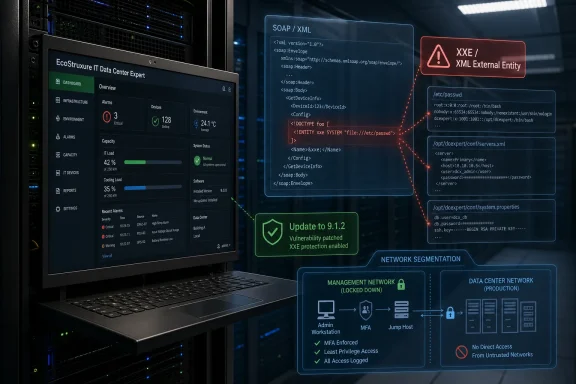 A Medium Bug Lands in a High-Trust Control Room
EcoStruxure IT Data Center Expert is not a glamorous target in the way an internet-facing VPN appliance or identity provider is glamorous. It is the kind of system that sits in the rack-management strata, collecting alerts, device information, UPS and cooling data, and operational state from equipment that most organizations would rather not touch unless something is already going wrong. That makes it easy to underestimate and hard to replace.The newly disclosed flaw, tracked as CVE-2026-8045, is a classic XML External Entity issue: an attacker with a Data Center Expert user account can send crafted XML payloads to SOAP service endpoints and potentially read server-side file contents. Schneider assigns the issue a CVSS 3.1 base score of 6.5, with network attack vector, low complexity, low privileges required, no user interaction, and high confidentiality impact.
That combination tells a familiar story. The vulnerability does not hand a stranger on the internet a one-click takeover, and the advisory does not claim code execution, data modification, or denial of service. But it does mean that a valid user account may be enough to turn a monitoring application into a file-reading oracle on the server side.
In ordinary enterprise software, authenticated file disclosure is bad. In a data center monitoring platform, it can be worse, because the server often knows things that individual operators do not: integration credentials, device inventory, topology hints, certificate material, logs, configuration files, backup paths, and sometimes the long-forgotten connective tissue between IT and facilities systems.
XML External Entities Are Old, Boring, and Still Dangerous
The phrase XML External Entity has been haunting security advisories for decades because the underlying failure is painfully simple. XML parsers can be configured to resolve external entities, which means a document can reference outside resources or local files as part of its processing. If a server accepts attacker-controlled XML and the parser is not locked down, the attacker may be able to make the server fetch or disclose things it should never touch.That is why XXE bugs feel antique and modern at the same time. The bug class belongs to an earlier era of SOAP services, XML schemas, and enterprise integration plumbing, but those technologies never disappeared from infrastructure products. They simply moved into management appliances, supervisory consoles, firmware-adjacent software, and long-lived products where backward compatibility has more political power than elegance.
The Schneider advisory says the vulnerable path involves SOAP service endpoints. That detail matters because SOAP tends to live where enterprise software needs structured machine-to-machine communication, not where a casual web user clicks around. The attack is therefore less about a flashy front-end exploit and more about abusing a trusted protocol surface that administrators may not routinely inspect.
There is also a psychological trap here. Security teams have learned to triage by exploitability at internet scale: unauthenticated remote code execution goes to the front of the queue, authenticated information disclosure goes somewhere lower. That instinct is understandable, but it can be dangerous when the affected product is part of the data center’s nervous system.
Authentication Is Not a Force Field
The advisory’s most reassuring phrase is also its most dangerous: the attacker needs a Data Center Expert user account. In many organizations, that will move the issue out of emergency mode and into the next maintenance cycle. But the phrase “authenticated attacker” hides a lot of operational mess.User accounts on infrastructure monitoring platforms are often shared too widely. Facilities teams, managed service providers, after-hours operators, auditors, vendors, and temporary project staff may all have had access at some point. Even where named accounts exist, they may be tied to old role models or broad permissions because the system is treated as a visibility console rather than a production control plane.
A low-privilege account can also be the prize from a separate incident. Phishing, password reuse, stale vendor credentials, weak internal segmentation, and forgotten local users all turn “requires authentication” into “requires the first step of many compromises.” Once an attacker has any foothold, products that centralize operational knowledge become natural reconnaissance targets.
The CVSS vector captures part of this: privileges are required, but attack complexity is low and no user interaction is needed. In plain English, if the attacker can log in and reach the endpoint, the bug does not appear to require a convoluted race condition or a fragile chain of environmental quirks. That is exactly the sort of vulnerability that becomes more useful after an intruder has already crossed the perimeter.
Data Center Expert Sits Where IT and Facilities Blur
EcoStruxure IT Data Center Expert occupies an awkward and important category. It is IT software, but it watches physical infrastructure. It may run as a virtual appliance, but it talks to power, cooling, environmental, and rack-level devices. It may be managed by IT operations, facilities, or a hybrid team that exists only in the org chart after something catches fire.That blurred ownership is where patching risk lives. Windows admins know how to push cumulative updates to fleets of desktops and servers. Network teams know how to plan firmware windows. Facilities teams know that rebooting the wrong monitoring system during a cooling incident can turn a maintenance task into a postmortem. Data center monitoring platforms often sit between those cultures.
Schneider’s advisory identifies critical infrastructure sectors including Information Technology, Critical Manufacturing, and Energy, with worldwide deployment. That does not mean every affected instance is sitting inside a power plant or factory. It means the product’s customer base includes environments where uptime, physical resilience, and operational visibility are themselves security concerns.
In those settings, “just patch it” is both correct and incomplete. A responsible operator needs to know who owns the appliance, which version is running, whether SOAP endpoints are reachable beyond the intended management network, what accounts exist, and whether any unexpected file access or suspicious XML traffic can be reconstructed from logs.
Version 9.1.2 Is the Fix, But Inventory Is the First Battle
The remediation is straightforward on paper: update EcoStruxure IT Data Center Expert to version 9.1.2. Schneider says that release includes the fix for CVE-2026-8045, and CISA’s republication points users back to Schneider’s software and firmware download channels. Affected versions are 9.1.1 and prior.The practical challenge is proving that all instances are accounted for. Products like Data Center Expert may have been deployed under an older name, StruxureWare Data Center Expert, and may be tracked in asset inventories with inconsistent naming. Some teams will know the product as an APC or Schneider monitoring box rather than by its current EcoStruxure branding.
That branding history matters because vulnerability management depends on matching advisories to real assets. If a scanner, CMDB, or spreadsheet contains “StruxureWare DCE,” “APC DCE,” “EcoStruxure IT,” or a hostname named after a site code and a rack row, the advisory may not automatically route to the right owner. A medium-severity CVE can survive for years in exactly that gap.
Organizations should treat this as a chance to clean up the asset record, not merely apply a hotfix. Confirm the version, identify whether the appliance is physical or virtual, record the network zones it can reach, map its authentication sources, and document who is authorized to administer it. The patch closes the known XXE path; the inventory work reduces the odds that the next advisory becomes a scavenger hunt.
The SOAP Endpoint Is a Reminder That Legacy Interfaces Never Really Leave
Modern security discourse is dominated by APIs, cloud tokens, OAuth scopes, and JSON payloads. Yet the advisory’s mention of SOAP is a reminder that data center software often carries long-lived integration surfaces forward because customers depend on them. In infrastructure management, compatibility is not nostalgia; it is a survival strategy.That does not make old interfaces bad. SOAP can be secured, XML can be parsed safely, and enterprise products can support legacy integrations without turning into a museum of exploit primitives. But every additional protocol surface needs the same security discipline as the modern web UI: input handling, authentication, authorization, logging, parser hardening, and test coverage for well-known bug classes.
XXE is particularly frustrating because the defense is not mysterious. XML parsers can disable external entity resolution and block document type declarations where they are not needed. Application code can constrain input, validate schemas, and avoid processing features that no business workflow requires. The persistence of XXE in mature products is usually less about ignorance than about the depth and age of enterprise code paths.
For administrators, the lesson is not to panic about SOAP. It is to avoid assuming that a product’s main login screen represents its full attack surface. Management platforms often expose APIs, agents, discovery services, migration tools, reporting endpoints, and integration channels that are invisible to casual users but reachable to anyone on the right network with the right account.
CISA’s Republication Changes the Audience, Not the Bug
Schneider published the advisory on June 9, 2026. CISA republished it on June 30 as an Industrial Control Systems advisory converted from Schneider’s CSAF notification. That conversion language is bureaucratic, but its effect is meaningful: it moves the issue from a vendor security notice into the broader ICS advisory stream watched by asset owners, MSSPs, vulnerability teams, and critical infrastructure defenders.CISA also includes its standard recommended practices: minimize network exposure, keep control systems off the public internet, place control networks behind firewalls, isolate them from business networks, and use secure remote access methods such as updated VPNs where remote access is necessary. These recommendations can sound generic because they appear in many ICS advisories, but they are not filler here.
A vulnerability requiring a product account is far less useful if the product is reachable only from a narrow management segment, accounts are individual and reviewed, and remote access is gated through monitored administrative paths. The same vulnerability becomes more interesting if the console is exposed to broad internal networks, shared credentials are common, and vendor or contractor access is loosely controlled.
The CISA republication also comes with a disclaimer that it is a verbatim republication of Schneider’s advisory and that CISA is not responsible for the editorial or technical accuracy of the converted vendor material. That caveat should not be read as skepticism about the vulnerability. It is a reminder that asset owners must still do their own impact analysis rather than treating any advisory feed as a complete risk decision.
The Risk Is Confidentiality, But the Consequences May Cascade
The published impact is information disclosure. The CVSS vector says confidentiality impact is high, while integrity and availability are not affected. That distinction is important: the advisory does not say an attacker can alter device states, shut down cooling, push firmware, or take over the Data Center Expert host.But confidentiality in infrastructure management is not a narrow concept. Files on the server can reveal credentials, configuration details, internal hostnames, certificate paths, service accounts, backup locations, integration secrets, and operational maps. Even if the disclosed file is not immediately sensitive in isolation, it may help an attacker understand the environment well enough to move laterally.
This is especially relevant in environments where Data Center Expert bridges monitoring across many devices. A single management platform may know more about the power and environmental estate than any individual operator. If an attacker can read local files from that server, the value of the exposure depends on how the product stores secrets, what logs contain, and what integrations have been configured.
The advisory does not publicly detail the exact files that can be accessed or the product’s internal storage layout. That is appropriate for a security notice, but it means defenders should think in terms of plausible exposure rather than waiting for exploit write-ups. If the server has sensitive local material, assume the vulnerability could matter to it until your testing and vendor documentation prove otherwise.
Windows Shops Should Not Dismiss This as Somebody Else’s ICS Problem
WindowsForum readers may be tempted to file this under industrial control systems and move on. That would be a mistake. Many data centers are Windows-heavy operations where domain-joined servers, Hyper-V or VMware management stacks, backup tools, monitoring dashboards, SNMP collectors, SQL systems, and facilities platforms coexist on the same administrative fabric.EcoStruxure IT Data Center Expert may not be a Windows component, but it can sit inside a Windows-administered environment and interact with systems that Windows teams care about. It may be monitored by Windows-based SIEM collectors, authenticated through enterprise identity workflows, backed up by enterprise backup tooling, or accessed from jump hosts maintained by the server team.
The vulnerability also illustrates a broader Windows enterprise lesson: risk increasingly gathers around management planes. Whether the product is a Microsoft service, a hypervisor console, a backup appliance, a UPS manager, or a data center monitoring platform, the console that sees everything becomes part of the attack surface. Patching endpoints while leaving infrastructure consoles loosely governed is a lopsided defense.
For sysadmins, the right response is operationally familiar. Find the asset, confirm the version, schedule the update, restrict access, review accounts, and check logs. The twist is that the owner may not sit in the same team that runs Windows Update, Defender, Entra ID, or group policy. Someone has to cross that boundary before an attacker does.
Account Hygiene Is the Underpriced Mitigation
Because CVE-2026-8045 requires a Data Center Expert user account, access governance becomes more than a compliance chore. It is a direct exploit precondition. If your user list is stale, your risk is higher than the CVSS score alone suggests.Start with the obvious: remove departed employees, retired contractors, and vendor accounts that no longer have a live business purpose. Then look at shared accounts. Shared operational logins are common in monitoring systems because they are convenient during incidents, but they destroy accountability and make it harder to assess exposure after a credential leak.
Role design also matters. If every user is effectively an administrator because the application’s permission model was never revisited, a low-privilege requirement becomes almost meaningless. Even when the vulnerability does not require admin rights, reducing unnecessary privileges limits what an attacker can do before, during, and after exploiting a bug.
Finally, examine how users reach the system. If Data Center Expert is available from broad corporate networks, a compromised workstation may be enough to reach it. If access requires a hardened jump host, MFA-protected VPN, device compliance, and network segmentation, the same vulnerability has a much narrower practical attack path.
Patching the Appliance Is Only Half the Maintenance Window
Updating to version 9.1.2 should be the priority, but the maintenance plan should not stop at the installer. Before the update, teams should capture the current version, export or verify backups according to Schneider’s guidance, document integrations, and alert stakeholders who depend on monitoring visibility. During the update, they should watch for service interruptions that could mask unrelated facility events.After the update, administrators should verify the reported version and confirm that normal monitoring functions still work. That sounds mundane, but infrastructure monitoring systems are only valuable if the alert pipeline remains trusted. A silent failure after a security update can be more operationally damaging than a visible outage.
The post-update window is also the time to review logs for suspicious activity. The advisory indicates crafted XML payloads to SOAP service endpoints as the exploitation method, so defenders should look for unusual SOAP requests, unexpected authentication activity, strange errors from XML parsing, and account behavior that does not match normal operating patterns. Logging depth will vary by deployment, but absence of evidence should not become evidence of absence.
Where possible, teams should also rotate sensitive credentials stored on or used by the platform if they believe exploitation may have occurred. That may be overkill for a routine patch in a tightly controlled environment with no suspicious logs. In a high-value environment with stale access controls or signs of compromise, it becomes a reasonable containment step.
Schneider’s Advisory Fits a Broader Pattern in Infrastructure Software
This is not the first time infrastructure management software has shown the tension between operational utility and security exposure, and it will not be the last. Products that centralize visibility and control create enormous defensive value, but they also concentrate secrets, topology, and authority. Attackers understand that.The industry has spent years telling organizations to monitor more, centralize more, integrate more, and automate more. Those are good recommendations. They also create management systems that become critical assets in their own right, deserving the same scrutiny as identity infrastructure and backup platforms.
The Schneider case is comparatively restrained: one disclosed CVE, medium severity, authenticated access, confidentiality impact, and a vendor fix available. That is not a reason to ignore it. It is an opportunity to handle a manageable vulnerability well before it becomes part of a chain.
The uncomfortable truth is that many breaches are not built from one catastrophic bug. They are built from medium bugs, stale accounts, flat networks, permissive internal access, and management consoles that nobody wants to reboot. CVE-2026-8045 belongs in that practical risk category.
The Patch Is Simple; the Governance Lesson Is Not
There is a clean version of this story: Schneider found or received a report of a vulnerability, issued an advisory, credited the researcher and CPCERT process, released version 9.1.2, and CISA amplified the notice. In that version, customers patch and move on.The messier version is the one administrators live with. They must determine whether the product exists in their estate, whether it is still supported, whether it carries an old name in documentation, who owns the update, what downtime is acceptable, and what secrets might be exposed if the bug was exploited. None of that fits neatly into a CVSS number.
The vulnerability’s scope is also narrower than the anxiety it may produce. The advisory does not say unauthenticated attackers can exploit exposed instances from the public internet, and it does not describe active exploitation. Defenders should avoid turning a medium-severity disclosure into theater.
But calm does not mean passive. The best response is to treat the advisory as a controlled test of infrastructure governance. If your organization can rapidly find every Data Center Expert instance, identify its owner, patch it, validate it, and restrict access, this incident becomes routine. If it cannot, the vulnerability has revealed a process gap worth fixing.
The Data Center Console Now Has Its Own Patch Tuesday
The most concrete action is to update EcoStruxure IT Data Center Expert to 9.1.2, but the better outcome is a clearer model for how data center management platforms are owned and defended. This advisory is small enough to manage and specific enough to learn from.- EcoStruxure IT Data Center Expert 9.1.1 and earlier are affected by CVE-2026-8045, while version 9.1.2 contains Schneider Electric’s fix.
- The flaw is an authenticated XXE vulnerability in SOAP service endpoints that can expose server-side file contents.
- The CVSS 3.1 score is 6.5, but the confidentiality impact is high and the affected product may hold sensitive operational context.
- Organizations should verify account lists, remove stale access, and restrict the console to appropriate management networks.
- Administrators should review logs for unusual SOAP activity or unexpected user behavior, especially in environments with broad internal access.
- The advisory should prompt asset-inventory cleanup where older StruxureWare or APC-era naming may obscure affected deployments.
References
- Primary source: CISA
Published: 2026-06-30T12:00:00+00:00
- Related coverage: db.gcve.eu
Vulnerability-Lookup
Vulnerability-Lookup - Fast vulnerability lookup correlation from different sources.db.gcve.eu - Related coverage: cve.imfht.com
CVE Database & AI Vulnerability Analysis - Vulnerability Platform
Free CVE database with AI-powered vulnerability analysis, daily intelligence, and AI-generated PoC analyses. Search 340K+ CVEs across vendors, products, and CWE categories. cve.imfht.com
- Related coverage: download.schneider-electric.com
- Related coverage: media.province-electric.com
Microsoft Word - EcoStruxure IT Data Center Expert 9.0.0 Virtual Machine Trial Software Release Notes.doc
PDF documentmedia.province-electric.com