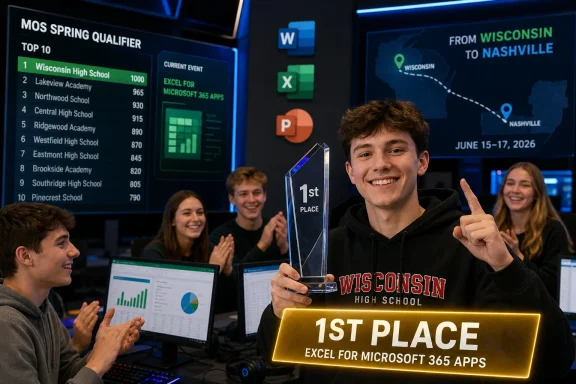
D.C. Everest students in Weston, Wisconsin, placed in the top 10 of the 2026 Microsoft Office Specialist Wisconsin State Championship Spring Qualifier, with Malea Lopes-Serrao winning the Microsoft Excel Microsoft 365 Apps category and advancing to the U.S. National Championship in Nashville on June 15–17, 2026. The local story is modest in scale but revealing in what it says about the modern Windows skills pipeline. At a moment when Microsoft’s public future is drenched in Copilot branding and AI infrastructure, a high-school Excel win is a reminder that the company’s most durable workplace platform is still built on spreadsheets, documents, presentations, and the people who know how to use them well.
The easy reaction is to treat this as a feel-good school announcement, the sort of item that briefly animates a district newsletter before disappearing beneath larger technology news. That would miss the point. The Microsoft Office Specialist contest is not just a student competition; it is a credentialing machine wrapped in a tournament, and it shows how Microsoft’s productivity software continues to define what “digital literacy” means in American classrooms and entry-level workplaces.
Every few years, the technology industry declares a new basic skill. First it was coding, then cloud fluency, then data science, then prompt engineering. Yet the spreadsheet remains stubbornly central because it sits at the uncomfortable intersection of business logic, personal productivity, reporting, and improvisation.
That is why Lopes-Serrao’s first-place finish in Excel matters more than the trophy-case version of the story suggests. Excel is not glamorous software. It is also one of the few applications that can be a calculator, a database, a dashboard, a planning tool, a budget, a lightweight programming environment, and an organizational crutch all at once.
For WindowsForum readers, this will sound familiar. The modern workplace may run on SaaS platforms and cloud APIs, but the last mile of decision-making still often lands in a workbook. Someone exports a CSV, cleans it up, adds formulas, formats a table, builds a chart, and turns a vague operational problem into something management can read.
That is not a minor skill. It is the foundation of a large share of white-collar automation, even when nobody calls it automation. In many offices, Excel is still where shadow IT begins.
Microsoft understands this perfectly. The company’s certification ecosystem exists partly because Office has become so ubiquitous that mere exposure is no longer enough. Saying “I know Excel” can mean anything from typing numbers into cells to building nested formulas, pivot tables, and data models. A credential gives schools and employers a more standardized signal, even if that signal is imperfect.
That structure turns routine software competency into something closer to scholastic sports. Students do not simply pass an exam and move on; they are ranked, recognized, and sent into a national bracket. The result is a competition format that gives career and technical education programs a visible win to point to.
There is a practical reason schools like this model. Certifications give administrators something measurable. They also give students a credential that can be placed on a résumé before a college degree, internship, or first full-time job.
But the contest also reflects a broader shift in education policy. High schools are under pressure to prove that graduates leave with workforce-ready skills, not just credits. A Microsoft Office Specialist result is easy to explain to parents, boards, and local employers: this student can use the tools most offices still run on.
The irony is that the very ordinariness of Office makes the achievement more legible. A cybersecurity competition may impress specialists. A robotics win may excite STEM advocates. But Word and Excel are understood by nearly everyone who has worked in an office, paid bills, managed inventory, filed reports, or survived a committee meeting.
For end users, this can feel like a branding fog. Is Excel a desktop app, a web app, a cloud-connected service, or a front end for AI-assisted analysis? The answer is yes. Microsoft’s genius has been to keep the old muscle memory intact while moving the commercial and administrative model underneath it.
That makes MOS certification more complicated than it appears. A student certified in Excel for Microsoft 365 Apps is not just demonstrating familiarity with a historical interface. They are being trained inside Microsoft’s current productivity stack, the one most organizations are either using now or being nudged toward through licensing and platform integration.
This is where the local contest touches the enterprise world. Sysadmins and IT managers know that user competence is a hidden cost center. Every organization pays for poor file hygiene, broken spreadsheets, misused templates, badly shared documents, accidental version chaos, and PowerPoint decks that become archaeological records of decisions nobody can trace.
Better Office skills do not solve those problems completely. But they reduce friction. They also create users who are less likely to treat every productivity task as a help-desk incident.
Still, certifications should be understood as signals, not guarantees. A certification can prove that a student knows how to operate within a defined exam environment. It cannot prove judgment, collaboration, communication, curiosity, or the ability to solve messy business problems without step-by-step instructions.
That distinction matters because the technology certification industry has always had a tendency toward inflation. Once a credential becomes common, it stops distinguishing the truly exceptional and starts functioning as a baseline. Microsoft itself has repeatedly revised, retired, and reorganized parts of its broader certification portfolio as products and job roles change.
MOS is somewhat insulated from that churn because Office skills remain broadly applicable. Word, Excel, and PowerPoint are not niche platforms. But the certification’s value still depends on whether students can connect exam knowledge to real work: cleaning data, summarizing findings, building reusable templates, documenting processes, and presenting information clearly.
That is why the D.C. Everest result is most interesting not as a credential story but as a teaching story. The school’s Career and Technical Education coordinator, Aaron Hoffman, framed the program around students learning and validating workforce skills. That is the right emphasis. The certificate matters because of the skill behind it, not the other way around.
For a regional high school, that is significant. Career and technical education often gets discussed in terms of trades, manufacturing, health care, agriculture, or public safety. But office productivity is also career and technical education, even if it lacks the visual drama of welding labs or robotics competitions.
In many communities, the first rung of the professional ladder still involves administrative, financial, clerical, sales, logistics, education, health-care support, or small-business roles where Office competence is assumed but not always taught. A student who can walk into those environments with verified skills has a real advantage.
That advantage is especially relevant outside major tech hubs. Not every student will become a software engineer, cloud architect, or AI researcher. Many will work in local businesses, schools, hospitals, manufacturers, nonprofits, or government offices where the decisive technology skill is not building an app from scratch but making existing systems produce useful work.
This is the part of digital-skills policy that too often gets buried. The country needs advanced computing talent, yes. It also needs millions of people who can use ordinary software with uncommon competence.
In Excel, for example, AI can suggest formulas, explain data, and help build summaries. But it cannot reliably know whether the underlying data is accurate, whether a business rule is being applied correctly, whether a result makes operational sense, or whether a workbook has become a fragile tower of hidden assumptions. A user who understands Excel is better positioned to catch AI mistakes.
The same is true in Word and PowerPoint. AI can accelerate drafting and formatting, but it does not automatically create a coherent argument, a compliant report, or a persuasive presentation. The user still needs domain knowledge and editorial judgment.
This is the practical case for teaching Office deeply in the Copilot era. The better students understand the application, the more effectively they can supervise automation inside it. The future is not “AI instead of Excel.” It is more likely to be Excel with AI embedded into workflows that still require human verification.
For IT departments, that distinction will be familiar from every previous wave of productivity tooling. Macros, templates, mail merge, Power Query, Teams integration, and cloud collaboration all promised to make users more efficient. Each also created new ways for users to make mistakes at scale. AI will follow the same pattern.
That does not make the program bad. It does mean readers should understand the incentives. Microsoft benefits when schools teach Microsoft tools as default workplace tools. Certiport benefits when certification becomes a recognized pathway. Pearson benefits when testing and credentialing remain embedded in education systems.
The students benefit too, and that is the important counterweight. A credential tied to widely used software has more immediate utility than many abstract digital-literacy badges. If the certification helps a student get an internship, win confidence, place into a better class, or stand out in a first job interview, the value is not theoretical.
The public-private nature of such programs has always been messy. Schools want practical curricula. Vendors want adoption. Students want credentials that travel beyond the classroom. When those incentives align, the result can be useful. When they do not, students can be left with badges nobody recognizes.
In this case, Office’s ubiquity gives MOS a stronger claim than many vendor credentials. The risk is not that students are learning irrelevant tools. The risk is that schools treat certification as the endpoint rather than the beginning of broader digital fluency.
That polish matters. It affects how students write résumés, handle interviews, complete internships, and navigate early workplace expectations. It also affects confidence. A student who has been told, through a competitive process, that they are among the best in their state at a real workplace tool may approach the professional world differently.
The divide is not simply between students who have devices and students who do not. It is between passive access and guided mastery. A laptop in a classroom does not automatically teach spreadsheet logic, document structure, version control, data hygiene, or presentation design.
This is where school systems have to be honest. Digital natives are not automatically digitally competent. Many students are fluent in phones, messaging, search, and media platforms while remaining underprepared for the productivity software that still dominates offices. The MOS contest is a reminder that those skills have to be taught, practiced, and assessed.
For administrators, that should be the real lesson from D.C. Everest’s showing. The outcome is not merely a set of rankings. It is evidence that structured instruction can turn everyday software into measurable capability.
Word remains the place where policies, reports, contracts, lesson plans, procedures, and proposals are assembled. Excel remains the place where organizations model reality, sometimes brilliantly and sometimes dangerously. PowerPoint remains the place where decisions are packaged for rooms full of people who do not have time to read the underlying work.
That is why a student competition in these applications belongs on a Windows enthusiast site. Windows is not only the kernel, the shell, the Start menu, or the hardware compatibility matrix. It is also the ecosystem of everyday work built around Microsoft applications, file formats, identity systems, and administrative assumptions.
For many users, Windows and Office are experienced as a single workplace environment. They sign into a domain or Microsoft 365 account, open Outlook, edit a Word document, update an Excel tracker, join a Teams meeting, and save files to OneDrive or SharePoint. The boundary between operating system and productivity suite is increasingly administrative rather than experiential.
In that environment, skill with Office is a form of platform literacy. It is not as deep as knowing PowerShell, Group Policy, Intune, Entra ID, or endpoint security. But it is closer to the surface where most work happens.
The timing is also notable. The national championship runs June 15–17, 2026, the same date the Wausau Daily Herald story appeared on June 17. That means the local announcement lands as the competition is occurring or concluding, depending on publication timing and event schedule. In a faster news cycle, that would be a complication. In this case, it reinforces the point that these credentialing events operate on a school-calendar rhythm, not a product-launch rhythm.
The local story also contains a small ambiguity worth noting. It says one winner per track will become a U.S. National Champion and earn a trip to represent the United States in Anaheim, California, while official MOS materials describe the U.S. event in Nashville and the broader championship pathway separately. The likely reading is that top U.S. winners advance toward the world-level event, but the naming can be confusing because “national” and “world” championship language often sits close together in promotional copy.
That ambiguity does not diminish the student achievement. If anything, it shows how layered the certification ecosystem has become. There are qualifying windows, state rankings, national finals, track-specific titles, and global competition opportunities. For families and schools, navigating that structure is part of the process.
The more important point is that a Wisconsin student will be competing nationally in Excel. That is a concrete achievement in a software category that employers still understand.
If the next decade of Microsoft 365 is shaped by Copilot, cloud identity, and increasingly automated workflows, then students like those at D.C. Everest are entering the workforce at exactly the right pressure point: where human judgment meets software that everyone thinks they already know. The spreadsheet is not going away; it is becoming more connected, more automated, and more consequential. That makes this Wisconsin classroom victory less like a nostalgic Office story and more like an early signal of what practical digital literacy will have to mean next.
The easy reaction is to treat this as a feel-good school announcement, the sort of item that briefly animates a district newsletter before disappearing beneath larger technology news. That would miss the point. The Microsoft Office Specialist contest is not just a student competition; it is a credentialing machine wrapped in a tournament, and it shows how Microsoft’s productivity software continues to define what “digital literacy” means in American classrooms and entry-level workplaces.
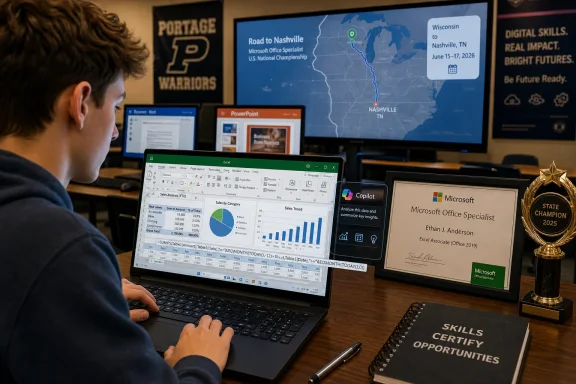 Excel Still Has a Longer Half-Life Than Most Tech Trends
Every few years, the technology industry declares a new basic skill. First it was coding, then cloud fluency, then data science, then prompt engineering. Yet the spreadsheet remains stubbornly central because it sits at the uncomfortable intersection of business logic, personal productivity, reporting, and improvisation.That is why Lopes-Serrao’s first-place finish in Excel matters more than the trophy-case version of the story suggests. Excel is not glamorous software. It is also one of the few applications that can be a calculator, a database, a dashboard, a planning tool, a budget, a lightweight programming environment, and an organizational crutch all at once.
For WindowsForum readers, this will sound familiar. The modern workplace may run on SaaS platforms and cloud APIs, but the last mile of decision-making still often lands in a workbook. Someone exports a CSV, cleans it up, adds formulas, formats a table, builds a chart, and turns a vague operational problem into something management can read.
That is not a minor skill. It is the foundation of a large share of white-collar automation, even when nobody calls it automation. In many offices, Excel is still where shadow IT begins.
Microsoft understands this perfectly. The company’s certification ecosystem exists partly because Office has become so ubiquitous that mere exposure is no longer enough. Saying “I know Excel” can mean anything from typing numbers into cells to building nested formulas, pivot tables, and data models. A credential gives schools and employers a more standardized signal, even if that signal is imperfect.
The Contest Turns Office Skills Into a Public Performance
The 2026 Microsoft Office Specialist U.S. National Championship, presented by Certiport, tests students in Word, Excel, and PowerPoint across Office 2019 and Microsoft 365 Apps tracks. The Nashville event runs June 15–17, 2026, and the spring qualification window closed May 1, 2026. Students generally qualify by submitting passing scores from eligible MOS certification exams, with state champions invited to compete nationally.That structure turns routine software competency into something closer to scholastic sports. Students do not simply pass an exam and move on; they are ranked, recognized, and sent into a national bracket. The result is a competition format that gives career and technical education programs a visible win to point to.
There is a practical reason schools like this model. Certifications give administrators something measurable. They also give students a credential that can be placed on a résumé before a college degree, internship, or first full-time job.
But the contest also reflects a broader shift in education policy. High schools are under pressure to prove that graduates leave with workforce-ready skills, not just credits. A Microsoft Office Specialist result is easy to explain to parents, boards, and local employers: this student can use the tools most offices still run on.
The irony is that the very ordinariness of Office makes the achievement more legible. A cybersecurity competition may impress specialists. A robotics win may excite STEM advocates. But Word and Excel are understood by nearly everyone who has worked in an office, paid bills, managed inventory, filed reports, or survived a committee meeting.
Microsoft 365 Has Not Replaced Office So Much as Rebranded Its Center of Gravity
The students in the Wausau Daily Herald report competed in Microsoft 365 Apps categories, not simply in a frozen old version of Office. That distinction matters because Microsoft has spent years shifting Office from a boxed product into a continuously updated subscription ecosystem. Word, Excel, and PowerPoint are still the familiar names, but they now live inside a broader Microsoft 365 strategy that includes OneDrive, Teams, SharePoint, identity management, device policy, and increasingly Copilot.For end users, this can feel like a branding fog. Is Excel a desktop app, a web app, a cloud-connected service, or a front end for AI-assisted analysis? The answer is yes. Microsoft’s genius has been to keep the old muscle memory intact while moving the commercial and administrative model underneath it.
That makes MOS certification more complicated than it appears. A student certified in Excel for Microsoft 365 Apps is not just demonstrating familiarity with a historical interface. They are being trained inside Microsoft’s current productivity stack, the one most organizations are either using now or being nudged toward through licensing and platform integration.
This is where the local contest touches the enterprise world. Sysadmins and IT managers know that user competence is a hidden cost center. Every organization pays for poor file hygiene, broken spreadsheets, misused templates, badly shared documents, accidental version chaos, and PowerPoint decks that become archaeological records of decisions nobody can trace.
Better Office skills do not solve those problems completely. But they reduce friction. They also create users who are less likely to treat every productivity task as a help-desk incident.
The Resume Signal Is Real, but It Is Not Magic
Certiport and Pearson pitch the Microsoft Office Specialist credential as a valuable résumé distinction, and that is broadly fair. For a student or early-career worker, it says something concrete: I did not merely claim familiarity with Office; I passed a recognized exam. In hiring contexts where candidates may have thin work histories, that can help.Still, certifications should be understood as signals, not guarantees. A certification can prove that a student knows how to operate within a defined exam environment. It cannot prove judgment, collaboration, communication, curiosity, or the ability to solve messy business problems without step-by-step instructions.
That distinction matters because the technology certification industry has always had a tendency toward inflation. Once a credential becomes common, it stops distinguishing the truly exceptional and starts functioning as a baseline. Microsoft itself has repeatedly revised, retired, and reorganized parts of its broader certification portfolio as products and job roles change.
MOS is somewhat insulated from that churn because Office skills remain broadly applicable. Word, Excel, and PowerPoint are not niche platforms. But the certification’s value still depends on whether students can connect exam knowledge to real work: cleaning data, summarizing findings, building reusable templates, documenting processes, and presenting information clearly.
That is why the D.C. Everest result is most interesting not as a credential story but as a teaching story. The school’s Career and Technical Education coordinator, Aaron Hoffman, framed the program around students learning and validating workforce skills. That is the right emphasis. The certificate matters because of the skill behind it, not the other way around.
Wisconsin’s Showing Fits a Bigger Pattern in Career and Technical Education
The D.C. Everest students named in the report performed well across Excel and Word. Lopes-Serrao placed first in Excel and third in Word. Lukas Schneider placed fourth in Excel, and Hayden Johnson placed ninth in Excel. That clustering suggests this is not a one-off student fluke; it points to a program capable of producing multiple competitive exam results.For a regional high school, that is significant. Career and technical education often gets discussed in terms of trades, manufacturing, health care, agriculture, or public safety. But office productivity is also career and technical education, even if it lacks the visual drama of welding labs or robotics competitions.
In many communities, the first rung of the professional ladder still involves administrative, financial, clerical, sales, logistics, education, health-care support, or small-business roles where Office competence is assumed but not always taught. A student who can walk into those environments with verified skills has a real advantage.
That advantage is especially relevant outside major tech hubs. Not every student will become a software engineer, cloud architect, or AI researcher. Many will work in local businesses, schools, hospitals, manufacturers, nonprofits, or government offices where the decisive technology skill is not building an app from scratch but making existing systems produce useful work.
This is the part of digital-skills policy that too often gets buried. The country needs advanced computing talent, yes. It also needs millions of people who can use ordinary software with uncommon competence.
The AI Moment Makes Office Skills More Important, Not Less
It is tempting to assume that generative AI will make Office skills less valuable. If Copilot can draft text, summarize documents, analyze data, and generate slides, why spend time certifying students in Word, Excel, and PowerPoint? The answer is that AI assistance raises the floor but does not eliminate the need to understand the room.In Excel, for example, AI can suggest formulas, explain data, and help build summaries. But it cannot reliably know whether the underlying data is accurate, whether a business rule is being applied correctly, whether a result makes operational sense, or whether a workbook has become a fragile tower of hidden assumptions. A user who understands Excel is better positioned to catch AI mistakes.
The same is true in Word and PowerPoint. AI can accelerate drafting and formatting, but it does not automatically create a coherent argument, a compliant report, or a persuasive presentation. The user still needs domain knowledge and editorial judgment.
This is the practical case for teaching Office deeply in the Copilot era. The better students understand the application, the more effectively they can supervise automation inside it. The future is not “AI instead of Excel.” It is more likely to be Excel with AI embedded into workflows that still require human verification.
For IT departments, that distinction will be familiar from every previous wave of productivity tooling. Macros, templates, mail merge, Power Query, Teams integration, and cloud collaboration all promised to make users more efficient. Each also created new ways for users to make mistakes at scale. AI will follow the same pattern.
The Championship Is Also a Marketing Engine
None of this should be read as pure altruism from Microsoft or Certiport. The MOS championship promotes a Microsoft-centered definition of productivity. It helps keep Office at the heart of classroom technology training. It turns students into credentialed participants in the Microsoft ecosystem before many have entered the workforce.That does not make the program bad. It does mean readers should understand the incentives. Microsoft benefits when schools teach Microsoft tools as default workplace tools. Certiport benefits when certification becomes a recognized pathway. Pearson benefits when testing and credentialing remain embedded in education systems.
The students benefit too, and that is the important counterweight. A credential tied to widely used software has more immediate utility than many abstract digital-literacy badges. If the certification helps a student get an internship, win confidence, place into a better class, or stand out in a first job interview, the value is not theoretical.
The public-private nature of such programs has always been messy. Schools want practical curricula. Vendors want adoption. Students want credentials that travel beyond the classroom. When those incentives align, the result can be useful. When they do not, students can be left with badges nobody recognizes.
In this case, Office’s ubiquity gives MOS a stronger claim than many vendor credentials. The risk is not that students are learning irrelevant tools. The risk is that schools treat certification as the endpoint rather than the beginning of broader digital fluency.
The Local Win Points to a National Skills Divide
A high school student traveling from Wisconsin to Nashville for an Excel competition may sound quaint beside the scale of current technology debates. But there is a serious equity issue underneath. Students with access to strong business education programs, certification testing, supportive instructors, and competition pathways gain a kind of practical polish that others may never receive.That polish matters. It affects how students write résumés, handle interviews, complete internships, and navigate early workplace expectations. It also affects confidence. A student who has been told, through a competitive process, that they are among the best in their state at a real workplace tool may approach the professional world differently.
The divide is not simply between students who have devices and students who do not. It is between passive access and guided mastery. A laptop in a classroom does not automatically teach spreadsheet logic, document structure, version control, data hygiene, or presentation design.
This is where school systems have to be honest. Digital natives are not automatically digitally competent. Many students are fluent in phones, messaging, search, and media platforms while remaining underprepared for the productivity software that still dominates offices. The MOS contest is a reminder that those skills have to be taught, practiced, and assessed.
For administrators, that should be the real lesson from D.C. Everest’s showing. The outcome is not merely a set of rankings. It is evidence that structured instruction can turn everyday software into measurable capability.
Word and Excel Remain the Unfashionable Infrastructure of Work
The technology press tends to cover platforms when they change visibly: a new Windows build, a major security incident, a cloud outage, a licensing shift, a new AI feature. Office skills rarely generate that kind of attention because they change slowly and live close to the user. But slow-moving infrastructure is still infrastructure.Word remains the place where policies, reports, contracts, lesson plans, procedures, and proposals are assembled. Excel remains the place where organizations model reality, sometimes brilliantly and sometimes dangerously. PowerPoint remains the place where decisions are packaged for rooms full of people who do not have time to read the underlying work.
That is why a student competition in these applications belongs on a Windows enthusiast site. Windows is not only the kernel, the shell, the Start menu, or the hardware compatibility matrix. It is also the ecosystem of everyday work built around Microsoft applications, file formats, identity systems, and administrative assumptions.
For many users, Windows and Office are experienced as a single workplace environment. They sign into a domain or Microsoft 365 account, open Outlook, edit a Word document, update an Excel tracker, join a Teams meeting, and save files to OneDrive or SharePoint. The boundary between operating system and productivity suite is increasingly administrative rather than experiential.
In that environment, skill with Office is a form of platform literacy. It is not as deep as knowing PowerShell, Group Policy, Intune, Entra ID, or endpoint security. But it is closer to the surface where most work happens.
The Nashville Trip Is a Milestone, Not the Finish Line
Lopes-Serrao’s next step is the Microsoft Excel event at the U.S. National Championship in Nashville. The official competition structure awards national winners by track, and first-place winners receive prizes and an invitation to continue toward the world championship stage. For the students involved, the event is part competition, part conference, and part résumé milestone.The timing is also notable. The national championship runs June 15–17, 2026, the same date the Wausau Daily Herald story appeared on June 17. That means the local announcement lands as the competition is occurring or concluding, depending on publication timing and event schedule. In a faster news cycle, that would be a complication. In this case, it reinforces the point that these credentialing events operate on a school-calendar rhythm, not a product-launch rhythm.
The local story also contains a small ambiguity worth noting. It says one winner per track will become a U.S. National Champion and earn a trip to represent the United States in Anaheim, California, while official MOS materials describe the U.S. event in Nashville and the broader championship pathway separately. The likely reading is that top U.S. winners advance toward the world-level event, but the naming can be confusing because “national” and “world” championship language often sits close together in promotional copy.
That ambiguity does not diminish the student achievement. If anything, it shows how layered the certification ecosystem has become. There are qualifying windows, state rankings, national finals, track-specific titles, and global competition opportunities. For families and schools, navigating that structure is part of the process.
The more important point is that a Wisconsin student will be competing nationally in Excel. That is a concrete achievement in a software category that employers still understand.
D.C. Everest’s Excel Win Says More Than the Scoreboard
The immediate facts are straightforward, but the implications are larger than a school announcement usually allows.- Malea Lopes-Serrao placed first in Wisconsin for Microsoft Excel in the Microsoft 365 Apps category and third in Microsoft Word for Microsoft 365 Apps.
- Lukas Schneider placed fourth and Hayden Johnson placed ninth in the Wisconsin Excel category, giving D.C. Everest multiple top-10 finishes.
- The 2026 spring qualifier required eligible students to submit passing MOS Word, Excel, or PowerPoint exam scores by May 1, 2026.
- The 2026 MOS U.S. National Championship is being held in Nashville, Tennessee, from June 15–17, 2026.
- The contest shows that Office proficiency remains a marketable workforce skill even as Microsoft’s product story increasingly centers on AI and cloud services.
- The strongest value of MOS certification is not the badge itself but the disciplined practice behind it.
If the next decade of Microsoft 365 is shaped by Copilot, cloud identity, and increasingly automated workflows, then students like those at D.C. Everest are entering the workforce at exactly the right pressure point: where human judgment meets software that everyone thinks they already know. The spreadsheet is not going away; it is becoming more connected, more automated, and more consequential. That makes this Wisconsin classroom victory less like a nostalgic Office story and more like an early signal of what practical digital literacy will have to mean next.
References
- Primary source: Wausau Daily Herald
Published: Wed, 17 Jun 2026 09:02:00 GMT
D.C. Everest students place in top 10 in Microsoft contest
D.C. Everest students placed in the top 10 of the 2026 Microsoft Office Specialist Wisconsin State Championship Spring Qualifier contest.www.wausaudailyherald.com - Related coverage: kciiradio.com
Highland Student to Compete in Microsoft Office Specialist National Championship | KCII Radio - The One to Count On
Highland Student to Compete in Microsoft Office Specialist National Championshipwww.kciiradio.com - Related coverage: buchananschools.com
- Related coverage: tcatknoxville.edu
- Related coverage: competitioninfo.com
Microsoft Office Specialist World Championship | Competition Info
(Updated 22 Mar 2026) The Microsoft Office Specialist World Championship presented by Certiport is a global competition that tests students’ skills on Microsoft Office Word... www.competitioninfo.com
- Related coverage: fastweb.com
Microsoft Office Specialist U.S. National Championship | Fastweb
Students ages 13–22 can turn their Microsoft Office skills into scholarship money. Learn how to qualify for the MOS U.S. National Championship and compete for up to $3,000 — plus a shot at the $8,000 World Championship prize in July 2026.www.fastweb.com
- Official source: microsoft.com
Introducing Microsoft innovations and programs to support AI-powered teaching and learning | Microsoft Education Blog
Announcing Microsoft Elevate for Educators—connecting educators, community, professional learning, and AI tools to enhance teaching. Join us.www.microsoft.com