

Write your data scientist resume in 2026 as a concise, tailored record of business outcomes, technical judgment, and hands-on project work—not as a list of tools. This guide covers fresh graduates, career changers, and experienced data scientists applying through online systems, using Microsoft Word on Windows 10 or Windows 11, Word for Microsoft 365, Word 2024, Word 2021, or Word for the web.
Applicant tracking systems vary by employer, so there is no single “ATS-proof” design. The safest approach is a straightforward document that is easy for both software and people to read.
Use this structure:
Name the working file clearly, for example:
Maintain a master resume containing all valid achievements, then make a separate copy for each application. Do not overwrite your master file when tailoring it.
Include:
A stronger entry-level example:
Group skills by purpose instead of creating one long comma-separated list. For example:
Customize this list for each role. If a posting emphasizes SQL, experimentation, customer analytics, forecasting, or a cloud platform, place the relevant and truthful skills where they are easy to find.
Do not list every tool you have ever opened. Remove technologies you cannot discuss with confidence, including what you used them for, how they fit into a workflow, and their limitations.
For senior roles, emphasize capabilities as well as tools:
For each role, include:
Weak bullet:
Stronger bullet:
Another strong pattern:
Quantify impact carefully. Useful measures include:
That statement is more credible than claiming a revenue increase that was never measured.
Choose projects tied to a realistic decision or operational problem, such as:
If you link a portfolio, GitHub repository, Kaggle profile, or personal site, test it before applying. Repositories should include a short README, setup instructions, data-source details, a clear description of results, and no credentials, private data, or employer-confidential material.
Before editing, make a short list from the job description:
Never copy a keyword into your resume if you cannot honestly support it.
Include certifications only when they support the target role. A cloud, machine-learning, data engineering, or analytics certification can help if the posting asks for that ecosystem. Do not let certifications displace evidence of practical work.
Save the editable master as a
Finally, open the exported file on your computer and inspect both pages. Confirm that headings, dates, bullets, links, and page breaks appear correctly, and that no project or experience bullet is split awkwardly across pages.
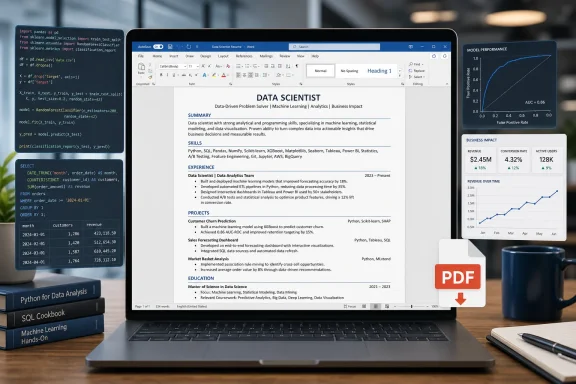 Start with an ATS-safe Word document
Applicant tracking systems vary by employer, so there is no single “ATS-proof” design. The safest approach is a straightforward document that is easy for both software and people to read.Use this structure:
- Contact information
- Professional summary
- Technical skills
- Experience
- Projects
- Education
- Certifications or additional information, if relevant
- Open Word.
- Select Blank document, or choose File > New and search for Resume.
- If you use a template, remove decorative elements that do not help explain your experience.
- Keep the main content in a single vertical reading order.
- Use clear headings such as Experience, Projects, Skills, and Education.
- Use a readable standard font and consistent formatting throughout.
- Avoid placing essential information only in text boxes, graphics, headers, footers, or icons.
Name the working file clearly, for example:
LastName_FirstName_DataScientist_Resume.docxMaintain a master resume containing all valid achievements, then make a separate copy for each application. Do not overwrite your master file when tailoring it.
Write a professional summary that proves relevance
Your summary belongs immediately below your name and contact details. It should normally be three to five lines, not a personal mission statement.Include:
- Your current level or years of relevant experience.
- Your strongest job-relevant technical capabilities.
- Your domain knowledge, if applicable.
- One or two measurable results or evidence points.
- The type of role you are targeting when it helps clarify your fit.
A stronger entry-level example:
An experienced example:Entry-level data scientist with hands-on experience building classification, forecasting, and NLP projects using Python, SQL, pandas, scikit-learn, and Power BI. Developed reproducible models and dashboards from public and operational datasets, including a churn model that improved validation recall by 14 percentage points over a baseline. Seeking a data scientist or analytics role focused on measurable product or business decisions.
Only claim outcomes you can explain and support in an interview.Data scientist with 5 years of experience delivering forecasting, experimentation, and machine-learning solutions in subscription and e-commerce environments. Built production-ready models using Python, SQL, Spark, and cloud data platforms; most recently improved customer-retention targeting while reducing unnecessary campaign spend. Known for translating ambiguous stakeholder questions into measurable analytical products.
Build a skills section recruiters can scan
Put skills near the top because both recruiters and screening systems commonly look for required technologies early.Group skills by purpose instead of creating one long comma-separated list. For example:
Code:
Programming and analysis: Python, SQL, R, pandas, NumPy, Jupyter
Machine learning: scikit-learn, XGBoost, PyTorch, TensorFlow, NLP, time-series forecasting
Data engineering: Spark, Airflow, dbt, ETL/ELT, Docker
Databases and cloud: PostgreSQL, Snowflake, BigQuery, AWS, Azure, Google Cloud
Visualization and communication: Power BI, Tableau, matplotlib, seaborn, experimentation
Workflow: Git, GitHub, Linux, AgileDo not list every tool you have ever opened. Remove technologies you cannot discuss with confidence, including what you used them for, how they fit into a workflow, and their limitations.
For senior roles, emphasize capabilities as well as tools:
- Causal inference
- Model monitoring
- Feature engineering
- Data governance
- Experiment design
- Stakeholder management
- MLOps
- Data quality
- Privacy-aware analytics
Turn experience into evidence of business impact
The experience section should show what changed because of your work. A job title and a list of routine responsibilities are not enough.For each role, include:
- Employer, location, job title, and dates.
- A brief context line if the organization or team is not self-explanatory.
- Three to six accomplishment bullets, with the strongest and most relevant first.
Action + problem or opportunity + method/tools + resultWeak bullet:
Built machine-learning models and dashboards for the marketing team.Stronger bullet:
Built a customer-churn prediction workflow in Python and SQL using XGBoost, enabling targeted retention outreach and improving campaign conversion by 18%.Another strong pattern:
Automated weekly revenue reporting from multiple source systems using SQL and Python, reducing manual preparation time from 8 hours to 45 minutes and providing leadership with consistent KPI definitions.Quantify impact carefully. Useful measures include:
- Revenue, cost, margin, or conversion change.
- Time saved.
- Reduction in errors or manual work.
- Model quality improvement against an appropriate baseline.
- Scale: users, customers, records, stores, models, or datasets.
- Adoption: teams supported, decisions influenced, dashboards used.
- Operational reliability: freshness, uptime, failure reduction, or deployment frequency.
Improved cross-validation F1 score from 0.71 to 0.82 compared with the prior baseline; partnered with operations to prepare the model for pilot deployment.That statement is more credible than claiming a revenue increase that was never measured.
Give projects the same seriousness as work experience
Projects are essential for freshers, career changers, and applicants whose current job does not show enough data science work. A good project demonstrates judgment, not merely that you completed a tutorial.Choose projects tied to a realistic decision or operational problem, such as:
- Customer churn or retention
- Fraud detection
- Demand forecasting
- Recommendation systems
- Customer segmentation
- Pricing analysis
- Experiment analysis
- Document classification or information extraction
- Computer vision quality inspection
- Retrieval-augmented generation evaluation
- Supply-chain, inventory, or time-series analysis
- The business or user problem.
- The data source and scale, where appropriate.
- Your preprocessing and analysis decisions.
- The model or analytical method.
- The evaluation method and result.
- How someone could use the output.
Code:
Retail Demand Forecasting Project | Python, SQL, Prophet, Power BI
• Consolidated 3 years of product and sales data, resolving missing dates, outliers, and inconsistent product identifiers.
• Compared seasonal-naive and forecasting-model baselines using rolling validation; selected the model with the lowest error for high-volume product groups.
• Delivered a Power BI planning dashboard that translated weekly forecasts into reorder signals and documented assumptions, limitations, and refresh steps.Tailor every version to the specific role
Do not send one unchanged resume to every employer.Before editing, make a short list from the job description:
- Required tools and programming languages.
- Preferred modeling or analytics methods.
- Business domain.
- Seniority expectations.
- Deliverables: dashboards, experimentation, production models, pipelines, stakeholder communication, or research.
- Required education, work authorization, location, or industry background.
- Adjust the professional summary to the role.
- Move the most relevant skills to the beginning of the skills section.
- Reorder experience bullets so the closest matches appear first.
- Add the exact terminology from the posting only where it accurately describes your work.
- Replace less relevant projects with projects that show the requested capability.
Never copy a keyword into your resume if you cannot honestly support it.
Include education and certifications with the right level of detail
For recent graduates, education can appear above experience if it is your strongest qualification. Include:- Degree and major.
- School.
- Graduation month and year, or expected graduation date.
- Relevant coursework only when it adds value.
- Academic honors only when meaningful and current.
Include certifications only when they support the target role. A cloud, machine-learning, data engineering, or analytics certification can help if the posting asks for that ecosystem. Do not let certifications displace evidence of practical work.
Proofread, save, and verify before submission
Before you export the document, perform these checks:- Read every line aloud or slowly from the bottom upward to catch errors your eyes skip.
- Verify job titles, dates, degree names, company names, project names, and metric calculations.
- Confirm that each link works.
- Check that bullet punctuation and date formats are consistent.
- Search the document for placeholders left by a template, such as “Name,” “Company,” or sample text.
- Ask whether every technical term could be explained in an interview.
Save the editable master as a
.docx file. If the employer requests PDF, use Word’s built-in export:- Select File > Export.
- Choose Create PDF/XPS or the available PDF export option.
- Save the PDF using the employer-ready filename.
.docx, upload .docx; if it requests PDF, upload PDF.Finally, open the exported file on your computer and inspect both pages. Confirm that headings, dates, bullets, links, and page breaks appear correctly, and that no project or experience bullet is split awkwardly across pages.
References
- Primary source: Analytics Insight
Published: 2026-07-19T15:30:00+00:00
How to Write a Data Scientist Resume in 2026 Guide
Learn how to write an ATS-friendly data scientist resume in 2026 with expert tips, essential sections, skills and strategies to impress recruiters.www.analyticsinsight.net
