

Microsoft has rebuilt Dataverse Search as an agentic system — an orchestrated, model‑driven loop that plans, executes, and refines queries against live Dataverse data — turning natural language questions into accurate, contextual answers across Dynamics 365, Power Apps, and Copilot surfaces. This architectural shift replaces the old fixed-stage text→SQL pipeline with an adaptive Orchestrator that reasons about intent, consults schema and glossaries, invokes specialized tools (schema lookup, semantic retrieval, SQL execution), retries or replans when results are incomplete, and anchors outputs with provenance. The change promises more reliable multi‑turn conversations, real‑time answers from live records, and easier democratization of CRM and operational data — but it also raises practical tradeoffs for latency, cost, governance, and long‑term risk that IT teams must manage carefully.
Dataverse has long been the canonical store for Dynamics 365 and Power Platform apps, but enterprise schemas are rarely simple: custom entities, hundreds of fields, ambiguous display names, and millions of rows make natural language querying fragile when implemented as a brittle, single‑pass text→SQL converter. Microsoft documents that the new Dataverse Search moves beyond retrieval‑only approaches by embedding an Agentic Orchestrator — a model‑driven planner that decomposes goals into steps, calls discrete tools (schema linking, semantic search, SQL execution), and iteratively corrects course when results aren’t adequate. This is explicitly positioned as model‑agnostic orchestration: the architecture is the innovation, not a single underlying model. The agentic approach is part of a larger Microsoft push to make agents first‑class citizens for enterprises: Model Context Protocol (MCP) servers, Copilot Studio for authoring agents, Azure AI Search (agentic retrieval), and governance surfaces such as Entra Agent ID and Agent 365 are all pieces in a broader platform designed to ground, route, and manage agentic workloads. Independent reporting and Microsoft product docs confirm this multi‑layer strategy that ties agent reasoning to tenant data, governance, and telemetry.
Independent platform documentation and Microsoft’s own product pages corroborate the architectural elements: Dataverse’s enhanced search configuration, the need for enhanced semantic indexing for Copilot/agents, and MCP/Foundry integrations are all documented on Microsoft Learn and Azure product pages. The broader agentic retrieval pattern — planners that perform multi‑step retrieval and iterative refinement — is likewise documented in Microsoft’s Azure AI Search blog announcing agentic retrieval. We therefore confirm the architecture and the posture; the evaluation numbers, however, are vendor‑reported and not independently reproducible from public datasets at this time unless reproduced by customers or third‑party tests. Treat the precise EX Accuracy and P80 latency numbers as vendor‑provided benchmarks requiring validation in your tenant. Caveat: exact percentages and latency figures (for example, the 96.2%/96.4% accuracy for lower complexity and 81.2% for complex prompts, with P80 latencies of 7.7s/7.5s/10.6s) appear only in Microsoft’s published evaluation and are not yet independently confirmed by neutral third‑party benchmarks. These should be considered directional until validated in your environment.
For teams willing to invest in data hygiene, governance, and measured pilots, agentic Dataverse Search can convert buried CRM and operational records into conversational, auditable insights that are actually safe to act on. For others, the greatest value will come from starting small, validating vendor claims within your tenant, and building the guardrails that make an agentic future reliable and auditable.
Source: Microsoft Agentic AI Transforms Microsoft Dataverse Search
 Background / Overview
Dataverse has long been the canonical store for Dynamics 365 and Power Platform apps, but enterprise schemas are rarely simple: custom entities, hundreds of fields, ambiguous display names, and millions of rows make natural language querying fragile when implemented as a brittle, single‑pass text→SQL converter. Microsoft documents that the new Dataverse Search moves beyond retrieval‑only approaches by embedding an Agentic Orchestrator — a model‑driven planner that decomposes goals into steps, calls discrete tools (schema linking, semantic search, SQL execution), and iteratively corrects course when results aren’t adequate. This is explicitly positioned as model‑agnostic orchestration: the architecture is the innovation, not a single underlying model. The agentic approach is part of a larger Microsoft push to make agents first‑class citizens for enterprises: Model Context Protocol (MCP) servers, Copilot Studio for authoring agents, Azure AI Search (agentic retrieval), and governance surfaces such as Entra Agent ID and Agent 365 are all pieces in a broader platform designed to ground, route, and manage agentic workloads. Independent reporting and Microsoft product docs confirm this multi‑layer strategy that ties agent reasoning to tenant data, governance, and telemetry. What changed: from fixed pipeline to agentic loop
The limits of a fixed NL→SQL pipeline
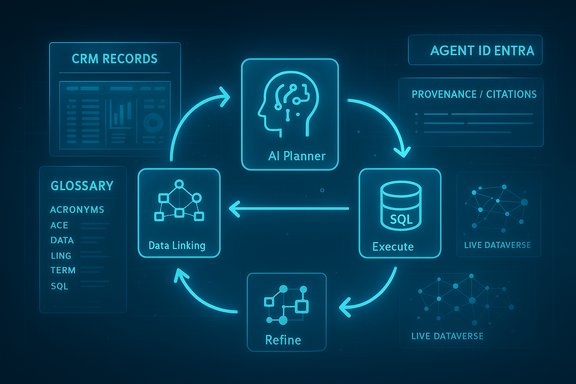
Earlier Dataverse Search implementations used sequential stages: parse the question, map to schema, link values, generate SQL, execute. Each stage was isolated; an error at one step could cascade and break the whole response. This is a well‑known failure mode in text‑to‑SQL systems where mis‑mapped columns or missing joins produce incorrect or empty results — especially in customized enterprise schemas. The new architecture replaces that brittle chain with a goal‑oriented loop that can adaptively change tactics.The agentic loop: plan → execute → refine
The Orchestrator treats a user question as a goal, not a single translation task. In practice it:- Rewrites follow‑ups into self‑contained queries by leveraging conversation context (so multi‑turn user flows remain coherent).
- Enriches the question with domain knowledge from glossaries and schema descriptions to disambiguate acronyms, business metrics, and similarly‑named fields.
- Plans a sequence of sub‑tasks and picks tools — e.g., schema lookup, semantic value search, SQL execution — deciding the order and when to combine results.
- Executes the plan, inspects the results, and self‑corrects if results are missing or inconsistent (replanning, expanding search scope, or changing joins).
- Returns final answers with a concise explanation and citations to the underlying records.
Key capabilities and business impacts
Real‑time, actionable answers from live data
Because the Orchestrator queries live Dataverse tables (not stale index snapshots alone), answers reflect the current state of CRM or service records. That means a salesperson can ask “Which opportunities are likely to close this week?” and get up‑to‑the‑minute results scoped to their security‑filtered view. This is explicitly designed to be a live, operational Q&A rather than a nightly report.Democratized access to relational data
The agent abstracts away schema complexity: nontechnical users can ask for “active, high‑priority cases not updated in 3 days” without knowing there are separate Incident and Activity tables or how to join them. The Orchestrator performs multi‑hop joins and uses the glossary to map business terms (e.g., “at risk” → a particular field value) so the answers match organizational semantics.Multi‑turn, contextual conversations
The system rewrites follow‑ups into single, coherent queries using conversation history, enabling natural interactions: ask for “top opportunities in Q4,” then refine with “How about Europe only?” and the agent applies the filter without dropping context. This leads to shorter workflows and faster decision cycles.Personalization and usage‑based learning
The Orchestrator uses tenant interaction signals to prioritize interpretations (for example, preferring frequently used custom fields), allowing the system to favor patterns that match organizational practice. Microsoft emphasizes that learning is scoped to tenant interaction signals and not external data — a privacy design point that matters to IT teams. This personalization can increase relevance over time but must be managed to avoid bias drift.How it works: tools and plumbing
The agentic Dataverse Search uses discrete tools the orchestrator can call:- schema_linking_tool — discover tables, relationships, and column metadata.
- data_linking_tool — semantic search across values and records to resolve entity mentions and fuzzy matches.
- sql_execution_tool — run synthesized SQL or deterministic queries against Dataverse.
- submit_plan_update_tool — capture plans, corrections, and provenance for auditing.
Verification: what Microsoft reports and what we can independently confirm
Microsoft’s Dynamics 365 blog and product pages describe the Orchestrator, toolset, glossaries, schema enrichment, and a set of evaluation metrics showing significant accuracy gains on curated enterprise prompts. Those vendor materials also include an example evaluation table reporting relaxed Execution Accuracy and P80 latencies across three complexity levels, and they publish customer anecdotes (e.g., a financial services customer moving from 22% to 97% Execution Accuracy on a marquee scenario). These claims come directly from Microsoft’s product blog and marketing materials.Independent platform documentation and Microsoft’s own product pages corroborate the architectural elements: Dataverse’s enhanced search configuration, the need for enhanced semantic indexing for Copilot/agents, and MCP/Foundry integrations are all documented on Microsoft Learn and Azure product pages. The broader agentic retrieval pattern — planners that perform multi‑step retrieval and iterative refinement — is likewise documented in Microsoft’s Azure AI Search blog announcing agentic retrieval. We therefore confirm the architecture and the posture; the evaluation numbers, however, are vendor‑reported and not independently reproducible from public datasets at this time unless reproduced by customers or third‑party tests. Treat the precise EX Accuracy and P80 latency numbers as vendor‑provided benchmarks requiring validation in your tenant. Caveat: exact percentages and latency figures (for example, the 96.2%/96.4% accuracy for lower complexity and 81.2% for complex prompts, with P80 latencies of 7.7s/7.5s/10.6s) appear only in Microsoft’s published evaluation and are not yet independently confirmed by neutral third‑party benchmarks. These should be considered directional until validated in your environment.
Strengths: where this approach shines
- Robustness against schema brittleness. The planner/refiner loop reduces single‑point failures in text→SQL pipelines by allowing course corrections and multi‑stage evidence gathering.
- Contextual, multi‑turn interactions. Conversation rewriting plus glossary enrichment supports natural dialogues and reduces repeated prompt engineering.
- Grounding and provenance. The use of semantic retrieval, SQL verification, and cited records creates explainable outputs suitable for enterprise audits.
- Scalability to complex schemas. Multi‑hop joins and schema linking make cross‑entity reasoning (Accounts → Opportunities → Custom Product tables) tractable even for heavily customized tenants.
- Platform alignment. Integration with MCP, Copilot Studio, Azure AI Search, and Dataverse fits enterprises already invested in Microsoft stacks, easing adoption.
Risks and limitations IT teams must manage
- Vendor‑reported metrics require tenant validation. Benchmarks reported by Microsoft are valuable but not universal; data distributions, schema quality, and tenant customization can materially affect accuracy and latency. Treat published numbers as benchmarks to beat rather than guarantees.
- Cost and latency tradeoffs. Agentic loops that replan and requery can consume more compute and I/O than a single‑shot approach. Microsoft’s P80 latencies point to realistic response times (several seconds for many queries), but real workloads and concurrency will drive costs and perceived responsiveness. Model routing and retrieval effort will directly influence consumption.
- Hallucination and over‑generalization risk. Even orchestrated agents can synthesize plausible but incorrect conclusions if retrieval is incomplete or glossaries are misaligned. Validation stations, deterministic checks, and exposing record citations are mandatory controls for high‑impact decisions.
- Agent sprawl and lifecycle governance. Copilot Studio makes agents easy to create; without governance (Agent 365, Entra Agent ID, lifecycle policies) organizations can accumulate many agents with excessive privileges, raising audit and compliance risks. Microsoft’s governance tooling addresses this but demands operational discipline.
- Dependency on Microsoft cloud ecosystem. The tight integration with Azure AI Search, Foundry, and Dataverse eases implementation for Microsoft customers but increases coupling and may complicate multi‑cloud or on‑prem requirements. Data residency, DLP, and contractual assurances should be validated for regulated workloads.
- Data quality and semantic drift. Glossaries and schema descriptions improve interpretation, but they require active maintenance. If business definitions change (new metrics, renamed products), the agent’s behavior will drift unless glossaries and descriptions are updated.
Practical guidance: piloting and operating agentic Dataverse Search
- Start with a narrow, high‑value pilot: pick a single domain (sales pipelines, service triage, or procurement) with measurable KPIs.
- Clean and annotate schema: add descriptive column/table descriptions in Dataverse and build a starter glossary of acronyms and business terms. This materially improves disambiguation.
- Define provenance policy: require every agentic answer to include record citations and a short derivation statement before enabling write‑back or action.
- Instrument validation stations: route any action‑creating output through a human approval step during early production.
- Monitor telemetry and cost: capture P95/P80 latency, invocation counts, model inference costs, and agent‑level runtime to detect regressions or cost surprises.
- Governance and lifecycle: register agents with Entra Agent ID, apply RBAC and least privilege, and implement kill switches and quarantining policies via Agent 365.
- Measure and iterate: compare agent outputs against your canonical reports and SQL queries to compute execution accuracy inside your tenant; use that as the gating metric for further rollout.
Tuning levers: glossaries, schema descriptions and retrieval effort
- Glossaries: Teach the agent your business vocabulary and acronyms so “HRR” or “QoQ” map to tenant definitions. Glossaries are a low‑effort, high‑impact control to align model interpretation with domain intent.
- Schema descriptions: Add human‑readable descriptions to tables and columns so the Orchestrator can select the correct “Status” among similar field names. This is especially useful in heavily customized tenants.
- Retrieval depth: Most platforms let you balance retrieval effort (how many candidate records or how many retrieval passes the planner runs) against latency. Start conservative; increase effort only for high‑value, high‑complexity queries.
Technical considerations for architects
- Multi‑hop joins at scale. Agentic planners must construct efficient queries that don’t spawn wide Cartesian joins. Ensure proper indexing and consider precomputed views for frequent multi‑entity patterns.
- Security and row‑level scoping. All retrieval tools must respect Dataverse security roles and row‑level permissions; test thoroughly with users who have differing privileges.
- Model choice and fallbacks. While Microsoft positions the approach as model‑agnostic, selecting a model (GPT‑4.1 is default in Copilot Studio as of recent updates) affects cost, latency, and reasoning quality; provide deterministic fallbacks for high‑risk actions.
- Observability. Log plan decisions, retrieval traces, and SQL queries so you can reproduce, debug, and audit agent behavior. This telemetry is indispensable for compliance and troubleshooting.
Industry context and independent corroboration
Microsoft’s agentic Dataverse Search is consistent with a broader industry shift toward planner‑based retrieval and agentic orchestration. Azure AI Search publicly announced agentic retrieval patterns that plan, run parallel searches, and synthesize results — claiming up to substantial improvements in relevance for complex questions. Third‑party coverage and analyst writeups around Build/Ignite conferences confirm Microsoft’s push to make agents first‑class in enterprise stacks, emphasizing MCP, Foundry, and governance elements. Those independent materials validate the architectural trajectory while also calling out governance and cost management as top operational concerns.A realistic example (how it looks in practice)
A seller at “Fourth Coffee Machines” searches for an account — fuzzy matching finds “Fourth Coffee” despite typos. They then ask Copilot “Show me my open opportunity at risk with Fourth Coffee.” The Orchestrator:- Rewrites the prompt to scope results to the current user.
- Maps “at risk” to a cold rating from the glossary.
- Uses schema_linking_tool to identify Account and Opportunity relationships.
- Runs SQL via sql_execution_tool to retrieve matches.
- Summarizes results and cites the opportunity records.
Conclusion: transformative but operationally demanding
Agentic Dataverse Search is a meaningful evolution: it reframes natural language access to enterprise data as an adaptive planning and execution problem rather than a fragile translation pipeline. The architecture aligns with Microsoft’s broader agent strategy (MCP, Copilot Studio, Azure AI Search) and delivers capabilities that can significantly shorten decision cycles and democratize access to relational data. However, the shift raises operational requirements that IT leaders must plan for: robust governance, provenance, validation gates, cost and performance monitoring, and active maintenance of glossaries and schema metadata.For teams willing to invest in data hygiene, governance, and measured pilots, agentic Dataverse Search can convert buried CRM and operational records into conversational, auditable insights that are actually safe to act on. For others, the greatest value will come from starting small, validating vendor claims within your tenant, and building the guardrails that make an agentic future reliable and auditable.
Source: Microsoft Agentic AI Transforms Microsoft Dataverse Search
