Debenhams Group’s decision to let shoppers discover, receive personalised recommendations and complete purchases entirely inside the PayPal app marks a significant step in the shift from mobile-first retail to agentic, AI-driven shopping experiences that compress discovery and checkout into a single conversational flow.
The partnership between Debenhams Group and PayPal brings a familiar set of retail capabilities—product discovery, personalised recommendations and checkout—into a single in-app AI assistant experience. Under the arrangement, shoppers can ask an AI assistant inside PayPal for product suggestions, browse curated selections from brands across the Debenhams Group portfolio, and complete payment without leaving the chat interface. The initiative is currently being trialled with U.S. customers and is slated for a broader roll-out across the U.S. and the U.K. later this year, with Debenhams positioning itself as the first UK retailer to support a full in-app PayPal shopping journey.
This move is part of a larger tectonic shift in online retail. What used to be a chain of discrete steps—search, browse, add to cart, checkout—now risks being replaced by a single, agentic interaction where an AI assistant can discover, compare and transact on behalf of a consumer. For retailers and payments providers, that shift creates both opportunity and a raft of operational, data-governance and regulatory challenges.
But the model also centralises power: discovery, recommendation and checkout converge in the assistant layer, and the plumbing that makes this reliable—catalog orchestration, tokenized payment rails and dispute resolution—can become concentrated in a small number of orchestration providers. That raises two fundamental questions for the retail industry:
Yet the story is also an engineering and governance challenge. Retailers who treat agentic experiences as a must-win channel without shoring up data hygiene, contractual protections and fulfilment orchestration risk operational headaches and eroded margins. Similarly, platforms and payment providers that accelerate rollouts without transparent terms and robust dispute and data governance risk regulatory pushback and merchant resistance.
For merchants and developers, the sensible path is deliberate experimentation: pilot, measure, negotiate, and preserve multichannel parity. Where agents deliver demonstrable, sustainable uplift and merchants retain control of customer relationships and data, agentic commerce will become a valuable addition to the retail toolkit. If the ecosystem heads toward closed, opaque intermediaries, merchants should prepare mitigation plans that prioritise portability, instrumented performance metrics and legal protections.
As AI shifts from assistant to agent, the retail industry faces a rare inflection point. The convenience and conversion promises are real—but the long-term winners will be those who marry technical discipline, clear commercial terms and consumer-centric governance into their agentic strategies.
Source: Retail Gazette Debenhams teams up with PayPal on AI-driven shopping - Retail Gazette
 Background / Overview
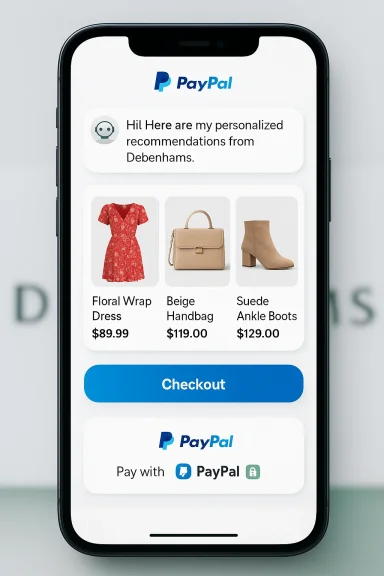
The partnership between Debenhams Group and PayPal brings a familiar set of retail capabilities—product discovery, personalised recommendations and checkout—into a single in-app AI assistant experience. Under the arrangement, shoppers can ask an AI assistant inside PayPal for product suggestions, browse curated selections from brands across the Debenhams Group portfolio, and complete payment without leaving the chat interface. The initiative is currently being trialled with U.S. customers and is slated for a broader roll-out across the U.S. and the U.K. later this year, with Debenhams positioning itself as the first UK retailer to support a full in-app PayPal shopping journey.This move is part of a larger tectonic shift in online retail. What used to be a chain of discrete steps—search, browse, add to cart, checkout—now risks being replaced by a single, agentic interaction where an AI assistant can discover, compare and transact on behalf of a consumer. For retailers and payments providers, that shift creates both opportunity and a raft of operational, data-governance and regulatory challenges.
What the Debenhams–PayPal experience does, technically
- Shoppers speak to an AI assistant embedded inside the PayPal mobile app.
- The assistant understands the shopper’s profile, asks follow-up questions, and tailors recommendations to taste and budget.
- Search results can surface curated SKUs from Debenhams Group brands (for example, fashion labels and mass-market ranges).
- Shoppers can complete purchases within the chat flow; PayPal uses saved credentials to settle payment and initiate delivery.
- The pilot integrates third-party AI tools such as Perplexity and Microsoft Copilot for broader discovery and reasoning support.
- The experience is designed so the merchant remains the merchant of record while PayPal provides wallet and payment orchestration, fraud mitigation and buyer-protection primitives.
Why this matters: the strategic case for both sides
For Debenhams Group
- Expand reach where intent is formed. Debenhams reports a high share of customers using PayPal (around 16% of sales processed through PayPal), so embedding discovery and checkout with that partner promises to convert on existing payment preferences and lower friction on affluent conversion paths.
- Faster path to purchase. Removing redirects and pre-filling shipping and payment details reduces friction, which can materially increase conversion rates and reduce cart abandonment.
- Brand discovery inside assistants. For mid-tier and fast-fashion brands, being discoverable inside an AI assistant can create new demand channels.
For PayPal
- Deeper role in the purchase flow. PayPal has publicly repositioned branded checkout and agentic commerce as strategic priorities. Enabling full journeys inside its app helps grow the “branded” payment share and keeps PayPal central to high-value moments of purchase intent.
- Leverage trust and protections. PayPal’s buyer/seller protections and fraud tools are presented as risk mitigants for purchases that originate in conversational surfaces.
- Network effects from Store Sync / orchestration. The ability to make a merchant discoverable across multiple AI surfaces via a single integration is attractive—one integration, many agentic surfaces.
Strengths: what this approach gets right
- Radically reduced friction. Streamlined checkout inside a conversation eliminates the usual cross-site, cross-app redirects and form-filling that kill conversion momentum.
- Personalisation at scale. An AI that understands profile, previous purchases and stated preferences can accelerate discovery while making it feel tailored.
- Payment and fraud infrastructure built in. Delegating payment to PayPal reduces the technical burden on the retailer for secure tokenized payments and dispute handling.
- Speed of merchant enablement. With catalog orchestration tooling and connectors, retailers can become discoverable across multiple assistant surfaces more quickly than building bespoke integrations.
- Potential conversion lift. Vendor materials and early experiments indicate higher conversion and faster purchase times when purchase flows remain in one context—claims that align with observed patterns in checkout optimisation.
Risks and operational challenges
While the benefits are compelling, the next phase of conversational, agentic commerce raises numerous practical and strategic risks retailers and platform operators must confront.Catalog fidelity and inventory parity
AI assistants that recommend products must rely on accurate catalog, inventory and pricing data. If information leaking from a retailer’s feed is stale or inconsistent with the merchant’s storefront, the result is oversells, disappointed customers, and costly disputes. Robust, real-time inventory sync is non-negotiable.Loss of brand control and reduced storefront context
When purchases are completed inside an assistant, shoppers may miss brand storytelling, detailed product pages, and upsell opportunities that retailers use to build lifetime value. For premium brands especially, curated browsing and site experience are part of the value proposition—an assistant-led flow risks flattening that experience.Data privacy, consent and visibility
Agentic experiences require data sharing between platform, payments partner and merchant. Customers need clarity about:- Which entity stores and uses their purchase and preference data
- How long that data is retained and for what purposes
- How customers can control or delete AI personalization data
Dispute resolution and consumer protection
Autonomous purchases create grey areas of liability: if an AI misinterprets a shopper’s brief and purchases the wrong item, who is responsible for refund, return shipping and other costs? Clear contractual and policy frameworks will be required between platforms, payments providers and merchants.Fraud vectors and new attack surfaces
Conversational checkouts introduce fresh fraud risks—from manipulated assistant prompts to social-engineering attacks that trick assistants into authorizing purchases. Existing fraud tooling must evolve to detect agentic-specific anomalies.Merchant economics and fees
PayPal’s role as orchestration and checkout provider raises questions about fees, revenue share and margin dilution. Many merchants will want transparency on economics before committing to long-term reliance on a single assistant surface.Technical architecture: what merchants and integrators must build
The shift to agentic commerce changes the checklist for retail IT teams. Key technical requirements include:- API-first product and catalog models with canonical attributes (GTINs, SKUs, sizes, colours).
- Real-time inventory and price endpoints that support low-latency queries and push updates.
- Order orchestration hooks that accept agent-originated orders and emit structured confirmations, cancellations and returns webhooks.
- Tokenized payment flows and compatibility with delegated payment primitives (short-lived tokens, merchant-authorized settlement).
- Robust logging, telemetry and attribution so merchants can trace which sales came from agentic surfaces and measure lifetime value.
- Privacy-first consent and data-retention controls that integrate with platform-level personalization.
Regulatory and policy considerations
Agentic commerce sits at the intersection of payments, consumer protection, privacy and competition policy. Key regulatory fault lines to watch:- Consumer consent and transparency. Regulators will demand that agents clearly disclose when they are acting on behalf of the user, what data is shared and who is liable for mistakes.
- Liability frameworks. Lawmakers and regulators may require contractual clarity on refunds, returns and misrepresentation when agents act autonomously.
- Competition and gatekeeping. The concentration of discovery and checkout in a few AI assistants could attract antitrust attention if platform operators extract disproportionate fees or lock merchants into proprietary protocols.
- Data portability and interoperability. Standards mandating portability of catalog and user preference data across assistant services would reduce vendor lock-in and help merchants reach multiple surfaces.
Commercial strategies for merchants: a playbook
Retailers should approach agentic commerce deliberately and pragmatically. Recommended steps:- Pilot, instrument, measure: Start small with controlled pilots to evaluate conversion, returns and dispute rates before committing to broad rollout.
- Negotiate protective terms: Obtain contractual guarantees on data usage, dispute handling and service-level expectations with orchestration partners.
- Preserve multichannel parity: Ensure pricing, availability and promotional parity across agentic surfaces and direct storefronts to avoid customer confusion and regulatory scrutiny.
- Invest in catalog hygiene: Clean, normalized product data is table stakes—invest in GTIN mapping, enriched metadata and image quality.
- Build analytics to track long-term LTV: Conversion uplift is valuable only if customer lifetime value and return rates justify distribution costs.
- Prepare fulfilment and returns workflows: Agent-originated orders must integrate seamlessly into existing warehouse, ERP and 3PL processes.
For developers and ISVs: practical engineering priorities
- Add pre-built connectors and templates for agentic endpoints to reduce merchant onboarding friction.
- Provide sandbox environments that simulate agentic traffic and allow merchants to test inventory and order flows under load.
- Implement observability for catalog sync processes and expose reconciliation tools that make it easy to detect mismatches.
- Prioritize secure token lifecycles and cryptographic delegation for delegated payments.
- Design SDKs that abstract agentic protocols while enabling merchants to retain brand control over key UX elements.
What to watch next: key signals that will determine success
- Conversion and dispute metrics. Real-world data on conversion uplift, average order value and dispute rates will reveal whether agentic convenience outlasts early hype.
- Merchant adoption velocity. Which merchant segments sign up, and at what pace? Fashion and fast-moving consumer goods may lead; luxury and high-service categories may lag.
- Protocol convergence or fragmentation. A fragmented ecosystem of incompatible agentic protocols will increase integration costs for merchants. Convergence around a small set of interoperable standards will lower barriers to entry.
- Regulatory interventions. Any regulatory guidance or rulings on agentic purchases, data use or platform liability will materially affect business models.
- Competitive responses. How rival payment providers, marketplaces and platforms respond—by offering their own agentic tooling or negotiating new commercial terms—will shape the strategic landscape.
Critical analysis: balancing transformation against concentration risk
The Debenhams–PayPal arrangement exemplifies the convenience-first logic of agentic commerce: reduce friction, convert intent to sale faster, and monetise moments where consumers are open to delegation. There is clear commercial sense in giving consumers a faster route from discovery to paid order, and PayPal’s existing trust infrastructure makes it a natural partner to reduce payments-related friction.But the model also centralises power: discovery, recommendation and checkout converge in the assistant layer, and the plumbing that makes this reliable—catalog orchestration, tokenized payment rails and dispute resolution—can become concentrated in a small number of orchestration providers. That raises two fundamental questions for the retail industry:
- Will merchants cede too much control over discovery and customer relationship to platforms and assistants?
- Can standards and contractual safeguards be designed quickly enough to preserve merchant choice, data portability and consumer protections?
Practical recommendations for WindowsForum readers (merchants, developers, IT leads)
- Treat agentic channels as another distribution channel—pilot with instrumentation and keep direct channels as the ground truth for pricing, brand experience and customer data.
- Make catalog and inventory reliability the first priority—invest in event-driven APIs, reconciliation tooling and alerts.
- Require explicit contractual protections around data, dispute handling and fees before integrating deeply with any single assistant surface.
- Update internal workflows (ERP, WMS, returns) so agent-originated orders are handled with the same SLAs and audit trails as other channels.
- Ensure your Windows-hosted tooling and integration middleware can handle webhooks, short-lived tokens and push-based inventory updates.
The verdict: incremental revolution with hard engineering and governance work ahead
Debenhams’ partnership with PayPal is not merely a marketing exercise; it is a concrete example of agentic commerce in deployment. It showcases the promise of smoother, more personalised shopping journeys, and it demonstrates the commercial bet that payments partners can capture more value by owning more of the discovery-to-settlement path.Yet the story is also an engineering and governance challenge. Retailers who treat agentic experiences as a must-win channel without shoring up data hygiene, contractual protections and fulfilment orchestration risk operational headaches and eroded margins. Similarly, platforms and payment providers that accelerate rollouts without transparent terms and robust dispute and data governance risk regulatory pushback and merchant resistance.
For merchants and developers, the sensible path is deliberate experimentation: pilot, measure, negotiate, and preserve multichannel parity. Where agents deliver demonstrable, sustainable uplift and merchants retain control of customer relationships and data, agentic commerce will become a valuable addition to the retail toolkit. If the ecosystem heads toward closed, opaque intermediaries, merchants should prepare mitigation plans that prioritise portability, instrumented performance metrics and legal protections.
As AI shifts from assistant to agent, the retail industry faces a rare inflection point. The convenience and conversion promises are real—but the long-term winners will be those who marry technical discipline, clear commercial terms and consumer-centric governance into their agentic strategies.
Source: Retail Gazette Debenhams teams up with PayPal on AI-driven shopping - Retail Gazette