

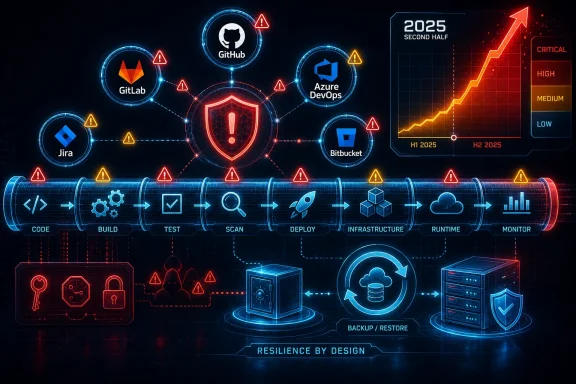
GitProtect.io said on June 1, 2026, that major DevOps platforms patched 236 vulnerabilities during 2025 across GitHub, GitLab, Azure DevOps, Jira, and Bitbucket, with 140 of those flaws rated high or critical and activity accelerating sharply in the second half. That is not just another annual security-counting exercise. It is a reminder that the systems used to build, review, ship, and automate software have become privileged infrastructure in their own right. If the code repository is now a production dependency, then DevOps security is no longer a developer-side concern; it is core business continuity.
The most important number in GitProtect.io’s report is not merely 236. It is the 59 percent of patched vulnerabilities that landed in the high or critical severity bands. Fourteen were critical, 126 were high, 75 were medium, and 21 were low, which means the bulk of the year’s documented platform risk sat in territory where delay can become expensive quickly.
That matters because DevOps platforms have accumulated authority. They store source code, issue histories, deployment credentials, workflow definitions, package hooks, release automation, pull request records, secrets-adjacent metadata, and institutional memory. A compromise here is rarely just a compromise of “developer tooling.” It can become a path into production, a source-code leak, a supply-chain event, or a paralysis incident when teams cannot ship fixes because the system used to ship them is unavailable.
The report’s scope also explains why WindowsForum readers should care even if they do not administer these platforms directly. GitHub, GitLab, Azure DevOps, Jira, and Bitbucket are the connective tissue behind countless Windows applications, internal tools, PowerShell automation repositories, infrastructure-as-code estates, and enterprise software delivery programs. A vulnerability in the platform layer can ripple into Windows desktop management, server operations, cloud workloads, and identity-driven automation.
This is the uncomfortable inversion of modern software delivery. The tools built to make releases faster and safer have themselves become high-value attack surfaces. The more organizations centralize around them, the more every flaw in the platform becomes a potential multiplier.
The quarterly sequence is almost too neat: 45 vulnerabilities in the first quarter, 52 in the second, 60 in the third, and 79 in the fourth. By the final quarter, the volume was 76 percent higher than in the first quarter. November alone accounted for 36 patched vulnerabilities, or 15 percent of the annual total.
There are two ways to read that. The optimistic reading is that vendors are finding, triaging, and fixing more issues. A rising patch count can reflect healthier disclosure pipelines and stronger security engineering. In software security, silence is not always safety; sometimes it is just poor visibility.
The less comforting reading is that attackers, researchers, and vendors are all converging on the same conclusion: DevOps platforms are worth deeper scrutiny. These tools sit close to code, identity, automation, and deployment. Any weakness that crosses from repository access to execution, escalation, or workflow manipulation can be disproportionately valuable.
The report does not prove that these ecosystems are collapsing under their own complexity. It does, however, show that complexity has become measurable in the vulnerability ledger. The second half of 2025 was not a seasonal blip so much as a signal that security teams are dealing with a growing class of platform risk at the exact point where organizations are asking software teams to move faster.
That distinction is important because vulnerability counts are easy to misuse. A high number can reflect a large attack surface, strong disclosure practices, active researcher attention, transparent advisory processes, or all of the above. A lower number can reflect fewer flaws, less public reporting, narrower counting criteria, or less visibility. Security teams should resist turning raw totals into league tables.
Only two of GitLab’s 2025 issues were classified as critical in the report: CVE-2025-25291 and CVE-2025-25292, both linked to ruby-saml and authentication logic. Authentication-adjacent bugs deserve particular scrutiny because the damage model is different from a narrowly scoped feature flaw. If identity boundaries fail, the attacker may not need to exploit the rest of the product in the expected way.
GitLab’s numbers therefore cut both ways. The decline from 2024 suggests improvement or at least reduced reported volume, but the absolute count keeps GitLab squarely in the operational risk conversation. For administrators, the practical lesson is not to panic over the count. It is to make sure self-managed instances, runners, integrations, and backup paths are treated as part of the same security domain.
That should make enterprise IT uncomfortable, because Jira and Bitbucket often sit at the boundary between engineering work and business process. Jira is where organizations track issues, incidents, approvals, feature work, compliance evidence, and operational dependencies. Bitbucket is where code and pipelines may live. Together, they often describe not only what the organization builds, but how the organization thinks.
The report identified two Atlassian-related vulnerabilities with CVSS scores of 10.0, the maximum rating. One was CVE-2024-38999, described as remote code execution in Bitbucket through a third-party dependency. The other was CVE-2025-66516, described as an XML external entity injection issue in Jira affecting confidentiality, integrity, and availability.
The third-party dependency angle is especially telling. DevOps platforms are not monoliths sealed away from the rest of the software ecosystem. They are built from frameworks, libraries, plugins, integrations, and external components. A flaw in one layer can surface as a platform-level crisis when the affected component sits in a sensitive path.
This is where software supply-chain rhetoric becomes operational reality. It is easy to tell application teams to inventory dependencies and patch promptly. It is harder when the dependency problem lives inside the platforms those teams rely on to do the inventorying and patching.
Four of the GitHub Cloud flaws were classified as critical. One of them, CVE-2025-178, was described as a composite GitHub Action vulnerability with a CVSS score of 10.0 that allowed arbitrary code execution. For many organizations, GitHub Actions is not a convenience layer; it is a deployment engine.
That makes workflow security a different kind of problem from repository access control. A code hosting platform stores the crown jewels, but an automation platform may have the keys to build, sign, publish, deploy, and notify. If arbitrary code execution enters that context, the attacker may be operating in a space where tokens, environment variables, artifacts, and privileged integrations are nearby.
GitHub’s split between Enterprise Server and Cloud also reflects a broader tension in platform security. Cloud services centralize responsibility and can move patches quickly. Self-hosted or enterprise-managed variants give organizations more control but also more operational burden. Neither model eliminates risk; each changes who must act and how fast.
For Windows-heavy environments, the GitHub angle matters because GitHub has become a common home for PowerShell modules, Windows administration scripts, infrastructure templates, .NET projects, internal tooling, and release workflows. A flaw in a workflow system can affect much more than a web application team. It can affect how administrators package, test, and deploy the scripts that keep the estate running.
One vulnerability, CVE-2025-47158, was described as allowing unauthenticated attackers to bypass authentication and manipulate assumed-immutable data, resulting in network-based privilege escalation. The phrase “assumed-immutable” is doing a lot of work here. Security architectures often depend on certain records, claims, artifacts, or workflow states being trustworthy once established.
When those assumptions break, defenders have to revisit more than a single patch. They have to ask what controls relied on that immutability, what logs can be trusted, what downstream decisions may have been made from manipulated state, and whether compensating controls would have noticed abuse. That is the deeper cost of platform vulnerabilities: they force organizations to audit their own assumptions.
Azure DevOps also occupies a peculiar position in many Microsoft shops. It may be tied into Entra ID, Azure subscriptions, pipelines, artifacts, test plans, boards, service connections, and Windows build systems. A critical flaw in that environment is not just another cloud-service advisory. It can intersect with the entire Microsoft development and operations stack.
The report’s Azure DevOps count is small, but the lesson is large. Platform centrality, not just vulnerability volume, should drive risk prioritization. A two-vulnerability year can still demand urgent attention if the affected service is wired into privileged automation.
GitProtect.io’s report says high-severity flaws climbed from 39 in the first half to 87 in the second. Critical flaws also more than doubled across the same period. That combination changes the conversation from routine patch hygiene to executive risk management.
DevOps systems are awkward to patch because they are always in use. Developers want access during the workday, release engineers need reliable pipelines, incident teams may need emergency deployment capability, and auditors may depend on issue history or change records. Taking a platform down for maintenance can be disruptive; delaying a patch can be worse.
The hosted-versus-self-managed split complicates this further. In hosted services, customers often benefit from vendor-side patching but still need to review integrations, tokens, workflows, user permissions, and audit trails. In self-managed deployments, customers may have to schedule upgrades, test compatibility, update runners or agents, and deal with plugin fallout.
That is why severity cannot be treated as a number on a dashboard. A critical DevOps vulnerability may require code freezes, credential rotation, pipeline review, backup validation, forensic checks, and stakeholder communication. The patch is the start of the work, not the end.
That does not make the recommendation wrong. It does mean readers should separate the vendor’s product positioning from the underlying operational point. Patching protects against known flaws, but it does not guarantee availability, recoverability, or integrity after an incident.
DevOps data is often more fragile than organizations admit. Repositories may be mirrored, but issues, pull requests, comments, pipeline logs, release records, wiki pages, project boards, permissions, and automation metadata are not always protected with the same seriousness as production databases. When a platform outage, account compromise, ransomware event, mistaken deletion, or bad integration hits, that metadata can be the difference between controlled recovery and organizational amnesia.
The resilience argument is broader than backup. Organizations need to know who can alter pipelines, which tokens can deploy, where secrets are stored, how quickly runners can be rebuilt, whether repositories can be restored with history intact, and whether issue data can be recovered in a usable form. They also need to test those assumptions before an incident.
For many IT teams, DevOps resilience is still underdeveloped because the tools grew organically. A department adopted GitHub, another standardized on Jira, a legacy group kept Bitbucket, and a Microsoft-aligned team used Azure DevOps. Years later, the organization discovers it has several overlapping software-delivery systems and no unified recovery model for any of them.
This is where many organizations are weakest. They treat hosted DevOps services as if vendor patching eliminates customer responsibility. It does not. If a compromised account creates a malicious workflow, if an overprivileged token leaks, if a third-party integration retains excessive access, or if a repository deletion wipes critical history, the customer is deeply involved in the outcome.
The same applies to self-managed platforms, but with more moving parts. Administrators must track advisories, upgrade on time, manage dependencies, secure databases and storage backends, protect runners, monitor logs, and keep recovery procedures current. A neglected self-hosted DevOps instance can become a privileged island with outdated software and broad internal access.
The report’s numbers should therefore push organizations toward governance, not just faster patching. DevOps administrators need a seat at the security table. Security teams need visibility into workflow changes and platform configuration. Developers need guardrails that do not turn every release into a ticket queue.
That balance is difficult but necessary. Locking everything down can encourage shadow tooling. Leaving everything open turns the platform into an attacker’s playground. The goal is not to make DevOps slow; it is to make the fast path trustworthy.
Consider the common chain. A developer signs in through a corporate identity provider. A repository contains scripts or infrastructure definitions. A pipeline uses service connections to deploy into cloud or on-premises environments. Artifacts are published for installation. A ticketing system records approvals and change history. Each link may rely on the DevOps platform’s integrity.
If an attacker can manipulate workflows, escalate privileges, or alter records, the downstream effect may appear somewhere else entirely. A Windows server receives a bad deployment. A signed package carries unwanted code. A privileged automation account runs a modified script. An incident review finds that the ticket trail is incomplete or unreliable.
That is why DevOps vulnerability management should be tied to identity hygiene. Conditional access, phishing-resistant authentication, least privilege, token expiration, protected branches, code-owner reviews, environment approvals, and audit retention are not decorative controls. They are the safety rails around systems that can change production.
Windows administrators do not need to become full-time DevSecOps engineers. But they do need to know which DevOps platforms can affect their estate, who owns them, how they are patched, how their credentials are governed, and how recovery would work if the platform were unavailable.
A useful security program should therefore ask concrete questions. Are self-managed instances patched within a defined service-level window? Are hosted services monitored for advisory-driven configuration changes? Are tokens short-lived and scoped? Are runners isolated? Are backups independent and tested? Are issue histories and pull request records recoverable? Are third-party apps reviewed with the same seriousness as SaaS applications?
The report also challenges the lazy assumption that “the vendor patched it” is the end state. Vendor patching may close the vulnerability, but it does not tell the customer whether exposure occurred, whether logs are sufficient, whether credentials should be rotated, or whether dependent workflows were abused. That assessment belongs inside the customer’s security operation.
There is also a cultural problem. Developers often see platform security controls as friction, while security teams sometimes see developer autonomy as risk. The 2025 vulnerability curve suggests both sides need a more mature bargain. Developers get reliable, fast tooling; security gets visibility, enforceable policy, and recoverability.
The organizations that handle this well will not be the ones with the longest policy documents. They will be the ones that know which platforms matter, which workflows are privileged, which data must be recoverable, and which vulnerabilities require immediate operational action.
The next phase of DevOps security will be less about whether organizations use GitHub, GitLab, Bitbucket, Jira, or Azure DevOps, and more about whether they understand the authority those platforms already have. The 2025 numbers show that attackers and researchers understand that authority very well. In 2026, the organizations that fare best will be those that stop treating DevOps tools as background plumbing and start managing them as critical infrastructure.
 The Build Pipeline Is Now the Blast Radius
The most important number in GitProtect.io’s report is not merely 236. It is the 59 percent of patched vulnerabilities that landed in the high or critical severity bands. Fourteen were critical, 126 were high, 75 were medium, and 21 were low, which means the bulk of the year’s documented platform risk sat in territory where delay can become expensive quickly.That matters because DevOps platforms have accumulated authority. They store source code, issue histories, deployment credentials, workflow definitions, package hooks, release automation, pull request records, secrets-adjacent metadata, and institutional memory. A compromise here is rarely just a compromise of “developer tooling.” It can become a path into production, a source-code leak, a supply-chain event, or a paralysis incident when teams cannot ship fixes because the system used to ship them is unavailable.
The report’s scope also explains why WindowsForum readers should care even if they do not administer these platforms directly. GitHub, GitLab, Azure DevOps, Jira, and Bitbucket are the connective tissue behind countless Windows applications, internal tools, PowerShell automation repositories, infrastructure-as-code estates, and enterprise software delivery programs. A vulnerability in the platform layer can ripple into Windows desktop management, server operations, cloud workloads, and identity-driven automation.
This is the uncomfortable inversion of modern software delivery. The tools built to make releases faster and safer have themselves become high-value attack surfaces. The more organizations centralize around them, the more every flaw in the platform becomes a potential multiplier.
The Calendar Tells a Worse Story Than the Annual Total
The annual total is attention-grabbing, but the trend line is the real story. GitProtect.io counted 97 patched vulnerabilities in the first half of 2025 and 139 in the second half, a 30 percent increase. Critical flaws also rose from four in the first half to 10 in the second.The quarterly sequence is almost too neat: 45 vulnerabilities in the first quarter, 52 in the second, 60 in the third, and 79 in the fourth. By the final quarter, the volume was 76 percent higher than in the first quarter. November alone accounted for 36 patched vulnerabilities, or 15 percent of the annual total.
There are two ways to read that. The optimistic reading is that vendors are finding, triaging, and fixing more issues. A rising patch count can reflect healthier disclosure pipelines and stronger security engineering. In software security, silence is not always safety; sometimes it is just poor visibility.
The less comforting reading is that attackers, researchers, and vendors are all converging on the same conclusion: DevOps platforms are worth deeper scrutiny. These tools sit close to code, identity, automation, and deployment. Any weakness that crosses from repository access to execution, escalation, or workflow manipulation can be disproportionately valuable.
The report does not prove that these ecosystems are collapsing under their own complexity. It does, however, show that complexity has become measurable in the vulnerability ledger. The second half of 2025 was not a seasonal blip so much as a signal that security teams are dealing with a growing class of platform risk at the exact point where organizations are asking software teams to move faster.
GitLab Shows That Volume and Direction Are Not the Same Thing
GitLab recorded the largest number of patched vulnerabilities in the report, with 129 across 2025. That figure is significant, but it also came with an important caveat: it represented a 16 percent year-on-year decline from 153 in 2024. The platform with the highest count was not necessarily the platform with the most alarming trajectory.That distinction is important because vulnerability counts are easy to misuse. A high number can reflect a large attack surface, strong disclosure practices, active researcher attention, transparent advisory processes, or all of the above. A lower number can reflect fewer flaws, less public reporting, narrower counting criteria, or less visibility. Security teams should resist turning raw totals into league tables.
Only two of GitLab’s 2025 issues were classified as critical in the report: CVE-2025-25291 and CVE-2025-25292, both linked to ruby-saml and authentication logic. Authentication-adjacent bugs deserve particular scrutiny because the damage model is different from a narrowly scoped feature flaw. If identity boundaries fail, the attacker may not need to exploit the rest of the product in the expected way.
GitLab’s numbers therefore cut both ways. The decline from 2024 suggests improvement or at least reduced reported volume, but the absolute count keeps GitLab squarely in the operational risk conversation. For administrators, the practical lesson is not to panic over the count. It is to make sure self-managed instances, runners, integrations, and backup paths are treated as part of the same security domain.
Atlassian’s Numbers Put Collaboration Tools in the Hot Seat
Atlassian products accounted for 87 vulnerabilities in the report, split between 48 in Bitbucket and 39 in Jira. The more striking detail is that all were classified as high or critical severity. Bitbucket’s total was also up 58 percent year on year from 2024.That should make enterprise IT uncomfortable, because Jira and Bitbucket often sit at the boundary between engineering work and business process. Jira is where organizations track issues, incidents, approvals, feature work, compliance evidence, and operational dependencies. Bitbucket is where code and pipelines may live. Together, they often describe not only what the organization builds, but how the organization thinks.
The report identified two Atlassian-related vulnerabilities with CVSS scores of 10.0, the maximum rating. One was CVE-2024-38999, described as remote code execution in Bitbucket through a third-party dependency. The other was CVE-2025-66516, described as an XML external entity injection issue in Jira affecting confidentiality, integrity, and availability.
The third-party dependency angle is especially telling. DevOps platforms are not monoliths sealed away from the rest of the software ecosystem. They are built from frameworks, libraries, plugins, integrations, and external components. A flaw in one layer can surface as a platform-level crisis when the affected component sits in a sensitive path.
This is where software supply-chain rhetoric becomes operational reality. It is easy to tell application teams to inventory dependencies and patch promptly. It is harder when the dependency problem lives inside the platforms those teams rely on to do the inventorying and patching.
GitHub’s Smaller Count Still Lands Heavily
GitHub patched 18 vulnerabilities during the year, according to the report, including five affecting GitHub Enterprise Server and 13 affecting GitHub Cloud. On raw volume, that is far below GitLab and Atlassian. On impact, the picture is less simple.Four of the GitHub Cloud flaws were classified as critical. One of them, CVE-2025-178, was described as a composite GitHub Action vulnerability with a CVSS score of 10.0 that allowed arbitrary code execution. For many organizations, GitHub Actions is not a convenience layer; it is a deployment engine.
That makes workflow security a different kind of problem from repository access control. A code hosting platform stores the crown jewels, but an automation platform may have the keys to build, sign, publish, deploy, and notify. If arbitrary code execution enters that context, the attacker may be operating in a space where tokens, environment variables, artifacts, and privileged integrations are nearby.
GitHub’s split between Enterprise Server and Cloud also reflects a broader tension in platform security. Cloud services centralize responsibility and can move patches quickly. Self-hosted or enterprise-managed variants give organizations more control but also more operational burden. Neither model eliminates risk; each changes who must act and how fast.
For Windows-heavy environments, the GitHub angle matters because GitHub has become a common home for PowerShell modules, Windows administration scripts, infrastructure templates, .NET projects, internal tooling, and release workflows. A flaw in a workflow system can affect much more than a web application team. It can affect how administrators package, test, and deploy the scripts that keep the estate running.
Azure DevOps Is Small in Count, Large in Consequence
Microsoft Azure DevOps appeared in the report with two critical vulnerabilities patched in 2025. In a table of hundreds, two may look like a footnote. In an enterprise environment standardized on Microsoft identity, Azure services, Visual Studio tooling, and Windows Server workflows, that footnote can matter a great deal.One vulnerability, CVE-2025-47158, was described as allowing unauthenticated attackers to bypass authentication and manipulate assumed-immutable data, resulting in network-based privilege escalation. The phrase “assumed-immutable” is doing a lot of work here. Security architectures often depend on certain records, claims, artifacts, or workflow states being trustworthy once established.
When those assumptions break, defenders have to revisit more than a single patch. They have to ask what controls relied on that immutability, what logs can be trusted, what downstream decisions may have been made from manipulated state, and whether compensating controls would have noticed abuse. That is the deeper cost of platform vulnerabilities: they force organizations to audit their own assumptions.
Azure DevOps also occupies a peculiar position in many Microsoft shops. It may be tied into Entra ID, Azure subscriptions, pipelines, artifacts, test plans, boards, service connections, and Windows build systems. A critical flaw in that environment is not just another cloud-service advisory. It can intersect with the entire Microsoft development and operations stack.
The report’s Azure DevOps count is small, but the lesson is large. Platform centrality, not just vulnerability volume, should drive risk prioritization. A two-vulnerability year can still demand urgent attention if the affected service is wired into privileged automation.
Severity Is Becoming the Management Problem
Security teams are used to vulnerability volume. The industry has lived with swollen CVE queues, emergency patch cycles, and “everything is critical” dashboards for years. What is harder is when volume rises alongside severity in systems that cannot be casually taken offline.GitProtect.io’s report says high-severity flaws climbed from 39 in the first half to 87 in the second. Critical flaws also more than doubled across the same period. That combination changes the conversation from routine patch hygiene to executive risk management.
DevOps systems are awkward to patch because they are always in use. Developers want access during the workday, release engineers need reliable pipelines, incident teams may need emergency deployment capability, and auditors may depend on issue history or change records. Taking a platform down for maintenance can be disruptive; delaying a patch can be worse.
The hosted-versus-self-managed split complicates this further. In hosted services, customers often benefit from vendor-side patching but still need to review integrations, tokens, workflows, user permissions, and audit trails. In self-managed deployments, customers may have to schedule upgrades, test compatibility, update runners or agents, and deal with plugin fallout.
That is why severity cannot be treated as a number on a dashboard. A critical DevOps vulnerability may require code freezes, credential rotation, pipeline review, backup validation, forensic checks, and stakeholder communication. The patch is the start of the work, not the end.
Backup Is the Vendor’s Pitch, but Resilience Is the Real Issue
GitProtect.io is not a neutral academic observer. It is part of Xopero Software and sells backup and recovery products for platforms including Jira, Bitbucket, GitHub, GitLab, and Azure DevOps. The report’s recommendation that organizations maintain independent backups of repositories and metadata aligns naturally with the company’s commercial interests.That does not make the recommendation wrong. It does mean readers should separate the vendor’s product positioning from the underlying operational point. Patching protects against known flaws, but it does not guarantee availability, recoverability, or integrity after an incident.
DevOps data is often more fragile than organizations admit. Repositories may be mirrored, but issues, pull requests, comments, pipeline logs, release records, wiki pages, project boards, permissions, and automation metadata are not always protected with the same seriousness as production databases. When a platform outage, account compromise, ransomware event, mistaken deletion, or bad integration hits, that metadata can be the difference between controlled recovery and organizational amnesia.
The resilience argument is broader than backup. Organizations need to know who can alter pipelines, which tokens can deploy, where secrets are stored, how quickly runners can be rebuilt, whether repositories can be restored with history intact, and whether issue data can be recovered in a usable form. They also need to test those assumptions before an incident.
For many IT teams, DevOps resilience is still underdeveloped because the tools grew organically. A department adopted GitHub, another standardized on Jira, a legacy group kept Bitbucket, and a Microsoft-aligned team used Azure DevOps. Years later, the organization discovers it has several overlapping software-delivery systems and no unified recovery model for any of them.
The Shared Responsibility Model Has Reached the Repository
Cloud security popularized the phrase shared responsibility, but DevOps platforms make it more concrete. Vendors must patch infrastructure flaws, harden services, publish advisories, and maintain secure defaults. Customers must still manage identity, permissions, integrations, backups, audit logging, workflow trust, and incident response.This is where many organizations are weakest. They treat hosted DevOps services as if vendor patching eliminates customer responsibility. It does not. If a compromised account creates a malicious workflow, if an overprivileged token leaks, if a third-party integration retains excessive access, or if a repository deletion wipes critical history, the customer is deeply involved in the outcome.
The same applies to self-managed platforms, but with more moving parts. Administrators must track advisories, upgrade on time, manage dependencies, secure databases and storage backends, protect runners, monitor logs, and keep recovery procedures current. A neglected self-hosted DevOps instance can become a privileged island with outdated software and broad internal access.
The report’s numbers should therefore push organizations toward governance, not just faster patching. DevOps administrators need a seat at the security table. Security teams need visibility into workflow changes and platform configuration. Developers need guardrails that do not turn every release into a ticket queue.
That balance is difficult but necessary. Locking everything down can encourage shadow tooling. Leaving everything open turns the platform into an attacker’s playground. The goal is not to make DevOps slow; it is to make the fast path trustworthy.
Windows Shops Should Read This as an Identity Story
For WindowsForum’s audience, the natural instinct may be to file this under application security. That would be too narrow. In a Microsoft-heavy environment, DevOps platforms increasingly intersect with identity, endpoint management, server automation, Azure resources, and Windows deployment practices.Consider the common chain. A developer signs in through a corporate identity provider. A repository contains scripts or infrastructure definitions. A pipeline uses service connections to deploy into cloud or on-premises environments. Artifacts are published for installation. A ticketing system records approvals and change history. Each link may rely on the DevOps platform’s integrity.
If an attacker can manipulate workflows, escalate privileges, or alter records, the downstream effect may appear somewhere else entirely. A Windows server receives a bad deployment. A signed package carries unwanted code. A privileged automation account runs a modified script. An incident review finds that the ticket trail is incomplete or unreliable.
That is why DevOps vulnerability management should be tied to identity hygiene. Conditional access, phishing-resistant authentication, least privilege, token expiration, protected branches, code-owner reviews, environment approvals, and audit retention are not decorative controls. They are the safety rails around systems that can change production.
Windows administrators do not need to become full-time DevSecOps engineers. But they do need to know which DevOps platforms can affect their estate, who owns them, how they are patched, how their credentials are governed, and how recovery would work if the platform were unavailable.
The 2025 Numbers Turn DevOps Hygiene Into Boardroom Risk
The practical reading of the report is not that every organization should abandon its current platform or treat GitHub, GitLab, Atlassian, and Microsoft as uniquely unsafe. These are large, complex, heavily scrutinized systems, and vulnerability discovery is part of their lifecycle. The stronger argument is that DevOps platforms now deserve the same risk discipline as identity providers, endpoint management systems, and production cloud control planes.A useful security program should therefore ask concrete questions. Are self-managed instances patched within a defined service-level window? Are hosted services monitored for advisory-driven configuration changes? Are tokens short-lived and scoped? Are runners isolated? Are backups independent and tested? Are issue histories and pull request records recoverable? Are third-party apps reviewed with the same seriousness as SaaS applications?
The report also challenges the lazy assumption that “the vendor patched it” is the end state. Vendor patching may close the vulnerability, but it does not tell the customer whether exposure occurred, whether logs are sufficient, whether credentials should be rotated, or whether dependent workflows were abused. That assessment belongs inside the customer’s security operation.
There is also a cultural problem. Developers often see platform security controls as friction, while security teams sometimes see developer autonomy as risk. The 2025 vulnerability curve suggests both sides need a more mature bargain. Developers get reliable, fast tooling; security gets visibility, enforceable policy, and recoverability.
The organizations that handle this well will not be the ones with the longest policy documents. They will be the ones that know which platforms matter, which workflows are privileged, which data must be recoverable, and which vulnerabilities require immediate operational action.
The Patch Count Is a Warning Light, Not a Scoreboard
GitProtect.io’s 2025 report offers plenty of numbers, but the safest reading is qualitative. DevOps platforms are accumulating security pressure because they are accumulating power. The more they orchestrate software delivery, the more attractive and consequential their flaws become.- The report counted 236 patched vulnerabilities across major DevOps platforms in 2025, with 140 rated high or critical.
- The second half of the year was materially worse than the first, with patched vulnerabilities rising from 97 to 139 and critical flaws rising from four to 10.
- GitLab had the highest total count at 129, but that was still down from 153 in 2024.
- Atlassian’s Jira and Bitbucket figures were notable because all 87 reported vulnerabilities were high or critical.
- GitHub’s smaller total still included critical GitHub Cloud issues, including a reported CVSS 10.0 GitHub Actions flaw.
- Azure DevOps had only two reported critical vulnerabilities, but its enterprise role makes even a small count operationally significant.
The next phase of DevOps security will be less about whether organizations use GitHub, GitLab, Bitbucket, Jira, or Azure DevOps, and more about whether they understand the authority those platforms already have. The 2025 numbers show that attackers and researchers understand that authority very well. In 2026, the organizations that fare best will be those that stop treating DevOps tools as background plumbing and start managing them as critical infrastructure.
References
- Primary source: SecurityBrief Australia
Published: 2026-06-01T08:30:42.243385

DevOps platform vulnerabilities rise in 2025 report
More than half of patched flaws in major DevOps tools were high or critical in 2025, putting software supply chains at greater risk.
securitybrief.com.au
