

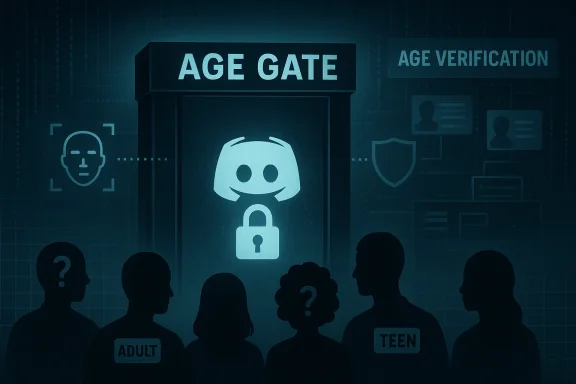
Discord’s latest safety pivot has detonated into one of the service’s biggest community crises — a global “Teen‑by‑Default” setting that funnels every account into a restricted experience unless the platform’s age‑assurance systems say otherwise, and a verification flow that can include on‑device facial age estimation or the submission of government ID to third‑party vendors.
Discord announced the global rollout of its teen‑by‑default safety architecture on February 9, 2026, saying the move builds on pilots in the UK and Australia and will begin a phased global deployment in early March. The stated objective: protect minors with stronger defaults while giving adults an option to verify and restore full features. Discord frames the change as privacy‑forward, promising on‑device facial estimation, quick deletion of submitted identity documents, and a background age‑inference model that avoids verification for many users.
The company followed that announcement with product documentation and clarification aimed at developers and server operators, underlining that most adults “won’t be asked to complete an age check” because Discord plans to infer age using signals such as account tenure, device details, and user activity. That same developer documentation cautions that the user experience will change by default: sensitive content may be blurred, age‑gated servers will be inaccessible, message request flows will be stricter, and speaking privileges in “Stage” channels may be locked behind age assurance.
Why did Discord make this move? The immediate driver was regulatory pressure in places like the UK, and the company’s stated aim of reducing risk to minors. But operationally, this is also an escape hatch for regulators who insist platforms demonstrate they have mechanisms to prevent minors from accessing adult content — whether or not a platform wants to broaden its data‑collection footprint to do it.
At Windows Central we polled readers about whether they would switch away from Discord because of the age‑assurance push; the results were stark: a majority of respondents said they would either leave or were considering it, and search interest for “Discord alternatives” spiked dramatically in the days after the announcement. The data point matters because it shows the policy produced not just noise but immediate intent to migrate among a core, engaged audience.
Why this intensity? Three linked concerns explain the churn:
Key verifiable facts:
Caveat: investor backing is not the same as operational control. Founders Fund’s investment in Persona does not prove any data sharing with Palantir; however, the public conversation is about perceived risk and governance — and that perception is shaping real behavior on the platform. Flagging that distinction is important: the presence of a high‑profile investor is a legitimate subject of scrutiny, but it is not, by itself, proof of downstream misuse.
But Discord misjudged the social contract around identity and biometrics. A responsible rollout to a global, privacy‑sensitive community needed:
For now, the path forward for Discord is clear but difficult: double down on transparent, auditable privacy practices; accelerate investment in privacy‑preserving verification alternatives; and treat vendor optics as a first‑class product concern. If Discord can make verifiable guarantees that identity data will not become a long‑term honeypot, some of the more extreme migration pressures may ease. If it cannot, the platform faces a slow unraveling as communities reorganize under tighter control of privacy‑forward or self‑hosted alternatives.
The conversation about safety and identity verification is not going away — but it can mature. The question for Discord’s leadership and for the industry is whether they want that conversation to be driven by invasive vendor lock‑in or by cryptographic, auditable, and privacy‑preserving design. The choices they make in the coming weeks will determine whether Discord keeps its communities or helps build an internet where identity checks are safer, not riskier.
Source: Windows Central Discord is in trouble, and we asked our readers if it's time to jump ship
 Background
Discord announced the global rollout of its teen‑by‑default safety architecture on February 9, 2026, saying the move builds on pilots in the UK and Australia and will begin a phased global deployment in early March. The stated objective: protect minors with stronger defaults while giving adults an option to verify and restore full features. Discord frames the change as privacy‑forward, promising on‑device facial estimation, quick deletion of submitted identity documents, and a background age‑inference model that avoids verification for many users.The company followed that announcement with product documentation and clarification aimed at developers and server operators, underlining that most adults “won’t be asked to complete an age check” because Discord plans to infer age using signals such as account tenure, device details, and user activity. That same developer documentation cautions that the user experience will change by default: sensitive content may be blurred, age‑gated servers will be inaccessible, message request flows will be stricter, and speaking privileges in “Stage” channels may be locked behind age assurance.
Why did Discord make this move? The immediate driver was regulatory pressure in places like the UK, and the company’s stated aim of reducing risk to minors. But operationally, this is also an escape hatch for regulators who insist platforms demonstrate they have mechanisms to prevent minors from accessing adult content — whether or not a platform wants to broaden its data‑collection footprint to do it.
What’s changing — the user‑facing picture
- All accounts will default to a teen‑appropriate experience unless age assurance proves otherwise. That includes stricter content filtering, limited server access, restricted messaging, and disabled stage‑speaking unless age‑assured.
- Age assurance methods include on‑device facial age estimation (video selfie processed locally), submitting government ID to a vendor partner, and Discord’s background age‑inference model — a mix intended to reduce friction for most adult users.
- Discord says verification prompts will be targeted (triggered by attempts to access age‑gated features or to change safety defaults) rather than universal scanning of every user. But the practical effect for many communities is that verification becomes necessary to restore pre‑existing access to NSFW channels, unblur sensitive media, or to speak in public events.
The community backlash — why people are fleeing
The reaction has been immediate and fierce. Within days of the global announcement a large, vocal subset of Discord’s user base threatened or began to cancel accounts, and look for alternatives — and that surge translated into real pressure on competing services. TeamSpeak, an older, voice‑focused communication platform, reported an “incredible surge” of new users and said hosting capacity had been reached in multiple regions as people looked for refuge from Discord’s new rules.At Windows Central we polled readers about whether they would switch away from Discord because of the age‑assurance push; the results were stark: a majority of respondents said they would either leave or were considering it, and search interest for “Discord alternatives” spiked dramatically in the days after the announcement. The data point matters because it shows the policy produced not just noise but immediate intent to migrate among a core, engaged audience.
Why this intensity? Three linked concerns explain the churn:
- Privacy and biometrics: Asking users to supply facial scans or government IDs — even optionally — creates unease. Biometrics and IDs are persistent, high‑value data points. Users worry about where those credentials will sit, how long they’ll be retained, and who might gain access.
- Vendor trust and past incidents: Discord previously worked with third‑party vendors for verification, and in October 2025 a vendor compromise exposed identity documents from appeals and verification workflows. Discord has publicly said the incident affected about 70,000 users, though attackers later claimed a much larger haul. That memory makes any new verification effort feel riskier.
- Centralization of identity providers: The emergence of a small set of vendors performing verification across multiple major platforms (Reddit, Roblox, Discord and others) concentrates sensitive identity data in fewer places. That consolidation raises systemic risk: a breach of one vendor can cascade across many services.
The Persona controversy: funding, retention, and optics
The sharpest flareup in the debate came when users noticed that Discord had tested an age‑verification flow tied to Persona, a well‑capitalized U.S. identity‑verification company. Persona’s rise has been fast: Series C and Series D funding rounds led by Founders Fund (the venture firm co‑founded by Peter Thiel) put Persona in the headlines and brought scrutiny because of the political and surveillance associations Thiel and Palantir carry in public discourse. Publications and privacy groups flagged those investor ties and questioned whether a company backed by Thiel’s Founders Fund should be entrusted with sensitive biometric and identity documents.Key verifiable facts:
- Persona is a major identity‑verification provider that has accepted large venture funding rounds, with Founders Fund among its lead investors. The company’s scale and investor base are matters of public record.
- Discord acknowledged running a limited experiment that routed some age‑verification flows through Persona during its UK testing — and later said that Persona participation was an experiment that has concluded. Persona’s involvement and the short retention window Discord cited during that test phase (reports said submitted verification material may have been retained temporarily, in some experiments for up to seven days) intensified concerns because it felt inconsistent with earlier claims of “no retention.”
Caveat: investor backing is not the same as operational control. Founders Fund’s investment in Persona does not prove any data sharing with Palantir; however, the public conversation is about perceived risk and governance — and that perception is shaping real behavior on the platform. Flagging that distinction is important: the presence of a high‑profile investor is a legitimate subject of scrutiny, but it is not, by itself, proof of downstream misuse.
The security history that fuels skepticism
Discord’s 2025 vendor incident — reported publicly as impacting about 70,000 credential or ID images — is the anchor point for most users’ mistrust. Two important facts are worth repeating and verifying:- Discord has acknowledged a vendor‑side incident tied to its identity verification pathway; the company reported roughly 70,000 affected government IDs in public disclosures. Attackers made larger claims about the scale of the data exfiltration, which Discord disputed. That discrepancy between attacker claims and the vendor’s reported numbers is typical after large incidents and should be treated with caution.
- The October 2025 incident did not take place inside Discord’s core production database; it happened in vendor support systems and appeal workflows, where identity documents used to contest an automated age decision were stored. The architecture of verification workflows — not just the verification technology itself — often explains where a breach can occur. Centralized document repositories, shared vendor dashboards, and human access controls are frequent soft spots.
Alternatives and migration dynamics
When users look for life beyond Discord they typically pursue two paths: commodity alternatives that mimic Discord’s feature set, and niche tools that prioritize either privacy or performance.- Stoat (formerly known under other names in the open‑source space) and Matrix‑powered clients rose in visibility because they offer open‑source, self‑hostable options that mirror Discord’s channel/voice model. In polling and search trends, Stoat has been one of the most discussed replacements for Discord among privacy‑minded communities.
- TeamSpeak, an older but resilient VoIP and community server product, is re‑emerging as a refuge for users who want voice chat without centralized identity verification. TeamSpeak’s architecture is still server‑centric and allows community operators more direct control over hosting and membership. The company itself reported a capacity surge and is expanding regions to meet demand.
- Matrix and other federated options (Element and similar clients) are attractive to technically adept communities because federation reduces single‑vendor risk and makes cross‑server migration feasible without wholesale lock‑in. But the UX and moderation tooling still lag behind Discord’s polish for many large communities.
- Feature parity: No alternative currently reproduces Discord’s exact combination of features, moderation tooling, and scale with equal convenience.
- Community disruption: Servers and communities are social contracts. Even tech‑savvy groups face friction in moving members, updating bots, and recreating integrations.
- Hosting and cost: Self‑hosting reduces vendor trust risk but introduces cost and operational complexity. Services like TeamSpeak or paid hosting offer lower friction but require monetary commitments and still collect some data (payment metadata, hosting logs).
What Discord could have done differently — a short playbook
Discord is now in damage‑control mode. The company publicly clarified several points — that most users won’t be forced through explicit verification, that facial estimates can run on‑device, and that vendors will delete documents quickly — but the communications could have anticipated and addressed three concrete concerns more forcefully:- Transparency about vendor selection and retention policies: publish audited vendor contracts and precise, auditable deletion guarantees (not just “quick deletion”), with independent verification where possible. The lack of crisp, verifiable guarantees created a vacuum filled by speculation and mistrust.
- Architect verification flows to minimize centralization: move toward privacy‑preserving proof systems (zero‑knowledge proofs, ephemeral attestations, or cryptographic age‑claims) that allow proving age without transferring or storing raw PII in vendor systems. Several cryptographic techniques exist that would meaningfully reduce the honeypot problem. Where legal regimes require specific document checks, Discord could have prioritized delegating those checks to user‑controlled wallets or other decentralized identity layers.
- Phased, opt‑in pilots with clearer exit criteria: a pilot that requires IDs or biometrics should have an explicit audit, an independent review, and a sunset clause with a public technical appendix. Discord’s terse language about “experiments” left too many unanswered questions.
Risks — beyond user churn
The near‑term risk is user attrition. The midterm risk is network fragmentation: communities will splinter across several smaller platforms, raising moderation and discoverability challenges. But the systemic risk is more worrying and underappreciated:- Data aggregation risk: If verification vendors are reused across multiple platforms, a single breach or lawful demand could expose documents linking people’s accounts across services. That turns identity verification from a per‑service safety tool into a cross‑platform surveillance vector.
- Regulatory backlash and legal uncertainty: Governments that compel age checks will welcome solutions that comply, but courts and privacy regulators may scrutinize how data flows to third parties and whether biometric processing meets local data‑protection standards. Discord’s voluntary adoption of mass age‑assurance before an explicit legal mandate invites litigation and legislative attention.
- Brand and economic fallout: Revenue from long‑time customers (Nitro subscribers) is at risk; migration reduces engagement, which can make the platform less attractive to partners and game publishers that rely on Discord’s community tools. That’s a slow burn but a durable one. The short, sharp PR crisis is only the beginning.
Where this likely goes next
- Discord will refine messaging and product flows to reassure the majority of adults who the company says won’t be prompted to verify. Expect additional developer and admin controls to help communities manage age‑gating without losing members.
- Competitors will continue to scale capacity: TeamSpeak’s capacity announcements show tangible movement; open‑source projects (Stoat/Matrix‑based clients) will try to close the quality gap fast. That creates a near‑term window for community migration, but true ecosystem replacement will take time.
- Policy and technical innovation will accelerate: privacy‑preserving age proofs, decentralized identity standards, and independent audits of identity vendors will become more mainstream as platforms try to balance safety and privacy. Market demand will drive vendors to adopt stronger guarantees or risk losing major customers.
Practical advice for community admins and users
If you manage a server or run a community on Discord, here’s a pragmatic checklist to prepare for the next weeks:- Communicate clearly with your members about the changes and what they mean for access to channels and events.
- Audit moderation bots, webhooks, and integrations: some automation may stop working if accounts are age‑gated or messaging behavior changes.
- Export critical assets and backups: roles, member lists, and important pinned content — migration is messy, and having a plan reduces disruption.
- Consider contingency hosting: test an alternative community platform (TeamSpeak, Matrix/Element, or a self‑hosted Stoat instance) before you need to move.
- Keep an eye on vendor communications and legal clarifications: Discord’s documentation is evolving and practical details (who gets prompted, when, and how documents are deleted) matter.
Final assessment — tradeoffs, strengths, and real risks
Discord’s intent — protect minors and comply with complex regulatory regimes — is legitimate and defensible. The company is right that platforms should invest in safety. Its proposed toolkit (on‑device estimation, vendor ID checks, and inference models) is a reasonable engineering mix for a company trying to meet legal and ethical expectations while preserving product utility. The strength of the approach is that it can reduce false negatives (minors seeing harmful content) without forcing heavy friction on every adult.But Discord misjudged the social contract around identity and biometrics. A responsible rollout to a global, privacy‑sensitive community needed:
- Far clearer, machine‑readable vendor retention policies and independent audits.
- Concrete commitments to privacy‑preserving verification methods where possible.
- Faster, more transparent gating of experiments (publish them, attach expiration dates and independent reviews).
Conclusion
Discord’s teen‑by‑default initiative is a watershed moment for social platforms: it forces a public reckoning about how we balance child safety, user privacy, and the architecture of identity at scale. The product choices Discord made are technically defensible, but the company underestimated the political and reputational costs of vendor selection and insufficiently specific retention guarantees. Communities and users are voting with their feet; TeamSpeak’s capacity warnings and spikes in searches for alternatives show that the market will respond quickly if trust frays.For now, the path forward for Discord is clear but difficult: double down on transparent, auditable privacy practices; accelerate investment in privacy‑preserving verification alternatives; and treat vendor optics as a first‑class product concern. If Discord can make verifiable guarantees that identity data will not become a long‑term honeypot, some of the more extreme migration pressures may ease. If it cannot, the platform faces a slow unraveling as communities reorganize under tighter control of privacy‑forward or self‑hosted alternatives.
The conversation about safety and identity verification is not going away — but it can mature. The question for Discord’s leadership and for the industry is whether they want that conversation to be driven by invasive vendor lock‑in or by cryptographic, auditable, and privacy‑preserving design. The choices they make in the coming weeks will determine whether Discord keeps its communities or helps build an internet where identity checks are safer, not riskier.
Source: Windows Central Discord is in trouble, and we asked our readers if it's time to jump ship
