

DTCC’s latest cloud move is more than a routine infrastructure update. It is a signal that one of the world’s most consequential post-trade utilities is now willing to place core market plumbing into public cloud environments, not just peripheral or experimental workloads. The company’s expanded partnerships with AWS and Microsoft bring that shift into sharper focus, with AWS tied to clearance, settlement and risk systems, and Microsoft positioned as the backbone for DTCC’s digital assets push.
For years, financial market infrastructure operators talked about cloud adoption as an inevitable destination, but usually in carefully bounded ways. Non-production workloads, analytics, and adjacent services were typically first in line, while the most sensitive systems stayed on private infrastructure. DTCC’s current strategy reflects how that conservative pattern is changing, albeit under heavy regulatory supervision.
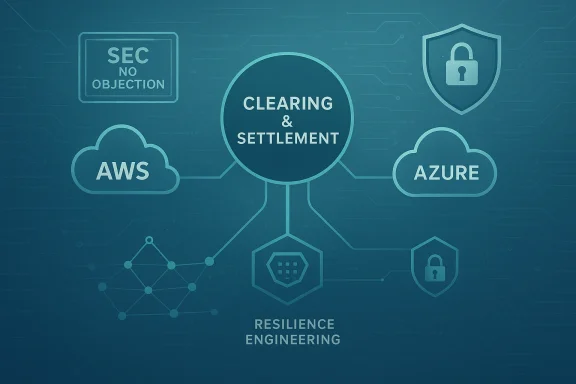
The scale of DTCC matters because it sits near the center of U.S. market plumbing. Its subsidiaries process enormous transaction volumes, and that scale makes resilience, security and recovery design non-negotiable rather than aspirational. DTCC says its clearing agency subsidiaries received a Notice of No Objection from the SEC in June 2025 allowing specified core services to move into a public cloud environment, which is the regulatory green light enabling this phase of the program.
This is not DTCC’s first cloud experiment. The firm has discussed cloud and resiliency work with AWS for more than a decade, and in 2023 it described a public-cloud prototype intended to improve multi-region resilience. What is new is that a defined set of core clearance and settlement applications is now being positioned for migration, which materially raises the stakes for the industry and the regulator alike.
The Microsoft side of the story is equally important, though it serves a different purpose. DTCC’s digital assets business is being built out as a distinct platform layer, with Azure as the cloud foundation for services such as ComposerX and Digital Launchpad. That division between core post-trade infrastructure and digital assets is a useful reminder that DTCC is modernizing two different business problems at once: legacy market infrastructure and the emerging tokenized-asset stack.
There is also a symbolic dimension. Public cloud has long been a debated topic in capital markets, with advocates pointing to elasticity and faster innovation, and skeptics warning about concentration risk, dependency on third-party providers and operational fragility. DTCC’s move suggests the industry is no longer debating whether cloud can be used at all, but how it can be used safely for the most essential workloads.
The practical significance extends to recovery design. DTCC says the architecture work is intended to improve resilience, fault isolation and recovery arrangements while strengthening cyber defenses. In plain English, the organization is trying to build a system where one failure does not drag down the rest, and where recovery can be faster, more granular and more automatable.
This kind of regulatory approval does not eliminate concern, but it changes the conversation. The issue is no longer whether a central market utility may explore cloud, but whether it can prove that its controls, resiliency architecture and operational governance are strong enough to preserve market stability. That is a much higher bar, and a much more consequential test.
DTCC also says the migration is gradual and incremental, which is exactly what one would expect for a transformation of this kind. That pacing matters because the firm is not just lifting and shifting workloads; it is rearchitecting systems to be more modular and cloud-enabled so that dependencies can be isolated and recovery can be managed more intelligently.
This modularity theme is crucial. In older mainframe-era architectures, systems were often tightly coupled, making large-scale change difficult and failure domains wide. DTCC’s cloud-first approach appears designed to break that pattern and create a more distributed operating model in which individual components can be updated, recovered or scaled without dragging down the entire stack.
There is a broader trend here that financial institutions have been chasing for several years. Once a firm moves a serious workload into cloud, it can begin to standardize deployment, testing, observability and recovery around the cloud platform’s ecosystem, which often accelerates both delivery and control. The tradeoff is that operational dependency on one provider can become more concentrated even as internal systems become less monolithic.
This is where public cloud can be persuasive for a utility like DTCC. Properly engineered, cloud can support geographically distributed deployments, more automated failover processes and faster recovery testing. That does not remove operational risk, but it can give architects tools that were harder to implement in legacy environments.
At the same time, cloud concentration remains the uncomfortable counterpoint. If critical infrastructure depends too heavily on a small number of hyperscale providers, the industry may reduce one class of risk while amplifying another. That tension is structural, and it is unlikely to go away just because the platform is secure or the contracts are well negotiated.
If DTCC can show that those controls hold up under real-world stress, other market utilities may become more comfortable following the same path. If not, the cloud-first message could harden skepticism and slow adoption elsewhere in the financial plumbing stack. Either way, the results will carry weight well beyond DTCC itself. That is the real industry story.
That matters because digital assets require a different operating model from conventional clearance and settlement systems. The business needs to absorb variable demand, support novel market structures and maintain governance and security controls while the underlying asset model is still evolving. Azure, in DTCC’s framing, is the platform intended to support that mix of flexibility and control.
DTCC also plans to migrate Digital Launchpad to Azure. That suggests the company is consolidating digital-asset infrastructure under a broader Microsoft stack, which could simplify development, integration and governance. It also makes Microsoft a deeper strategic partner in the future architecture of tokenization and related workflows.
This is also the part of the announcement where future optionality matters most. Digital asset markets are still defining their standards, business models and interoperability requirements. DTCC is trying to avoid building a brittle platform that only works for one version of tokenization, instead creating a foundation that can evolve as the market does.
That combination suggests DTCC is not treating AI as a customer-facing novelty. Instead, it is framing AI as an internal productivity layer that can help engineers, testers and business users move faster while maintaining the discipline that critical infrastructure demands. In a highly regulated environment, that is probably the only sustainable way to deploy AI at scale.
There is, however, a difference between using AI to assist development and letting AI shape production-critical decisions. DTCC will have to maintain strict governance around code quality, model behavior, auditability and change control. The more mission-critical the platform, the more carefully bounded AI assistance must be.
But the enterprise value case goes beyond speed. Better developer tooling can also improve consistency, shorten delivery cycles and reduce the risk of manual error in repetitive tasks. That is especially useful where compliance, resilience and security are part of the release criteria, not separate workstreams. Efficiency and control do not have to be opposites.
For AWS, the announcement reinforces its position as a serious provider for regulated financial infrastructure, not just banks and investment firms. For Microsoft, the digital-asset expansion strengthens Azure’s claim to be an enterprise platform for tokenization, governance and developer productivity in financial services. Both vendors benefit from being associated with critical infrastructure credibility.
The broader market implication is that cloud architecture is becoming part of competitive differentiation in post-trade infrastructure. Firms that can offer faster recovery, better data services and smoother integration with digital assets may gain an edge, while those tied too tightly to static legacy estates could be perceived as slower to adapt.
This is also a reminder that market infrastructure competition is increasingly shaped by software architecture. The winners may be those who can combine compliance-grade reliability with modern cloud economics and digital-asset readiness. That is a demanding standard, but it is where the market appears to be heading.
For enterprises, especially brokers, custodians, market makers and financial software vendors, the impact could be much more immediate. DTCC’s architecture choices affect integration patterns, file formats, service availability, testing expectations and contingency planning. If DTCC’s modernization succeeds, counterparties may ultimately benefit from cleaner interfaces and faster rollouts of new services.
The digital assets side is where consumer-facing implications could appear sooner, though still indirectly. Better infrastructure for tokenized securities, faster issuance workflows and more robust settlement plumbing could help make digital asset products more reliable and more institutionally credible. That does not mean consumers will suddenly see a new market structure overnight, but it does mean the infrastructure is moving into position.
The key for readers is to recognize that this is not a consumer app story masquerading as an enterprise story. It is a market-structure story in which the downstream effects may eventually touch consumers through faster settlement, better data quality, new asset forms and more dependable operations.
The digital assets program also deserves close attention because it may move faster than the core infrastructure track. DTCC has already signaled that tokenization and related services are a strategic priority, and Microsoft’s expanded role suggests the company wants a platform that can evolve with the market rather than merely keep pace with it. That could make DTCC a significant architect of the next institutional digital-asset stack.
Source: IT Brief Australia https://itbrief.com.au/story/dtcc-expands-cloud-first-push-with-aws-microsoft/
 Overview
For years, financial market infrastructure operators talked about cloud adoption as an inevitable destination, but usually in carefully bounded ways. Non-production workloads, analytics, and adjacent services were typically first in line, while the most sensitive systems stayed on private infrastructure. DTCC’s current strategy reflects how that conservative pattern is changing, albeit under heavy regulatory supervision.The scale of DTCC matters because it sits near the center of U.S. market plumbing. Its subsidiaries process enormous transaction volumes, and that scale makes resilience, security and recovery design non-negotiable rather than aspirational. DTCC says its clearing agency subsidiaries received a Notice of No Objection from the SEC in June 2025 allowing specified core services to move into a public cloud environment, which is the regulatory green light enabling this phase of the program.
This is not DTCC’s first cloud experiment. The firm has discussed cloud and resiliency work with AWS for more than a decade, and in 2023 it described a public-cloud prototype intended to improve multi-region resilience. What is new is that a defined set of core clearance and settlement applications is now being positioned for migration, which materially raises the stakes for the industry and the regulator alike.
The Microsoft side of the story is equally important, though it serves a different purpose. DTCC’s digital assets business is being built out as a distinct platform layer, with Azure as the cloud foundation for services such as ComposerX and Digital Launchpad. That division between core post-trade infrastructure and digital assets is a useful reminder that DTCC is modernizing two different business problems at once: legacy market infrastructure and the emerging tokenized-asset stack.
Why This Matters
The headline is not just that DTCC uses cloud; it is that public cloud is now being treated as viable for mission-critical financial infrastructure under a regulated framework. That has implications far beyond one company, because DTCC’s architecture choices often influence how exchanges, brokers, custodians and vendors think about their own modernization roadmaps.There is also a symbolic dimension. Public cloud has long been a debated topic in capital markets, with advocates pointing to elasticity and faster innovation, and skeptics warning about concentration risk, dependency on third-party providers and operational fragility. DTCC’s move suggests the industry is no longer debating whether cloud can be used at all, but how it can be used safely for the most essential workloads.
The practical significance extends to recovery design. DTCC says the architecture work is intended to improve resilience, fault isolation and recovery arrangements while strengthening cyber defenses. In plain English, the organization is trying to build a system where one failure does not drag down the rest, and where recovery can be faster, more granular and more automatable.
The regulatory signal
The SEC’s No Objection notice is the hinge on which the whole program turns. Without it, the migration of core services to public cloud would remain an interesting concept; with it, the effort becomes an approved path, subject to the boundaries of the filing and the ongoing expectations of regulators.This kind of regulatory approval does not eliminate concern, but it changes the conversation. The issue is no longer whether a central market utility may explore cloud, but whether it can prove that its controls, resiliency architecture and operational governance are strong enough to preserve market stability. That is a much higher bar, and a much more consequential test.
- Core services can be cloud-hosted, but only with strong controls and a clear regulatory framework.
- Resilience is the key selling point, not just cost or speed.
- Public cloud becomes a market-structure issue, not merely an IT decision.
- Regulators are now part of the architecture conversation from the start.
AWS and the Core Market Infrastructure Push
DTCC’s AWS relationship is the more technically sensitive part of the announcement because it touches clearance, settlement and risk applications that sit close to the heart of financial market operations. According to DTCC, AWS is providing the cloud infrastructure for specified core applications supporting the clearing subsidiaries NSCC, FICC and DTC.DTCC also says the migration is gradual and incremental, which is exactly what one would expect for a transformation of this kind. That pacing matters because the firm is not just lifting and shifting workloads; it is rearchitecting systems to be more modular and cloud-enabled so that dependencies can be isolated and recovery can be managed more intelligently.
This modularity theme is crucial. In older mainframe-era architectures, systems were often tightly coupled, making large-scale change difficult and failure domains wide. DTCC’s cloud-first approach appears designed to break that pattern and create a more distributed operating model in which individual components can be updated, recovered or scaled without dragging down the entire stack.
What AWS brings
AWS is not just providing compute and storage here. DTCC says it is also using AWS artificial intelligence tools in software development and testing, and piloting enterprise agents across the software development lifecycle. That suggests the cloud relationship is expanding from infrastructure into engineering productivity and software assurance.There is a broader trend here that financial institutions have been chasing for several years. Once a firm moves a serious workload into cloud, it can begin to standardize deployment, testing, observability and recovery around the cloud platform’s ecosystem, which often accelerates both delivery and control. The tradeoff is that operational dependency on one provider can become more concentrated even as internal systems become less monolithic.
- AWS hosts the specified core applications tied to clearing subsidiaries.
- AI tools are being used in development and testing, not just production operations.
- Enterprise agents are being piloted across the software lifecycle.
- The initiative is incremental, not a one-shot cutover.
Resilience, Security and Recovery
DTCC’s language around resilience should be read carefully. It is not simply using cloud to “save money” or “move faster,” the two clichés that often dominate enterprise cloud conversations. Instead, the emphasis is on fault isolation, recovery design and cyber defense, all of which matter more in an environment where a failure can ripple through the market ecosystem.This is where public cloud can be persuasive for a utility like DTCC. Properly engineered, cloud can support geographically distributed deployments, more automated failover processes and faster recovery testing. That does not remove operational risk, but it can give architects tools that were harder to implement in legacy environments.
At the same time, cloud concentration remains the uncomfortable counterpoint. If critical infrastructure depends too heavily on a small number of hyperscale providers, the industry may reduce one class of risk while amplifying another. That tension is structural, and it is unlikely to go away just because the platform is secure or the contracts are well negotiated.
Risk isolation in practice
The meaningful advance in DTCC’s approach is not the rhetoric of resilience; it is the attempt to engineer systems so that a single failure does not cascade. In modern operations terms, that means clear service boundaries, robust observability, tested fallback paths and disciplined recovery runbooks.If DTCC can show that those controls hold up under real-world stress, other market utilities may become more comfortable following the same path. If not, the cloud-first message could harden skepticism and slow adoption elsewhere in the financial plumbing stack. Either way, the results will carry weight well beyond DTCC itself. That is the real industry story.
- Resilience is being redesigned, not merely promised.
- Cyber defense is part of the cloud architecture, not an afterthought.
- Recovery speed may improve if the architecture works as intended.
- Provider concentration remains a live systemic concern.
Microsoft and the Digital Assets Expansion
The Microsoft relationship runs in parallel to the AWS effort, but it is aimed at a different strategic frontier. DTCC says Microsoft will now extend its role across the digital assets business, beyond ComposerX and related Azure hosting, to cover all initiatives in that division.That matters because digital assets require a different operating model from conventional clearance and settlement systems. The business needs to absorb variable demand, support novel market structures and maintain governance and security controls while the underlying asset model is still evolving. Azure, in DTCC’s framing, is the platform intended to support that mix of flexibility and control.
DTCC also plans to migrate Digital Launchpad to Azure. That suggests the company is consolidating digital-asset infrastructure under a broader Microsoft stack, which could simplify development, integration and governance. It also makes Microsoft a deeper strategic partner in the future architecture of tokenization and related workflows.
ComposerX and Digital Launchpad
ComposerX appears to be DTCC’s vehicle for digital-asset workflow design and tokenization enablement, while Digital Launchpad sounds like the service layer through which those capabilities are accessed and scaled. Moving these services under a unified Azure foundation should make it easier to align data, identity, security and application services.This is also the part of the announcement where future optionality matters most. Digital asset markets are still defining their standards, business models and interoperability requirements. DTCC is trying to avoid building a brittle platform that only works for one version of tokenization, instead creating a foundation that can evolve as the market does.
- Microsoft is now tied to the full digital assets program.
- Azure becomes the foundation for changing market-use cases.
- Digital Launchpad migration signals deeper platform consolidation.
- Governance and security remain central to the design.
AI and Developer Productivity
One of the more underappreciated aspects of the announcement is the explicit use of AI tools in software development, testing and workflow support. DTCC says it is using Microsoft 365 Copilot across the organization and GitHub Copilot inside DTCC Digital Assets, while AWS AI tools are also being piloted across the development lifecycle.That combination suggests DTCC is not treating AI as a customer-facing novelty. Instead, it is framing AI as an internal productivity layer that can help engineers, testers and business users move faster while maintaining the discipline that critical infrastructure demands. In a highly regulated environment, that is probably the only sustainable way to deploy AI at scale.
There is, however, a difference between using AI to assist development and letting AI shape production-critical decisions. DTCC will have to maintain strict governance around code quality, model behavior, auditability and change control. The more mission-critical the platform, the more carefully bounded AI assistance must be.
The productivity case
The productivity upside is obvious. Copilot-style tooling can accelerate boilerplate coding, improve test coverage suggestions and reduce the friction of cross-team collaboration. For a large organization with long-lived systems and multiple modernization tracks, even modest efficiency gains can add up quickly.But the enterprise value case goes beyond speed. Better developer tooling can also improve consistency, shorten delivery cycles and reduce the risk of manual error in repetitive tasks. That is especially useful where compliance, resilience and security are part of the release criteria, not separate workstreams. Efficiency and control do not have to be opposites.
- Copilot tools are being used internally across DTCC.
- AI is framed as a productivity layer, not just a product feature.
- Governance will be critical for safe use in regulated workflows.
- Development, testing and operations are all part of the AI strategy.
Competitive and Market Implications
DTCC’s move will be watched closely by competitors, technology vendors and regulators because it sets a practical reference point for what the next generation of market infrastructure may look like. Once a utility with DTCC’s profile commits to public cloud for core services, the discussion shifts from theoretical risk to operational precedent.For AWS, the announcement reinforces its position as a serious provider for regulated financial infrastructure, not just banks and investment firms. For Microsoft, the digital-asset expansion strengthens Azure’s claim to be an enterprise platform for tokenization, governance and developer productivity in financial services. Both vendors benefit from being associated with critical infrastructure credibility.
The broader market implication is that cloud architecture is becoming part of competitive differentiation in post-trade infrastructure. Firms that can offer faster recovery, better data services and smoother integration with digital assets may gain an edge, while those tied too tightly to static legacy estates could be perceived as slower to adapt.
What rivals will notice
Rivals will not just look at the technology stack; they will look at the regulatory process and the operational controls. If DTCC can demonstrate that core services on public cloud satisfy the expectations of the SEC and the market, that validation could become a template for others. If the process proves cumbersome, others may proceed more cautiously.This is also a reminder that market infrastructure competition is increasingly shaped by software architecture. The winners may be those who can combine compliance-grade reliability with modern cloud economics and digital-asset readiness. That is a demanding standard, but it is where the market appears to be heading.
- AWS gains validation in regulated market infrastructure.
- Microsoft gains depth in digital assets and tokenization.
- Cloud architecture becomes a competitive differentiator.
- DTCC may set a blueprint for other utilities and clearing firms.
Enterprise vs Consumer Impact
For ordinary investors, the DTCC announcement will not produce an obvious day-one change. The core benefits are mostly indirect: more reliable post-trade processing, potentially better resilience during incidents and a stronger foundation for future market innovations. Those are the kinds of improvements that only become visible when something goes wrong or when a new capability launches cleanly.For enterprises, especially brokers, custodians, market makers and financial software vendors, the impact could be much more immediate. DTCC’s architecture choices affect integration patterns, file formats, service availability, testing expectations and contingency planning. If DTCC’s modernization succeeds, counterparties may ultimately benefit from cleaner interfaces and faster rollouts of new services.
The digital assets side is where consumer-facing implications could appear sooner, though still indirectly. Better infrastructure for tokenized securities, faster issuance workflows and more robust settlement plumbing could help make digital asset products more reliable and more institutionally credible. That does not mean consumers will suddenly see a new market structure overnight, but it does mean the infrastructure is moving into position.
Separate timelines, separate risks
Enterprise modernization and consumer benefit often move on different clocks. DTCC can modernize its core stack in ways that are invisible to the public while still laying groundwork for broader market changes later. That is typical of infrastructure transformation: the technical milestones arrive long before the user-facing benefits do.The key for readers is to recognize that this is not a consumer app story masquerading as an enterprise story. It is a market-structure story in which the downstream effects may eventually touch consumers through faster settlement, better data quality, new asset forms and more dependable operations.
- Consumers see indirect benefits first.
- Enterprises face the most immediate operational change.
- Digital asset infrastructure may reach users sooner than core clearance changes.
- Interface and reliability gains are likely more visible than cost savings.
Strengths and Opportunities
DTCC’s strategy has real strengths because it aligns modern infrastructure with regulatory discipline instead of treating them as opposing goals. The use of two hyperscale providers also gives DTCC a way to match different workloads to different strategic needs, which is sensible for an institution trying to modernize both legacy and emerging platforms. The opportunity is not just technical modernization, but a broader repositioning of DTCC as a next-generation market utility.- Stronger resilience through modular cloud architecture.
- Faster recovery design via better isolation and recovery tooling.
- Improved developer productivity with AI-assisted workflows.
- Clearer platform strategy separating core market infrastructure from digital assets.
- Better scalability for changing transaction and market demands.
- Stronger governance posture through cloud-native controls and observability.
- Potential industry leadership if the migration succeeds at scale.
Risks and Concerns
The risks are just as real, and they should not be softened by the optimism of the vendor messaging. Public cloud can improve agility, but it can also deepen dependency on external providers and concentrate risk in places that are less visible to end users. In a system as important as DTCC, resilience claims must be proven repeatedly, not assumed from architecture diagrams.- Provider concentration risk if too much critical infrastructure depends on one cloud.
- Operational complexity during incremental migration of core systems.
- Cybersecurity exposure if cloud controls are misconfigured or inconsistently governed.
- Regulatory scrutiny may intensify as the scope of migration expands.
- Interoperability challenges could emerge between legacy and cloud-native systems.
- AI governance risk if development tools are used without tight controls.
- Contingency planning burden increases as platform dependencies multiply.
Looking Ahead
The next phase of this story will be about execution, not announcement value. The industry will want to see which applications move first, how DTCC validates performance and recovery, and whether the company can sustain operational discipline while migrating systems that are central to market stability. If the company succeeds, it will have established one of the clearest public-cloud precedents in global market infrastructure.The digital assets program also deserves close attention because it may move faster than the core infrastructure track. DTCC has already signaled that tokenization and related services are a strategic priority, and Microsoft’s expanded role suggests the company wants a platform that can evolve with the market rather than merely keep pace with it. That could make DTCC a significant architect of the next institutional digital-asset stack.
- Migration milestones for the specified core applications.
- Evidence of resilience testing and recovery validation.
- Further expansion of AI tooling across development and operations.
- Progress on Digital Launchpad migration to Azure.
- New digital asset product rollouts under the ComposerX umbrella.
Source: IT Brief Australia https://itbrief.com.au/story/dtcc-expands-cloud-first-push-with-aws-microsoft/
Last edited:
