

Dubai Municipality launched an AI-powered park design challenge on June 28, 2026, inviting global participants to redesign Al Safa 2 Park with artificial intelligence, with applications open until August 15, 2026 and total prize money of AED200,000 for the top three entries.
The announcement is framed as a civic design competition, but its real significance is larger: Dubai is trying to turn generative AI from a screen-bound productivity tool into a planning instrument for the physical city. That makes the challenge interesting well beyond landscape architecture. If AI can help decide how a park handles shade, heat, movement, accessibility, and community use, the question is no longer whether cities will use algorithms, but how visibly and accountably they will do so.
The past three years of AI adoption have been dominated by chat windows, copilots, coding assistants, and image generators. Dubai’s park challenge points to a different phase, where AI becomes part of the workflow for public infrastructure rather than a layer added after the fact. The emirate is not merely asking contestants to make attractive renderings; it is asking them to show how AI shaped analysis, iteration, and decision-making.
That distinction matters. Urban design has always used models, simulations, and expert systems, but the current AI wave changes the accessibility and speed of those tools. A student team, startup, or small design studio can now generate site scenarios, visualize alternative layouts, and test assumptions in ways that once required specialized software, large consulting budgets, or weeks of manual work.
Dubai is also positioning this as a human-led process, and that caveat is doing a lot of political work. The official messaging insists that AI will expand possibilities rather than replace designers. That is the right formulation, but it also reveals the central tension: the more powerful these tools become, the harder it will be to prove that the human remained the decision-maker rather than the presenter of an algorithmically favored answer.
The park setting makes the experiment unusually concrete. Unlike a chatbot feature or a back-office automation project, a public park is experienced by children, older residents, workers, families, cyclists, dog walkers, and people who simply need shade. Bad AI output here would not be an abstract model failure. It would be a bench in the wrong place, a pathway that excludes wheelchair users, a heat island disguised as a plaza, or a beautiful rendering that wilts under a Gulf summer.
Competitions like this do two things at once. They crowdsource ideas from outside the usual municipal pipeline, and they broadcast the vocabulary that public agencies want the market to adopt. In this case, Dubai Municipality is telling architects, planners, researchers, students, startups, and AI specialists that future design credibility will depend not only on taste and technical competence, but on explainable use of data and AI tools.
The requirement for a fully integrated master plan is important. Contestants are expected to submit data analysis, visualizations, detailed plans and drawings, and an explanation of how AI informed the design process. That shifts the challenge away from the superficial “AI art contest” category and toward something closer to a civic systems exercise.
Still, a competition is not a completed park. The language around “visionary and implementable” design concepts is doing careful balancing. Dubai wants bold ideas, but it also wants proposals that can survive contact with budgets, maintenance teams, climate, regulations, and the lived habits of residents.
This is where many AI-for-cities pitches become brittle. Generative tools are excellent at producing options, but cities are not short of options. They are short of durable trade-offs. A credible AI-assisted park design must explain not just what looks good, but why one spatial decision beats another when heat, water use, accessibility, safety, maintenance, and community preference collide.
A park is a useful test bed because its performance is multidimensional. It is not enough to count visitors. A good park must manage sun exposure, circulation, noise, vegetation, safety, inclusivity, seasonal usability, and social comfort. It must work at different times of day and for different groups who may have conflicting needs.
AI can help here if it is used as an analytical amplifier. It can compare layouts, model shade patterns, examine pedestrian flows, support microclimate analysis, synthesize survey feedback, and generate design alternatives from constraints. In the best version of this experiment, AI becomes a way to make hidden design assumptions visible.
The risk is that the process becomes performative. A team can easily produce polished dashboards, synthetic personas, and photorealistic renderings that imply rigor without demonstrating it. Cities will need to learn how to judge AI-assisted design not by the sophistication of the prompt stack, but by the quality of the evidence behind the spatial choices.
That is why Dubai’s judging criteria will matter as much as the winning concept. The stated criteria include the strength of the AI-integrated approach, spatial intelligence, feasibility, human-centered experience, inclusivity, sustainability, narrative clarity, and the ability to translate data into practical spatial outcomes. Those are the right headings; the hard part is applying them with enough skepticism.
Dubai’s challenge suggests a more interesting definition of smart infrastructure. The smartest thing in a city may not be a camera or a data lake. It may be a shaded walking route that exists because designers used climate data, mobility analysis, and community input to put trees, paths, and seating where people actually need them.
That is a more humane version of urban technology, and it is also harder to fake. A resident does not care whether a park was designed with AI if the result is hostile at noon, confusing for families, or inaccessible for people with disabilities. Public space judges technology by experience, not by press-release ambition.
The opportunity is real. AI-assisted planning could help cities avoid some of the default failures of generic park design: ornamental lawns that consume water, large exposed plazas that photograph well but empty out in heat, playgrounds that ignore caregivers, or circulation patterns that favor aerial symmetry over human movement.
But the technology should not be romanticized. AI systems inherit the limits of their data and the priorities of their operators. If the input data underrepresents certain residents, if the optimization target is aesthetic novelty, or if the process rewards spectacle over maintenance, the output will reproduce those biases at municipal scale.
Community participation also helps counter a common criticism of top-down smart-city projects. When technology is introduced into civic planning, residents often experience it as something done to them rather than with them. Inviting the community into the selection process creates a visible democratic layer, even if the initial filtering remains in expert hands.
The limits should be acknowledged. Public voting can reward the most visually dramatic proposal, not necessarily the most durable one. It can favor renderings over maintenance realities, or amenities over ecological performance. If the shortlist is strong, community input can sharpen legitimacy. If the shortlist is weak, voting merely chooses between polished mistakes.
The stronger model is a layered one. Experts should test feasibility, safety, inclusivity, environmental performance, and compliance. Residents should test social truth: whether a design feels useful, welcoming, and grounded in the community’s daily life. AI should support both groups, not obscure the basis on which decisions are made.
This is where transparency becomes crucial. A design team should be able to explain which AI tools were used, what data they relied on, what assumptions were made, where human judgment overrode machine suggestions, and what uncertainties remain. Without that, “AI-powered” becomes branding rather than governance.
AI-assisted design could be genuinely useful in this domain. Microclimate modeling, solar exposure analysis, wind behavior, surface-temperature estimates, irrigation planning, and planting strategies are all areas where computational tools can improve decisions. The value is not that AI can “imagine” a park. It is that AI can help stress-test whether a park will be comfortable enough to use.
That practical climate angle is the strongest argument for the challenge. Too much public discussion of AI focuses on novelty: the image, the concept, the wow factor. In park design, the most important AI contribution may be invisible to visitors because it shows up as a cooler walkway, a better-placed canopy, a playground that remains usable longer, or a planting plan that reduces maintenance pressure.
There is also an accessibility dimension. AI tools can help simulate movement through space and identify friction points for people with mobility needs, families with strollers, older residents, and children. Again, the tool is useful only if the design process values those users from the beginning.
The danger is optimization theater. A proposal may claim to optimize shade or inclusion without offering verifiable metrics. Cities should resist the temptation to treat AI-generated analysis as self-authenticating. The better question is simple: can the team show how the analysis changed the design?
In IT, administrators increasingly ask how AI tools handle data, auditability, security, permissions, and accountability. In urban design, the vocabulary changes, but the concerns remain. What data was used? Who validated the output? Can decisions be explained? What happens when the model is wrong? Who is responsible when a recommendation becomes a built feature?
The challenge also mirrors the current enterprise debate over copilots. A copilot that drafts an email is low-risk. A copilot that influences legal review, network policy, medical triage, or civic planning enters a different category. The more consequential the decision, the more the system needs traceability.
That is why Dubai’s insistence on human-led final decisions is not just reassuring language. It is a necessary control. But as IT professionals know, “human in the loop” can mean everything from meaningful review to rubber-stamping. The implementation details decide whether the phrase has teeth.
For technologists, the lesson is that AI adoption is becoming interdisciplinary. The next wave will not be contained within developer tools or office suites. It will touch planning, facilities, operations, design, compliance, and citizen experience. The people who understand systems, governance, and failure modes will have a role far outside the traditional server room.
That is the model to watch. Not AI as a hidden internal tool. Not AI as a novelty visualization engine. AI as a required, declared part of the civic design process, subject to evaluation and public presentation.
If this approach spreads, cities may begin to ask for AI process documentation the way they ask for environmental studies, accessibility compliance, or cost estimates. Design teams may need to show not only what they propose, but how their computational workflow shaped the proposal. That could create higher standards, or it could create a new layer of bureaucratic theater.
The difference will depend on procurement maturity. Public agencies will need evaluators who can distinguish meaningful AI-assisted analysis from decorative automation. They will need rules for data provenance, privacy, model limitations, and explainability. They will also need the confidence to reject dazzling but impractical concepts.
Dubai has advantages here. The city is comfortable with large-scale urban experimentation, and its government has repeatedly used headline-grabbing initiatives to pull markets toward desired capabilities. The challenge is that fast-moving ambition must be paired with public trust. Parks are not software demos. Once built, they become part of residents’ everyday environment.
This is a real risk. Generative tools are trained on vast libraries of existing visual patterns, and they are very good at producing the globalized design language of contemporary urbanism: flowing paths, lush canopies, sculptural shade structures, glowing nighttime renders, happy families, frictionless diversity. The result can look like everywhere and nowhere.
A successful proposal for Al Safa 2 will have to resist that. It should use AI to understand the site, not erase it. It should reflect Dubai’s climate, culture, rhythms, and community needs rather than exporting a placeless park aesthetic with better rendering quality.
The same applies to sustainability. A park that looks green is not necessarily sustainable. The design must account for water, planting resilience, maintenance, materials, shade, and long-term use. AI can help analyze these variables, but it can also make unsustainable fantasies look seductively plausible.
That is why the human-led promise matters most at the level of judgment. AI can generate the menu. It should not define the appetite. The final design should be chosen because it works for people and place, not because it best demonstrates the fashionability of AI.
Dubai’s AI-powered park challenge is a modest competition wrapped around a large proposition: that the next smart-city frontier is not more screens, but better physical places shaped by computational intelligence and public judgment. If the winning design proves practical, inclusive, and climate-aware, Al Safa 2 could become a useful model for AI-assisted civic design; if it becomes another showcase for polished automation, it will be a reminder that cities need wisdom more than novelty. The future of AI in urban life will be decided not by whether machines can imagine parks, but by whether people can use machines to build places that still feel unmistakably human.
The announcement is framed as a civic design competition, but its real significance is larger: Dubai is trying to turn generative AI from a screen-bound productivity tool into a planning instrument for the physical city. That makes the challenge interesting well beyond landscape architecture. If AI can help decide how a park handles shade, heat, movement, accessibility, and community use, the question is no longer whether cities will use algorithms, but how visibly and accountably they will do so.
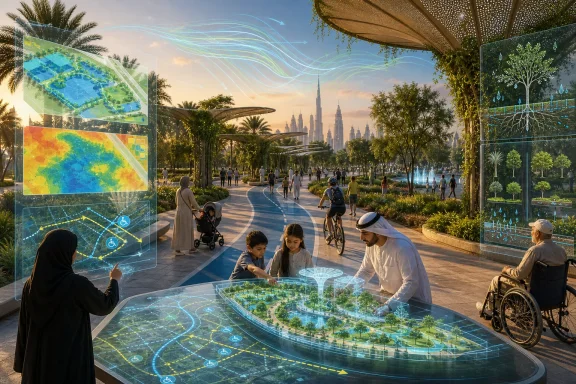 Dubai Moves AI Out of the Dashboard and Into the Dirt
The past three years of AI adoption have been dominated by chat windows, copilots, coding assistants, and image generators. Dubai’s park challenge points to a different phase, where AI becomes part of the workflow for public infrastructure rather than a layer added after the fact. The emirate is not merely asking contestants to make attractive renderings; it is asking them to show how AI shaped analysis, iteration, and decision-making.That distinction matters. Urban design has always used models, simulations, and expert systems, but the current AI wave changes the accessibility and speed of those tools. A student team, startup, or small design studio can now generate site scenarios, visualize alternative layouts, and test assumptions in ways that once required specialized software, large consulting budgets, or weeks of manual work.
Dubai is also positioning this as a human-led process, and that caveat is doing a lot of political work. The official messaging insists that AI will expand possibilities rather than replace designers. That is the right formulation, but it also reveals the central tension: the more powerful these tools become, the harder it will be to prove that the human remained the decision-maker rather than the presenter of an algorithmically favored answer.
The park setting makes the experiment unusually concrete. Unlike a chatbot feature or a back-office automation project, a public park is experienced by children, older residents, workers, families, cyclists, dog walkers, and people who simply need shade. Bad AI output here would not be an abstract model failure. It would be a bench in the wrong place, a pathway that excludes wheelchair users, a heat island disguised as a plaza, or a beautiful rendering that wilts under a Gulf summer.
The Prize Money Is Modest, but the Signal Is Not
The AED200,000 prize pool is not large by the standards of major public works, especially in a city famous for ambitious infrastructure. First place receives AED100,000, second place AED65,000, and third place AED35,000. As procurement economics, that is small; as a public signal, it is sharp.Competitions like this do two things at once. They crowdsource ideas from outside the usual municipal pipeline, and they broadcast the vocabulary that public agencies want the market to adopt. In this case, Dubai Municipality is telling architects, planners, researchers, students, startups, and AI specialists that future design credibility will depend not only on taste and technical competence, but on explainable use of data and AI tools.
The requirement for a fully integrated master plan is important. Contestants are expected to submit data analysis, visualizations, detailed plans and drawings, and an explanation of how AI informed the design process. That shifts the challenge away from the superficial “AI art contest” category and toward something closer to a civic systems exercise.
Still, a competition is not a completed park. The language around “visionary and implementable” design concepts is doing careful balancing. Dubai wants bold ideas, but it also wants proposals that can survive contact with budgets, maintenance teams, climate, regulations, and the lived habits of residents.
This is where many AI-for-cities pitches become brittle. Generative tools are excellent at producing options, but cities are not short of options. They are short of durable trade-offs. A credible AI-assisted park design must explain not just what looks good, but why one spatial decision beats another when heat, water use, accessibility, safety, maintenance, and community preference collide.
Al Safa 2 Is a Test Site for a Bigger Urban Operating System
Al Safa 2 Park is being cast as the immediate canvas, but the challenge is clearly intended as a prototype for a wider method of public-space design. Dubai Municipality’s language repeatedly emphasizes sustainability, accessibility, wellbeing, social interaction, and quality of life. Those are familiar urban-policy goals, but the AI layer changes the way they might be measured and optimized.A park is a useful test bed because its performance is multidimensional. It is not enough to count visitors. A good park must manage sun exposure, circulation, noise, vegetation, safety, inclusivity, seasonal usability, and social comfort. It must work at different times of day and for different groups who may have conflicting needs.
AI can help here if it is used as an analytical amplifier. It can compare layouts, model shade patterns, examine pedestrian flows, support microclimate analysis, synthesize survey feedback, and generate design alternatives from constraints. In the best version of this experiment, AI becomes a way to make hidden design assumptions visible.
The risk is that the process becomes performative. A team can easily produce polished dashboards, synthetic personas, and photorealistic renderings that imply rigor without demonstrating it. Cities will need to learn how to judge AI-assisted design not by the sophistication of the prompt stack, but by the quality of the evidence behind the spatial choices.
That is why Dubai’s judging criteria will matter as much as the winning concept. The stated criteria include the strength of the AI-integrated approach, spatial intelligence, feasibility, human-centered experience, inclusivity, sustainability, narrative clarity, and the ability to translate data into practical spatial outcomes. Those are the right headings; the hard part is applying them with enough skepticism.
The Smart City Finally Meets the Park Bench
For years, the phrase smart city has often meant sensors, dashboards, traffic systems, digital identity, and public-service apps. Parks sat awkwardly in that narrative. They were essential to urban life, but they did not fit the same enterprise-technology template as mobility platforms or cloud government portals.Dubai’s challenge suggests a more interesting definition of smart infrastructure. The smartest thing in a city may not be a camera or a data lake. It may be a shaded walking route that exists because designers used climate data, mobility analysis, and community input to put trees, paths, and seating where people actually need them.
That is a more humane version of urban technology, and it is also harder to fake. A resident does not care whether a park was designed with AI if the result is hostile at noon, confusing for families, or inaccessible for people with disabilities. Public space judges technology by experience, not by press-release ambition.
The opportunity is real. AI-assisted planning could help cities avoid some of the default failures of generic park design: ornamental lawns that consume water, large exposed plazas that photograph well but empty out in heat, playgrounds that ignore caregivers, or circulation patterns that favor aerial symmetry over human movement.
But the technology should not be romanticized. AI systems inherit the limits of their data and the priorities of their operators. If the input data underrepresents certain residents, if the optimization target is aesthetic novelty, or if the process rewards spectacle over maintenance, the output will reproduce those biases at municipal scale.
Community Voting Adds Legitimacy, but Not a Substitute for Expertise
One of the more politically astute pieces of the challenge is the planned community role in selecting winning entries after the judging panel shortlists designs. That acknowledges a basic truth about public parks: residents are not passive users of a finished product. They are the people who know how a place feels at school pickup, after evening prayers, during a heat wave, or on a weekend morning.Community participation also helps counter a common criticism of top-down smart-city projects. When technology is introduced into civic planning, residents often experience it as something done to them rather than with them. Inviting the community into the selection process creates a visible democratic layer, even if the initial filtering remains in expert hands.
The limits should be acknowledged. Public voting can reward the most visually dramatic proposal, not necessarily the most durable one. It can favor renderings over maintenance realities, or amenities over ecological performance. If the shortlist is strong, community input can sharpen legitimacy. If the shortlist is weak, voting merely chooses between polished mistakes.
The stronger model is a layered one. Experts should test feasibility, safety, inclusivity, environmental performance, and compliance. Residents should test social truth: whether a design feels useful, welcoming, and grounded in the community’s daily life. AI should support both groups, not obscure the basis on which decisions are made.
This is where transparency becomes crucial. A design team should be able to explain which AI tools were used, what data they relied on, what assumptions were made, where human judgment overrode machine suggestions, and what uncertainties remain. Without that, “AI-powered” becomes branding rather than governance.
The Climate Case Is Stronger Than the Renderings
Dubai’s climate makes the park challenge more than an aesthetic exercise. Shade, thermal comfort, vegetation strategy, water efficiency, and evening usability are not optional features in Gulf public space. They are the difference between a park that serves the community and one that exists mainly as a map label.AI-assisted design could be genuinely useful in this domain. Microclimate modeling, solar exposure analysis, wind behavior, surface-temperature estimates, irrigation planning, and planting strategies are all areas where computational tools can improve decisions. The value is not that AI can “imagine” a park. It is that AI can help stress-test whether a park will be comfortable enough to use.
That practical climate angle is the strongest argument for the challenge. Too much public discussion of AI focuses on novelty: the image, the concept, the wow factor. In park design, the most important AI contribution may be invisible to visitors because it shows up as a cooler walkway, a better-placed canopy, a playground that remains usable longer, or a planting plan that reduces maintenance pressure.
There is also an accessibility dimension. AI tools can help simulate movement through space and identify friction points for people with mobility needs, families with strollers, older residents, and children. Again, the tool is useful only if the design process values those users from the beginning.
The danger is optimization theater. A proposal may claim to optimize shade or inclusion without offering verifiable metrics. Cities should resist the temptation to treat AI-generated analysis as self-authenticating. The better question is simple: can the team show how the analysis changed the design?
For WindowsForum Readers, This Is the Same AI Shift Wearing a Hard Hat
At first glance, a Dubai park-design competition may seem far removed from the daily concerns of Windows users, sysadmins, and IT pros. But the underlying shift is familiar. AI is moving from optional assistant to embedded workflow layer, and the same governance problems that appear in enterprise software are now appearing in public infrastructure.In IT, administrators increasingly ask how AI tools handle data, auditability, security, permissions, and accountability. In urban design, the vocabulary changes, but the concerns remain. What data was used? Who validated the output? Can decisions be explained? What happens when the model is wrong? Who is responsible when a recommendation becomes a built feature?
The challenge also mirrors the current enterprise debate over copilots. A copilot that drafts an email is low-risk. A copilot that influences legal review, network policy, medical triage, or civic planning enters a different category. The more consequential the decision, the more the system needs traceability.
That is why Dubai’s insistence on human-led final decisions is not just reassuring language. It is a necessary control. But as IT professionals know, “human in the loop” can mean everything from meaningful review to rubber-stamping. The implementation details decide whether the phrase has teeth.
For technologists, the lesson is that AI adoption is becoming interdisciplinary. The next wave will not be contained within developer tools or office suites. It will touch planning, facilities, operations, design, compliance, and citizen experience. The people who understand systems, governance, and failure modes will have a role far outside the traditional server room.
The World’s First Claim Is Less Important Than the Model It Normalizes
Dubai calls this the world’s first AI-powered park design challenge. Such firsts are always hard to police, especially in a field where design studios, universities, and cities have already experimented with computational planning and generative design. The claim is less important than the fact that a major municipality is making AI integration an explicit condition of a public-space competition.That is the model to watch. Not AI as a hidden internal tool. Not AI as a novelty visualization engine. AI as a required, declared part of the civic design process, subject to evaluation and public presentation.
If this approach spreads, cities may begin to ask for AI process documentation the way they ask for environmental studies, accessibility compliance, or cost estimates. Design teams may need to show not only what they propose, but how their computational workflow shaped the proposal. That could create higher standards, or it could create a new layer of bureaucratic theater.
The difference will depend on procurement maturity. Public agencies will need evaluators who can distinguish meaningful AI-assisted analysis from decorative automation. They will need rules for data provenance, privacy, model limitations, and explainability. They will also need the confidence to reject dazzling but impractical concepts.
Dubai has advantages here. The city is comfortable with large-scale urban experimentation, and its government has repeatedly used headline-grabbing initiatives to pull markets toward desired capabilities. The challenge is that fast-moving ambition must be paired with public trust. Parks are not software demos. Once built, they become part of residents’ everyday environment.
The Competition Dubai Is Really Running Is Against Generic Urbanism
The most compelling reading of the Al Safa 2 challenge is not that Dubai wants an AI-designed park. It is that Dubai wants to avoid a generic park. The official language repeatedly emphasizes local identity, human experience, and participatory design, suggesting an awareness that technology alone can flatten places rather than deepen them.This is a real risk. Generative tools are trained on vast libraries of existing visual patterns, and they are very good at producing the globalized design language of contemporary urbanism: flowing paths, lush canopies, sculptural shade structures, glowing nighttime renders, happy families, frictionless diversity. The result can look like everywhere and nowhere.
A successful proposal for Al Safa 2 will have to resist that. It should use AI to understand the site, not erase it. It should reflect Dubai’s climate, culture, rhythms, and community needs rather than exporting a placeless park aesthetic with better rendering quality.
The same applies to sustainability. A park that looks green is not necessarily sustainable. The design must account for water, planting resilience, maintenance, materials, shade, and long-term use. AI can help analyze these variables, but it can also make unsustainable fantasies look seductively plausible.
That is why the human-led promise matters most at the level of judgment. AI can generate the menu. It should not define the appetite. The final design should be chosen because it works for people and place, not because it best demonstrates the fashionability of AI.
The Al Safa 2 Experiment Gives the AI Hype a Real Address
The challenge’s most concrete details are also its most revealing. This is not a vague innovation pledge; it has a site, a deadline, a prize structure, a participant pool, and evaluation criteria. That gives observers something to measure.- Dubai Municipality is inviting professionals, students, researchers, startups, AI specialists, and technology innovators to submit AI-assisted concepts for Al Safa 2 Park by August 15, 2026.
- The competition requires participants to explain how AI tools supported analysis, iteration, spatial planning, environmental response, user insights, performance improvement, and visualization.
- The prize pool totals AED200,000, with AED100,000 for first place, AED65,000 for second place, and AED35,000 for third place.
- The judging process will combine government leaders and design, architecture, AI, and future-city experts before shortlisted concepts are opened to community participation.
- The central test is whether AI can help produce a park that is more sustainable, accessible, inclusive, comfortable, and socially useful, rather than merely more photogenic.
- The broader precedent is that public agencies may increasingly ask designers to document AI workflows as part of civic infrastructure proposals.
Dubai’s AI-powered park challenge is a modest competition wrapped around a large proposition: that the next smart-city frontier is not more screens, but better physical places shaped by computational intelligence and public judgment. If the winning design proves practical, inclusive, and climate-aware, Al Safa 2 could become a useful model for AI-assisted civic design; if it becomes another showcase for polished automation, it will be a reminder that cities need wisdom more than novelty. The future of AI in urban life will be decided not by whether machines can imagine parks, but by whether people can use machines to build places that still feel unmistakably human.
References
- Primary source: Gulf Today
Published: 2026-06-28T14:50:20.530979
Dubai launches world’s first AI-powered park design chall...
Under the directives of Sheikh Hamdan Bin Mohammed Bin Rashid Al Maktoum, Crown Prince of Dubai, Deputy Prime Minister, Minister of Defence, and Chairman of The... www.gulftoday.ae
- Independent coverage: Emirates 24|7
Published: 2026-06-28T12:50:20.536398
Dubai launches world's first AI-powered park design challenge - Emirates 24|7
Dubai launches the world's first AI-powered garden design challenge to reimagine Al Safa Park 2, offering AED 200,000 in prizes and accepting applications until 15 Augustwww.emirates247.com - Independent coverage: Government of Dubai Media Office
Published: 2026-06-28T12:50:20.535906
- Related coverage: gulfnews.com
Dubai Launches World’s First AI-Powered Park Design Challenge at Al Safa 2 with Dh200,000 Cash Prizes
Enter Dubai’s AI-powered park design competition to reimagine Al Safa 2 Park with smart, sustainable solutions and compete for a share of Dh200,000 in prizes.gulfnews.com - Related coverage: khaleejtimes.com
Dubai launches Dh200,000 AI-designed park challenge to redesign Al Safa 2 Park | Khaleej Times
Dubai Municipality launches the world’s first AI-powered park design challenge. The initiative invites designers, urban planners, students, researchers, AI innovators to reimagine Al Safa 2 Park.www.khaleejtimes.com - Related coverage: iranianuae.ae
Attention Architects and Urban Planners: Dubai Launches First Global AI Park Design Challenge — ایرانیان امارات
Dubai has announced the launch of the first Global AI Park Design Challenge, an international competition aimed at redesigning Al Safa 2 Park. The total prize pool for the competition is AED 200,00...iranianuae.ae
- Related coverage: dm.gov.ae
- Related coverage: protocol.dubai.ae
- Related coverage: thegulfpulse.com
Dubai public spaces enter new urban phase | The Gulf Pulse
Dubai has approved new public-space projects, including Creek lighting, an AI park design challenge, a falcon market and Reservoir Park.thegulfpulse.com - Related coverage: connectingtravel.com
- Related coverage: gebalgroup.com
