

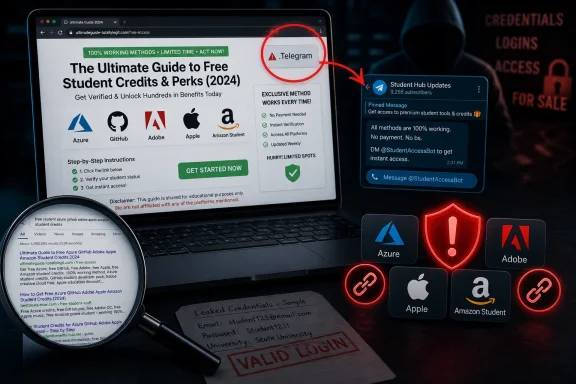
A spammy Dwell collection advertising “Telegram accounts” and garbled “.Telegram” student email credentials is best understood as a fraud-and-abuse pitch, not a shopping guide: it repackages black-market account sales, student-discount abuse, and contact-channel spam into a faux consumer article aimed at search engines. The pitch is clumsy, but the underlying market is not harmless. It points to a larger problem for Microsoft, GitHub, Adobe, Amazon, Apple, schools, and users: identity verification has become valuable enough that criminals now sell access to it as a product.
The submitted post reads like a machine-spun article that has been patched together from two different schemes. The headline promises Telegram accounts with instant access and photos, while the body repeatedly talks about “.Telegram” email addresses that are obviously meant to be “.edu” academic accounts. That mismatch is not an innocent typo; it is the fingerprint of spam content engineered to catch search queries without caring whether the prose survives human reading.
The sales path is equally revealing. Instead of explaining a legitimate product, the post pushes readers toward Telegram, WhatsApp, and a domain-like brand string for private contact. That is the usual shape of gray-market account selling: keep the persuasive landing page public, move negotiation and payment into a private channel, and leave the buyer with little recourse when the account fails, is reclaimed, or never existed.
The topic matters to WindowsForum readers because the bait is not merely a social-media account. The post specifically invokes Microsoft Azure for Students, GitHub’s Student Developer Pack, Adobe Creative Cloud, Apple education pricing, and Amazon Prime Student. In other words, it is selling a shortcut into the trust systems used by the modern developer and productivity economy.
This is where the spam becomes more than nuisance content. A fake or purchased academic identity is not a coupon code. It is an account credential, a verification artifact, and often a foothold into someone else’s institution.
Microsoft and GitHub sit at the center of this economy. GitHub’s education program verifies students and then connects them to a bundle of partner offers. Microsoft’s Azure for Students program provides cloud access without requiring a credit card in the conventional consumer-trial sense, making it attractive to learners — and to anyone who wants disposable compute.
That design creates tension. The easier a company makes student verification for real learners, especially those without traditional U.S. “.edu” addresses, the easier it becomes for fraudsters to probe the edges of the system. The more restrictive the verification flow becomes, the more legitimate students in countries or institutions with weaker identity infrastructure get blocked.
The spam post exploits that tension. It tells readers that the gate is valuable, then suggests the gate can be bought. The pitch is aimed at people who believe the official process is inconvenient, unfair, or too slow — and at people who do not want to qualify at all.
The irony is that the original subject, illicit .edu access, is serious enough on its own. Academic email accounts are not generic inboxes. They are issued by schools, colleges, universities, and educational organizations that use them for identity, enrollment, learning management systems, Wi-Fi, library access, billing portals, and internal communications.
Buying one can mean several different things, none of them reassuring. The account may be stolen from a real student. It may be created through fraudulent enrollment. It may be temporarily controlled by a reseller who plans to reclaim it. It may be nothing more than a fake address that passes one weak check and fails the next.
The buyer thinks they are purchasing a discount. In reality, they may be purchasing a liability that can vanish at any moment.
That matters because these programs are not merely marketing giveaways. They are controlled offers bound by terms of service, fraud controls, and abuse monitoring. If a user lies about eligibility, uses someone else’s school account, or buys a pre-verified identity, the platform can revoke access, terminate the account, claw back benefits, or block future verification.
For developers, the risk is especially ugly. A GitHub account is often tied to source code, collaboration history, package publishing, CI/CD secrets, SSH keys, and professional reputation. Linking that identity to a purchased academic credential introduces a dependency on a stranger’s account hygiene and honesty.
For cloud users, the exposure can be worse. Azure credits attached to a fraudulent identity can lead to suspended subscriptions, lost workloads, and unexpected compliance headaches. If the account was originally compromised, activity performed under it can also create a messy audit trail.
A compromised academic mailbox may include password resets, course records, personal documents, financial aid notices, identity documents, or access links to university systems. Even if the buyer never intends to steal anything, possession of that account can put them in contact with sensitive data that belongs to someone else. That is no longer bargain hunting; it is participation in an identity-abuse chain.
There is also the practical problem of account recovery. The original student, the school, or the reseller may retain control over recovery email addresses, phone numbers, single sign-on, or administrative reset channels. The buyer can change a password and still lose the account the next time an institution forces a reset.
That is why “lifetime access” claims in this market are nonsense. The account lives only as long as the underlying fraud remains undetected, the original owner remains locked out, the school keeps the account active, and the reseller does not decide to sell it again.
That does not make Telegram itself the villain. Like email, Discord, WhatsApp, Reddit, and forums, it is a communications platform that can be used for legitimate communities or for abuse. But when a public article tells readers to move immediately to Telegram or WhatsApp to buy accounts, it is signaling that the transaction cannot survive normal platform accountability.
This is a useful rule for readers: if the seller wants to move identity credentials, academic access, cloud credits, or “verified” accounts through a private messaging channel, assume you are not buying a legitimate service. You are entering a dispute system where the seller controls the narrative, the evidence, and often the only contact handle.
That is especially true when payment is requested through irreversible methods. Crypto, gift cards, friends-and-family transfers, and informal remittance channels are not just payment preferences. They are part of the risk model.
That format is designed to pass quick inspection. A moderator, search crawler, or casual reader may see paragraphs about risk and legitimate alternatives. But the repeated contact blocks tell the real story. The page is not trying to protect users from buying accounts; it is trying to capture users who searched for buying accounts.
This hybrid style is becoming more common because platforms have improved at detecting blunt spam. Instead of “buy accounts now” repeated fifty times, the modern spam post imitates a responsible explainer, includes a few warnings, and then embeds the seller’s handle. The language of safety becomes the packaging for the unsafe act.
For forums and community sites, that creates a moderation challenge. The content may contain true statements about fraud risks, but its operational purpose is still promotion. The presence of a few ethical paragraphs does not sanitize a call to buy compromised or fraudulently obtained credentials.
GitHub has long recognized that a student email address should not be the only path to verification. Student IDs and other dated proof can help legitimate learners qualify. Microsoft’s student programs have also had to accommodate cases where institutional email, GitHub verification, and account identity do not line up neatly.
That flexibility is good policy. It prevents American domain conventions from becoming a gatekeeper for global education. But it also creates seams that abuse markets try to exploit: fake student cards, reused documents, identity mismatches, rented accounts, and mass-created profiles.
The right answer is not to slam the door on everyone without a perfect email domain. It is to build layered verification, detect repeat abuse, and make recovery paths humane for legitimate students. If platforms overcorrect, the fraudsters will adapt while real students get locked out.
A purchased academic account used by an employee or contractor can become a shadow identity inside corporate workflows. It may show up in GitHub commits, cloud prototypes, documentation access, AI tooling, or shared design assets. If that identity later disappears, the organization may lose access to code, files, logs, or billing records.
The problem is not just policy violation. It is continuity. Work done under a disposable or fraudulent identity is harder to audit, harder to transfer, and harder to defend if something goes wrong. Security teams already worry about personal GitHub accounts and unmanaged cloud subscriptions; bought student credentials add another layer of opacity.
A sensible organization should not need a special “no fake .edu accounts” rule to address this. It should already require work assets to live under managed identities, approved repositories, and sanctioned cloud tenants. The spam economy is simply a reminder that unmanaged identity is where accountability goes to die.
A compromised student mailbox can expose more than software perks. It can contain housing information, tuition bills, disability accommodations, immigration paperwork, health-related notices, disciplinary communications, and family financial details. Academic identity is often a teenager or young adult’s first major digital identity outside the home, and it is frequently less protected than a corporate account.
Schools are also victims. IT departments must investigate takeovers, reset accounts, fight spam reputation damage, and respond to platform abuse reports. When compromised academic accounts are used to create cloud workloads, spam campaigns, or developer accounts, the institution may be dragged into cleanup it did not cause.
That is why buying such an account is not morally neutral. Even if the buyer only wants cheaper software, the supply chain may begin with someone else losing control of their digital life.
For someone who genuinely wants student benefits, the clean path is enrollment. Community colleges, online university courses, continuing education programs, and accredited certificate programs may provide legitimate academic status. The key word is legitimate: the point is not to buy a mailbox, but to become an actual learner in an institution that issues credentials.
For non-students, the answer is more prosaic but safer. Use free tiers, open-source alternatives, trial programs, startup credits where eligible, employer-provided tooling, public cloud sandboxes, and community editions. These may be less glamorous than a bundled student pack, but they do not put your identity, data, or professional accounts at risk.
There is also a reputational argument. Developers and IT pros build careers on trust. Saving a few dollars through a fake credential is a poor trade if it ties your GitHub, Microsoft, or Adobe identity to fraud.
The “six photos” framing in the headline is another warning sign. Spam campaigns often attach irrelevant images or collections to make a post look richer to crawlers and more plausible to readers. The content itself does the rest: keyword stuffing, repeated contact methods, unnatural punctuation, and brand-name lists designed to catch search traffic.
Windows communities are particularly attractive targets because the audience contains students, developers, admins, gamers, and power users who understand the value of software subscriptions. A post promising cheap Microsoft, GitHub, or Adobe access is not random; it is aimed at exactly the people most likely to know what those products cost.
Moderation should therefore treat account-selling posts as a security issue, not merely a cleanliness issue. They are a pathway to credential theft, platform abuse, and user harm.
That is when the blast radius grows. A developer may connect the account to GitHub. A student may sync files into cloud storage. A freelancer may use it for client work. A tinkerer may spin up cloud services. The longer the account survives, the more painful the eventual loss becomes.
When the account is revoked, there may be no appeal that does not require admitting the fraud. When the seller disappears, there is no support contract. When the platform asks for proof of enrollment, the buyer has none. The apparent bargain becomes a trap built out of dependency.
This is why the safest advice is blunt: do not buy accounts, do not buy verification, and do not build anything important on an identity you cannot honestly recover.
Here is what Windows users, students, developers, and admins should take away from this particular campaign:
 The Scam Is Sloppy, but the Business Model Is Familiar
The submitted post reads like a machine-spun article that has been patched together from two different schemes. The headline promises Telegram accounts with instant access and photos, while the body repeatedly talks about “.Telegram” email addresses that are obviously meant to be “.edu” academic accounts. That mismatch is not an innocent typo; it is the fingerprint of spam content engineered to catch search queries without caring whether the prose survives human reading.The sales path is equally revealing. Instead of explaining a legitimate product, the post pushes readers toward Telegram, WhatsApp, and a domain-like brand string for private contact. That is the usual shape of gray-market account selling: keep the persuasive landing page public, move negotiation and payment into a private channel, and leave the buyer with little recourse when the account fails, is reclaimed, or never existed.
The topic matters to WindowsForum readers because the bait is not merely a social-media account. The post specifically invokes Microsoft Azure for Students, GitHub’s Student Developer Pack, Adobe Creative Cloud, Apple education pricing, and Amazon Prime Student. In other words, it is selling a shortcut into the trust systems used by the modern developer and productivity economy.
This is where the spam becomes more than nuisance content. A fake or purchased academic identity is not a coupon code. It is an account credential, a verification artifact, and often a foothold into someone else’s institution.
Student Verification Became a Currency
The market for academic accounts exists because student status has become a high-value credential. A verified student can unlock cloud credits, developer tools, design software, AI coding assistants, storage, training platforms, and discounted hardware. For a legitimate student, that is a sensible on-ramp into professional tools; for a reseller, it is inventory.Microsoft and GitHub sit at the center of this economy. GitHub’s education program verifies students and then connects them to a bundle of partner offers. Microsoft’s Azure for Students program provides cloud access without requiring a credit card in the conventional consumer-trial sense, making it attractive to learners — and to anyone who wants disposable compute.
That design creates tension. The easier a company makes student verification for real learners, especially those without traditional U.S. “.edu” addresses, the easier it becomes for fraudsters to probe the edges of the system. The more restrictive the verification flow becomes, the more legitimate students in countries or institutions with weaker identity infrastructure get blocked.
The spam post exploits that tension. It tells readers that the gate is valuable, then suggests the gate can be bought. The pitch is aimed at people who believe the official process is inconvenient, unfair, or too slow — and at people who do not want to qualify at all.
The “.Edu” Confusion Is the Tell
The post’s repeated substitution of “Telegram” for “edu” makes the scam look absurd, but it also shows how these campaigns are assembled. The text appears to be a recycled “buy .edu email” article that has been mechanically altered to rank for Telegram-account queries. That sort of keyword laundering is common in low-grade search spam: change the nouns, preserve the monetizable skeleton, and hope the search engine indexes the page before moderators remove it.The irony is that the original subject, illicit .edu access, is serious enough on its own. Academic email accounts are not generic inboxes. They are issued by schools, colleges, universities, and educational organizations that use them for identity, enrollment, learning management systems, Wi-Fi, library access, billing portals, and internal communications.
Buying one can mean several different things, none of them reassuring. The account may be stolen from a real student. It may be created through fraudulent enrollment. It may be temporarily controlled by a reseller who plans to reclaim it. It may be nothing more than a fake address that passes one weak check and fails the next.
The buyer thinks they are purchasing a discount. In reality, they may be purchasing a liability that can vanish at any moment.
Platforms Treat This as Abuse, Not Clever Shopping
The strongest misconception in posts like this is the idea that misusing student verification is a harmless hack. It is not. GitHub’s Student Developer Pack is for actively verified students, and access can expire or require revalidation. Partner offers can change, fail, or become unavailable if a user has already redeemed a trial. Microsoft’s student cloud benefits similarly depend on eligibility, identity consistency, and verification.That matters because these programs are not merely marketing giveaways. They are controlled offers bound by terms of service, fraud controls, and abuse monitoring. If a user lies about eligibility, uses someone else’s school account, or buys a pre-verified identity, the platform can revoke access, terminate the account, claw back benefits, or block future verification.
For developers, the risk is especially ugly. A GitHub account is often tied to source code, collaboration history, package publishing, CI/CD secrets, SSH keys, and professional reputation. Linking that identity to a purchased academic credential introduces a dependency on a stranger’s account hygiene and honesty.
For cloud users, the exposure can be worse. Azure credits attached to a fraudulent identity can lead to suspended subscriptions, lost workloads, and unexpected compliance headaches. If the account was originally compromised, activity performed under it can also create a messy audit trail.
The Security Risk Is Bigger Than the Discount
The immediate pitch is “save money.” The real risk is “inherit someone else’s compromise.” Purchased accounts often arrive with passwords, recovery details, session cookies, or instructions that encourage the buyer to disable security controls. Every one of those steps should make a security-minded user walk away.A compromised academic mailbox may include password resets, course records, personal documents, financial aid notices, identity documents, or access links to university systems. Even if the buyer never intends to steal anything, possession of that account can put them in contact with sensitive data that belongs to someone else. That is no longer bargain hunting; it is participation in an identity-abuse chain.
There is also the practical problem of account recovery. The original student, the school, or the reseller may retain control over recovery email addresses, phone numbers, single sign-on, or administrative reset channels. The buyer can change a password and still lose the account the next time an institution forces a reset.
That is why “lifetime access” claims in this market are nonsense. The account lives only as long as the underlying fraud remains undetected, the original owner remains locked out, the school keeps the account active, and the reseller does not decide to sell it again.
Telegram Is the Marketplace, Not the Product
The post’s Telegram angle is not accidental even if the article text is garbled. Telegram has become a common coordination channel for account sellers, spam shops, crypto-payment operators, gray-market software vendors, and abuse-as-a-service communities. Its channel and direct-message model makes it easy to advertise publicly and transact privately.That does not make Telegram itself the villain. Like email, Discord, WhatsApp, Reddit, and forums, it is a communications platform that can be used for legitimate communities or for abuse. But when a public article tells readers to move immediately to Telegram or WhatsApp to buy accounts, it is signaling that the transaction cannot survive normal platform accountability.
This is a useful rule for readers: if the seller wants to move identity credentials, academic access, cloud credits, or “verified” accounts through a private messaging channel, assume you are not buying a legitimate service. You are entering a dispute system where the seller controls the narrative, the evidence, and often the only contact handle.
That is especially true when payment is requested through irreversible methods. Crypto, gift cards, friends-and-family transfers, and informal remittance channels are not just payment preferences. They are part of the risk model.
Search Spam Turns Abuse Into Advice
The submitted Dwell page has another layer: it wraps the sales pitch in a fake “ultimate guide” that appears to warn readers about legality and safety while repeatedly placing contact details in the body. This is a familiar content-marketing trick. The article pretends to be educational, but the conversion path remains illegal or abusive.That format is designed to pass quick inspection. A moderator, search crawler, or casual reader may see paragraphs about risk and legitimate alternatives. But the repeated contact blocks tell the real story. The page is not trying to protect users from buying accounts; it is trying to capture users who searched for buying accounts.
This hybrid style is becoming more common because platforms have improved at detecting blunt spam. Instead of “buy accounts now” repeated fifty times, the modern spam post imitates a responsible explainer, includes a few warnings, and then embeds the seller’s handle. The language of safety becomes the packaging for the unsafe act.
For forums and community sites, that creates a moderation challenge. The content may contain true statements about fraud risks, but its operational purpose is still promotion. The presence of a few ethical paragraphs does not sanitize a call to buy compromised or fraudulently obtained credentials.
Microsoft and GitHub Are Caught Between Access and Abuse
There is a legitimate policy problem underneath the spam. Not every real student has a U.S.-style .edu address. Many universities around the world use local domains, shared portals, paper documentation, or inconsistent identity systems. Some students have valid enrollment but no institutional mailbox at all.GitHub has long recognized that a student email address should not be the only path to verification. Student IDs and other dated proof can help legitimate learners qualify. Microsoft’s student programs have also had to accommodate cases where institutional email, GitHub verification, and account identity do not line up neatly.
That flexibility is good policy. It prevents American domain conventions from becoming a gatekeeper for global education. But it also creates seams that abuse markets try to exploit: fake student cards, reused documents, identity mismatches, rented accounts, and mass-created profiles.
The right answer is not to slam the door on everyone without a perfect email domain. It is to build layered verification, detect repeat abuse, and make recovery paths humane for legitimate students. If platforms overcorrect, the fraudsters will adapt while real students get locked out.
Enterprise IT Should Read This as an Identity Story
For enterprise administrators, the lesson is not limited to student discounts. The same abuse pattern applies to contractor accounts, developer sandboxes, partner portals, trial tenants, SaaS credits, and unmanaged personal identities that touch company work. Anywhere a status label unlocks access, someone will try to resell the label.A purchased academic account used by an employee or contractor can become a shadow identity inside corporate workflows. It may show up in GitHub commits, cloud prototypes, documentation access, AI tooling, or shared design assets. If that identity later disappears, the organization may lose access to code, files, logs, or billing records.
The problem is not just policy violation. It is continuity. Work done under a disposable or fraudulent identity is harder to audit, harder to transfer, and harder to defend if something goes wrong. Security teams already worry about personal GitHub accounts and unmanaged cloud subscriptions; bought student credentials add another layer of opacity.
A sensible organization should not need a special “no fake .edu accounts” rule to address this. It should already require work assets to live under managed identities, approved repositories, and sanctioned cloud tenants. The spam economy is simply a reminder that unmanaged identity is where accountability goes to die.
The Victims Are Often Students, Not Vendors
It is tempting to frame this as a loss for large companies that can afford a few abused discounts. That misses the human side. Many sold accounts originate with real students whose credentials were phished, reused, leaked, or socially engineered.A compromised student mailbox can expose more than software perks. It can contain housing information, tuition bills, disability accommodations, immigration paperwork, health-related notices, disciplinary communications, and family financial details. Academic identity is often a teenager or young adult’s first major digital identity outside the home, and it is frequently less protected than a corporate account.
Schools are also victims. IT departments must investigate takeovers, reset accounts, fight spam reputation damage, and respond to platform abuse reports. When compromised academic accounts are used to create cloud workloads, spam campaigns, or developer accounts, the institution may be dragged into cleanup it did not cause.
That is why buying such an account is not morally neutral. Even if the buyer only wants cheaper software, the supply chain may begin with someone else losing control of their digital life.
There Are Legitimate Ways to Get the Tools
The most frustrating part of the pitch is that many legitimate options exist. Students without .edu addresses can often verify through official documents. Developers can use free tiers from GitHub, Microsoft, Google, AWS, JetBrains, Vercel, Cloudflare, and others without pretending to be enrolled. Open-source tools can replace many commercial products for learning and early-stage work.For someone who genuinely wants student benefits, the clean path is enrollment. Community colleges, online university courses, continuing education programs, and accredited certificate programs may provide legitimate academic status. The key word is legitimate: the point is not to buy a mailbox, but to become an actual learner in an institution that issues credentials.
For non-students, the answer is more prosaic but safer. Use free tiers, open-source alternatives, trial programs, startup credits where eligible, employer-provided tooling, public cloud sandboxes, and community editions. These may be less glamorous than a bundled student pack, but they do not put your identity, data, or professional accounts at risk.
There is also a reputational argument. Developers and IT pros build careers on trust. Saving a few dollars through a fake credential is a poor trade if it ties your GitHub, Microsoft, or Adobe identity to fraud.
Forums Need to Treat This as Abuse Content
Community sites should not mistake this sort of post for user-generated advice. It is commercial spam that advertises a prohibited transaction. The correct response is removal, account action, and, where possible, filtering of repeated contact handles and domains.The “six photos” framing in the headline is another warning sign. Spam campaigns often attach irrelevant images or collections to make a post look richer to crawlers and more plausible to readers. The content itself does the rest: keyword stuffing, repeated contact methods, unnatural punctuation, and brand-name lists designed to catch search traffic.
Windows communities are particularly attractive targets because the audience contains students, developers, admins, gamers, and power users who understand the value of software subscriptions. A post promising cheap Microsoft, GitHub, or Adobe access is not random; it is aimed at exactly the people most likely to know what those products cost.
Moderation should therefore treat account-selling posts as a security issue, not merely a cleanliness issue. They are a pathway to credential theft, platform abuse, and user harm.
The Real Price Is Paid After the Login Works
The dangerous moment is not when a fake account fails. It is when it works. Success teaches the buyer that the shortcut is safe, encourages more use, and leads them to store files, code, subscriptions, and recovery paths inside an identity they do not truly control.That is when the blast radius grows. A developer may connect the account to GitHub. A student may sync files into cloud storage. A freelancer may use it for client work. A tinkerer may spin up cloud services. The longer the account survives, the more painful the eventual loss becomes.
When the account is revoked, there may be no appeal that does not require admitting the fraud. When the seller disappears, there is no support contract. When the platform asks for proof of enrollment, the buyer has none. The apparent bargain becomes a trap built out of dependency.
This is why the safest advice is blunt: do not buy accounts, do not buy verification, and do not build anything important on an identity you cannot honestly recover.
The Dwell Spam Shows How Cheap Identity Abuse Has Become
The submitted post is not sophisticated journalism, but it is useful evidence of a mature underground market. It shows that account sellers believe there is enough demand to advertise openly, enough confusion to exploit, and enough search traffic around student benefits to justify recycled content.Here is what Windows users, students, developers, and admins should take away from this particular campaign:
- The page is promotional spam for account selling, even though parts of it imitate a safety guide.
- The repeated “.Telegram” wording appears to be garbled “.edu” spam, which suggests recycled or machine-altered content rather than a coherent legitimate offer.
- Buying verified academic, Telegram, GitHub, Microsoft, or cloud accounts can expose the buyer to scams, bans, data loss, and possible involvement with stolen credentials.
- Legitimate student benefits require legitimate student status, and many programs provide verification paths that do not depend solely on a U.S. .edu email address.
- Work projects, source code, subscriptions, and cloud resources should never depend on a purchased or borrowed identity.
- Forum operators should remove posts that advertise account sales through private messaging channels, even when those posts include superficial warnings about legality or safety.
References
- Primary source: Dwell
Published: 2026-05-24T14:17:08.701080
- Related coverage: themplsegotist.com
- Related coverage: paranoidcybersecurity.com

