

Telegram Signal Copier said on June 1, 2026, that TSC Infinity, its cloud-hosted Telegram trade automation platform, now works across iOS, Android, Mac, Windows, Linux, and browsers without requiring a VPS, local installation, or an always-open trading terminal. The announcement is less about another mobile app than about a shift in where trade automation actually lives. TSC is trying to move signal copying out of the fragile world of desktop sessions, home broadband, and rented Windows servers, and into the same always-on cloud model that has already swallowed email, documents, and enterprise software.
That is a bigger claim than “now available on your phone.” If TSC Infinity works as advertised, the trader’s device becomes a control panel rather than the execution engine. For WindowsForum readers, that distinction matters: this is one more niche where the Windows PC is no longer the required center of gravity, even when the workflow was historically built around it.
For years, Telegram signal copying has been a very Windows-shaped business. A trader would run a copier application locally, often alongside MetaTrader, or rent a VPS and keep that remote Windows machine alive around the clock. The pitch was simple: if Telegram receives the signal and the trading terminal is connected, the copier can parse the message and place the trade.
The weakness was just as simple. If the machine reboots, the VPS provider has an outage, the terminal disconnects, Windows Update barges in, or the trader closes a laptop at the wrong moment, the automation chain breaks. That is not a cosmetic inconvenience in a market where the difference between “copied” and “missed” can be seconds.
TSC Infinity’s cloud-first design attacks that dependency directly. The company says the execution layer runs on its own cloud infrastructure, with users managing accounts, channels, lot sizes, broker settings, and trade history from whatever device is in front of them. In that model, the iPhone app, Android app, browser dashboard, Mac, Linux laptop, or Windows desktop is not the thing doing the trading. It is the thing talking to the thing doing the trading.
That shift mirrors a familiar pattern in business software. The local client starts as the product, then becomes an interface, then becomes one interface among many. The cloud service becomes the durable system of record. TSC is applying that logic to a corner of retail trading where local Windows software and VPS folklore have remained stubbornly durable.
TSC Infinity’s cross-device expansion does not make Windows irrelevant. It does, however, weaken one of Windows’ less glamorous monopolies: being the always-on box in the corner that must remain awake so a user’s trading automation does not fall over.
That is a meaningful change for three groups. Mac users no longer have to treat Windows as the hidden tax on signal automation. Linux users are not left waiting for unofficial workarounds. Windows users themselves get a cleaner bargain: they can still use a PC when it is convenient, but they are no longer required to preserve a delicate desktop state for the sake of execution continuity.
This is where the announcement intersects with the broader Windows ecosystem. Microsoft has spent years making Windows more cloud-connected, more update-driven, and more security-managed. Those changes are sensible at fleet scale, but they can be hostile to hobbyist and semi-professional workflows that assume a local machine will remain untouched indefinitely. A cloud copier turns that tension into someone else’s infrastructure problem.
But a VPS is not a product experience. It is a maintenance burden with a monthly invoice. Users still have to install software, manage credentials, deal with remote desktops, monitor uptime, and understand enough of the stack to know when something has silently failed. That may be acceptable for power users, but it is a poor fit for the retail trader who wants automation without becoming a part-time systems administrator.
TSC’s “no VPS required” message lands because it reframes the old model as unnecessary complexity. If the vendor can host the execution engine, scale it, patch it, monitor it, and expose controls through a browser or mobile app, the trader’s personal infrastructure becomes secondary. The user no longer has to ask whether the copier is running on the right machine. The user has to ask whether the cloud service is trustworthy.
That is a better question, but not an easier one. Moving execution into TSC’s cloud removes many local failure modes while concentrating responsibility inside the vendor’s infrastructure. The trade-off is not “risk versus no risk.” It is fragmented user-managed risk versus centralized vendor-managed risk.
The important claim is not merely that TSC’s internal pipeline can move quickly. It is that the device is no longer in the critical path. A phone can be off, a laptop can be asleep, and a desktop can be halfway through a reboot without changing whether the cloud service receives and acts on a Telegram signal.
That distinction makes the speed claim more plausible in one sense and less complete in another. Cloud-side automation can remove consumer-device latency and local connectivity failures. It cannot eliminate broker-side latency, liquidity issues, slippage, spreads, rejected orders, or the basic market reality that a copied signal is never the same as a guaranteed fill.
The healthy reading is this: TSC is claiming a fast internal handoff from signal to execution instruction, not a magical guarantee of market outcome. Traders should treat the number as an infrastructure benchmark, not a profit promise.
TSC says Infinity uses ParseX AI, its proprietary parsing engine, to interpret signal formats without manual keyword configuration. The company claims support for structured text, conversational messages, screenshots, non-standard formatting, emojis, and more than 150 languages. If accurate, that makes the parser as central to the product as the cloud hosting itself.
This is also where the marketing gets hardest to evaluate from the outside. Parsing a clean “BUY EURUSD” message is trivial. Parsing a screenshot, extracting the relevant trade parameters, distinguishing an update from a new signal, and handling multilingual ambiguity is a much harder problem. In automation, the expensive failures are rarely the obvious ones; they are the edge cases that look obvious to humans and ambiguous to machines.
For IT professionals, the architecture question is familiar. The user interface can be polished, the cloud can be highly available, and the notification system can be elegant. But if the parser misreads intent, the entire stack faithfully automates the wrong action. In trading software, correctness matters at least as much as uptime.
But trade automation is different from manual mobile trading. A mobile brokerage app still makes the user the execution engine; the trader looks, decides, taps, confirms, and lives with the result. A cloud signal copier removes the user from the moment of execution. The phone becomes a governance surface for rules that will fire later, perhaps while the trader is asleep.
That is why TSC’s insistence that its iOS and Android apps are “full copier functionality” matters. A companion app that only shows status would preserve the desktop as the real command center. A true mobile control plane lets a user create, adjust, and audit automation rules from the phone itself.
The convenience is obvious. So is the risk. Making it easy to adjust lot sizes, swap brokers, change channel rules, or enable automation from a phone lowers friction in a domain where friction sometimes protects users from impulsive decisions. The best version of this product gives traders control from anywhere. The worst version could make risky automation feel as casual as checking a notification.
Automation without auditability is a black box with a buy button. If a trade goes wrong, the trader needs to know which channel produced the signal, how it was parsed, what rule applied, which account received the order, and when the execution request was sent. A cross-device dashboard with per-channel and per-date filtering is not just a convenience feature; it is the user’s defense against confusion.
This is especially important for multi-account managers and prop firm challenge participants, two groups TSC explicitly mentions. Those users live under constraints that casual traders may not face: drawdown limits, consistency rules, account segregation, and the need to reconstruct decisions after the fact. A permanent cloud audit trail can make automation more manageable, provided it is detailed and trustworthy.
There is a lesson here from enterprise IT. Notifications tell you that something happened. Logs tell you what happened, why it happened, and whether it should happen again. TSC’s dashboard will earn confidence not by looking modern, but by making post-trade reconstruction boringly precise.
But every “always-on” product invites the same question: always on for whom, under what conditions, and with what recourse when it fails? TSC says Infinity uses cloud servers with automatic scaling, continuous backup, and rolling updates. That is the vocabulary of modern software operations, and it is the right vocabulary. It does not by itself answer questions about service-level guarantees, incident transparency, regional redundancy, or broker-specific failure handling.
Retail traders are often less demanding than enterprise buyers in the procurement phase and much more emotional in the outage phase. If a SaaS CRM has a hiccup, a sales rep may lose an hour. If a trade copier misses or mishandles a signal during a volatile market move, a trader may blame the vendor for a financial loss that is difficult to attribute cleanly.
That makes operational communication critical. A cloud automation vendor needs more than uptime; it needs status visibility, incident reporting, and a clear boundary between platform failure, broker rejection, market slippage, and user misconfiguration. Without that boundary, every bad outcome becomes a support dispute.
That does not make the model inherently unsafe. In many ways, a professionally managed cloud service can be safer than a poorly maintained Windows VPS with reused passwords, outdated software, exposed remote desktop access, and no monitoring. Centralized infrastructure can support stronger patching, logging, segmentation, and abuse detection than most individual traders can manage.
But the user must still ask hard questions. How are credentials stored? What permissions are required? Can access be revoked cleanly? Is there two-factor authentication? Are broker connections isolated per user? What happens if a Telegram channel is compromised? What safeguards prevent a malformed or malicious signal from triggering unintended trades?
These questions do not undermine TSC’s announcement; they define the next phase of evaluation. When software moves from local utility to cloud execution service, trust shifts from “does this run on my machine?” to “does this vendor deserve operational authority over my trades?” For security-minded users, that is the whole ballgame.
Still, the symbol matters because many retail automation setups are not properly managed systems. They are aging laptops, budget VPS instances, desktop PCs used for unrelated tasks, or remote machines configured once and then forgotten. In that world, an unexpected reboot is not a theoretical edge case. It is Tuesday.
TSC’s cloud model benefits from that reality. The company does not have to persuade every trader that Windows is bad. It only has to persuade them that their personal Windows environment is not the right place for a mission-critical automation loop. That is a subtler and more persuasive argument.
For Windows enthusiasts, this should not be read as an insult to the platform. It is a reminder that not every Windows workload belongs on a personal Windows endpoint. The PC remains a powerful interface for analysis, configuration, and oversight. The always-on execution layer may simply belong somewhere else.
TSC is selling relief from that complexity. A browser-based dashboard and native mobile apps offer a consumer software posture: sign in, connect services, configure rules, and let the platform run. That is how modern users expect software to behave.
The danger is that simplified setup can obscure the seriousness of what is being configured. Trade automation is not a calendar sync tool. A wrong setting can change position size, risk exposure, execution frequency, or account drawdown. Good product design must therefore make dangerous actions clear without burying users in expert-only configuration screens.
This is where TSC’s 24/7 support and first-time setup assistance could matter. If the company is moving beyond technically adept desktop users toward a broader mobile-first audience, onboarding becomes part of the safety model. The easier it is to start, the more important it is to start correctly.
That is how SaaS expectations work. Once a trader can configure a channel on a Mac, check execution from an iPhone, adjust risk from an Android tablet, and review history from a Windows desktop, the old model starts to feel broken rather than merely older. The requirement shifts from “does it run on my machine?” to “why does it need my machine at all?”
Competitors will likely answer with their own cloud pitches, mobile dashboards, and “no VPS” messaging. Some will be serious infrastructure products. Others will be thin wrappers around old assumptions. The dividing line will be whether execution truly moves out of the user’s device path or whether vendors merely add mobile monitoring to a desktop-dependent system.
TSC has an advantage if it can define the category early. It also takes on the burden of proving that cloud signal copying can be reliable, secure, explainable, and supportable at scale. Being first with a compelling architecture is useful. Staying trusted after the first high-profile incident is harder.
That is a rational trade for many users. Most retail traders are not good infrastructure operators, and they should not have to be. A specialized vendor can often do a better job than a scattered population of individuals maintaining fragile desktop setups.
But vendor dependence has consequences. If pricing changes, policies change, integrations break, or support quality declines, users may discover that convenience came with lock-in. The more deeply a service becomes embedded in a trader’s workflow, the harder it is to replace.
This is not unique to TSC. It is the standard bargain of cloud software. The difference is that in trade automation, the stakes are immediate and financial. A bad SaaS migration can interrupt productivity. A bad trading automation migration can affect open risk.
TSC’s announcement pushes the category toward more professional software architecture. Cloud execution, cross-device dashboards, mobile control, persistent logs, multilingual parsing, broker switching, and risk configuration are the language of a maturing platform, not a hobby script. That does not validate every signal provider, every strategy, or every user outcome. It does show where the tooling is headed.
The more mature the tooling becomes, the more visible the underlying trading risks become. If missed trades from local downtime decrease, users may focus more on signal quality, risk settings, broker execution, and strategy discipline. Better infrastructure does not make a bad signal good. It just ensures the bad signal is copied more reliably.
That is the paradox of automation. Reliability amplifies whatever sits upstream. If the strategy is sound, automation can preserve consistency. If the strategy is reckless, automation can remove the human hesitation that might have slowed the damage.
That is a bigger claim than “now available on your phone.” If TSC Infinity works as advertised, the trader’s device becomes a control panel rather than the execution engine. For WindowsForum readers, that distinction matters: this is one more niche where the Windows PC is no longer the required center of gravity, even when the workflow was historically built around it.
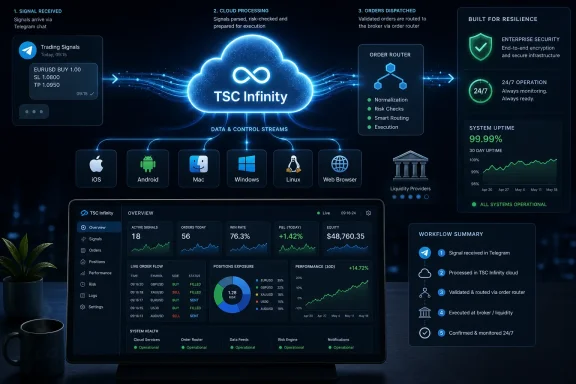 The Real Product Is Not the App, It Is the Absence of the PC
For years, Telegram signal copying has been a very Windows-shaped business. A trader would run a copier application locally, often alongside MetaTrader, or rent a VPS and keep that remote Windows machine alive around the clock. The pitch was simple: if Telegram receives the signal and the trading terminal is connected, the copier can parse the message and place the trade.The weakness was just as simple. If the machine reboots, the VPS provider has an outage, the terminal disconnects, Windows Update barges in, or the trader closes a laptop at the wrong moment, the automation chain breaks. That is not a cosmetic inconvenience in a market where the difference between “copied” and “missed” can be seconds.
TSC Infinity’s cloud-first design attacks that dependency directly. The company says the execution layer runs on its own cloud infrastructure, with users managing accounts, channels, lot sizes, broker settings, and trade history from whatever device is in front of them. In that model, the iPhone app, Android app, browser dashboard, Mac, Linux laptop, or Windows desktop is not the thing doing the trading. It is the thing talking to the thing doing the trading.
That shift mirrors a familiar pattern in business software. The local client starts as the product, then becomes an interface, then becomes one interface among many. The cloud service becomes the durable system of record. TSC is applying that logic to a corner of retail trading where local Windows software and VPS folklore have remained stubbornly durable.
Windows Loses Its Accidental Monopoly
The trading world has never been as platform-neutral as marketing departments like to suggest. MetaTrader’s deep Windows history, broker plug-ins, local automation tools, and VPS hosting culture have made Windows the default operating system for many retail trading stacks. Even Mac users who preferred Apple hardware often found themselves running Windows somewhere else, whether through virtualization, remote desktop, or a rented server.TSC Infinity’s cross-device expansion does not make Windows irrelevant. It does, however, weaken one of Windows’ less glamorous monopolies: being the always-on box in the corner that must remain awake so a user’s trading automation does not fall over.
That is a meaningful change for three groups. Mac users no longer have to treat Windows as the hidden tax on signal automation. Linux users are not left waiting for unofficial workarounds. Windows users themselves get a cleaner bargain: they can still use a PC when it is convenient, but they are no longer required to preserve a delicate desktop state for the sake of execution continuity.
This is where the announcement intersects with the broader Windows ecosystem. Microsoft has spent years making Windows more cloud-connected, more update-driven, and more security-managed. Those changes are sensible at fleet scale, but they can be hostile to hobbyist and semi-professional workflows that assume a local machine will remain untouched indefinitely. A cloud copier turns that tension into someone else’s infrastructure problem.
The VPS Was a Workaround Masquerading as Architecture
The retail trading community has long treated the VPS as a rite of passage. If you wanted automation to run overnight, across time zones, or through travel, you rented a remote Windows machine close to your broker’s servers and hoped the provider was more reliable than your home setup. For many traders, that worked well enough.But a VPS is not a product experience. It is a maintenance burden with a monthly invoice. Users still have to install software, manage credentials, deal with remote desktops, monitor uptime, and understand enough of the stack to know when something has silently failed. That may be acceptable for power users, but it is a poor fit for the retail trader who wants automation without becoming a part-time systems administrator.
TSC’s “no VPS required” message lands because it reframes the old model as unnecessary complexity. If the vendor can host the execution engine, scale it, patch it, monitor it, and expose controls through a browser or mobile app, the trader’s personal infrastructure becomes secondary. The user no longer has to ask whether the copier is running on the right machine. The user has to ask whether the cloud service is trustworthy.
That is a better question, but not an easier one. Moving execution into TSC’s cloud removes many local failure modes while concentrating responsibility inside the vendor’s infrastructure. The trade-off is not “risk versus no risk.” It is fragmented user-managed risk versus centralized vendor-managed risk.
The Fifteen-Millisecond Claim Demands Context
TSC says Infinity can execute signals in under 15 milliseconds. That is the sort of number that makes a press release sparkle and makes experienced traders squint. Execution speed is not a single number in a real trading workflow; it is a chain of delays that includes message receipt, parsing, decision logic, broker connectivity, order routing, and broker-side execution.The important claim is not merely that TSC’s internal pipeline can move quickly. It is that the device is no longer in the critical path. A phone can be off, a laptop can be asleep, and a desktop can be halfway through a reboot without changing whether the cloud service receives and acts on a Telegram signal.
That distinction makes the speed claim more plausible in one sense and less complete in another. Cloud-side automation can remove consumer-device latency and local connectivity failures. It cannot eliminate broker-side latency, liquidity issues, slippage, spreads, rejected orders, or the basic market reality that a copied signal is never the same as a guaranteed fill.
The healthy reading is this: TSC is claiming a fast internal handoff from signal to execution instruction, not a magical guarantee of market outcome. Traders should treat the number as an infrastructure benchmark, not a profit promise.
Telegram Signals Are Easy to Receive and Hard to Understand
Signal copying sounds mechanical until you look at the messages that traders actually send. Some are structured cleanly, with pair, direction, entry, stop loss, and take profit levels in predictable lines. Others are conversational, multilingual, emoji-heavy, image-based, or revised in follow-up posts. A human trader can infer meaning from context; software has to turn that mess into an executable instruction.TSC says Infinity uses ParseX AI, its proprietary parsing engine, to interpret signal formats without manual keyword configuration. The company claims support for structured text, conversational messages, screenshots, non-standard formatting, emojis, and more than 150 languages. If accurate, that makes the parser as central to the product as the cloud hosting itself.
This is also where the marketing gets hardest to evaluate from the outside. Parsing a clean “BUY EURUSD” message is trivial. Parsing a screenshot, extracting the relevant trade parameters, distinguishing an update from a new signal, and handling multilingual ambiguity is a much harder problem. In automation, the expensive failures are rarely the obvious ones; they are the edge cases that look obvious to humans and ambiguous to machines.
For IT professionals, the architecture question is familiar. The user interface can be polished, the cloud can be highly available, and the notification system can be elegant. But if the parser misreads intent, the entire stack faithfully automates the wrong action. In trading software, correctness matters at least as much as uptime.
Mobile Trading Has Arrived, but Automation Is Not Just Trading on a Phone
TSC’s announcement leans into a real market shift: retail traders increasingly expect to manage financial activity from phones. Brokerage apps, crypto exchanges, prop-trading dashboards, and banking platforms have trained users to assume that serious financial tools should fit in a pocket. The old distinction between “real work on desktop” and “light monitoring on mobile” is eroding.But trade automation is different from manual mobile trading. A mobile brokerage app still makes the user the execution engine; the trader looks, decides, taps, confirms, and lives with the result. A cloud signal copier removes the user from the moment of execution. The phone becomes a governance surface for rules that will fire later, perhaps while the trader is asleep.
That is why TSC’s insistence that its iOS and Android apps are “full copier functionality” matters. A companion app that only shows status would preserve the desktop as the real command center. A true mobile control plane lets a user create, adjust, and audit automation rules from the phone itself.
The convenience is obvious. So is the risk. Making it easy to adjust lot sizes, swap brokers, change channel rules, or enable automation from a phone lowers friction in a domain where friction sometimes protects users from impulsive decisions. The best version of this product gives traders control from anywhere. The worst version could make risky automation feel as casual as checking a notification.
The Audit Trail May Matter More Than the Push Alert
The flashy part of a cross-device copier is the instant notification: pair, direction, channel, lot size, execution time, delivered to a lock screen. That is useful, especially for traders who want reassurance that an automated system is alive. But the more consequential feature may be the cloud-stored signal history.Automation without auditability is a black box with a buy button. If a trade goes wrong, the trader needs to know which channel produced the signal, how it was parsed, what rule applied, which account received the order, and when the execution request was sent. A cross-device dashboard with per-channel and per-date filtering is not just a convenience feature; it is the user’s defense against confusion.
This is especially important for multi-account managers and prop firm challenge participants, two groups TSC explicitly mentions. Those users live under constraints that casual traders may not face: drawdown limits, consistency rules, account segregation, and the need to reconstruct decisions after the fact. A permanent cloud audit trail can make automation more manageable, provided it is detailed and trustworthy.
There is a lesson here from enterprise IT. Notifications tell you that something happened. Logs tell you what happened, why it happened, and whether it should happen again. TSC’s dashboard will earn confidence not by looking modern, but by making post-trade reconstruction boringly precise.
Always-On Infrastructure Is a Promise and a Liability
The strongest argument for TSC Infinity is resilience. A home PC can fail. A laptop can sleep. A phone can lose signal. A VPS can misbehave. By moving execution to managed cloud infrastructure, TSC can potentially reduce the accidental downtime that causes missed signals.But every “always-on” product invites the same question: always on for whom, under what conditions, and with what recourse when it fails? TSC says Infinity uses cloud servers with automatic scaling, continuous backup, and rolling updates. That is the vocabulary of modern software operations, and it is the right vocabulary. It does not by itself answer questions about service-level guarantees, incident transparency, regional redundancy, or broker-specific failure handling.
Retail traders are often less demanding than enterprise buyers in the procurement phase and much more emotional in the outage phase. If a SaaS CRM has a hiccup, a sales rep may lose an hour. If a trade copier misses or mishandles a signal during a volatile market move, a trader may blame the vendor for a financial loss that is difficult to attribute cleanly.
That makes operational communication critical. A cloud automation vendor needs more than uptime; it needs status visibility, incident reporting, and a clear boundary between platform failure, broker rejection, market slippage, and user misconfiguration. Without that boundary, every bad outcome becomes a support dispute.
Device-Agnostic Trading Raises Security Questions the Press Release Cannot Settle
A cloud-hosted copier necessarily handles sensitive connections. It may interact with Telegram accounts, broker accounts, trading platforms, or bridge services. The exact mechanics matter, because convenience in trading automation often depends on delegating authority to software that can place orders.That does not make the model inherently unsafe. In many ways, a professionally managed cloud service can be safer than a poorly maintained Windows VPS with reused passwords, outdated software, exposed remote desktop access, and no monitoring. Centralized infrastructure can support stronger patching, logging, segmentation, and abuse detection than most individual traders can manage.
But the user must still ask hard questions. How are credentials stored? What permissions are required? Can access be revoked cleanly? Is there two-factor authentication? Are broker connections isolated per user? What happens if a Telegram channel is compromised? What safeguards prevent a malformed or malicious signal from triggering unintended trades?
These questions do not undermine TSC’s announcement; they define the next phase of evaluation. When software moves from local utility to cloud execution service, trust shifts from “does this run on my machine?” to “does this vendor deserve operational authority over my trades?” For security-minded users, that is the whole ballgame.
The Windows Update Problem Becomes a Symbol
It is easy to make too much of Windows Update reboots. Sensible admins can configure maintenance windows, active hours, group policies, and update controls. A properly managed system should not randomly destroy a trading session.Still, the symbol matters because many retail automation setups are not properly managed systems. They are aging laptops, budget VPS instances, desktop PCs used for unrelated tasks, or remote machines configured once and then forgotten. In that world, an unexpected reboot is not a theoretical edge case. It is Tuesday.
TSC’s cloud model benefits from that reality. The company does not have to persuade every trader that Windows is bad. It only has to persuade them that their personal Windows environment is not the right place for a mission-critical automation loop. That is a subtler and more persuasive argument.
For Windows enthusiasts, this should not be read as an insult to the platform. It is a reminder that not every Windows workload belongs on a personal Windows endpoint. The PC remains a powerful interface for analysis, configuration, and oversight. The always-on execution layer may simply belong somewhere else.
The Product Also Sells Freedom From Expertise
The most revealing phrase in the announcement may be “no local installation.” For technically confident users, installation is a minor hurdle. For everyone else, it is where support tickets begin. Drivers, permissions, antivirus warnings, terminal paths, broker plug-ins, Telegram sessions, and VPS credentials can turn a supposedly simple automation setup into a weekend project.TSC is selling relief from that complexity. A browser-based dashboard and native mobile apps offer a consumer software posture: sign in, connect services, configure rules, and let the platform run. That is how modern users expect software to behave.
The danger is that simplified setup can obscure the seriousness of what is being configured. Trade automation is not a calendar sync tool. A wrong setting can change position size, risk exposure, execution frequency, or account drawdown. Good product design must therefore make dangerous actions clear without burying users in expert-only configuration screens.
This is where TSC’s 24/7 support and first-time setup assistance could matter. If the company is moving beyond technically adept desktop users toward a broader mobile-first audience, onboarding becomes part of the safety model. The easier it is to start, the more important it is to start correctly.
Cross-Device Continuity Is a Feature Traders Will Quickly Treat as a Baseline
If TSC Infinity succeeds, the market will not treat cross-device continuity as exotic for long. Users rarely remain grateful for removed friction. They adapt, then demand the same experience everywhere else.That is how SaaS expectations work. Once a trader can configure a channel on a Mac, check execution from an iPhone, adjust risk from an Android tablet, and review history from a Windows desktop, the old model starts to feel broken rather than merely older. The requirement shifts from “does it run on my machine?” to “why does it need my machine at all?”
Competitors will likely answer with their own cloud pitches, mobile dashboards, and “no VPS” messaging. Some will be serious infrastructure products. Others will be thin wrappers around old assumptions. The dividing line will be whether execution truly moves out of the user’s device path or whether vendors merely add mobile monitoring to a desktop-dependent system.
TSC has an advantage if it can define the category early. It also takes on the burden of proving that cloud signal copying can be reliable, secure, explainable, and supportable at scale. Being first with a compelling architecture is useful. Staying trusted after the first high-profile incident is harder.
The Trade Is Simpler Setup for Deeper Vendor Dependence
The honest version of this story is not that TSC Infinity removes infrastructure risk. It relocates infrastructure risk. The trader no longer has to manage a VPS, but the trader now depends on TSC’s cloud operations. The trader no longer needs a Windows box running all night, but the trader now needs confidence in TSC’s uptime, parsing, security, and broker integrations.That is a rational trade for many users. Most retail traders are not good infrastructure operators, and they should not have to be. A specialized vendor can often do a better job than a scattered population of individuals maintaining fragile desktop setups.
But vendor dependence has consequences. If pricing changes, policies change, integrations break, or support quality declines, users may discover that convenience came with lock-in. The more deeply a service becomes embedded in a trader’s workflow, the harder it is to replace.
This is not unique to TSC. It is the standard bargain of cloud software. The difference is that in trade automation, the stakes are immediate and financial. A bad SaaS migration can interrupt productivity. A bad trading automation migration can affect open risk.
The Signal-Copier Market Is Growing Up
Telegram signal copying has always occupied an awkward space between retail enthusiasm, gray-market advice culture, and legitimate automation tooling. Some traders use it seriously. Others chase signal channels with unrealistic expectations. Vendors in the category must serve a market that wants speed and simplicity, while avoiding the implication that automation solves the hard parts of trading.TSC’s announcement pushes the category toward more professional software architecture. Cloud execution, cross-device dashboards, mobile control, persistent logs, multilingual parsing, broker switching, and risk configuration are the language of a maturing platform, not a hobby script. That does not validate every signal provider, every strategy, or every user outcome. It does show where the tooling is headed.
The more mature the tooling becomes, the more visible the underlying trading risks become. If missed trades from local downtime decrease, users may focus more on signal quality, risk settings, broker execution, and strategy discipline. Better infrastructure does not make a bad signal good. It just ensures the bad signal is copied more reliably.
That is the paradox of automation. Reliability amplifies whatever sits upstream. If the strategy is sound, automation can preserve consistency. If the strategy is reckless, automation can remove the human hesitation that might have slowed the damage.
The Cloud Copier Era Arrives With a Checklist, Not a Victory Lap
TSC Infinity’s cross-device expansion is worth watching because it turns a historically desktop-bound workflow into a cloud service that follows the user across devices. The practical implications are concrete, even if some of the vendor’s strongest claims will need proving over time.- TSC says Infinity is now accessible through iOS, Android, Mac, Windows, Linux, and modern web browsers without requiring a VPS or local installation.
- The key architectural change is that trade execution runs in TSC’s cloud rather than on the trader’s phone, PC, laptop, or rented Windows server.
- The strongest user benefit is continuity: signals can still be processed when a personal device is off, asleep, disconnected, or being used elsewhere.
- The biggest unresolved questions are operational transparency, credential security, parsing accuracy, broker-side execution behavior, and user control over risk settings.
- Windows remains useful as a management and analysis surface, but it is no longer the unavoidable execution host in this model.
- Traders should treat the under-15-millisecond claim as an infrastructure claim, not as a guarantee of fills, profit, or immunity from slippage.
References
- Primary source: USA Today
Published: 2026-06-01T17:22:06.373860
TSC Infinity Expands Cross-Device Telegram Trade Automation to iOS, Android, Mac, Windows, and Linux — No VPS Required
TSC Infinity Brings True Device-Agnostic Trade Automation to 90,000+ Traders Worldwide, Executing Signals in Under 15www.usatoday.com - Related coverage: barchart.com
TSC Infinity Expands Cross-Device Telegram Trade Automation to iOS, Android, Mac, Windows, and Linux — No VPS Required
TSC Infinity Brings True Device-Agnostic Trade Automation to 90,000+ Traders Worldwide, Executing Signals in Under 15 Milliseconds Regardless of Platform, Time Zone, or Internet ConnectivityUnited States, June 1, 2026 -- Telegram Signal Copier (TSC),...www.barchart.com
- Related coverage: globenewswire.com
Mobile Trading Is Reshaping Retail Markets: TSC Infinity is
How TSC Infinity Is Leading the Way in the Rise of the Mobile-First Trading Era...www.globenewswire.com - Related coverage: investegate.co.uk
Telegram Signal Copier Launches TSC Infinity-A Fully Cloud-Based Telegram Copier for Seamless Trade Automation | Company Announcement | Investegate
Investegate announcements from Telegram Signal Copier Launches TSC Infinity-A Fully Cloud-Based Telegram Copier for Seamless Trade Automationwww.investegate.co.uk - Related coverage: app.dealroom.co
Telegram Signal Copier launches TSC Infinity cloud-based trade automation platform for 90,000+ traders | Dealroom.co
Telegram Signal Copier, a signal management platform serving over 90,000 traders globally, has launched TSC Infinity, a fully cloud-based trade automation system. The web-based platform, launching 11 May 2026, replaces the company's desktop application whilst maintaining all existing...app.dealroom.co - Related coverage: telegramsignalcopier.com
Top Telegram Signal Copier (2026): 5 Copiers Tested & Ranked
We tested 5 best Telegram signal copiers in 2026 — TSC, TFXCopier, TSCopier, Copygram & Telegram Copier. See pricing, speed, Trustpilot ratings, and which one is worth your money. telegramsignalcopier.com
- Related coverage: techbullion.com
TSC Infinity Is the Cloud Telegram Copier Traders Have Been Waiting For- No VPS, No Meta API! - TechBullion
If you have ever tried to automate your Telegram trading signals, you already know the pain. You rent a VPS. You install the software. You configure everything on one Windows machine — and then you switch to your Mac, your tablet, or your phone, and suddenly nothing works the way it should. Your...techbullion.com
