

Microsoft announced Consent-Based Recording for voice interactions in Dynamics 365 Contact Center on May 8, 2026, adding a Copilot Studio-driven mechanism that captures a caller’s recording choice in an AI voice agent and carries that decision into any customer service representative handoff. The feature sounds procedural, but it lands in the middle of a much larger fight over how enterprises operationalize AI without turning compliance into a patchwork of scripts, toggles, and agent memory. Microsoft is not merely adding a consent prompt; it is trying to make consent a system state. That distinction matters because the contact center is where corporate AI ambitions most often collide with law, labor, and customer trust.
For years, call recording consent has been treated as something that happens at the edge of the interaction. A customer hears an announcement, presses a key, stays on the line, or speaks to an agent who may or may not repeat the required language. The technical system behind the call often records, transcribes, routes, summarizes, and analyzes based on configuration rather than on a durable consent signal.
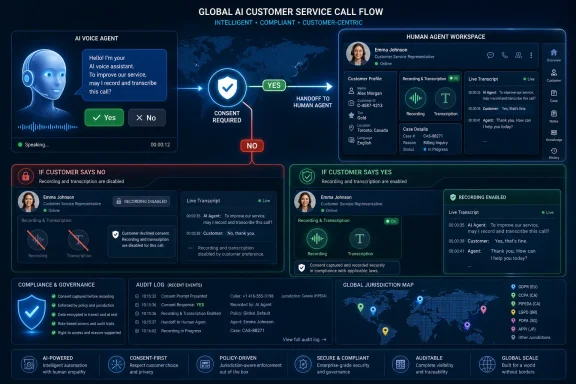
Consent-Based Recording changes that model inside Dynamics 365 Contact Center. The caller’s choice is captured by a voice-enabled agent built in Microsoft Copilot Studio, and that choice then governs whether the call is recorded or transcribed as the interaction moves through the system. If the call escalates to a human customer service representative, the consent decision follows the call.
That sounds like the obvious way it should always have worked. In practice, it is exactly the kind of obviousness enterprise software often fails to deliver until regulation, customer complaints, and operational risk force the issue. Contact centers are full of seams: between IVR and live agent, between CRM and telephony, between transcription engines and quality tools, between in-house and outsourced support operations.
Microsoft’s move is therefore less about the consent prompt itself than about the removal of those seams as places where policy can leak. Once consent is represented as a first-class value in the interaction lifecycle, the customer service representative does not need to interpret the caller’s answer or remember which jurisdiction requires what wording. The platform can enforce the result.
Voice agents are not old-school IVR trees with better voices. They can understand speech, collect intent, route calls, trigger actions, and generate data that becomes useful elsewhere in the enterprise. Once those interactions are transcribed, summarized, and indexed, they stop being ephemeral calls and become corporate knowledge assets. The compliance burden rises accordingly.
The problem is not that recording laws suddenly became complicated. They already were. The problem is that AI makes the consequences of a bad recording decision much larger. A call that should not have been recorded may now feed a transcript, a quality review, an AI-generated summary, analytics dashboards, training workflows, or downstream automation.
That is why consent cannot live only in the opening script. It has to live in the same system that controls recording, transcription, and agent tools. Microsoft’s framing around “privacy by design” is vendor language, but the product behavior points to a real architectural shift: compliance rules are being embedded into the workflow rather than appended as training material.
A caller may begin with an automated voice agent, decline recording, then ask for a human. In a weaker system, the live representative might receive the call in a workspace where recording controls still exist, transcripts appear by default, or the agent must infer whether the earlier consent step happened. Even if the policy is clear, the interface may invite error.
Microsoft says that when consent is not granted, the call proceeds without recording or transcription, and the pause/resume recording controls are disabled for the representative after handoff. That is a crucial design choice. It prevents the live agent from accidentally starting or resuming a recording that the caller declined.
The reverse case is also important. If consent is granted, recording and transcription can continue, and the representative retains the pause/resume recording controls in Contact Center Workspace. That allows organizations to handle sensitive moments, holds, or internal consultation workflows while preserving the core consent trail.
This is the kind of dull enterprise feature that becomes exciting only when it prevents a disaster. A global support operation does not need every agent to be a telecommunications privacy specialist. It needs the interface to make the compliant action the default action and the non-compliant action unavailable.
Microsoft’s documentation makes clear that this capability is designed for inbound voice workstreams associated with a voice-enabled agent. It is not a blanket recording-consent engine for every possible Dynamics 365 Contact Center call path. Outbound calling, inbound workstreams without a voice-enabled agent, and external transfers introduce their own boundaries.
That distinction matters because “consent-based recording” can sound more universal than the feature actually is. If a business has multiple voice entry points, legacy telephony integrations, outsourced agents, or non-Microsoft transfer destinations, it still needs to map where Microsoft’s enforcement starts and ends. A compliance feature inside one platform cannot govern the behavior of another party’s recorder.
There is also a configuration trap hiding in the convenience. Microsoft’s guidance indicates that administrators and makers must properly set up the consent topic and workstream behavior. If the workstream is configured for recording and transcription but the agent does not actually prompt callers as intended, organizations could end up with a system that behaves as though callers opted in.
That should get every admin’s attention. The product can enforce a consent choice once the choice exists, but it cannot substitute for governance around how the prompt is authored, when it runs, which languages it supports, and whether testing proves that it fires before meaningful recording or transcription proceeds.
Traditional call recording notices are often legalistic and rushed. They work because customers have been trained to ignore them. AI voice agents, by contrast, are supposed to be conversational, adaptive, and useful. The consent prompt must therefore do more than satisfy counsel; it has to fit the tone of the interaction.
This is where Copilot Studio makers will need restraint. A consent request should be short, explicit, and difficult to misunderstand. It should not be buried in a long synthetic monologue about service improvement, personalization, or “enhancing your experience.” A customer should know whether the call will be recorded, whether it will be transcribed, and what happens if they say no.
There is an obvious tension here. Businesses want recordings and transcripts because they are valuable for quality monitoring, dispute resolution, training, analytics, and AI summaries. Customers may want service without surveillance. Consent-Based Recording gives organizations a cleaner way to respect that choice, but it does not magically make the choice neutral.
The best deployments will treat the consent prompt as part of product design, not just legal wording. If a customer declines recording and still receives competent service, trust improves. If declining consent quietly degrades the experience, routes the caller into a slower path, or prevents the representative from understanding context that should have been collected another way, the consent model becomes performative.
Microsoft’s own contact center stack increasingly depends on this transformation. Transcripts can support agent assistance. Summaries can reduce after-call work. Analytics can show patterns across thousands of interactions. Supervisors can review conversations without listening to every minute of audio.
Those capabilities are valuable, but they make the consent boundary more important. If a customer declines recording, the system also needs to decide what happens to transcription. Microsoft’s implementation links the two in the consent flow: when consent is not granted, the call proceeds without recording or transcription, and the representative does not see transcripts.
That is the conservative design, and it is probably the right one. From a customer’s perspective, a transcript can be more revealing than an audio recording because it is searchable, portable, and easier to process at scale. Treating transcription as a separate, lower-risk artifact would be a mistake in many jurisdictions and an insult to common sense in most others.
The harder question is what happens around the edges. Microsoft’s documentation notes that a limited recording of the consent prompt and response may be retained temporarily to support compliance requirements. That is defensible, but it illustrates the unavoidable paradox: proving that a caller declined recording may require recording the moment in which they declined.
Boring is good here. The most successful compliance controls are the ones that do not require heroic agent behavior. If the customer declines, the recording button should not be available. If the customer consents, the transcript should flow consistently. If the call transfers between representatives inside Dynamics 365 Contact Center, the original choice should persist.
This is also where Microsoft’s platform pitch becomes stronger. Enterprises already invested in Dynamics 365 Customer Service, Copilot Studio, and Power Platform may prefer a native consent path over custom integrations stitched between a contact center platform, a CRM, a bot framework, and a recording vendor. Every integration is a place where state can be lost.
But the same platform gravity that makes Microsoft attractive also raises the stakes. If Dynamics 365 Contact Center becomes the central place where voice, AI, case context, and representative workflows meet, then misconfiguration has broader consequences. Centralization reduces fragmentation, but it also concentrates risk.
Admins should therefore treat Consent-Based Recording as a control that needs lifecycle management. It should be included in test scripts, release notes, supervisory training, and privacy reviews. It should be validated in every language and call path where it is enabled. And it should be rechecked whenever voice-agent topics, workstreams, or recording settings change.
That is the old compliance problem. The new one is that global companies increasingly want a unified AI contact center that behaves consistently while still respecting local obligations. A business may want the same voice agent architecture in North America, Europe, and Asia-Pacific, but the permissible recording and transcription behavior may differ by market.
A system-enforced consent signal gives global operators a common pattern. Ask early, preserve the answer, enforce it across the interaction. That does not solve every legal nuance, but it gives administrators a more reliable building block than agent scripting alone.
The alternative is brittle. Custom logic in one region, manual representative checks in another, separate recording workflows for different call queues, and compliance rules buried in training documents all create drift. Drift is not just inefficient; it is how companies end up with recordings they cannot use, transcripts they should not have created, and customers who were told one thing while the system did another.
Microsoft is trying to make the legally relevant choice travel with the call. That may sound narrow, but it is exactly the kind of metadata discipline AI systems need. The more automated the contact center becomes, the more important it is that rights, preferences, and constraints move through the system as enforceable state.
That design recognizes that user interfaces are policy surfaces. A button is not neutral. If a CSR can click “record,” the organization has created the possibility that the CSR will click it. Training can reduce the probability, but interface design can remove it.
This is especially important in high-turnover contact center environments. Representatives may be new, outsourced, seasonal, or under pressure to resolve calls quickly. They should not be asked to reconcile a caller’s earlier consent decision with a compliance matrix while simultaneously handling an angry customer, a complex case, and a script.
Disabling controls is not glamorous, but it is how responsible enterprise software behaves. It turns governance into affordance. The representative sees what the system permits, not every theoretical function the platform supports.
The same logic will likely spread. As AI agents take on more front-line tasks, human workspaces will need to reflect machine-collected constraints: consent, authentication status, data-sharing preferences, accessibility needs, escalation conditions, and regional policy. The desktop of the future will not just show customer context; it will show the boundaries of permissible action.
Customers will not care whether the voice agent was built in Copilot Studio or whether the representative used Contact Center Workspace. They will care whether the company respected what they said. If a caller says no to recording and later discovers a transcript, the entire AI service model suffers reputational damage.
For enterprise buyers, trust is also internal. Legal teams need confidence that the system can enforce policy. Security teams need to understand where audio and transcripts live. Operations leaders need recordings for quality and training without creating unusable evidence. Agents need interfaces that do not force them into compliance guesswork.
Microsoft’s advantage is that it can connect these concerns across a single platform story. Its challenge is that the platform story must hold up under real deployments, not just clean demos. Contact centers are messy systems full of exceptions, transfers, language issues, caller behavior, and administrator shortcuts.
This feature is a sign that Microsoft understands the direction of travel. AI contact centers cannot scale on vibes. They need policy-aware workflows where customer choices become machine-readable constraints. Consent-Based Recording is a small but telling example of that principle.
But organizations can still undermine the spirit of the control. They can write prompts that pressure customers. They can make refusal inconvenient. They can route non-consenting callers into worse experiences. They can use other systems outside the Dynamics 365 path to capture interaction data in ways the caller would not reasonably expect.
This is where technology and governance separate. Microsoft can provide the enforcement mechanism inside its product. Customers must still decide how transparent they want to be, how much data they truly need, and whether their AI strategy respects the person on the other end of the line.
For WindowsForum’s IT-pro audience, the lesson is familiar: a vendor feature is not a compliance program. It is a component. The work begins when administrators map call flows, identify unsupported scenarios, test edge cases, and document what happens when a call leaves the Microsoft-controlled environment.
There is also an audit dimension. Organizations should know how consent decisions are logged, how long supporting artifacts are retained, who can access transcripts when consent exists, and how supervisors are prevented from bypassing controls. The announcement focuses on the live interaction, but the data lifecycle after the call remains just as important.
That does not diminish the feature. In fact, its specificity is what makes it useful. Enterprise software fails when it promises to solve abstract compliance and then leaves admins to discover the exceptions in production. A narrower feature that clearly governs a high-risk interaction path is more valuable than a vague compliance banner.
The right deployment posture is therefore optimistic but skeptical. Enable it where the call path matches the supported model. Test it with consenting and non-consenting callers. Transfer calls to representatives and verify the workspace behavior. Confirm that transcripts appear only when they should. Validate what happens during representative-to-representative transfers and consult scenarios.
IT teams should also involve privacy and legal stakeholders before the first production rollout. The question is not only whether the system can ask for consent, but whether the wording, timing, retention behavior, and fallback path satisfy the organization’s obligations. A voice agent can make compliance smoother, but it can also automate a flawed policy at scale.
That shift is uncomfortable because it forces different teams to collaborate. Contact center operations, IT administrators, Power Platform makers, legal counsel, privacy officers, and security teams all have a stake in the same call flow. A consent prompt is no longer “just legal.” It is authored in Copilot Studio, enforced in Dynamics 365 Contact Center, experienced by the caller, and reflected in the representative workspace.
This is where Microsoft’s ecosystem can be powerful or dangerous. The low-code promise lets business teams move faster, but compliance-sensitive voice flows should not be treated like ordinary bot experiments. A maker who changes the conversation start topic may inadvertently affect recording behavior. An admin who changes a workstream setting may alter the legal posture of thousands of calls.
The correct response is not to freeze innovation. It is to apply software-engineering discipline to customer-service automation. Version the agent. Review the prompt. Test the transfer. Document the setting. Monitor the logs. Train the supervisors. Rehearse the failure modes.
AI contact centers will not be judged only by containment rates or reduced handle time. They will be judged by whether they can automate without becoming reckless. Consent-Based Recording is one of the mechanisms that can make that possible, provided customers deploy it with the seriousness it deserves.
That signal lets the system make decisions after the caller has moved beyond the AI agent. It governs transcription, recording controls, and representative visibility. It persists across the interaction rather than evaporating at the transfer boundary.
For organizations trying to scale AI-powered service, that is the model to watch. Customer choices must become portable constraints. Otherwise, every escalation, transfer, channel switch, and integration becomes a potential compliance failure.
The feature also hints at how Microsoft will likely keep evolving Dynamics 365 Contact Center. More policy decisions will move into the platform. More AI-agent interactions will produce state that shapes the human-agent experience. More compliance controls will be expressed as UI behavior rather than after-the-fact review.
Source: Microsoft Consent-Based Recording for Voice AI in D365 Contact Center
 Microsoft Turns Consent From a Script Into Infrastructure
For years, call recording consent has been treated as something that happens at the edge of the interaction. A customer hears an announcement, presses a key, stays on the line, or speaks to an agent who may or may not repeat the required language. The technical system behind the call often records, transcribes, routes, summarizes, and analyzes based on configuration rather than on a durable consent signal.Consent-Based Recording changes that model inside Dynamics 365 Contact Center. The caller’s choice is captured by a voice-enabled agent built in Microsoft Copilot Studio, and that choice then governs whether the call is recorded or transcribed as the interaction moves through the system. If the call escalates to a human customer service representative, the consent decision follows the call.
That sounds like the obvious way it should always have worked. In practice, it is exactly the kind of obviousness enterprise software often fails to deliver until regulation, customer complaints, and operational risk force the issue. Contact centers are full of seams: between IVR and live agent, between CRM and telephony, between transcription engines and quality tools, between in-house and outsourced support operations.
Microsoft’s move is therefore less about the consent prompt itself than about the removal of those seams as places where policy can leak. Once consent is represented as a first-class value in the interaction lifecycle, the customer service representative does not need to interpret the caller’s answer or remember which jurisdiction requires what wording. The platform can enforce the result.
The AI Contact Center Needed a Harder Compliance Boundary
Dynamics 365 Contact Center is part of Microsoft’s broader effort to make customer service less dependent on disconnected telephony stacks and more integrated with Copilot, Dataverse, routing, transcripts, summaries, and business workflows. That integration is useful precisely because it centralizes so much of the customer interaction. It is also risky for the same reason.Voice agents are not old-school IVR trees with better voices. They can understand speech, collect intent, route calls, trigger actions, and generate data that becomes useful elsewhere in the enterprise. Once those interactions are transcribed, summarized, and indexed, they stop being ephemeral calls and become corporate knowledge assets. The compliance burden rises accordingly.
The problem is not that recording laws suddenly became complicated. They already were. The problem is that AI makes the consequences of a bad recording decision much larger. A call that should not have been recorded may now feed a transcript, a quality review, an AI-generated summary, analytics dashboards, training workflows, or downstream automation.
That is why consent cannot live only in the opening script. It has to live in the same system that controls recording, transcription, and agent tools. Microsoft’s framing around “privacy by design” is vendor language, but the product behavior points to a real architectural shift: compliance rules are being embedded into the workflow rather than appended as training material.
The Handoff Is Where the Old Model Broke
The most important part of Microsoft’s announcement is not that a voice agent can ask for consent. It is that the consent decision persists when the call moves from the AI agent to a customer service representative. In the real world, handoffs are where tidy compliance designs become messy.A caller may begin with an automated voice agent, decline recording, then ask for a human. In a weaker system, the live representative might receive the call in a workspace where recording controls still exist, transcripts appear by default, or the agent must infer whether the earlier consent step happened. Even if the policy is clear, the interface may invite error.
Microsoft says that when consent is not granted, the call proceeds without recording or transcription, and the pause/resume recording controls are disabled for the representative after handoff. That is a crucial design choice. It prevents the live agent from accidentally starting or resuming a recording that the caller declined.
The reverse case is also important. If consent is granted, recording and transcription can continue, and the representative retains the pause/resume recording controls in Contact Center Workspace. That allows organizations to handle sensitive moments, holds, or internal consultation workflows while preserving the core consent trail.
This is the kind of dull enterprise feature that becomes exciting only when it prevents a disaster. A global support operation does not need every agent to be a telecommunications privacy specialist. It needs the interface to make the compliant action the default action and the non-compliant action unavailable.
Microsoft Is Selling Simplicity, But the Fine Print Still Matters
The announcement presents Consent-Based Recording as an operational simplifier, and in many environments it will be. It reduces custom logic, avoids manual checks, and gives administrators a cleaner way to align voice-agent behavior with live-agent controls. But it does not remove the need for careful configuration.Microsoft’s documentation makes clear that this capability is designed for inbound voice workstreams associated with a voice-enabled agent. It is not a blanket recording-consent engine for every possible Dynamics 365 Contact Center call path. Outbound calling, inbound workstreams without a voice-enabled agent, and external transfers introduce their own boundaries.
That distinction matters because “consent-based recording” can sound more universal than the feature actually is. If a business has multiple voice entry points, legacy telephony integrations, outsourced agents, or non-Microsoft transfer destinations, it still needs to map where Microsoft’s enforcement starts and ends. A compliance feature inside one platform cannot govern the behavior of another party’s recorder.
There is also a configuration trap hiding in the convenience. Microsoft’s guidance indicates that administrators and makers must properly set up the consent topic and workstream behavior. If the workstream is configured for recording and transcription but the agent does not actually prompt callers as intended, organizations could end up with a system that behaves as though callers opted in.
That should get every admin’s attention. The product can enforce a consent choice once the choice exists, but it cannot substitute for governance around how the prompt is authored, when it runs, which languages it supports, and whether testing proves that it fires before meaningful recording or transcription proceeds.
The Consent Prompt Becomes Part of the User Experience
The customer experience question is more subtle than Microsoft’s announcement suggests. Asking for consent early in a call is good compliance hygiene, but it is also one of the first moments in which a customer forms an opinion about the AI voice agent. A clumsy prompt can make the entire interaction feel defensive before it has begun.Traditional call recording notices are often legalistic and rushed. They work because customers have been trained to ignore them. AI voice agents, by contrast, are supposed to be conversational, adaptive, and useful. The consent prompt must therefore do more than satisfy counsel; it has to fit the tone of the interaction.
This is where Copilot Studio makers will need restraint. A consent request should be short, explicit, and difficult to misunderstand. It should not be buried in a long synthetic monologue about service improvement, personalization, or “enhancing your experience.” A customer should know whether the call will be recorded, whether it will be transcribed, and what happens if they say no.
There is an obvious tension here. Businesses want recordings and transcripts because they are valuable for quality monitoring, dispute resolution, training, analytics, and AI summaries. Customers may want service without surveillance. Consent-Based Recording gives organizations a cleaner way to respect that choice, but it does not magically make the choice neutral.
The best deployments will treat the consent prompt as part of product design, not just legal wording. If a customer declines recording and still receives competent service, trust improves. If declining consent quietly degrades the experience, routes the caller into a slower path, or prevents the representative from understanding context that should have been collected another way, the consent model becomes performative.
Recording Is No Longer Just Recording
One reason this feature matters is that the term recording undersells what modern contact centers do with audio. A call recording used to mean an audio file stored for compliance, quality assurance, or dispute resolution. In an AI-enabled environment, the call can become a transcript, a summary, an intent signal, a sentiment indicator, a case note, and a training artifact.Microsoft’s own contact center stack increasingly depends on this transformation. Transcripts can support agent assistance. Summaries can reduce after-call work. Analytics can show patterns across thousands of interactions. Supervisors can review conversations without listening to every minute of audio.
Those capabilities are valuable, but they make the consent boundary more important. If a customer declines recording, the system also needs to decide what happens to transcription. Microsoft’s implementation links the two in the consent flow: when consent is not granted, the call proceeds without recording or transcription, and the representative does not see transcripts.
That is the conservative design, and it is probably the right one. From a customer’s perspective, a transcript can be more revealing than an audio recording because it is searchable, portable, and easier to process at scale. Treating transcription as a separate, lower-risk artifact would be a mistake in many jurisdictions and an insult to common sense in most others.
The harder question is what happens around the edges. Microsoft’s documentation notes that a limited recording of the consent prompt and response may be retained temporarily to support compliance requirements. That is defensible, but it illustrates the unavoidable paradox: proving that a caller declined recording may require recording the moment in which they declined.
Enterprise Buyers Will See a Governance Feature, Not a Checkbox
For IT leaders, the practical value of Consent-Based Recording will depend on how well it fits into governance processes. A single toggle is useful, but only if it can be deployed predictably across environments, audited during change management, and tested after updates. Contact center administrators will want to know not merely whether the feature exists, but whether it can be made boring.Boring is good here. The most successful compliance controls are the ones that do not require heroic agent behavior. If the customer declines, the recording button should not be available. If the customer consents, the transcript should flow consistently. If the call transfers between representatives inside Dynamics 365 Contact Center, the original choice should persist.
This is also where Microsoft’s platform pitch becomes stronger. Enterprises already invested in Dynamics 365 Customer Service, Copilot Studio, and Power Platform may prefer a native consent path over custom integrations stitched between a contact center platform, a CRM, a bot framework, and a recording vendor. Every integration is a place where state can be lost.
But the same platform gravity that makes Microsoft attractive also raises the stakes. If Dynamics 365 Contact Center becomes the central place where voice, AI, case context, and representative workflows meet, then misconfiguration has broader consequences. Centralization reduces fragmentation, but it also concentrates risk.
Admins should therefore treat Consent-Based Recording as a control that needs lifecycle management. It should be included in test scripts, release notes, supervisory training, and privacy reviews. It should be validated in every language and call path where it is enabled. And it should be rechecked whenever voice-agent topics, workstreams, or recording settings change.
Global Compliance Is a Product Problem Now
Microsoft’s announcement leans heavily on global operations, and for good reason. Call recording rules vary widely by country, region, and sometimes state. Some jurisdictions permit one-party consent, others require all-party consent, and many organizations set a stricter global standard simply to avoid operational chaos.That is the old compliance problem. The new one is that global companies increasingly want a unified AI contact center that behaves consistently while still respecting local obligations. A business may want the same voice agent architecture in North America, Europe, and Asia-Pacific, but the permissible recording and transcription behavior may differ by market.
A system-enforced consent signal gives global operators a common pattern. Ask early, preserve the answer, enforce it across the interaction. That does not solve every legal nuance, but it gives administrators a more reliable building block than agent scripting alone.
The alternative is brittle. Custom logic in one region, manual representative checks in another, separate recording workflows for different call queues, and compliance rules buried in training documents all create drift. Drift is not just inefficient; it is how companies end up with recordings they cannot use, transcripts they should not have created, and customers who were told one thing while the system did another.
Microsoft is trying to make the legally relevant choice travel with the call. That may sound narrow, but it is exactly the kind of metadata discipline AI systems need. The more automated the contact center becomes, the more important it is that rights, preferences, and constraints move through the system as enforceable state.
The Agent Desktop Is Becoming a Policy Surface
One underappreciated aspect of this feature is the role of Contact Center Workspace. Microsoft is not simply relying on the backend to stop recordings; it is changing what the representative can do in the interface. When consent is denied, recording controls are disabled.That design recognizes that user interfaces are policy surfaces. A button is not neutral. If a CSR can click “record,” the organization has created the possibility that the CSR will click it. Training can reduce the probability, but interface design can remove it.
This is especially important in high-turnover contact center environments. Representatives may be new, outsourced, seasonal, or under pressure to resolve calls quickly. They should not be asked to reconcile a caller’s earlier consent decision with a compliance matrix while simultaneously handling an angry customer, a complex case, and a script.
Disabling controls is not glamorous, but it is how responsible enterprise software behaves. It turns governance into affordance. The representative sees what the system permits, not every theoretical function the platform supports.
The same logic will likely spread. As AI agents take on more front-line tasks, human workspaces will need to reflect machine-collected constraints: consent, authentication status, data-sharing preferences, accessibility needs, escalation conditions, and regional policy. The desktop of the future will not just show customer context; it will show the boundaries of permissible action.
Microsoft’s Bigger Bet Is Trustworthy Automation
Consent-Based Recording sits neatly inside Microsoft’s broader strategy: make Copilot Studio the place where organizations build agents, make Dynamics 365 Contact Center the place where those agents meet customers, and make the Microsoft cloud the place where the resulting data becomes useful. That strategy depends on trust.Customers will not care whether the voice agent was built in Copilot Studio or whether the representative used Contact Center Workspace. They will care whether the company respected what they said. If a caller says no to recording and later discovers a transcript, the entire AI service model suffers reputational damage.
For enterprise buyers, trust is also internal. Legal teams need confidence that the system can enforce policy. Security teams need to understand where audio and transcripts live. Operations leaders need recordings for quality and training without creating unusable evidence. Agents need interfaces that do not force them into compliance guesswork.
Microsoft’s advantage is that it can connect these concerns across a single platform story. Its challenge is that the platform story must hold up under real deployments, not just clean demos. Contact centers are messy systems full of exceptions, transfers, language issues, caller behavior, and administrator shortcuts.
This feature is a sign that Microsoft understands the direction of travel. AI contact centers cannot scale on vibes. They need policy-aware workflows where customer choices become machine-readable constraints. Consent-Based Recording is a small but telling example of that principle.
The Catch Is That “No” Must Mean No
The credibility of this feature will ultimately depend on whether “no” is treated as a genuine choice. Microsoft says that if consent is not granted, recording and transcription do not proceed, and CSRs cannot start or pause recording or transcripts. That is the right baseline.But organizations can still undermine the spirit of the control. They can write prompts that pressure customers. They can make refusal inconvenient. They can route non-consenting callers into worse experiences. They can use other systems outside the Dynamics 365 path to capture interaction data in ways the caller would not reasonably expect.
This is where technology and governance separate. Microsoft can provide the enforcement mechanism inside its product. Customers must still decide how transparent they want to be, how much data they truly need, and whether their AI strategy respects the person on the other end of the line.
For WindowsForum’s IT-pro audience, the lesson is familiar: a vendor feature is not a compliance program. It is a component. The work begins when administrators map call flows, identify unsupported scenarios, test edge cases, and document what happens when a call leaves the Microsoft-controlled environment.
There is also an audit dimension. Organizations should know how consent decisions are logged, how long supporting artifacts are retained, who can access transcripts when consent exists, and how supervisors are prevented from bypassing controls. The announcement focuses on the live interaction, but the data lifecycle after the call remains just as important.
The Practical Reading for Admins Is Narrower Than the Marketing
Microsoft’s announcement is broad in tone, but administrators should read it as a specific capability with specific prerequisites. It applies to voice interactions involving Copilot Studio voice agents and Dynamics 365 Contact Center handoffs. It is not a universal substitute for jurisdictional legal review, recording policy design, or contact center architecture work.That does not diminish the feature. In fact, its specificity is what makes it useful. Enterprise software fails when it promises to solve abstract compliance and then leaves admins to discover the exceptions in production. A narrower feature that clearly governs a high-risk interaction path is more valuable than a vague compliance banner.
The right deployment posture is therefore optimistic but skeptical. Enable it where the call path matches the supported model. Test it with consenting and non-consenting callers. Transfer calls to representatives and verify the workspace behavior. Confirm that transcripts appear only when they should. Validate what happens during representative-to-representative transfers and consult scenarios.
IT teams should also involve privacy and legal stakeholders before the first production rollout. The question is not only whether the system can ask for consent, but whether the wording, timing, retention behavior, and fallback path satisfy the organization’s obligations. A voice agent can make compliance smoother, but it can also automate a flawed policy at scale.
The New Compliance Work Moves Into the Call Flow
Consent-Based Recording is best understood as part of a larger migration of governance into operational software. In the old model, policies lived in binders, training modules, and legal review. In the new model, they increasingly live in routing rules, interface states, data labels, retention policies, and AI-agent topics.That shift is uncomfortable because it forces different teams to collaborate. Contact center operations, IT administrators, Power Platform makers, legal counsel, privacy officers, and security teams all have a stake in the same call flow. A consent prompt is no longer “just legal.” It is authored in Copilot Studio, enforced in Dynamics 365 Contact Center, experienced by the caller, and reflected in the representative workspace.
This is where Microsoft’s ecosystem can be powerful or dangerous. The low-code promise lets business teams move faster, but compliance-sensitive voice flows should not be treated like ordinary bot experiments. A maker who changes the conversation start topic may inadvertently affect recording behavior. An admin who changes a workstream setting may alter the legal posture of thousands of calls.
The correct response is not to freeze innovation. It is to apply software-engineering discipline to customer-service automation. Version the agent. Review the prompt. Test the transfer. Document the setting. Monitor the logs. Train the supervisors. Rehearse the failure modes.
AI contact centers will not be judged only by containment rates or reduced handle time. They will be judged by whether they can automate without becoming reckless. Consent-Based Recording is one of the mechanisms that can make that possible, provided customers deploy it with the seriousness it deserves.
The Consent Signal Is the Product’s Real News
Microsoft’s new feature is easy to summarize, but its implications are broader than the summary. The consent prompt is the visible part. The durable consent signal is the real product.That signal lets the system make decisions after the caller has moved beyond the AI agent. It governs transcription, recording controls, and representative visibility. It persists across the interaction rather than evaporating at the transfer boundary.
For organizations trying to scale AI-powered service, that is the model to watch. Customer choices must become portable constraints. Otherwise, every escalation, transfer, channel switch, and integration becomes a potential compliance failure.
The feature also hints at how Microsoft will likely keep evolving Dynamics 365 Contact Center. More policy decisions will move into the platform. More AI-agent interactions will produce state that shapes the human-agent experience. More compliance controls will be expressed as UI behavior rather than after-the-fact review.
What IT Teams Should Notice Before They Flip the Switch
The immediate lesson is not that every Dynamics 365 Contact Center customer should enable the feature tomorrow. The lesson is that recording consent now belongs in the architecture conversation, not merely in the opening announcement script. Teams that treat it as a checkbox will miss both the value and the risk.- Consent-Based Recording is aimed at inbound voice interactions that use a Copilot Studio voice-enabled agent and can preserve the caller’s recording decision through escalation to a customer service representative.
- If the caller grants consent, recording and transcription can proceed, and representatives retain the relevant recording controls in Contact Center Workspace.
- If the caller does not grant consent, the interaction continues without recording or transcription, and the representative cannot start or manipulate recording for that call.
- Administrators and makers still need to configure the voice agent, consent topic, and workstream correctly, because a system-enforced choice only helps when the choice is actually captured.
- The feature reduces manual agent risk, but it does not replace legal review, call-flow testing, regional policy mapping, or governance for systems outside Microsoft’s control.
- The most important operational test is the handoff, because that is where older consent models most often lost context or pushed responsibility back onto the human representative.
Source: Microsoft Consent-Based Recording for Voice AI in D365 Contact Center
