

Microsoft’s latest Dynamics 365 announcement at Ignite frames a decisive next step in enterprise AI: Copilot, agents, and Model Context Protocol (MCP) servers are being pushed from concept into production-ready building blocks, with new first‑party agents (notably the Sales Development Agent), expanded MCP coverage across ERP/Power Platform, and a new agent management layer called Agent 365 for governance and lifecycle control.
Microsoft has been evolving Copilot from an embedded assistant into a platform for agentic business applications — systems that don’t just inform people but act on their behalf. That strategy stitches together three core pieces:
Yet the real work for enterprises will be non‑technical: process redesign, governance discipline, careful pilot measurement, and workforce reskilling. Vendor claims like the 15.1% conversion lift are valuable signposts and worth testing, but they are not turnkey guarantees. Early adopter benefits are tangible (time savings, responsiveness), but so are the risks: compliance gaps, model failures, and cultural resistance.
Organizational readiness — data hygiene, governance, and a clear human‑in‑the‑loop strategy — will determine whether Copilot‑driven agents become a multiplier or a maintenance burden. For organizations that pair pilots with strong controls and measurable KPIs, agents offer a credible path to scale repetitive work and free humans for higher‑value interactions. For others that skip governance or over‑trust vendor lift numbers, the promise may produce uneven returns.
Microsoft’s announcements mark an inflection point: agentic business applications are no longer hypothetical. The platform pieces are shipping; the question for business leaders is whether they will invest in the operational capabilities needed to make agents reliable, auditable, and accountable at scale.
Conclusion
The move to agentic business applications represents a structural shift in how work can be executed inside enterprise systems: from manual interactions with multiple apps toward delegated actions performed by governed, auditable agents. Microsoft’s combination of Copilot, expanded MCP servers, and agent lifecycle tools is a credible attempt to make that transition practical. The pathway to meaningful ROI is clear — pilot rigor, governance first, and incremental scaling — and companies that apply those disciplines will be best positioned to benefit from this next wave of automation.
Source: Microsoft The future of business with Microsoft Copilot and Dynamics 365 - Microsoft Dynamics 365 Blog
 Background
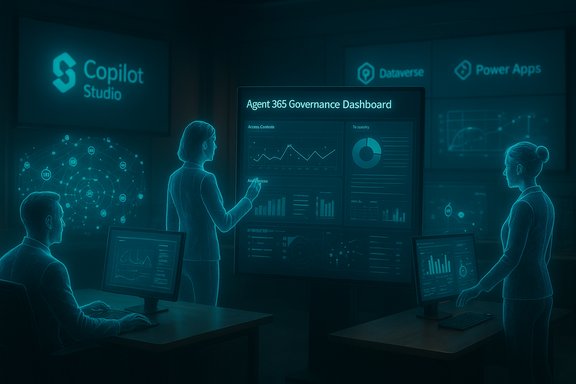
Microsoft has been evolving Copilot from an embedded assistant into a platform for agentic business applications — systems that don’t just inform people but act on their behalf. That strategy stitches together three core pieces:- Copilot Studio — the low‑code/pro‑dev authoring and runtime environment for building agents.
- Dataverse / Power Platform — the state and integration substrate agents use to read/write business data.
- Dynamics 365 and Microsoft 365 apps — the surfaces where agents deliver value and where humans interact with outcomes.
What Microsoft announced (at a glance)
- A new Sales Development Agent to autonomously research, qualify, and follow up on leads; available to Frontier Program customers in December 2025. Microsoft reports a 15.1% lift in lead‑to‑opportunity conversion in internal sales trials.
- Expanded Model Context Protocol (MCP) servers across Dynamics 365 and the Power Platform:
- A dynamic Dynamics 365 ERP MCP server (public preview) exposing hundreds of thousands of ERP functions to agents in real time.
- An analytics MCP server (public preview coming December 2025) to bridge ERP transaction data and BI/metrics for agent reasoning.
- A Power Apps MCP server (public preview) to let agents trigger approvals, forms, and app logic.
- Dataverse MCP server declared generally available, enabling natural‑language interactions grounded in Dataverse.
- A governance/control plane in the form of Agent 365, surfaced through the Frontier early‑access program, to manage agent identities, permissions, telemetry, and policy enforcement. Coverage in the press describes Agent 365 as a control layer that treats agents like digital employees.
Why this matters: from productivity helpers to business actors
For more than a year Microsoft has embedded generative AI into Office apps and Dynamics modules to speed drafting, summarization, and role‑specific insights. The recent announcements push beyond that: agents are now being framed as operational actors that can:- Operate continuously to capture and act on asynchronous signals (e.g., follow‑ups, lead research).
- Cross application boundaries (Outlook, Teams, CRM, ERP) while respecting tenant identity and security.
- Trigger deterministic workflows (Power Automate / Power Apps) and write back into business systems through MCP servers that mediate context, permissions, and tooling.
The practical implication for organizations is a potential reallocation of human effort: automating repetitive, predictable work while moving humans into oversight, exception handling, and higher‑value relationship tasks.
Sales Development Agent: what it does and the claims
Core capabilities
- Continuous prospect research and personalized outreach (email drafts, follow‑ups).
- Lead qualification and handoff to human sellers when escalation is required.
- Integration with Dynamics 365, Salesforce, Outlook, and Teams to operate in sellers’ workflows.
Microsoft’s performance claim
Microsoft reports that in internal use by its own sales organization the Sales Development Agent drove a 15.1% increase in lead‑to‑opportunity conversion across 61,734 total outreach touches between January 1 and November 7, 2025. That figure is presented as internal Microsoft sales team data.Independent corroboration and context
Multiple industry outlets covered Microsoft’s agent push and the Sales Development Agent announcement; the messaging is consistent across the Microsoft post and press pieces that followed. Independent coverage confirms availability through preview/Frontier channels and the vendor positioning versus CRM incumbents. However, the 15.1% conversion lift is an internal metric published by Microsoft and currently lacks independent third‑party validation in public reporting; treat it as a vendor result that should be replicated under your conditions before using it as a forecasted outcome.MCP servers: the plumbing that makes agents practical
What MCP is and why it matters
The Model Context Protocol (MCP) is a standardized protocol that exposes tools, actions, and contextual metadata from applications to agent runtimes. In short, MCP is a bridge that allows agents to:- Discover available actions (tools) in an application context.
- Retrieve the minimal, permissioned data needed to reason and act.
- Execute actions safely through the app’s existing security and auditing surfaces.
Dynamics 365 ERP MCP (public preview)
Microsoft’s new dynamic ERP MCP server replaces the earlier static tool set with a dynamic capability that can navigate forms, set fields, and invoke actions across Finance, Supply Chain, HR, and Project Operations — effectively unlocking hundreds of thousands of ERP functions for agentic workflows. The server inherits application‑level permissioning, auditing, and ISV customizations, which is important for compliance and traceability.Dataverse and Power Apps MCP
- Dataverse MCP is now generally available and provides makers and users with natural‑language interactions grounded in Dataverse data and metadata.
- Power Apps MCP (public preview) lets agents trigger approvals, form submissions, and components from custom apps, treating Power Apps as composable building blocks in agent workflows.
Why multiple MCP servers matter
Having MCP variants for ERP, analytics, Dataverse, and Power Apps means agents can operate across transactional systems, analytical models, and citizen‑developer apps without repeated rework. For businesses, that lowers the friction of deploying agents into operational processes and gives IT more consistent controls.Governance, security, and operational controls
The announcements stress governance, and Microsoft is explicitly shipping tools and patterns to:- Register agent identities and control access via Entra (Azure AD).
- Limit which agent platforms can interact with MCP servers.
- Enforce tenant‑scoped grounding so outputs are based on authorized tenant data.
- Provide telemetry and observability dashboards to monitor agent behavior (Agent 365).
These details are essential because agents that can do write‑backs or autonomously route approvals introduce audit, compliance, and risk surfaces that didn’t exist with pure “read‑only” copilots.
Strengths: where this can move the needle for businesses
- Scale and throughput: Agents can run continuous outreach (sales), supplier communications, case triage, and routine finance tasks, increasing throughput without linear headcount growth. Microsoft positions agents as a way to scale sales outreach and reduce administrative burden.
- Integration without heavy custom code: MCP standardization reduces custom connector work, keeping ISV extensions and customizations accessible to agents under the application’s native security model.
- Speed of prototyping: Copilot Studio and low‑code agents let citizen makers and pro developers iterate faster; teams can pilot small, measurable scenarios quickly.
- Governance‑native approach: Agent 365 plus MCP’s permissioned interactions provide a path to safe scaling, so enterprises can adopt more quickly while maintaining controls. Press coverage highlights Agent 365 as a centralized control plane for agent management.
Risks and material questions enterprises must answer
- Vendor metrics vs. real‑world replication
- Microsoft’s 15.1% lift is reported from internal sales usage. That’s meaningful as a signal but not a guarantee — results will vary by industry, lead quality, existing processes, and the degree of human oversight. Treat such figures as pilot outcomes, not enterprise forecasts.
- Governance fatigue and drift
- Agent capabilities create new governance domains (agent identities, model choices, prompt governance, and runtime telemetry). Organizations must integrate agent controls into existing GRC, privacy, and audit workflows — failing that risks policy drift or uncontrolled write‑backs. Microsoft’s guidance and Power Platform governance posts recommend extending existing controls, but customers must operationalize them.
- Model reliability and hallucination
- Agents make decisions based on model outputs and data context. In high‑stakes actions (financial transactions, contract responses) hallucinations or reasoning errors could have costly consequences. Every write‑back should have human‑in‑the‑loop gates until confidence and observability are proven. Independent reporting and commentary highlight token limits, model differences, and potential risks to accuracy in complex operations.
- Workforce changes and skill shifts
- Analysts and line workers must shift from task execution to agent oversight, orchestration, and exception resolution. This requires re‑skilling and cultural change — an area Microsoft is addressing via partnerships (for example, with Harvard Business School for executive education), but it’s not an automatic transition.
- Ecosystem and vendor competition
- Microsoft is explicit that agents can connect to competing CRMs (Salesforce is called out in Microsoft materials and press coverage) — this heightens competitive dynamics. Customers must evaluate claims against incumbent platform investments and migration costs. Industry coverage documents Microsoft’s messaging as competitive with Salesforce’s agent offerings.
Practical checklist for IT and business leaders
- Start with high‑value, low‑risk pilots.
- Examples: inbound lead qualification, supplier email triage, document intake for finance, or a meeting‑prep agent for sales. Measure time saved, conversion lift, and error rate.
- Define agent tiers and permissions.
- Map agent roles to least‑privilege access (read‑only, write‑with‑approval, write‑autonomously for sanctioned low‑risk tasks). Extend existing PIM / Entra controls to agent identities.
- Use MCP to limit blast radius.
- Only expose the minimal set of tools and fields an agent needs; prefer tools that require approval steps for material transactions. Validate the Allowed MCP clients list and enforce tenant‑scoped grounding.
- Build an observability and incident playbook.
- Instrument agent runs with telemetry, store run histories, and implement a blameless incident response for model failures or inappropriate write‑backs. Microsoft and third‑party guidance recommend runtime monitoring and prompt evaluation baselines.
- Invest in data hygiene and grounding.
- Agents are only as reliable as the data they reason over. Clean, well‑governed Dataverse and ERP data yields better outcomes; tag sensitive fields and create allow‑lists for agent usage.
- Set expectations and train people.
- Define the human‑agent interaction model (who reviews what, SLA for validation, exception escalation) and train users to interpret agent outputs critically.
How to evaluate vendor claims and pilot results
- Require transparent pilot design that includes control groups, and measure conversion lift, false positive rate, mean time to resolution, and time saved for human workers.
- Insist on runbooks for all agent‑driven write‑backs and change management records for any automation that touches finance or compliance functions.
- Ask for replicable evidence: if a vendor claims percentage lifts, obtain the methodology and raw metrics so your analytics team can validate them under your conditions.
Competitive and market view
The market is rapidly positioning around agent frameworks. Salesforce (Agentforce) and other major players are crafting their own agent plays, which pushes enterprise customers to evaluate not just feature parity but interoperability, governance, and total cost of ownership.- Microsoft’s advantage: tight integration across Microsoft 365, Dataverse, Azure security controls, and the ability to expose existing Dynamics/Power Platform investments to agents via MCP.
- The competitive pressure: vendors are touting agent concepts that promise comparable outcomes, and organizations should compare cross‑platform interoperability and vendor lock‑in risks. Coverage shows Microsoft is also marketing agent capabilities as a way to reduce reliance on alternative CRM systems.
Real customer examples and early partner pilots
Microsoft highlights early adopter stories and partner pilots — for example, Ramp used Microsoft Foundry with Business Central and Teams to prototype an agentic expense workflow, and partners like Accenture plan pilots for Sales Development Agent to scale inside sales services. These use cases illustrate feasible near‑term wins (expense automation, lead qualification), but are still early and often in preview.Where to watch next (milestones)
- Public preview windows for MCP servers — Dynamics ERP MCP is public preview now; analytics MCP in public preview in December 2025. Verify tenant prerequisites before enrolling.
- Sales Development Agent: Frontier Program availability in December 2025 for early customers; broader availability timelines not yet detailed in Microsoft’s post.
- Agent 365: early access through Frontier with product docs and press coverage indicating admin control surfaces will expand during the preview window.
Final assessment: pragmatic optimism with operational rigor
Microsoft’s architecture — Copilot Studio + Dataverse/Power Platform + MCP + Agent 365 — is a coherent and pragmatic approach to operationalizing agents across enterprise systems. The strength of this strategy is its attention to governance, standardized connectivity (MCP), and integration into the productivity surfaces people already use.Yet the real work for enterprises will be non‑technical: process redesign, governance discipline, careful pilot measurement, and workforce reskilling. Vendor claims like the 15.1% conversion lift are valuable signposts and worth testing, but they are not turnkey guarantees. Early adopter benefits are tangible (time savings, responsiveness), but so are the risks: compliance gaps, model failures, and cultural resistance.
Organizational readiness — data hygiene, governance, and a clear human‑in‑the‑loop strategy — will determine whether Copilot‑driven agents become a multiplier or a maintenance burden. For organizations that pair pilots with strong controls and measurable KPIs, agents offer a credible path to scale repetitive work and free humans for higher‑value interactions. For others that skip governance or over‑trust vendor lift numbers, the promise may produce uneven returns.
Microsoft’s announcements mark an inflection point: agentic business applications are no longer hypothetical. The platform pieces are shipping; the question for business leaders is whether they will invest in the operational capabilities needed to make agents reliable, auditable, and accountable at scale.
Conclusion
The move to agentic business applications represents a structural shift in how work can be executed inside enterprise systems: from manual interactions with multiple apps toward delegated actions performed by governed, auditable agents. Microsoft’s combination of Copilot, expanded MCP servers, and agent lifecycle tools is a credible attempt to make that transition practical. The pathway to meaningful ROI is clear — pilot rigor, governance first, and incremental scaling — and companies that apply those disciplines will be best positioned to benefit from this next wave of automation.
Source: Microsoft The future of business with Microsoft Copilot and Dynamics 365 - Microsoft Dynamics 365 Blog
Last edited:
