

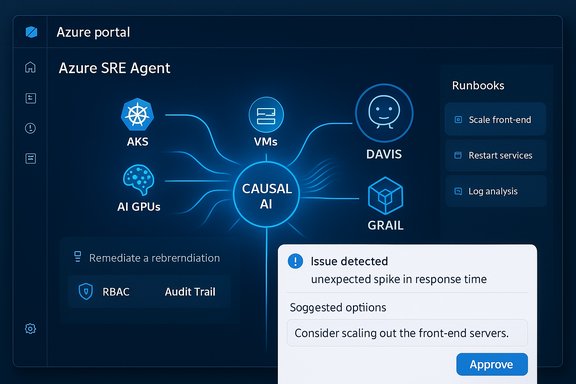
Dynatrace’s preview of a purpose-built cloud operations solution for Microsoft Azure marks a clear pivot from passive observability to actionable, portal-native operations—pairing Dynatrace’s causal AI and telemetry lakehouse with Microsoft’s Azure SRE Agent to surface remediation hints, automate low‑risk fixes, and continuously optimize cloud spend.
Background / Overview
Dynatrace announced a new, Azure‑focused cloud operations offering that is available in preview and is being showcased at Microsoft Ignite. The vendor frames the product as a next‑generation solution that brings comprehensive visibility, AI‑driven prevention, automated remediation, and continuous optimization to Azure environments, with general availability targeted for early 2026. Microsoft’s Azure SRE Agent is a portal‑native “agentic” reliability assistant that continuously monitors resources, offers an investigative chat-style surface inside the Azure portal, and can propose or (with governance) execute mitigations. Azure bills this agent using Azure Agent Units (AAUs)—a consumption model that combines a baseline always‑on component and incremental usage charges for active tasks. Microsoft’s product and billing documentation specifies 4 AAUs per agent per hour for baseline monitoring, plus 0.25 AAU per second for each active task executed by the agent while it runs. These pricing and billing details are currently published in Microsoft’s SRE Agent documentation and pricing pages. Independent industry coverage confirms Dynatrace’s announcement and highlights the broader narrative: observability platforms are moving from “explain what happened” to “help fix it safely,” and cloud vendors are enabling partners to feed context and actions into provider‑native control planes. Several media and financial outlets have reiterated Dynatrace’s positioning as the first observability platform to integrate with Azure SRE Agent (a vendor claim buyers should confirm during evaluation).What Dynatrace is selling: core capabilities
Dynatrace’s Azure cloud operations preview bundles four headline capabilities aimed at platform and SRE teams working in Azure:- Comprehensive Visibility — expanded telemetry and metadata ingestion across Azure services to build higher‑fidelity topology and causal models.
- Auto‑Prevention — proactively detect and warn of emerging risks using health templates and risk scoring.
- Auto‑Remediation — package causal findings into remediation hints and wire them into runbooks, with gated automation for low‑risk actions.
- Auto‑Optimization — continuous rightsizing, idle resource cleanup, and recommendations to control cloud costs.
Technical architecture: telemetry, causal AI, and the control plane
Expanded telemetry ingestion
Dynatrace says the new solution increases coverage of Azure Monitor telemetry and related Azure services to enrich its full‑stack maps. That means ingesting:- Distributed traces and transaction spans
- Metrics with higher cardinality (AKS, GPUs, AI training clusters)
- Logs and event streams
- Business‑level telemetry (SLO/SLA signals)
Mapping diagnostics into Azure SRE Agent
The integration maps Dynatrace outputs (diagnostics, implicated resources, timestamps, confidence scores, recommended runbook steps) into Azure SRE Agent’s investigative UI. The SRE Agent can then:- Surface remediation hints in a chat or incident workflow inside the portal
- Trigger low‑risk automations under an approval gate
- Execute approved runbook actions and record audit trails tied to Azure identities
Cost model and practical budgeting (AAUs, telemetry, and egress)
Costs for a combined Dynatrace + Azure SRE Agent deployment come from multiple buckets and must be modeled together:- Azure SRE Agent baseline and active flow (AAUs)
- Baseline: 4 AAUs per agent per hour. Monthly baseline per agent ≈ 4 AAU/hr 24 hr/day 30 days ≈ 2,880 AAUs/month before regional pricing conversion.
- Active flow: 0.25 AAU per second per task while the agent executes actions.
- Dynatrace telemetry ingestion and retention (metrics, traces, logs) — incremental cost scales with volume and retention windows.
- Egress and API invocation charges if telemetry must traverse tenant boundaries or be exported between services.
- Operational costs for runbook maintenance, governance, and FinOps tooling.
Why this matters: operational benefits for Azure‑first enterprises
- Faster, more precise root‑cause analysis. By feeding richer telemetry into causal AI, teams can reduce noisy alerts and focus on the underlying causes of incidents rather than surface symptoms. This shortens the time-to-diagnosis in complex, microservices and AI‑heavy estates.
- Lower context switching. Surfacing remediation hints and runbook steps inside Azure reduces the need to jump between vendor consoles, tickets, and portal workflows during incidents.
- Safer automation. The integration’s design (approval gates, RBAC, audit trails) is intended to preserve human oversight while enabling repeatable, low‑risk automations.
- Cost control for AI workloads. Continuous rightsizing and idle‑resource cleanup are particularly relevant for GPU/accelerator‑intensive AI training and inference, where idle time can be a major expense.
- Single‑pane Azure governance. Integrating partner telemetry into Azure’s control plane enables a consistent identity, governance, and billing model to evaluate and approve operational actions.
Risks, caveats, and governance concerns
Agentic automation adds capabilities — and new responsibilities. Key risks include:- Over‑automation hazard. Poorly scoped or untested runbooks can cause cascading changes or unintended recovery actions. A conservative automation ramp (read‑only → gated actions → low‑risk automation) is essential.
- Opaque or hard‑to‑predict billing. AAU consumption for active tasks, combined with telemetry ingestion growth, can produce surprising bills if not modeled and monitored. Always estimate baseline AAUs and test active flow behavior during pilot runs.
- High‑cardinality telemetry costs and performance. Large AKS clusters, thousands of pods, or intense AI telemetry produce high cardinality that stresses ingestion pipelines. Validate GRAIL and pipeline performance under realistic load and sample/prune telemetry where appropriate.
- Security and least‑privilege. Any automation that can change infrastructure must be governed by least‑privilege identities, role-based authorizations, and immutable logs. Misconfigured connectors or over‑privileged service principals are primary attack vectors for destructive automation.
- Vendor claims vs. field reality. Statements like “move closer to fully autonomous operations” or “first to integrate” are vendor positioning. Confirm integration depth, measurable MTTR improvements, and customer references in procurement materials.
How to pilot safely: a recommended sequence
- Define measurable KPIs up front:
- Baseline MTTR, target MTTR, percentage of incidents auto‑resolved, false positive automation rate, and realized monthly AAU consumption.
- Start with read‑only mode:
- Ingest telemetry, display remediation hints in the portal, and collect operator feedback with no automated changes.
- Validate remediation suggestions with runbook testing:
- Treat runbooks as code; run CI‑backed unit tests and sandboxed rehearsals.
- Enable gated low‑risk automations:
- Start with safe actions (tagging, non‑disruptive restarts, scaling up transient capacity) requiring operator approval or a one‑click confirmation.
- Measure and iterate:
- Track AAU consumption, Dynatrace ingestion volume, MTTR delta, and false positive rates. Expand scope only when metrics show consistent improvement and safety.
- Institutionalize governance:
- Enforce RBAC, maintain audit trails, and integrate runbook changes into change control processes.
Procurement checklist: what to validate before signing
- Integration depth: telemetry export vs. API-level context vs. bi‑directional runbook execution.
- Proof points and reference customers that match your scale and workload profile.
- AAU cost modeling and a sample forecast for baseline + expected active flows.
- Dynatrace telemetry ingestion estimate and retention policy impact on price.
- Runbook management and testing tools (CI/CD for runbooks, sandboxing).
- Data residency and compliance controls for telemetry and model outputs.
- SLA and support model for the integrated product (who owns remediation when automation runs go wrong).
- Exit and portability clauses for automation and runbook artifacts.
Vendor positioning and market context
Dynatrace’s announcement follows a broader industry movement: observability vendors are embedding AI and automation into operational workflows while hyperscalers build native agentic surfaces that partners can populate with richer signals. Microsoft’s SRE Agent productizes the control plane for agentic operations—complete with a billing model (AAUs), regional preview availability, and a design that centers human approval for active remediation. Dynatrace positions itself as the first observability vendor to integrate with that surface, leveraging its Davis causal AI and GRAIL telemetry store to provide higher‑confidence remediation hints. Third‑party coverage has echoed the core narrative while adding market context (Dynatrace’s financial strength and investor reaction), but independent journalists and analysts caution that real operational value will be proven in customer pilots and reference deployments. The “agentic operations” pattern—observability signals feeding the provider’s execution surface—is emerging as the default for enterprise cloud operations where governance and centralized control matter.Technical validation: what’s already verifiable, and what needs pilots
Verified, public facts:- Dynatrace has publicly announced a cloud operations solution for Azure that is in preview and will be demonstrated at Microsoft Ignite; vendor materials state GA is planned for early 2026.
- Dynatrace and Microsoft published an integration announcement positioning Dynatrace as the first observability vendor integrating with Azure SRE Agent. This is a vendor claim reported across press distribution channels.
- Microsoft’s SRE Agent billing model and AAU definitions are publicly documented (4 AAUs/hr baseline and 0.25 AAU/sec active tasks), and billing for SRE Agent began in September 2025. These technical billing details should be used in pilot cost models.
- Specific MTTR reduction percentages, absolute dollar savings from rightsizing, and claims of exclusivity or “first” status in a technical sense (implementation depth matters). Treat these as marketing until independently validated with production references.
Operational playbook: governance, security, and SRE changes
- Enforce least‑privilege service principals for any automation actions. Lock down runbook scopes to granular resource sets.
- Require human review for any remediation action that can alter data integrity, storage, or horizontal scaling of stateful services.
- Version runbooks in source control, run automated tests, and stage changes through CI/CD into sandbox environments before enabling in production.
- Instrument a “canary” automation policy that executes on a small percentage of incidents and scales only when metrics validate safety and benefit.
- Build FinOps dashboards that show combined AAU consumption and Dynatrace ingestion costs to avoid visibility gaps between observability and cloud billing teams.
Conclusion
Dynatrace’s new Azure‑focused cloud operations preview represents a pragmatic and technically interesting step toward agentic, AI‑driven cloud operations: richer telemetry, causal AI analysis, portal‑native remediation hints, and a path to controlled automation inside Azure’s governance model. The combination of Dynatrace’s Davis and GRAIL with Microsoft’s Azure SRE Agent promises tangible operational benefits—reduced context switching, faster root‑cause analysis, and potential cost savings for AI workloads—if organizations approach adoption with discipline.The practical advice for Azure‑first enterprises is straightforward: run a tightly scoped pilot that measures MTTR, AAU consumption, and false positive automation rates; validate integration depth and reference deployments; enforce strong runbook governance and least‑privilege identities; and phase automation with human‑in‑the‑loop controls. Vendor marketing may frame this as “moving closer to fully autonomous operations,” but the safe path to autonomy is incremental, measured, and evidence‑based.
Dynatrace’s announcement is verifiable in vendor and Microsoft materials and echoed by independent outlets; the proof of true operational leverage will appear as enterprise pilots mature, AAU consumption becomes predictable, and reference customers publish measurable outcomes. Buyers who model costs, maintain governance, and treat runbooks as production code will be best positioned to capture the efficiency gains on offer while avoiding the known hazards of early agentic automation.
Source: EnterpriseTalk Dynatrace Offers New Cloud Operations Solution for Microsoft Azure
