

Microsoft Edge’s latest Canary build has turned into an unlikely pressure valve for one of the most frustrating shifts in YouTube’s mobile strategy: background play is being walled off behind YouTube Premium, yet Edge Canary on Android appears to restore it for free, at least for now. That makes the browser not just a technical curiosity, but a quiet rebuke to Google’s growing habit of tightening the non-subscriber experience. The twist is especially sharp because it arrives while YouTube Premium in the U.S. is moving toward a higher price point, with reports indicating the individual plan is climbing to $15.99 per month in the June 2026 billing cycle.
The modern browser wars are no longer just about speed, rendering quality, or extensions. They are about behavior control, and YouTube has become one of the clearest examples of how a platform can shape that control to protect subscriptions. Google has spent the last several years using product design, policy enforcement, and increasingly aggressive friction to ensure that premium features stay premium, and background playback has been one of the most valuable perks in that bundle.
That makes the Android browser workaround particularly important. When users discovered that background play had stopped working in several third-party mobile browsers, reports quickly pointed to a deliberate change rather than a bug. Google later confirmed that background playback is intended to be exclusive to Premium users and that the company had updated the experience to keep behavior consistent across platforms. In plain English: if you are not paying, the loophole is supposed to close.
Microsoft, meanwhile, has spent years trying to make Edge matter on mobile without merely copying Chrome. On Android, Edge Canary has repeatedly served as Microsoft’s laboratory for experimental browsing features, including a background video playback flag that surfaced last year and later made the browser attractive to people trying to keep YouTube audio going while switching apps. The fact that Microsoft is now associated with a workaround to one of Google’s most valuable paid features is less ironic than it first appears. Browsers built on Chromium inherit a common technical base, but the policy choices layered on top can still diverge dramatically.
There is also a broader competitive context. Google’s browser and video ecosystem are tightly coupled, and the company has little incentive to make life easy for users who avoid Premium. Microsoft, by contrast, benefits whenever Edge is seen as the browser that gives users back a little control, whether that means ad blocking, media controls, or background playback. That is not a strategy built on moral purity; it is a strategy built on differentiation. And in mobile browsing, differentiation is hard to come by.
The timing matters too. YouTube Premium’s price in the U.S. is reportedly rising to $15.99 for individual subscribers, with family and other tiers also increasing. When a subscription gets pricier, users become more likely to look for alternatives, workarounds, or rival services. That does not mean the workaround is permanent, but it does mean the incentive to exploit it is growing right when Google is asking users to pay more.
The appeal is even stronger because YouTube is already one of the biggest ad-supported services on the planet. Users are often willing to tolerate ads if the experience remains tolerable, but once playback controls, background listening, and consistency become restricted, the value proposition starts to feel more coercive than convenient. A browser that quietly restores the missing behavior becomes more than a browser; it becomes an escape hatch.
It also matters that the feature appears to rely on browser settings and Chromium-derived plumbing, not on a special relationship with YouTube. That means Google could potentially tighten the rules in the web app, the player, or related detection logic. In other words, the workaround is clever, but it lives on borrowed time unless Google decides not to keep pushing.
That logic is particularly visible right now because the U.S. pricing increase is landing at the same time that users are becoming more aware of alternative ways to preserve the old experience. The result is a classic squeeze: Google raises the cost of convenience, while browsers and third-party tools try to keep convenience accessible. When those two forces collide, users are the battleground.
That distinction matters because it changes the interpretation of future failures. If the feature disappears again from Edge or other browsers, users should not assume instability first. They should consider the possibility that Google has simply hardened enforcement. In platform terms, the moment a workaround becomes visible, it becomes a target.
That is especially true on Android, where browser switching is less emotionally charged than on desktop. Many users keep multiple browsers installed for specific jobs, and a browser that can quietly preserve YouTube audio in the background can become the one people reach for when they want just enough escape from the platform rules. It does not have to replace Chrome outright to matter; it only has to become the default for a subset of tasks.
The irony is that Microsoft’s advantage here comes from the same shared Chromium foundation that powers Chrome itself. The browsers compete on presentation, defaults, and policy behavior more than they do on raw engine identity. That is why a small flag or site setting can have an outsized strategic effect. In 2026, the browser is increasingly a policy surface, not just a rendering surface.
Because the feature comes from Canary, it is also more visible to enthusiasts than ordinary users. That matters because enthusiast discoveries often seed broader adoption. The people who find these workarounds first tend to be the same people who explain them, test them, and normalize them across communities. The real distribution channel is not the browser store; it is word of mouth.
That limitation also gives the workaround a split identity. On Android, it is a practical alternative. On iPhone, it may be only a rumor, a hope, or a feature gap that reminds users how little control browsers sometimes have over their own fate. The device you carry still decides what kind of freedom your browser can offer. That’s the uncomfortable truth behind all “browser hacks.”
That means Microsoft’s best opportunities often come from using Chromium in slightly different ways, not from reinventing the engine itself. A background-play flag, a media indicator, or a smarter tab control may sound small, but those details are where browser loyalty is actually won. Users rarely switch browsers because of benchmarks; they switch because one browser does a concrete thing better.
Those refinements matter because background playback only becomes compelling when users can manage audio cleanly. A browser that can keep YouTube alive in the background but cannot make it easy to identify, mute, or control tabs is only half solved. Microsoft seems to understand that the browser’s media layer is now part of its competitive surface, not just a utility detail.
It also reinforces the idea that users do not always want a subscription for every convenience. Some are happy to pay for premium services, but others feel the line between a feature and a toll booth has become too thin. In that environment, even a temporary workaround can look like consumer advocacy. Or at least consumer relief.
There is also a symbolic value. Microsoft wants Edge to be seen as a browser that helps users work with the web, not only through the web. Features that improve media handling, multitasking, and content control make the browser feel more complete, which in turn makes it easier for IT to justify standardization. Enterprises do not want a browser that wins headlines; they want a browser that earns trust.
That said, not every rival will want to frame the issue the same way. Some browsers will be cautious about appearing to facilitate policy circumvention, while others will see user demand as the only metric that matters. The browser market is fragmented enough that there is room for both positions. That fragmentation is part of the opportunity.
But every time Google tightens the screws, it risks nudging more people toward alternative browsers, ad blockers, and unofficial workarounds. That is the paradox of aggressive monetization: it can improve short-term conversion while degrading long-term goodwill. The more YouTube feels like a walled garden, the more some users will spend time looking for the fence door.
The other question is how Google responds. If YouTube continues tightening non-Premium access, then browser makers will keep testing the edges of what the platform allows. If Google tolerates partial leakage, then Edge’s advantage could linger just long enough to influence user habits. In either case, the real story is that browsers are becoming one of the last meaningful places where users can resist platform monetization choices.
Source: Windows Central Microsoft Edge is the surprising answer to Google burying YouTube mobile background play behind a paywall
 Background
The modern browser wars are no longer just about speed, rendering quality, or extensions. They are about behavior control, and YouTube has become one of the clearest examples of how a platform can shape that control to protect subscriptions. Google has spent the last several years using product design, policy enforcement, and increasingly aggressive friction to ensure that premium features stay premium, and background playback has been one of the most valuable perks in that bundle.That makes the Android browser workaround particularly important. When users discovered that background play had stopped working in several third-party mobile browsers, reports quickly pointed to a deliberate change rather than a bug. Google later confirmed that background playback is intended to be exclusive to Premium users and that the company had updated the experience to keep behavior consistent across platforms. In plain English: if you are not paying, the loophole is supposed to close.
Microsoft, meanwhile, has spent years trying to make Edge matter on mobile without merely copying Chrome. On Android, Edge Canary has repeatedly served as Microsoft’s laboratory for experimental browsing features, including a background video playback flag that surfaced last year and later made the browser attractive to people trying to keep YouTube audio going while switching apps. The fact that Microsoft is now associated with a workaround to one of Google’s most valuable paid features is less ironic than it first appears. Browsers built on Chromium inherit a common technical base, but the policy choices layered on top can still diverge dramatically.
There is also a broader competitive context. Google’s browser and video ecosystem are tightly coupled, and the company has little incentive to make life easy for users who avoid Premium. Microsoft, by contrast, benefits whenever Edge is seen as the browser that gives users back a little control, whether that means ad blocking, media controls, or background playback. That is not a strategy built on moral purity; it is a strategy built on differentiation. And in mobile browsing, differentiation is hard to come by.
The timing matters too. YouTube Premium’s price in the U.S. is reportedly rising to $15.99 for individual subscribers, with family and other tiers also increasing. When a subscription gets pricier, users become more likely to look for alternatives, workarounds, or rival services. That does not mean the workaround is permanent, but it does mean the incentive to exploit it is growing right when Google is asking users to pay more.
How the Workaround Works
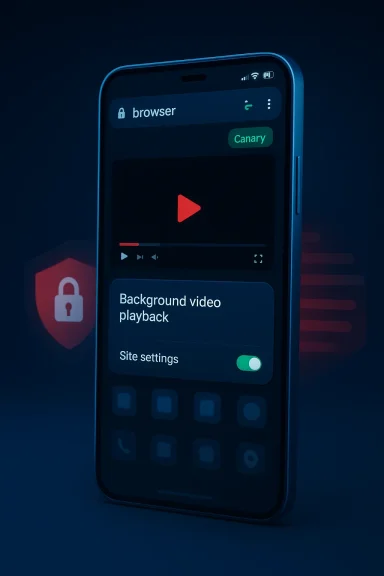
At the center of the story is a deceptively simple feature buried in Edge Canary for Android. Users can enable background video playback through Edge’s site settings, and once activated, media can keep playing when the browser is minimized or when the device moves on to another app. In reported tests, that behavior has extended to YouTube, which is exactly what makes the feature so disruptive to Google’s plan.The practical appeal
For everyday users, this is not a gimmick. It is the difference between pausing a podcast every time you check email and keeping an audio stream alive while you work, commute, or multitask. People who use YouTube for music, lectures, ambient audio, or long-form commentary have a real incentive to keep playback going in the background, and Edge Canary makes that workflow feel native instead of hacked together.The appeal is even stronger because YouTube is already one of the biggest ad-supported services on the planet. Users are often willing to tolerate ads if the experience remains tolerable, but once playback controls, background listening, and consistency become restricted, the value proposition starts to feel more coercive than convenient. A browser that quietly restores the missing behavior becomes more than a browser; it becomes an escape hatch.
The technical caveat
This is still Edge Canary, which means rough edges are part of the package. Experimental builds can break, regress, or expose features unevenly, and users should expect that behavior to change without warning. Microsoft’s own Canary strategy has always been about testing ideas before they are ready for the mainstream, not guaranteeing stable delivery. That is why the workaround is interesting as a signal, but not yet as a product promise.It also matters that the feature appears to rely on browser settings and Chromium-derived plumbing, not on a special relationship with YouTube. That means Google could potentially tighten the rules in the web app, the player, or related detection logic. In other words, the workaround is clever, but it lives on borrowed time unless Google decides not to keep pushing.
Why Google Is Tightening the Screws
Google’s background-play crackdown is not happening in isolation. It fits a wider pattern of reducing the usefulness of ad blockers, curbing workarounds, and encouraging users into paid tiers. The company has already taken multiple steps over the past few years to defend YouTube’s monetization model, and background playback is one of the easiest premium perks to weaponize because its value is obvious the moment it disappears.Monetization pressure
YouTube Premium is not just about ad-free viewing. It is a bundle of ad removal, offline downloads, and background play, and Google has every reason to keep those features tightly linked. By making background playback exclusive, the company turns a convenience into a conversion tool, which is textbook platform economics. The higher the subscription price, the more aggressively Google needs the product to justify itself.That logic is particularly visible right now because the U.S. pricing increase is landing at the same time that users are becoming more aware of alternative ways to preserve the old experience. The result is a classic squeeze: Google raises the cost of convenience, while browsers and third-party tools try to keep convenience accessible. When those two forces collide, users are the battleground.
The anti-workaround mindset
Google has also been more explicit about maintaining “consistency” across platforms. That sounds neutral, but in practice it often means reducing the edge cases where non-paying users can enjoy premium behavior. The company’s confirmation to Android Authority that background playback was being updated to preserve exclusivity left little room for ambiguity. This is not a bug fix in the traditional sense; it is a policy fix.That distinction matters because it changes the interpretation of future failures. If the feature disappears again from Edge or other browsers, users should not assume instability first. They should consider the possibility that Google has simply hardened enforcement. In platform terms, the moment a workaround becomes visible, it becomes a target.
Why Microsoft Benefits
Microsoft does not need to openly antagonize Google to benefit from this development. Edge on Android gains attention whenever it demonstrates a useful difference from Chrome, especially one that is immediately legible to consumers. Background playback is the kind of feature people understand in seconds, not minutes, and that clarity is extremely valuable in a crowded browser market.A differentiator in a Chrome-dominated market
Chrome’s dominance has always been its central challenge and its central shield. For users who already live in Google’s ecosystem, Chrome is the default because it is familiar, synced, and frictionless. But if Edge can offer something Chrome cannot or will not offer, even temporarily, it gives Microsoft a talking point that is easy to market and easy to try.That is especially true on Android, where browser switching is less emotionally charged than on desktop. Many users keep multiple browsers installed for specific jobs, and a browser that can quietly preserve YouTube audio in the background can become the one people reach for when they want just enough escape from the platform rules. It does not have to replace Chrome outright to matter; it only has to become the default for a subset of tasks.
A familiar Microsoft pattern
This would not be the first time Microsoft has benefited from a loophole in a Google service, and it will not be the last. The company has long positioned Edge as the browser that respects user choice while still leaning on Chromium compatibility. When that posture lines up with a user-visible benefit, especially one tied to audio or media, Microsoft gets to look pragmatic rather than ideological.The irony is that Microsoft’s advantage here comes from the same shared Chromium foundation that powers Chrome itself. The browsers compete on presentation, defaults, and policy behavior more than they do on raw engine identity. That is why a small flag or site setting can have an outsized strategic effect. In 2026, the browser is increasingly a policy surface, not just a rendering surface.
The Android-First Story and the iPhone Question
Right now, this is primarily an Android story. The reported workaround is tied to Microsoft Edge Canary for Android, and that makes sense because Android browsers have more room to experiment with settings, flags, and playback behavior than iOS browsers usually do. The Android web stack is also a more open field for browser competition, where small changes can travel faster and do more damage to incumbents.Why Android is the battlefield
Android users are accustomed to browser variety, and Chromium-based browsers can diverge in useful ways while still remaining compatible with the same web. That means one browser can quietly become the favorite for media, another for privacy, and another for enterprise compatibility. Edge Canary’s background-play behavior fits neatly into that ecosystem, especially for people already juggling browser choices.Because the feature comes from Canary, it is also more visible to enthusiasts than ordinary users. That matters because enthusiast discoveries often seed broader adoption. The people who find these workarounds first tend to be the same people who explain them, test them, and normalize them across communities. The real distribution channel is not the browser store; it is word of mouth.
iOS remains the uncertainty
For iPhone users, the story is murkier. Microsoft Edge on iOS is constrained by Apple’s browser rules and WebKit requirements, which usually make browser differentiation narrower than on Android. If the workaround does not appear in Edge Canary for iOS, that would not be surprising, and it would reinforce how platform policy shapes browser behavior as much as browser makers do.That limitation also gives the workaround a split identity. On Android, it is a practical alternative. On iPhone, it may be only a rumor, a hope, or a feature gap that reminds users how little control browsers sometimes have over their own fate. The device you carry still decides what kind of freedom your browser can offer. That’s the uncomfortable truth behind all “browser hacks.”
The Broader Browser Strategy
Microsoft’s mobile browser strategy has been surprisingly consistent over time: win by being useful in places where the default browser feels constrained. That has meant leaning into features like ad blocking, media controls, and experimental playback behavior rather than trying to out-Google Google on search identity or ecosystem lock-in. The Edge Canary background-play discovery fits that playbook perfectly.Chromium is both a blessing and a trap
Because Edge is built on Chromium, Microsoft inherits a huge compatibility advantage. Websites usually behave well, developers do not need to target a special engine, and users get broadly familiar behavior. But Chromium also creates a shared battlefield: if Google changes the rules in YouTube, Microsoft can only maneuver within the limits of the same underlying web stack.That means Microsoft’s best opportunities often come from using Chromium in slightly different ways, not from reinventing the engine itself. A background-play flag, a media indicator, or a smarter tab control may sound small, but those details are where browser loyalty is actually won. Users rarely switch browsers because of benchmarks; they switch because one browser does a concrete thing better.
The UI polish matters too
The timing of the workaround is interesting because Microsoft has also been refining Edge’s media UI. Recent reports noted audio indicators in tab cards and a mute or unmute option in the tab context menu in Canary, even if one of those controls was still misbehaving. That suggests Microsoft is treating media handling as an area of ongoing investment, not a side quest.Those refinements matter because background playback only becomes compelling when users can manage audio cleanly. A browser that can keep YouTube alive in the background but cannot make it easy to identify, mute, or control tabs is only half solved. Microsoft seems to understand that the browser’s media layer is now part of its competitive surface, not just a utility detail.
Enterprise vs Consumer Impact
The consumer story is obvious: people want their audio to keep playing without paying more than they think is reasonable. But for enterprises, the implications are more nuanced. Companies rarely care whether Edge can sneak around a YouTube subscription wall, but they do care that the browser remains capable, manageable, and aligned with their broader Microsoft stack.Consumer value
For consumers, background play is a quality-of-life feature. It helps with podcasts, lectures, live streams, ambient music, and long-form commentary, and it makes mobile browsers feel more like media tools rather than tightly controlled portals. If Edge Canary can preserve that behavior, it gives users a reason to install, test, and keep Microsoft’s browser around.It also reinforces the idea that users do not always want a subscription for every convenience. Some are happy to pay for premium services, but others feel the line between a feature and a toll booth has become too thin. In that environment, even a temporary workaround can look like consumer advocacy. Or at least consumer relief.
Enterprise relevance
For enterprises, the bigger question is whether Edge continues to prove that it can serve as a flexible, policy-aware browser without becoming bloated. Microsoft has worked hard to position Edge as a serious enterprise browser, and Chrome’s dominance in the market means every meaningful differentiator matters. A browser that is both compatible and configurable is easier to deploy than one that is merely familiar.There is also a symbolic value. Microsoft wants Edge to be seen as a browser that helps users work with the web, not only through the web. Features that improve media handling, multitasking, and content control make the browser feel more complete, which in turn makes it easier for IT to justify standardization. Enterprises do not want a browser that wins headlines; they want a browser that earns trust.
Competitive Implications
The competitive impact of this workaround extends beyond Microsoft and Google. It sends a signal to the entire browser market that small features can still move users, even in a world where many people assume browser choice is settled. If enough people talk about Edge because it keeps YouTube audio alive, that creates a form of product awareness Chrome cannot easily neutralize without changing its own rules.What rivals will notice
Brave, Vivaldi, Samsung Internet, and other Chromium-based browsers will all be watching closely. If Edge gains attention for background playback, competitors may either reinforce their own audio features or emphasize privacy and ad-blocking in ways that keep them relevant. A workaround that starts as a Microsoft story can easily become a broader expectation across the mobile browser segment.That said, not every rival will want to frame the issue the same way. Some browsers will be cautious about appearing to facilitate policy circumvention, while others will see user demand as the only metric that matters. The browser market is fragmented enough that there is room for both positions. That fragmentation is part of the opportunity.
Google’s likely response
Google has several options, and none of them are especially user-friendly. It can harden YouTube against browser-based background playback, it can continue nudging users toward Premium, or it can tolerate partial leakage while focusing on larger subscription and ad-revenue goals. Given the company’s recent statements, the first two options seem more likely than the third.But every time Google tightens the screws, it risks nudging more people toward alternative browsers, ad blockers, and unofficial workarounds. That is the paradox of aggressive monetization: it can improve short-term conversion while degrading long-term goodwill. The more YouTube feels like a walled garden, the more some users will spend time looking for the fence door.
Strengths and Opportunities
The most obvious strength of this Edge Canary discovery is that it solves a real problem in a way users immediately understand. It also gives Microsoft a rare consumer-facing win on mobile, where browser identity is usually difficult to sustain. More broadly, it reinforces Edge’s reputation as a browser willing to experiment with useful behavior instead of merely echoing Chrome.- Immediate utility for YouTube listeners who want background audio without Premium.
- Clear browser differentiation in a crowded Chromium market.
- Positive word-of-mouth potential among Android users and power users.
- Stronger media-handling identity for Edge Canary and future Edge releases.
- A practical reason to switch for users dissatisfied with YouTube’s tightening rules.
- Momentum for Microsoft’s mobile browser strategy beyond basic compatibility.
- A reminder that small features matter when they map directly to everyday use.
Risks and Concerns
The biggest concern is obvious: this may not last. Because the feature sits in Canary, and because Google has already shown it is willing to block background play for non-Premium users, the workaround could disappear as quickly as it appeared. There is also the usual Canary problem of instability, which means a feature that looks polished one week can break the next.- High risk of Google countermeasures targeting browser-based playback.
- Canary instability could make the experience unreliable.
- Feature rollout uncertainty may confuse users looking for stable behavior.
- Platform asymmetry means Android may benefit while iOS does not.
- Policy and terms-of-service tension could make the workaround short-lived.
- User expectations may outgrow reality if Microsoft does not carry it to stable.
- Overreliance on loopholes can distract from genuinely durable browser improvements.
Looking Ahead
The key question now is not whether the workaround exists, but whether Microsoft turns it into something durable. If background playback graduates from Canary into Dev, Beta, and eventually Stable, Edge could claim a meaningful niche in mobile browsing. If it disappears under pressure, it will still have served as proof that user demand for basic media freedom remains strong.The other question is how Google responds. If YouTube continues tightening non-Premium access, then browser makers will keep testing the edges of what the platform allows. If Google tolerates partial leakage, then Edge’s advantage could linger just long enough to influence user habits. In either case, the real story is that browsers are becoming one of the last meaningful places where users can resist platform monetization choices.
- Watch for whether the background video playback toggle reaches Edge Stable on Android.
- Watch for whether Google hardens YouTube against browser-based workarounds.
- Watch for whether Edge Canary behavior changes in future builds.
- Watch for similar features appearing in other Chromium browsers.
- Watch for whether YouTube Premium’s price rise changes user behavior further.
Source: Windows Central Microsoft Edge is the surprising answer to Google burying YouTube mobile background play behind a paywall
