

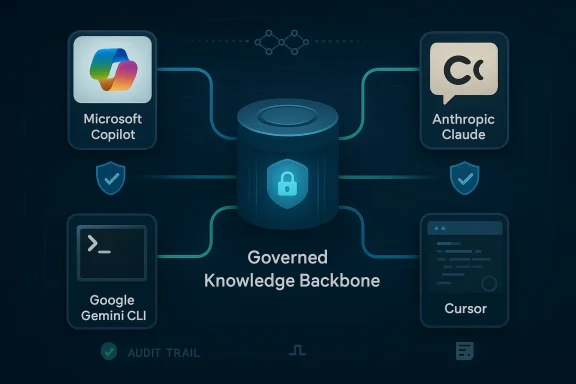
eGain’s new enterprise AI platform connectors are a sign that enterprise AI is moving past the novelty phase and into the harder work of governance, consistency, and operational trust. The company is pairing its AI Knowledge Hub with Microsoft Copilot, Anthropic Claude, Google Gemini CLI, and Cursor, framing the release as a way to give AI systems a single governed source of truth instead of forcing employees and developers to improvise across scattered repositories. That pitch matters because AI success in the enterprise is increasingly judged not by flashy demos, but by whether answers are repeatable, auditable, and safe enough to act on. The announcement also lands at exactly the right moment in the market: Model Context Protocol (MCP) has become one of the clearest interoperability trends in enterprise AI, and both Anthropic and Microsoft have publicly documented support for MCP-style connections in their ecosystems. eGain’s move therefore is not just about compatibility; it is about inserting itself into the emerging control plane for AI knowledge, where the real competition is over who owns the governed layer beneath the model.
For years, eGain has positioned itself as a knowledge management company first and an AI company second, and that framing turns out to be an asset in the current market. The company’s 2025 product direction centered on eGain Composer, a modular platform built on the company’s AI Knowledge Hub, with explicit emphasis on trusted knowledge, compliance, and composable integration. That earlier launch described the problem clearly: enterprise AI systems are often fragmented, disconnected, and inflexible, which makes them difficult to trust at scale. The new connectors are best understood as the next step in that roadmap. If Composer was about giving developers a stronger internal foundation, the connectors are about extending that foundation into the tools people already use every day.
This is also happening against a backdrop of rising concern about AI accuracy and governance. Microsoft’s own documentation says Copilot grounding depends on the user’s permissions and the sources available to the system, and it warns that outdated or incomplete source material can lead to outdated answers. Anthropic, meanwhile, has been telling enterprise buyers that Claude can use uploaded documents and connected data sources as context, while also stressing that enterprise customers can keep data private and use company knowledge to scale expertise across teams. Those are helpful capabilities, but they also expose the same enterprise pain point: context is everything, and context is usually scattered.
The industry’s current obsession with agentic AI makes that pain point even more serious. In a simple chatbot world, a stale answer is annoying. In an agentic workflow, a stale answer can be operationally dangerous because it can shape an action, not just a response. That is why eGain keeps returning to language like certified answers, source citations, and auditable trails. The company is trying to persuade buyers that a governed knowledge layer is no longer an optional add-on. It is the part that makes AI usable in serious business settings.
eGain’s timing is also strategically smart because enterprises are increasingly mixing AI vendors instead of betting everything on one stack. Microsoft Copilot dominates productivity and identity conversations. Claude has become a favored choice in knowledge work and long-context tasks. Gemini is increasingly present in Google-centric environments. Cursor has emerged as a powerful AI-native development environment. eGain is clearly trying to meet buyers where they already are, rather than forcing a platform rip-and-replace.
The release also emphasizes that these connectors are part of a broader AI Knowledge Connector family. eGain says the family spans content connectors, data connectors, experience connectors, and process connectors, which together are meant to unify knowledge across applications, repositories, workflows, and AI surfaces. That architecture is important because it shows that eGain is not thinking in terms of one-off integrations. It is thinking in terms of a layered system where content is ingested, governed, delivered, and audited.
eGain’s language around certified answers with source citations is also strategically important. Retrieval is not the same as assurance. A document search can show possible information; a certified answer can tell the user which information the organization has approved as authoritative. That distinction is likely to resonate with compliance teams, legal teams, and operations leaders who are wary of AI systems that appear confident but cannot explain themselves.
That matters because custom connectors are expensive and brittle. Every one-off integration adds maintenance burden, increases the chance of breakage, and creates a governance headache. MCP reduces some of that friction by giving vendors a common language for connecting AI clients to enterprise systems. In practical enterprise IT terms, that means the organization can think more about knowledge quality and less about stitching together one fragile bridge after another.
The company’s message is essentially: let the assistants vary, but keep the knowledge source fixed and governed. That is a smart positioning move because it allows eGain to sell into mixed environments without forcing customers to choose a single AI religion. Microsoft shops, Google-centric teams, Claude adopters, and developer-first organizations can all be served by the same core knowledge layer.
That is why eGain’s emphasis on a governed knowledge foundation is more than marketing language. It is the answer to a real enterprise limitation: the biggest bottleneck in AI adoption is often not model access, but knowledge discipline.
That is a huge distinction. Employees already expect to ask Copilot questions about work. If eGain can improve the trustworthiness of those answers without changing the desktop, the browser, or the identity stack, then adoption friction drops sharply. For CIOs, that means the pitch is easier to justify because it layers onto existing Microsoft investments instead of requiring a parallel platform.
That is why eGain’s language around certified knowledge and traceability matters. The company is not selling Copilot as a new assistant. It is selling the idea that Copilot can be made safer and more useful by attaching it to a stronger content layer.
This is where a knowledge platform either becomes essential or becomes invisible. If eGain can be the layer that keeps Copilot answers defensible, it earns a place in the operating model. If not, the enterprise may still use Copilot, but it will treat knowledge governance as an afterthought.
Anthropic has positioned Claude as a work companion that can use company knowledge and connected data sources, while also emphasizing enterprise security and privacy controls. Google’s Gemini ecosystem has likewise become more relevant to developer workflows, especially where CLI and tool-based interaction matter. By supporting both, eGain is signaling that it wants to serve a mixed AI estate rather than a single-vendor shop.
This is the subtle but important strategic bet behind eGain’s release. It is not trying to make developers use a separate portal. It is trying to bring sanctioned knowledge into the workflow they already prefer.
This is especially important in environments where Microsoft, Google, and developer-first tools coexist. EGain is trying to be the common layer that makes that coexistence manageable.
eGain has been making this argument for a while. Its platform messaging around Trusted Knowledge and AI CX automation has consistently stressed that AI needs a reliable content layer to deliver usable answers. The new connectors push that thesis outward: not just into customer service, but into employee productivity and software development workflows too.
That is why the announcement matters beyond eGain’s immediate product line. It reflects a broader market shift toward AI-ready content. Enterprises are learning that simply storing documents is not the same as making them useful for AI. The content must be current, approved, searchable, permissioned, and structured enough to be trusted.
A generic model can generate plausible responses. A governed knowledge platform can give the organization a response it is willing to stand behind. That matters in regulated industries, in customer-facing workflows, and in internal processes where policy drift can create real cost.
The strength of that ambition is that it fits the market’s direction. The weakness is that it raises expectations. Platforms must prove durability, not just compatibility.
That is where eGain is trying to compete. It is not trying to win the model war. It is trying to win the knowledge layer war underneath the models.
The more valuable the governed source of truth becomes, the less the buyer may care which brand is doing the summarizing. That is an uncomfortable possibility for vendors whose business strategies rely on assistant loyalty rather than data discipline.
A few competitive advantages stand out:
There are also broader industry signals to watch. MCP adoption will matter because interoperability only helps if it becomes durable. Microsoft Copilot’s evolving grounding and connector story will matter because it determines how much room third-party knowledge layers have. The same is true for Claude and Google’s AI tooling ecosystems, which are likely to keep expanding their enterprise and developer footprints.
eGain’s announcement is therefore more than a product update. It is a statement about where enterprise AI is headed: toward systems that are not just intelligent, but governed, traceable, and operationally reliable. If that direction holds, the winners will not be the loudest AI brands. They will be the ones that make AI safe enough to trust, and practical enough to use every day.
Source: Bitget eGain Announces Enterprise AI Platform Connectors for Copilot, Claude, Gemini, and Cursor | Bitget News
 Background
For years, eGain has positioned itself as a knowledge management company first and an AI company second, and that framing turns out to be an asset in the current market. The company’s 2025 product direction centered on eGain Composer, a modular platform built on the company’s AI Knowledge Hub, with explicit emphasis on trusted knowledge, compliance, and composable integration. That earlier launch described the problem clearly: enterprise AI systems are often fragmented, disconnected, and inflexible, which makes them difficult to trust at scale. The new connectors are best understood as the next step in that roadmap. If Composer was about giving developers a stronger internal foundation, the connectors are about extending that foundation into the tools people already use every day.This is also happening against a backdrop of rising concern about AI accuracy and governance. Microsoft’s own documentation says Copilot grounding depends on the user’s permissions and the sources available to the system, and it warns that outdated or incomplete source material can lead to outdated answers. Anthropic, meanwhile, has been telling enterprise buyers that Claude can use uploaded documents and connected data sources as context, while also stressing that enterprise customers can keep data private and use company knowledge to scale expertise across teams. Those are helpful capabilities, but they also expose the same enterprise pain point: context is everything, and context is usually scattered.
The industry’s current obsession with agentic AI makes that pain point even more serious. In a simple chatbot world, a stale answer is annoying. In an agentic workflow, a stale answer can be operationally dangerous because it can shape an action, not just a response. That is why eGain keeps returning to language like certified answers, source citations, and auditable trails. The company is trying to persuade buyers that a governed knowledge layer is no longer an optional add-on. It is the part that makes AI usable in serious business settings.
eGain’s timing is also strategically smart because enterprises are increasingly mixing AI vendors instead of betting everything on one stack. Microsoft Copilot dominates productivity and identity conversations. Claude has become a favored choice in knowledge work and long-context tasks. Gemini is increasingly present in Google-centric environments. Cursor has emerged as a powerful AI-native development environment. eGain is clearly trying to meet buyers where they already are, rather than forcing a platform rip-and-replace.
Why this announcement matters now
The key idea is not that eGain has created a new assistant. It is that eGain wants to become the governed content backbone behind multiple assistants. That is an important shift in enterprise software economics. If the model is the brain, the knowledge hub is increasingly the memory.- It reduces dependence on any single assistant brand.
- It supports mixed-vendor enterprise environments.
- It creates a stronger governance story for regulated workflows.
- It helps tie AI output to approved source material.
- It makes AI more usable inside existing business processes.
Overview
At the center of the release is a family of AI platform connectors that link eGain AI Knowledge Hub to Microsoft Copilot, Claude, Gemini CLI, and Cursor. The company’s stated goal is to provide unified, governed, and traceable answers wherever employees or developers are working. That is a meaningful shift from isolated knowledge portals toward a knowledge experience that travels with the user across multiple tools. It also reflects a simple reality of enterprise life: workers do not want to leave the tool they are in just to verify policy, check a procedure, or retrieve an approved answer.The release also emphasizes that these connectors are part of a broader AI Knowledge Connector family. eGain says the family spans content connectors, data connectors, experience connectors, and process connectors, which together are meant to unify knowledge across applications, repositories, workflows, and AI surfaces. That architecture is important because it shows that eGain is not thinking in terms of one-off integrations. It is thinking in terms of a layered system where content is ingested, governed, delivered, and audited.
The connector categories
Each connector class answers a different enterprise problem. Content connectors deal with fragmented repositories; data connectors help expose live enterprise data; experience connectors push trusted answers into the applications where work happens; and process connectors enforce identity, policy, and approval rules. That is not just product taxonomy. It is an argument that enterprise AI cannot be trusted if knowledge, access control, and workflow rules are treated as separate concerns.- Content Connectors gather content from policy stores, CRM knowledge, SharePoint, Confluence, and conversation archives.
- Data Connectors bring in real-time enterprise data without forcing duplicate pipelines.
- Experience Connectors place trusted answers into Salesforce, SAP, Zendesk, Amazon Connect, Genesys, Talkdesk, and developer environments like Cursor.
- Process Connectors align AI actions with identity, access, and business policy requirements.
eGain’s language around certified answers with source citations is also strategically important. Retrieval is not the same as assurance. A document search can show possible information; a certified answer can tell the user which information the organization has approved as authoritative. That distinction is likely to resonate with compliance teams, legal teams, and operations leaders who are wary of AI systems that appear confident but cannot explain themselves.
Certified knowledge versus generic retrieval
The release leans hard on trust because trust is where the market is moving. Enterprises do not need more improvisation from AI systems; they need fewer surprises. eGain’s pitch is that the value of AI rises sharply when the answer is traceable and the source is governed.- Generic retrieval can surface content.
- Governed knowledge can standardize the approved answer.
- Source citations make audits easier.
- Policy controls reduce accidental disclosure.
- Consistent content reduces support and training overhead.
Why MCP Matters
The most important technical detail in this announcement is MCP. Model Context Protocol has rapidly become the shorthand for connecting AI systems to enterprise tools and data sources, and eGain is clearly betting that the standard will matter as much as any model brand. Anthropic describes Claude’s enterprise capabilities as including connections to company knowledge and data sources, while Microsoft has published documentation showing Copilot and Copilot Studio can use connectors, grounding sources, and MCP-style integrations. eGain’s support for MCP puts it squarely in that interoperability story.That matters because custom connectors are expensive and brittle. Every one-off integration adds maintenance burden, increases the chance of breakage, and creates a governance headache. MCP reduces some of that friction by giving vendors a common language for connecting AI clients to enterprise systems. In practical enterprise IT terms, that means the organization can think more about knowledge quality and less about stitching together one fragile bridge after another.
A standard becomes a battleground
When a standard starts spreading, the competitive fight shifts upward. If MCP becomes the default pipe, then vendors compete on what flows through it: quality, provenance, governance, and policy control. That is exactly the opening eGain seems to be targeting.The company’s message is essentially: let the assistants vary, but keep the knowledge source fixed and governed. That is a smart positioning move because it allows eGain to sell into mixed environments without forcing customers to choose a single AI religion. Microsoft shops, Google-centric teams, Claude adopters, and developer-first organizations can all be served by the same core knowledge layer.
- MCP can reduce integration overhead.
- It can make enterprise AI deployments more portable.
- It can lower dependence on custom point-to-point adapters.
- It can improve procurement confidence.
- It can make governance easier to standardize.
Standards do not solve content problems
This is where the distinction between infrastructure and intelligence matters. A protocol can connect systems, but it cannot fix a broken knowledge base. If the answer is stale, the AI will still be wrong. If permissions are messy, the AI will still be risky. If source material conflicts, the AI will still inherit the conflict.That is why eGain’s emphasis on a governed knowledge foundation is more than marketing language. It is the answer to a real enterprise limitation: the biggest bottleneck in AI adoption is often not model access, but knowledge discipline.
- MCP helps with connection.
- Governance helps with trust.
- Certification helps with accountability.
- Citations help with verification.
- Policy enforcement helps with compliance.
Microsoft Copilot and the Enterprise Desktop
Microsoft Copilot is the most strategically important surface in the launch because it sits inside the productivity and identity stack that so many enterprises already use. Microsoft’s documentation shows that Copilot can ground responses in accessible work content and that administrators can manage sources, access, and related behavior. That makes Copilot a natural distribution point for governed enterprise content. eGain is not trying to create a new daily habit from scratch. It is trying to make an existing habit more trustworthy.That is a huge distinction. Employees already expect to ask Copilot questions about work. If eGain can improve the trustworthiness of those answers without changing the desktop, the browser, or the identity stack, then adoption friction drops sharply. For CIOs, that means the pitch is easier to justify because it layers onto existing Microsoft investments instead of requiring a parallel platform.
Why Copilot is the anchor
Copilot has the gravity of the Microsoft desktop behind it. Once employees rely on it for policy guidance, workflow support, and internal Q&A, tolerance for bad answers drops dramatically. A wrong answer in a casual chatbot is annoying. A wrong answer in a mainstream productivity assistant can become a governance event.That is why eGain’s language around certified knowledge and traceability matters. The company is not selling Copilot as a new assistant. It is selling the idea that Copilot can be made safer and more useful by attaching it to a stronger content layer.
- Copilot can become a higher-trust interface.
- Enterprises can preserve existing Microsoft workflows.
- Governance teams can get better visibility into source material.
- Employees can stay in the flow of work.
- Support teams can reduce repetitive internal questions.
Desktop gravity creates enterprise expectations
The more central Copilot becomes, the less room there is for sloppy content. That is good news for vendors like eGain, but it also raises the bar. Enterprises will expect content freshness, clear ownership, and policy alignment. They will want to know who updates the answer, how often it is reviewed, and how exceptions are handled.This is where a knowledge platform either becomes essential or becomes invisible. If eGain can be the layer that keeps Copilot answers defensible, it earns a place in the operating model. If not, the enterprise may still use Copilot, but it will treat knowledge governance as an afterthought.
The practical buyer question
Copilot buyers are unlikely to care about abstract AI branding. They will care about whether the connector helps with:- support ticket reduction
- policy consistency
- employee self-service
- data protection
- faster onboarding
Claude, Gemini, and the Multi-Model Enterprise
The inclusion of Claude and Gemini CLI tells you that eGain is not only targeting business users. It is also targeting the builders and technical operators who increasingly work inside AI-native environments. That is significant because enterprise AI adoption is often led by developers, IT teams, and operations teams before it reaches the broader workforce. The tools those groups choose shape the architecture of the enterprise.Anthropic has positioned Claude as a work companion that can use company knowledge and connected data sources, while also emphasizing enterprise security and privacy controls. Google’s Gemini ecosystem has likewise become more relevant to developer workflows, especially where CLI and tool-based interaction matter. By supporting both, eGain is signaling that it wants to serve a mixed AI estate rather than a single-vendor shop.
Why developer surfaces matter
Developer tools are where AI becomes sticky. If a technical team starts trusting a governed knowledge source inside an IDE or terminal, that source can become part of the company’s day-to-day muscle memory. That matters because developer workflows frequently spill into operations, support, and implementation guidance.- Developers need fast answers inside their tools.
- They also need answers they can trust under pressure.
- Internal runbooks and standards must stay current.
- Policy guidance matters during incident response.
- Tribal knowledge should not live in one person’s head.
Governance is not the enemy of speed
There is a common assumption that governance slows developers down. In reality, bad knowledge slows them down much more. A trusted answer inside Cursor or Gemini CLI can save time precisely because it reduces second-guessing, rework, and accidental policy violations.This is the subtle but important strategic bet behind eGain’s release. It is not trying to make developers use a separate portal. It is trying to bring sanctioned knowledge into the workflow they already prefer.
- Faster access to internal guidance.
- Less context switching.
- Better alignment with engineering policy.
- Cleaner provenance for decisions.
- Stronger operational consistency.
Claude and Gemini are strategic, not decorative
The fact that eGain named Claude and Gemini in the same announcement as Copilot underscores a broader reality: enterprises are no longer choosing a single AI surface. They are mixing them. That makes a neutral governed layer more attractive than an assistant-specific content silo.This is especially important in environments where Microsoft, Google, and developer-first tools coexist. EGain is trying to be the common layer that makes that coexistence manageable.
Enterprise Knowledge Management as AI Infrastructure
This release is really a vote for knowledge management as AI infrastructure. That may sound old-fashioned in a market obsessed with foundation models, but it is increasingly hard to dismiss. A stronger model cannot compensate for fragmented, outdated, or contradictory enterprise knowledge. The better the AI gets, the more damaging bad content becomes, because the outputs look more polished while still being wrong.eGain has been making this argument for a while. Its platform messaging around Trusted Knowledge and AI CX automation has consistently stressed that AI needs a reliable content layer to deliver usable answers. The new connectors push that thesis outward: not just into customer service, but into employee productivity and software development workflows too.
Knowledge quality is operational quality
In customer service, knowledge quality affects handle time, customer satisfaction, and escalations. In internal workflows, it affects onboarding, incident response, and employee productivity. In development environments, it affects coding standards, implementation consistency, and release discipline. In each case, the knowledge layer is not passive storage. It is an operational system with measurable consequences.That is why the announcement matters beyond eGain’s immediate product line. It reflects a broader market shift toward AI-ready content. Enterprises are learning that simply storing documents is not the same as making them useful for AI. The content must be current, approved, searchable, permissioned, and structured enough to be trusted.
- Good content lowers friction.
- Bad content amplifies AI mistakes.
- Governance makes knowledge defensible.
- Provenance improves accountability.
- Consistency improves adoption.
The role of certified answers
The phrase certified answers should not be treated as a small feature. It is one of the most important signals in the release because it addresses a core enterprise anxiety: who owns the truth?A generic model can generate plausible responses. A governed knowledge platform can give the organization a response it is willing to stand behind. That matters in regulated industries, in customer-facing workflows, and in internal processes where policy drift can create real cost.
Why this is a platform move
eGain is trying to position itself as more than a knowledge repository. It wants to be the governed knowledge layer that can feed assistants, agents, and IDEs. That is a platform ambition, not just a connector business.The strength of that ambition is that it fits the market’s direction. The weakness is that it raises expectations. Platforms must prove durability, not just compatibility.
Competitive Implications
The release also says something larger about the enterprise AI market. Competition is shifting from model capability alone to context quality, governance, and distribution inside the workflow. That creates pressure on all the major AI vendors because it changes what buyers care about. They no longer just ask, “Which model is best?” They ask, “Which platform gives us trustworthy answers inside the tools we already use?”That is where eGain is trying to compete. It is not trying to win the model war. It is trying to win the knowledge layer war underneath the models.
Why mixed environments favor connector players
Large enterprises rarely run a perfectly uniform stack. Microsoft for productivity, Google for some cloud and collaboration, Claude for certain reasoning-heavy use cases, and Cursor for development is a realistic mix. In that world, a connector-based knowledge layer has obvious appeal because it avoids vendor lock-in while improving governance.- It works across different AI assistants.
- It reduces duplicated knowledge logic.
- It helps unify policy across workflows.
- It offers a cleaner governance story.
- It gives buyers more flexibility in procurement.
The risk to incumbent assistant vendors
This kind of move also creates a subtle competitive threat to AI assistant vendors. If enterprises begin to think of the assistant as the interface and the governed knowledge layer as the real asset, then the assistant becomes more interchangeable. That could weaken vendor lock-in over time.The more valuable the governed source of truth becomes, the less the buyer may care which brand is doing the summarizing. That is an uncomfortable possibility for vendors whose business strategies rely on assistant loyalty rather than data discipline.
eGain’s opportunity is governance
What eGain appears to understand is that the market is becoming less tolerant of “trust me” AI. Buyers want evidence. They want provenance. They want to know that answers came from approved content. That is where the company can differentiate.A few competitive advantages stand out:
- Governance-first positioning
- MCP-aligned interoperability
- Certified answer workflows
- Cross-platform knowledge delivery
- Enterprise compliance framing
Strengths and Opportunities
The strongest aspect of this announcement is that it speaks directly to the biggest enterprise pain points: fragmented knowledge, inconsistent AI behavior, and weak governance. eGain is not claiming that better prompts solve the enterprise problem. It is claiming that better knowledge architecture does, and that is a much more credible story for serious buyers.- Cross-platform reach across Microsoft, Anthropic, Google, and developer tools.
- MCP alignment that reduces integration friction.
- Certified answers that improve traceability and trust.
- Governed knowledge that can support compliance-heavy workflows.
- Enterprise flexibility for mixed-vendor environments.
- Workflow embedding that keeps users inside their existing tools.
- Developer relevance that extends the use case beyond customer service.
Why the timing helps
The market is more receptive to governance-led AI stories now than it was a year ago. Pilot fatigue is real. Many enterprises have learned the hard way that generic AI enthusiasm does not automatically produce durable ROI. eGain’s message lands well in that climate because it offers a practical answer to a practical problem.Risks and Concerns
The biggest risk is that the market may still view knowledge governance as necessary but not sufficient. Enterprises want trustworthy AI, but they also want simplicity, fast deployment, and visible productivity gains. If eGain’s story feels too infrastructure-heavy, it could struggle against vendors that package AI value more aggressively in user-facing terms.- Execution risk if integrations are uneven across platforms.
- Content quality risk if the underlying knowledge is stale or incomplete.
- Adoption risk if governance slows rollout or feels too rigid.
- Competitive risk from larger platform vendors with native distribution.
- Perception risk if buyers see connectors as plumbing rather than value.
- Dependency risk on MCP momentum continuing to expand.
- Compliance risk if certification claims are not operationally rigorous.
The hidden challenge
The hardest part of this strategy is that it depends on knowledge discipline inside the customer’s organization. eGain can provide the architecture, but the enterprise still has to maintain content hygiene. If buyers are not ready to invest in that discipline, the platform’s value will be harder to realize.Looking Ahead
The most important question now is whether enterprises will treat governed knowledge as a core AI requirement or as a nice-to-have layer added later. If the former wins, eGain is in a strong strategic position. If the latter wins, the company may still find success, but the path will be slower and more fragmented.There are also broader industry signals to watch. MCP adoption will matter because interoperability only helps if it becomes durable. Microsoft Copilot’s evolving grounding and connector story will matter because it determines how much room third-party knowledge layers have. The same is true for Claude and Google’s AI tooling ecosystems, which are likely to keep expanding their enterprise and developer footprints.
What to watch next
- Whether enterprises adopt eGain’s connectors as part of broader AI governance programs.
- How quickly MCP becomes a standard requirement in procurement.
- Whether Copilot buyers prioritize governed knowledge over generic assistant features.
- How well eGain proves certified-answer quality in regulated environments.
- Whether developer teams in Cursor and similar tools embrace governed knowledge sources.
- Whether other vendors copy the connector-and-governance pattern.
- Whether eGain can show measurable ROI beyond improved answer quality.
eGain’s announcement is therefore more than a product update. It is a statement about where enterprise AI is headed: toward systems that are not just intelligent, but governed, traceable, and operationally reliable. If that direction holds, the winners will not be the loudest AI brands. They will be the ones that make AI safe enough to trust, and practical enough to use every day.
Source: Bitget eGain Announces Enterprise AI Platform Connectors for Copilot, Claude, Gemini, and Cursor | Bitget News
