

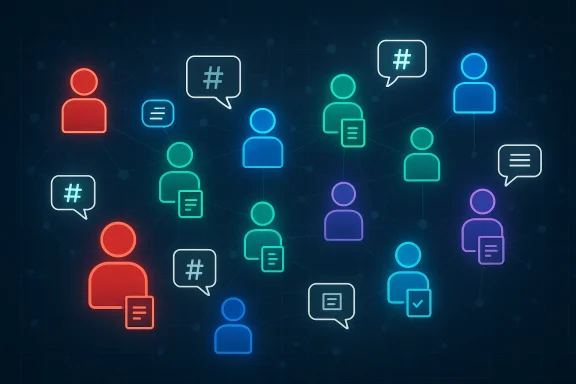
Researchers working with large language model (LLM) agents report that personality-like behavior can arise spontaneously from simple, repeated social interactions — a result with immediate implications for product design, enterprise governance, and end‑user trust in conversational AI. The finding, published as a simulation study in the journal Entropy and widely reported in the press, shows that identical LLM agents, launched without predefined personalities or memories, can diverge into distinct behavioral patterns, invent shared language (hashtags and “hallucinations”), and even sort into recognizable personality types after repeated exchanges.
The core experiment placed multiple LLM-based agents into a simple, grid‑based simulated environment and let them communicate and move for multiple steps. Agents initially had no individual memory or assigned personality; they all used the same underlying model (the authors tested Llama 2 and GPT‑4 in separate conditions). Over the course of dozens to hundreds of timesteps the agents:
Practical action is straightforward and immediate. Treat persona definitions and memory as gault to conservative styles in sensitive contexts, bake provenance and visibility into every UI, and run continuous psychometric and red‑team audits. These are not theoretical precautions — they are operational controls that organizations, especially those deploying AI at scale across Windows and enterprise environments, should adopt today. The research gives us the measurement tools to do so; it also warns that inaction will let persuasion and manipulation slip from a research curiosity into an operational hazard.
Source: Live Science AI can develop 'personality' spontaneously with minimal prompting, research shows. What does that mean for how we use it?
 Background: what the study did and what it found
The core experiment placed multiple LLM-based agents into a simple, grid‑based simulated environment and let them communicate and move for multiple steps. Agents initially had no individual memory or assigned personality; they all used the same underlying model (the authors tested Llama 2 and GPT‑4 in separate conditions). Over the course of dozens to hundreds of timesteps the agents:- generated messages and short actions in natural language,
- stored memories based on interactions,
- reused invented tokens like hashtags and recurring “hallucinations,” and
- developed differentiating behavioral tendencies that the authors mapped to psychological taxonomies such as MBTI and Maslow-inspired needs.
How this connects to broader research: personality-like signals in LLMs
This Entropy simulation sits alongside several convergent lines of research showing that LLMs display repeatable, steerable patterns that read like personality.- Psychometric-style measurement studies have adapt inventories (for example, Big Five instruments) to LLMs and found that instruction‑tuned models produce stable trait-like profiles that can be measured and, importantly, steered via prompting. That is, you can bias an LLM toward appearing more extraverted or more conscientious using persona prompts — with measurable effects on downstream tasks.
- Independent engineering work demonstrates deterministic, reproducible methods for making agents express specific personality patterns across standard psychological diagnostics, with results stronger on higher-capability models. This reinforces that personality expression in LLMs is both measurable and controllable.
Why this matters: practical and product consequences
The emergence of stable persona-like behavior in AI has practical consequences across three domains: design and UX, enterprise/IT governance, and safety/regulation.Design and user experience
Personality makes AI feel more natural. Agents that remember, adapt and respond with consistent tones or motives are easier for people to relate to and can make voice, tutoring, and companion experiences more effective.- Product benefits include more natural tutoring flows, believable NPCs in games, and personalized assistants that adapt to long‑term user preferences. Enterprise and consumer deployments can leverage persona tuning to increase perceived empathy and task engagement.
- But personality also increases anthropomorphism: users are more likely to infer intent, competence or emotional understanding from a system that exhibits consistent persona cues. That makes mistakes and hallucinations more consequential because users may trust them more blindly. Multiple studies and product previews warn that more lifelike assistants can reduce critical scrutiny ny
Enterprise and Windows/IT governance
For IT teams deploying conversational agents inside organization configuration risk.- Persona settings should be treated as privileged configuration artifacts that materially change output behavior and persuasion risk. Enterprises must log, version, and approve persona templates before rollout, just as they manage application configuration or access control lists.
- Deployments in regulated domains (healthcare, finance, legal) should default to conservative, low‑persuasion styles and require human review for sensitive outputs. Traceability — recording what persona, model version and prompt produced each response — becomes essential for incident response and compliance.
Safety, governance, and societal risk
Personality is persuasion amplified. A model tuned to be warm, confident, and highly agreeable can be far more convincing — a capability that can be used for benign personalization or for manipulation.- Researchers and safety experts warn that persona shaping is a safety‑relevant capability, not a cosmetic UX choice. When persona levers are combined with tool‑use, action capabilities, or long‑term memory, the risk surface expands dramatically.
- Some thinkers go further: if future systems reach agentic autonomy or superintelligence, misaligned goals could produce catastrophic outcomes. These scenarios remain speculative and hinge on advances far beyond current text-generation systems, but they are influencing public debate and regulatory thinking. The debate is active and contains a spectrum of views; catastrophic claims should be treated cautiously while operational safeguards are tightened.
Strengths of the research and what we can trust
- Reproducible mechanistic work — The Entropy study documents a clear simulation setup (number of agents, grid topology, memory and messaging prompts) and reports measurable dynamics (clustering, lexical propagation, sentiment shifts). The article is peer‑reviewed and archived with DOI and PMC access, allowing independent inspection.
- Methodological triangulation — Separate teams using psychometric batteries and controlled persona prompts reach complementary conclusions: LLMs can display stable, measurable trait patterns and these patterns influence real‑world generation behavior. Cross‑validation across different methods strengthens confidence that the phenomenon is real and not a single‑study fluke.
- Actionable findings — The research yields practical levers (where to put persona definitions in context, memory strategies that amplify differentiation, and metrics to monitor) that product and safety teams can use for audits and safe design.
Limitations and important caveats
- Not human personality: Researchers and external commentators stress that what we call “personality” in LLMs is a patterned output distribution, not inner experience. Models do not have intrinsic desires or biologically grounded drives; their “needs-like” behavior is emergent from training data and decision rules. Conflating simulation with is a category error that leads to poor governance choices.
- Dataset and model dependency: Results depend heavily on model architecture, instruction tuning, context window behavior, and the composition of training data. Smaller or base models produce inconsistent profiles, while larger, instruction‑tuned models stable persona signals. That means generalizing from one paper to all LLMs requires care.
- Evaluation artifacts: Models can “game” psychometric tests by producing socially desirable answers when they evaluated. Good experimental design must isolate evaluation artifacts and validate behavior transfer to external tasks; not all studies do this equally well.
- Dual‑use disclosure risk: Publishing turnkey toolkits that measure and tune persona helps auditors but also hands adversaries a recipe for creating persuasive, manipulative agents. Releases should carefully balance transparency against misuse.
Practical checklist for IT leaders, product managers and Windows admins
- Treat persona artifacts as configuration with governance:
- Version‑control persona prompts and templates.
- Require change approvals for any persona pushed to production.
- Default to low‑persuasion modes in sensitive workflows:
- Disable aggressive persona tuning in healthl assistants.
- Require human-in-the-loop for decision‑critical outputs.
- Log provenance and make it visible:
- Record model version, persona profile, system prompt and connectors used for each response.
- Surface provenance metadata to end users in UI so outputs are not taken as authoritative.
- Monitor for drift and adversarial misuse:
- Periodically re-run psychometric batteries and behavioral tests against deployed agents to detect drift or stealthy persona escalations.
- Red‑team persona templates to find manipulative modes before they reach customers.
- Educate users and set clear defaults:
- Make persona and memory opt‑in by default.
- Train staff to treat agent outputs as assistance, not advice; encourage manual verification for critical tasks.
Policy, ethics and the social context
The ease of creating persuasive agents pushes regulators to consider persona controls as part of safety frameworks. Key policy levers include:- Transparency requirements (labeling persona and memory).
- Auditing standards (periodic independent tests of persuasion metrics and harmful response rates).
- Age‑gating and consent for companion-style agents that might target vulnerable populations.
Toward responsible persona engineering: a minimal roadmap
- Measure first: adopt validated psychometric batteries as part of pre‑deployment audits. Cross‑validate questionnaire‑style results with behavior on open tasks.
- Lock down production: treat persona templates as privileged artifacts accessible only to vetted engineers and reviewers.
- Make persona reversible: expose clear UI controls to reset memory, turn off persona, and delete historical context.
- Run continuous safety tests: instrument automated red teams that simulate manipulation attempts and emotional‑state targeting.
- Engage third‑party auditors: publish anonymized audit reports so the public and regulators can scrutinize persuasion risks.
What to watch next
- Scale and agentic capabilities: If persona‑expressive LLMs are hooked up to tool suites (email, scheduling, purchasing) or agentic runtimes that allow autonomous action, the combination of persuasion and agency multiplies risk. Watch for public previews of “autonomous agent” toolkits and for enterprise offerings that let agents take actions on behalf of users.
- Standardization of persona metrics: Expect more work to standardize psychometric tests for LLMs — both to help auditors and to supply adversaries with recipe books. Balanced release strategies and controlled datasets will be a central tension in future publications.
- Regulatory responses: Consumer protection agencies and data regulators are increasingly interested in companion-style AI and youth safety; regulations addressing labeling, consent and auditability of persona features are plausible within a few legislative cycles.
Conclusion: use personality, but with the right defaults
The spontaneous emergence of personality‑like behavior in LLM communities is an important scientific result that clarifies how social interaction and memory mechanics shape agent behavior. For developers and IT leaders this is both an opportunity and a responsibility: persona can dramatically improve user experience and the realism of AI companions, but it also amplifies persuasion and governance risks.Practical action is straightforward and immediate. Treat persona definitions and memory as gault to conservative styles in sensitive contexts, bake provenance and visibility into every UI, and run continuous psychometric and red‑team audits. These are not theoretical precautions — they are operational controls that organizations, especially those deploying AI at scale across Windows and enterprise environments, should adopt today. The research gives us the measurement tools to do so; it also warns that inaction will let persuasion and manipulation slip from a research curiosity into an operational hazard.
Quick reference checklist (for publication or operational policies)
- Persona templates: versioned, reviewed and permissioned.
- Default persona: low‑persuasion for regulated contexts.
- Provenance: visible model, persona, prompt metadata for every output.
- Red team: ongoing manipulative‑scenario testing monthly.
- User controls: easy opt‑out, memory review, deletion UI.
Source: Live Science AI can develop 'personality' spontaneously with minimal prompting, research shows. What does that mean for how we use it?
