

Enhans announced on June 11, 2026, that it has joined Microsoft for Startups Pegasus, an invite-only Microsoft program that helps growth-stage startups scale on Azure and reach enterprise customers through technical, marketplace, and co-sell support. The news matters less because another AI startup has found a cloud patron, and more because it shows where the enterprise agent market is hardening: around infrastructure, governance, and distribution. AgentOS is being positioned not as a chatbot interface, but as a workflow execution layer for companies that want AI agents to do real operational work without turning the business into an uncontrolled experiment.
The Microsoft for Startups Pegasus Program has always been partly about credits and architecture, but its sharper purpose is distribution. Microsoft does not need another logo to say Azure runs AI workloads; it needs credible software companies that can turn Azure consumption into repeatable enterprise deals. Pegasus is designed for that middle zone where a startup has moved beyond a prototype but still needs help navigating corporate procurement, security review, marketplace packaging, and the long road from “interesting demo” to “approved production system.”
That context makes Enhans’ acceptance strategically useful for both sides. Enhans gets access to Azure architecture guidance, Microsoft’s go-to-market machinery, and a pathway toward co-sell readiness. Microsoft gets another agentic AI company building on its cloud at a moment when every hyperscaler is trying to turn the agent boom into durable platform gravity.
The important word in the announcement is not “AI,” which has become table stakes. It is “execution.” Enhans is selling AgentOS as a system that connects business context, AI agents, human approvals, and execution actions across operational workflows. That is a very different pitch from the copilots that answer questions, summarize documents, or sit beside an employee while the actual work remains stubbornly manual.
This is the enterprise agent bet in its cleanest form: the dashboard era produced insight, the automation era produced brittle scripts, and the agent era is supposed to produce governed action. Whether Enhans can deliver that at global scale is the open question. But joining Pegasus gives the company a more credible route into the Microsoft-shaped enterprise stack where those answers will be tested.
Enhans says the platform can generate workflows tailored to a customer’s operating environment, spanning market monitoring, pricing operations, quality assurance, brand analysis, document work, and response operations. That list is revealing because it avoids the usual futuristic abstractions. These are messy, repetitive, cross-system jobs where employees already switch between portals, spreadsheets, internal tools, approval chains, and external marketplaces.
The company’s older branding, CommerceOS, made that focus explicit. The platform launched under that name in November 2025, then became AgentOS on May 1, 2026, as Enhans expanded the pitch from commerce automation to broader enterprise operations. That rebrand is not just cosmetic. It reflects the wider industry migration from vertical automation toward horizontal agent platforms that claim they can learn the shape of a business and execute across it.
But this is also where the risks become sharper. The more useful an AI agent becomes, the more dangerous it becomes when it misunderstands context, drifts from policy, or acts too quickly. A system that drafts a market summary can be wrong without necessarily breaking the business. A system that changes prices, files responses, updates documents, or operates across marketplaces needs a much stricter contract with reality.
That is why Enhans’ emphasis on human approvals and governed workflows is not boilerplate. It is the core of the product category. Enterprise AI agents will not win because they are clever in a benchmark; they will win if administrators can constrain them, observe them, and recover from their mistakes.
For IT buyers, Azure can lower some of the perceived risk. Many large companies already have Microsoft identity, compliance, procurement, and cloud governance processes in place. A startup that can fit into those channels has a much easier conversation than one asking a Fortune 1000 customer to bless an unfamiliar cloud pattern from scratch.
That advantage is also a dependency. Pegasus helps startups build with Microsoft technology and connect to Microsoft’s sales channels, but the tradeoff is that the startup’s growth story becomes intertwined with Azure economics and Microsoft’s partner priorities. For AI companies, cloud partnership is no longer just about infrastructure cost. It is about credibility, route to market, and the right to sit in front of enterprise buyers who are already overwhelmed by AI pitches.
Enhans appears to understand that. The announcement frames Pegasus around Azure architecture, go-to-market execution, co-sell readiness, and global enterprise expansion. That is exactly the checklist a startup needs if it wants AgentOS to be considered for production workflows rather than innovation-lab pilots.
Still, Azure does not magically solve the agent problem. It provides the platform on which the problem can be attacked at scale. The real work remains in integration design, workflow mapping, permission boundaries, auditability, customer-specific customization, and the unpleasant edge cases that only appear once a system touches real business processes.
Benchmarks like OnlineMind2Web are useful because they test whether agents can navigate digital environments beyond toy examples. They give buyers a way to separate vague agent marketing from demonstrated capability. In a market crowded with companies claiming to automate anything, a credible benchmark result can open doors.
But benchmarks are not deployments. A web task benchmark can show that an agent has technical promise, while still leaving unanswered whether the system can handle customer-specific policies, latency constraints, credential management, exception handling, multilingual environments, and compliance requirements. Enterprise IT teams will care less about the leaderboard than about what happens when an agent encounters a changed page layout, an ambiguous approval rule, or a partially failed transaction.
This is why Enhans’ reported customer base is more important than the benchmark in practical terms. The company says AgentOS serves more than 20 enterprise customers across commerce, manufacturing, and finance, with deployments spanning more than 1,000 marketplaces in over 50 countries. If those numbers translate into sustained production usage, they suggest Enhans has already had to confront some of the unpleasant complexity that breaks agent demos.
The geographic and marketplace breadth is particularly relevant. Operating across 1,000 marketplaces is not merely a scale claim; it implies variation in interfaces, rules, product data, pricing conventions, languages, and local market behavior. That is precisely the kind of fragmented environment where agentic systems can be valuable if they are reliable — and expensive if they are not.
That distinction matters because AI procurement has become a theater of logos. Startups want cloud badges, hyperscalers want startup momentum, and customers want reassurance that someone credible has looked under the hood. Pegasus can help Enhans get into more rooms, but the hard buyer questions remain unchanged.
Those questions should be familiar to any WindowsForum reader who has ever supported a business system after the sales team leaves. How are agent actions logged? Can administrators replay a decision path? How are credentials scoped? What happens when a model response conflicts with policy? Can a human approval step be enforced rather than merely recommended? How quickly can an agent be disabled if it starts behaving badly?
The announcement gestures at those answers through language about governed actions, human approvals, and enterprise-grade workflows. That is the right vocabulary. The next test is whether those controls are deep enough for companies that operate under audit, compliance, and contractual obligations.
Microsoft’s involvement may help set the bar higher. Azure-native architecture patterns, Entra ID integration, marketplace procurement, and co-sell expectations all push startups toward enterprise discipline. But the burden of proof remains with Enhans, especially as AgentOS moves from commerce use cases into broader operational work.
Agentic AI challenges that compromise. If a system can perform work across applications, the organization must decide which actions can be autonomous, which require approval, and which should remain off limits. That is not a model-selection problem. It is an operating model problem.
AgentOS is explicitly trying to occupy that gap. Enhans argues that insights alone do not run a business, and that the value of AI comes from turning those insights into safe, governed action. That is a sharper claim than “AI will make workers more productive,” and it is also much harder to prove.
The appeal is obvious. Many businesses are full of repetitive operational work that is too variable for old-school robotic process automation and too tedious for skilled employees. AI agents promise to bridge that gap by understanding context and taking action across systems that do not neatly connect.
The danger is equally obvious. The same flexibility that makes agents useful makes them hard to certify. Traditional automation is brittle, but its brittleness is visible; it follows a known script until it breaks. Agentic systems can appear more adaptable while also making decisions that are harder to predict, especially when the environment shifts.
That is why the next phase of enterprise AI will be less about agent autonomy in the abstract and more about bounded autonomy. The winning platforms will not simply say that agents can act. They will show where they can act, when they must ask, what they know, what they are forbidden to do, and how administrators can prove it later.
Pegasus helps fill that layer. It gives Microsoft a way to identify startups that are mature enough to sell into enterprise accounts but still early enough to be shaped by Azure architecture and Microsoft marketplace incentives. In return, those startups may receive technical support, sales guidance, and access to Microsoft’s customer network.
This is especially important in agentic AI because the category is unlikely to be owned by a single horizontal assistant. Enterprises will need agents for finance operations, commerce operations, manufacturing quality, IT service management, legal workflows, supply chain monitoring, security triage, and countless narrow processes. Microsoft can build some of that itself, but it cannot build all of it.
The strategic play is to make Azure the default home for those agents. If startups like Enhans succeed, Microsoft benefits not only from cloud consumption but from the perception that enterprise AI execution happens inside its ecosystem. That perception matters when CIOs are deciding where to place their AI governance, data, and integration bets.
For Enhans, the benefit is equally clear. A Seoul-founded company with a San Francisco office can use Pegasus to punch above its weight in global enterprise sales. Microsoft’s brand does not erase the difficulty of cross-border expansion, but it can reduce friction in markets where trust, procurement, and security review often matter as much as product capability.
The risk of staying CommerceOS is that the company becomes boxed into one vertical story. The rebrand to AgentOS broadens the field and makes the product legible to buyers thinking about AI operations more generally. It tells customers that Enhans is not just automating commerce teams; it is trying to become an execution fabric for agentic work.
That is a larger market, but also a more crowded one. Every enterprise software vendor now wants to be the place where AI agents live. Microsoft has Copilot Studio and its broader Azure AI stack. Salesforce, ServiceNow, UiPath, Atlassian, and others are all pushing versions of workflow-aware AI. Startups are filling every niche between browser automation, agent orchestration, enterprise search, and process mining.
Enhans’ differentiation appears to rest on three claims: agents that can use complex digital environments, workflows generated around customer context, and existing deployments across marketplaces and industries. Those are credible ingredients. The challenge is turning them into a platform story that does not dissolve into generic agent language.
That challenge will intensify as the market matures. “AgentOS” is an ambitious name because it suggests a control plane, not a feature. Customers will expect breadth, governance, integration, and reliability consistent with that framing. Pegasus may help Enhans scale the infrastructure and sales motion, but the product must earn the operating-system metaphor in the field.
If an agent misreads a marketplace signal, does it recommend a pricing change or execute one? If a compliance-sensitive document is processed, where is the data stored and who can inspect it? If a human approval is required, can the workflow continue without it? If a web interface changes mid-task, does the agent stop, retry, escalate, or improvise?
These are not hostile questions. They are the questions that determine whether AI agents become production systems or remain impressive demos with limited permissions. Enterprise administrators have spent decades cleaning up after tools that promised abstraction and delivered another layer of operational risk.
This is where Microsoft’s ecosystem can help but not fully protect Enhans. Azure gives customers familiar levers for identity, security, compliance, monitoring, and regional deployment. It may also make procurement easier through Microsoft Marketplace and co-sell channels. But the behavior of the agent layer itself remains the vendor’s responsibility.
For Windows-heavy enterprises, the broader lesson is that agent adoption will look less like installing a new app and more like onboarding a privileged operational actor. Agents may need service accounts, role-based access, approval routing, audit logs, and incident response procedures. They will sit closer to business process automation than to chat-based productivity software.
That framing should sober up the hype without dismissing the opportunity. If AgentOS can safely automate work that currently burns thousands of human hours across fragmented marketplaces and operational systems, the value is real. If it cannot show control under stress, the same autonomy becomes a liability.
The AI agent market is entering its accountability phase, and that is good news for buyers who have had enough demos and not enough durable systems. Enhans’ Pegasus move puts AgentOS in the right arena: Azure-backed, enterprise-facing, and forced to compete on governance as much as intelligence. If the company can make agents useful without making them reckless, this kind of platform may become one of the more important layers in the post-copilot enterprise stack.
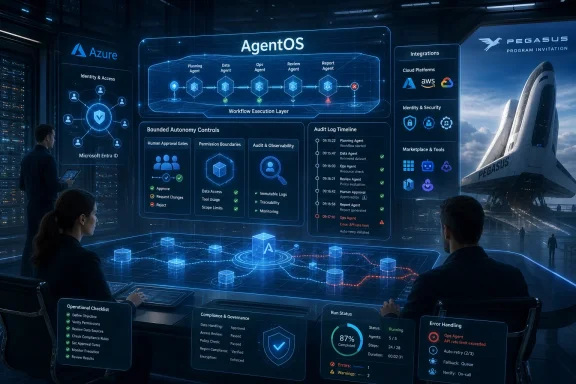 Microsoft’s Startup Machine Is Becoming an AI Distribution Layer
The Microsoft for Startups Pegasus Program has always been partly about credits and architecture, but its sharper purpose is distribution. Microsoft does not need another logo to say Azure runs AI workloads; it needs credible software companies that can turn Azure consumption into repeatable enterprise deals. Pegasus is designed for that middle zone where a startup has moved beyond a prototype but still needs help navigating corporate procurement, security review, marketplace packaging, and the long road from “interesting demo” to “approved production system.”That context makes Enhans’ acceptance strategically useful for both sides. Enhans gets access to Azure architecture guidance, Microsoft’s go-to-market machinery, and a pathway toward co-sell readiness. Microsoft gets another agentic AI company building on its cloud at a moment when every hyperscaler is trying to turn the agent boom into durable platform gravity.
The important word in the announcement is not “AI,” which has become table stakes. It is “execution.” Enhans is selling AgentOS as a system that connects business context, AI agents, human approvals, and execution actions across operational workflows. That is a very different pitch from the copilots that answer questions, summarize documents, or sit beside an employee while the actual work remains stubbornly manual.
This is the enterprise agent bet in its cleanest form: the dashboard era produced insight, the automation era produced brittle scripts, and the agent era is supposed to produce governed action. Whether Enhans can deliver that at global scale is the open question. But joining Pegasus gives the company a more credible route into the Microsoft-shaped enterprise stack where those answers will be tested.
AgentOS Is Selling the Unsexy Part of AI: Operational Discipline
The generative AI market spent its first wave dazzling users with interfaces. The second wave is less glamorous and more consequential: who gets permission to act, which systems are touched, what approvals are required, and how failures are audited after the fact. AgentOS lives in that second wave.Enhans says the platform can generate workflows tailored to a customer’s operating environment, spanning market monitoring, pricing operations, quality assurance, brand analysis, document work, and response operations. That list is revealing because it avoids the usual futuristic abstractions. These are messy, repetitive, cross-system jobs where employees already switch between portals, spreadsheets, internal tools, approval chains, and external marketplaces.
The company’s older branding, CommerceOS, made that focus explicit. The platform launched under that name in November 2025, then became AgentOS on May 1, 2026, as Enhans expanded the pitch from commerce automation to broader enterprise operations. That rebrand is not just cosmetic. It reflects the wider industry migration from vertical automation toward horizontal agent platforms that claim they can learn the shape of a business and execute across it.
But this is also where the risks become sharper. The more useful an AI agent becomes, the more dangerous it becomes when it misunderstands context, drifts from policy, or acts too quickly. A system that drafts a market summary can be wrong without necessarily breaking the business. A system that changes prices, files responses, updates documents, or operates across marketplaces needs a much stricter contract with reality.
That is why Enhans’ emphasis on human approvals and governed workflows is not boilerplate. It is the core of the product category. Enterprise AI agents will not win because they are clever in a benchmark; they will win if administrators can constrain them, observe them, and recover from their mistakes.
Azure Gives AgentOS a Bigger Stage, and a Bigger Burden
Running AgentOS on Azure is the predictable part of the announcement, but it is not trivial. Enterprise-grade agent systems are infrastructure-hungry in ways that conventional SaaS applications are not. They may require model orchestration, identity integration, logging, secure access to business systems, document processing, regional deployment choices, and careful separation between customer data and model behavior.For IT buyers, Azure can lower some of the perceived risk. Many large companies already have Microsoft identity, compliance, procurement, and cloud governance processes in place. A startup that can fit into those channels has a much easier conversation than one asking a Fortune 1000 customer to bless an unfamiliar cloud pattern from scratch.
That advantage is also a dependency. Pegasus helps startups build with Microsoft technology and connect to Microsoft’s sales channels, but the tradeoff is that the startup’s growth story becomes intertwined with Azure economics and Microsoft’s partner priorities. For AI companies, cloud partnership is no longer just about infrastructure cost. It is about credibility, route to market, and the right to sit in front of enterprise buyers who are already overwhelmed by AI pitches.
Enhans appears to understand that. The announcement frames Pegasus around Azure architecture, go-to-market execution, co-sell readiness, and global enterprise expansion. That is exactly the checklist a startup needs if it wants AgentOS to be considered for production workflows rather than innovation-lab pilots.
Still, Azure does not magically solve the agent problem. It provides the platform on which the problem can be attacked at scale. The real work remains in integration design, workflow mapping, permission boundaries, auditability, customer-specific customization, and the unpleasant edge cases that only appear once a system touches real business processes.
The Benchmark Claim Helps, but Enterprises Will Ask Harder Questions
Enhans also points to its CUA, or Computer-Using Agent, technology, which it says ranked among the global top five on the OnlineMind2Web benchmark for performing web-based tasks in complex digital environments. That claim matters because web task execution is one of the practical frontiers for agentic AI. Many enterprise processes still depend on using websites, dashboards, portals, and admin consoles that were never designed for clean API automation.Benchmarks like OnlineMind2Web are useful because they test whether agents can navigate digital environments beyond toy examples. They give buyers a way to separate vague agent marketing from demonstrated capability. In a market crowded with companies claiming to automate anything, a credible benchmark result can open doors.
But benchmarks are not deployments. A web task benchmark can show that an agent has technical promise, while still leaving unanswered whether the system can handle customer-specific policies, latency constraints, credential management, exception handling, multilingual environments, and compliance requirements. Enterprise IT teams will care less about the leaderboard than about what happens when an agent encounters a changed page layout, an ambiguous approval rule, or a partially failed transaction.
This is why Enhans’ reported customer base is more important than the benchmark in practical terms. The company says AgentOS serves more than 20 enterprise customers across commerce, manufacturing, and finance, with deployments spanning more than 1,000 marketplaces in over 50 countries. If those numbers translate into sustained production usage, they suggest Enhans has already had to confront some of the unpleasant complexity that breaks agent demos.
The geographic and marketplace breadth is particularly relevant. Operating across 1,000 marketplaces is not merely a scale claim; it implies variation in interfaces, rules, product data, pricing conventions, languages, and local market behavior. That is precisely the kind of fragmented environment where agentic systems can be valuable if they are reliable — and expensive if they are not.
Pegasus Is a Signal to Buyers, Not a Substitute for Due Diligence
For enterprise buyers, Pegasus membership is a signal, not a guarantee. It says Microsoft sees enough promise in Enhans to provide a deeper level of startup support. It does not say AgentOS is automatically appropriate for regulated workflows, high-risk decisions, or unattended execution across critical systems.That distinction matters because AI procurement has become a theater of logos. Startups want cloud badges, hyperscalers want startup momentum, and customers want reassurance that someone credible has looked under the hood. Pegasus can help Enhans get into more rooms, but the hard buyer questions remain unchanged.
Those questions should be familiar to any WindowsForum reader who has ever supported a business system after the sales team leaves. How are agent actions logged? Can administrators replay a decision path? How are credentials scoped? What happens when a model response conflicts with policy? Can a human approval step be enforced rather than merely recommended? How quickly can an agent be disabled if it starts behaving badly?
The announcement gestures at those answers through language about governed actions, human approvals, and enterprise-grade workflows. That is the right vocabulary. The next test is whether those controls are deep enough for companies that operate under audit, compliance, and contractual obligations.
Microsoft’s involvement may help set the bar higher. Azure-native architecture patterns, Entra ID integration, marketplace procurement, and co-sell expectations all push startups toward enterprise discipline. But the burden of proof remains with Enhans, especially as AgentOS moves from commerce use cases into broader operational work.
The Agent Market Is Moving From Copilots to Accountability
The Enhans announcement lands at a useful inflection point. The first generation of enterprise generative AI products often treated the user as the safety layer. A copilot could draft, summarize, suggest, and search, while a human remained responsible for turning outputs into actions. That model was easier to deploy because it preserved existing accountability structures.Agentic AI challenges that compromise. If a system can perform work across applications, the organization must decide which actions can be autonomous, which require approval, and which should remain off limits. That is not a model-selection problem. It is an operating model problem.
AgentOS is explicitly trying to occupy that gap. Enhans argues that insights alone do not run a business, and that the value of AI comes from turning those insights into safe, governed action. That is a sharper claim than “AI will make workers more productive,” and it is also much harder to prove.
The appeal is obvious. Many businesses are full of repetitive operational work that is too variable for old-school robotic process automation and too tedious for skilled employees. AI agents promise to bridge that gap by understanding context and taking action across systems that do not neatly connect.
The danger is equally obvious. The same flexibility that makes agents useful makes them hard to certify. Traditional automation is brittle, but its brittleness is visible; it follows a known script until it breaks. Agentic systems can appear more adaptable while also making decisions that are harder to predict, especially when the environment shifts.
That is why the next phase of enterprise AI will be less about agent autonomy in the abstract and more about bounded autonomy. The winning platforms will not simply say that agents can act. They will show where they can act, when they must ask, what they know, what they are forbidden to do, and how administrators can prove it later.
Microsoft Gets Another Azure-Native Agent Bet
From Microsoft’s perspective, Enhans is part of a broader competitive contest. Azure is already central to Microsoft’s AI strategy, from foundation-model services and developer tooling to Copilot-branded applications and enterprise data platforms. But the company also needs a healthy layer of independent software vendors building specialized AI applications that consume Azure and make Microsoft’s cloud more attractive.Pegasus helps fill that layer. It gives Microsoft a way to identify startups that are mature enough to sell into enterprise accounts but still early enough to be shaped by Azure architecture and Microsoft marketplace incentives. In return, those startups may receive technical support, sales guidance, and access to Microsoft’s customer network.
This is especially important in agentic AI because the category is unlikely to be owned by a single horizontal assistant. Enterprises will need agents for finance operations, commerce operations, manufacturing quality, IT service management, legal workflows, supply chain monitoring, security triage, and countless narrow processes. Microsoft can build some of that itself, but it cannot build all of it.
The strategic play is to make Azure the default home for those agents. If startups like Enhans succeed, Microsoft benefits not only from cloud consumption but from the perception that enterprise AI execution happens inside its ecosystem. That perception matters when CIOs are deciding where to place their AI governance, data, and integration bets.
For Enhans, the benefit is equally clear. A Seoul-founded company with a San Francisco office can use Pegasus to punch above its weight in global enterprise sales. Microsoft’s brand does not erase the difficulty of cross-border expansion, but it can reduce friction in markets where trust, procurement, and security review often matter as much as product capability.
The CommerceOS Rebrand Tells the Real Story
The move from CommerceOS to AgentOS is easy to dismiss as startup naming fashion, but it reveals the company’s ambition. Commerce automation is a strong wedge because online marketplaces are operationally complex, high-volume, and rich with repetitive tasks. A platform that can monitor markets, manage pricing, analyze brands, and handle response workflows has a clear reason to exist.The risk of staying CommerceOS is that the company becomes boxed into one vertical story. The rebrand to AgentOS broadens the field and makes the product legible to buyers thinking about AI operations more generally. It tells customers that Enhans is not just automating commerce teams; it is trying to become an execution fabric for agentic work.
That is a larger market, but also a more crowded one. Every enterprise software vendor now wants to be the place where AI agents live. Microsoft has Copilot Studio and its broader Azure AI stack. Salesforce, ServiceNow, UiPath, Atlassian, and others are all pushing versions of workflow-aware AI. Startups are filling every niche between browser automation, agent orchestration, enterprise search, and process mining.
Enhans’ differentiation appears to rest on three claims: agents that can use complex digital environments, workflows generated around customer context, and existing deployments across marketplaces and industries. Those are credible ingredients. The challenge is turning them into a platform story that does not dissolve into generic agent language.
That challenge will intensify as the market matures. “AgentOS” is an ambitious name because it suggests a control plane, not a feature. Customers will expect breadth, governance, integration, and reliability consistent with that framing. Pegasus may help Enhans scale the infrastructure and sales motion, but the product must earn the operating-system metaphor in the field.
Enterprise IT Will Judge AgentOS by Failure Modes
The most serious buyers will not begin with the happy path. They will ask how AgentOS fails. That is where agentic AI moves from conference-stage optimism to administrator reality.If an agent misreads a marketplace signal, does it recommend a pricing change or execute one? If a compliance-sensitive document is processed, where is the data stored and who can inspect it? If a human approval is required, can the workflow continue without it? If a web interface changes mid-task, does the agent stop, retry, escalate, or improvise?
These are not hostile questions. They are the questions that determine whether AI agents become production systems or remain impressive demos with limited permissions. Enterprise administrators have spent decades cleaning up after tools that promised abstraction and delivered another layer of operational risk.
This is where Microsoft’s ecosystem can help but not fully protect Enhans. Azure gives customers familiar levers for identity, security, compliance, monitoring, and regional deployment. It may also make procurement easier through Microsoft Marketplace and co-sell channels. But the behavior of the agent layer itself remains the vendor’s responsibility.
For Windows-heavy enterprises, the broader lesson is that agent adoption will look less like installing a new app and more like onboarding a privileged operational actor. Agents may need service accounts, role-based access, approval routing, audit logs, and incident response procedures. They will sit closer to business process automation than to chat-based productivity software.
That framing should sober up the hype without dismissing the opportunity. If AgentOS can safely automate work that currently burns thousands of human hours across fragmented marketplaces and operational systems, the value is real. If it cannot show control under stress, the same autonomy becomes a liability.
The Pegasus Win Gives Enhans a Door, Not a Destination
Enhans’ acceptance into Microsoft for Startups Pegasus gives the company three practical advantages.- It gives Enhans a stronger Azure architecture path for scaling AgentOS into enterprise-grade deployments.
- It gives the company access to Microsoft’s go-to-market support at a time when AI startups must prove they can sell beyond pilots.
- It puts AgentOS closer to Microsoft Marketplace and co-sell motions that matter to large enterprise procurement teams.
- It strengthens Enhans’ credibility as it expands from commerce automation into broader agentic operations.
- It does not eliminate the need for customers to validate governance, security, auditability, and failure handling before allowing agents to execute real work.
The AI agent market is entering its accountability phase, and that is good news for buyers who have had enough demos and not enough durable systems. Enhans’ Pegasus move puts AgentOS in the right arena: Azure-backed, enterprise-facing, and forced to compete on governance as much as intelligence. If the company can make agents useful without making them reckless, this kind of platform may become one of the more important layers in the post-copilot enterprise stack.
References
- Primary source: The National Law Review
Published: 2026-06-11T16:48:17.292420
- Official source: microsoft.com
Microsoft for Startups | Pegasus Program
We provide entrepreneurs and founders of startups with the cloud resources and mentoring they need in their journey from idea to exit. Read stories and deep dive into about the success of our founders.www.microsoft.com
- Official source: learn.microsoft.com
Azure IP Co-Sell Acceleration | Microsoft Learn
This article provides information on how to navigate the Azure IP Co-sell which is one of Microsoft’s top go-to-market benefits for startups and partners building software on Azure.learn.microsoft.com - Related coverage: techcrunch.com
Microsoft launches Pegasus program for startups, awarding up to $350,000 in credits | TechCrunch
Microsoft's new program for startups, Pegasus, will award up to $350,000 in tech credits across GitHub, Azure and LinkedIn.techcrunch.com - Official source: news.microsoft.com
- Related coverage: enhans.ai
Enhans :: Mind2Web: The Benchmark for AI Agent Evaluation and Performance
Get the latest AI Tech updates from Enhans. This article was published on Nov 07, 2025.www.enhans.ai

- Related coverage: bigtechwire.com
- Official source: partner.microsoft.com
Fuel your growth with Azure IP co-sell
Whether you’re new to the Microsoft commercial marketplace or already selling with us, discover how to unlock Azure IP co-sell for your business.partner.microsoft.com
- Official source: startups.microsoft.com
- Official source: download.microsoft.com
