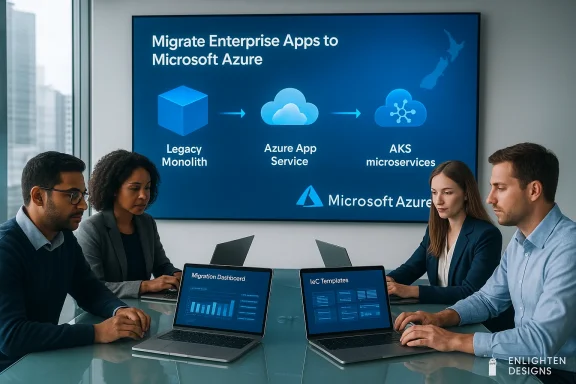
Enlighten Designs’ announcement that it has earned the Migrate Enterprise Apps to Microsoft Azure specialization is more than a marketing milestone — it is a concrete signal that the Hamilton, New Zealand-based consultancy has satisfied Microsoft’s formal gates for migrating production web application workloads, applying DevOps practices, and operating cloud-based app services at enterprise scale.
Microsoft’s partner program has been restructured in recent years to push beyond simple badge accumulation toward measurable, auditable proof of capability. The Migrate Enterprise Apps to Microsoft Azure specialization (formerly described as Modernization of Web Applications to Azure) is one of the workload-focused specializations that sits on top of the broader Solutions Partner designations. Earning it requires partners to demonstrate customer success, staff skilling, performance metrics tied to Azure consumption, and a successful third‑party audit of migration practices. These requirements are documented on Microsoft’s partner pages and in Partner Center guidance.
Enlighten Designs’ own announcement states the firm cleared those gates and says the specialization unlocks additional Microsoft partner funding eligibility, prioritized partner visibility, and specialized support programs for its clients. Enlighten presents this credential as validation of its two-decade relationship with Microsoft and its capability in agile modernization, DevOps, intelligent refactoring, and continuous cloud management.
Industry commentary and community threads also highlight the partner program’s evolution: firms that previously relied on older competencies now invest in audit-ready processes and packaged offers to capture migration demand. The practical consequence for customers: a specialization is now one datapoint among many; procurement should prefer partners that combine Microsoft validation with verifiable operational metrics and domain-specific experience.
That said, customers should treat the specialization as one element of partner evaluation. The credential lowers certain procurement frictions and signals repeatable process maturity, but it does not eliminate the need for tailored scoping, PoV work, and contractual safeguards that address data integrity, operational runbooks, and TCO. By interrogating the specialization’s concrete evidence — audited reports, customer references, certification rosters, and ACR data — organisations can convert a promising badge into predictable, measurable business outcomes.
Enlighten’s recognition places it alongside a global set of partners who have committed to audited, production-grade migration practices. For customers ready to modernize legacy web applications, the key question is not whether the partner has the specialization — it is whether that partner can demonstrate, in writing and in a small PoV, that they can deliver the specific migration outcomes your business needs.
Source: Weekly Voice Enlighten Designs Earns Migrate Enterprise Apps to Microsoft Azure Specialisation | Weekly Voice
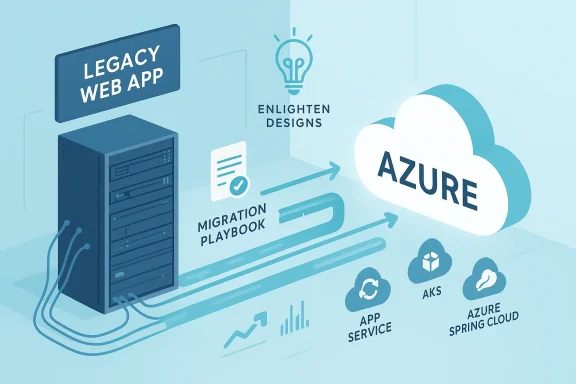 Background
Microsoft’s partner program has been restructured in recent years to push beyond simple badge accumulation toward measurable, auditable proof of capability. The Migrate Enterprise Apps to Microsoft Azure specialization (formerly described as Modernization of Web Applications to Azure) is one of the workload-focused specializations that sits on top of the broader Solutions Partner designations. Earning it requires partners to demonstrate customer success, staff skilling, performance metrics tied to Azure consumption, and a successful third‑party audit of migration practices. These requirements are documented on Microsoft’s partner pages and in Partner Center guidance.Enlighten Designs’ own announcement states the firm cleared those gates and says the specialization unlocks additional Microsoft partner funding eligibility, prioritized partner visibility, and specialized support programs for its clients. Enlighten presents this credential as validation of its two-decade relationship with Microsoft and its capability in agile modernization, DevOps, intelligent refactoring, and continuous cloud management.
What the Migrate Enterprise Apps to Microsoft Azure specialization actually requires
Understanding the bar Microsoft sets explains why the specialization is meaningful for customers evaluating migration partners.- Solutions Partner prerequisite. Organizations must already hold an active Solutions Partner designation in either Data & AI (Azure) or Digital & App Innovation (Azure) before applying for the specialization. This ensures partners have a baseline of measurable performance, skilling and customer success in a broader solution area.
- Azure Consumed Revenue (ACR). Partners must show a minimum level of Azure consumption related to app-hosting services. Microsoft’s public guidance specifies a requirement that, for this specialization, a partner demonstrate a total of USD 5,000 in ACR from App Service or Azure Spring Cloud across three months and across at least three customers (aggregated). This threshold is deliberately modest compared to other specializations but is intended to ensure partners are operating real, production workloads.
- Skilling and certifications. The partner organization must have at least three individuals who have passed key Azure certifications — specifically Azure Developer Associate and Azure DevOps Engineer Expert (the same individual may count for multiple badges). This reflects Microsoft’s emphasis on both development and CI/CD/DevOps capability when modernizing web apps.
- Third‑party audit. Microsoft requires a remote, third‑party audit of the partner’s migration processes and operational practices. The audit modal looks for documented methodologies, runbooks, evidence of repeatable migration playbooks, and production customer success stories. Passing the audit is a gating item to earn the specialization.
- Customer success evidence. Partners must supply customer references and evidence demonstrating successful, production-level migrations and ongoing management of app services on Azure. Microsoft evaluates these as part of the application and the audit.
What Enlighten Designs claims and what we verified
Enlighten’s press release and blog post make three central claims:- Enlighten has achieved the Migrate Enterprise Apps to Microsoft Azure specialization.
- The credential gives clients access to Microsoft-backed funding and programs that accelerate modernization.
- The recognition validates Enlighten’s technical capabilities across modernization, DevOps, AI augmentation, and ongoing cloud operations.
- Microsoft’s partner documentation confirms the nature of the specialization and its requirements (ACR, skilling, and audit). The Partner Center pages and the specialization landing pages detail the same qualification gates Enlighten references. This corroborates the structural claim: that the specialization exists and that it requires the items Enlighten lists.
- Enlighten’s Azure Marketplace listing for a PaaS migration jumpstart and the company blog provide tangible evidence of migration methodology and an active commercial offering tied to Azure app modernization. That listing confirms the company sells migration services that align with the specialization’s functional scope.
- Independent partner announcements from other vendors (CEI, Silamir, NashTech and others) confirm that Microsoft continues to issue and enforce similar requirements for this specialization — including third‑party audits and ACR thresholds — and that the specialization is actively used as a competitive differentiator in the market. This establishes that Enlighten’s award sits within a wider, verifiable industry pattern.
Why this matters for customers — strengths and practical value
For organizations evaluating a migration partner, Enlighten’s specialization provides several practical advantages:- Third‑party verified processes. The required audit is a useful signal: an independent review reduces the likelihood that claimed practices are only marketing rhetoric. Customers can expect the partner to have documented migration playbooks and operational controls.
- Verified skilling across dev and DevOps. The certification bar ensures that a proportion of the partner’s staff have demonstrated competency with Azure development and DevOps practices — important when moving legacy web apps into PaaS models or when automating pipelines and testing.
- Commercial pathways to Microsoft resources. Earning the specialization positions a partner to be more visible in Microsoft’s partner search and, subject to regional programs, to access co‑sell opportunities and certain partner incentives that can reduce customer migration costs or provide funding for assessments and pilots. That can materially lower friction for customers who want Microsoft-aligned procurement or joint engagements.
- Evidence of production-scale experience. The ACR requirement — small but meaningful — plus customer success references provide evidence that the partner has at least several production migrations under its belt. A marketplace offer for a 3‑week migration jumpstart, as Enlighten advertises, is consistent with repeatable, packaged migration capability.
- Ecosystem integration. Partners that secure this specialization are often conversant with PaaS patterns (Azure App Service, Azure Spring Cloud), DevOps pipelines, and ancillary services (APIM, Application Insights, Azure SQL or managed database options). For customers, this reduces integration risk and accelerates modernization roadmaps.
Important caveats and risks customers should weigh
Earning the specialization is meaningful, but it is not a substitute for disciplined procurement and technical due diligence. Key caveats:- Specialization ≠ blanket guarantee of outcomes. The specialization certifies that the partner meets Microsoft’s program gates at the time of audit, not that every future migration will be frictionless. Migration projects still carry business and technical risk — unanticipated dependencies, legacy integration gaps, data and identity complications, and regulatory constraints — that require tailored scoping and proof-of-value pilots.
- Partner incentives and funding are conditional. While Microsoft runs partner-funded programs and co‑sell incentives, access to funds or co‑sell mandates depends on program rules, region, deal size, and prioritization. Customers should ask for explicit descriptions of the type and amount of Microsoft funding previously secured in comparable engagements and how any incentive would be applied to their project. Microsoft’s partner incentive rules are public but complex.
- Potential for vendor lock‑in. Modernizing to Azure PaaS yields operational benefits but also deepens dependency on Azure platform services, runtime behaviors, and platform-specific features. Customers should weigh the trade-offs between short-term velocity (use of managed PaaS features) and long-term portability (containerized, orchestrator-based designs or multi‑cloud abstraction layers).
- Audit scope and variability. Third‑party audits validate process maturity but not every aspect of security posture or operational readiness. Customers should verify that the partner’s audited engagements are similar in scale and compliance profile to their own workloads. Ask for sanitized audit evidence, customer references, and post-migration operational metrics.
- Hidden costs and runbook gaps. App modernization often moves cost from ops to cloud consumption and new tooling (APIM, telemetry, backup/DR patterns, observability). Ensure total cost of ownership (TCO) and runbooks for incident response and lifecycle management are part of the proposal. Microsoft collateral emphasizes these trade-offs in modernization case studies.
Technical implications: what successful migrations to Azure usually require
Customers should expect the partner to address several technical domains; use these as a checklist during evaluation.1. Application assessment and dependency mapping
- Inventory runtimes, frameworks, and libraries.
- Map external integrations, messaging patterns, and stateful components.
- Produce a dependency graph and a cutover plan for each critical path.
2. Architecture choices: lift‑and‑shift vs refactor vs replatform
- Lift‑and‑shift into IaaS can be fastest but delivers fewer operational benefits.
- Replatform to Azure App Service, Azure Kubernetes Service (AKS), or Azure Spring Cloud depending on app architecture.
- Full refactor may be required to leverage microservices, serverless, or managed data services.
3. DevOps and CI/CD
- Automated pipelines for build, test, staging, and production deployments.
- Infrastructure-as-code (IaC) using Bicep/Terraform.
- Canary or blue/green deployment patterns to reduce cutover risk.
4. Observability, security, and runbooks
- Distributed tracing, telemetry, and structured logging (Application Insights, Log Analytics).
- Identity integration (Entra ID), secure secrets (Key Vault), and least-privilege role definitions.
- Operational runbooks for failover, scaling, and incident response.
5. Data strategy
- Migration of stateful data (databases, queues) must be planned with replication, cutover windows, and rollback paths.
- Consider compatibility (SQL Server to Azure SQL Managed Instance), latency, and DR designs.
Practical procurement checklist for organisations evaluating Enlighten (or any partner claiming the specialization)
Ask for the following and evaluate the answers critically:- Show the Microsoft specialization certificate or Partner Center confirmation, and specify the date of the third‑party audit.
- Provide at least three customer references for production migrations (include industry, scale, and migration pattern used).
- Demonstrate the exact Azure App Service / Spring Cloud ACR evidence that supported the specialization, or provide substitute evidence of production consumption.
- Share sanitized audit evidence or a summary of the third‑party audit findings (what was validated, what gaps were identified and remediated).
- Provide a sample migration runbook and a post‑migration operating playbook (incident procedures, backups, patching cadence, security monitoring).
- Explain co‑sell or funding mechanics: what Microsoft programs will be leveraged, how funding is accessed, and who manages those interactions.
- Present a TCO model that includes projected cloud consumption, support, observability, and runbook staffing.
- Confirm staffing and certifications on the proposed delivery team (which individuals hold Azure Developer Associate / DevOps Engineer Expert certs).
- Ask for a 4–8 week proof‑of‑value (PoV) plan with measurable success criteria and rollback triggers.
- Insist on contractual SLAs for cutover windows, data integrity, and post‑migration remediation obligations.
How Enlighten’s offering compares with industry peers
Enlighten’s specialization aligns with a growing cohort of partners who advertise the same capability. Other firms — including CEI, NashTech, iLink Digital, Silamir and others — have publicly announced the Migrate Enterprise Apps to Azure specialization in recent years. These peer announcements show a consistent pattern: partners use the specialization to open co‑sell opportunities, reassure customers on methodology, and package jumpstart offers for rapid modernization. That pattern validates the specialization’s market utility but also raises the bar for differentiators beyond the badge itself — for example, vertical expertise, proprietary migration accelerators, or unique IP in refactoring.Industry commentary and community threads also highlight the partner program’s evolution: firms that previously relied on older competencies now invest in audit-ready processes and packaged offers to capture migration demand. The practical consequence for customers: a specialization is now one datapoint among many; procurement should prefer partners that combine Microsoft validation with verifiable operational metrics and domain-specific experience.
Recommendations for CIOs, architects and procurement teams
- Treat the specialization as a strong signal of capability but not a substitute for a PoV and targeted due diligence. Use the procurement checklist above to convert claims into measurable commitments.
- Insist on a PoV that includes both technical and business KPIs: reduced downtime, measurable performance gains, and a bounded TCO estimate.
- Ask for a multi‑phase roadmap: assessment, pilot, migration, optimization, and knowledge transfer. Confirm who owns each deliverable and the escalation path to Microsoft or third parties if needed.
- Consider a hybrid modernization approach where appropriate: preserve what works (semantic layers, critical DB nodes) and modernize incremental components to PaaS to reduce risk and spread cost.
- Evaluate portability trade-offs. If long-term multi‑cloud flexibility matters, prefer containerized or orchestrator-based designs over heavy reliance on proprietary PaaS features — or negotiate export paths as part of the contract.
Conclusion
Enlighten Designs’ award of the Migrate Enterprise Apps to Microsoft Azure specialization is an important, verifiable achievement. The specialization’s requirements — a Solutions Partner designation, defined Azure consumption evidence, staff certifications, and a third‑party audit — make it a meaningful credential for organisations seeking partners for web app modernization on Azure. Enlighten’s public materials and marketplace listings confirm the company operates packaged migration offerings that align with those requirements.That said, customers should treat the specialization as one element of partner evaluation. The credential lowers certain procurement frictions and signals repeatable process maturity, but it does not eliminate the need for tailored scoping, PoV work, and contractual safeguards that address data integrity, operational runbooks, and TCO. By interrogating the specialization’s concrete evidence — audited reports, customer references, certification rosters, and ACR data — organisations can convert a promising badge into predictable, measurable business outcomes.
Enlighten’s recognition places it alongside a global set of partners who have committed to audited, production-grade migration practices. For customers ready to modernize legacy web applications, the key question is not whether the partner has the specialization — it is whether that partner can demonstrate, in writing and in a small PoV, that they can deliver the specific migration outcomes your business needs.
Source: Weekly Voice Enlighten Designs Earns Migrate Enterprise Apps to Microsoft Azure Specialisation | Weekly Voice