

The first week of November delivered a compact but consequential wave of enterprise-focused technology updates — from vendor-built “agentic AI” suites and cloud marketplace localization to construction‑grade digitalization partnerships and modest but meaningful network hardware refreshes — that together signal a clear push: vendors are moving beyond proof‑of‑concept AI and platform marketing toward verticalized, production-ready tools and smoother local procurement models for large buyers.
Enterprise IT in late‑stage 2025 is defined by a few interlocking trends: rapid adoption of large multimodal models and agent frameworks, hyperscaler efforts to localize and simplify procurement and compliance, and a parallel focus on industrialization — turning demos into auditable, governable production systems. The announcements this week exemplify those trends across multiple sectors: software partners packaging agents for business processes, construction firms standardizing digital project controls, cloud marketplaces reducing procurement friction in large geographies, systems integrators targeting heavy industry operations with multimodal agents, and hardware vendors filling gaps at the network edge.
However, the headline outcomes — reduced downtime, improved safety, automated decision‑making — remain vendor‑reported until validated by independent pilots and audits. In safety‑critical sectors like energy, buyers must insist on explainability, immutable audit trails, and contractual guarantees for model performance and data handling. Where the announcements are strongest is in packaging and go‑to‑market: these moves will likely accelerate pilot velocity and make it easier for enterprises to trial agentic capabilities in production contexts. The real test for the industry will be whether these early production patterns can deliver measurable operational improvements while preserving safety, compliance, and auditability in high‑stakes environments.
In short: the week was less about one transformational product and more about an ecosystem shift — toward verticalized, governed agentic AI and locally tailored cloud procurement — that shifts the onus on buyers to probe governance, pilot rigor, and measurable outcomes before scaling.
Source: Techcircle It's a wrap: News this week (Nov 1-7)
 Background
Enterprise IT in late‑stage 2025 is defined by a few interlocking trends: rapid adoption of large multimodal models and agent frameworks, hyperscaler efforts to localize and simplify procurement and compliance, and a parallel focus on industrialization — turning demos into auditable, governable production systems. The announcements this week exemplify those trends across multiple sectors: software partners packaging agents for business processes, construction firms standardizing digital project controls, cloud marketplaces reducing procurement friction in large geographies, systems integrators targeting heavy industry operations with multimodal agents, and hardware vendors filling gaps at the network edge.Overview of the week’s top items
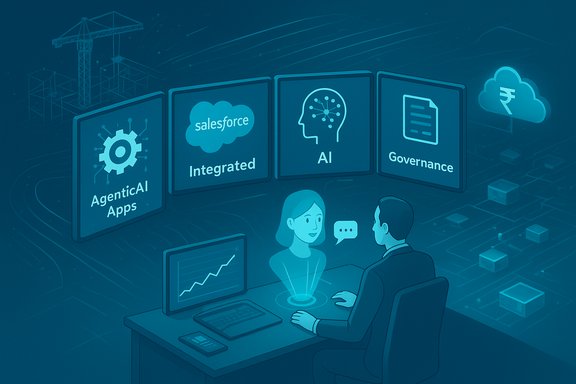
- Nagarro launched a suite of Agentic AI solutions built on Salesforce technology, including five industry‑specific assistants for sales, service, retail, financial services, and logistics.
- Adani Group entered a three‑year strategic partnership with Autodesk to deploy Autodesk Construction Cloud (ACC) and BIM advisory services across Adani’s global infrastructure projects as part of its “Parivartan” digital transformation.
- AWS Marketplace launched a localized marketplace in India with Indian‑rupee (INR) listings and invoicing to simplify procurement for domestic customers and ISVs.
- Infosys introduced an AI agent for energy operations that bundles Infosys Topaz, Infosys Cobalt, Microsoft Copilot Studio and Azure OpenAI Foundry (GPT‑family) to enable conversational, multimodal access to operational data.
- Consistent Infosystems released an Ethernet media converter aimed at mixed copper/fibre enterprise networks, supporting 10/100/1000 Mbps and industrial temperature and voltage protection specs.
Nagarro’s Agentic AI suite: from automation to autonomy
What was announced
Nagarro unveiled a portfolio of five Salesforce‑centric agentic solutions intended to push organizations from rule‑based automation toward AI‑driven autonomy inside the Salesforce ecosystem. The named products are:- Assista — voice‑based sales assistant
- SupportMate — customer‑service diagnostic assistant
- RetailMate — retail order & invoice management
- FinZy — loan‑processing automation for financial institutions
- FreightAssist — logistics insights and case support.
Why it matters
- Verticalized agents reduce integration time. By offering industry‑specific assistants that sit on Salesforce, Nagarro lowers the engineering burden for customers already invested in that CRM and workflow ecosystem.
- Voice and conversational interfaces are production‑friendly for deskless and mobile workforces. Sales and logistics teams often operate away from PCs; voice agents extend AI assistance into those workflows.
Strengths
- Pre‑integrated with Salesforce reduces build effort and leverages existing identity and data models.
- Industry focus makes it easier to craft prompt templates, retrieval schemas and KPIs that map to operational outcomes.
Risks and caveats
- Governance and auditability. Agentic assistants that influence customer or financial outcomes must provide provenance for assertions and auditable decision trails. Vendor claims around “autonomy” should be validated with concrete governance features (immutable logs, model versioning, evidence citation). Where vendors tout outcomes, those are directional until validated by independent pilots.
- Vendor lock‑in and data pipelines. Deep integration into Salesforce and proprietary agent fabrics can create migration friction; procurement teams should insist on data portability and explicit export rights.
Adani + Autodesk: construction operations get a single source of truth
What was announced
Adani Group and Autodesk signed a three‑year strategic partnership to deploy Autodesk Construction Cloud (ACC) and BIM advisory services across Adani’s global infrastructure portfolio under Adani’s “Parivartan” digital transformation program. The collaboration includes process standardization, partner enablement, workforce upskilling, and an intent to create a single source of truth for project decision‑making.Practical implications
- Digital project operations at scale. Large infra portfolios suffer from fragmented project data; ACC and BIM can centralize designs, schedules, RFIs and progress reporting to improve decision windows and reduce rework.
- Skills and partner enablement are decisive. Technology alone won’t change outcomes — the agreement emphasises process standardization and workforce upskilling, which are essential for realizing digital ROI.
Strengths
- Consolidation of project data into a shared BIM environment helps with traceability, sustainability tracking, and lifecycle planning.
- Autodesk’s platform approach (data model + integrations) suits large, repeatable infra programs.
Risks and caveats
- Change management. Large construction ecosystems include many SMEs, subcontractors and legacy systems. Success requires phased rollouts, enforced data contracts and robust onboarding programs.
- Interoperability and standards. BIM standards and model fidelity must be governed; otherwise the “single source of truth” becomes a silo with incomplete buy‑in.
AWS Marketplace India: procurement and compliance simplified
What was announced
AWS launched a localized AWS Marketplace in India, enabling Indian customers to purchase third‑party software and services in Indian Rupees with local invoicing, making procurement simpler for Indian enterprises and enabling Indian ISVs and partners to list products with INR prices.Why it matters
- Reduces procurement friction. Local currency invoicing and regionally aware billing simplifies buying for both public and private enterprises that must manage forex, tax, and local accounting rules.
- Boosts local ISV go‑to‑market. Listing in INR lowers the friction for Indian ISVs and channel partners to sell through AWS’s procurement channels.
Strengths
- Expected acceleration of cloud and SaaS adoption among enterprises previously held back by complex cross‑border procurement.
- Aligns with hyperscalers’ broader infrastructure investments and talent programs in the region.
Risks and caveats
- Procurement is only one friction. Legal, data residency, and compliance controls remain important; organizations should still evaluate contractual terms, SLAs, and data processing addenda.
- Vendor maturity matters. Localized marketplaces make it easier to buy, but procurement teams must still require verifiable references, security certifications, and clear support SLAs.
Infosys’ AI Agent for energy operations: technical blueprint and procurement checklist
What was announced
Infosys introduced an AI agent for energy operations, positioned as a production‑grade, multimodal assistant that converts operational telemetry, well logs, images, and reports into conversational, evidence‑grounded insights. The solution bundles:- Infosys Topaz — an agent fabric / orchestration runtime
- Infosys Cobalt — cloud blueprints and compliance templates
- Microsoft Copilot Studio — low‑code agent creation and orchestration
- Azure AI Foundry / Azure OpenAI — hosted multimodal models (including GPT‑family models such as GPT‑4o).
How the architecture is composed
Infosys’ public materials and partner documentation describe a layered architecture that maps to contemporary best practice for agentic systems:- Data ingestion & governance: lakehouse or knowledge graph storing telemetry, logs, documents, and media with data contracts and access controls.
- Retrieval & grounding: vector search and document retrieval to ground model outputs in specific evidence.
- Agent fabric & orchestration: Topaz runtime for prompt templates, toolchains, human‑in‑the‑loop gates, and observability.
- Model runtime & hosting: Azure AI Foundry / Azure OpenAI host multimodal models, with Copilot Studio as the low‑code authoring surface.
- Edge nodes: local deterministic loops for low‑latency safety interlocks and OT segmentation.
What is verifiable and what remains vendor‑reported
- The composition of the stack (Topaz + Cobalt + Microsoft tooling) is corroborated in vendor materials and platform docs; these building blocks are real and interoperable.
- Outcome metrics (e.g., % reduction in NPT, hours saved) are vendor‑reported and not yet validated by third‑party audits in the public announcement; procurement teams should treat headline numbers as directional until independent case studies are available.
Procurement & implementation checklist (recommended)
- Define measurable pilot KPIs: mean time to insight (MTTI), hours saved per shift, change in NPT incidents.
- Require evidence provenance: each agent response must cite source documents and telemetry windows.
- Insist on auditable logs: immutable event logs, model versioning and drift detection must be contractually required.
- Run safety validations: red‑team tests and OT‑specific adversarial scenarios before any agent‑driven recommendations are allowed to influence live control actions.
- Confirm hybrid architecture: clearly specify which functions run at the edge vs cloud, recovery/rollback paths and offline fail‑safe behavior.
- Budget for MLOps: continuous retraining, monitoring, and human‑in‑the‑loop staffing for domain shifts.
Strengths
- Packaged production patterns reduce engineering lift for energy operators by predefining agent templates, connectors and governance scaffolding.
- Microsoft partnership provides a familiar runtime (Copilot Studio + Azure Foundry) for customers already invested in Azure.
Risks and caveats
- Safety‑critical context. Energy operations are regulated and safety‑sensitive; any agent that influences operational decisions raises liability and compliance questions that require careful contractual and technical containment.
- Model selection and failover. The “exact” model variant for a given deployment will depend on latency, cost and procurement choices; buyers must specify model SLAs and fallback behavior.
Consistent Infosystems: Ethernet media converter — small product, pragmatic value
What was announced
Consistent Infosystems launched an Ethernet media converter targeted at enterprise and industrial networks. Key product highlights include support for 10/100/1000 Mbps, automatic MDI/MDI‑X detection, operating temperatures from 0 °C to +65 °C, and voltage protection geared toward data‑centre, industrial facilities and surveillance deployments. The device is aimed at extending fibre links while keeping local copper distribution.Why it matters
- Practical connectivity: Many enterprise campuses and multi‑building sites mix copper and fibre; media converters are a low‑cost way to extend fibre while preserving existing copper devices.
- Industrial tolerance: Operating temperature and voltage protections make the device suitable for non‑climate‑controlled telecom rooms or edge PoE camera installations.
Strengths and limitations
- Strength: Low‑friction deployment and automatic MDI/MDI‑X remove common configuration errors.
- Limitation: Media converters are a tactical, not strategic, fix; for long‑term campus modernization, organizations should consider converged switches and PoE zoning strategies.
Cross‑cutting analysis: what the week’s updates reveal
Themes
- Verticalization of agentic AI. Both Nagarro and Infosys emphasize domain‑specific agents — a clear shift from horizontal LLM demos to packaged vertical workloads that include connectors, templates and governance scaffolding.
- Local procurement and market tailoring. AWS Marketplace India underscores hyperscalers’ recognition that procurement, currency and compliance are significant adoption barriers in large markets.
- Production readiness over novelty. Infosys’ messaging stresses Topaz and Cobalt as frameworks to turn “one‑off demos” into repeatable patterns — indicating increasing attention to MLOps, audit trails and operator workflows.
Strategic strengths across the announcements
- Packaging reduces engineering lift and shortens time to value.
- Partnerships with hyperscalers (Microsoft, AWS) give enterprise buyers familiar runtimes and procurement paths.
Shared risks and industry-wide caveats
- Governance, explainability and auditability remain the Achilles’ heel of rapid agent deployment. Vendor claims about outcomes should be validated through transparent pilots and third‑party audits.
- Operational safety in industrial settings. When agents influence OT decisions, deterministic safety interlocks and explicit fail‑safe contracts are essential.
- Procurement complacency. Local marketplaces and ‘prebuilt’ agent packs lower friction but do not remove the need for rigorous security reviews, interoperability testing and contractual SLAs.
Practical guidance for IT leaders and procurement teams
Fast checklist before buying agentic solutions
- Confirm the stack: ask vendors to enumerate the exact components (agent fabric, vector store, model runtime, edge components) and which are first‑party vs third‑party.
- Demand provenance: each generated insight must link to the evidence items (documents, telemetry windows) used to generate it.
- Require auditable governance: immutable logs, model versioning, and SLAs for retraining and model rollbacks.
- Pilot with measurable KPIs: predefine success metrics (MTTI, hours saved, % reduction in NPT or errors) and require transparent methodologies for those measurements.
- Plan hybrid operations: ensure latency‑sensitive functions run at the edge with explicit fallback behavior for offline periods.
Recommended phased implementation roadmap
- Start small: automate one high‑value, low‑risk workflow (for example, report generation or invoice extraction).
- Instrument heavily: capture baseline metrics for time spent, accuracy and incident response.
- Validate externally: seek third‑party audits and independent pilot testimonials before scale‑up.
- Scale cautiously: expand agent responsibilities only after governance and safety thresholds are met.
Final assessment: measured optimism, not uncritical enthusiasm
This week’s announcements are notable for their pragmatism. Vendors and integrators are moving from experiments to patterns — prepackaged agent fabrics, cloud blueprints, and verticalized assistants designed to shorten time‑to‑value. The simultaneous push to localize procurement (AWS Marketplace India) and standardize digital project operations (Adani + Autodesk) complements that shift by removing commercial and process frictions that slow enterprise adoption.However, the headline outcomes — reduced downtime, improved safety, automated decision‑making — remain vendor‑reported until validated by independent pilots and audits. In safety‑critical sectors like energy, buyers must insist on explainability, immutable audit trails, and contractual guarantees for model performance and data handling. Where the announcements are strongest is in packaging and go‑to‑market: these moves will likely accelerate pilot velocity and make it easier for enterprises to trial agentic capabilities in production contexts. The real test for the industry will be whether these early production patterns can deliver measurable operational improvements while preserving safety, compliance, and auditability in high‑stakes environments.
In short: the week was less about one transformational product and more about an ecosystem shift — toward verticalized, governed agentic AI and locally tailored cloud procurement — that shifts the onus on buyers to probe governance, pilot rigor, and measurable outcomes before scaling.
Source: Techcircle It's a wrap: News this week (Nov 1-7)
