

Change is coming to Exchange Online, and Microsoft is trying to make that change easier to see before it becomes disruptive. The new Change Optics Report, now in Public Preview, gives admins a central place to identify messages that match patterns tied to announced service changes, including scenarios that may be throttled or rejected in the future. In practical terms, it turns change management from a reactive exercise into a measurable workflow. That matters because in large tenants, even a small amount of legacy traffic can become a real operational risk once Microsoft tightens enforcement.
Microsoft’s Exchange Online team has spent the last several years moving more of the platform’s operational guidance into the product itself. Reports, insights, trace tools, and message-center notices have increasingly been used together to help administrators understand not only what changed, but what is likely to break next. The Change Optics Report fits that pattern by focusing on forward-looking visibility rather than retrospective troubleshooting.
That distinction is important. Traditional reporting answers a question like, “Why was this message delayed?” The new report answers a more strategic question: “Which messages in my tenant look like they will be affected when Microsoft enforces the next policy change?” In a cloud service that evolves continuously, that is a much more valuable kind of telemetry.
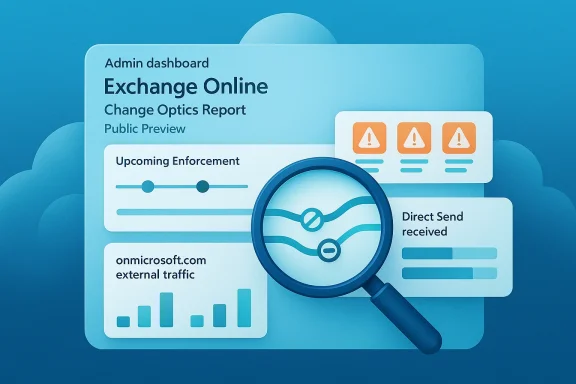
The initial scenarios tell us a lot about Microsoft’s priorities. The first centers on onmicrosoft.com traffic sent externally, which Microsoft says is aimed at large organizations that still rely on that domain and need to clean it up before throttling occurs. The second focuses on Direct Send traffic received by a tenant, which supports admins who want to enable the Reject Direct Send setting but first need to identify legitimate mail paths that would otherwise be interrupted. Both scenarios are less about novelty than about reducing technical debt.
This is also a continuation of a broader Exchange Online strategy. Microsoft has been tightening mail-flow behavior, modernizing message trace, and giving admins more detailed reporting around mail flow risk. The new report is not a standalone feature in isolation; it is part of a larger shift toward change-aware operations inside Exchange Online.
The practical benefit is obvious. Admins can use the report to locate traffic that still depends on behavior Microsoft has already signaled may change, then work backward to owners, applications, or business processes. That is far more efficient than waiting for a policy change to trigger user complaints.
One of the clearest examples is the Reject Direct Send work. Microsoft explained that Direct Send can be abused or misunderstood, and it introduced a setting that allows tenants to block unauthorized messages that claim to come from accepted domains. At the same time, Microsoft acknowledged that many organizations still have legitimate systems using that path, which means admins need a way to discover those senders before flipping the switch.
A similar pattern exists around onmicrosoft.com usage. That domain is often associated with tenant setup, fallback behavior, or older configuration decisions. But if a large organization is still sending external mail from it, that can signal a configuration issue, branding concern, or dependency that should be addressed before Microsoft enforces additional controls. The change optics concept is designed to expose exactly that kind of hidden operational residue.
The new report also builds on Microsoft’s growing mail-flow reporting estate in the new Exchange admin center. Microsoft already offers an expanding set of mail flow reports, message trace, mail flow insights, and troubleshooting views in the modern EAC. The Change Optics Report adds a new dimension: it is not just about what happened, but about what should be investigated because a future change may affect it. Microsoft Learn’s mail-flow documentation already frames reporting as a way to establish baselines and discover trends, which is exactly the model this new report extends.
Source: Microsoft Exchange Team Blog Change Optics Report released into Public Preview to showcase messages impacted by future changes | Microsoft Community Hub
 Overview
Microsoft’s Exchange Online team has spent the last several years moving more of the platform’s operational guidance into the product itself. Reports, insights, trace tools, and message-center notices have increasingly been used together to help administrators understand not only what changed, but what is likely to break next. The Change Optics Report fits that pattern by focusing on forward-looking visibility rather than retrospective troubleshooting.That distinction is important. Traditional reporting answers a question like, “Why was this message delayed?” The new report answers a more strategic question: “Which messages in my tenant look like they will be affected when Microsoft enforces the next policy change?” In a cloud service that evolves continuously, that is a much more valuable kind of telemetry.
The initial scenarios tell us a lot about Microsoft’s priorities. The first centers on onmicrosoft.com traffic sent externally, which Microsoft says is aimed at large organizations that still rely on that domain and need to clean it up before throttling occurs. The second focuses on Direct Send traffic received by a tenant, which supports admins who want to enable the Reject Direct Send setting but first need to identify legitimate mail paths that would otherwise be interrupted. Both scenarios are less about novelty than about reducing technical debt.
This is also a continuation of a broader Exchange Online strategy. Microsoft has been tightening mail-flow behavior, modernizing message trace, and giving admins more detailed reporting around mail flow risk. The new report is not a standalone feature in isolation; it is part of a larger shift toward change-aware operations inside Exchange Online.
Why this matters now
For years, Exchange admins have had to infer impact from release notes, blog posts, and support articles. That approach works poorly when a tenant’s mail flow contains a mix of modern clients, legacy applications, third-party services, hybrid routing, and historical exceptions. Microsoft’s new reporting model reduces guesswork by surfacing example messages that match expected problem patterns.The practical benefit is obvious. Admins can use the report to locate traffic that still depends on behavior Microsoft has already signaled may change, then work backward to owners, applications, or business processes. That is far more efficient than waiting for a policy change to trigger user complaints.
- It moves change management closer to the mailbox layer.
- It gives admins a sample set of impacted messages, not just a warning.
- It supports proactive remediation before enforcement begins.
- It complements existing message trace and mail flow reports.
- It reduces the risk of surprise outages caused by old assumptions.
Background
The Exchange Online team has been increasingly explicit about the tension between service improvements and customer disruption. Microsoft wants to improve platform security, compliance, and reliability, but many tenants still rely on older patterns that were acceptable years ago. The result is a constant balancing act between tightening the platform and giving customers enough time and visibility to adapt.One of the clearest examples is the Reject Direct Send work. Microsoft explained that Direct Send can be abused or misunderstood, and it introduced a setting that allows tenants to block unauthorized messages that claim to come from accepted domains. At the same time, Microsoft acknowledged that many organizations still have legitimate systems using that path, which means admins need a way to discover those senders before flipping the switch.
A similar pattern exists around onmicrosoft.com usage. That domain is often associated with tenant setup, fallback behavior, or older configuration decisions. But if a large organization is still sending external mail from it, that can signal a configuration issue, branding concern, or dependency that should be addressed before Microsoft enforces additional controls. The change optics concept is designed to expose exactly that kind of hidden operational residue.
The new report also builds on Microsoft’s growing mail-flow reporting estate in the new Exchange admin center. Microsoft already offers an expanding set of mail flow reports, message trace, mail flow insights, and troubleshooting views in the modern EAC. The Change Optics Report adds a new dimension: it is not just about what happened, but about what should be investigated because a future change may affect it. Microsoft Learn’s mail-flow documentation already frames reporting as a way to establish baselines and discover trends, which is exactly the model this new report extends.
Source: Microsoft Exchange Team Blog Change Optics Report released into Public Preview to showcase messages impacted by future changes | Microsoft Community Hub
