

Microsoft’s push into enterprise document intelligence is no longer theoretical: EY has adopted Azure AI Document Intelligence to automate tax return preparation, shifting weeks of manual-entry work into an automated, model-driven pipeline that the vendor says scales across thousands of form types. The result, as Microsoft’s published customer materials and independent industry analyses report, is a radical drop in repetitive labor and a repeatable model-building factory that turns one expert annotator and generative AI–created synthetic data into production-grade extractors at enterprise scale.
EY’s tax practice faces a classic enterprise data problem: clients submit thousands of long, heterogeneous forms—some exceeding 50 pages, others near 300—and the first step in any return historically required human teams to open, read and rekey values into EY’s systems. Manual extraction is slow, expensive and error-prone.
Microsoft’s customer story describes how EY turned to Azure AI Document Intelligence (the evolved Form Recognizer/document-extraction service), combined with Azure Foundry and generative model tooling, to automate extraction, preserve evidentiary traceability and scale model creation across thousands of document types. The firm reports an initial build of roughly 20 custom models in the first year and a dramatic acceleration to several hundred models in production the following year—claims Microsoft published as part of the customer narrative.
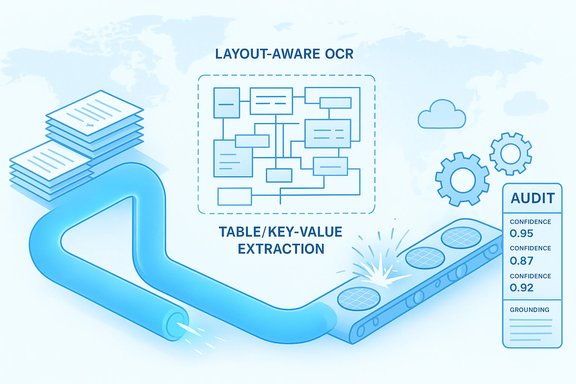
Outside that customer story, independent technical summaries and platform comparisons confirm the capabilities Azure brings to document understanding: layout-aware OCR, table and key‑value extraction, confidence scores and provenance snippets that are essential for regulated, audit-grade workflows. These primitives are the foundation for Retrieval‑Augmented Generation (RAG) and agentic copilots that rely on deterministic evidence when presenting answers.
However, certain customer-level operational metrics reported in vendor case studies—model counts, per-case time savings, or quoted practitioner comments—should be treated as customer‑reported outcomes unless independently audited. For example, Microsoft’s customer narrative about EY describes a jump from ~20 models in year one to hundreds in production and quotes practitioners about annotation speed; those particulars come from Microsoft’s published case material and are plausible, but buyers should require reference validation and pilot-level benchmarking before assuming the same results. Where direct, independent verification is absent in the public record, those figures are best treated as directional.
That said, vendor case studies should be read as operational playbooks rather than guaranteed outcomes. The headline numbers (model counts, hours saved, minutes-per-page) are useful directional evidence, but organisations must validate them on their own documents, with contract protections in place and an operational plan to detect drift, control costs and preserve portability. When those steps are taken, document intelligence transforms a repetitive bottleneck into a repeatable engineering asset—but without that discipline, automation can create new operational and compliance risks at scale.
Conclusion
EY’s adoption illustrates the practical tipping point enterprises face today: the tooling to convert unstructured, long-form documents into structured, auditable data exists and can be deployed at scale. The difference between promise and production isn’t model architecture alone—it’s the engineering of governance, repeatable model pipelines, cost controls and human oversight. For WindowsForum readers planning their own journeys, the sensible path is conservative pilot → contractual hardening → human‑in‑the‑loop productionization → measured scale. That sequence keeps the benefits—speed, scale and reduced toil—while managing the real risks that accompany automated decisioning in regulated, high‑trust domains.
Source: Microsoft Microsoft Unified supercharges EY tax services with AI document intelligence | Microsoft Customer Stories
 Background / Overview
EY’s tax practice faces a classic enterprise data problem: clients submit thousands of long, heterogeneous forms—some exceeding 50 pages, others near 300—and the first step in any return historically required human teams to open, read and rekey values into EY’s systems. Manual extraction is slow, expensive and error-prone.Microsoft’s customer story describes how EY turned to Azure AI Document Intelligence (the evolved Form Recognizer/document-extraction service), combined with Azure Foundry and generative model tooling, to automate extraction, preserve evidentiary traceability and scale model creation across thousands of document types. The firm reports an initial build of roughly 20 custom models in the first year and a dramatic acceleration to several hundred models in production the following year—claims Microsoft published as part of the customer narrative.
Outside that customer story, independent technical summaries and platform comparisons confirm the capabilities Azure brings to document understanding: layout-aware OCR, table and key‑value extraction, confidence scores and provenance snippets that are essential for regulated, audit-grade workflows. These primitives are the foundation for Retrieval‑Augmented Generation (RAG) and agentic copilots that rely on deterministic evidence when presenting answers.
How EY built the pipeline: the technical anatomy
Ingestion and layout analysis
EY’s ingestion layer feeds PDFs, scanned images and born-digital documents into Azure storage and Document Intelligence. The platform performs OCR and layout parsing to produce a structured representation (blocks, lines, tables, bounding boxes) so downstream systems can link every extracted value back to the exact page location. This layout graph is the baseline for defensible extractions used in tax and audit.Custom model training and synthetic augmentation
Tax forms are highly variable and jurisdiction‑specific, so prebuilt models alone are insufficient. EY built custom models and—critically—used generative AI to accelerate annotation: a single human annotator labels a page, then generative techniques synthesize variations to expand the training set. Microsoft and EY position this approach as both efficient and privacy-preserving because synthetic examples remove the need to expose sensitive client data for model training. This mix of human annotation + synthetic augmentation is what turned bespoke model efforts into a near‑industrial factory process for EY.Model lifecycle and repeatability
Rather than cherishing each model as a handcrafted artifact, EY instituted a repeatable pipeline: label representative pages, produce synthetic variations, train a custom Document Intelligence model, validate with confidence thresholds, and deploy. The process reduced annotation time from a day per page to roughly an hour for a single page in many cases, enabling rapid throughput and a trained annotation team to scale production work. Microsoft’s write‑up frames this as transforming model creation from artisanal craft into factory-scale engineering.Grounding, traceability and evidence-first outputs
Every automated extraction is accompanied by a confidence score and a grounding snippet or bounding box so reviewers can jump from an extracted field to the source evidence. This evidence-first posture is necessary for audit defensibility and regulatory scrutiny, and it is one of Document Intelligence’s key enterprise features. Independent analyses of Azure’s document stack emphasize these provenance controls as the differentiator that lets organizations use automated extractions in regulated workflows.Business impact: speed, scale and cost
- Massive labor reduction: For routine extraction tasks, EY’s pattern converts what were hours of clerical entry into minutes of validation and exception handling.
- Faster turnaround: Automated extraction accelerates the initial steps of tax returns and audits, which shortens cycle time and improves responsiveness to clients.
- Scalability: The factory approach—annotate → synthesize → train—lets EY scale from a handful of custom extractors to hundreds, enabling coverage across diverse jurisdictions and form variants.
- Reallocation of skilled staff: Developers and senior tax advisers are freed from repetitive annotation work and can focus on exception handling, client advisory and quality assurance.
Why this matters: platform, governance and partner economics
Microsoft’s approach ties three elements together in a way that matters to global professional services firms:- A unified data and model control plane (Azure Foundry / Copilot Studio) that enables multi-model routing and enterprise governance.
- Document Intelligence primitives that produce layout-aware JSON and provenance metadata suitable for downstream RAG and agentic use.
- Partner delivery and “factory” resources that help customers move from pilot to production faster than bespoke engineering teams alone.
Independent verification and what’s provable
Key platform capabilities—layout extraction, table reconstruction, confidence scoring, and containerized on‑prem options—are documented across vendor materials and independent comparisons of IDP (Intelligent Document Processing) vendors. Azure’s Document Intelligence is consistently identified as a best-fit for Microsoft-centric enterprises needing hybrid or on‑prem parity. Likewise, the pattern of pairing Document Intelligence with RAG and governance tooling has been validated across multiple Microsoft customer stories and community analyses.However, certain customer-level operational metrics reported in vendor case studies—model counts, per-case time savings, or quoted practitioner comments—should be treated as customer‑reported outcomes unless independently audited. For example, Microsoft’s customer narrative about EY describes a jump from ~20 models in year one to hundreds in production and quotes practitioners about annotation speed; those particulars come from Microsoft’s published case material and are plausible, but buyers should require reference validation and pilot-level benchmarking before assuming the same results. Where direct, independent verification is absent in the public record, those figures are best treated as directional.
Critical analysis — strengths, blind spots and operational risks
Strengths (what works)
- Evidence-first design: Extracted values link back to original locations, which supports regulatory defensibility and audit trails—essential for tax and audit workflows.
- Scalable model pipeline: Combining one human annotator with synthetic augmentation lowers the marginal cost of training new models, enabling coverage of thousands of document types. This materially reduces the barrier to specialization.
- Platform integration: Running document extraction on Azure lets organizations reuse identity, DLP, logging, and regional residency controls already present in Microsoft stacks—shortening procurement and compliance cycles.
- Operational reuse: Once a model-building pipeline exists, it becomes a repeatable asset; EY can productize templates, reuse annotator teams and centralize governance rather than redoing work case-by-case.
Blind spots and risks
- Model error and hallucination risk: Generative inference (used to normalize or infer missing fields) can be wrong. Even with grounding, inferred or normalized values may misinterpret jurisdictional nuances or unique tax line items. Conservative confidence thresholds and human gates are necessary.
- Data residency and contractual exposure: Large global firms must confirm ingestion, model calls and logs reside in acceptable Azure regions and negotiate explicit non‑training clauses if they do not want their client data used for provider model training. Vendor case studies often do not publish contract-level guarantees—those must be negotiated.
- Cost at scale: Consumption pricing (OCR, model inference, storage) can grow quickly. Without FinOps controls or provisioned throughput, document pipelines handling millions of pages can produce unpredictable bills. Plan for capacity packs, Copilot credits, or provisioned units where available.
- Vendor and operational lock‑in: Deep integration with a single cloud and platform tools accelerates delivery but increases migration cost. Maintain exportable structured outputs (JSON, Parquet), and design an exit plan for indexes and transformation code.
- Deskilling and human oversight: Over-automation risks eroding junior staff’s domain judgement. Embed training and rotation so staff retain skills for review, exceptions and quality assurance.
Practical checklist and best practices for buyers
- Pilot with representative worst-case documents
- Include long, low-quality scans, non-standard layouts and non-English pages.
- Define field-level acceptance rules
- Use confidence thresholds; require manual review for low-confidence or materially consequential fields.
- Contractual safeguards
- Negotiate explicit non‑training clauses, retention/deletion SLAs, breach notifications and data residency commitments.
- Governance and audit trails
- Record ingestion logs, model version, prompt history, and human approvals in an immutable or tamper-evident store.
- FinOps and consumption planning
- Estimate per-page and per-inference costs; pilot actual document volumes to build realistic forecasts. Use Copilot credits or capacity reservations where appropriate.
- Human-in-the-loop and sampling
- Continuously sample automated outputs against a gold standard to detect drift and model degradation.
- Exit and portability
- Design pipelines so indexes, embeddings and transformed datasets can be exported and rehosted if needed.
A recommended 90‑day rollout plan (practical, sequenced)
- Week 0–2: Discovery and scoping
- Inventory document types, volumes, sensitivity and regulatory constraints; choose 2–3 high-frequency forms for the pilot.
- Week 2–6: Sandbox pilot (use redacted or synthetic data)
- Build a Proof of Concept with human annotators and synthetic augmentation; measure extraction precision/recall.
- Week 6–10: Shadow production with human review
- Deploy model in a review-only mode where humans validate outputs; collect performance metrics and error modes.
- Week 10–12: Iterate, SLAs and commercial terms
- Tune thresholds, finalize contractual terms (non-training, retention), and prepare runbook for incident handling.
- Post-90 days: Controlled production rollout
- Gradually expand to more forms, automate exception routing, and operationalize monitoring, drift detection and FinOps alerts.
Final verdict for WindowsForum readers
EY’s use of Azure AI Document Intelligence is a high‑signal example of how large professional‑services firms can move from tedium to scale without compromising governance—provided they treat governance, FinOps and human-in-the-loop control as first-class engineering problems. The technical primitives Azure provides—layout-aware extraction, provenance snippets, confidence scoring and hybrid deployment options—are exactly the features regulated firms need to rely on automation in tax, audit and compliance contexts.That said, vendor case studies should be read as operational playbooks rather than guaranteed outcomes. The headline numbers (model counts, hours saved, minutes-per-page) are useful directional evidence, but organisations must validate them on their own documents, with contract protections in place and an operational plan to detect drift, control costs and preserve portability. When those steps are taken, document intelligence transforms a repetitive bottleneck into a repeatable engineering asset—but without that discipline, automation can create new operational and compliance risks at scale.
Conclusion
EY’s adoption illustrates the practical tipping point enterprises face today: the tooling to convert unstructured, long-form documents into structured, auditable data exists and can be deployed at scale. The difference between promise and production isn’t model architecture alone—it’s the engineering of governance, repeatable model pipelines, cost controls and human oversight. For WindowsForum readers planning their own journeys, the sensible path is conservative pilot → contractual hardening → human‑in‑the‑loop productionization → measured scale. That sequence keeps the benefits—speed, scale and reduced toil—while managing the real risks that accompany automated decisioning in regulated, high‑trust domains.
Source: Microsoft Microsoft Unified supercharges EY tax services with AI document intelligence | Microsoft Customer Stories
