

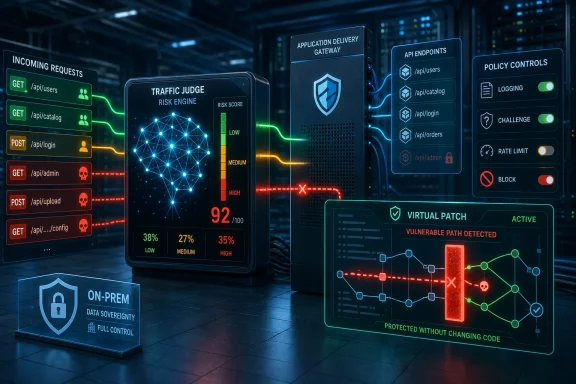
F5 announced on June 9, 2026, that it has added neural-network-based risk scoring, on-premises API security, and virtual patching capabilities to its web application and API protection portfolio within the F5 Application Delivery and Security Platform. The move is less about adding another acronym to the security stack than about shifting the WAF from a rulebook into a real-time adjudicator. F5 is betting that the next phase of application defense will be won by systems that can score intent continuously, not merely recognize known attack strings. That bet is timely, but it also raises the oldest question in security automation: when the machine is allowed to decide faster, who is responsible when it decides wrong?
The web application firewall has always lived with an uncomfortable compromise. It sits close enough to the application to see the attack, but historically it has depended on signatures, tuned policies, and human-maintained rule sets that often arrive after the attacker has already found the weak seam. F5’s new risk engine is an attempt to compress that gap.
The company says the engine uses a neural network that continuously learns from multiple factors, including high-confidence signatures and attack indicators, and then assigns risk to each request. That phrasing matters. F5 is not saying signatures disappear; it is saying signatures become one input among many.
That is the correct framing for 2026. Signature-based blocking is still useful, especially for commodity attack traffic, but it is not a strategy for a world in which reconnaissance, payload mutation, and exploit chaining can be accelerated by AI tools. A modern WAAP platform must infer behavior, not simply match text.
This is also why the announcement fits F5’s broader effort to make its Application Delivery and Security Platform more than a rebranded bundle. F5 has spent years owning the traffic path for enterprise applications through BIG-IP, NGINX, Distributed Cloud services, and related security products. The risk engine pushes the company’s argument one step further: if F5 already sees the requests, it should be able to judge them before the app has to.
That window is where enterprise security most often breaks down. A vulnerability is identified, the scanners light up, a CVE or advisory begins circulating, and the application owner still needs days or weeks to patch, test, stage, and deploy. Attackers do not wait for a CAB meeting.
F5’s answer is to connect detection with policy action and, through its Distributed Cloud Web App Scanning capability, virtual patching at the application delivery layer. A virtual patch is not a substitute for fixing vulnerable code. It is a shield placed in front of the vulnerable path while the real fix moves through engineering and change control.
That distinction will matter to WindowsForum readers running mixed estates. Many organizations still host line-of-business applications on Windows Server, IIS, .NET Framework, legacy middleware, and third-party packages that cannot be patched on a SaaS vendor’s schedule. For those environments, time-to-mitigation is often more important than theoretical purity.
The risk is that virtual patching becomes a sedative. If a WAAP blocks exploit attempts, the urgency to remediate root causes can fade. F5’s platform can reduce exposure, but it cannot resolve technical debt hiding behind old web services, forgotten APIs, and applications no one wants to own.
F5’s newer model tries to treat every request as a signal-producing event. Instead of asking only whether a request matches a known bad pattern, the platform can evaluate the context around it: indicators of exploitation, behavioral anomalies, known signatures, API structure, authentication expectations, and traffic characteristics.
That does not remove the need for policy. It changes where policy lives. Security teams are no longer merely curating a list of forbidden strings; they are deciding what levels of risk merit logging, challenge, throttling, blocking, or temporary compensating controls.
This is where the product direction becomes operationally interesting. A risk score is useful only if it is understandable enough for defenders to act on and predictable enough that application owners trust it. If the platform becomes a black box that “felt suspicious,” it will quickly be demoted to alerting mode in serious environments.
The best version of F5’s approach would give teams machine-speed triage without removing human accountability. The worst version would generate a stream of opaque confidence scores that create the appearance of intelligence while shifting false positives and false negatives into someone else’s ticket queue.
That is a pointed answer to a real buyer objection. Many API security tools assume cloud telemetry, SaaS analytics, or continuous vendor connectivity. That is acceptable for many companies, but it is not always acceptable for defense, public sector, healthcare, financial services, critical infrastructure, or highly segmented industrial environments.
Air-gapped and restricted networks are not magically safe. They often contain some of the most brittle and least visible APIs in the enterprise. Internal APIs can expose sensitive data, lack consistent authentication, drift from documentation, or become dependency traps for applications nobody wants to disturb.
Local API security also speaks to data sovereignty and operational control. Some organizations simply cannot ship API metadata, traffic-derived insights, or schema details to an external service for analysis. For them, a cloud-only security model is not a product limitation; it is a nonstarter.
F5’s advantage is that it already lives in environments where traffic inspection, load balancing, and application delivery have long been local concerns. If the company can bring modern API discovery and risk assessment into those same estates without forcing a cloud dependency, it has a credible path into accounts that newer cloud-native API security vendors struggle to reach.
Those numbers are useful, and buyers should pay attention to independent testing when it is available. Security marketing is full of claims that sound impressive until they are placed in front of a repeatable test harness. A credible third-party score at least gives procurement and security architecture teams something more concrete than a demo.
But benchmark results are not production reality. Real applications have messy authentication flows, undocumented endpoints, partner integrations, mobile clients, brittle legacy behaviors, and business logic that rarely resembles a lab environment. A product that performs well in testing can still require careful tuning before it safely protects a live application.
The AI Guardrails component also deserves careful reading. F5 says the combined WAAP and guardrails approach can block large language model attacks such as prompt injection and improper output handling. That is relevant because enterprises are rapidly placing AI features behind web apps and APIs, but LLM security remains an immature discipline compared with conventional WAF categories.
The correct conclusion is not that F5 has solved AI-era application security. The better conclusion is that the boundary between application security, API security, bot defense, and AI input/output controls is collapsing. F5 is trying to turn that collapse into a platform story.
The repetition does not make the underlying concern false. AI-assisted vulnerability discovery, exploit generation, phishing, credential attack tooling, and payload mutation can increase the tempo of attacks. Even when the attacker is not using a frontier model, automation and cheap compute already make web-facing services a high-volume target.
F5 CTO Joel Moses is right to emphasize the shrinking time between vulnerability identification and exploitation. The industry has spent years improving patch pipelines, yet many enterprises still cannot patch critical applications quickly without risking outages. Attackers only need one exposed path; defenders must preserve the business while closing all of them.
Where the AI narrative becomes slippery is when vendors imply that AI-powered defense cleanly cancels AI-powered offense. It does not. Machine learning can improve prioritization and detection, but it also introduces model drift, explainability problems, and dependence on vendor-controlled training signals.
The more honest framing is that application security is becoming a speed contest. F5’s neural-network risk engine is a tool for competing in that contest. It is not a guarantee of victory.
Many Windows environments still include a mix of IIS-hosted apps, ASP.NET applications, vendor portals, internal APIs, reverse proxies, legacy authentication patterns, and newer cloud services. Those systems often sit behind application delivery controllers or web proxies that became permanent fixtures years ago. If those control points become smarter, the security posture of the whole estate can change without rewriting every application.
That is the optimistic view. The harder view is that more intelligence at the delivery layer can mask how fragile the application layer has become. A risk engine can detect suspicious behavior, but it cannot fix insecure design, broken authorization, missing inventory, or abandoned code.
The most practical use case is not “let the WAF run the security program.” It is “use the WAAP layer to reduce immediate risk while security and application teams prioritize permanent fixes.” That sounds less dramatic, but it is how mature environments actually operate.
The platform also has implications for incident response. If every request is scored and correlated, responders may gain better context during active exploitation. They can see not just that traffic hit a URL, but that the platform considered the request risky based on multiple signals and took a policy action.
At first glance, that sounds like a boom. In practice, it is a warning that spending will rise while pressure on teams remains severe. More budget does not automatically mean more people, more expertise, or cleaner architecture.
Security leaders are being asked to defend more applications, more APIs, more SaaS integrations, more AI experiments, and more cloud footprints while proving efficiency to boards that are tired of tool sprawl. This is why platform consolidation keeps showing up in vendor strategy. If buyers are wary of adding yet another console, sellers must argue that their platform replaces several narrower tools.
F5’s announcement lands directly in that procurement climate. A neural-network-backed WAAP, API security for disconnected environments, bot mitigation, Layer 7 DoS protection, AI Guardrails, and virtual patching all sound like separate categories until they are packaged as one application delivery and security layer.
That packaging will appeal to some enterprises and alarm others. Consolidation can reduce operational drag, but it also deepens vendor dependence. A platform that becomes the enforcement point for applications, APIs, bots, AI traffic, and virtual patches is not just another security control; it is infrastructure.
That distinction matters because alert volume remains one of the great unsolved problems in security operations. Many teams do not fail because they lack logs. They fail because they have too many weak signals and too few people able to interpret them in time.
If F5 can turn raw request telemetry into prioritized context, it improves the defender’s odds. If it simply adds another stream of AI-scored alerts, it joins the pile. The difference will be measured in operational outcomes, not press-release language.
There is also a governance question. When an automated system blocks a request, throttles a client, or applies a virtual patch, someone must be able to explain why. In regulated industries, “the neural network scored it badly” will not satisfy auditors, developers, or business owners if revenue-impacting traffic is disrupted.
That is where F5’s heritage may help. The company sells to organizations that care deeply about uptime and traffic control. A security feature that breaks applications too easily will not last long in F5’s customer base.
But the category has changed because the environment around it changed. APIs became the real application surface. Bots became business logic attackers rather than mere scrapers. AI features introduced new input and output risks. Legacy applications stayed online longer than anyone planned.
In that world, the WAF evolves into something broader: a runtime security broker for application traffic. It watches requests, understands APIs, applies policies, detects bots, mitigates DoS, shields vulnerabilities, and increasingly evaluates AI-specific abuse patterns. WAAP is an awkward acronym, but it reflects a real architectural shift.
F5’s neural-network risk engine is best understood as part of that shift. The company wants the enforcement layer to become adaptive enough to handle attacks that are not yet neatly catalogued. That is a reasonable ambition, provided customers maintain a healthy skepticism about how adaptive systems are trained, validated, and monitored.
The competitive pressure is obvious. Cloudflare, Akamai, Imperva, Fastly, Palo Alto Networks, Microsoft, and cloud provider-native controls are all fighting for pieces of the same application security budget. F5’s differentiation is its long-standing role in enterprise application delivery and its ability to span on-premises, cloud, and restricted environments.
False positives are not a minor inconvenience for application security teams. They can break checkout flows, partner integrations, internal workflows, mobile app sessions, and identity handoffs. Once a security tool is blamed for business disruption, application owners become much less willing to accept aggressive policies.
Risk scoring can help by creating gradations of response. A suspicious request does not always need to be blocked immediately. It can be logged, challenged, rate-limited, routed for deeper inspection, or subjected to a temporary rule while analysts review the evidence.
But scoring also creates temptation. If the dashboard gives a confident number, executives may expect automatic action. Security teams will need to decide where automation is safe, where it needs supervision, and where application-specific context still wins.
This is especially true for APIs. Many API attacks look like legitimate business transactions with malicious intent behind them. Broken object-level authorization, excessive data access, and abuse of sensitive business flows are difficult because the request may be syntactically valid. The machine must understand enough context to distinguish expected use from exploitation.
A sysadmin or security engineer evaluating F5’s direction should focus on deployment realities. Which applications sit behind F5 today? Which APIs are undocumented? Which business units still require on-premises security controls? Which vulnerabilities routinely take too long to patch? Which teams will own policy decisions when automated risk scoring recommends enforcement?
Those questions are less glamorous than neural networks, but they are the difference between buying capability and improving security. A tool that sees traffic across critical apps can become a high-leverage control. A tool deployed without ownership clarity becomes another expensive dashboard.
There is also a skills issue. Application security increasingly requires people who understand HTTP, identity, APIs, cloud routing, legacy application behavior, and attacker tradecraft. Platforms can reduce toil, but they do not remove the need for human judgment at the boundary between infrastructure and software.
F5’s announcement should therefore be read as an invitation to revisit architecture. If the WAAP layer can provide continuous scoring and virtual patching, organizations should decide in advance what kinds of findings trigger immediate action, what gets escalated, and what remains advisory. Waiting until an active exploit campaign is underway is the wrong time to write that playbook.
 F5 Wants the WAF to Stop Waiting for the Signature
The web application firewall has always lived with an uncomfortable compromise. It sits close enough to the application to see the attack, but historically it has depended on signatures, tuned policies, and human-maintained rule sets that often arrive after the attacker has already found the weak seam. F5’s new risk engine is an attempt to compress that gap.The company says the engine uses a neural network that continuously learns from multiple factors, including high-confidence signatures and attack indicators, and then assigns risk to each request. That phrasing matters. F5 is not saying signatures disappear; it is saying signatures become one input among many.
That is the correct framing for 2026. Signature-based blocking is still useful, especially for commodity attack traffic, but it is not a strategy for a world in which reconnaissance, payload mutation, and exploit chaining can be accelerated by AI tools. A modern WAAP platform must infer behavior, not simply match text.
This is also why the announcement fits F5’s broader effort to make its Application Delivery and Security Platform more than a rebranded bundle. F5 has spent years owning the traffic path for enterprise applications through BIG-IP, NGINX, Distributed Cloud services, and related security products. The risk engine pushes the company’s argument one step further: if F5 already sees the requests, it should be able to judge them before the app has to.
The New Selling Point Is Time, Not Detection
The central promise here is not that F5 can identify every new exploit before anyone else. No vendor can credibly claim that. The promise is that risk scoring can buy defenders time between vulnerability discovery and durable remediation.That window is where enterprise security most often breaks down. A vulnerability is identified, the scanners light up, a CVE or advisory begins circulating, and the application owner still needs days or weeks to patch, test, stage, and deploy. Attackers do not wait for a CAB meeting.
F5’s answer is to connect detection with policy action and, through its Distributed Cloud Web App Scanning capability, virtual patching at the application delivery layer. A virtual patch is not a substitute for fixing vulnerable code. It is a shield placed in front of the vulnerable path while the real fix moves through engineering and change control.
That distinction will matter to WindowsForum readers running mixed estates. Many organizations still host line-of-business applications on Windows Server, IIS, .NET Framework, legacy middleware, and third-party packages that cannot be patched on a SaaS vendor’s schedule. For those environments, time-to-mitigation is often more important than theoretical purity.
The risk is that virtual patching becomes a sedative. If a WAAP blocks exploit attempts, the urgency to remediate root causes can fade. F5’s platform can reduce exposure, but it cannot resolve technical debt hiding behind old web services, forgotten APIs, and applications no one wants to own.
Scoring Every Request Changes the Security Conversation
Traditional WAF enforcement often collapses into a binary decision: block or allow. That model is simple to explain and painful to operate. Turn rules too aggressively and users break workflows; run too permissively and attackers stroll through the gray areas.F5’s newer model tries to treat every request as a signal-producing event. Instead of asking only whether a request matches a known bad pattern, the platform can evaluate the context around it: indicators of exploitation, behavioral anomalies, known signatures, API structure, authentication expectations, and traffic characteristics.
That does not remove the need for policy. It changes where policy lives. Security teams are no longer merely curating a list of forbidden strings; they are deciding what levels of risk merit logging, challenge, throttling, blocking, or temporary compensating controls.
This is where the product direction becomes operationally interesting. A risk score is useful only if it is understandable enough for defenders to act on and predictable enough that application owners trust it. If the platform becomes a black box that “felt suspicious,” it will quickly be demoted to alerting mode in serious environments.
The best version of F5’s approach would give teams machine-speed triage without removing human accountability. The worst version would generate a stream of opaque confidence scores that create the appearance of intelligence while shifting false positives and false negatives into someone else’s ticket queue.
API Security Moves Back Inside the Building
The second major piece of the announcement, F5 API Security Local Edition, is just as important as the neural network headline. F5 says the local edition provides API visibility, governance, and security entirely on premises, without depending on external services or cloud connectivity.That is a pointed answer to a real buyer objection. Many API security tools assume cloud telemetry, SaaS analytics, or continuous vendor connectivity. That is acceptable for many companies, but it is not always acceptable for defense, public sector, healthcare, financial services, critical infrastructure, or highly segmented industrial environments.
Air-gapped and restricted networks are not magically safe. They often contain some of the most brittle and least visible APIs in the enterprise. Internal APIs can expose sensitive data, lack consistent authentication, drift from documentation, or become dependency traps for applications nobody wants to disturb.
Local API security also speaks to data sovereignty and operational control. Some organizations simply cannot ship API metadata, traffic-derived insights, or schema details to an external service for analysis. For them, a cloud-only security model is not a product limitation; it is a nonstarter.
F5’s advantage is that it already lives in environments where traffic inspection, load balancing, and application delivery have long been local concerns. If the company can bring modern API discovery and risk assessment into those same estates without forcing a cloud dependency, it has a credible path into accounts that newer cloud-native API security vendors struggle to reach.
The SecureIQLab Numbers Are Strong, but They Are Not the Whole Story
F5 is also leaning on SecureIQLab testing, saying F5 WAAP and F5 AI Guardrails achieved a 97.09 percent total security score. The company says the results included 100 percent accuracy against key risks in the OWASP WAF Top 10 and API Top 10, along with perfect scores for bot attack mitigation and Layer 7 denial-of-service protection.Those numbers are useful, and buyers should pay attention to independent testing when it is available. Security marketing is full of claims that sound impressive until they are placed in front of a repeatable test harness. A credible third-party score at least gives procurement and security architecture teams something more concrete than a demo.
But benchmark results are not production reality. Real applications have messy authentication flows, undocumented endpoints, partner integrations, mobile clients, brittle legacy behaviors, and business logic that rarely resembles a lab environment. A product that performs well in testing can still require careful tuning before it safely protects a live application.
The AI Guardrails component also deserves careful reading. F5 says the combined WAAP and guardrails approach can block large language model attacks such as prompt injection and improper output handling. That is relevant because enterprises are rapidly placing AI features behind web apps and APIs, but LLM security remains an immature discipline compared with conventional WAF categories.
The correct conclusion is not that F5 has solved AI-era application security. The better conclusion is that the boundary between application security, API security, bot defense, and AI input/output controls is collapsing. F5 is trying to turn that collapse into a platform story.
The AI Threat Narrative Is Convenient, but Not Imaginary
Every security vendor now has an AI threat story, and most of them sound suspiciously similar. Attackers are using AI to move faster. Defenders are overwhelmed. Automation is the only way to keep up. Buy the platform.The repetition does not make the underlying concern false. AI-assisted vulnerability discovery, exploit generation, phishing, credential attack tooling, and payload mutation can increase the tempo of attacks. Even when the attacker is not using a frontier model, automation and cheap compute already make web-facing services a high-volume target.
F5 CTO Joel Moses is right to emphasize the shrinking time between vulnerability identification and exploitation. The industry has spent years improving patch pipelines, yet many enterprises still cannot patch critical applications quickly without risking outages. Attackers only need one exposed path; defenders must preserve the business while closing all of them.
Where the AI narrative becomes slippery is when vendors imply that AI-powered defense cleanly cancels AI-powered offense. It does not. Machine learning can improve prioritization and detection, but it also introduces model drift, explainability problems, and dependence on vendor-controlled training signals.
The more honest framing is that application security is becoming a speed contest. F5’s neural-network risk engine is a tool for competing in that contest. It is not a guarantee of victory.
Windows Shops Should Read This as an Application Delivery Story
For Windows-heavy enterprises, the significance of F5’s announcement is not limited to edge security. It is about the growing convergence of application delivery, identity-aware access, API governance, and runtime protection. That convergence increasingly determines whether old and new applications can coexist without becoming an unmanaged attack surface.Many Windows environments still include a mix of IIS-hosted apps, ASP.NET applications, vendor portals, internal APIs, reverse proxies, legacy authentication patterns, and newer cloud services. Those systems often sit behind application delivery controllers or web proxies that became permanent fixtures years ago. If those control points become smarter, the security posture of the whole estate can change without rewriting every application.
That is the optimistic view. The harder view is that more intelligence at the delivery layer can mask how fragile the application layer has become. A risk engine can detect suspicious behavior, but it cannot fix insecure design, broken authorization, missing inventory, or abandoned code.
The most practical use case is not “let the WAF run the security program.” It is “use the WAAP layer to reduce immediate risk while security and application teams prioritize permanent fixes.” That sounds less dramatic, but it is how mature environments actually operate.
The platform also has implications for incident response. If every request is scored and correlated, responders may gain better context during active exploitation. They can see not just that traffic hit a URL, but that the platform considered the request risky based on multiple signals and took a policy action.
The Budget Story Is a Warning Disguised as Growth
The Futurum Group’s market projection gives this announcement its broader economic frame. The firm projects the global cybersecurity market will grow from $335.8 billion in 2025 to $521.7 billion by 2031, a 7.6 percent compound annual growth rate. Cloud security, security operations and governance, risk management and control, data security, and application security are expected to be among the faster-growing categories.At first glance, that sounds like a boom. In practice, it is a warning that spending will rise while pressure on teams remains severe. More budget does not automatically mean more people, more expertise, or cleaner architecture.
Security leaders are being asked to defend more applications, more APIs, more SaaS integrations, more AI experiments, and more cloud footprints while proving efficiency to boards that are tired of tool sprawl. This is why platform consolidation keeps showing up in vendor strategy. If buyers are wary of adding yet another console, sellers must argue that their platform replaces several narrower tools.
F5’s announcement lands directly in that procurement climate. A neural-network-backed WAAP, API security for disconnected environments, bot mitigation, Layer 7 DoS protection, AI Guardrails, and virtual patching all sound like separate categories until they are packaged as one application delivery and security layer.
That packaging will appeal to some enterprises and alarm others. Consolidation can reduce operational drag, but it also deepens vendor dependence. A platform that becomes the enforcement point for applications, APIs, bots, AI traffic, and virtual patches is not just another security control; it is infrastructure.
Automation Helps Most When It Narrows the Human Job
The best argument for F5’s approach is not that it eliminates manual security work. It is that it can make manual work less chaotic. A risk score, if well explained and tied to policy, can help teams decide which events deserve human attention and which can be handled automatically.That distinction matters because alert volume remains one of the great unsolved problems in security operations. Many teams do not fail because they lack logs. They fail because they have too many weak signals and too few people able to interpret them in time.
If F5 can turn raw request telemetry into prioritized context, it improves the defender’s odds. If it simply adds another stream of AI-scored alerts, it joins the pile. The difference will be measured in operational outcomes, not press-release language.
There is also a governance question. When an automated system blocks a request, throttles a client, or applies a virtual patch, someone must be able to explain why. In regulated industries, “the neural network scored it badly” will not satisfy auditors, developers, or business owners if revenue-impacting traffic is disrupted.
That is where F5’s heritage may help. The company sells to organizations that care deeply about uptime and traffic control. A security feature that breaks applications too easily will not last long in F5’s customer base.
The WAF Is Becoming a Runtime Security Broker
For years, critics argued that WAFs were blunt instruments. They were useful for compliance, commodity filtering, and emergency shielding, but not a substitute for secure code. That criticism was fair, and it still is.But the category has changed because the environment around it changed. APIs became the real application surface. Bots became business logic attackers rather than mere scrapers. AI features introduced new input and output risks. Legacy applications stayed online longer than anyone planned.
In that world, the WAF evolves into something broader: a runtime security broker for application traffic. It watches requests, understands APIs, applies policies, detects bots, mitigates DoS, shields vulnerabilities, and increasingly evaluates AI-specific abuse patterns. WAAP is an awkward acronym, but it reflects a real architectural shift.
F5’s neural-network risk engine is best understood as part of that shift. The company wants the enforcement layer to become adaptive enough to handle attacks that are not yet neatly catalogued. That is a reasonable ambition, provided customers maintain a healthy skepticism about how adaptive systems are trained, validated, and monitored.
The competitive pressure is obvious. Cloudflare, Akamai, Imperva, Fastly, Palo Alto Networks, Microsoft, and cloud provider-native controls are all fighting for pieces of the same application security budget. F5’s differentiation is its long-standing role in enterprise application delivery and its ability to span on-premises, cloud, and restricted environments.
The Real Test Will Be False Positives at Enterprise Scale
The most important number F5 did not put at the center of the announcement is the one customers will discover in production: how often the system gets in the way. Blocking attacks is necessary. Avoiding damage to legitimate users is what determines whether the control stays in enforcement mode.False positives are not a minor inconvenience for application security teams. They can break checkout flows, partner integrations, internal workflows, mobile app sessions, and identity handoffs. Once a security tool is blamed for business disruption, application owners become much less willing to accept aggressive policies.
Risk scoring can help by creating gradations of response. A suspicious request does not always need to be blocked immediately. It can be logged, challenged, rate-limited, routed for deeper inspection, or subjected to a temporary rule while analysts review the evidence.
But scoring also creates temptation. If the dashboard gives a confident number, executives may expect automatic action. Security teams will need to decide where automation is safe, where it needs supervision, and where application-specific context still wins.
This is especially true for APIs. Many API attacks look like legitimate business transactions with malicious intent behind them. Broken object-level authorization, excessive data access, and abuse of sensitive business flows are difficult because the request may be syntactically valid. The machine must understand enough context to distinguish expected use from exploitation.
The Forum Crowd Should Watch the Plumbing, Not the Slogan
For WindowsForum’s audience, the practical question is not whether “AI-powered WAAP” sounds modern. It does. The practical question is where this kind of control fits into an existing estate and what it changes for day-to-day operations.A sysadmin or security engineer evaluating F5’s direction should focus on deployment realities. Which applications sit behind F5 today? Which APIs are undocumented? Which business units still require on-premises security controls? Which vulnerabilities routinely take too long to patch? Which teams will own policy decisions when automated risk scoring recommends enforcement?
Those questions are less glamorous than neural networks, but they are the difference between buying capability and improving security. A tool that sees traffic across critical apps can become a high-leverage control. A tool deployed without ownership clarity becomes another expensive dashboard.
There is also a skills issue. Application security increasingly requires people who understand HTTP, identity, APIs, cloud routing, legacy application behavior, and attacker tradecraft. Platforms can reduce toil, but they do not remove the need for human judgment at the boundary between infrastructure and software.
F5’s announcement should therefore be read as an invitation to revisit architecture. If the WAAP layer can provide continuous scoring and virtual patching, organizations should decide in advance what kinds of findings trigger immediate action, what gets escalated, and what remains advisory. Waiting until an active exploit campaign is underway is the wrong time to write that playbook.
F5’s Bet Comes Down to Who Trusts the Traffic Judge
The concrete takeaway is that F5 is trying to make the application delivery layer a more active security decision point. That could be valuable for enterprises drowning in web, API, bot, and AI-related risk, but only if the resulting automation is explainable, tunable, and tied to operational discipline.- F5’s new WAAP capabilities move the WAF model toward continuous request scoring rather than simple signature matching.
- F5 API Security Local Edition is aimed at organizations that need API discovery and protection without cloud connectivity.
- Virtual patching can reduce exposure quickly, but it should not become an excuse to delay permanent code or platform fixes.
- SecureIQLab’s reported 97.09 percent score strengthens F5’s marketing case, though production results will depend on tuning and application complexity.
- The most important operational test will be whether risk scoring reduces analyst workload without creating unacceptable false positives.
- Windows-heavy and hybrid enterprises should evaluate the announcement as part of application delivery architecture, not as a standalone security feature.
References
- Primary source: Security Boulevard
Published: 2026-06-17T19:00:36.083154
F5 Embeds Neural Network in WAF Platform to Continuously Assess Risks - Security Boulevard
F5 enhances its WAAP platform with a neural network-driven risk engine: Real-time threat scoring and patching against AI-driven exploits.securityboulevard.com - Related coverage: f5.com
F5 achieves 97.09% total security protection score for their WAAP and AI Guardrails solution | F5
In a recent security briefing, SecureIQLab evaluated F5’s Application Delivery and Security Platform, studying the platform’s WAAP capabilities when deployed alongside F5 AI Guardrails. The results were impressive, earning a total security score of 97.09%.www.f5.com - Related coverage: ad-hoc-news.de
Security-first twist, F5 Distributed Cloud WAAP targets AI-era threats
F5 is pushing its Distributed Cloud Web Application and API Protection deeper into AI-era security, bundling WAF, API security, DDoS defense and bot protection into one SaaS platform that runs across clouds and at the edge for enterprises modernizing hybrid apps.www.ad-hoc-news.de - Related coverage: f5.com.cn
API security risks persist across all environments, even when air-gapped | F5
Internal APIs often have reduced governance and visibility, creating vulnerabilities that attackers can exploit even if air-gapped or protected on-premises.www.f5.com.cn
