

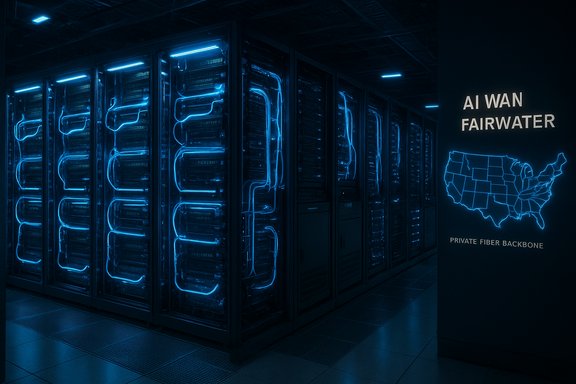
Microsoft’s new Fairwater installation in Atlanta is not a conventional data center expansion — it’s the next step in a deliberate strategy to stitch multiple purpose-built sites into a single, continent-spanning AI compute fabric that Microsoft calls an AI superfactory, powered by a dedicated AI WAN and a bespoke networking protocol co-developed with industry partners. The result: denser racks, rack-to-rack NVLink fabrics, closed‑loop liquid cooling, a two‑story footprint to shorten cable runs, and a private fiber backbone that Microsoft says grew by more than 25% to roughly 120,000 miles in the last year to support near‑real‑time cooperation between sites. Those innovations are designed to let thousands — and by Microsoft’s description, hundreds of thousands — of NVIDIA Blackwell GPUs act like a single, distributed supercomputer across multiple locations.
Background / Overview
Microsoft’s Fairwater program is a purpose-built Azure AI datacenter design focused on frontier AI workloads: massive pre-training, fine-tuning, reinforcement learning, and the end-to-end lifecycle tasks that large foundation-model developers demand. Fairwater started with a Wisconsin site and now includes an Atlanta facility configured around high-density racks of NVIDIA Blackwell-class accelerators, a physical architecture that intentionally departs from conventional cloud datacenter design to squeeze latency and maximize rack-to-rack and site-to-site bandwidth. The architecture emphasizes a single, flat cluster fabric within a site and a dedicated optical backbone across sites to reduce congestion and support very large distributed training jobs. These moves come on the heels of Microsoft’s public commitment to very large capital spending on AI infrastructure: the company disclosed plans to invest roughly $80 billion in fiscal 2025 on AI‑ready data centers and related infrastructure, a strategic bet to secure capacity and performance for Azure’s AI customers. That spending and the strategic importance of major AI customers such as OpenAI have driven Microsoft to rethink network, compute, cooling, and power at scale.What Fairwater Atlanta actually is
A two‑story, ultra‑dense rack design
Fairwater Atlanta uses a two‑story building design intentionally chosen to reduce interconnect distances between racks and thereby lower latency inside the cluster. Shorter runs mean the physical constraints of cable length and signal propagation have less impact on the synchronous communication patterns required by large distributed model training. Microsoft says that rack‑ and row‑level power densities are pushed significantly higher than typical cloud installations — roughly 140 kW per rack and about 1,360 kW per row — enabled by system-level liquid cooling. These are not incremental changes; they are design decisions meant to trade footprint and mechanical complexity for extreme compute density.Liquid cooling and sustainability choices
Fairwater’s cooling is a closed‑loop liquid system designed to reuse coolant for long periods (Microsoft indicates initial fill water equivalent to what about 20 homes use annually, with replacement only when chemistry demands). The system supports the thermals of densely packed GPU racks without high water consumption, and Microsoft emphasizes sustainability by reducing water usage and improving thermal efficiency. Liquid cooling enables greater rack power densities and, according to Microsoft, better steady‑state utilization of GPU fleets during sustained training runs.NVLink and rack‑scale GPU domains
Inside each rack, Microsoft aligns with NVIDIA’s rack-scale GB200/GB300 NVL72 domain approach: up to 72 Blackwell GPUs per rack, connected via NVLink to realize all‑to‑all GPU communication with very high intra‑rack bandwidth (Microsoft cites ~1.8 TB/s GPU‑to‑GPU bandwidth per rack and very large pooled memory domains). NVIDIA’s NVL72 building blocks and NVLink switch fabrics are designed exactly for this kind of dense, low‑latency GPU domain, enabling a single rack to behave like a tightly coupled accelerator for the most demanding training workloads. Microsoft's specification of NVLink and GB200/GB300 align with vendor specs and broader industry deployments.The AI WAN: dedicated fiber and a distributed supercomputer vision
What Microsoft built — a dedicated optical backbone
Microsoft says it built out an AI WAN — an optical backbone of dedicated fiber connecting Fairwater sites so they can behave as a single distributed cluster. That backbone consists of newly built fiber plus repurposed holdings and, per Microsoft, over 120,000 miles of fiber deployed or brought into service in the last year to expand its AI network reach and reliability nationwide. The goal is to allow traffic required for model training to traverse between sites with minimal congestion and with routing optimized to support synchronous, high‑bandwidth GPU‑to‑GPU traffic patterns.Why private fiber matters for distributed training
Training at the scale of trillions of parameters requires frequent, heavy exchanges of gradients and activations between shards of the model during synchronous updates. Public Internet routes or shared cloud backplanes are susceptible to variable congestion and queuing delays that can dramatically slow a training job or waste compute cycles in lock‑step synchronizations. A private optical backbone minimizes the number of hops, reduces jitter and burst congestion, and allows network operators to provision and prioritize flows that directly map to model synchronization needs. Microsoft frames this as enabling a “virtual supercomputer” spanning multiple sites rather than a collection of independent datacenters.The Multi‑Path Reliable Connected (MRC) protocol
Microsoft, NVIDIA, and OpenAI are credited with co‑developing a custom networking protocol Microsoft calls Multi‑Path Reliable Connected (MRC). According to Microsoft’s engineering notes, MRC targets improved telemetry, agile load balancing, packet trimming and spraying, rapid retransmission, and advanced congestion control tuned specifically for AI traffic patterns — traffic that is often latency‑sensitive, bursty, and requires reliable in‑order delivery semantics across multiple physical routes. Microsoft says MRC lets the network choose optimized routes between Fairwater sites and supports aggressive telemetry so the system can detect and recover from loss or congestion rapidly. That level of coordination reflects the tight coupling between middleware, firmware, and fabric control needed for modern distributed machine learning. Caveat: Microsoft’s published technical narrative explains MRC at a high level, but detailed protocol specifications, interoperability guarantees, and third‑party verifications have not been published to the level of an RFC or standards document. This means MRC’s operational boundaries and how it will interoperate with commodity networking stacks remain greenfield and require independent validation to assess portability and lock‑in risk. Treat vendor statements about proprietary protocols as design intent rather than fully auditable technical contracts until specifications are published.Scale, economics, and Microsoft’s capital posture
The $80B infrastructure commitment
Microsoft’s public commitment to invest roughly $80 billion in its fiscal 2025 cycle on AI‑ready infrastructure underpins these projects. That spending covers datacenters, networking, new racks, and associated capital expenditures intended to secure capacity for Azure customers and strategic partners. The scale of that spending — reported by multiple outlets and acknowledged by Microsoft — is a direct response to the surge in demand for GPU‑centric compute and the anticipated runway for foundation‑model development.Why fungibility matters
Fairwater is described as built for “fungibility”: the idea that different classes of compute — training, fine‑tuning, evaluation, and inference — can be assigned to the best‑fit infrastructure across the fleet. A distributed AI WAN makes it possible to redirect workloads dynamically across sites, squeeze latency out of the slowest path segments, and balance utilization so that rare but heavy training jobs do not starve inference or customer‑facing services. Fungibility increases overall resource utilization and can reduce per‑model costs when implemented well.What Microsoft did not disclose (and why it matters)
Microsoft’s public write‑ups emphasize architecture and capabilities but do not publish exact per‑site GPU counts, aggregate FLOPS, or detailed pricing and service SLAs for tenants. Claims about “hundreds of thousands of GPUs” and multi‑exabyte storage across sites are plausible and consistent with NVIDIA’s GB200/GB300 rack‑scale building blocks, but those numbers should be treated as high‑level engineering scale statements rather than independently auditable inventory counts. Independent verification (regulatory filings, customer contract disclosures, or third‑party audits) would be needed to translate marketing‑scale claims into concrete capacity numbers.OpenAI, cloud spend, and the evolving partnership landscape
OpenAI’s multi‑provider strategy and compute spend
OpenAI — historically Microsoft’s marquee AI partner — has broadened its supplier base, inking major compute and cloud deals with multiple parties including CoreWeave, Oracle, AWS, and Google Cloud as part of an effort to secure redundant capacity for its "Stargate"/infrastructure program. OpenAI’s multi‑provider procurement reflects both supply diversity and negotiation leverage, and it complicates the simple narrative of a single hyperscaler‑anchored compute supplier. Multiple industry reports also suggest that OpenAI’s inference spending on Azure alone reached very large, unprecedented levels through 2025. These reports, if accurate, underline why hyperscalers are scaling their AI infrastructure so aggressively.Financial pressure and leaked figures
Independent investigative reporting and leaked financial material discussed in the press suggest that OpenAI’s inference spend on Azure was in the billions of dollars in the first three quarters of 2025 — a figure that, in one analysis, was reported at roughly $8.7 billion by Q3 — and that the organization’s cash burn could be on the order of several billion in 2025. Other reputable outlets have reported projections of a $9 billion cash burn in calendar year 2025 derived from investor documents. These numbers have major implications: if a substantial portion of a model developer’s margins is consumed by raw inference compute, pricing dynamics for enterprise customers and the sustainability of foundation‑model economics come under pressure. Readers should note that leaked financials and newsletter reporting vary and can include assumptions that differ from audited financial statements.Why this matters to Microsoft and the broader cloud market
Microsoft benefits when its customers — like OpenAI — scale and buy Azure capacity, and its Fairwater investments are a strategic way to keep performance and pricing attractive for hyperscale model builders. At the same time, OpenAI’s diversification to other providers dilutes exclusivity and increases price competition among cloud vendors. The economics of AI compute — capital intensity, GPU supply constraints, power and cooling costs, and the need for private fiber — make long‑term contracting and capacity guarantees a central negotiating lever between customers and cloud providers.Operational and systemic risks
Grid dependence and power resilience
Fairwater Atlanta eschews on‑site generation and UPS systems by design, relying heavily on a stable municipal grid and software/hardware power management to smooth peaks. That strategy reduces capital and operational cost but introduces exposure to grid instability and regional weather or transmission events. Microsoft argues city grid reliability and smart power controls — software‑driven load shaping, GPU power thresholds, and local storage to mask short transients — mitigate this risk; however, any long‑duration outage or severe grid event could force workload displacement or cancellations that undermine training schedules. The tradeoff is simple: cost and carbon benefits versus rare but consequential operational risk.Networking protocol lock‑in and interoperability
MRC is presented as a key performance enabler, but when a provider builds proprietary routing and congestion‑control mechanisms that are tailored to its fiber, switches, and device firmware, interoperability becomes a central question. Customers that wish to move workloads off‑platform or stitch on‑premises training clusters to Azure Fairwater may face integration complexity if MRC requires specific hardware or operator control. Without open standards or published protocol specs, industry customers should expect vendor‑specific operational models and limited portability. Microsoft’s adoption of SONiC and broad ethernet ecosystems in parts of the design does, however, signal an attempt to avoid total vendor lock‑in for commodity layers.Security, supply chain, and geo‑resilience
A highly concentrated, single‑cluster superfactory design risks systemic failure modes if a supply chain disruption affects key components (GPUs, interconnects, or specialized power systems), or if regulatory or geopolitical constraints limit the movement of hardware or data. A distributed approach can mitigate some of this risk, but that only works if intersite networking and operational playbooks are robust and redundant. Microsoft’s use of private fiber helps reduce public internet exposure but centralizes critical attack surfaces (fiber cuts, fiber supply chain, cable route security) that require specialized operational controls.Competitive and market implications
Where Microsoft’s AI WAN puts it in the market
Microsoft’s public messaging positions it as building a planet‑scale AI superfactory that is differentiated by integration of custom networking, NVLink rack domains, and a private fiber backbone. This implants Microsoft in the same strategic space as other hyperscalers and specialized providers that are racing to offer predictable, high‑performance AI compute: AWS, Google Cloud, Oracle, CoreWeave, and niche players that sell GPU capacity at scale. The presence of multiple major providers and large multi‑billion dollar deals between OpenAI and other vendors shows that customers want diversified, redundant compute pipelines — and hyperscalers have to both compete on price and guarantee performance and time‑to‑result.Impact on enterprise customers and AI model economics
High‑performance fabrics and private fiber translate into faster training turnaround and improved model iteration velocity. For enterprise customers, that means improved time-to-market for new models and features. But the capital intensity pushes up the cost floor for large models — which raises questions about pricing, multi‑tenant economics, and accessibility for smaller teams. If inference and training economics remain stretched, model owners may pass costs to end customers or pursue architectural changes (quantization, sparsity, distillation) to lower compute intensity. The industry could bifurcate into a tier of frontier model providers that can afford exascale operations and a wider ecosystem focused on more efficient, cheaper inference.Practical takeaways for IT leaders and architects
- For cloud architects: Expect to treat Fairwater‑class sites as differentiated tiers of infrastructure — optimized for large scale training jobs — and to design job placement and scheduling systems that can exploit the AI WAN when synchronization latency matters.
- For procurement teams: Long‑term compute contracts, multi‑provider strategies, and careful SLAs around intersite latency, route resiliency, and packet loss are now strategic levers. Diversification reduces counterparty risk.
- For security and resilience planners: Factor in the operational implications of grid reliance and private fiber routes. Run tabletop exercises for regional grid loss and fiber outages; ensure workload migration and snapshot strategies are tested.
- For model owners: Reassess model architecture for compute efficiency — quantization, parameter sharding, and model compression become cost levers when exascale training bills run into the millions per month. Leverage fungibility across sites to place long‑running epochs in the cheapest high‑throughput facility.
What to watch next
- Whether Microsoft publishes detailed specifications, interoperability docs, or RFC‑style papers for MRC that enable third‑party verification and broader adoption beyond Microsoft’s fiber domain.
- How OpenAI’s multi‑provider strategy and reported inference economics evolve in public filings or audited disclosures — this will shape pricing and demand signals for hyperscaler infrastructure.
- Regulatory and grid resilience responses as hyperscalers lean on municipal power at scale; expect increased scrutiny of energy contracts and local infrastructure impacts.
Conclusion — engineering leap, commercial gamble
Fairwater Atlanta and the AI WAN represent a tangible engineering response to the unique networking and thermal demands of frontier model training. Microsoft has married physical innovation (two‑story datacenter layout, closed‑loop liquid cooling, NVLink rack domains) with network investments (private fiber, MRC protocol) to create an operational environment where geographically dispersed GPUs can behave like a single, coherent supercomputer. That is a meaningful architectural advance in trying to close the distance‑induced performance gap for very large synchronous training jobs. At the same time, the effort amplifies a fundamental commercial tension: the cost of frontier AI — driven by GPU hardware, energy, and now a private fiber backbone — is enormous, pushing customers like OpenAI to multi‑provider strategies and forcing hyperscalers to place very large capital bets. Microsoft’s investments and design choices tilt the economic calculus in favor of performance and utilization, but they also create operational dependencies (grid resilience, proprietary networking) that require careful mitigation. The technology is impressive; the business model that must support it is unproven at the same scale. The next year will be decisive in proving whether “AI WAN” and the concept of an AI superfactory can be both an engineering triumph and a sustainable market proposition.Source: SDxCentral Microsoft details ‘AI WAN’ connecting distributed Fairwater AI superfactory
