

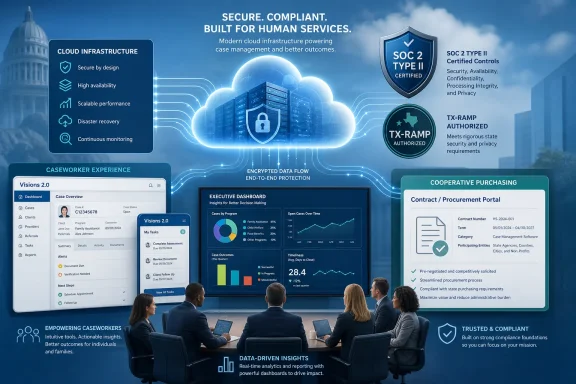
FAMCare announced in May 2026 from St. Louis that it has expanded its Microsoft Azure infrastructure, released FAMCare Visions 2.0, achieved SOC 2 Type II and TX-RAMP Level 2 certifications, and widened procurement access for government buyers through SHI’s NASPO ValuePoint cloud contract. The move is not a flashy consumer-software launch; it is a compliance-and-infrastructure play aimed at agencies that cannot afford unreliable systems or vague audit trails. For human services organizations, the story is less about Azure as a brand name and more about the hardening of a software category that increasingly looks like public-sector critical infrastructure. FAMCare is betting that the next contest in case management software will be won not by the longest feature checklist, but by the vendor that can make data defensible when regulators, funders, courts, and communities come asking.
The phrase “social work case management software” still sounds administrative, almost clerical. That undersells what platforms like FAMCare now do. In child welfare, juvenile justice, behavioral health, aging services, homeless services, tribal programs, victim services, and veterans support, the case record is often the operating system of the agency.
That means these platforms sit at a difficult junction. They hold sensitive personal information, document service delivery, support compliance reporting, and increasingly produce the outcome data that determines whether programs keep funding. A slow or unavailable system is not merely an IT inconvenience; it can interrupt intake, delay referrals, weaken documentation, and leave workers piecing together a person’s history from memory or spreadsheets.
FAMCare’s latest announcement should be read through that lens. Azure expansion, Visions 2.0, SOC 2 Type II, TX-RAMP Level 2, and NASPO availability are separate milestones on paper, but they point in the same direction. The vendor is trying to move from “case management application” to “trusted operational substrate” for organizations whose technology choices are constrained by audits, grant terms, privacy obligations, and procurement rules.
That is also why the announcement matters to WindowsForum readers. This is not a Windows desktop story in the old sense, but it is very much a Microsoft ecosystem story: Azure infrastructure, Power BI integration, cloud procurement, security attestations, and the continuing migration of government-adjacent workloads away from local servers and into managed platforms.
The appeal of Azure is not simply that it can scale. It is that Microsoft’s cloud gives vendors a way to package resilience, identity, monitoring, backup, compliance inheritance, and geographic redundancy into something that a county department or nonprofit agency can procure without building the whole stack itself. For a smaller agency, the alternative may not be a beautifully engineered private cloud; it may be an aging server, a fragile VPN, and an overworked IT generalist trying to keep everything patched.
That does not mean cloud migration removes risk. It changes the shape of risk. Agencies move from worrying primarily about local hardware failure to worrying about vendor controls, shared responsibility, tenant configuration, data residency, identity compromise, third-party access, and contractual exit paths. In regulated work, the cloud is not a magic eraser for operational liability.
FAMCare’s framing is therefore telling. The company is not pitching Azure expansion as a generic modernization badge. It is linking the infrastructure investment directly to defensible data, system resilience, and the ability of frontline teams to access client records when they need them. In social work, uptime and latency are not abstract service-level metrics; they determine whether staff can quickly see prior assessments, safety plans, referrals, authorizations, and outcomes.
There is also a broader market signal here. The human services software sector has long included highly configurable platforms, niche databases, and legacy systems customized to specific state or county processes. By leaning more visibly into Azure, FAMCare is aligning itself with the procurement and security expectations that already dominate Microsoft-heavy public-sector IT environments.
SOC 2 Type II is particularly important because it addresses whether controls operated effectively over time, rather than merely existing on a given day. For agencies storing sensitive client data, that distinction matters. A point-in-time security promise is weaker than an audit-backed demonstration that processes for security, availability, and confidentiality have been functioning across an observation period.
TX-RAMP Level 2 adds a more geographically specific but strategically useful credential. Texas requires certain cloud services used by state agencies and institutions of higher education to meet TX-RAMP certification requirements, and Level 2 is associated with services handling confidential or more sensitive agency data. For vendors selling into public-sector environments, Texas has become one of the states where cloud authorization cannot be treated as a casual checkbox.
FAMCare’s combination of SOC 2 Type II and TX-RAMP Level 2 should therefore be understood as a go-to-market move as much as a security move. The company is telling risk officers and procurement teams that it has done enough of the paperwork, control mapping, and audit preparation to enter serious conversations. In a sector where buyers may be mission-driven but procurement offices are necessarily skeptical, that matters.
The NASPO ValuePoint angle strengthens the same message. FAMCare says it is available through SHI International’s NASPO ValuePoint Cloud Solutions contract, a route that can simplify purchasing for eligible public entities. This does not eliminate agency due diligence, nor should it. But cooperative contracts can shorten the distance between “we need a modern case management platform” and “we have a viable purchasing path.”
Configurability is the first battleground. Agencies rarely operate exactly alike, even when they serve similar populations. Grant requirements differ, state reporting fields differ, court processes differ, tribal governance requirements differ, and local practice models differ. A rigid application forces the agency to contort around the software; a heavily customized application can become expensive, brittle, and difficult to upgrade.
FAMCare’s pitch is that agencies can tailor workflows without custom development. That is the promise every configurable platform makes, but the stakes are real. If Visions 2.0 can let agencies adapt forms, routing, reporting, and program logic without turning every change request into a services engagement, it reduces one of the chronic costs of public-sector software: the hidden tax of customization.
The user interface is the second battleground, and it may be the most underestimated. Social workers and case managers do not need consumer-app whimsy. They need screens that respect time pressure, cognitive load, field work, documentation requirements, and the emotional intensity of the job. A modern UI in this context is not a cosmetic refresh; it is a worker-retention and data-quality issue.
Bad interfaces create bad records. If staff cannot find the right place to enter information, if forms are too slow, if navigation obscures history, or if reporting requirements feel disconnected from actual service delivery, the system will accumulate workarounds. Those workarounds eventually become the audit problem the software was supposed to prevent.
Power BI also places FAMCare squarely inside the Microsoft data ecosystem. For agencies already using Microsoft 365, Entra ID, Teams, SharePoint, SQL Server, or Azure services, Power BI can become the lingua franca of performance management. That is powerful because it lets program leaders, executives, and analysts work with data in a familiar environment instead of relying entirely on canned reports.
But this is where IT leaders should be careful. Data visualization is only as trustworthy as the underlying data model, permissions structure, and governance process. A beautiful dashboard can still mislead if definitions are inconsistent, if fields are incomplete, or if users can slice sensitive client data in inappropriate ways.
The opportunity for FAMCare is to connect case records with outcome-level reporting in a way that agencies can defend. The risk is that every dashboard becomes an invitation to overinterpret messy human services data. A chart showing service completion, housing stability, recidivism, family reunification, or program participation is not merely a business metric; it can influence funding, staffing, and public perception.
That is why “defensible data” is a more consequential phrase than it first appears. In this sector, defensibility means an agency can explain where a number came from, who entered the underlying data, when it changed, what definitions were used, and whether access was controlled. Power BI can make that data visible. It cannot, by itself, make the data trustworthy.
The consequences are not limited to embarrassment or regulatory fines. Data exposure can endanger clients, undermine trust in agencies, and chill participation in services. For victim services and child welfare programs in particular, confidentiality is not an abstract value; it can be a safety condition.
That raises the bar for vendors. Encryption, role-based access controls, logging, availability planning, and audit trails are table stakes. Agencies also need clarity about incident response, breach notification, backup restoration, privileged access, third-party subcontractors, and the practical boundaries of support staff access. In cloud software, the vendor’s internal discipline becomes part of the agency’s risk profile.
FAMCare’s emphasis on SOC 2 Type II, TX-RAMP Level 2, HIPAA-aligned architecture, and role-based access controls is designed to answer that concern. The wording is careful: HIPAA-aligned is not the same thing as magically making every agency HIPAA compliant. Compliance depends on how the system is configured, what data is stored, who uses it, and which legal obligations apply.
Still, the direction is correct. Agencies need vendors that can speak in the language of controls and evidence, not just empathy and mission. The best human services software vendors will have to be both socially literate and security literate. FAMCare is trying to show that it can be both.
For many vendors, the gravitational pull is toward SaaS-only delivery. It simplifies support, speeds upgrades, and gives the vendor greater control over the operating environment. Customers gain convenience but often lose some autonomy. In regulated environments, that tradeoff is not always straightforward.
By keeping multiple deployment models in view, FAMCare may be trying to serve a fragmented market. A large county, a tribal organization, a statewide program, and a small nonprofit may have very different expectations about control, procurement, and IT staffing. A single deployment model can become a barrier before the software is even evaluated.
But flexibility also creates complexity. Supporting hosted subscription, on-premises, and other hosted deployments can make version management, patching, documentation, and customer support harder. The more environments a vendor supports, the more discipline it needs to keep security posture and product capability consistent.
That tension is likely to define this market for several more years. Cloud-first may be the direction of travel, but the human services sector still contains many agencies that cannot move at startup speed. The winners will be vendors that modernize without treating every cautious buyer as backward.
In the past, a system could succeed by helping staff track clients, notes, services, and reports. Today, the same system may need to support performance-based contracts, grant reporting, demographic analysis, privacy audits, incident reviews, and executive dashboards. Every external requirement becomes a workflow requirement.
That is why reporting and configuration sit so close together. If an agency receives a new grant with specific outcome measures, it needs to capture the right fields at the right moments in the service process. If those fields are bolted on later, data quality suffers. If they are embedded naturally into the workflow, reporting becomes a byproduct of practice rather than a scramble before a deadline.
FAMCare’s “defensible, outcome-level data” positioning is aimed at this reality. The company is not simply selling recordkeeping. It is selling the ability to survive scrutiny. In human services, that scrutiny may come from a state agency, a federal grant monitor, a local board, a court, a journalist, or a community demanding proof that a program works.
The danger is that software can also intensify measurement culture in ways that distort practice. Not every meaningful outcome is easy to quantify, and not every data point deserves dashboard treatment. Good software should reduce administrative burden, not turn social workers into data-entry clerks for the benefit of distant reviewers.
For WindowsForum readers, the lesson is familiar. Microsoft no longer needs every workload to be a Windows Server workload in the old-fashioned sense. It wins when applications depend on Azure, integrate with Microsoft identity, expose data through Power BI, and become part of a broader enterprise architecture governed through Microsoft tools.
That does not make FAMCare a Microsoft product. It does make the platform easier to understand as part of the Microsoft public-sector orbit. Agencies that already trust Azure, already manage users through Microsoft identity systems, and already analyze data in Power BI may find the integration story more compelling than a standalone platform with its own reporting universe.
This is where the cloud ecosystem becomes self-reinforcing. The more agencies standardize around Microsoft’s administrative and analytics tools, the more valuable it becomes for vendors to integrate with them. The more vendors integrate, the more agencies see Microsoft as the default environment for public-sector digital operations.
There are tradeoffs. Deep ecosystem alignment can reduce friction, but it can also increase dependency. Agencies should ask how easily they can export data, change analytics tools, migrate identity assumptions, or separate from a vendor if needs change. Public-sector software decisions can outlast the officials, CIOs, and program directors who approve them.
Human services agencies are not blank slates. They arrive with legacy data, program silos, local terminology, forms that encode years of practice, and staff who may be skeptical because they have survived previous software transitions. A new platform version can reduce friction, but it cannot eliminate organizational complexity.
This is especially true for configurable systems. Configuration without governance can become chaos. Every program wants its own fields, statuses, forms, and reports; every supervisor has a preferred workflow; every funder introduces new requirements. Without a disciplined design process, flexibility becomes fragmentation.
The strongest version of FAMCare’s pitch is that Visions 2.0 gives agencies tools to adapt without custom development while the Azure and certification work gives executives confidence in the platform’s foundation. But the actual customer outcome will depend on whether implementation teams can translate messy practice into coherent digital operations.
That is the piece buyers should scrutinize. Ask not only what the software can do, but how the vendor helps agencies decide what it should do. In social work technology, restraint can be as important as capability.
Azure-backed hosting, SOC 2 reporting, TX-RAMP certification, and cooperative procurement are all mechanisms for reducing institutional burden. They do not make technology simple, but they can make it more attainable. A small agency should not need a cloud security engineering team to operate a reliable case management system.
At the same time, outsourcing infrastructure does not outsource accountability. Agency leaders still need to understand access control, data retention, reporting definitions, and incident procedures. They still need internal policies. They still need to train staff. They still need to know what happens when a contract ends.
This is where vendor transparency matters. The most useful platform vendors do not merely say “trust us”; they give customers the documentation, audit evidence, administrative controls, and contractual clarity needed to govern responsibly. Certifications help, but they are not a substitute for operational understanding.
FAMCare’s announcement suggests an awareness of that buyer anxiety. The company is speaking to agencies that want the benefits of cloud modernization but cannot afford ambiguity. In 2026, that may be the mainstream buyer profile, not the exception.
Role-based access controls are therefore not a minor feature. They are the mechanism by which agencies reflect real-world responsibility inside software. A caseworker may need detailed access to assigned clients; a supervisor may need team-level visibility; a grant manager may need aggregate reporting; an executive may need outcomes without unnecessary personal detail.
If those roles are too loose, sensitive data spreads. If they are too restrictive, staff create workarounds. The best systems make appropriate access easy and inappropriate access difficult, while preserving audit trails that can answer uncomfortable questions later.
Power BI integration complicates and elevates this issue. Analytics tools can democratize insight, but they can also widen data exposure if governance is weak. Agencies need to think carefully about row-level security, de-identification, aggregation thresholds, export permissions, and who is allowed to build or publish dashboards.
This is another reason SOC 2 and TX-RAMP matter but do not end the conversation. Platform security is a shared system of vendor controls and customer configuration. FAMCare can provide the scaffolding; agencies still need to decide how authority maps to data.
That anxiety is not theoretical. Public-sector and nonprofit organizations have become attractive targets because they hold sensitive data and often operate with constrained security budgets. At the same time, funders increasingly want outcome evidence, not just activity counts. The software must be secure enough for confidential records and flexible enough for evolving measurement demands.
FAMCare is positioning itself as the compliance-first answer to that problem. The phrase is marketing, but the strategy is coherent. In a crowded software market, compliance credentials, cloud resilience, reporting depth, and procurement accessibility can be more persuasive than a flashy feature demo.
The risk for FAMCare is that “compliance-first” can sound defensive if it is not matched by usability. Social workers do not experience software as a certification portfolio. They experience it as the screen in front of them during a difficult day. If Visions 2.0 genuinely improves daily workflow, the compliance story becomes stronger because the data will be better.
That is the central product truth here: compliance depends on adoption. A system people avoid cannot produce defensible records. A system that supports practice can.
FAMCare’s Azure expansion and Visions 2.0 release show where the human services software market is heading: toward platforms that blend public-cloud resilience, configurable workflows, analytics, and compliance credentials into a single operational promise. The vendors that win will not be the ones that merely move databases into the cloud or collect the most badges. They will be the ones that help agencies turn sensitive human stories into protected, reliable, explainable records without burying frontline workers under the machinery of proof.
 Case Management Software Is Becoming Public Infrastructure
The phrase “social work case management software” still sounds administrative, almost clerical. That undersells what platforms like FAMCare now do. In child welfare, juvenile justice, behavioral health, aging services, homeless services, tribal programs, victim services, and veterans support, the case record is often the operating system of the agency.That means these platforms sit at a difficult junction. They hold sensitive personal information, document service delivery, support compliance reporting, and increasingly produce the outcome data that determines whether programs keep funding. A slow or unavailable system is not merely an IT inconvenience; it can interrupt intake, delay referrals, weaken documentation, and leave workers piecing together a person’s history from memory or spreadsheets.
FAMCare’s latest announcement should be read through that lens. Azure expansion, Visions 2.0, SOC 2 Type II, TX-RAMP Level 2, and NASPO availability are separate milestones on paper, but they point in the same direction. The vendor is trying to move from “case management application” to “trusted operational substrate” for organizations whose technology choices are constrained by audits, grant terms, privacy obligations, and procurement rules.
That is also why the announcement matters to WindowsForum readers. This is not a Windows desktop story in the old sense, but it is very much a Microsoft ecosystem story: Azure infrastructure, Power BI integration, cloud procurement, security attestations, and the continuing migration of government-adjacent workloads away from local servers and into managed platforms.
Azure Is the Argument, Not Just the Hosting Provider
FAMCare says its expanded Microsoft Azure infrastructure is intended to deliver improved performance, greater redundancy, and reinforced data security. Those are familiar cloud promises, but in this market they carry a particular weight. Human services agencies often have small IT teams, uneven budgets, and software estates built over years of grants, local mandates, and program-specific reporting requirements.The appeal of Azure is not simply that it can scale. It is that Microsoft’s cloud gives vendors a way to package resilience, identity, monitoring, backup, compliance inheritance, and geographic redundancy into something that a county department or nonprofit agency can procure without building the whole stack itself. For a smaller agency, the alternative may not be a beautifully engineered private cloud; it may be an aging server, a fragile VPN, and an overworked IT generalist trying to keep everything patched.
That does not mean cloud migration removes risk. It changes the shape of risk. Agencies move from worrying primarily about local hardware failure to worrying about vendor controls, shared responsibility, tenant configuration, data residency, identity compromise, third-party access, and contractual exit paths. In regulated work, the cloud is not a magic eraser for operational liability.
FAMCare’s framing is therefore telling. The company is not pitching Azure expansion as a generic modernization badge. It is linking the infrastructure investment directly to defensible data, system resilience, and the ability of frontline teams to access client records when they need them. In social work, uptime and latency are not abstract service-level metrics; they determine whether staff can quickly see prior assessments, safety plans, referrals, authorizations, and outcomes.
There is also a broader market signal here. The human services software sector has long included highly configurable platforms, niche databases, and legacy systems customized to specific state or county processes. By leaning more visibly into Azure, FAMCare is aligning itself with the procurement and security expectations that already dominate Microsoft-heavy public-sector IT environments.
The Compliance Pitch Is Really a Procurement Pitch
SOC 2 Type II and TX-RAMP Level 2 sound like security announcements, and they are. But their practical force is often felt first in procurement. Certifications and attestations reduce the amount of explanation a vendor must provide before a cautious agency can even consider a purchase.SOC 2 Type II is particularly important because it addresses whether controls operated effectively over time, rather than merely existing on a given day. For agencies storing sensitive client data, that distinction matters. A point-in-time security promise is weaker than an audit-backed demonstration that processes for security, availability, and confidentiality have been functioning across an observation period.
TX-RAMP Level 2 adds a more geographically specific but strategically useful credential. Texas requires certain cloud services used by state agencies and institutions of higher education to meet TX-RAMP certification requirements, and Level 2 is associated with services handling confidential or more sensitive agency data. For vendors selling into public-sector environments, Texas has become one of the states where cloud authorization cannot be treated as a casual checkbox.
FAMCare’s combination of SOC 2 Type II and TX-RAMP Level 2 should therefore be understood as a go-to-market move as much as a security move. The company is telling risk officers and procurement teams that it has done enough of the paperwork, control mapping, and audit preparation to enter serious conversations. In a sector where buyers may be mission-driven but procurement offices are necessarily skeptical, that matters.
The NASPO ValuePoint angle strengthens the same message. FAMCare says it is available through SHI International’s NASPO ValuePoint Cloud Solutions contract, a route that can simplify purchasing for eligible public entities. This does not eliminate agency due diligence, nor should it. But cooperative contracts can shorten the distance between “we need a modern case management platform” and “we have a viable purchasing path.”
Visions 2.0 Shows Where the Real Product Battle Is Moving
The general availability of FAMCare Visions 2.0 is the announcement’s product heart. The company highlights an enhanced configuration engine, a modernized user interface, expanded reporting, and native Microsoft Power BI integration. Those are not random upgrades. They map directly to the pain points that define human services software projects.Configurability is the first battleground. Agencies rarely operate exactly alike, even when they serve similar populations. Grant requirements differ, state reporting fields differ, court processes differ, tribal governance requirements differ, and local practice models differ. A rigid application forces the agency to contort around the software; a heavily customized application can become expensive, brittle, and difficult to upgrade.
FAMCare’s pitch is that agencies can tailor workflows without custom development. That is the promise every configurable platform makes, but the stakes are real. If Visions 2.0 can let agencies adapt forms, routing, reporting, and program logic without turning every change request into a services engagement, it reduces one of the chronic costs of public-sector software: the hidden tax of customization.
The user interface is the second battleground, and it may be the most underestimated. Social workers and case managers do not need consumer-app whimsy. They need screens that respect time pressure, cognitive load, field work, documentation requirements, and the emotional intensity of the job. A modern UI in this context is not a cosmetic refresh; it is a worker-retention and data-quality issue.
Bad interfaces create bad records. If staff cannot find the right place to enter information, if forms are too slow, if navigation obscures history, or if reporting requirements feel disconnected from actual service delivery, the system will accumulate workarounds. Those workarounds eventually become the audit problem the software was supposed to prevent.
Power BI Integration Makes Microsoft’s Gravity Visible
Native integration with Microsoft Power BI may be the most strategically revealing feature in the announcement. It signals that FAMCare understands reporting is no longer a back-office export function. Agencies want dashboards, visualizations, funder-ready metrics, and operational views that can be adjusted as programs change.Power BI also places FAMCare squarely inside the Microsoft data ecosystem. For agencies already using Microsoft 365, Entra ID, Teams, SharePoint, SQL Server, or Azure services, Power BI can become the lingua franca of performance management. That is powerful because it lets program leaders, executives, and analysts work with data in a familiar environment instead of relying entirely on canned reports.
But this is where IT leaders should be careful. Data visualization is only as trustworthy as the underlying data model, permissions structure, and governance process. A beautiful dashboard can still mislead if definitions are inconsistent, if fields are incomplete, or if users can slice sensitive client data in inappropriate ways.
The opportunity for FAMCare is to connect case records with outcome-level reporting in a way that agencies can defend. The risk is that every dashboard becomes an invitation to overinterpret messy human services data. A chart showing service completion, housing stability, recidivism, family reunification, or program participation is not merely a business metric; it can influence funding, staffing, and public perception.
That is why “defensible data” is a more consequential phrase than it first appears. In this sector, defensibility means an agency can explain where a number came from, who entered the underlying data, when it changed, what definitions were used, and whether access was controlled. Power BI can make that data visible. It cannot, by itself, make the data trustworthy.
The Human Services Cloud Has a Different Threat Model
Security discussions in government software often default to the language of frameworks and controls. Those matter, but human services platforms carry a threat model that is both technical and deeply personal. A compromised case record may expose health information, domestic violence history, immigration-related context, juvenile justice involvement, substance-use treatment, family relationships, tribal affiliation, or location details for vulnerable people.The consequences are not limited to embarrassment or regulatory fines. Data exposure can endanger clients, undermine trust in agencies, and chill participation in services. For victim services and child welfare programs in particular, confidentiality is not an abstract value; it can be a safety condition.
That raises the bar for vendors. Encryption, role-based access controls, logging, availability planning, and audit trails are table stakes. Agencies also need clarity about incident response, breach notification, backup restoration, privileged access, third-party subcontractors, and the practical boundaries of support staff access. In cloud software, the vendor’s internal discipline becomes part of the agency’s risk profile.
FAMCare’s emphasis on SOC 2 Type II, TX-RAMP Level 2, HIPAA-aligned architecture, and role-based access controls is designed to answer that concern. The wording is careful: HIPAA-aligned is not the same thing as magically making every agency HIPAA compliant. Compliance depends on how the system is configured, what data is stored, who uses it, and which legal obligations apply.
Still, the direction is correct. Agencies need vendors that can speak in the language of controls and evidence, not just empathy and mission. The best human services software vendors will have to be both socially literate and security literate. FAMCare is trying to show that it can be both.
The Old On-Premises Debate Has Not Vanished
FAMCare says it remains available as a hosted subscription model or as a perpetual license for on-premises or hosted deployment with a separate maintenance agreement. That flexibility is notable because it resists the idea that every agency is on the same cloud timeline. Some public-sector buyers still have policy, integration, bandwidth, data sovereignty, or political reasons to prefer local or separately hosted deployments.For many vendors, the gravitational pull is toward SaaS-only delivery. It simplifies support, speeds upgrades, and gives the vendor greater control over the operating environment. Customers gain convenience but often lose some autonomy. In regulated environments, that tradeoff is not always straightforward.
By keeping multiple deployment models in view, FAMCare may be trying to serve a fragmented market. A large county, a tribal organization, a statewide program, and a small nonprofit may have very different expectations about control, procurement, and IT staffing. A single deployment model can become a barrier before the software is even evaluated.
But flexibility also creates complexity. Supporting hosted subscription, on-premises, and other hosted deployments can make version management, patching, documentation, and customer support harder. The more environments a vendor supports, the more discipline it needs to keep security posture and product capability consistent.
That tension is likely to define this market for several more years. Cloud-first may be the direction of travel, but the human services sector still contains many agencies that cannot move at startup speed. The winners will be vendors that modernize without treating every cautious buyer as backward.
Auditors and Funders Are Becoming Product Managers by Proxy
One of the quieter forces behind FAMCare’s announcement is the growing influence of funders and auditors on software design. Agencies increasingly need to prove not only that services were delivered, but that the data supporting those claims is complete, timely, and tied to outcomes. That pressure changes what a case management platform must be.In the past, a system could succeed by helping staff track clients, notes, services, and reports. Today, the same system may need to support performance-based contracts, grant reporting, demographic analysis, privacy audits, incident reviews, and executive dashboards. Every external requirement becomes a workflow requirement.
That is why reporting and configuration sit so close together. If an agency receives a new grant with specific outcome measures, it needs to capture the right fields at the right moments in the service process. If those fields are bolted on later, data quality suffers. If they are embedded naturally into the workflow, reporting becomes a byproduct of practice rather than a scramble before a deadline.
FAMCare’s “defensible, outcome-level data” positioning is aimed at this reality. The company is not simply selling recordkeeping. It is selling the ability to survive scrutiny. In human services, that scrutiny may come from a state agency, a federal grant monitor, a local board, a court, a journalist, or a community demanding proof that a program works.
The danger is that software can also intensify measurement culture in ways that distort practice. Not every meaningful outcome is easy to quantify, and not every data point deserves dashboard treatment. Good software should reduce administrative burden, not turn social workers into data-entry clerks for the benefit of distant reviewers.
Microsoft’s Public-Sector Flywheel Keeps Spinning
FAMCare’s Azure and Power BI moves fit into a much larger pattern: Microsoft’s steady consolidation of public-sector technology gravity. Azure provides the infrastructure layer, Microsoft 365 provides the productivity layer, Entra ID provides identity, Power BI provides analytics, and procurement vehicles increasingly make Microsoft-adjacent solutions easier to buy. Vendors that align with that stack inherit some of its momentum.For WindowsForum readers, the lesson is familiar. Microsoft no longer needs every workload to be a Windows Server workload in the old-fashioned sense. It wins when applications depend on Azure, integrate with Microsoft identity, expose data through Power BI, and become part of a broader enterprise architecture governed through Microsoft tools.
That does not make FAMCare a Microsoft product. It does make the platform easier to understand as part of the Microsoft public-sector orbit. Agencies that already trust Azure, already manage users through Microsoft identity systems, and already analyze data in Power BI may find the integration story more compelling than a standalone platform with its own reporting universe.
This is where the cloud ecosystem becomes self-reinforcing. The more agencies standardize around Microsoft’s administrative and analytics tools, the more valuable it becomes for vendors to integrate with them. The more vendors integrate, the more agencies see Microsoft as the default environment for public-sector digital operations.
There are tradeoffs. Deep ecosystem alignment can reduce friction, but it can also increase dependency. Agencies should ask how easily they can export data, change analytics tools, migrate identity assumptions, or separate from a vendor if needs change. Public-sector software decisions can outlast the officials, CIOs, and program directors who approve them.
The Press Release Is Optimistic, but the Test Is Implementation
Vendor announcements tend to flatten the hardest part: implementation. FAMCare can expand Azure infrastructure, certify controls, improve configuration, and integrate Power BI, but agencies still have to map workflows, clean data, train users, govern permissions, and manage change. That is where case management projects succeed or fail.Human services agencies are not blank slates. They arrive with legacy data, program silos, local terminology, forms that encode years of practice, and staff who may be skeptical because they have survived previous software transitions. A new platform version can reduce friction, but it cannot eliminate organizational complexity.
This is especially true for configurable systems. Configuration without governance can become chaos. Every program wants its own fields, statuses, forms, and reports; every supervisor has a preferred workflow; every funder introduces new requirements. Without a disciplined design process, flexibility becomes fragmentation.
The strongest version of FAMCare’s pitch is that Visions 2.0 gives agencies tools to adapt without custom development while the Azure and certification work gives executives confidence in the platform’s foundation. But the actual customer outcome will depend on whether implementation teams can translate messy practice into coherent digital operations.
That is the piece buyers should scrutinize. Ask not only what the software can do, but how the vendor helps agencies decide what it should do. In social work technology, restraint can be as important as capability.
Smaller Agencies Need Resilience Without Becoming Cloud Architects
One reason this announcement has broader significance is that many nonprofits and smaller public agencies need enterprise-grade resilience without enterprise-grade IT staffing. They face the same privacy expectations as larger organizations but often lack the personnel to design and maintain sophisticated infrastructure. A managed platform can close that gap.Azure-backed hosting, SOC 2 reporting, TX-RAMP certification, and cooperative procurement are all mechanisms for reducing institutional burden. They do not make technology simple, but they can make it more attainable. A small agency should not need a cloud security engineering team to operate a reliable case management system.
At the same time, outsourcing infrastructure does not outsource accountability. Agency leaders still need to understand access control, data retention, reporting definitions, and incident procedures. They still need internal policies. They still need to train staff. They still need to know what happens when a contract ends.
This is where vendor transparency matters. The most useful platform vendors do not merely say “trust us”; they give customers the documentation, audit evidence, administrative controls, and contractual clarity needed to govern responsibly. Certifications help, but they are not a substitute for operational understanding.
FAMCare’s announcement suggests an awareness of that buyer anxiety. The company is speaking to agencies that want the benefits of cloud modernization but cannot afford ambiguity. In 2026, that may be the mainstream buyer profile, not the exception.
The Case Record Is Now a Security Boundary
The traditional security perimeter has dissolved so many times that the phrase is almost cliché. But in human services, the case record itself is becoming a security boundary. Who can see it, who can change it, who can report on it, and who can export it are central governance questions.Role-based access controls are therefore not a minor feature. They are the mechanism by which agencies reflect real-world responsibility inside software. A caseworker may need detailed access to assigned clients; a supervisor may need team-level visibility; a grant manager may need aggregate reporting; an executive may need outcomes without unnecessary personal detail.
If those roles are too loose, sensitive data spreads. If they are too restrictive, staff create workarounds. The best systems make appropriate access easy and inappropriate access difficult, while preserving audit trails that can answer uncomfortable questions later.
Power BI integration complicates and elevates this issue. Analytics tools can democratize insight, but they can also widen data exposure if governance is weak. Agencies need to think carefully about row-level security, de-identification, aggregation thresholds, export permissions, and who is allowed to build or publish dashboards.
This is another reason SOC 2 and TX-RAMP matter but do not end the conversation. Platform security is a shared system of vendor controls and customer configuration. FAMCare can provide the scaffolding; agencies still need to decide how authority maps to data.
FAMCare Is Selling Confidence in an Anxious Market
The most important word in FAMCare’s announcement may be “confidence.” Agencies are under pressure from regulators, funders, boards, clients, and communities. They need systems that help them demonstrate control at a time when both cyber threats and administrative expectations are rising.That anxiety is not theoretical. Public-sector and nonprofit organizations have become attractive targets because they hold sensitive data and often operate with constrained security budgets. At the same time, funders increasingly want outcome evidence, not just activity counts. The software must be secure enough for confidential records and flexible enough for evolving measurement demands.
FAMCare is positioning itself as the compliance-first answer to that problem. The phrase is marketing, but the strategy is coherent. In a crowded software market, compliance credentials, cloud resilience, reporting depth, and procurement accessibility can be more persuasive than a flashy feature demo.
The risk for FAMCare is that “compliance-first” can sound defensive if it is not matched by usability. Social workers do not experience software as a certification portfolio. They experience it as the screen in front of them during a difficult day. If Visions 2.0 genuinely improves daily workflow, the compliance story becomes stronger because the data will be better.
That is the central product truth here: compliance depends on adoption. A system people avoid cannot produce defensible records. A system that supports practice can.
The Practical Reading for WindowsForum’s IT Crowd
FAMCare’s announcement is not a mass-market Microsoft story, but it lands squarely in the world IT pros now inhabit: cloud infrastructure, compliance inheritance, identity governance, analytics integration, and procurement constraints all converging inside line-of-business software. For agencies evaluating case management platforms, the news offers several concrete signals.- FAMCare is leaning further into Microsoft Azure as the infrastructure foundation for hosted case management workloads.
- FAMCare Visions 2.0 appears aimed at reducing custom-development dependency through stronger configuration, a refreshed interface, expanded reporting, and Power BI integration.
- SOC 2 Type II and TX-RAMP Level 2 certifications give procurement, security, and compliance teams more evidence to review, but they do not replace agency-specific due diligence.
- NASPO ValuePoint availability through SHI can make purchasing simpler for eligible public-sector buyers, especially where cooperative contracts are already part of the procurement playbook.
- Agencies should treat Power BI integration as both an analytics opportunity and a governance responsibility, because dashboards can expose sensitive patterns as easily as they reveal operational insight.
- The hardest work remains implementation, including workflow design, permissions, data migration, staff training, and long-term reporting governance.
FAMCare’s Azure expansion and Visions 2.0 release show where the human services software market is heading: toward platforms that blend public-cloud resilience, configurable workflows, analytics, and compliance credentials into a single operational promise. The vendors that win will not be the ones that merely move databases into the cloud or collect the most badges. They will be the ones that help agencies turn sensitive human stories into protected, reliable, explainable records without burying frontline workers under the machinery of proof.
References
- Primary source: Carroll County Mirror-Democrat
Published: 2026-06-02T16:30:16.308917
FAMCare Strengthens Social Work Case Management Software with Azure Expansion
famcare.net Adds Azure Infrastructure, Visions 2.0, and Two Security Certifications St. Louis, United States - May 31,www.mycarrollcountynews.com - Related coverage: famcare.net
- Related coverage: shi.com
SHI Awarded Multi-Year NASPO ValuePoint Software Value-Added Reseller Contract | News | SHI
NASPO ValuePoint facilitates administration of the NASPO group contracting consortium of state Chief Procurement Officials for the benefit of cooperative procurement for state departments, institutions, agencies, and political subdivisions; as well as other eligible entities.www.shi.com
- Related coverage: smartsuite.com
TX-RAMP - Level 2
TX-RAMP Level 2 assesses and authorizes cloud services used by Texas agencies to secure confidential or regulated data. www.smartsuite.com
- Related coverage: dir.texas.gov
TX-RAMP Resources Library | Texas Department of Information Resources
Resources Welcome to the TX-RAMP Resources page to view all of the TX-RAMP resources available to help guide your organization and prepare for the upcoming impacts of TX-RAMP. Resources are developed based on DIR TX-RAMP submissions to help you through the TX-RAMP submission process.dir.texas.gov

