

Microsoft’s Research team has quietly released Fara‑7B, a compact but capable on‑device agentic model that sees your screen, predicts mouse and keyboard actions, and executes multi‑step web tasks locally on Windows, marking a deliberate shift from cloud‑first assistant designs toward private, low‑latency local AI for everyday computer use.
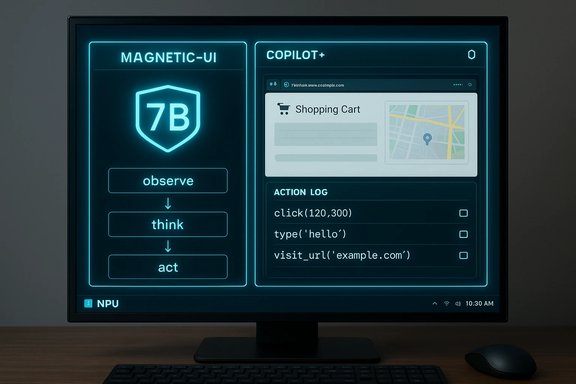
Fara‑7B is described by Microsoft as a Computer Use Agent (CUA) — a new class of small language models (SLMs) designed not just to generate text but to act inside a desktop environment by ingesting screenshots plus a textual goal and emitting structured “observe → think → act” steps (for example: click(x,y), type("..."), scroll. The model is compact (roughly 7 billion parameters) and built on a multimodal backbone derived from Qwen‑2.5‑VL‑7B, enabling it to reason about pixels and text together. Microsoft published the research writeup and supporting artifacts in late November 2025 and released the model weights as an open‑weight research artifact, making Fara‑7B available for community inspection and experimentation. Microsoft pairs the model with a developer sandbox called Magentic‑UI and provides quantized, hardware‑optimized variants intended for Copilot+ PCs — machines with NPUs designed to accelerate local inference.
Caveat: vendor‑reported counts (trajectories, GPUs used for training, step counts) are useful but require independent verification; treat exact infrastructure claims as vendor‑provided unless independently audited.
Key corroborations:
To make local inference practical, Microsoft supplies quantized and silicon‑optimized builds intended for Copilot+ PCs — Windows 11 machines with modern NPUs (neural processing units) that accelerate low‑bit quantized models. On such hardware, the model can run with acceptable latency and local privacy properties that Microsoft calls “pixel sovereignty” (keeping screenshots, action traces and inference on device). Practical takeaway: on a properly equipped Copilot+ machine with an NPU and optimized runtime, Fara‑7B is designed to run locally rather than send sensitive UI images to cloud servers. This reduces round‑trip latency and potential data egress — an attractive characteristic for regulated enterprises and privacy‑sensitive users.
Key risks:
Opportunities:
This release underscores two converging trends:
For Windows users and developers, Fara‑7B is both a practical tool to prototype local agents and a concrete prompt to rethink permissions, identity, and logging for the next generation of desktop assistants. The coming months should focus on independent benchmarking, enterprise pilot programs under strict controls, and cross‑industry standards for agent auditability and attestation so that on‑device convenience does not come at the cost of avoidable risk.
Microsoft’s Fara‑7B is an important milestone in the evolution of Windows as an agent platform: it proves that efficient agentic models can act like humans on a desktop while running locally, but it also hands administrators and developers a complex set of operational and security responsibilities that cannot be deferred. Experiment with care, log everything, and treat agentic features as first‑class security primitives in the Windows ecosystem.
Source: Futura, Le média qui explore le monde New Microsoft AI that clicks, types and browses like a human runs locally - Futura-Sciences
 Background / Overview
Fara‑7B is described by Microsoft as a Computer Use Agent (CUA) — a new class of small language models (SLMs) designed not just to generate text but to act inside a desktop environment by ingesting screenshots plus a textual goal and emitting structured “observe → think → act” steps (for example: click(x,y), type("..."), scroll. The model is compact (roughly 7 billion parameters) and built on a multimodal backbone derived from Qwen‑2.5‑VL‑7B, enabling it to reason about pixels and text together. Microsoft published the research writeup and supporting artifacts in late November 2025 and released the model weights as an open‑weight research artifact, making Fara‑7B available for community inspection and experimentation. Microsoft pairs the model with a developer sandbox called Magentic‑UI and provides quantized, hardware‑optimized variants intended for Copilot+ PCs — machines with NPUs designed to accelerate local inference. What Fara‑7B actually is
A short technical snapshot
- Model class: Agentic Small Language Model (CUA).
- Parameter count: ~7 billion parameters (7B).
- Backbone: Built on or distilled from Qwen‑2.5‑VL‑7B (multimodal).
- Context window: Very long context support (Microsoft cites up to 128k tokens).
- Inputs: One or more screenshots (pixel inputs), a textual goal, and action/history trace.
- Outputs: Human‑readable chain‑of‑thought reasoning followed by structured tool calls that encode UI primitives (pixel coordinates for clicks, typed text, scrolls, visit_url, web_search, etc..
How it perceives and acts
Fara‑7B uses visual grounding — it ingests screenshots and reasons about the visible layout the way a human would, predicting pixel coordinates for interactions rather than relying on DOM trees or accessibility APIs. That makes it broadly usable across sites with obfuscated DOMs, but it also means the model is sensitive to visual layout changes, dynamic UIs, and CAPTCHAs. The runtime typically executes the model’s primitive actions through a Playwright‑style interface inside Magentic‑UI, which records and auditable logs every step.Training, data pipeline and why 7B matters
Microsoft’s published materials explain the core idea: a synthetic, multi‑agent trajectory generator (referred to internally as FaraGen or Magentic‑One) created large numbers of multi‑step web interaction traces (search, click, fill, submit) and filtered them with verifier agents. The high‑quality synthetic dataset — reported in the research notes as hundreds of thousands of trajectories and roughly a million verified steps — was used to supervise‑fine‑tune a compact 7B model that can plan and act efficiently. This distillation approach is the technical rationale for compressing agentic capability into a small footprint that can run locally. Why does this matter? Large cloud models are powerful but expensive and privacy‑exposing; Microsoft’s thesis is that carefully engineered data pipelines and task specialization can let much smaller models match larger agents’ practical performance on domain‑specific tasks while enabling local execution on consumer hardware.Caveat: vendor‑reported counts (trajectories, GPUs used for training, step counts) are useful but require independent verification; treat exact infrastructure claims as vendor‑provided unless independently audited.
Benchmarks and performance: what the numbers say
Microsoft’s reported benchmark highlights include a 73.5% task‑completion score on the WebVoyager benchmark, a result the company cites as competitive or superior to larger prompt‑driven agent set‑ups in certain configurations. Microsoft also reports that Fara‑7B typically completes tasks in far fewer steps (≈16 average steps) compared with some comparators (≈41 steps), a measure the company uses to argue for practical efficiency. Independent and third‑party checks reported lower but still notable performance numbers (for example, Browserbase’s independent evaluation protocol cited lower WebVoyager scores), highlighting the standard caveat: benchmark harnesses, dataset selection, evaluation policies and retry rules materially shape outcomes. In short, the public numbers are promising but should be interpreted as qualified until independent cross‑vendor replication is abundant.Key corroborations:
- Microsoft Research technical brief and model card publish the benchmark claims and experimental setup.
- Multiple tech outlets and community benchmarks reported similar figures and flagged the vendor‑supplied nature of the evaluation.
How Fara‑7B runs on your PC: Magentic‑UI, Copilot+ PCs and pixel sovereignty
Microsoft provides a research sandbox — Magentic‑UI — which exposes Playwright‑style primitives to the model and logs a visible chain of thought for auditability. The company recommends running experiments inside Dockerized or VM sandboxes and building human‑in‑the‑loop gates at predefined “Critical Points” (actions where irreversible changes or sensitive operations might occur, such as purchases, logins, or message sends).To make local inference practical, Microsoft supplies quantized and silicon‑optimized builds intended for Copilot+ PCs — Windows 11 machines with modern NPUs (neural processing units) that accelerate low‑bit quantized models. On such hardware, the model can run with acceptable latency and local privacy properties that Microsoft calls “pixel sovereignty” (keeping screenshots, action traces and inference on device). Practical takeaway: on a properly equipped Copilot+ machine with an NPU and optimized runtime, Fara‑7B is designed to run locally rather than send sensitive UI images to cloud servers. This reduces round‑trip latency and potential data egress — an attractive characteristic for regulated enterprises and privacy‑sensitive users.
Real world UX: demos and failure modes
Microsoft’s demo scenarios emphasize everyday, low‑risk tasks:- Browsing and summarizing search results.
- Adding items to a shopping cart and pausing at the checkout Critical Point.
- Driving mapping services to compute distances and extract points of interest.
- Brittleness on dynamic or highly interactive pages: pixel‑based coordinate prediction can misfire on layouts that change or contain animated content.
- Fragile recovery from misclicks: small coordinate errors can cascade into wrong pages, requiring robust rollback logic in the host runtime.
- Anti‑bot defenses and CAPTCHAs: these remain a substantial obstacle; robust agentic navigation must include fallback strategies for explicit human interaction.
Security, privacy and governance: new surfaces, old problems
Fara‑7B’s ability to click, type, and navigate introduces important endpoint risk vectors that require enterprise controls and thoughtful governance.Key risks:
- Expanded attack surface: An automated agent that can interact with web UIs creates new privilege classes. If an agent is tricked into clicking a malicious link or entering credentials, the consequences can be severe. Software‑level Critical Points help, but they are not a silver bullet; layered OS controls (agent accounts, ACLs), DLP integration, and MDM policy are necessary.
- Dual‑use of open weights: Making weights publicly available accelerates defensive research and transparency, but it also lowers the bar for malicious actors to study and probe the model, discover failure modes, and craft jailbreaks. Microsoft acknowledges this trade‑off and pairs the release with red‑teaming and documented refusal behaviors — but defenders must assume increased adversary interest.
- Auditability and provenance: Every agent action must produce immutable logs and signed manifests if used in sensitive contexts. Microsoft’s Magentic‑UI records action traces, but integrating those logs with enterprise SIEM, attestation and policy engines is an operational necessity.
- Fara‑7B’s local execution model can reduce cloud egress of screenshots and action traces — a major advantage for regulated industries. However, local does not equal secure by default; sandboxing, strict file system and network permissions, and secure storage for models and logs are required to realize the privacy benefits.
Responsible deployment: recommended safeguards and a practical checklist
Microsoft and community reporting converge on a practical set of precautions for experimenting with or piloting Fara‑7B:- Use Magentic‑UI Docker sandbox or a fully isolated VM for any experiments; avoid production accounts.
- Start with read‑only goals: search, summarize, or extract data without logging in or transacting.
- Require explicit user confirmation at every Critical Point (checkout, credentials, message sending).
- Capture and retain detailed action logs; feed those logs into a security review process and test them against red‑team scenarios.
- Apply OS‑level guardrails: run agents under non‑admin accounts, enforce ACLs, limit network access, and use DLP/MAM policies where applicable.
- Use content safety filters and programmatic checks for high‑risk outputs.
Developer and IT operational implications
For developers and IT teams, Fara‑7B is both an opportunity and a mandate.Opportunities:
- Faster local automation prototypes: with 7B weights and quantized builds, researchers and developers can prototype agentic features without the expense of cloud API calls.
- New UX patterns: agents that act on behalf of users enable new Windows affordances — taskbar agent controls, Ask Copilot entry points, and visible Agent Workspace sandboxes that surface agent status and trust.
- Open‑weight tooling: MIT‑licensed weights and Hugging Face model cards accelerate ecosystem innovation and third‑party tooling (for example, instrumented runtimes and runtime attestations).
- Policy design: IT must classify agent capabilities, map them to resource scopes, and define per‑agent permission sets. Agent accounts should be revocable and auditable.
- Hardware standardization: OEMs and enterprise procurement must require clear NPU capabilities and present meaningful real‑world benchmarks; marketing TOPS claims are insufficient without reproducible task metrics.
- Continuous validation: Because agents interact with third‑party websites, teams must implement continuous monitoring and automated regression tests to detect UI drift and functional breakage.
Competitive context and industry trends
Fara‑7B is part of a broader industry push toward compact, task‑specialized local models and agentic systems. Competitors and adjacent efforts include agentic browsers and mobile agent launches that aim to provide similar “agent acts on web” capabilities — but the distinguishing features of Fara‑7B are Microsoft’s explicit ecosystem play (Copilot front end, Agent Workspace primitives, Magentic‑UI), the open‑weight release, and the emphasis on pixel‑based perception rather than DOM‑centric approaches.This release underscores two converging trends:
- The hardware acceleration of local inference (NPUs on Copilot+ PCs) that makes on‑device agents viable.
- The use of synthetic multi‑agent data pipelines to cheaply produce vast numbers of verified interaction traces that enable small models to learn complex multi‑step behavior.
What remains unverified or needs close watching
Microsoft’s materials are thorough, but several items need independent verification or longer observation:- The generalization of benchmark performance to adversarial, dynamic, and international websites: vendor benchmarks are promising but not definitive. Independent community benchmarking is essential.
- Exact training infra and counting claims (e.g., specific GPU counts and training wall‑clock) — some model card details appear vendor‑provided and merit cautious interpretation until reproducible logs are available.
- The attack surface in real enterprise settings: sandboxing and Critical Points mitigate risk, but real deployments will surface novel bypasses and UX‑security tradeoffs that only operational experience will reveal.
How to try Fara‑7B safely today (concise starter recipe)
- Download the Magentic‑UI Docker artifacts and the Fara‑7B research weights into an isolated lab network.
- Allocate a Copilot+ test machine (or an NPU‑equipped lab PC) and use the provided quantized build for low‑latency inference.
- Run the canonical read‑only demos (search + summarize) and inspect the chain‑of‑thought outputs and full action logs.
- Gradually add gates: Critical Point confirmations for any form submission, sign‑in or payment flows.
- Engage a security red team to attempt to induce unsafe actions or bypass confirmation gates before any pilot on real users or production data.
Final assessment — opportunity and caution in equal measure
Fara‑7B represents one of the clearest demonstrations yet that local, private, agentic AI is practical for many everyday desktop tasks. The combination of a compact 7B parameter footprint, a synthetic data pipeline that produces verified multi‑step trajectories, and silicon‑optimized builds for NPUs creates a credible path for on‑device automation that avoids sending UI images to cloud providers. That is a meaningful shift for privacy‑sensitive scenarios and low‑latency applications. At the same time, the release amplifies known and novel risks. Agents that act like users broaden the endpoint threat model, increase the governance burden on IT, and demand robust sandboxing, attestation, and continuous validation. The open‑weight decision accelerates research and defensive hardening — but it also invites adversarial study. The prudent path is not to ban agentic experiments but to adopt structured, instrumented, auditable pilots that integrate security, legal, and product risk controls from day one.For Windows users and developers, Fara‑7B is both a practical tool to prototype local agents and a concrete prompt to rethink permissions, identity, and logging for the next generation of desktop assistants. The coming months should focus on independent benchmarking, enterprise pilot programs under strict controls, and cross‑industry standards for agent auditability and attestation so that on‑device convenience does not come at the cost of avoidable risk.
Microsoft’s Fara‑7B is an important milestone in the evolution of Windows as an agent platform: it proves that efficient agentic models can act like humans on a desktop while running locally, but it also hands administrators and developers a complex set of operational and security responsibilities that cannot be deferred. Experiment with care, log everything, and treat agentic features as first‑class security primitives in the Windows ecosystem.
Source: Futura, Le média qui explore le monde New Microsoft AI that clicks, types and browses like a human runs locally - Futura-Sciences
