FEV and Microsoft are partnering to run Microsoft’s Phi-4-mini-instruct locally on NVIDIA DRIVE AGX accelerated compute, positioning in-car generative AI as an offline-capable vehicle feature rather than a cloud-only dashboard assistant.
FEV and Microsoft announced on Thursday, July 9, 2026, that they are collaborating on in-vehicle generative AI built on NVIDIA GPU-accelerated compute, using Microsoft’s Phi-4-mini-instruct in Microsoft Foundry on NVIDIA DRIVE AGX. The important takeaway is not that another company wants to put a chatbot in a car. It is that the companies are describing a system designed to keep core AI-assisted vehicle interactions available without a permanent internet connection.
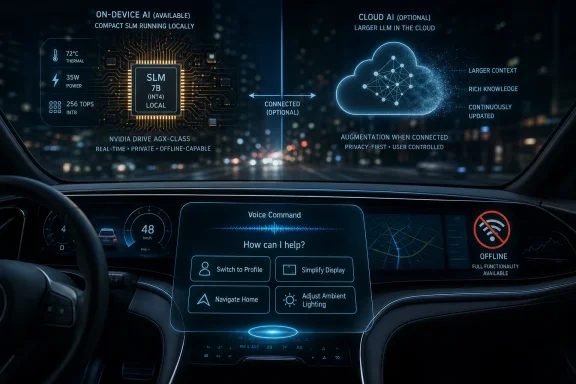
That changes the shape of the story. Many automotive AI demonstrations still assume that the vehicle is mostly an endpoint: the driver speaks, the car sends the request to the cloud, a remote model processes it, and the answer comes back. FEV and Microsoft are talking about a more vehicle-centered architecture, where a small language model can run inside the car and cloud-based large language models can supplement it when needed.
BusinessMole framed the collaboration as a way to integrate NVIDIA GPU-accelerated compute and AI model microservices into vehicles for multimodal voice, text, and gesture interactions. The Manila Times, carrying the Newsaktuell item from Aachen, Germany, described the same core idea: in-car interaction that can work directly in the vehicle, independent of a permanent internet connection. That line is the practical difference between an assistant that works only when the network cooperates and one that can still handle supported tasks in a garage, tunnel, rural road, or congested cellular zone.
The first examples are intentionally narrow: dashboard configuration and individual vehicle profiles through voice commands. That may sound modest compared with autonomous-driving headlines, but it is exactly the sort of in-cabin task where generative AI can be useful if it is fast, constrained, and reliable. Modern vehicle settings are already sprawling across displays, profile menus, infotainment pages, climate controls, safety notifications, accessibility options, and driver-preference systems. If an assistant can understand a natural request and map it safely to those functions, it can reduce friction without pretending to drive the car.
For OEMs, the more important change is architectural. Running Phi-4-mini-instruct locally on NVIDIA DRIVE AGX gives automakers a path to place some AI inference inside the vehicle rather than sending every request to a backend. That can help with latency, resilience, and operating cost, especially for repeated low-risk tasks that do not need broad world knowledge. It also gives OEMs more control over which functions run locally, which escalate to cloud-based models, and which should not be handled by generative AI at all.
What this enables now, based on the announcement, is a credible development path for local in-cabin AI focused on domain-specific tasks such as dashboard and profile configuration. It also supports a hybrid model in which a local small language model acts as a baseline or backup while cloud-based LLMs remain available for broader or heavier tasks.
What remains speculative is equally important. The announcement does not name an automaker that will ship this in a production vehicle. It does not provide a rollout date for consumers. It does not specify which vehicle lines, operating systems, regions, or trim levels might use the technology. It does not describe the exact split between local processing and cloud escalation. It does not publish data-handling rules, retention policies, driver-consent flows, update cadence, validation process, or safety boundaries. Until those details appear, this should be read as a platform collaboration and engineering direction, not as a finished feature coming to a named model next month.
FEV and Microsoft are not claiming that Phi-4-mini-instruct replaces every cloud-based large language model in every automotive scenario. The source material is more measured: the embedded small language model can serve as local backup intelligence for cloud-based LLMs, and cloud-based LLMs can be supplemented or partially replaced depending on the use case. That distinction matters because automotive computing has harder constraints than a browser, phone, or smart speaker. Cars face limited power budgets, long product cycles, demanding reliability expectations, uneven connectivity, and complex software stacks.
The local-inference argument can be stated simply: common vehicle-control and personalization tasks should not always need a round trip to the cloud. A local model does not need to know the entire internet to interpret a request such as changing a display layout, applying a profile, or adjusting a supported cabin setting. It needs to understand the vehicle’s available functions, the driver’s intent, the current state, and the rules that determine whether the request is allowed. That is a domain-specific automotive problem, not a general web-search problem.
Thomas Hülshorst, Group Vice President Intelligent Mobility and Software at FEV, said the collaboration with Microsoft and NVIDIA shows how small, efficient language models can transform in-vehicle experiences by delivering powerful functionality without the overhead of larger systems. In this context, “overhead” means more than raw compute. It includes latency, connectivity dependence, backend scaling, recurring infrastructure cost, and the difficulty of making remote intelligence feel native inside a car.
Cloud-based LLMs still have clear advantages. They can support broader knowledge, heavier reasoning, centralized updates, fleet-level services, and integrations beyond the vehicle. But in the FEV-Microsoft approach, the cloud is no longer the only place where language understanding can happen. The vehicle gets its own local intelligence layer for supported tasks, with cloud services used where they make sense.
That matters because automotive AI failures are often mundane rather than dramatic. A driver asks for a profile change and the assistant stalls. A voice command fails in a parking garage. A backend update changes behavior. A service outage turns a premium feature into a spinner. These are not necessarily safety incidents, but they train customers to distrust the feature.
Local inference changes that failure mode. If central functions remain available with limited or no internet connection, the vehicle can preserve a baseline of usefulness when cloud features degrade. BusinessMole used the phrase “local backup,” while The Manila Times version described embedded small language models as robust local backup intelligence for cloud-based LLMs. The implication is straightforward: the in-car assistant should not collapse just because the backend is unavailable.
The source material says embedded small language models can reduce backend and infrastructure costs because cloud-based LLMs can be supplemented or partially replaced depending on the use case. That is not a side note. Generative AI features can become expensive to operate at scale if every user interaction triggers remote inference. In a vehicle fleet, that problem is complicated by long ownership periods, different regional connectivity conditions, and the need to support features for years after a car is sold.
A cloud-only assistant creates uncomfortable tradeoffs. If the automaker absorbs inference costs, margins can suffer as usage grows. If the customer pays through a subscription, adoption may be limited. If the feature is throttled or discontinued, the software-defined vehicle promise becomes weaker. Local inference does not make AI free, but it can make some costs more predictable by shifting supported tasks onto hardware already inside the vehicle.
The value is not “small model good, large model bad.” The value is placement. Some requests belong in the vehicle. Some belong in the cloud. Some should stay with conventional controls. The decision matters because software-defined vehicle functions become recurring obligations once they ship to customers.
For OEM planning, the practical framework looks like this:
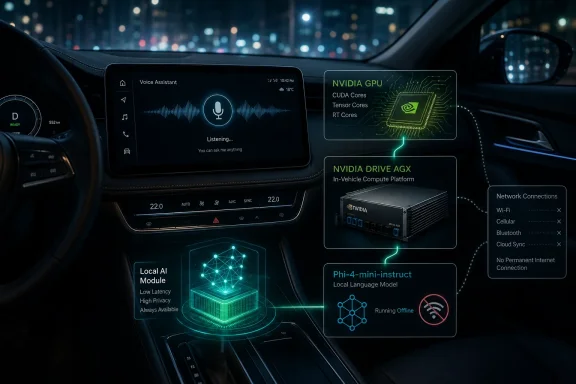
The announcement names NVIDIA DRIVE AGX accelerated compute. That matters because running an AI assistant inside a car is not the same as running a voice assistant on a countertop device. The vehicle environment includes thermal constraints, power limits, safety boundaries, long-lived hardware, and interaction with many electronic systems. Automotive software also has to survive a product lifecycle much longer than a typical consumer app.
The important point is not simply that a GPU is present. It is that automakers increasingly want centralized or domain-based compute platforms that can support multiple software-defined experiences: driver assistance, cabin intelligence, personalization, sensing, infotainment, and future feature updates. FEV and Microsoft are applying that compute direction to generative AI inside the cabin rather than limiting it to autonomy or perception.
That boundary should stay clear. The announcement does not turn Phi-4-mini-instruct into a driving system. The cited examples are dashboard and individual vehicle profile configuration, not steering, braking, or perception. Voice-driven in-cabin AI can still create problems if it is poorly designed, but it is a different category from autonomous-driving decision-making. A responsible deployment would keep the assistant inside defined permissions, validate requested actions, ask for confirmation when appropriate, and preserve conventional controls when the model misunderstands a command.
The phrase “AI model microservices” is also notable because it suggests a modular approach rather than one all-powerful assistant bolted onto infotainment. In a vehicle, modularity matters. OEMs need to isolate capabilities, manage versions, update components, constrain access, and contain failure. That is how generative AI becomes deployable in a setting where “the model got confused” is not an acceptable product strategy.
That matters because the car is a poor place to rely on only one interaction method. Touchscreens can distract. Voice can struggle with cabin noise, accents, overlapping passengers, or situations where a driver simply does not want to speak. Gesture can be ambiguous, but it may be useful for quick adjustments. Text can matter when parked, in companion apps, or on passenger-side displays.
The design challenge is not just recognizing input. It is arbitration. If a driver speaks one command, taps a control, and gestures toward a display, the system has to determine intent and decide what it is allowed to change. That is where a domain-specific local model may be more credible than a generic chatbot. It can be optimized around the vehicle’s known functions, states, policies, and permissions.
This is also where automotive AI demos often overpromise. They show a polished natural-language command but skip the difficult parts: ambiguity, driver distraction, profile conflicts, offline operation, error recovery, permissions, and auditability. FEV and Microsoft’s announcement does not answer all of those questions. It does, however, point to a narrower and more plausible path: start with bounded vehicle functions, run supported intelligence locally, and use cloud models where they add clear value.
Consumer AI products can change behavior quickly, apologize for errors, and patch rough edges after release. Cars are different. They are expensive, regulated, long-lived products used by people who may be driving at speed, carrying passengers, or operating in poor weather. Even non-driving AI features need predictability that many consumer AI products have not consistently delivered.
That is why domain- and task-specific optimization is central. A general-purpose model inside a car is risky unless its actions are constrained. The model may interpret intent, generate a response, or map natural language to a function. But the surrounding system must decide whether the function exists, whether the current user has permission, whether the vehicle state allows the change, and whether the action requires confirmation.
For fleet operators, dealerships, mobility providers, and IT teams that manage vehicle-adjacent systems, the operational checklist is familiar:
If common cabin commands, profile preferences, and vehicle-setting requests can be processed in the vehicle, fewer interactions may need to be sent to a backend. That could support better data minimization, lower exposure, and clearer boundaries between local control and cloud-enabled services. But the source material does not say that no data leaves the car, and it does not provide a data-handling policy. That distinction matters.
Vehicles are already data-rich consumer devices. They can know where people go, how they drive, which phones are paired, which profiles exist, what media is used, and how cabin systems are configured. Adding generative AI creates another layer of inferred preferences and conversational commands. A local small language model does not solve privacy by itself. It only creates the technical option to process some tasks closer to the user.
The trust question will depend on what OEMs disclose. Drivers may accept cloud dependence for navigation search, streaming, or external information. They may be less comfortable with every spoken preference, cabin adjustment, or profile change being routed through a remote AI service. Automakers that can clearly explain what runs locally, what goes to the cloud, and why will have an advantage over those that hide the architecture behind a branded assistant icon.
Microsoft Foundry is relevant here because OEMs and suppliers need model management, deployment governance, and service boundaries even if customers never see those layers. The more this looks like a managed vehicle feature rather than an experimental chatbot, the more likely it is to survive the scrutiny that automotive deployment demands.
For years, automakers have moved functions from physical controls into software. That created flexibility, but it also created menu sprawl. Drivers now hunt through screens for settings that once had dedicated knobs or buttons. Reviewers, regulators, and customers have all pushed back against interface complexity, especially when touch-first designs increase distraction.
AI is being positioned as one way to reduce that friction: keep the software-defined flexibility, but let users express intent naturally. The risk is that automakers use AI as an excuse to bury even more functions. The opportunity is that a well-constrained assistant can make software-defined vehicles easier to use without replacing essential controls.
That distinction matters. Voice, text, and gesture should supplement good interface design, not excuse bad design. A driver should not need to negotiate with an AI model to find a defogger, hazard control, mirror adjustment, or safety-critical setting. But for personalization, profile changes, display layouts, recurring preferences, and non-urgent configuration, natural interaction can be genuinely useful.
Individual vehicle profiles are a strong example. A family vehicle, fleet car, or shared mobility vehicle may have multiple users with different display layouts, seat preferences, infotainment defaults, accessibility needs, and driver-assistance preferences. A local model that understands profile configuration could make those transitions smoother, especially when connectivity is weak or privacy expectations are high.
The real test will not be whether the system understands a polished demo command. It will be whether it handles messy real-world requests: restore a previous layout, use a commuting profile, keep one screen unchanged, apply a setting only for the current driver, or ask for confirmation before changing something persistent. Those tasks require context, permissions, memory, and restraint. That is why a domain-specific automotive implementation is more credible than a generic chatbot wrapper.
That similarity confirms the core facts: FEV and Microsoft are working together; the system uses NVIDIA GPU-accelerated compute; it involves AI model microservices; it uses Phi-4-mini-instruct in Microsoft Foundry; it runs on NVIDIA DRIVE AGX accelerated compute; it targets multimodal voice, text, and gesture interaction; and it is designed to operate without requiring a permanent internet connection.
The same coverage also shows the limits of the news. There is no named production vehicle. There is no named OEM customer. There is no consumer rollout date. There is no deployment scope. There is no list of supported markets or languages. There is no detailed explanation of how local inference and cloud escalation will be divided. There is no published data-handling policy. There is no stated pricing or subscription model. There is no public validation framework for how generated actions will be tested before reaching customers.
Those gaps should temper the hype. The automotive industry has seen many platform announcements that sound close to production but take years to reach showrooms, if they do at all. What is notable here is not an immediate launch. It is the architectural direction: FEV and Microsoft are treating local generative AI as a serious part of the software-defined vehicle stack.
For WindowsForum readers, the connection is the broader pattern: modern computing is becoming hybrid by default. Local devices handle latency-sensitive, private, or resilience-critical tasks. Cloud services provide scale, broader intelligence, synchronization, and heavy compute. The car is becoming another endpoint in that model, but with stricter expectations than a PC, phone, or smart speaker.
The useful lesson is not that every device should run every model locally. It is that AI placement matters. A feature that feels magical in a demo can become irritating if it fails offline, responds slowly, costs too much to operate, or changes behavior unpredictably after a backend update. In vehicles, those irritations are magnified because owners expect core functions to keep working for many years.
That is why the FEV-Microsoft-NVIDIA stack is worth watching. It combines a small model, a managed Microsoft platform, automotive engineering, and in-vehicle accelerated compute. If OEMs adopt it, the result could be a more practical kind of car assistant: less focused on being a general conversational companion, more focused on handling specific vehicle functions reliably.
 The News: Local AI Moves Into the Vehicle
FEV and Microsoft announced on Thursday, July 9, 2026, that they are collaborating on in-vehicle generative AI built on NVIDIA GPU-accelerated compute, using Microsoft’s Phi-4-mini-instruct in Microsoft Foundry on NVIDIA DRIVE AGX. The important takeaway is not that another company wants to put a chatbot in a car. It is that the companies are describing a system designed to keep core AI-assisted vehicle interactions available without a permanent internet connection.That changes the shape of the story. Many automotive AI demonstrations still assume that the vehicle is mostly an endpoint: the driver speaks, the car sends the request to the cloud, a remote model processes it, and the answer comes back. FEV and Microsoft are talking about a more vehicle-centered architecture, where a small language model can run inside the car and cloud-based large language models can supplement it when needed.
BusinessMole framed the collaboration as a way to integrate NVIDIA GPU-accelerated compute and AI model microservices into vehicles for multimodal voice, text, and gesture interactions. The Manila Times, carrying the Newsaktuell item from Aachen, Germany, described the same core idea: in-car interaction that can work directly in the vehicle, independent of a permanent internet connection. That line is the practical difference between an assistant that works only when the network cooperates and one that can still handle supported tasks in a garage, tunnel, rural road, or congested cellular zone.
The first examples are intentionally narrow: dashboard configuration and individual vehicle profiles through voice commands. That may sound modest compared with autonomous-driving headlines, but it is exactly the sort of in-cabin task where generative AI can be useful if it is fast, constrained, and reliable. Modern vehicle settings are already sprawling across displays, profile menus, infotainment pages, climate controls, safety notifications, accessibility options, and driver-preference systems. If an assistant can understand a natural request and map it safely to those functions, it can reduce friction without pretending to drive the car.
What Changes for Readers and OEMs
For drivers, the immediate promise is simpler interaction with vehicle functions that are already becoming too buried in software menus. Instead of digging through display settings or profile pages, a user could ask the car to change a dashboard layout, restore a preferred configuration, or adjust a vehicle profile. The key improvement is not novelty; it is availability. If the supported function can run locally, the interaction should not fail simply because the vehicle lacks a strong data connection.For OEMs, the more important change is architectural. Running Phi-4-mini-instruct locally on NVIDIA DRIVE AGX gives automakers a path to place some AI inference inside the vehicle rather than sending every request to a backend. That can help with latency, resilience, and operating cost, especially for repeated low-risk tasks that do not need broad world knowledge. It also gives OEMs more control over which functions run locally, which escalate to cloud-based models, and which should not be handled by generative AI at all.
What this enables now, based on the announcement, is a credible development path for local in-cabin AI focused on domain-specific tasks such as dashboard and profile configuration. It also supports a hybrid model in which a local small language model acts as a baseline or backup while cloud-based LLMs remain available for broader or heavier tasks.
What remains speculative is equally important. The announcement does not name an automaker that will ship this in a production vehicle. It does not provide a rollout date for consumers. It does not specify which vehicle lines, operating systems, regions, or trim levels might use the technology. It does not describe the exact split between local processing and cloud escalation. It does not publish data-handling rules, retention policies, driver-consent flows, update cadence, validation process, or safety boundaries. Until those details appear, this should be read as a platform collaboration and engineering direction, not as a finished feature coming to a named model next month.
Small Models Are the Point, Not the Compromise
The announcement’s emphasis on small language models is easy to undersell because the AI industry often equates bigger models with better products. In this case, smaller is the strategy.FEV and Microsoft are not claiming that Phi-4-mini-instruct replaces every cloud-based large language model in every automotive scenario. The source material is more measured: the embedded small language model can serve as local backup intelligence for cloud-based LLMs, and cloud-based LLMs can be supplemented or partially replaced depending on the use case. That distinction matters because automotive computing has harder constraints than a browser, phone, or smart speaker. Cars face limited power budgets, long product cycles, demanding reliability expectations, uneven connectivity, and complex software stacks.
The local-inference argument can be stated simply: common vehicle-control and personalization tasks should not always need a round trip to the cloud. A local model does not need to know the entire internet to interpret a request such as changing a display layout, applying a profile, or adjusting a supported cabin setting. It needs to understand the vehicle’s available functions, the driver’s intent, the current state, and the rules that determine whether the request is allowed. That is a domain-specific automotive problem, not a general web-search problem.
Thomas Hülshorst, Group Vice President Intelligent Mobility and Software at FEV, said the collaboration with Microsoft and NVIDIA shows how small, efficient language models can transform in-vehicle experiences by delivering powerful functionality without the overhead of larger systems. In this context, “overhead” means more than raw compute. It includes latency, connectivity dependence, backend scaling, recurring infrastructure cost, and the difficulty of making remote intelligence feel native inside a car.
The Cloud Is Still There, But It Loses Its Monopoly
This is not an anti-cloud announcement. It is a hierarchy change.Cloud-based LLMs still have clear advantages. They can support broader knowledge, heavier reasoning, centralized updates, fleet-level services, and integrations beyond the vehicle. But in the FEV-Microsoft approach, the cloud is no longer the only place where language understanding can happen. The vehicle gets its own local intelligence layer for supported tasks, with cloud services used where they make sense.
That matters because automotive AI failures are often mundane rather than dramatic. A driver asks for a profile change and the assistant stalls. A voice command fails in a parking garage. A backend update changes behavior. A service outage turns a premium feature into a spinner. These are not necessarily safety incidents, but they train customers to distrust the feature.
Local inference changes that failure mode. If central functions remain available with limited or no internet connection, the vehicle can preserve a baseline of usefulness when cloud features degrade. BusinessMole used the phrase “local backup,” while The Manila Times version described embedded small language models as robust local backup intelligence for cloud-based LLMs. The implication is straightforward: the in-car assistant should not collapse just because the backend is unavailable.
The Economics Matter as Much as the Experience
FEV and Microsoft are also making a cost argument, and it may be the part automakers care about most.The source material says embedded small language models can reduce backend and infrastructure costs because cloud-based LLMs can be supplemented or partially replaced depending on the use case. That is not a side note. Generative AI features can become expensive to operate at scale if every user interaction triggers remote inference. In a vehicle fleet, that problem is complicated by long ownership periods, different regional connectivity conditions, and the need to support features for years after a car is sold.
A cloud-only assistant creates uncomfortable tradeoffs. If the automaker absorbs inference costs, margins can suffer as usage grows. If the customer pays through a subscription, adoption may be limited. If the feature is throttled or discontinued, the software-defined vehicle promise becomes weaker. Local inference does not make AI free, but it can make some costs more predictable by shifting supported tasks onto hardware already inside the vehicle.
The value is not “small model good, large model bad.” The value is placement. Some requests belong in the vehicle. Some belong in the cloud. Some should stay with conventional controls. The decision matters because software-defined vehicle functions become recurring obligations once they ship to customers.
For OEM planning, the practical framework looks like this:
- Good local use cases: dashboard layout changes, profile configuration, supported cabin settings, simple personalization, and offline fallback for defined commands.
- Likely cloud-dependent use cases: broad knowledge queries, dynamic external services, complex trip planning, large-scale personalization across services, and features that require current remote data.
- Key dependencies: NVIDIA DRIVE AGX availability in the vehicle architecture, Microsoft Foundry integration, OEM permission models, validated vehicle-function APIs, update management, and clear fallback behavior.
- Open questions: named OEM customers, production timing, supported languages, regional availability, safety validation, data retention, cloud-escalation rules, subscription model, and how much control drivers will have over local versus cloud processing.
NVIDIA DRIVE AGX Is the Edge Compute Layer
Microsoft brings the model and platform story. FEV brings automotive engineering and deployment credibility. NVIDIA supplies the in-vehicle accelerated compute layer that makes the local part plausible.The announcement names NVIDIA DRIVE AGX accelerated compute. That matters because running an AI assistant inside a car is not the same as running a voice assistant on a countertop device. The vehicle environment includes thermal constraints, power limits, safety boundaries, long-lived hardware, and interaction with many electronic systems. Automotive software also has to survive a product lifecycle much longer than a typical consumer app.
The important point is not simply that a GPU is present. It is that automakers increasingly want centralized or domain-based compute platforms that can support multiple software-defined experiences: driver assistance, cabin intelligence, personalization, sensing, infotainment, and future feature updates. FEV and Microsoft are applying that compute direction to generative AI inside the cabin rather than limiting it to autonomy or perception.
That boundary should stay clear. The announcement does not turn Phi-4-mini-instruct into a driving system. The cited examples are dashboard and individual vehicle profile configuration, not steering, braking, or perception. Voice-driven in-cabin AI can still create problems if it is poorly designed, but it is a different category from autonomous-driving decision-making. A responsible deployment would keep the assistant inside defined permissions, validate requested actions, ask for confirmation when appropriate, and preserve conventional controls when the model misunderstands a command.
The phrase “AI model microservices” is also notable because it suggests a modular approach rather than one all-powerful assistant bolted onto infotainment. In a vehicle, modularity matters. OEMs need to isolate capabilities, manage versions, update components, constrain access, and contain failure. That is how generative AI becomes deployable in a setting where “the model got confused” is not an acceptable product strategy.
Voice Is the Headline, but Multimodal Control Is the Larger Goal
Boris Scholl, Vice President of Engineering at Microsoft, described the collaboration as shaping intelligent, voice-driven interfaces through advanced AI frameworks and domain- and task-specific optimizations. Voice is the easiest shorthand, but the announcement also names multimodal voice, text, and gesture interactions.That matters because the car is a poor place to rely on only one interaction method. Touchscreens can distract. Voice can struggle with cabin noise, accents, overlapping passengers, or situations where a driver simply does not want to speak. Gesture can be ambiguous, but it may be useful for quick adjustments. Text can matter when parked, in companion apps, or on passenger-side displays.
The design challenge is not just recognizing input. It is arbitration. If a driver speaks one command, taps a control, and gestures toward a display, the system has to determine intent and decide what it is allowed to change. That is where a domain-specific local model may be more credible than a generic chatbot. It can be optimized around the vehicle’s known functions, states, policies, and permissions.
This is also where automotive AI demos often overpromise. They show a polished natural-language command but skip the difficult parts: ambiguity, driver distraction, profile conflicts, offline operation, error recovery, permissions, and auditability. FEV and Microsoft’s announcement does not answer all of those questions. It does, however, point to a narrower and more plausible path: start with bounded vehicle functions, run supported intelligence locally, and use cloud models where they add clear value.
Deployment Is the Real Test
The phrase “high standards of automotive deployment” in Scholl’s comments is not filler. It is the hardest part of the story.Consumer AI products can change behavior quickly, apologize for errors, and patch rough edges after release. Cars are different. They are expensive, regulated, long-lived products used by people who may be driving at speed, carrying passengers, or operating in poor weather. Even non-driving AI features need predictability that many consumer AI products have not consistently delivered.
That is why domain- and task-specific optimization is central. A general-purpose model inside a car is risky unless its actions are constrained. The model may interpret intent, generate a response, or map natural language to a function. But the surrounding system must decide whether the function exists, whether the current user has permission, whether the vehicle state allows the change, and whether the action requires confirmation.
For fleet operators, dealerships, mobility providers, and IT teams that manage vehicle-adjacent systems, the operational checklist is familiar:
- Who is allowed to change a vehicle profile?
- Which commands work offline?
- What happens when the local model and cloud service disagree?
- How are model updates validated before deployment?
- Can an OEM roll back a problematic behavior?
- What is logged locally, what is sent to the cloud, and who can access it?
- How are shared vehicles, rental vehicles, and fleet vehicles handled?
- What controls remain available if the AI layer fails?
Privacy Is an Open Question, Not a Solved Problem
The announcement does not make privacy the headline, but local inference inevitably raises the issue.If common cabin commands, profile preferences, and vehicle-setting requests can be processed in the vehicle, fewer interactions may need to be sent to a backend. That could support better data minimization, lower exposure, and clearer boundaries between local control and cloud-enabled services. But the source material does not say that no data leaves the car, and it does not provide a data-handling policy. That distinction matters.
Vehicles are already data-rich consumer devices. They can know where people go, how they drive, which phones are paired, which profiles exist, what media is used, and how cabin systems are configured. Adding generative AI creates another layer of inferred preferences and conversational commands. A local small language model does not solve privacy by itself. It only creates the technical option to process some tasks closer to the user.
The trust question will depend on what OEMs disclose. Drivers may accept cloud dependence for navigation search, streaming, or external information. They may be less comfortable with every spoken preference, cabin adjustment, or profile change being routed through a remote AI service. Automakers that can clearly explain what runs locally, what goes to the cloud, and why will have an advantage over those that hide the architecture behind a branded assistant icon.
Microsoft Foundry is relevant here because OEMs and suppliers need model management, deployment governance, and service boundaries even if customers never see those layers. The more this looks like a managed vehicle feature rather than an experimental chatbot, the more likely it is to survive the scrutiny that automotive deployment demands.
The Dashboard Example Is More Important Than It Sounds
“Configure the dashboard by voice command” sounds like a convenience feature. In practice, it points to a larger issue in modern vehicle design.For years, automakers have moved functions from physical controls into software. That created flexibility, but it also created menu sprawl. Drivers now hunt through screens for settings that once had dedicated knobs or buttons. Reviewers, regulators, and customers have all pushed back against interface complexity, especially when touch-first designs increase distraction.
AI is being positioned as one way to reduce that friction: keep the software-defined flexibility, but let users express intent naturally. The risk is that automakers use AI as an excuse to bury even more functions. The opportunity is that a well-constrained assistant can make software-defined vehicles easier to use without replacing essential controls.
That distinction matters. Voice, text, and gesture should supplement good interface design, not excuse bad design. A driver should not need to negotiate with an AI model to find a defogger, hazard control, mirror adjustment, or safety-critical setting. But for personalization, profile changes, display layouts, recurring preferences, and non-urgent configuration, natural interaction can be genuinely useful.
Individual vehicle profiles are a strong example. A family vehicle, fleet car, or shared mobility vehicle may have multiple users with different display layouts, seat preferences, infotainment defaults, accessibility needs, and driver-assistance preferences. A local model that understands profile configuration could make those transitions smoother, especially when connectivity is weak or privacy expectations are high.
The real test will not be whether the system understands a polished demo command. It will be whether it handles messy real-world requests: restore a previous layout, use a commuting profile, keep one screen unchanged, apply a setting only for the current driver, or ask for confirmation before changing something persistent. Those tasks require context, permissions, memory, and restraint. That is why a domain-specific automotive implementation is more credible than a generic chatbot wrapper.
What the Coverage Confirms — and What It Does Not
BusinessMole and The Manila Times are closely aligned because both draw from the same underlying announcement. BusinessMole emphasizes the collaboration on the NVIDIA Drive Platform and describes FEV and Microsoft as teaming up to bring in-vehicle generative AI to the automotive industry. The Manila Times version, via Newsaktuell from Aachen, Germany, frames the cooperation as an efficient AI model approach for in-car applications built on NVIDIA and notes that the issuer is responsible for the announcement’s content.That similarity confirms the core facts: FEV and Microsoft are working together; the system uses NVIDIA GPU-accelerated compute; it involves AI model microservices; it uses Phi-4-mini-instruct in Microsoft Foundry; it runs on NVIDIA DRIVE AGX accelerated compute; it targets multimodal voice, text, and gesture interaction; and it is designed to operate without requiring a permanent internet connection.
The same coverage also shows the limits of the news. There is no named production vehicle. There is no named OEM customer. There is no consumer rollout date. There is no deployment scope. There is no list of supported markets or languages. There is no detailed explanation of how local inference and cloud escalation will be divided. There is no published data-handling policy. There is no stated pricing or subscription model. There is no public validation framework for how generated actions will be tested before reaching customers.
Those gaps should temper the hype. The automotive industry has seen many platform announcements that sound close to production but take years to reach showrooms, if they do at all. What is notable here is not an immediate launch. It is the architectural direction: FEV and Microsoft are treating local generative AI as a serious part of the software-defined vehicle stack.
Why WindowsForum Readers Should Care
This story is not about Windows running on a dashboard. It is about Microsoft’s AI platform strategy moving into a demanding edge environment where cloud-only assumptions are not good enough.For WindowsForum readers, the connection is the broader pattern: modern computing is becoming hybrid by default. Local devices handle latency-sensitive, private, or resilience-critical tasks. Cloud services provide scale, broader intelligence, synchronization, and heavy compute. The car is becoming another endpoint in that model, but with stricter expectations than a PC, phone, or smart speaker.
The useful lesson is not that every device should run every model locally. It is that AI placement matters. A feature that feels magical in a demo can become irritating if it fails offline, responds slowly, costs too much to operate, or changes behavior unpredictably after a backend update. In vehicles, those irritations are magnified because owners expect core functions to keep working for many years.
That is why the FEV-Microsoft-NVIDIA stack is worth watching. It combines a small model, a managed Microsoft platform, automotive engineering, and in-vehicle accelerated compute. If OEMs adopt it, the result could be a more practical kind of car assistant: less focused on being a general conversational companion, more focused on handling specific vehicle functions reliably.
What to Watch Next
The next meaningful developments will be concrete, not conceptual: a named OEM, a production vehicle program, a rollout window, supported functions, local-versus-cloud boundaries, data-handling details, and a clear explanation of how AI-driven vehicle commands are validated and constrained. Until those arrive, the FEV-Microsoft announcement is best read as a serious signal that in-car generative AI is moving toward local, offline-capable deployment on automotive-grade compute — but not yet as proof that a finished assistant is headed to a specific showroom.References
- Primary source: BusinessMole
Published: 2026-07-09T10:20:10.775707
Drive platform Microsoft and FEV Join Forces to Develop Efficient AI Model for In-Car Applications on NVIDIA Drive Platform - BusinessMole
FEV and Microsoft are teaming up to bring powerful, in-vehicle Generative AI capabilities to the automotive industry. This collaboration, announced on Thursday…www.businessmole.com - Independent coverage: The Manila Times
Published: 2026-07-09T10:20:10.770240
FEV collaborates with Microsoft on efficient AI model approach for in car applications built on NVIDIA | The Manila Times
FEV collaborates with Microsoft on efficient AI model approach for in car applications built on NVIDIA www.manilatimes.net
- Related coverage: nvidia.com
In-Vehicle Computing for Autonomous Vehicles
NVIDIA DRIVE AGX gives you a scalable and energy-efficient AI computing platform designed to process the complex workloads required for autonomous driving.www.nvidia.com - Related coverage: developer.nvidia.com
DRIVE AGX Autonomous Vehicle Development Platform | NVIDIA Developer
An end-to-end, modular development platform and reference architecture for designing autonomous vehicles (AVs).developer.nvidia.com - Official source: learn.microsoft.com
Foundry Models from partners and community - Microsoft Foundry | Microsoft Learn
Learn about Microsoft Foundry Models from partners and community, including their capabilities, supported input and output types, Azure Marketplace requirements, and troubleshooting.learn.microsoft.com - Related coverage: docs.nvidia.com
- Related coverage: blogs.nvidia.com
NVIDIA Expands Automotive Ecosystem With Physical AI | NVIDIA Blog
Leading global automakers, mobility innovators, suppliers and software providers harness NVIDIA accelerated computing to deliver AI from cloud to car.blogs.nvidia.com - Official source: techcommunity.microsoft.com
- Related coverage: modelavailability.com
Phi-4-mini-instruct by Microsoft — Availability on Microsoft Foundry | Model Availability
Compare Phi-4-mini-instruct availability, pricing, regions, and deployment types across Microsoft Foundry.modelavailability.com
- Related coverage: magna.com
- Related coverage: developer.download.nvidia.com
- Related coverage: images.nvidia.com
- Related coverage: windowscentral.com
Microsoft's new AI delivers 10x faster responses with lower latency | Windows Central
Microsoft recently unveiled a new small language model called Phi-4-mini-flash-reasoning designed to bolster adaptive learning platforms and on-device due to its reduced latency, improved throughput, and math reasoning.www.windowscentral.com - Related coverage: t3.com
Here’s what Nvidia and Qualcomm just revealed for the future of automotive intelligence | T3
Nvidia and Qualcomm both made major car tech announcements at CESwww.t3.com - Related coverage: techradar.com
50 Microsoft tools you can use for free just in time for Build 2026 | TechRadar
Free tools from across the Microsoft ecosystemwww.techradar.com - Related coverage: axios.com
Microsoft launches Phi-3, a new open-source small language model
The company says Phi-3 can handle many of the same tasks as the large language models.www.axios.com