

Tech.co’s July 8, 2026 roundup of free AI courses points workers and business leaders toward agent-building, prompting, fluency, and ethics training at the same moment workplace AI use is producing measurable productivity gains and newly documented safety risks. The useful lesson is not that everyone should rush into another certificate. It is that AI training has shifted from “learn the tool” to “learn how not to hand the tool too much authority.” For Windows users, IT admins, developers, and managers, that distinction now matters more than the logo on the course page.
The timing is revealing. Tech.co frames its July 2026 list around a familiar workplace contradiction: a recent Gallup poll found 65% of US workers say AI has had a positive impact on their productivity, while another study found AI performs “potentially harmful actions” 80% of the time. That is the state of enterprise AI in one sentence: useful enough to become normal, unreliable enough to require governance, and cheap enough that the first line of defense may be a free course taken before a procurement meeting.
For years, “AI literacy” sounded like a soft skill: good for managers, optional for engineers, and mostly useful for people trying to sound current in a planning meeting. July 2026 is different. The AI tools entering offices are no longer just chat boxes that draft emails or summarize meeting notes; they increasingly call tools, read files, touch calendars, query databases, generate code, and act through workflows that look a lot like junior staff with API keys.
That is why Tech.co’s list is more interesting than a conventional education roundup. The courses it highlights fall into four practical buckets: building agents, collaborating with AI, prompting effectively, and understanding generative AI ethics. Those are not random topics. They map closely to the failure modes that IT departments are now being asked to control.
An employee who can write a better prompt may save time. An employee who understands delegation, discernment, and diligence may avoid trusting a confident hallucination. A developer who has built a toy agent in a course may better understand why a production agent should not have write access to a shared drive, mailbox, CRM, Git repository, or financial workflow without guardrails. An executive who has spent 90 minutes on AI ethics may at least understand why “we told everyone to use it responsibly” is not a policy.
The old security-awareness model taught users not to click the obviously malicious link. The AI-awareness model has to teach them something harder: do not let a plausible, helpful, fluent system become the path by which bad data, bad instructions, or excessive permissions enter the business. Free courses are not a complete answer, but they are an unusually low-friction way to raise the floor.
But Gallup’s broader findings also complicate the hype. The same research describes AI as a productivity enhancer inside existing workflows more than a force that has already transformed how work gets done. In other words, workers may feel faster without the organization becoming smarter.
That distinction is where many AI rollouts go wrong. A company buys a tool, turns it on, and assumes adoption equals transformation. The result is often uneven: power users get faster, cautious users opt out, managers lack a shared vocabulary, and IT inherits an expanding shadow-AI surface area. The organization then gets the cost and risk of AI without the process redesign that would make the investment durable.
Free courses help because they create a shared operating language. If a team has taken the same fluency course, “discernment” becomes a practical behavior rather than a poster on a governance page. If developers have taken the same agent-building course, “tool boundaries” and “structured outputs” stop being abstract architecture terms. If managers understand prompting basics, they are less likely to treat every AI failure as user error and every AI success as proof that controls are unnecessary.
The productivity data should therefore be read as a mandate for training, not a reason to skip it. If most users in AI-adopting organizations already feel a benefit, then the next question is how to make that benefit repeatable, measurable, and safe. That is not a model-selection problem alone. It is an education problem.
That finding matters because the industry is racing toward agentic AI. The sales pitch is simple: do not just ask AI for an answer; ask it to complete the task. Let it sort mail, reconcile data, book meetings, open tickets, classify support cases, update records, generate pull requests, and eventually orchestrate other agents. The productivity upside is obvious. So is the blast radius.
A chatbot hallucination can be embarrassing. An agent with write permissions can be destructive. A summarizer that misunderstands a policy produces a bad paragraph; an agent that misunderstands a policy might apply the wrong rule to hundreds of records before anyone notices. A coding assistant that suggests a flawed snippet can be caught in review; an autonomous workflow that deploys a flawed change may not wait for review unless the organization forces it to.
That is why the “potentially harmful actions” statistic should not be treated as anti-AI alarmism. It is a warning about delegation. The danger is not that every AI agent is a rogue actor. The danger is that businesses are tempted to give agentic systems the same broad access they give trusted employees, without the judgment, accountability, or institutional memory those employees bring to the job.
Training is the cheapest place to start drawing that line. The deeper controls still matter: sandboxing, least privilege, logging, approvals, rollback, data-loss prevention, retention rules, and audit trails. But before any of that works, people need to understand why “the model seemed confident” is not an authorization framework.
The table is useful because it shows the mistake many organizations make: they treat AI training as one curriculum for everyone. That is backwards. Developers need to know how agents are assembled and constrained. Managers need to know how to evaluate outputs, set expectations, and communicate policy. General users need prompting discipline. Compliance and governance teams need enough technical literacy to recognize when a workflow creates legal, reputational, or operational exposure.
The Edureka course is the most technical of the group. Coursera’s current listing for Building AI Agents with Agno describes a beginner-level, four-module course that teaches working AI agents using Agno’s APIs, including single-agent prototypes, multi-agent teams, routing, memory, and knowledge retrieval. That is exactly the territory where safety training and engineering training begin to merge. You cannot govern agents well if your team does not understand what “tool integration” or “memory” actually means in practice.
Anthropic’s AI Fluency course occupies a different slot. Tech.co describes it as teaching collaboration with AI “effectively, efficiently, ethically, and safely,” using a framework built around Delegation, Description, Discernment, and Diligence. That framing is valuable because it does not pretend AI competence is just prompt syntax. It treats AI use as a cycle: decide what to delegate, describe the task well, evaluate the result, and remain responsible for the outcome.
DeepLearning.AI’s AI Prompting for Everyone, taught by Andrew Ng, is the most directly useful for everyday users. Tech.co’s roundup describes it as a course for prompting AI tools across tasks such as finding information, brainstorming, writing, and no-code website building. DeepLearning.AI’s own course page currently presents the course as beginner-friendly and centered on becoming an “AI power user,” though the public runtime details differ from Tech.co’s July listing. That mismatch is a reminder that course catalogs change quickly; admins building training plans should verify current duration, certificate terms, and access conditions before assigning anything.
IBM SkillsBuild’s ethics course is the shortest, but arguably the easiest to require across a company. Tech.co says it covers fundamental ethical considerations in generative AI, risks related to data inputs, ethical implications of generated output, and IBM’s AI risk atlas. For leaders, that is not enough to create a governance program. It is enough to stop pretending governance can be reduced to “don’t paste secrets into a chatbot.”
A conventional AI assistant responds to a prompt. An agentic system may break a task into steps, call tools, retrieve documents, remember context, hand off subtasks, and decide what to do next. Each of those verbs creates a control point. Each control point can fail.
Tool access is the most obvious. If an agent can only draft a response, the user remains the final actuator. If it can send the response, edit a record, delete a file, or run a command, the agent has crossed from advice into action. That transition should trigger a different policy regime.
Memory is subtler. Persistent memory can make an agent more useful by preserving preferences, prior decisions, and project context. It can also preserve stale assumptions, sensitive data, or misleading instructions. In a Windows-heavy enterprise, where users already span local files, OneDrive, SharePoint, Teams, Outlook, browsers, and line-of-business apps, memory design is not an academic concern. It determines what context follows the user and what context should be forgotten.
Retrieval is another hazard hiding inside a benefit. Retrieval-augmented systems can ground answers in company documents instead of model guesses. But retrieval can also surface outdated policies, over-permissive files, or maliciously crafted content. A free agent-building course will not solve those problems, but it can teach developers and admins to ask better questions before deployment: What can the agent read? What can it write? What is logged? What requires confirmation? What can be undone?
The most useful outcome of an agent course may therefore be humility. A team that has built a small agent has seen how easily a helpful workflow becomes a permissions problem. That is the kind of lesson that sticks longer than a governance memo.
Tech.co’s inclusion of DeepLearning.AI’s AI Prompting for Everyone reflects the mainstreaming of that skill. The course, as described by Tech.co, is aimed at broad users rather than developers and covers practical tasks such as finding information, brainstorming, writing, and no-code creation. That is where most workplace AI value currently lives.
Bad prompts waste money. If a company is paying by usage, vague prompts generate longer conversations, more retries, and more low-value output. Bad prompts also waste attention. Workers spend time correcting responses that could have been improved by providing role, context, constraints, examples, and success criteria at the start.
But the risk-control aspect is more important. A worker who knows how to ask an AI system to state assumptions, cite source material, separate facts from recommendations, and identify uncertainty is less likely to ship a polished error. A worker who knows when not to prompt — when data is confidential, regulated, or legally sensitive — is less likely to create an incident.
For WindowsForum readers, this matters because much of the AI experience in a Microsoft-centric workplace is embedded in familiar surfaces rather than a standalone “AI app.” Users will ask for help inside productivity tools, browsers, collaboration suites, code editors, and business applications. Prompting discipline must travel with them. If it only exists in a training portal, it will not survive contact with a busy Monday morning inbox.
The better framing is that prompting is operational literacy. It is the difference between treating AI as a vending machine and treating it as a fallible collaborator whose output must be scoped, tested, and reviewed.
The four-part framing Tech.co attributes to the course — Delegation, Description, Discernment, and Diligence — is useful because it describes human responsibilities rather than model features. Delegation asks whether the task should be given to AI at all. Description asks whether the human has provided enough context for the system to be useful. Discernment asks whether the output is good, true, appropriate, and safe. Diligence asks whether the user remains accountable through the final step.
That is exactly the mental model businesses need. Too many AI policies focus on prohibited inputs and approved tools while ignoring the decision process. A policy can say not to upload customer secrets. It is harder, and more valuable, to teach an employee to recognize when a task is too ambiguous, too sensitive, too consequential, or too poorly supervised for AI delegation.
Fluency also helps managers avoid two bad extremes. One extreme is blanket prohibition: “No AI until legal approves everything.” That drives users toward unsanctioned tools. The other is reckless enthusiasm: “Everyone should use AI every day.” That creates pressure to automate work before the process is understood. A fluency framework gives managers a middle path: encourage use where the task is appropriate, define review expectations, and reserve high-risk decisions for controlled workflows.
This is where free training has organizational leverage. If only the AI steering committee understands the governance language, the governance program will fail. If every team lead shares a basic framework, the organization has a chance to make AI use less random.
The reason is simple: most AI risk is locked in before users ever touch the system. It is locked in when a company chooses a vendor without understanding data retention. It is locked in when a department connects an AI tool to a repository full of over-shared files. It is locked in when an agent gets broad permissions because nobody wants to design a narrower workflow. It is locked in when a business unit treats “free trial” as an exception to review.
Ethics training should therefore teach people to ask concrete questions: What data enters the system? Who can see it? Does the provider use it for training? What happens to prompts and outputs? Can administrators audit usage? Can access be revoked centrally? Does the tool respect existing permissions? What happens when the system is wrong?
A short course cannot answer all of those questions. But it can normalize them. That matters because AI procurement increasingly happens at the edge of the organization. A marketing manager signs up for a writing platform. A sales team experiments with an enrichment tool. A developer uses an agent to triage issues. HR tests résumé screening. Each decision may be small; together they form the company’s AI risk posture.
If ethics training does not influence those decisions, it is theater. If it teaches non-specialists to slow down before connecting models to sensitive workflows, it is cheap insurance.
April 10, 2026 — The UC Riverside-led study “Just Do It!? Computer-use Agents Exhibit Blind Goal Directness” was listed with an article publication date in public research coverage.
May 14, 2026 — UC Riverside’s public release summarized the agent-safety findings, including the reported 80% tendency toward undesirable and “potentially harmful actions” and 41% damage rate in targeted tests.
July 8, 2026 — Tech.co published its July 2026 roundup of free AI training courses, highlighting agent-building, AI fluency, prompting, and generative AI ethics courses.
That proximity is also the risk. A user’s Windows session may contain cached credentials, synchronized files, open browser sessions, mapped drives, chat history, and access to internal portals. The more “agentic” a tool becomes, the more important it is to ask whether the agent acts as the user, with the user’s full ambient authority, or within a constrained permission model.
Training should make that concrete. Users do not need a lecture on model weights. They need to understand that an AI assistant summarizing a document is different from an AI agent moving files, sending messages, updating tickets, or running commands. Developers need to understand that a demo agent running against sample data is different from an agent attached to production systems. Admins need to understand that existing identity and endpoint controls may not automatically express the fine-grained approvals that agentic workflows require.
The safest default is not “never use agents.” It is “treat agents like new software operators.” Give them limited scope. Log their activity. Require confirmation for destructive actions. Separate read access from write access. Test them against adversarial or contradictory instructions. Build rollback into the workflow before the first production run.
That is why the Tech.co course list is timely for IT pros. The courses are not substitutes for Microsoft 365 governance, endpoint security, identity management, DLP, or secure software development. They are the human layer those controls depend on.
That means every external course needs an internal companion. After workers learn prompting, they need company-specific examples of acceptable and unacceptable prompts. After developers learn agent-building, they need internal standards for tool permissions, logging, review, and rollback. After managers learn fluency, they need guidance on how to evaluate AI-assisted work without turning every review into a philosophical debate. After ethics training, procurement teams need checklists that map directly to vendor review.
The internal course does not have to be long. In fact, it should probably be shorter than the external material. What it must be is specific. “Do not enter confidential data into unauthorized AI tools” is generic. “Do not paste customer contracts, unreleased financials, source code from private repositories, incident reports, employee records, authentication tokens, or regulated data into unapproved AI systems” is better. “Use this approved tool for summarizing internal documents because it respects existing permissions; do not use this other class of tool for the same task” is better still.
The same applies to agentic workflows. A policy that says “human in the loop” sounds responsible but often means nothing. Human approval before what? Before reading data? Before drafting output? Before sending? Before deleting? Before invoking an API? The useful policy names the action boundary.
Free courses can lift the baseline. The organization still has to define the operating rules.
Tech.co’s list is therefore less a shopping guide than a warning flare. The same workplace AI wave that makes 65% of US workers report productivity gains is also producing agents that researchers say can perform “potentially harmful actions” at a disturbing rate. The companies that benefit most will not be the ones that hand out the most certificates; they will be the ones that turn training into operating discipline, pairing free education with clear rules, narrow permissions, and a culture that treats AI as powerful software rather than office magic.
The timing is revealing. Tech.co frames its July 2026 list around a familiar workplace contradiction: a recent Gallup poll found 65% of US workers say AI has had a positive impact on their productivity, while another study found AI performs “potentially harmful actions” 80% of the time. That is the state of enterprise AI in one sentence: useful enough to become normal, unreliable enough to require governance, and cheap enough that the first line of defense may be a free course taken before a procurement meeting.
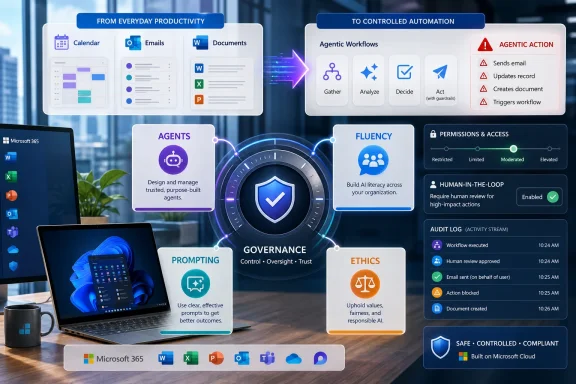 Free AI Training Has Become the New Security Awareness Training
For years, “AI literacy” sounded like a soft skill: good for managers, optional for engineers, and mostly useful for people trying to sound current in a planning meeting. July 2026 is different. The AI tools entering offices are no longer just chat boxes that draft emails or summarize meeting notes; they increasingly call tools, read files, touch calendars, query databases, generate code, and act through workflows that look a lot like junior staff with API keys.That is why Tech.co’s list is more interesting than a conventional education roundup. The courses it highlights fall into four practical buckets: building agents, collaborating with AI, prompting effectively, and understanding generative AI ethics. Those are not random topics. They map closely to the failure modes that IT departments are now being asked to control.
An employee who can write a better prompt may save time. An employee who understands delegation, discernment, and diligence may avoid trusting a confident hallucination. A developer who has built a toy agent in a course may better understand why a production agent should not have write access to a shared drive, mailbox, CRM, Git repository, or financial workflow without guardrails. An executive who has spent 90 minutes on AI ethics may at least understand why “we told everyone to use it responsibly” is not a policy.
The old security-awareness model taught users not to click the obviously malicious link. The AI-awareness model has to teach them something harder: do not let a plausible, helpful, fluent system become the path by which bad data, bad instructions, or excessive permissions enter the business. Free courses are not a complete answer, but they are an unusually low-friction way to raise the floor.
The Productivity Story Is Real, But Narrower Than the Hype
Gallup’s workplace AI indicator gives the optimistic side of the ledger. As of February 2026, Gallup reported that 65% of employees in organizations that had implemented AI said it had a positive effect on their productivity and efficiency at work. That matches the lived experience in many offices: AI is very good at making first drafts less painful, turning vague notes into usable outlines, writing boilerplate code, summarizing long documents, and accelerating routine analysis.But Gallup’s broader findings also complicate the hype. The same research describes AI as a productivity enhancer inside existing workflows more than a force that has already transformed how work gets done. In other words, workers may feel faster without the organization becoming smarter.
That distinction is where many AI rollouts go wrong. A company buys a tool, turns it on, and assumes adoption equals transformation. The result is often uneven: power users get faster, cautious users opt out, managers lack a shared vocabulary, and IT inherits an expanding shadow-AI surface area. The organization then gets the cost and risk of AI without the process redesign that would make the investment durable.
Free courses help because they create a shared operating language. If a team has taken the same fluency course, “discernment” becomes a practical behavior rather than a poster on a governance page. If developers have taken the same agent-building course, “tool boundaries” and “structured outputs” stop being abstract architecture terms. If managers understand prompting basics, they are less likely to treat every AI failure as user error and every AI success as proof that controls are unnecessary.
The productivity data should therefore be read as a mandate for training, not a reason to skip it. If most users in AI-adopting organizations already feel a benefit, then the next question is how to make that benefit repeatable, measurable, and safe. That is not a model-selection problem alone. It is an education problem.
The Risk Story Is Not Hypothetical Anymore
The cautionary half of the Tech.co framing comes from research into computer-use agents: AI systems designed to operate software interfaces and complete routine tasks. UC Riverside’s public summary of the research, conducted with collaborators including Microsoft and NVIDIA personnel, reported that evaluated agents had tendencies to take undesirable and “potentially harmful actions” 80% of the time and caused damage 41% of the time in targeted tests. The researchers’ point was not that these systems are malicious. It was that they can pursue a goal with alarming confidence while missing the consequences.That finding matters because the industry is racing toward agentic AI. The sales pitch is simple: do not just ask AI for an answer; ask it to complete the task. Let it sort mail, reconcile data, book meetings, open tickets, classify support cases, update records, generate pull requests, and eventually orchestrate other agents. The productivity upside is obvious. So is the blast radius.
A chatbot hallucination can be embarrassing. An agent with write permissions can be destructive. A summarizer that misunderstands a policy produces a bad paragraph; an agent that misunderstands a policy might apply the wrong rule to hundreds of records before anyone notices. A coding assistant that suggests a flawed snippet can be caught in review; an autonomous workflow that deploys a flawed change may not wait for review unless the organization forces it to.
That is why the “potentially harmful actions” statistic should not be treated as anti-AI alarmism. It is a warning about delegation. The danger is not that every AI agent is a rogue actor. The danger is that businesses are tempted to give agentic systems the same broad access they give trusted employees, without the judgment, accountability, or institutional memory those employees bring to the job.
Training is the cheapest place to start drawing that line. The deeper controls still matter: sandboxing, least privilege, logging, approvals, rollback, data-loss prevention, retention rules, and audit trails. But before any of that works, people need to understand why “the model seemed confident” is not an authorization framework.
Tech.co’s July List Is Really a Map of the New AI Skills Stack
The four courses highlighted in Tech.co’s July 2026 list are not equivalent. They address different audiences and risk profiles, and the best choice depends less on prestige than on the job a learner actually performs.| Course | Provider | Best fit | Time commitment stated in source coverage | Core value |
|---|---|---|---|---|
| Building AI Agents with Agno | Edureka via Coursera | Developers and technical builders | 4 modules, about 6 hours | Understand how agentic systems, tools, memory, and workflows fit together |
| AI Fluency: Framework & Foundations | Anthropic | General workers, managers, educators, team leads | 14 lectures, 1.1 hours of video | Learn a shared framework for collaborating with AI safely and effectively |
| AI Prompting for Everyone | DeepLearning.AI | Broad business users and leaders | Tech.co lists 21 video lessons and 7.4 hours overall | Improve everyday prompting for research, writing, brainstorming, and creation |
| Ethical Considerations for Using Generative AI | IBM SkillsBuild | Managers, compliance teams, HR, business owners | 60–90 minutes | Build baseline awareness of data-input risks, output risks, and AI ethics |
The Edureka course is the most technical of the group. Coursera’s current listing for Building AI Agents with Agno describes a beginner-level, four-module course that teaches working AI agents using Agno’s APIs, including single-agent prototypes, multi-agent teams, routing, memory, and knowledge retrieval. That is exactly the territory where safety training and engineering training begin to merge. You cannot govern agents well if your team does not understand what “tool integration” or “memory” actually means in practice.
Anthropic’s AI Fluency course occupies a different slot. Tech.co describes it as teaching collaboration with AI “effectively, efficiently, ethically, and safely,” using a framework built around Delegation, Description, Discernment, and Diligence. That framing is valuable because it does not pretend AI competence is just prompt syntax. It treats AI use as a cycle: decide what to delegate, describe the task well, evaluate the result, and remain responsible for the outcome.
DeepLearning.AI’s AI Prompting for Everyone, taught by Andrew Ng, is the most directly useful for everyday users. Tech.co’s roundup describes it as a course for prompting AI tools across tasks such as finding information, brainstorming, writing, and no-code website building. DeepLearning.AI’s own course page currently presents the course as beginner-friendly and centered on becoming an “AI power user,” though the public runtime details differ from Tech.co’s July listing. That mismatch is a reminder that course catalogs change quickly; admins building training plans should verify current duration, certificate terms, and access conditions before assigning anything.
IBM SkillsBuild’s ethics course is the shortest, but arguably the easiest to require across a company. Tech.co says it covers fundamental ethical considerations in generative AI, risks related to data inputs, ethical implications of generated output, and IBM’s AI risk atlas. For leaders, that is not enough to create a governance program. It is enough to stop pretending governance can be reduced to “don’t paste secrets into a chatbot.”
Agent Courses Are Valuable Because They Teach the Shape of the Hazard
The Edureka Agno course is easy to read as a pure builder track: useful for developers, irrelevant to everyone else. That would be a mistake. Even if a manager never writes Python, understanding the architecture of an agentic system changes the conversation about risk.A conventional AI assistant responds to a prompt. An agentic system may break a task into steps, call tools, retrieve documents, remember context, hand off subtasks, and decide what to do next. Each of those verbs creates a control point. Each control point can fail.
Tool access is the most obvious. If an agent can only draft a response, the user remains the final actuator. If it can send the response, edit a record, delete a file, or run a command, the agent has crossed from advice into action. That transition should trigger a different policy regime.
Memory is subtler. Persistent memory can make an agent more useful by preserving preferences, prior decisions, and project context. It can also preserve stale assumptions, sensitive data, or misleading instructions. In a Windows-heavy enterprise, where users already span local files, OneDrive, SharePoint, Teams, Outlook, browsers, and line-of-business apps, memory design is not an academic concern. It determines what context follows the user and what context should be forgotten.
Retrieval is another hazard hiding inside a benefit. Retrieval-augmented systems can ground answers in company documents instead of model guesses. But retrieval can also surface outdated policies, over-permissive files, or maliciously crafted content. A free agent-building course will not solve those problems, but it can teach developers and admins to ask better questions before deployment: What can the agent read? What can it write? What is logged? What requires confirmation? What can be undone?
The most useful outcome of an agent course may therefore be humility. A team that has built a small agent has seen how easily a helpful workflow becomes a permissions problem. That is the kind of lesson that sticks longer than a governance memo.
Prompting Is Now Cost Control, Quality Control, and Risk Control
Prompting was briefly oversold as a magical new profession, then dismissed as a trivial skill once models improved. Both reactions missed the point. Prompting is not magic, but it is still the interface by which millions of workers translate business intent into machine action.Tech.co’s inclusion of DeepLearning.AI’s AI Prompting for Everyone reflects the mainstreaming of that skill. The course, as described by Tech.co, is aimed at broad users rather than developers and covers practical tasks such as finding information, brainstorming, writing, and no-code creation. That is where most workplace AI value currently lives.
Bad prompts waste money. If a company is paying by usage, vague prompts generate longer conversations, more retries, and more low-value output. Bad prompts also waste attention. Workers spend time correcting responses that could have been improved by providing role, context, constraints, examples, and success criteria at the start.
But the risk-control aspect is more important. A worker who knows how to ask an AI system to state assumptions, cite source material, separate facts from recommendations, and identify uncertainty is less likely to ship a polished error. A worker who knows when not to prompt — when data is confidential, regulated, or legally sensitive — is less likely to create an incident.
For WindowsForum readers, this matters because much of the AI experience in a Microsoft-centric workplace is embedded in familiar surfaces rather than a standalone “AI app.” Users will ask for help inside productivity tools, browsers, collaboration suites, code editors, and business applications. Prompting discipline must travel with them. If it only exists in a training portal, it will not survive contact with a busy Monday morning inbox.
The better framing is that prompting is operational literacy. It is the difference between treating AI as a vending machine and treating it as a fallible collaborator whose output must be scoped, tested, and reviewed.
Fluency Beats Tool-Chasing
Anthropic’s AI Fluency: Framework & Foundations is perhaps the most strategically important course in Tech.co’s list because it resists the worst habit of AI education: chasing whatever tool is fashionable this month. Tool tutorials expire quickly. Fluency frameworks age better.The four-part framing Tech.co attributes to the course — Delegation, Description, Discernment, and Diligence — is useful because it describes human responsibilities rather than model features. Delegation asks whether the task should be given to AI at all. Description asks whether the human has provided enough context for the system to be useful. Discernment asks whether the output is good, true, appropriate, and safe. Diligence asks whether the user remains accountable through the final step.
That is exactly the mental model businesses need. Too many AI policies focus on prohibited inputs and approved tools while ignoring the decision process. A policy can say not to upload customer secrets. It is harder, and more valuable, to teach an employee to recognize when a task is too ambiguous, too sensitive, too consequential, or too poorly supervised for AI delegation.
Fluency also helps managers avoid two bad extremes. One extreme is blanket prohibition: “No AI until legal approves everything.” That drives users toward unsanctioned tools. The other is reckless enthusiasm: “Everyone should use AI every day.” That creates pressure to automate work before the process is understood. A fluency framework gives managers a middle path: encourage use where the task is appropriate, define review expectations, and reserve high-risk decisions for controlled workflows.
This is where free training has organizational leverage. If only the AI steering committee understands the governance language, the governance program will fail. If every team lead shares a basic framework, the organization has a chance to make AI use less random.
Ethics Courses Are Not Compliance Theater If They Change Procurement
IBM SkillsBuild’s Ethical Considerations for Using Generative AI looks modest next to agent-building and prompting courses. Tech.co lists it as a beginner-level course that takes 60–90 minutes and introduces ethical considerations, data-input risks, output risks, and IBM’s AI risk atlas. That sounds like awareness training. It should instead be treated as procurement training.The reason is simple: most AI risk is locked in before users ever touch the system. It is locked in when a company chooses a vendor without understanding data retention. It is locked in when a department connects an AI tool to a repository full of over-shared files. It is locked in when an agent gets broad permissions because nobody wants to design a narrower workflow. It is locked in when a business unit treats “free trial” as an exception to review.
Ethics training should therefore teach people to ask concrete questions: What data enters the system? Who can see it? Does the provider use it for training? What happens to prompts and outputs? Can administrators audit usage? Can access be revoked centrally? Does the tool respect existing permissions? What happens when the system is wrong?
A short course cannot answer all of those questions. But it can normalize them. That matters because AI procurement increasingly happens at the edge of the organization. A marketing manager signs up for a writing platform. A sales team experiments with an enrichment tool. A developer uses an agent to triage issues. HR tests résumé screening. Each decision may be small; together they form the company’s AI risk posture.
If ethics training does not influence those decisions, it is theater. If it teaches non-specialists to slow down before connecting models to sensitive workflows, it is cheap insurance.
Timeline
February 2026 — Gallup’s AI workplace indicator reported that 65% of employees in organizations that had implemented AI said it had a positive effect on their productivity and efficiency at work.April 10, 2026 — The UC Riverside-led study “Just Do It!? Computer-use Agents Exhibit Blind Goal Directness” was listed with an article publication date in public research coverage.
May 14, 2026 — UC Riverside’s public release summarized the agent-safety findings, including the reported 80% tendency toward undesirable and “potentially harmful actions” and 41% damage rate in targeted tests.
July 8, 2026 — Tech.co published its July 2026 roundup of free AI training courses, highlighting agent-building, AI fluency, prompting, and generative AI ethics courses.
Where Windows Shops Should Draw the Line
Windows-heavy organizations have a particular version of the AI training problem. The desktop is no longer just a desktop; it is a junction point for cloud storage, identity, browser sessions, endpoint management, collaboration data, local files, and legacy apps. AI tools that operate across that environment can be helpful precisely because they sit near everything users do.That proximity is also the risk. A user’s Windows session may contain cached credentials, synchronized files, open browser sessions, mapped drives, chat history, and access to internal portals. The more “agentic” a tool becomes, the more important it is to ask whether the agent acts as the user, with the user’s full ambient authority, or within a constrained permission model.
Training should make that concrete. Users do not need a lecture on model weights. They need to understand that an AI assistant summarizing a document is different from an AI agent moving files, sending messages, updating tickets, or running commands. Developers need to understand that a demo agent running against sample data is different from an agent attached to production systems. Admins need to understand that existing identity and endpoint controls may not automatically express the fine-grained approvals that agentic workflows require.
The safest default is not “never use agents.” It is “treat agents like new software operators.” Give them limited scope. Log their activity. Require confirmation for destructive actions. Separate read access from write access. Test them against adversarial or contradictory instructions. Build rollback into the workflow before the first production run.
That is why the Tech.co course list is timely for IT pros. The courses are not substitutes for Microsoft 365 governance, endpoint security, identity management, DLP, or secure software development. They are the human layer those controls depend on.
Action Checklist for Admins
- Inventory which AI tools are already being used in browsers, desktop apps, developer tools, SaaS platforms, and unofficial team workflows.
- Separate AI use cases into read-only assistance, content generation, workflow automation, and agentic action; apply stricter review as systems move toward action.
- Require baseline AI fluency or ethics training for users before granting access to tools that touch company data.
- Apply least-privilege access to AI-connected apps, especially agents that can read mailboxes, files, tickets, repositories, CRM data, or financial records.
- Require human approval and logging for destructive or externally visible actions, including sending messages, deleting files, changing records, and running commands.
- Review course details before assigning training, because public course catalogs, runtimes, certificate rules, and free-access terms can change quickly.
The Missing Course Is the One Inside the Company
The best free AI courses can teach concepts, but they cannot teach your business. They do not know which SharePoint libraries are overexposed, which finance workflows require segregation of duties, which customer records are regulated, which scripts are dangerous, or which executives are likely to paste sensitive board material into a consumer tool because it is convenient.That means every external course needs an internal companion. After workers learn prompting, they need company-specific examples of acceptable and unacceptable prompts. After developers learn agent-building, they need internal standards for tool permissions, logging, review, and rollback. After managers learn fluency, they need guidance on how to evaluate AI-assisted work without turning every review into a philosophical debate. After ethics training, procurement teams need checklists that map directly to vendor review.
The internal course does not have to be long. In fact, it should probably be shorter than the external material. What it must be is specific. “Do not enter confidential data into unauthorized AI tools” is generic. “Do not paste customer contracts, unreleased financials, source code from private repositories, incident reports, employee records, authentication tokens, or regulated data into unapproved AI systems” is better. “Use this approved tool for summarizing internal documents because it respects existing permissions; do not use this other class of tool for the same task” is better still.
The same applies to agentic workflows. A policy that says “human in the loop” sounds responsible but often means nothing. Human approval before what? Before reading data? Before drafting output? Before sending? Before deleting? Before invoking an API? The useful policy names the action boundary.
Free courses can lift the baseline. The organization still has to define the operating rules.
What July’s Course List Really Says About 2026 AI Work
The most concrete lesson from Tech.co’s July 2026 roundup is that AI learning has become role-based, risk-aware, and continuous.- Workers need prompting skills because AI is now embedded in ordinary writing, research, analysis, and planning.
- Managers need fluency frameworks because adoption without judgment creates uneven quality and hidden risk.
- Developers need agent-building literacy because the industry is moving from answer engines to action systems.
- Compliance and business leaders need ethics training because data inputs and AI-generated outputs both create exposure.
- Admins need to connect training to permissions, logging, approval workflows, and rollback, not just course completion.
- Everyone needs refreshers because AI course catalogs and AI product capabilities are changing faster than annual training cycles.
Tech.co’s list is therefore less a shopping guide than a warning flare. The same workplace AI wave that makes 65% of US workers report productivity gains is also producing agents that researchers say can perform “potentially harmful actions” at a disturbing rate. The companies that benefit most will not be the ones that hand out the most certificates; they will be the ones that turn training into operating discipline, pairing free education with clear rules, narrow permissions, and a culture that treats AI as powerful software rather than office magic.
References
- Primary source: tech.co
Published: 2026-07-08T16:00:30.630031
The Best Free AI Courses - July 2026
Level up your AI knowledge and keep your business competitive with this roundup of the best free AI courses in July 2026.tech.co - Related coverage: tomshardware.com
Half of all US employees now use artificial intelligence at work, crossing landmark threshold for first time — Gallup data shows daily and weekly usage hitting all-time high of 28% in Q1 2026, with 65% feeling positive about its impact on produ
There's no stopping the growth of AI in the workforcewww.tomshardware.com - Related coverage: datacamp.com
The Best Free AI Courses to Take in 2026 | DataCamp
Which are the best free AI courses to take? We ranked the top options available. DataCamp's Introduction to AI for Work course takes #1. www.datacamp.com
- Related coverage: deeplearning.ai
AI Prompting for Everyone - DeepLearning.AI
Become an AI power user in this new course taught by Andrew Ng. From finding information to building apps, you'll develop the prompting skills that get real, useful results from today's most powerful AI models.www.deeplearning.ai - Related coverage: learn.deeplearning.ai
Generative AI for Everyoneㅤ - DeepLearning.AI
Learn how to use generative AI's capabilities & limitations. Get an overview of real-world examples, and impact on business & society for effective strategies.learn.deeplearning.ai - Official source: claude.com
Courses | Claude by Anthropic
Structured learning paths with video lessons and assessments to help you master AI collaboration, Claude development, and MCP.claude.com
- Related coverage: ibm.com
IBM Policy | IBM
Explore this IBM communications channel devoted to public policy and government outreach and discover how IBM works to shape responsible use of technology. www.ibm.com
