

AI is no longer a future promise—it’s an operational imperative that separates trophy winners from the also-rans, and Microsoft’s message at Ignite 2025 crystallized that divide around a single idea: becoming a Frontier Firm.
Microsoft used Ignite 2025 to stake a claim about what winning with AI looks like at scale: embed intelligence into everyday work, democratize AI creation, and bake observability and governance into every layer so innovation can scale with trust. That framing is bolstered by a commissioned IDC InfoBrief that Microsoft cites—IDC reports that roughly two-thirds of organizations are using AI today and that a segment Microsoft calls Frontier Firms are seeing significantly greater returns (notably, multiples of the returns seen by slower adopters).
Those claims align with multiple independent industry measurements showing rapid AI adoption: broad surveys from academic and consulting institutions recorded a sharp jump in organizations using AI across one or more business functions over the past two years, and major analyst firms report enthusiasm for agentic AI and rising enterprise investment. At the same time, independent analyses and vendor-neutral research consistently show a gap between experimentation and enterprise-scale value—precisely the gap Microsoft says Frontier Firms overcome by design, not luck.
This article unpacks the Frontier Firm thesis, verifies the headline claims where possible, examines the practical technologies Microsoft highlighted at Ignite (Work IQ, Copilot upgrades, Agent 365, Copilot+ PCs), evaluates empirical business outcomes, and lays out a concrete playbook IT leaders can use to move from pilot projects to measurable, trusted scale.
Independent industry studies corroborate the broad trend—AI adoption has surged to a majority of firms—but exact percentages vary by survey methodology. For example:
Why this matters:
Caution: “context” is useful only when the underlying data is high quality and properly governed. Many enterprises underestimate the effort required to prepare and instrument data so agents can safely act; Work IQ can accelerate value—but it does not replace data engineering and robust access controls.
Why it’s important:
Caveat: vendor control planes reduce friction but also introduce new dependencies. Organizations should design escape hatches (exportable policy artifacts, vendor-neutral logs) to avoid lock-in and to ensure auditability for regulators.
Why this matters:
Caveat: on-device models are constrained by compute and memory; not all enterprise model workloads migrate cleanly to local NPUs. For many organizations the hybrid architecture (local + cloud) is optimal.
Independent press coverage confirms the existence of these customer programs and the general types of benefits described. However, there are two important caveats for readers and IT decision-makers:
Independent industry studies back up the broad conclusions—widespread adoption, surging investment, and growing evidence of significant business impact—while also warning that most firms have yet to cross the bridge from pilots to enterprise-scale value. The practical path to becoming a Frontier Firm is straightforward in concept but challenging in execution: prioritize measurable use cases, invest in data and governance, instrument everything, and scale deliberately.
Organizations that treat agentic AI like a new class of operational service—complete with registries, access controls, observability, and continuous measurement—will be best positioned to turn today’s promise into tomorrow’s competitive moat.
Source: Microsoft Becoming a Frontier Firm: Unlocking the business value of AI | The Microsoft Cloud Blog
 Background / Overview
Microsoft used Ignite 2025 to stake a claim about what winning with AI looks like at scale: embed intelligence into everyday work, democratize AI creation, and bake observability and governance into every layer so innovation can scale with trust. That framing is bolstered by a commissioned IDC InfoBrief that Microsoft cites—IDC reports that roughly two-thirds of organizations are using AI today and that a segment Microsoft calls Frontier Firms are seeing significantly greater returns (notably, multiples of the returns seen by slower adopters).Those claims align with multiple independent industry measurements showing rapid AI adoption: broad surveys from academic and consulting institutions recorded a sharp jump in organizations using AI across one or more business functions over the past two years, and major analyst firms report enthusiasm for agentic AI and rising enterprise investment. At the same time, independent analyses and vendor-neutral research consistently show a gap between experimentation and enterprise-scale value—precisely the gap Microsoft says Frontier Firms overcome by design, not luck.
This article unpacks the Frontier Firm thesis, verifies the headline claims where possible, examines the practical technologies Microsoft highlighted at Ignite (Work IQ, Copilot upgrades, Agent 365, Copilot+ PCs), evaluates empirical business outcomes, and lays out a concrete playbook IT leaders can use to move from pilot projects to measurable, trusted scale.
What Microsoft means by a “Frontier Firm”
A definition that centers mindset and execution
Microsoft’s public messaging defines a Frontier Firm not by industry or size but by mindset and execution. The core attributes are:- AI-first differentiation: AI is used to create unique products, services, or customer experiences, not only to automate back-office tasks.
- Breadth and depth: AI runs across multiple business functions—Microsoft cites an average of seven functions for Frontier Firms, with heavy use in customer service, marketing, IT, product development, and security.
- Ubiquitous creation: AI development is democratized—frontline workers, not just engineers, can assemble agents and copilots to solve domain problems.
- Observability and governance: Systems are instrumented end-to-end so teams can monitor performance, privacy, and compliance in production.
Three practical traits Microsoft emphasizes
At Ignite and in the associated briefings, Microsoft summarized Frontier Firm practice into three actionable traits:- Integrate AI into everyday workflows to amplify human creativity and decision-making.
- Democratize AI creation so innovation is driven from the edges as well as the center.
- Prioritize observability, security, and compliance across all AI systems.
Validating the headline claims and numbers
The adoption rate and returns
Microsoft cites an IDC InfoBrief that reports roughly 68% of organizations using AI and that Frontier Firms realize returns three times higher than slow adopters. It also references metrics where Frontier Firms report four times better outcomes across brand differentiation, cost efficiency, top-line growth, and customer experience, with listed percentages (brand 87%, cost efficiency 86%, top-line growth 88%, CX 85%).Independent industry studies corroborate the broad trend—AI adoption has surged to a majority of firms—but exact percentages vary by survey methodology. For example:
- University-level AI tracking (large-scale AI Index reports) and global analyst surveys reported adoption in the 70–80% range for organizations using AI in at least one function over 2024–2025.
- Consulting surveys (McKinsey, Deloitte and similar) show high levels of experimentation and growing enterprise deployments, but they consistently warn that scaling to enterprise-level impact remains challenging for most companies.
Business outcomes and monetization
Microsoft’s messaging says Frontier Firms are not just automating—they’re monetizing AI: 67% monetize industry-specific AI use cases and 58% use custom AI solutions. Independent studies show a clear trend toward industry-specific and customized models as enterprises mature; however, third-party research also indicates:- Significant variation by sector: financial services, telecom, and parts of manufacturing often report the highest levels of scaled use cases and monetization, while other sectors still wrestle with integration and regulation.
- A persistent scaling gap: while a majority of firms experiment with GenAI, a much smaller share achieve measurable enterprise-wide ROI or embed AI into mission-critical systems.
The technology Microsoft showcased at Ignite 2025 — what matters to IT
Work IQ, Copilot updates, and the promise of context
Work IQ is presented as the intelligence layer that fuses an organization’s work data, personalized memory (user behavior and preferences), and inference to deliver contextualized, proactive assistance inside Microsoft 365 and Copilot agents.Why this matters:
- Context reduces hallucination risk by narrowing the model’s scope to relevant enterprise data and inferred intent.
- Embedding Work IQ into agents enables higher-value tasks (e.g., automated brief generation, meeting facilitation) because the system combines document context, calendar signals, and historical patterns.
Caution: “context” is useful only when the underlying data is high quality and properly governed. Many enterprises underestimate the effort required to prepare and instrument data so agents can safely act; Work IQ can accelerate value—but it does not replace data engineering and robust access controls.
Agent 365 — the control plane for an agentic workforce
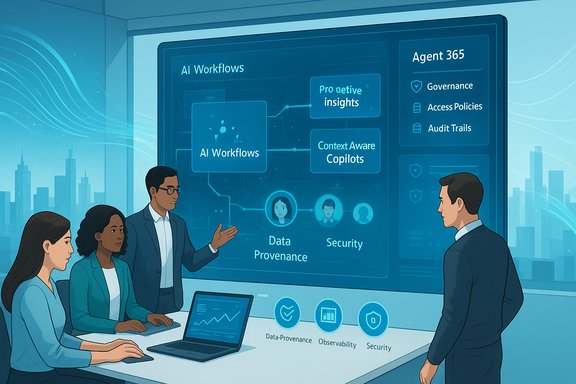
Agent 365 is Microsoft’s response to the governance problem: a registry, access controls, visualization, interoperability, and security primitives to manage agents like first-class operational entities.Why it’s important:
- It directly addresses a major friction point: how do you keep track of hundreds or thousands of autonomous agents and ensure they respect policies, data boundaries, and audit requirements?
- Centralized observability and a registry make it possible to retire or patch misbehaving agents rapidly.
Caveat: vendor control planes reduce friction but also introduce new dependencies. Organizations should design escape hatches (exportable policy artifacts, vendor-neutral logs) to avoid lock-in and to ensure auditability for regulators.
Copilot+ PCs and on-device inference
Copilot+ PCs (and Windows-level AI search and on-device capabilities) are designed to move some workloads offline to local NPUs and secure Windows ML runtimes.Why this matters:
- On-device inference reduces latency and surface area for sensitive data by keeping processing local.
- It opens opportunities for always-on, contextual experiences (local semantic search across files, low-latency assistants).
Caveat: on-device models are constrained by compute and memory; not all enterprise model workloads migrate cleanly to local NPUs. For many organizations the hybrid architecture (local + cloud) is optimal.
Real-world results: what the customer stories actually say
Microsoft highlighted three illustrative customers: Levi Strauss & Co., ABB, and Land O’Lakes. Public Microsoft customer stories report significant outcomes—Levi’s quotes projects that once took a year now done in a day using Copilot and Copilot+ PCs; ABB reports energy and efficiency gains from Genix Copilot built on Azure; Land O’Lakes is described as embedding AI in agricultural processes to optimize supply chains.Independent press coverage confirms the existence of these customer programs and the general types of benefits described. However, there are two important caveats for readers and IT decision-makers:
- Customer success narratives often highlight the best outcomes and use-case-specific results. The spectacular result for one workflow (e.g., converting a year-long modeling process into an afternoon) is real for that workflow, but it does not imply every process will scale with identical returns without similar data, integration, and organizational support.
- Percentages and savings reported in case studies often reflect early adopters who optimized a small set of high-value workflows. When scaling to hundreds of workflows, outcomes typically vary and require additional investment in monitoring, retraining, and change management.
Risks, governance, and the observability imperative
Operational and security risks
Deploying agentic AI at scale introduces risks that IT and security teams must manage:- Data leakage and permission creep: Agents that access multiple systems can unintentionally expose data; strict least-privilege and token management are essential.
- Runtime vulnerabilities: Emerging CVEs affecting inference frameworks and model-serving components indicate that production deployments must be treated like any other service: patching, runtime controls, and incident response planning are required.
- Model behavior drift: Agents that are not continuously monitored degrade over time—observability is necessary to detect quality regressions, bias, and performance degradation.
Compliance, explainability, and auditability
Enterprise deployments need audit trails, explainability for decisions that affect customers or regulatory outcomes, and a robust model-era change-management process. Microsoft’s focus on Agent 365, logging, and control planes addresses these needs, but enterprises must also:- Keep provenance metadata for training data and fine-tuning artifacts.
- Implement automated tests and acceptance criteria for agents before they run in production.
- Maintain human-in-the-loop checkpoints for high-risk decisions.
Cultural and organizational risks
Scaling AI is primarily an organizational challenge:- Siloed ownership between IT and business can stall value capture.
- Experimentation without measurement or a feedback loop creates “pilot purgatory.”
- Upskilling is necessary but often underfunded; companies that invest most in scaled outcomes also invest in training and role redesign.
Practical roadmap: 7 steps to move from pilot to Frontier-scale impact
- Start with a value-focused inventory
- Map business processes by expected ROI, regulatory risk, and data readiness.
- Prioritize 3–5 pilot processes with measurable KPIs.
- Build the foundational data plumbing
- Invest in quality-of-data projects: cataloging, sensitivity labeling, and reliable retrieval.
- Implement RAG (retrieval-augmented generation) patterns where appropriate to ground generative outputs.
- Create an agent registry and governance baseline
- Maintain source-controlled definitions for agents, including data sources, access scopes, and acceptance tests.
- Use role-based access and least privilege.
- Instrument observability from day one
- Log prompts, outputs, confidence scores (where available), and decision outcomes.
- Establish production SLAs and SLOs for agent performance and error rates.
- Democratize safely
- Provide self-service tools for business users with templates and guardrails.
- Gate higher-risk capabilities (e.g., multi-system actions) behind IT review and approvals.
- Measure and iterate
- Collect quantitative KPIs (time saved, revenue impact, error reduction) and qualitative feedback (user trust, adoption).
- Automate retraining and model evaluation where feasible.
- Scale with responsible automation
- Expand use to new functions once governance, security, and ROI tests pass.
- Maintain a continuous compliance and risk assessment cadence.
Strategic takeaways for CIOs and IT leaders
- The single biggest determinant of success is not the model you choose—it's whether you design the organization to operate with agents as first-class entities.
- Invest early in observability—without it, scale amplifies risk as fast as it amplifies value.
- Treat democratization as a tech + people + process problem. Tools like Copilot Studio and low-code builders accelerate creation, but adoption only sticks when change management is concurrent.
- Keep an eye on hybrid architectures. On-device inference (Copilot+ PCs, Windows AI search) is powerful for latency-sensitive and sensitive-data use cases; cloud models remain indispensable for heavy lifting.
- Expect vendor ecosystems and third-party partnerships to matter more than ever. Control planes (Agent 365-like systems) that interoperate with partners will be the glue that binds enterprise-grade agent deployments.
Conclusion
Microsoft’s “Frontier Firm” framing captures a pressing reality: AI is no longer confined to isolated experiments. The frontier is defined by organizations that marry ambition with disciplined execution—embedding intelligent agents into workflows, democratizing creation while enforcing guardrails, and instrumenting systems with production-grade observability.Independent industry studies back up the broad conclusions—widespread adoption, surging investment, and growing evidence of significant business impact—while also warning that most firms have yet to cross the bridge from pilots to enterprise-scale value. The practical path to becoming a Frontier Firm is straightforward in concept but challenging in execution: prioritize measurable use cases, invest in data and governance, instrument everything, and scale deliberately.
Organizations that treat agentic AI like a new class of operational service—complete with registries, access controls, observability, and continuous measurement—will be best positioned to turn today’s promise into tomorrow’s competitive moat.
Source: Microsoft Becoming a Frontier Firm: Unlocking the business value of AI | The Microsoft Cloud Blog
