

Microsoft’s latest public framing of enterprise AI — “Frontier Transformation” built on a foundation of Intelligence + Trust — is both an escalation and a consolidation of the company’s strategy for selling AI into the enterprise. The message delivered in the company’s official blog post is straightforward: move beyond productivity gains toward democratizing intelligence across roles and industries by embedding Copilots and autonomous agents into everyday workflows, while providing the governance and observability enterprises demand. For WindowsForum readers who care about what this means for IT strategy, procurement, security and the shape of the modern Windows workplace, the announcement is important — and it deserves skeptical, practical analysis.
Microsoft positions Frontier Transformation as the next phase after the efficiency-focused wave of AI adoption. The company argues that the new stage emphasizes three linked traits:
Why this matters: Microsoft is tying AI tooling, governance and enterprise data plumbing into a single commercial narrative that spans Windows 11, Copilot‑enabled devices, Microsoft 365, Azure and a growing fabric of agent tooling. For IT teams making platform bets, that pitch is both compelling and strategically consequential — it promises reduced fragmentation, faster time-to-value, and integrated compliance, while increasing the technical and contractual coupling to Microsoft’s stack.
Notable examples Microsoft highlights:
But the path is not frictionless. Vendor‑reported metrics should be validated, regulatory and liability frameworks must be defined for high‑risk use cases, and organizations must weigh the benefits of integrated tooling against the long-term cost and strategic dependence that come with a single‑vendor stack.
For IT leaders making decisions now: treat Frontier Transformation as an architectural play, not a silver bullet. Use pilots to learn the operational requirements of agentic systems, insist on auditability and provenance, and build an internal operating model that can manage agents with the same rigor used for people. When done right, these technologies can meaningfully accelerate work and creativity — but they demand the same discipline, measurement and governance that enterprises already apply to mission‑critical systems.
Frontier Transformation promises to put the “I” back in AI by grounding intelligence in people’s work and enterprise data. That is a useful framing — provided organizations pair ambition with the hard operational work required to make agentic systems safe, auditable and genuinely productive. The vendor narrative is clear; the hard work now belongs to CIOs, security teams and business owners who must translate that promise into reliable outcomes without surrendering control.
Source: The Official Microsoft Blog How Microsoft is empowering Frontier Transformation with Intelligence + Trust - The Official Microsoft Blog
 Overview: what Microsoft announced (and why it matters)
Microsoft positions Frontier Transformation as the next phase after the efficiency-focused wave of AI adoption. The company argues that the new stage emphasizes three linked traits:- AI in the flow of human ambition — Copilots and agents embedded directly in the tools people use.
- Ubiquitous innovation — enabling creators and makers at every level with accessible, production-ready AI capabilities.
- Observability at every layer — unified governance and control through a central control plane for agents.
Why this matters: Microsoft is tying AI tooling, governance and enterprise data plumbing into a single commercial narrative that spans Windows 11, Copilot‑enabled devices, Microsoft 365, Azure and a growing fabric of agent tooling. For IT teams making platform bets, that pitch is both compelling and strategically consequential — it promises reduced fragmentation, faster time-to-value, and integrated compliance, while increasing the technical and contractual coupling to Microsoft’s stack.
Background: the building blocks of Frontier Transformation
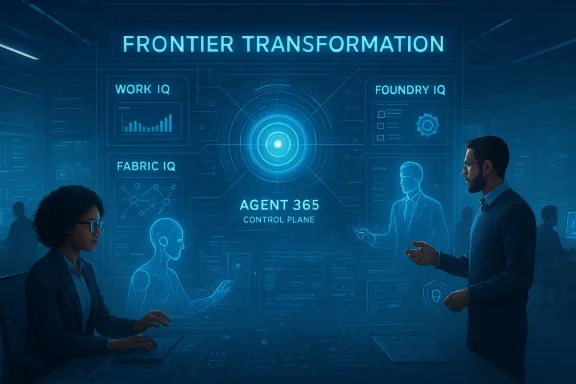
Work IQ, Fabric IQ, Foundry IQ — what they are (and what they claim to solve)
Microsoft’s intelligence layer is a three‑part concept:- Work IQ — described as the capability that understands how people work. It’s positioned to deliver context-aware insights into activities, patterns and workflows so Copilots can be action-oriented rather than generic assistants.
- Fabric IQ — the semantic, governed layer for reasoning over an organization’s data. This maps to Microsoft’s existing efforts around Microsoft Fabric, OneLake and governed data estates: a single place to store, catalog and make corporate data available for safe reasoning.
- Foundry IQ — the application and agent runtime: Microsoft describes Foundry as the world’s leading AI app server powering safe, scalable agent experiences. Practically, this is the runtime where models, agent logic and orchestration occur, with emphasis on observability and governance.
Agent 365 and Agent Factory: governance meets scale
- Agent 365 is Microsoft’s control plane: a unified view to register, observe, govern and secure agents (including third-party agents). The product is pitched as the “people‑management” equivalent for AI agents — telemetry, alerts, identity mapping, permissioning and a single console for compliance.
- Agent Factory is an operational offering that packages the intelligence layer into an ROI-driven model: Microsoft and partners will help firms convert manual, multi-step workflows into agentic systems tied to measurable outcomes. It’s a managed path from pilot to production that includes engineering support and governance templates.
Real customers, real claims — and what’s verifiable
Microsoft’s blog illustrates the Frontier narrative with a series of customer case studies spanning healthcare, retail, finance, education, manufacturing and creative industries. These customer stories are important because they show how enterprises are applying the stack. Many of the on-stage and published customer stories are corroborated by Microsoft customer case pages, partner blogs and company press releases; the pattern is consistent: domain expertise + Microsoft platform yields faster workflows and new services.Notable examples Microsoft highlights:
- Epic (healthcare) — Microsoft credits Epic AI with generating clinical documentation at scale, reporting a reduction in prior authorization time by over 40% and more than 16 million automatically generated patient record summaries in a single month. The blog also claims imaging follow-up drove early cancer detection at Christ Hospital to 69% versus a national average of about 46%.
Caution: these are partner‑reported metrics and, as of this writing, cannot be fully corroborated with independent peer-reviewed studies in the public domain. When patient outcomes are cited, IT and clinical leaders should treat vendor-supplied effectiveness numbers as directional until validated by clinical audits or independent evaluations. - Levi Strauss & Co. — standardized on Windows 11, Copilot+ PCs, Intune, Microsoft 365 Copilot and Microsoft Foundry to create a unified, AI-enabled workplace. Levi’s reports dramatic time savings on projects and improved cross‑functional collaboration — claims that align with vendor customer stories and public Microsoft case studies.
- London Stock Exchange Group (LSEG) — Microsoft states LSEG consolidated 30 legacy systems, 1,200 datasets and more than 33 petabytes into Microsoft Fabric, cutting product development timelines from years to months and providing Fabric-powered Copilot experiences to users. LSEG’s public Microsoft customer story independently documents this consolidation and the resulting product development improvements.
- University of Manchester — the university became the first higher-education institution to provide Microsoft 365 Copilot access and training to all 65,000 students and staff. This move is confirmed by university and Microsoft UK announcements and is a clear example of institutional-scale Copilot access paired with training and policy frameworks.
- Pantone — launched a Pantone Palette Generator built on Microsoft Foundry and Azure AI Search; Microsoft and Pantone accounts describe a multi-agent architecture and state the development team saved 200+ hours during the proof‑of‑concept stage. Pantone and Microsoft technical writeups corroborate the agentic architecture and the stack (Azure OpenAI, Azure AI Search, Cosmos DB).
- Land O’Lakes — developed an agronomy assistant named Oz built on Microsoft Foundry and Copilot tuning, pitched as turning an 800‑page guide into on‑demand farm recommendations for agronomists. The partnership and product announcements appear across multiple partner and Microsoft briefings; operational numbers (exact IT migration percentages or efficacy gains) remain company-reported.
- Mercedes-Benz and Merc-AMG PETRONAS F1 Team — Microsoft public statements and news coverage confirm a multi-year deal to integrate Azure and AI into Mercedes’s operations, including factory telemetry and trackside analytics. Mercedes has also reportedly used GitHub Copilot to increase developer engagement and delivered measurable time savings on factory diagnostics through digital chat systems.
- ServiceNow, Workday, Genspark — positioned as ecosystem partners that integrate their governance and agent orchestration capabilities with Agent 365, enabling customers (for example AstraZeneca) to manage agentic workflows with fewer friction points. Microsoft and partner statements indicate joint offerings to observe and control agent fleets.
Strengths: what Microsoft’s approach gets right
Microsoft’s Frontier Transformation narrative addresses several real enterprise pain points:- Integrated data + compute + governance: Pulling data governance (Fabric IQ), workflow understanding (Work IQ) and a production runtime (Foundry IQ) into one vendor narrative reduces integration risk for customers who already run large parts of their estate on Azure, Microsoft 365 and Windows. A unified control plane (Agent 365) is a sensible answer to the inevitable agent sprawl problem.
- Focus on grounded intelligence: The emphasis on grounding Copilots and agents in an organization’s own data, taxonomies, and workflows is the correct architectural choice to reduce hallucinations and to make outputs auditable. Retrieval‑augmented generation (RAG) and domain‑tuning are central to trustworthy outcomes in regulated industries.
- Operational observability: Bringing observability to each layer — telemetry for agents, identity mapping, permissioning and governance templates — is essential. Enterprises know how to manage humans at scale; giving IT similar tools for agents is a necessary step to de-risk adoption.
- Built-in lifecycle tooling: Foundry-style runtimes that include model catalogs, testing, and deployment orchestration address a major gap between laboratory experiments and production-grade AI. The Agent Factory concept recognizes that many customers need professional services and packaged solutions to convert pilots into ROI.
- Ecosystem and partner strategy: Microsoft’s emphasis on partner integrations (Adobe, ServiceNow, Workday, etc.) is pragmatic: enterprises rarely standardize on single-vendor stacks at the application layer, so cross-vendor integration and federation of governance are required for real adoption.
Risks, blind spots and vendor-specific tradeoffs
The Microsoft narrative is powerful, but it comes with material tradeoffs and risks that IT leaders must factor into any procurement or architectural decision.- Vendor concentration and lock-in
- Building Copilots, agent orchestration, data governance and device experiences tightly around a single vendor stack increases switching costs. Consolidating datasets and operational workflows into Microsoft Fabric, Foundry and Copilot tooling may accelerate time-to-value but concentrates operational control and platform dependency in one ecosystem.
- Shadow AI and agent sprawl
- Microsoft itself acknowledges the shift from shadow IT to shadow AI. As employees can more easily create agents and Copilot experiences, organizations face a governance problem: how to detect, vet, and control unofficial agents. Agent 365 is presented as the solution, but practical enforcement across distributed teams will require investment in processes and incentives.
- Safety, liability and regulatory exposure
- In high-stakes domains (healthcare, finance, regulated manufacturing) the consequences of incorrect agent advice can be severe. Vendor-reported outcome numbers (e.g., changes in cancer detection rates, percent reductions in authorization time) should be audited and validated. Organizations must establish liability frameworks, clinical oversight, and regulatory compliance before operationalizing agentic decision support.
- Data sovereignty and provenance
- Fabric IQ promises a governed semantic layer — but enterprises with strict data residency or sovereignty needs will want explicit contractual guarantees and architectural patterns (e.g., private endpoints, regional model hosting, telemetry controls). Provenance and ability to trace model outputs back to data sources are critical for audits and compliance.
- Model choice and heterogeneous stacks
- Microsoft promotes an open, heterogeneous platform but defaulting to the vendor’s tooling or hosted models will shape which models and provenance rules are practical. Organizations should plan for model-agnostic abstractions, clear testing protocols, and a model‑evaluation framework that lets them swap or augment models without rewriting agent logic.
- Operational cost and complexity
- Agents require live monitoring, retraining, versioning, and orchestration. The cost profile includes not just cloud compute but also governance, testing, observability and incident response. IT leaders should budget for these operational overheads rather than assuming cost parity with human-only processes.
Practical recommendations for IT leaders
If your organization is evaluating Frontier-style stacks or considering Microsoft as the backbone for enterprise agents, here are practical, prioritized steps:- Start with a risk-adjusted pilot
- Target low‑risk, high-value workflows that are human-in-the-loop (e.g., document summarization, research assistance, preliminary triage). Use these pilots to build governance playbooks, measurement frameworks and incident response paths.
- Define a measurement and audit framework
- For every agent, require acceptance criteria that include accuracy targets, allowable failure modes, and a plan to measure business outcomes (time saved, error rates, compliance gains). Log inputs and outputs to support retrospective analysis.
- Treat Agent 365 (or equivalent control planes) as a critical security surface
- Integrate agent registration with identity services and role‑based permissioning. Ensure that any third-party agent must be registered, scanned and approved before access to sensitive data or privileged APIs is granted.
- Insist on provenance and RAG evidence
- Use retrieval-augmented generation and require agents to surface the documents, dataset names and snippets that informed any recommendation. This isn’t just good hygiene — it’s essential for audits and for reducing hallucination risk.
- Plan for hybrid, model-agnostic deployments
- Keep a layering strategy that separates orchestration logic from specific model endpoints. Evaluate multi-model strategies that let you prefer specialized models for discrete tasks, and maintain the ability to replace or augment models as performance and cost evolve.
- Invest in people and change management
- Tooling alone won’t create the value Microsoft promises. Invest in training, governance literacy, and a center of excellence that marries domain experts with platform engineers. University-style programs (like the University of Manchester’s Copilot rollout) show how scale can be coupled with training and policy.
How to judge Microsoft’s claims: what to ask vendors and partners
When reviewing Microsoft’s Frontier offers or similar vendor stacks, ask these concrete questions:- Which metrics are independently auditable, and can you show the raw measurement approach?
- Can agent telemetry be exported to third-party observability platforms or SIEMs for independent analysis?
- How are model updates, drift detection and rollback managed in production?
- What contractual guarantees exist around data residency, model non‑use, and telemetry retention?
- How do you support multi-cloud, multi-model strategies to prevent lock-in?
- What is the total cost of ownership across compute, storage, governance and ongoing safety testing?
The bottom line: a credible path with real tradeoffs
Microsoft’s Frontier Transformation narrative and its Intelligence + Trust framework crystallize a powerful enterprise vision: deliver Copilots and agents that are both useful and governable by grounding them in enterprise data and giving IT a control plane. The customer examples — from finance and retail to healthcare and universities — illustrate practical wins and demonstrate that production-grade agent workflows are happening today.But the path is not frictionless. Vendor‑reported metrics should be validated, regulatory and liability frameworks must be defined for high‑risk use cases, and organizations must weigh the benefits of integrated tooling against the long-term cost and strategic dependence that come with a single‑vendor stack.
For IT leaders making decisions now: treat Frontier Transformation as an architectural play, not a silver bullet. Use pilots to learn the operational requirements of agentic systems, insist on auditability and provenance, and build an internal operating model that can manage agents with the same rigor used for people. When done right, these technologies can meaningfully accelerate work and creativity — but they demand the same discipline, measurement and governance that enterprises already apply to mission‑critical systems.
Frontier Transformation promises to put the “I” back in AI by grounding intelligence in people’s work and enterprise data. That is a useful framing — provided organizations pair ambition with the hard operational work required to make agentic systems safe, auditable and genuinely productive. The vendor narrative is clear; the hard work now belongs to CIOs, security teams and business owners who must translate that promise into reliable outcomes without surrendering control.
Source: The Official Microsoft Blog How Microsoft is empowering Frontier Transformation with Intelligence + Trust - The Official Microsoft Blog
