

Fujifilm’s Australian AI advisory pitch in June 2026 argues that enterprises should stop treating “AI” as a sprawling abstraction and instead turn Microsoft 365 Copilot into measurable, governed business value through task-level redesign, disciplined data boundaries, and incremental adoption. That sounds modest beside the industry’s louder promises of autonomous agents and self-running companies, but it is also the more serious proposition. The hard part of enterprise AI was never getting a chatbot to summarize a meeting; it was deciding which work should change, who owns the result, and what happens when probabilistic software meets deterministic business obligations. Fujifilm’s message lands because it reframes AI success not as model access, but as operational clarity.
The enterprise AI market has spent the past three years making “AI” almost useless as a planning term. It can mean a writing assistant in Outlook, a retrieval tool in Teams, a custom agent over a document library, a workflow automation sitting between CRM and ERP, or a semi-autonomous system acting on behalf of a department. These are not variations of the same risk profile. They are different operating models hiding under one fashionable label.
That linguistic sprawl matters because executives approve budgets around categories, while employees experience technology through tasks. If a board asks for an AI strategy, the temptation is to produce a platform roadmap, a governance deck, and a list of candidate use cases broad enough to satisfy every stakeholder. Fujifilm’s Avron Welgemoed is making the opposite case: shrink the aperture until the organization can see the work.
The company’s formulation is blunt. Most organizations are not failing because they lack access to AI capability. They are failing because “AI” remains so vague that leaders cannot answer the first-order questions: what value is achievable, where to start, and what success should look like. That is not a procurement problem. It is a management problem disguised as a technology one.
This is a particularly sharp critique for Microsoft 365 customers because, for many organizations, Copilot is already the first large-scale AI system their staff will touch. It is embedded in the productivity estate, adjacent to email, documents, meetings, chats, spreadsheets, and knowledge work habits accumulated over decades. If a company cannot extract safe, measurable value there, its chances of succeeding with more exotic AI automation are not improved by moving faster.
That gives Microsoft an enormous advantage in enterprise AI. Copilot does not need to persuade employees to move into a new interface from scratch; it arrives inside tools they already use. Microsoft’s 2026 messaging around Copilot, agents, and its broader “frontier” workplace story leans heavily on that idea: intelligence embedded in everyday work, grounded in organizational context, and protected by enterprise controls.
But this same advantage is also the risk. If Copilot is exposed to messy permissions, stale content, unclear ownership, and uncontrolled document sprawl, it does not magically transform that environment into an ordered knowledge graph. It reflects the organization back to itself, sometimes with unnerving fluency. The more natural the answer sounds, the more dangerous it becomes when the underlying data estate is poorly maintained.
Fujifilm’s argument is therefore not anti-ambition. It is anti-theater. The company is saying that AI value in Microsoft 365 will come from making real tasks faster, better, or more consistent, not from declaring that the workplace has become “AI-powered.” That distinction should resonate with IT pros who have lived through collaboration migrations, intranet rebuilds, enterprise search projects, and knowledge-management programs that promised transformation but often produced another layer of clutter.
Those are very different conversations. In the first, success may be measured by activation rates, prompt workshops, or anecdotal productivity gains. In the second, success requires a before-and-after view of a business process: how long the task took, how many people touched it, where defects entered, what approval gates mattered, and whether the AI-assisted version actually improved the outcome.
This is where many AI pilots stall. They begin with enthusiasm because the demonstrations are easy. A user asks Copilot to summarize a meeting, draft an email, or turn notes into a project plan, and the result is immediately legible. The difficulty comes later, when the organization tries to aggregate those moments into a business case.
Personal productivity is real, but it is slippery. Time saved in one inbox may be consumed by more meetings, more messages, or more review work elsewhere. If the organization cannot connect the AI-assisted task to throughput, revenue, risk reduction, customer satisfaction, or employee capacity, the pilot remains a collection of improved moments rather than an operating change.
Fujifilm’s answer is to start where the business already understands the pain. A good use case is not simply “people spend time writing” or “teams need better knowledge access.” It is a defined task with recognized inputs, repeatable constraints, and an outcome that managers already care about. That is less glamorous than building a general-purpose agent, but it is far more likely to survive contact with production.
At one end, AI is domesticated into a nicer autocomplete. Staff get better drafts, faster summaries, and improved meeting notes, but the organization never asks whether entire handoffs, review cycles, or information flows could be redesigned. The technology is useful, yet strategically underfed. It becomes another feature in the office suite rather than a lever for changing work.
At the other end, leaders chase autonomy before they have earned it. The organization wants agents to initiate actions, coordinate workflows, query systems, generate outputs, and reduce labor across departments. But the data is not ready, exceptions are not mapped, process owners disagree, and nobody has defined what the agent is allowed to decide. The demo works because the happy path is narrow. Production fails because the business is not.
The third failure mode is quieter and more corrosive. Leaders know AI introduces new risks, but formalizing those risks forces conversations they would rather delay. Who is accountable when a Copilot-generated response includes outdated pricing language? Which teams own the approved content an agent is allowed to use? What happens when an employee can surface information they technically had access to but never should have seen in context?
These are not edge cases. They are the central governance questions of enterprise AI. Avoiding them does not preserve momentum; it merely transfers the cost to a later incident, audit, or failed rollout.
The distinction matters because organizations often blur it under pressure. If Copilot can draft a proposal using approved material, can it also decide which clause applies? If an agent can summarize customer history, can it recommend a discount? If it can prepare a response, can it send one? Each step moves from assistance toward agency, and each step changes the control model.
This is where the Windows and Microsoft 365 ecosystem has a particular challenge. Microsoft’s pitch is increasingly integrated: Copilot in apps, agents in workflows, connectors into business systems, and security and governance layers spanning identity, information protection, and endpoint management. The architecture encourages organizations to imagine AI as a fabric across work.
That fabric metaphor is powerful, but it can obscure the seams. Systems of record exist precisely because certain facts must be durable, auditable, and authoritative. Generative systems are valuable because they can reason across ambiguity and produce useful approximations. Treating the second as though it were the first is how organizations get confident nonsense wrapped in corporate branding.
The practical answer is not to keep AI away from important work. It is to design the handoff. AI can prepare, summarize, classify, draft, compare, and recommend, but the organization must decide where human review, deterministic validation, system-of-record checks, and audit trails enter the process. That design work is architecture, even if it looks more like governance than infrastructure.
This is why many organizations discover that Copilot readiness is really SharePoint, Teams, OneDrive, Exchange, Purview, and Entra hygiene by another name. The AI layer does not eliminate years of inconsistent folder structures, abandoned workspaces, over-permissioned sites, duplicated templates, and forgotten documents. It makes those issues more visible and more consequential.
The old enterprise search problem was that users could not find what they needed. The new AI problem is that users may find, summarize, and act on things they do not fully understand. That is an upgrade in capability, but also an escalation in risk. Retrieval with a conversational interface can collapse distance between a user and information that was previously buried by friction.
Fujifilm’s emphasis on “data discipline inside Microsoft 365” is therefore a practical warning. Organizations looking for AI value often want to buy a new layer, but many of the necessary controls already exist in the Microsoft estate. The harder question is whether they are configured, maintained, and understood well enough to support AI-assisted work.
This is also where IT departments should resist being reduced to license administrators. Copilot readiness is not merely assigning seats and publishing acceptable-use guidance. It is a chance for IT, security, records managers, legal teams, and business owners to revisit the implicit information architecture of the organization. AI did not create the mess, but it removes the excuse for leaving it unmanaged.
A focused agent can help by producing a first-pass response from curated content: approved clauses, templates, brand standards, marketing language, and review notes. The value is not that the AI “understands sales” in some sweeping sense. The value is that it narrows the source material, standardizes the first draft, and reduces the number of avoidable review cycles.
That is an important distinction. The agent is not replacing the deal desk or turning salespeople loose with unconstrained generation. It is compressing the preparation phase so a manager can review a better starting point faster. Human judgment remains in the loop, but it is applied later and more efficiently.
This is where ROI becomes more plausible. Time saved per deal, fewer handoffs, reduced review load, faster turnaround, and more consistent response quality are measurable. They are also business outcomes that leaders already understand. Unlike generic productivity claims, they can be tied to pipeline velocity, bid quality, and staff capacity.
The example also exposes why curated content matters. An agent that drafts from a chaotic document estate can create more review burden, not less. A sales response assembled from outdated collateral, superseded legal language, or inconsistent brand claims becomes a liability. The AI use case therefore forces the organization to do the unglamorous content governance that it should have done anyway.
But Fujifilm’s position is subtler. It argues for introducing “just enough” planning and governance early so adoption can scale without surprises. That is not bureaucracy for its own sake. It is an attempt to slow the right things down: decisions about data access, task ownership, review points, and acceptable use.
The distinction matters because speed is not one thing. Organizations can move quickly in experimentation while being deliberate about production boundaries. They can let teams test Copilot for drafting and summarization while taking more care with agents that generate customer-facing material or touch regulated records. They can encourage use while still requiring that high-impact workflows have named owners and defined controls.
This is the maturity model many CIOs should prefer because it avoids the false choice between enthusiasm and paralysis. AI adoption does not need to wait for a perfect enterprise framework, but neither should it be allowed to metastasize through informal practices no one can audit. The middle path is task-by-task governance: concrete enough to be useful, narrow enough to be fast, and repeatable enough to become institutional muscle.
There is a cultural component here as well. Making risk explicit can feel like negativity in organizations desperate to show AI progress. Yet the teams that name the risks early are often the ones that move faster later, because they do not have to retrofit accountability after users have already built habits around unmanaged tools.
That is the logical evolution of the product. Summaries and drafts are useful, but the larger prize is work orchestration: coordinating tasks, using business context, connecting to data sources, and reducing human effort across repeatable processes. Microsoft’s advantage is that it can place those capabilities close to where knowledge workers already spend their day.
But as Copilot becomes more agentic, the cost of vague AI strategy rises. A poorly governed summarization tool may produce confusion. A poorly governed agent can produce action. Even if human approval remains required, a bad first draft, wrong recommendation, or inappropriate retrieval can still distort decisions and waste time at scale.
This is why the sales response example is more instructive than a generic vision of AI agents. It defines the corpus, the task, the reviewer, and the expected business value. It keeps the agent close to a known workflow rather than letting it roam across the organization in search of usefulness. That is how enterprises should domesticate agentic AI: not by pretending it is harmless, but by giving it a job description.
For WindowsForum’s IT-minded audience, the lesson is familiar from endpoint management and identity security. Capability without policy becomes sprawl. Policy without usability becomes shadow IT. The winning pattern is managed enablement, where the platform makes the approved path easier than the risky workaround.
That creates a pragmatic bias. A CIO may be fascinated by frontier models, bespoke applications, or specialist AI platforms, but the first scaled AI experience for most employees will likely arrive through tools already procured. The economics, training path, compliance posture, and support model all point toward Microsoft 365 as the initial AI proving ground.
Fujifilm, as an advisory and services player, is naturally positioning itself around that reality. The message is convenient for a Microsoft-centric services business, but it is not wrong. Most organizations do not need to begin their AI maturity journey with a custom model strategy. They need to know whether Copilot can safely reduce the pain in real work.
The risk, of course, is that Microsoft 365 becomes the only lens through which AI value is understood. Not every process lives in Microsoft’s world, and not every business problem is solved by a productivity-layer assistant. But Fujifilm’s narrower claim is defensible: because so much organizational data and daily work already sit in Microsoft 365, it is the most immediate place to prove whether AI governance and value creation can coexist.
That makes Copilot a test of organizational seriousness. If the company cannot define tasks, clean up access, curate content, and measure outcomes in the environment it already controls, the problem is unlikely to be solved by adding more platforms.
Copilot complicates this because many benefits are distributed. A worker saves eight minutes summarizing a meeting. A manager drafts a document faster. A team finds a policy more quickly. These moments are useful, but they do not automatically show up in the P&L. Worse, they may create more output for others to review, turning individual speed into organizational noise.
Task-level redesign gives CIOs a better measurement frame. Instead of asking whether Copilot made everyone more productive, ask whether it reduced proposal preparation time by a defined percentage, shortened contract review cycles, improved first-response quality, or cut the number of people required to assemble a recurring report. These are narrower claims, but they are stronger.
The most credible AI business cases will probably look boring at first. They will identify a high-volume or high-value task, map the current process, introduce AI assistance within controlled boundaries, and measure whether the outcome changed. That is not the mythology of autonomous enterprise transformation. It is the discipline of operational improvement.
The irony is that this boring approach may be the only route to the ambitious one. Organizations earn the right to automate more complex work by proving they can govern simpler AI-assisted tasks. Maturity compounds when each successful use case leaves behind better data, clearer ownership, reusable patterns, and more confident users.
Starting with known work reverses the burden. The business defines the pain; IT and advisory partners determine whether Copilot can help; security and governance teams define the safe operating envelope; managers decide what success means. This is a healthier sequence because it keeps AI subordinate to business intent.
It also makes employee adoption more credible. Workers are more likely to trust AI that helps with a task they already recognize than an abstract transformation program imposed from above. A salesperson does not need a lecture on generative AI to appreciate a better first draft assembled from approved content. A legal reviewer does not need hype if the review notes are clearer and the source material is controlled.
There is still room for experimentation. In fact, organizations should encourage employees to discover useful personal workflows. But the bridge from individual usefulness to enterprise value must be deliberately built. Otherwise, Copilot becomes a patchwork of private efficiencies rather than a shared capability.
This is where IT leaders can reclaim the strategic center. Their role is not simply to say yes or no to AI. It is to translate between platform capability, business process, risk appetite, and measurable value. In the Copilot era, the best CIOs will be less like tool buyers and more like operating-model editors.
 The AI Strategy Problem Is Now a Vocabulary Problem
The enterprise AI market has spent the past three years making “AI” almost useless as a planning term. It can mean a writing assistant in Outlook, a retrieval tool in Teams, a custom agent over a document library, a workflow automation sitting between CRM and ERP, or a semi-autonomous system acting on behalf of a department. These are not variations of the same risk profile. They are different operating models hiding under one fashionable label.That linguistic sprawl matters because executives approve budgets around categories, while employees experience technology through tasks. If a board asks for an AI strategy, the temptation is to produce a platform roadmap, a governance deck, and a list of candidate use cases broad enough to satisfy every stakeholder. Fujifilm’s Avron Welgemoed is making the opposite case: shrink the aperture until the organization can see the work.
The company’s formulation is blunt. Most organizations are not failing because they lack access to AI capability. They are failing because “AI” remains so vague that leaders cannot answer the first-order questions: what value is achievable, where to start, and what success should look like. That is not a procurement problem. It is a management problem disguised as a technology one.
This is a particularly sharp critique for Microsoft 365 customers because, for many organizations, Copilot is already the first large-scale AI system their staff will touch. It is embedded in the productivity estate, adjacent to email, documents, meetings, chats, spreadsheets, and knowledge work habits accumulated over decades. If a company cannot extract safe, measurable value there, its chances of succeeding with more exotic AI automation are not improved by moving faster.
Microsoft 365 Has Become the Default AI Battlefield
For Australian organizations that have already moved significant work into public cloud platforms, Microsoft 365 is not merely a software subscription. It is the practical geography of the modern workplace. It is where staff communicate, where files accumulate, where permissions drift, where governance policies are tested, and where business knowledge is both created and lost.That gives Microsoft an enormous advantage in enterprise AI. Copilot does not need to persuade employees to move into a new interface from scratch; it arrives inside tools they already use. Microsoft’s 2026 messaging around Copilot, agents, and its broader “frontier” workplace story leans heavily on that idea: intelligence embedded in everyday work, grounded in organizational context, and protected by enterprise controls.
But this same advantage is also the risk. If Copilot is exposed to messy permissions, stale content, unclear ownership, and uncontrolled document sprawl, it does not magically transform that environment into an ordered knowledge graph. It reflects the organization back to itself, sometimes with unnerving fluency. The more natural the answer sounds, the more dangerous it becomes when the underlying data estate is poorly maintained.
Fujifilm’s argument is therefore not anti-ambition. It is anti-theater. The company is saying that AI value in Microsoft 365 will come from making real tasks faster, better, or more consistent, not from declaring that the workplace has become “AI-powered.” That distinction should resonate with IT pros who have lived through collaboration migrations, intranet rebuilds, enterprise search projects, and knowledge-management programs that promised transformation but often produced another layer of clutter.
Copilot Is a Work-Redesign Tool, Not a Magic Layer
The most interesting phrase in Fujifilm’s framing is that moving from pilots to production requires treating AI as a work-redesign exercise, not a technology rollout. That is the hinge of the whole argument. A rollout asks whether users have access, training, licenses, and support. Work redesign asks whether the task itself should now be performed differently.Those are very different conversations. In the first, success may be measured by activation rates, prompt workshops, or anecdotal productivity gains. In the second, success requires a before-and-after view of a business process: how long the task took, how many people touched it, where defects entered, what approval gates mattered, and whether the AI-assisted version actually improved the outcome.
This is where many AI pilots stall. They begin with enthusiasm because the demonstrations are easy. A user asks Copilot to summarize a meeting, draft an email, or turn notes into a project plan, and the result is immediately legible. The difficulty comes later, when the organization tries to aggregate those moments into a business case.
Personal productivity is real, but it is slippery. Time saved in one inbox may be consumed by more meetings, more messages, or more review work elsewhere. If the organization cannot connect the AI-assisted task to throughput, revenue, risk reduction, customer satisfaction, or employee capacity, the pilot remains a collection of improved moments rather than an operating change.
Fujifilm’s answer is to start where the business already understands the pain. A good use case is not simply “people spend time writing” or “teams need better knowledge access.” It is a defined task with recognized inputs, repeatable constraints, and an outcome that managers already care about. That is less glamorous than building a general-purpose agent, but it is far more likely to survive contact with production.
The Three Failure Patterns Are Already Familiar to IT
Welgemoed identifies three common failure modes: organizations stop at personal productivity, leap too early into complex process automation, or avoid the uncomfortable planning work around ownership, boundaries, and risk. Anyone who has run enterprise IT will recognize the pattern. It is the old bimodal trap with a generative AI accent.At one end, AI is domesticated into a nicer autocomplete. Staff get better drafts, faster summaries, and improved meeting notes, but the organization never asks whether entire handoffs, review cycles, or information flows could be redesigned. The technology is useful, yet strategically underfed. It becomes another feature in the office suite rather than a lever for changing work.
At the other end, leaders chase autonomy before they have earned it. The organization wants agents to initiate actions, coordinate workflows, query systems, generate outputs, and reduce labor across departments. But the data is not ready, exceptions are not mapped, process owners disagree, and nobody has defined what the agent is allowed to decide. The demo works because the happy path is narrow. Production fails because the business is not.
The third failure mode is quieter and more corrosive. Leaders know AI introduces new risks, but formalizing those risks forces conversations they would rather delay. Who is accountable when a Copilot-generated response includes outdated pricing language? Which teams own the approved content an agent is allowed to use? What happens when an employee can surface information they technically had access to but never should have seen in context?
These are not edge cases. They are the central governance questions of enterprise AI. Avoiding them does not preserve momentum; it merely transfers the cost to a later incident, audit, or failed rollout.
Probabilistic Tools Do Not Belong in Deterministic Clothing
Fujifilm’s most technically important point is also its least flashy: generative AI is probabilistic, while systems of record are deterministic. That should be printed above every enterprise Copilot deployment plan. A model can produce plausible language, infer intent, and synthesize messy context, but it does not become a ledger, contract repository, HR authority, or compliance system just because it can talk about those things fluently.The distinction matters because organizations often blur it under pressure. If Copilot can draft a proposal using approved material, can it also decide which clause applies? If an agent can summarize customer history, can it recommend a discount? If it can prepare a response, can it send one? Each step moves from assistance toward agency, and each step changes the control model.
This is where the Windows and Microsoft 365 ecosystem has a particular challenge. Microsoft’s pitch is increasingly integrated: Copilot in apps, agents in workflows, connectors into business systems, and security and governance layers spanning identity, information protection, and endpoint management. The architecture encourages organizations to imagine AI as a fabric across work.
That fabric metaphor is powerful, but it can obscure the seams. Systems of record exist precisely because certain facts must be durable, auditable, and authoritative. Generative systems are valuable because they can reason across ambiguity and produce useful approximations. Treating the second as though it were the first is how organizations get confident nonsense wrapped in corporate branding.
The practical answer is not to keep AI away from important work. It is to design the handoff. AI can prepare, summarize, classify, draft, compare, and recommend, but the organization must decide where human review, deterministic validation, system-of-record checks, and audit trails enter the process. That design work is architecture, even if it looks more like governance than infrastructure.
The Data Estate Is the Real Copilot Readiness Test
The least glamorous work in AI is also the work most likely to determine whether Copilot succeeds. Permissions, content quality, lifecycle management, ownership, sensitivity labels, retention policies, and data boundaries are not exciting. They are also the foundation on which Microsoft 365 AI experiences depend.This is why many organizations discover that Copilot readiness is really SharePoint, Teams, OneDrive, Exchange, Purview, and Entra hygiene by another name. The AI layer does not eliminate years of inconsistent folder structures, abandoned workspaces, over-permissioned sites, duplicated templates, and forgotten documents. It makes those issues more visible and more consequential.
The old enterprise search problem was that users could not find what they needed. The new AI problem is that users may find, summarize, and act on things they do not fully understand. That is an upgrade in capability, but also an escalation in risk. Retrieval with a conversational interface can collapse distance between a user and information that was previously buried by friction.
Fujifilm’s emphasis on “data discipline inside Microsoft 365” is therefore a practical warning. Organizations looking for AI value often want to buy a new layer, but many of the necessary controls already exist in the Microsoft estate. The harder question is whether they are configured, maintained, and understood well enough to support AI-assisted work.
This is also where IT departments should resist being reduced to license administrators. Copilot readiness is not merely assigning seats and publishing acceptable-use guidance. It is a chance for IT, security, records managers, legal teams, and business owners to revisit the implicit information architecture of the organization. AI did not create the mess, but it removes the excuse for leaving it unmanaged.
The Sales Agent Example Shows Why Narrow Beats Grand
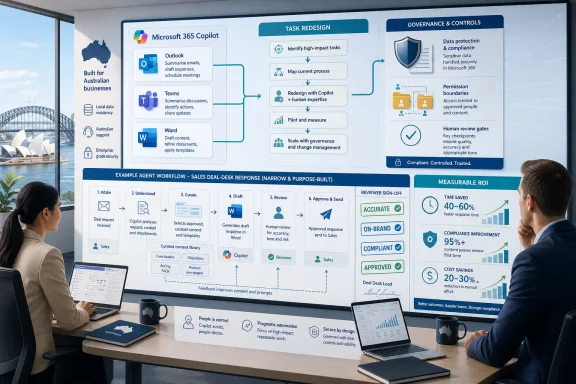
Fujifilm’s clearest customer-style example is a Copilot agent for sales and deal-desk response preparation. The task is mundane, high-friction, and commercially meaningful: responding to an opportunity by locating approved content, tailoring it, and pushing drafts through review by product, legal, commercial, and management stakeholders. This is exactly the kind of work that consumes organizational capacity without looking like a single broken process.A focused agent can help by producing a first-pass response from curated content: approved clauses, templates, brand standards, marketing language, and review notes. The value is not that the AI “understands sales” in some sweeping sense. The value is that it narrows the source material, standardizes the first draft, and reduces the number of avoidable review cycles.
That is an important distinction. The agent is not replacing the deal desk or turning salespeople loose with unconstrained generation. It is compressing the preparation phase so a manager can review a better starting point faster. Human judgment remains in the loop, but it is applied later and more efficiently.
This is where ROI becomes more plausible. Time saved per deal, fewer handoffs, reduced review load, faster turnaround, and more consistent response quality are measurable. They are also business outcomes that leaders already understand. Unlike generic productivity claims, they can be tied to pipeline velocity, bid quality, and staff capacity.
The example also exposes why curated content matters. An agent that drafts from a chaotic document estate can create more review burden, not less. A sales response assembled from outdated collateral, superseded legal language, or inconsistent brand claims becomes a liability. The AI use case therefore forces the organization to do the unglamorous content governance that it should have done anyway.
The CIO’s Job Is to Slow the Right Things Down
The fashionable complaint about enterprise AI governance is that it slows innovation. Sometimes that is true. A committee can absolutely smother useful experimentation under policy language, risk matrices, and abstract principles that never touch a real workflow.But Fujifilm’s position is subtler. It argues for introducing “just enough” planning and governance early so adoption can scale without surprises. That is not bureaucracy for its own sake. It is an attempt to slow the right things down: decisions about data access, task ownership, review points, and acceptable use.
The distinction matters because speed is not one thing. Organizations can move quickly in experimentation while being deliberate about production boundaries. They can let teams test Copilot for drafting and summarization while taking more care with agents that generate customer-facing material or touch regulated records. They can encourage use while still requiring that high-impact workflows have named owners and defined controls.
This is the maturity model many CIOs should prefer because it avoids the false choice between enthusiasm and paralysis. AI adoption does not need to wait for a perfect enterprise framework, but neither should it be allowed to metastasize through informal practices no one can audit. The middle path is task-by-task governance: concrete enough to be useful, narrow enough to be fast, and repeatable enough to become institutional muscle.
There is a cultural component here as well. Making risk explicit can feel like negativity in organizations desperate to show AI progress. Yet the teams that name the risks early are often the ones that move faster later, because they do not have to retrofit accountability after users have already built habits around unmanaged tools.
Microsoft’s Agent Push Raises the Stakes
Microsoft’s current direction makes Fujifilm’s caution more urgent, not less. The company is no longer pitching Copilot only as a helpful assistant inside Office apps. Its 2026 workplace AI narrative increasingly centers on agents, organizational context, enterprise data protection, and AI systems that can take on more execution across Microsoft 365 and connected business applications.That is the logical evolution of the product. Summaries and drafts are useful, but the larger prize is work orchestration: coordinating tasks, using business context, connecting to data sources, and reducing human effort across repeatable processes. Microsoft’s advantage is that it can place those capabilities close to where knowledge workers already spend their day.
But as Copilot becomes more agentic, the cost of vague AI strategy rises. A poorly governed summarization tool may produce confusion. A poorly governed agent can produce action. Even if human approval remains required, a bad first draft, wrong recommendation, or inappropriate retrieval can still distort decisions and waste time at scale.
This is why the sales response example is more instructive than a generic vision of AI agents. It defines the corpus, the task, the reviewer, and the expected business value. It keeps the agent close to a known workflow rather than letting it roam across the organization in search of usefulness. That is how enterprises should domesticate agentic AI: not by pretending it is harmless, but by giving it a job description.
For WindowsForum’s IT-minded audience, the lesson is familiar from endpoint management and identity security. Capability without policy becomes sprawl. Policy without usability becomes shadow IT. The winning pattern is managed enablement, where the platform makes the approved path easier than the risky workaround.
Australia’s Cloud-First Reality Makes This More Than a Vendor Story
The article’s Australian context matters because many local organizations are already living with the consequences of cloud consolidation. Microsoft 365, Azure, Dynamics 365, and the surrounding security stack are not peripheral systems for many enterprises and public-sector bodies. They are the default substrate for work.That creates a pragmatic bias. A CIO may be fascinated by frontier models, bespoke applications, or specialist AI platforms, but the first scaled AI experience for most employees will likely arrive through tools already procured. The economics, training path, compliance posture, and support model all point toward Microsoft 365 as the initial AI proving ground.
Fujifilm, as an advisory and services player, is naturally positioning itself around that reality. The message is convenient for a Microsoft-centric services business, but it is not wrong. Most organizations do not need to begin their AI maturity journey with a custom model strategy. They need to know whether Copilot can safely reduce the pain in real work.
The risk, of course, is that Microsoft 365 becomes the only lens through which AI value is understood. Not every process lives in Microsoft’s world, and not every business problem is solved by a productivity-layer assistant. But Fujifilm’s narrower claim is defensible: because so much organizational data and daily work already sit in Microsoft 365, it is the most immediate place to prove whether AI governance and value creation can coexist.
That makes Copilot a test of organizational seriousness. If the company cannot define tasks, clean up access, curate content, and measure outcomes in the environment it already controls, the problem is unlikely to be solved by adding more platforms.
The Hardest AI Metric Is Still the One Finance Believes
Every enterprise AI discussion eventually collides with ROI. The industry’s early productivity studies and vendor case studies can be encouraging, but finance teams rarely fund transformation on the basis of vibes. They want to know whether AI reduces cost, increases revenue, improves quality, cuts risk, or frees capacity that can be redeployed.Copilot complicates this because many benefits are distributed. A worker saves eight minutes summarizing a meeting. A manager drafts a document faster. A team finds a policy more quickly. These moments are useful, but they do not automatically show up in the P&L. Worse, they may create more output for others to review, turning individual speed into organizational noise.
Task-level redesign gives CIOs a better measurement frame. Instead of asking whether Copilot made everyone more productive, ask whether it reduced proposal preparation time by a defined percentage, shortened contract review cycles, improved first-response quality, or cut the number of people required to assemble a recurring report. These are narrower claims, but they are stronger.
The most credible AI business cases will probably look boring at first. They will identify a high-volume or high-value task, map the current process, introduce AI assistance within controlled boundaries, and measure whether the outcome changed. That is not the mythology of autonomous enterprise transformation. It is the discipline of operational improvement.
The irony is that this boring approach may be the only route to the ambitious one. Organizations earn the right to automate more complex work by proving they can govern simpler AI-assisted tasks. Maturity compounds when each successful use case leaves behind better data, clearer ownership, reusable patterns, and more confident users.
The Copilot Era Rewards Organizations That Know Their Own Work
The central insight in Fujifilm’s advice to CIOs is to start with one high-value task the business already understands. That sounds obvious until one observes how often AI programs begin with technology selection rather than workflow selection. The result is a familiar inversion: the organization buys capability, then goes hunting for problems dramatic enough to justify it.Starting with known work reverses the burden. The business defines the pain; IT and advisory partners determine whether Copilot can help; security and governance teams define the safe operating envelope; managers decide what success means. This is a healthier sequence because it keeps AI subordinate to business intent.
It also makes employee adoption more credible. Workers are more likely to trust AI that helps with a task they already recognize than an abstract transformation program imposed from above. A salesperson does not need a lecture on generative AI to appreciate a better first draft assembled from approved content. A legal reviewer does not need hype if the review notes are clearer and the source material is controlled.
There is still room for experimentation. In fact, organizations should encourage employees to discover useful personal workflows. But the bridge from individual usefulness to enterprise value must be deliberately built. Otherwise, Copilot becomes a patchwork of private efficiencies rather than a shared capability.
This is where IT leaders can reclaim the strategic center. Their role is not simply to say yes or no to AI. It is to translate between platform capability, business process, risk appetite, and measurable value. In the Copilot era, the best CIOs will be less like tool buyers and more like operating-model editors.
The Lesson Fujifilm Wants CIOs to Learn Before the Agent Wave Breaks
Fujifilm’s argument is not that every organization should move slowly. It is that they should move concretely. The closer AI gets to everyday work, the less useful grand strategy becomes unless it can be expressed as a governed task with a measurable outcome.- Organizations should define AI use cases at the level of real work, not at the level of platform capability.
- Microsoft 365 Copilot is likely to be the first scaled AI experience for many staff, which makes Microsoft 365 data hygiene a business priority rather than an IT housekeeping exercise.
- Personal productivity gains matter, but they rarely become enterprise ROI unless they are connected to process-level outcomes.
- Generative AI should be treated as probabilistic assistance, not as a deterministic system of record.
- Narrow agents built on curated content and explicit review paths are more likely to produce value than broad agents introduced before ownership and boundaries are clear.
- CIOs should make risk explicit early, because delayed governance usually returns later as rework, audit exposure, or loss of trust.
References
- Primary source: iTnews
Published: 2026-06-03T20:50:10.501012
Fujifilm: Turning AI ambition into practical business value - iTnews
Scaling AI starts with clarity: knowing where it creates value, how it fits into daily work, and how to manage risk from the beginning.www.itnews.com.au - Official source: blogs.microsoft.com
Unlocking human ambition to drive business growth with AI - The Official Microsoft Blog
As our customers progress toward becoming Frontier Firms, they are using AI not only to optimize how work gets done, but to reinvent their business on the promise of growth. Organizations can now unlock creativity, accelerate innovation and democratize intelligence by bringing Copilots and...blogs.microsoft.com - Related coverage: ir.fujifilm.com
- Related coverage: asset-fb.fujifilm.com
FB_brochure2025_e_0324.indd
city square front of New York business district,New York State,USA.asset-fb.fujifilm.com
