

Fujitsu has been honored with two category wins at the 2025 Microsoft Japan Partner of the Year awards — the AI Innovation Award and the Migrate SAP Award — recognizing a generative-AI prototype built for Japan Airlines and Fujitsu’s RISE with SAP delivery under its “Higher with Fujitsu” offering.
Microsoft’s Partner of the Year program is a high-profile annual benchmark that spotlights partners delivering measurable customer outcomes on Microsoft platforms. The 2025 cycle placed special weight on production-grade AI, platformized model lifecycle management, and large-scale cloud migrations — categories where hyperscalers and systems integrators demonstrated heavily engineered, governed solutions. Microsoft publicly positioned the program as highly competitive in 2025, with thousands of nominations and winners announced around its Ignite event. For Fujitsu, the two awards represent a strategic double-play: validating both (1) frontline, edge-capable generative AI (a pilot with Japan Airlines that uses small language models on tablets), and (2) deep modernization and migration work for mission‑critical SAP estates using RISE with SAP on Microsoft Azure. Fujitsu’s own press materials frame the wins as part of its Uvance business model and a multi-year push with Microsoft to deliver sustainability-focused digital transformation.
For IT leaders and procurement teams, these awards are a reason to start a disciplined conversation with Fujitsu: use the honor as a shortlisting signal, then demand production‑grade evidence — telemetry, runbooks, references, security attestations, and exit clauses — before committing to large-scale rollouts. Fujitsu’s scale, Microsoft partnership, and productized IP make it a serious contender for enterprises seeking an Azure‑centric path to both modernization and operational AI; converting that potential into reliable business outcomes requires the same level of rigor that the awards seek to recognize.
Source: ACN Newswire Fujitsu recognized with two Microsoft Japan Partner of the Year awards
 Background / Overview
Microsoft’s Partner of the Year program is a high-profile annual benchmark that spotlights partners delivering measurable customer outcomes on Microsoft platforms. The 2025 cycle placed special weight on production-grade AI, platformized model lifecycle management, and large-scale cloud migrations — categories where hyperscalers and systems integrators demonstrated heavily engineered, governed solutions. Microsoft publicly positioned the program as highly competitive in 2025, with thousands of nominations and winners announced around its Ignite event. For Fujitsu, the two awards represent a strategic double-play: validating both (1) frontline, edge-capable generative AI (a pilot with Japan Airlines that uses small language models on tablets), and (2) deep modernization and migration work for mission‑critical SAP estates using RISE with SAP on Microsoft Azure. Fujitsu’s own press materials frame the wins as part of its Uvance business model and a multi-year push with Microsoft to deliver sustainability-focused digital transformation. Why these wins matter: the commercial signal
Winning complementary awards in AI and SAP migration at the same partner event isn’t just a publicity moment; it’s a go‑to‑market signal with practical implications for buyers and competitors.- Platform alignment: Both solutions — the JAL generative‑AI prototype and RISE with SAP operations — lean heavily on Microsoft platform primitives, notably Azure AI Foundry and Azure infrastructure. That alignment increases the likelihood of co‑sell traction and prioritized field engagement with Microsoft.
- Breadth and depth: The awards highlight Fujitsu’s ability to deliver both lightweight, edge-capable AI for front-line users and heavy-duty ERP migrations that require long-term operational guarantees. For large enterprises, partners who can bridge front-line AI and back‑office ERP modernization reduce vendor handoffs and integration risk.
- Market credibility: Microsoft Partner honors are frequently used by procurement teams as a short‑listing filter. They do not replace due diligence, but they accelerate conversations and can unlock Microsoft channels, early access, and co‑marketing.
The AI Innovation Award: technical anatomy and implications
What Fujitsu announced
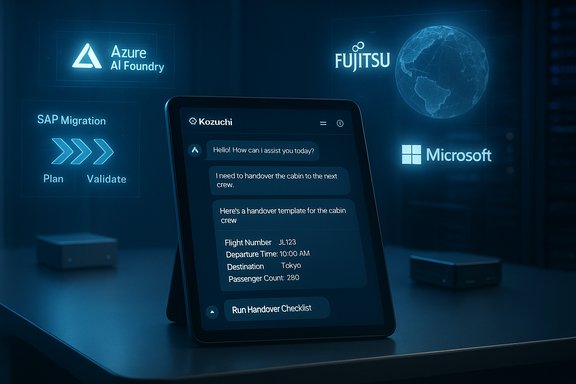
Fujitsu’s AI Innovation Award recognizes a prototype developed with Headwaters Co., Ltd. for Japan Airlines (JAL). The project uses Microsoft’s Phi-4 small language model (SLM) — intentionally sized and optimized for offline inference — alongside Fujitsu’s Kozuchi platform and Headwaters’ on-device engineering to produce handover reports on cabin‑crew tablets via a chat-like UI. Fujitsu described fine‑tuning the SLM with Kozuchi to adapt the model to airline reporting templates and terminology.Azure AI Foundry: the production plane
Microsoft’s Azure AI Foundry is the intended production environment and toolchain for such projects: model discovery and catalogs, customization (fine‑tuning and RAG), multi‑agent orchestration, and observability are core Foundry features that partners use to manage model lifecycle, safety, and telemetry. For enterprises, Foundry’s tooling is central to moving beyond isolated PoCs to governed, auditable AI services.Why an on‑device SLM matters
Running a compact, quantized SLM on tablets addresses three operational constraints common in aviation and other regulated sectors:- Connectivity resilience: cabin crews operate in intermittent connectivity environments; on‑device inference reduces dependence on in‑flight connectivity.
- Latency and usability: local inference improves responsiveness for quick report drafting during short duty windows.
- Data minimization: processing sensitive operational notes locally reduces outbound data egress and simplifies compliance concerns.
Technical strengths reported
- Use of an SLM (Phi‑4) optimized for offline performance and quantized inference.
- Domain adaptation via Fujitsu Kozuchi to align outputs with existing JAL handover report formats and vocabularies.
- Edge engineering by Headwaters to run the SLM on commodity tablets in a chat‑style UI that crews can use with minimal training.
Risks and operational caveats
The architecture is sensible for the use case, but any edge‑deployed generative AI must address non-trivial operational risks:- Quality control and hallucinations — even fine‑tuned SLMs can produce incorrect or misleading text; human‑in‑the‑loop checkpoints and confidence scoring are essential.
- Update and governance cadence — secure model update channels, signed model artifacts, and a documented rollout/rollback plan are necessary to avoid stale models or uncompromised devices.
- Observability at the edge — traces and telemetry must be collected securely and with user privacy in mind so anomalies and drift can be detected without leaking sensitive content.
The Migrate SAP Award: RISE with SAP and “Higher with Fujitsu”
Fujitsu’s RISE with SAP position
Fujitsu received the Migrate SAP Award for delivering RISE with SAP, premium supplier option via Higher with Fujitsu — a packaged migration and managed‑services play that runs SAP S/4HANA on Azure under Fujitsu’s operations. Fujitsu was already the first Japanese premium supplier for RISE with SAP when it announced the offering in 2023; the 2025 award signals execution maturity and customer outcomes at scale.What buyers get from a premium supplier
- A single-supplier path that bundles change‑management, migration, and long‑term operations.
- Prebuilt playbooks for S/4HANA conversion, cutover orchestration, and managed security on Azure.
- Potentially smoother co‑sell engagement and platform-level optimizations tied to Azure infrastructure and Microsoft tooling.
Practical procurement considerations
Large SAP migrations are multi‑year, mission‑critical programs. An award signals a partner’s capability but should be converted into contractual protections and verifiable deliverables:- Define strict cutover acceptance tests and rollback criteria.
- Require named references with similar scope and industry, and request measurable KPIs (system availability, transaction latency, total cost of ownership before/after).
- Insist on FinOps controls and an initial cloud consumption cap or cost‑governance triggers; SAP on cloud can create sustained, high OPEX if unmonitored.
Strategic reading: what Fujitsu’s twin wins reveal
A deliberate, integrated go‑to‑market
The combination of an operationally focused generative‑AI pilot and a repeatable SAP migration offering suggests Fujitsu is aiming to own both the enterprise core and the edge‑AI overlay. For customers, that narrative is attractive: modernize the ERP backbone, then surface AI‑driven productivity across front-line workflows that consume and enrich ERP data. Fujitsu’s Uvance strategy and a five‑year global partnership with Microsoft give it structural levers to build combined solution stacks.Microsoft’s platform bet is visible
Microsoft’s Azure AI Foundry, Copilot primitives, and Azure infrastructure are central to the kinds of projects Microsoft wants partners to scale. Fujitsu’s wins mirror that push: partners that demonstrate production AI governance and reliable SAP migrations fit squarely into Microsoft’s co‑sell ambitions.Talent and operational scale
Fujitsu reports a global workforce of about 113,000 employees and cited training and certification initiatives with Microsoft for roughly 28,000 employees involved in Uvance solution delivery. The company also reported consolidated revenues of 3.6 trillion yen for the fiscal year ended March 31, 2025 — facts Fujitsu uses to underline delivery scale and financial stability. Buyers should weigh this scale against regional delivery needs and the vendor’s ability to allocate skilled teams to their programs.What enterprise buyers should ask next (practical checklist)
- Ask for named references and production KPIs (before/after metrics) for both the AI pilot and any SAP migration work.
- Request architecture artifacts:
- Model cards and governance plans for AI models used on device.
- Data flow diagrams, retention and export policies for generated outputs.
- Telemetry, observability dashboards, and incident runbooks.
- Validate security and compliance:
- Evidence of third‑party penetration testing and SOC2 or equivalent attestations for managed services.
- Documented controls for model updates and code signing for on‑device models.
- Financial guardrails:
- FinOps playbook for SAP on Azure, with initial consumption caps and escalation triggers.
- Clear pricing for model updates and maintenance of on‑device inference components.
- Portability and exit planning:
- Contractual clauses to export conversation logs, model artefacts, and ERP configuration in open formats to minimize lock‑in.
Strengths, but also clear risks
Strengths
- End‑to‑end capability across edge AI and core ERP modernization reduces integration risk.
- Microsoft alignment increases co‑sell potential and access to platform-level engineering.
- Repeatable IP: Kozuchi and Higher with Fujitsu indicate productized approaches rather than one‑offs.
Risks and limits
- Award ≠ guarantee: recognition validates judged outcomes, but procurement teams must convert signals into contractual SLAs and independently verifiable evidence.
- Operational complexity: on‑device SLMs require secure update pipelines, telemetry, and change control processes that not every integrator handles well at scale.
- Cost and lock‑in: consolidating ERP and AI workloads on an Azure + RISE stack increases platform coupling; explicit exit, export and rollback clauses are necessary.
Turning recognition into procurement-grade evidence
Awards are a useful filter, but the difference between a successful pilot and enterprise adoption is operational rigor. To convert Fujitsu’s recognition into procurement certainty:- Insist Fujitsu produce redacted telemetry and a short list of customer references for the exact capability being procured.
- Require a small, time‑boxed pilot that replicates your environment and collects measurable KPIs and cost metrics.
- Demand runbooks, certified resource rosters, and a documented model lifecycle plan (versioning, testing, rollback).
- For SAP migrations, set explicit go‑live acceptance criteria, data reconciliation tests, and a financial incentive/penalty framework for missed SLAs.
Wider context: partner awards and the ecosystem
Microsoft’s 2025 awards underscored the industry transition from experiments to governed, productized AI platforms. Partners who combine platform engineering, strict governance, and domain IP are receiving recognition and the associated commercial advantages. That said, partner awards remain one element in vendor selection — complementary evidence (security attestations, named references, audited delivery metrics) is essential before awarding high-risk contracts or migrating mission‑critical workloads.Conclusion
Fujitsu’s twin wins at the 2025 Microsoft Japan Partner of the Year awards — AI Innovation for the JAL on‑device generative AI prototype, and Migrate SAP for its RISE with SAP premium supplier delivery via Higher with Fujitsu — are meaningful endorsements of a strategy that unites edge AI and core ERP modernization under Microsoft’s platform umbrella. The technical choices (Phi‑4 SLM, Kozuchi fine‑tuning, Azure AI Foundry) and the RISE play reflect current best practices for production AI and cloud migration, but they also bring familiar operational and governance demands.For IT leaders and procurement teams, these awards are a reason to start a disciplined conversation with Fujitsu: use the honor as a shortlisting signal, then demand production‑grade evidence — telemetry, runbooks, references, security attestations, and exit clauses — before committing to large-scale rollouts. Fujitsu’s scale, Microsoft partnership, and productized IP make it a serious contender for enterprises seeking an Azure‑centric path to both modernization and operational AI; converting that potential into reliable business outcomes requires the same level of rigor that the awards seek to recognize.
Source: ACN Newswire Fujitsu recognized with two Microsoft Japan Partner of the Year awards
