

Microsoft’s plan to fold its Copilot AI into Xbox is no longer an experiment confined to Windows and mobile: Xbox leadership has publicly confirmed that Gaming Copilot will arrive on current-generation Xbox consoles “later this year,” even as the newly appointed head of Microsoft Gaming warned employees she will not let AI turn games into “soulless AI slop.” The announcement — delivered at GDC and amplified across Xbox channels — crystallizes a new crossroads for Microsoft: one path promises convenience and accessibility; the other raises questions about creative integrity, privacy, and how platform-level AI should be governed.
Microsoft’s Copilot brand has expanded aggressively across its product lines: Office, Windows, Edge, and now gaming. What began as a text-and-assist feature has evolved into a cross-device, context-aware assistant that Microsoft describes as a way to help players “stay in the action” by answering questions, offering hints, managing installs, and assisting with account tasks without leaving a play session. The first public iterations of Gaming Copilot were rolled into Windows 11’s Game Bar and a mobile second-screen experience; these have been tested with Xbox Insiders and select hardware partners.
At the same time, Microsoft recently reorganized its gaming leadership. Asha Sharma — a veteran of Microsoft’s CoreAI organization who joined the company in 2024 — became CEO of Microsoft Gaming in late February 2026. In her introductory memo to staff, Sharma explicitly tried to calm developer and player concerns about indiscriminate generative AI use: “As monetization and AI evolve and influence this future, we will not chase short‑term efficiency or flood our ecosystem with soulless AI slop.” That line has become shorthand for a public expectation: Microsoft says it will put guardrails around AI in games, even as it leans into AI-driven product features.
The tension between those two realities — aggressive productization of Copilot and a promise to avoid “AI slop” — is the heart of the controversy. Today’s rollout timeline for console Copilot raises practical and philosophical questions in equal measure.
Two facts matter here and deserve precise framing:
First, embedding an assistant into consoles is itself a productization of AI; it will be used to surface commerce and service flows. That’s not inherently “soulless,” but the risk is clear: platform‑level AI can normalize product-first interventions in games (prompts, nudges, or overlays) that change player experience and developer intent. If monetization is prioritized, Copilot could become a vector for promoting DLC, microtransactions, or subscription upgrades at moments of player vulnerability. That would be the exact scenario Sharma’s memo warns against.
Second, creators worry about creative dilution. AI assistance (in-game hints, adaptive difficulty, or automated content creation) can help players who are stuck, but it can also undercut the satisfaction of discovery and mastery that many games are built around. The phenomenon is not theoretical: developers and players have already pushed back against features that shorten the loop of exploration and problem solving. Microsoft’s messaging must therefore reconcile platform‑level convenience with developer control and player agency.
In short: Microsoft’s stated aim to avoid “slop” is laudable, but the console Copilot move forces a governance test. The company must show — in code, policies, and developer toolkits — that it will uphold creative standards while integrating AI features.
Community sentiment has a particular flavor of fatigue: players have already seen AI assistants appear in storefronts, streaming services, and shopping experiences — some of which felt intrusive. The worry is not only practical but cultural: will AI erode the sense of authorship and craft in the medium? Microsoft’s messaging will need to be accompanied by concrete developer controls (APIs to disable or adapt Copilot behavior in-game, explicit “no-prompt” modes for preservation of player experience, clear monetization rules) to reassure the ecosystem.
If Microsoft executes Copilot with strong governance and developer empowerment, it could raise the accessibility and convenience bar for all consoles. If it fails to govern commerce and creativity, Copilot risks becoming a symbol of platform overreach — exactly the outcome Sharma’s memo warned against. The difference between those two outcomes will be in the details: whether Microsoft publishes binding rules, gives creators meaningful control, and sets privacy defaults that respect shared household use.
What to watch next:
Conclusion
Gaming Copilot coming to Xbox consoles is not a minor UX tweak; it is a strategic bet that places AI at the heart of how Microsoft expects players to interact with games and services. The move can improve accessibility and reduce friction, but it will only earn player and developer trust if Microsoft converts rhetoric into enforceable policy and practical controls. For players and creators who value human-made craft, the promise of “no soulless AI slop” cannot be an aspirational line in an internal memo — it must be reflected in the product’s design, the platform’s contract with studios, and the privacy and governance mechanics that ship with console firmware. The coming months will reveal whether Xbox can walk that line or whether convenience will quietly eclipse craft.
Source: Destructoid Microsoft confirms Copilot AI is coming to Xbox, mere weeks after new CEO said gaming division would avoid ‘soulless slop’
 Background / Overview
Microsoft’s Copilot brand has expanded aggressively across its product lines: Office, Windows, Edge, and now gaming. What began as a text-and-assist feature has evolved into a cross-device, context-aware assistant that Microsoft describes as a way to help players “stay in the action” by answering questions, offering hints, managing installs, and assisting with account tasks without leaving a play session. The first public iterations of Gaming Copilot were rolled into Windows 11’s Game Bar and a mobile second-screen experience; these have been tested with Xbox Insiders and select hardware partners.At the same time, Microsoft recently reorganized its gaming leadership. Asha Sharma — a veteran of Microsoft’s CoreAI organization who joined the company in 2024 — became CEO of Microsoft Gaming in late February 2026. In her introductory memo to staff, Sharma explicitly tried to calm developer and player concerns about indiscriminate generative AI use: “As monetization and AI evolve and influence this future, we will not chase short‑term efficiency or flood our ecosystem with soulless AI slop.” That line has become shorthand for a public expectation: Microsoft says it will put guardrails around AI in games, even as it leans into AI-driven product features.
The tension between those two realities — aggressive productization of Copilot and a promise to avoid “AI slop” — is the heart of the controversy. Today’s rollout timeline for console Copilot raises practical and philosophical questions in equal measure.
What is Gaming Copilot?
The feature set in plain terms
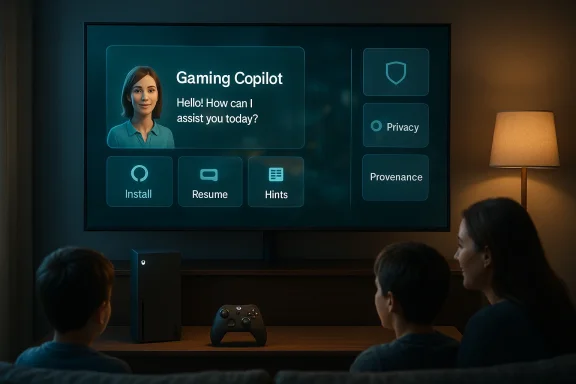
Gaming Copilot is positioned as an in-session, context-aware digital assistant built on Microsoft’s Copilot stack. Its advertised capabilities include:- Quick, conversational answers to account and service questions (for example, “When does my Game Pass subscription expire?”) without leaving gameplay.
- Gameplay hints, walkthrough guidance, and tips tailored to the player’s current context or a screenshot the assistant analyzes.
- Hands-free tasks such as installing, updating, or launching games through natural language prompts.
- Platform-level actions like achievement lookups, friend invites, or store searches — all mediated by the Copilot UI.
How Copilot works (at a technical level)
Microsoft’s Copilot is a layered architecture that blends cloud-hosted large models, local context sources (screenshots, game telemetry), and platform APIs. On Windows 11, the Game Bar version runs as an overlay and uses a local context window to capture information such as the active game, recent screenshots, and user account state; responses are generated by cloud services and surfaced in the overlay. Microsoft’s wording suggests the console integration will borrow the same pattern: local context capture plus cloud model inference, mediated by Xbox system APIs. The company has not published full architecture diagrams or the exact AI model family used for gaming Copilot, so some implementation details remain unconfirmed publicly.The new confirmation: consoles and timing
At the Game Developers Conference (GDC) panel, Sonali Yadav, Xbox’s gaming AI partner group product manager, told attendees that Gaming Copilot will come to current‑generation consoles “later this year.” Microsoft previously rolled a Copilot beta into the Windows Game Bar and added a Copilot experience to the Xbox mobile app and certain handheld partners; the console launch represents the next step in bringing the assistant to the living room.Two facts matter here and deserve precise framing:
- “Later this year” is a Microsoft-provided window, not a specific ship date. The phrase implies a 2026 deployment on Xbox Series X|S (the “current-generation consoles”), but Microsoft has not announced a calendar date or the details of any staggered regional rollouts. That means gamers should expect a phased rollout rather than an instantaneous, global switch-on.
- Console integration is functionally different from the Game Bar and mobile experiences because of the living‑room environment, shared accounts, and potential for persistent audio/voice activation. That change in context increases the stakes for privacy, moderation, and content control.
Why Microsoft is pushing Copilot into the living room
Microsoft’s rationale is straightforward: make gaming less friction-filled and more discoverable for casual and hardcore players alike. Copilot serves three strategic goals:- Drive engagement: reducing friction — installing, finding, or resuming games — keeps players in the Xbox ecosystem longer and supports subscription services like Game Pass.
- Surface value: Copilot can act as a product-layer differentiator for Xbox hardware and software, positioning Microsoft as an AI-forward platform provider in an increasingly commoditized console market.
- Upsell and retention: context-aware prompts can remind users about expiring subscriptions, content add-ons, and promotions at moments when those prompts are most relevant. That has obvious commercial appeal for Microsoft.
The tension with Asha Sharma’s “no soulless AI slop” promise
Asha Sharma’s memo boils down to a governance pledge: Microsoft says it will avoid replacing human craft with cheap generative outputs or short‑term monetization hacks. The console Copilot confirmation complicates that promise in two ways.First, embedding an assistant into consoles is itself a productization of AI; it will be used to surface commerce and service flows. That’s not inherently “soulless,” but the risk is clear: platform‑level AI can normalize product-first interventions in games (prompts, nudges, or overlays) that change player experience and developer intent. If monetization is prioritized, Copilot could become a vector for promoting DLC, microtransactions, or subscription upgrades at moments of player vulnerability. That would be the exact scenario Sharma’s memo warns against.
Second, creators worry about creative dilution. AI assistance (in-game hints, adaptive difficulty, or automated content creation) can help players who are stuck, but it can also undercut the satisfaction of discovery and mastery that many games are built around. The phenomenon is not theoretical: developers and players have already pushed back against features that shorten the loop of exploration and problem solving. Microsoft’s messaging must therefore reconcile platform‑level convenience with developer control and player agency.
In short: Microsoft’s stated aim to avoid “slop” is laudable, but the console Copilot move forces a governance test. The company must show — in code, policies, and developer toolkits — that it will uphold creative standards while integrating AI features.
Privacy, data, and security considerations
Bringing Copilot to consoles raises a cluster of privacy and security questions that Xbox must answer in detail. The key concerns include:- Context capture and telemetry: For Copilot to give in‑game, context-sensitive answers it needs access to screenshots, game state, and sometimes telemetry. Microsoft will need to clarify what data is captured, how long it’s stored, and whether it leaves the console to cloud services. Existing Game Bar behavior offers a precedent, but consoles are often shared across families and children, which complicates consent models.
- Voice and always-listening activation: If Copilot supports voice activation on console, Microsoft must clearly communicate whether the device is ever listening, what triggers are required, and how audio snippets are handled. Misconfigurations or opaque controls could create surveillance anxieties among users.
- Third-party content and hallucinations: Any generative assistant risks making factual errors or producing “hallucinations.” In a gaming context that could mean incorrect gameplay tips, wrong achievement instructions, or erroneous account guidance. Microsoft will need robust fallbacks and explicit signals when an answer is probabilistic rather than authoritative.
- Child safety and moderation: Consoles are home to minors; features must be compliant with child-protection frameworks, local laws, and platform policies. Copilot’s outputs need content filtering and moderation — not just for profanity, but for safety and age-appropriate guidance.
Developer and community reaction — early signs
Initial responses from developers and the community have been mixed. Some developers welcome the productivity and support potential: Copilot could lower support costs, reduce churn for complex games, and help players who otherwise would give up. Others are skeptical or hostile: fans worry that assistant prompts will be used for microtransaction prompts or that AI will be weaponized as a discovery engine to surface monetized content over genuinely relevant help.Community sentiment has a particular flavor of fatigue: players have already seen AI assistants appear in storefronts, streaming services, and shopping experiences — some of which felt intrusive. The worry is not only practical but cultural: will AI erode the sense of authorship and craft in the medium? Microsoft’s messaging will need to be accompanied by concrete developer controls (APIs to disable or adapt Copilot behavior in-game, explicit “no-prompt” modes for preservation of player experience, clear monetization rules) to reassure the ecosystem.
Potential strengths: what Copilot could actually improve
It’s worth cataloguing the legitimate benefits Gaming Copilot could deliver — not as hype but as concrete, achievable outcomes:- Accessibility: Copilot could dramatically improve accessibility by letting players request descriptions, adaptive input mappings, or summaries without changing the core game logic. That’s a meaningful win for players with disabilities.
- Onboarding: New or complex games often have high churn. Timely, optional guidance could bring players up to speed without forcing developers to build extensive tutorial trees for every edge case.
- Time-savers: Quick account actions (e.g., checking Game Pass status, resuming a saved game remotely, or installing a required update) reduce friction in multi-device scenarios and can improve overall platform satisfaction.
- Support automation: For developers and publishers, Copilot could offload routine support queries to the platform (e.g., troubleshooting install errors), freeing human support resources for subtler problems.
Key risks and failure modes
However, the downsides are real and require mitigation:- Monetization creep: When platform assistants can surface offers in context, the incentive to push purchases at the point of pain is strong. That shift could degrade experience and erode trust if it’s not explicitly prohibited or controlled.
- Creative interference: If Copilot is allowed to alter difficulty, add persistent hints, or generate substitute content, it may reduce the value of deliberate game design and the satisfaction of discovery. Developers should be able to opt out or strictly limit Copilot interventions.
- Data overreach: Consoles in the living room are shared devices. Any feature that captures contextual screenshots or audio must default to conservative privacy settings and provide transparent controls.
- Model errors and liability: Incorrect guidance can lead to lost progress, inappropriate content, or misdirected purchases. Microsoft needs robust confidence thresholds, provenance markers, and a clear policy for when Copilot’s answers are non-authoritative.
- Trust erosion: If players feel Copilot exists to monetize them rather than help them, the platform could suffer reputational damage that outweighs the short-term engagement boost. That’s exactly the reputational risk Sharma’s memo was designed to head off.
What Microsoft must do to keep its promise
If Microsoft truly intends to avoid “soulless AI slop,” the console Copilot launch must be accompanied by three things: governance, developer control, and transparency.1. Governance — clear, enforceable rules
Microsoft should publish a Copilot developer policy that includes:- A prohibition on unsolicited monetization prompts from system-level assistants inside gameplay.
- Guidelines for when Copilot may surface paid content and how that must be disclosed.
- A model of audit logs and external review for high-risk use cases (child safety, health, finance).
2. Developer control — APIs and opt-outs
Game creators must be able to:- Explicitly disable Copilot assistance in specific play modes (e.g., competitive multiplayer or narrative-driven modes where immersion matters).
- Choose the level of assistance Copilot can offer (from “off” to “hints-only” to “full coaching”).
- Provide developer-supplied canonical guidance (so Copilot cites the studio as the authoritative source for certain tips).
3. Transparency — explainability and provenance
Copilot responses should:- Flag when a suggestion is generated (versus pulled from official documentation).
- Provide short provenance notes (“based on official game guide” vs. “Copilot inference”).
- Let users view and purge any stored contextual data associated with Copilot interactions.
Practical advice for players and developers (what to do now)
For players:- Wait for the official Xbox announcement and rollout notes; don’t accept platform or console firmware updates without reading the privacy and opt-in language.
- When Copilot becomes available, look for account-level toggles that control listening and contextual capture; default to conservative settings if privacy matters to you.
- Use developer-provided in‑game options to keep hints off in games where discovery is central to the experience.
- Track Microsoft’s Copilot developer docs and API plans closely; early integration can preserve design intent and give you control over how assistance is offered.
- Advocate for explicit platform-level prohibitions on monetization intrusions during gameplay and push for transparent provenance markers for any Copilot content.
- Test Copilot interactions in private builds to ensure the assistant’s behavior aligns with your design and does not inadvertently disclose spoilers or secret mechanics.
How this will shape the next console generation narrative
The console generation roadmap is increasingly about software differentiation as much as silicon. Microsoft’s push to make Xbox an “AI-first” gaming platform is consistent with broader company strategy: tie hardware to services and cloud AI to create sticky experiences. That strategy can be a competitive advantage, but it introduces trade-offs.If Microsoft executes Copilot with strong governance and developer empowerment, it could raise the accessibility and convenience bar for all consoles. If it fails to govern commerce and creativity, Copilot risks becoming a symbol of platform overreach — exactly the outcome Sharma’s memo warned against. The difference between those two outcomes will be in the details: whether Microsoft publishes binding rules, gives creators meaningful control, and sets privacy defaults that respect shared household use.
Final assessment and what to watch for
Microsoft’s confirmation that Gaming Copilot will arrive on Xbox consoles “later this year” is a consequential product move and a stress test of the company’s stated commitment to protect game craft. The technical promise is real: contextual assistance, cross-device continuity, and frictionless account actions would be valuable to many players. But the cultural promise will be harder to keep: avoiding “soulless AI slop” requires more than words — it requires publishable policy, developer controls, transparent privacy practices, and a demonstrated reluctance to monetize assistance at the expense of experience.What to watch next:
- The official Xbox blog or console firmware notes that define the Copilot feature set and rollout schedule.
- Microsoft’s Copilot for Gaming developer documentation and any published policy on in-game monetization nudges.
- Privacy documentation detailing what contextual data is captured, stored, or shared when Copilot is active on console.
- Early community and developer reactions during the console beta (Xbox Insiders) and whether Microsoft changes course in response.
Conclusion
Gaming Copilot coming to Xbox consoles is not a minor UX tweak; it is a strategic bet that places AI at the heart of how Microsoft expects players to interact with games and services. The move can improve accessibility and reduce friction, but it will only earn player and developer trust if Microsoft converts rhetoric into enforceable policy and practical controls. For players and creators who value human-made craft, the promise of “no soulless AI slop” cannot be an aspirational line in an internal memo — it must be reflected in the product’s design, the platform’s contract with studios, and the privacy and governance mechanics that ship with console firmware. The coming months will reveal whether Xbox can walk that line or whether convenience will quietly eclipse craft.
Source: Destructoid Microsoft confirms Copilot AI is coming to Xbox, mere weeks after new CEO said gaming division would avoid ‘soulless slop’
