

Developers from Denmark have introduced GDPRchat, a ChatGPT-style privacy-focused chatbot for European users that stores user information exclusively within the EU, follows local personal-data protection standards, and wraps a Mistral AI large language model in infrastructure hosted by Hetzner. For Windows shops, the practical takeaway is straightforward: GDPRchat is worth evaluating as a controlled, privacy-first assistant for lower-risk drafting, summarization, translation, brainstorming, and web-assisted research—but not as an automatic replacement for Microsoft Copilot, ChatGPT Enterprise, Gemini, or an internal AI platform.
If you are responsible for Windows endpoints, Microsoft 365 policy, browser controls, or data-protection review, the next step is not to declare GDPRchat approved or rejected on branding alone. Join the trial or waiting list if your organization needs a European-hosted AI option, then evaluate it against concrete criteria: what data is retained, how deletion works, whether prompts train models, what logs are kept, which subprocessors are involved, how Brave Search queries are handled, what contractual terms are available for organizations, and whether the tool can be governed well enough for your users. GDPRchat’s value is not that it eliminates AI risk. Its value is that it gives privacy-conscious European users and organizations another option to test against those questions.
GDPRchat arrives with a name that sounds less like consumer software than a legal position. That is the point. As Mezha reported, citing CyberNews, the service is being marketed as a “European counterpart to ChatGPT” with privacy as its defining feature, not as a checkbox tucked into a settings page.
The core claim is easy to understand: user information stays exclusively within the EU, the chatbot is developed in accordance with the EU General Data Protection Regulation, and the service is presented as complying with local personal-data protection standards. In a market where most users judge AI tools by speed, fluency, and brand familiarity, GDPRchat is betting that a meaningful group of European users will also judge them by jurisdiction, data handling, and procurement defensibility.
That is a difficult position to hold against larger platforms. ChatGPT remains the most visible general-purpose chatbot, while Google Gemini and Microsoft Copilot benefit from distribution through Google’s and Microsoft’s existing ecosystems. Copilot in particular matters to WindowsForum.com readers because it sits close to the Microsoft environment many organizations already manage: Windows, Edge, Microsoft 365, Entra ID, Intune, Teams, and the broader productivity stack.
GDPRchat cannot out-distribute those platforms on day one. It is instead trying to out-position them. The message from FRITS AI Aps, the Copenhagen-based company behind the service, is that the most important feature of an AI assistant may be where the data goes after the user presses Enter.
That framing fits the current enterprise problem. Generative AI has moved from novelty to workplace utility faster than many compliance teams could react. Employees paste customer correspondence into chatbots, summarize contracts, draft HR messages, troubleshoot code, translate documents, and ask systems to reason over fragments of internal data. The privacy risk is not theoretical; it is built into the convenience.
The old software question was whether a vendor stored files securely. The newer AI question is broader: what happens to a user’s questions, drafts, corrections, uploaded context, search requests, device metadata, and account history when the assistant becomes part of the workflow? GDPRchat’s answer is deliberately European: keep the data in the EU, disclose the design, avoid third-party analytics and advertising systems, and make user rights visible.
That does not automatically make GDPRchat better than ChatGPT, Gemini, or Copilot at reasoning, coding, summarizing, or research. It does make it a useful marker of where the AI market is splitting. One path optimizes for model capability and platform integration. The other optimizes for trust boundaries, procurement defensibility, and legal comfort.
The uncomfortable truth for IT leaders is that both paths matter. A privacy-first chatbot that cannot meet user expectations will struggle to escape niche status. A powerful chatbot with unclear or unsuitable data flows will remain a governance problem. GDPRchat is entering precisely that gap.
According to the source material, GDPRchat is based on a large language model from the French company Mistral AI. Its infrastructure is hosted by the German cloud provider Hetzner. The company developing the service, FRITS AI Aps, is based in Copenhagen. The service therefore presents itself as Danish product design around a French model, running on German hosting, for European users.
That combination answers a procurement question that is increasingly common in privacy-sensitive environments: can an organization use generative AI without routing sensitive work through a consumer service or a stack it does not understand?
GDPRchat’s answer is yes, provided the buyer accepts its European-hosted design, data-handling commitments, and current product limits. That is not the same as saying the product is risk-free. It is saying the risk profile is different. For some buyers, that difference will matter more than the difference between one chatbot’s tone and another’s.
The use of Mistral AI is especially important. Europe has produced credible AI companies, but the market for everyday chat assistants is still dominated by larger global platforms. GDPRchat is not trying to invent the model layer from scratch. It is building a privacy and product wrapper around a European model provider.
That may be a realistic path for many AI tools. Training frontier models is expensive, talent-intensive, and difficult to sustain. Building controlled interfaces, enterprise policies, data-handling guarantees, and localized user experiences around existing models is a different business. It is less glamorous than announcing a new foundation model, but it may be closer to what many organizations actually need.
Hetzner’s role also matters because hosting is where privacy and sovereignty claims become concrete. A model may be European in origin, but if prompts, logs, or backups flow through infrastructure that does not match the vendor’s privacy promises, the procurement argument weakens. GDPRchat’s claim that user information is stored exclusively within the EU is therefore central to its identity.
For Windows users and IT administrators, this is where the story intersects with daily reality. Copilot is familiar because it is Microsoft’s AI layer across products many organizations already use. GDPRchat is the opposite kind of tool: not native to Windows, not bundled with Office, not pushed through an operating-system experience, but intentionally separated from the largest American platform stacks.
That separation can be a disadvantage in usability. It can also be the feature that makes the tool interesting to risk officers. A standalone AI assistant with European hosting may be easier to explain in a data-protection impact assessment than a deeply integrated assistant whose convenience depends on broad access to a user’s productivity environment.
This is the trade-off GDPRchat asks buyers to consider. Integration creates power. Separation can create control.
A chatbot query is often more revealing than a traditional search. A user may not just type “contract renewal clause”; they may paste a paragraph, describe a dispute, identify a customer, or ask for a negotiation strategy. When AI tools use external search, the privacy question becomes not only where the chat is stored, but what leaves the system during retrieval.
The developers’ answer is that Brave receives only the text of the query, without identifying data such as IP address or account information. All queries, they say, are sent from European servers. In other words, GDPRchat is trying to separate query content from user identity before it reaches Brave.
That is an important architectural claim. If implemented as described, Brave would receive the search text but not the user’s account details or IP address. GDPRchat would be acting as the intermediary, keeping the user-facing identity layer inside its European-controlled service.
But the distinction is still worth spelling out for IT buyers. A query can be personal even when the sender is not identified by IP address or account name. If a user searches for a rare legal matter, a company-specific incident, a customer name, or an internal project phrase, the text itself can carry sensitive information.
That does not invalidate GDPRchat’s design. It does mean administrators should not treat “no identifying data” as equivalent to “no sensitive data.” The safest deployment of any AI search assistant still requires user training, input classification, and guardrails around what employees may paste into prompts.
GDPRchat’s reliance on Brave also demonstrates the difficulty of building a fully European AI assistant in practice. Even a service designed around EU storage and European infrastructure may still depend on a non-European component for web retrieval. The developers appear to have described a minimization approach. But the dependency complicates the cleanest version of the privacy message.
That complication is useful, not fatal. It reminds buyers that “European AI” is not a magic state achieved by choosing a domain name and a hosting region. It is a chain of design decisions: model provider, hosting provider, logging policy, analytics policy, search routing, account management, support tooling, payment systems, app distribution, support access, and deletion processes.
GDPRchat’s strongest claim is not that every part of the internet becomes European when a user opens the app. It is that the service is designed to reduce exposure, concentrate control in Europe, and explain the remaining flows more openly than many default consumer AI experiences.
For privacy-conscious users, that may be enough to try it. For enterprise administrators, it is the start of due diligence, not the end.
That legal backdrop is one reason some European buyers scrutinize where AI services are operated, who controls them, and what legal regimes may apply. The concern is not simply that an American company might mishandle data. It is that a company subject to US jurisdiction may face legal demands that European customers want to understand before they send sensitive information into a service.
GDPRchat is built for that concern. Lars Kolind, identified in the source material as the head of FRITS AI Aps, framed the matter in personal terms: “My data is mine, and mine alone. That's why I use European instead of American AI.” It is a concise expression of the product’s market position: privacy, jurisdiction, and user control are not secondary features.
The problem is that slogans are easier than implementation. Data control is not merely about where a server sits. It is about who operates the service, who can access the data, which subprocessors are involved, where backups live, what logs are retained, how support staff authenticate, whether telemetry exists, how deletion works, what happens during abuse investigations, and what legal regimes can compel disclosure.
GDPRchat addresses some of those questions directly. It says information is stored exclusively within the EU. It says it follows GDPR. It says it does not use third-party analytics, tracking, or advertising systems. It says users can obtain information about processed data and request deletion of their account and related information.
Those are meaningful commitments because they map to real user rights and real administrative concerns. A service that does not rely on third-party analytics, tracking, or ad systems has fewer data flows to explain. A service that supports access and deletion requests is at least aligning its user-facing posture with GDPR expectations.
But enterprises should still ask for documentation before treating any AI assistant as approved for sensitive work. The questions should be specific:
The source material gives GDPRchat a credible privacy posture. It does not provide a complete enterprise security review. That distinction matters because the most dangerous phrase in AI procurement is “GDPR-compliant” used as a conversation stopper.
GDPR is not a badge a vendor pins to a product and never revisits. It is an operating obligation. GDPRchat’s name raises expectations accordingly.
For consumers, the privacy argument may be persuasive but fragile. Many users say they want privacy until the private product is slower, weaker, waitlisted, less integrated, or less familiar. The fact that GDPRchat has a waiting list due to demand is a positive signal, but waiting lists can measure curiosity as much as durable adoption.
For companies, the calculation is different. A less integrated but more governable assistant may be preferable to an unmanaged consumer tool, especially if employees are otherwise pasting sensitive material into whatever chatbot is easiest to reach. The relevant question is not always “Is this the most capable chatbot?” It is often “Can this chatbot reduce the risk of unsanctioned AI use?”
That is where GDPRchat could find a role. Organizations do not need every employee to use the most capable general-purpose AI system available for every task. They need a defensible default for approved categories of work. If a privacy-focused assistant is good enough for drafting, summarization, translation, brainstorming, and routine research, it may absorb everyday usage that would otherwise go to consumer-grade tools.
Windows environments make this tension sharper. Microsoft Copilot’s advantage is proximity. For many users, Copilot is not a destination; it is part of the software environment around them. GDPRchat has to be chosen deliberately.
That deliberate choice can be a strength in regulated settings. A company that rolls out GDPRchat as an approved assistant is making an explicit policy statement. It can train users around a specific tool, define acceptable-use categories, and monitor adoption against shadow AI use. Copilot, by contrast, may require organizations to think carefully about which Microsoft surfaces are enabled, which accounts are in scope, and how AI features interact with existing productivity data.
This is not an argument that GDPRchat is inherently safer than every Microsoft, Google, or OpenAI offering in every configuration. Enterprise versions of major platforms may include contractual protections, admin controls, regional processing options, retention settings, audit capabilities, and identity integration that a newer tool may not yet match. The correct comparison is not “European good, American bad.” It is: which service has the right model quality, controls, documentation, contracts, retention settings, subprocessors, and administrative fit for the work being done?
A tight market comparison looks like this:
For American vendors, GDPRchat is a reminder that privacy positioning can become a product feature in its own right. For European vendors, it is an opening—but only if the product holds up under real procurement review.
The commercial model is straightforward: a free plan with daily limits and a paid version with more credits and additional features. The source material does not give pricing in the verified facts, so the important point is the split between trial-like access and heavier paid usage.
The catch is access. Due to demand, registration and immediate trial access are not yet available; the company is still adding new users to a waiting list. That is both a marketing win and a product risk.
A waiting list creates scarcity, and scarcity can reinforce the idea that the service has struck a nerve. It also gives the company time to scale infrastructure, observe usage patterns, tune moderation, and avoid a launch-day collapse. For a privacy-focused service, controlled onboarding may be preferable to explosive growth that forces hurried compromises.
But AI markets move quickly. If interested users cannot try GDPRchat when their motivation is highest, some will return to the tools they already know. ChatGPT, Gemini, and Copilot do not need to win every argument about privacy if they win the moment of need.
For business buyers, delayed access can also slow evaluation. Security teams, data-protection officers, and IT administrators need test accounts, documentation, contractual terms, and predictable onboarding. A waitlist is acceptable for a new consumer app; it is less convenient for a procurement process.
Still, demand is the better launch problem to have. Europe has seen many privacy-oriented products fail not because their values were wrong, but because users did not care enough to switch. GDPRchat’s early pressure suggests at least some users are ready to treat privacy as a primary AI feature.
The more difficult question is what happens after they get in. Privacy may persuade users to register. Quality, speed, reliability, language support, app polish, and useful search will decide whether they stay.
Generative AI services already collect unusually sensitive interaction data by design. Users reveal intentions, uncertainties, drafts, work problems, personal questions, legal concerns, business plans, code, and internal language. Adding third-party analytics or advertising systems to that environment creates additional surfaces for profiling and leakage.
By rejecting those systems, GDPRchat is making an architectural and commercial choice. It is reducing the number of outside parties that need to be explained to users and auditors. It is also giving up some of the measurement and monetization machinery that consumer software companies often rely on.
That choice aligns with the service’s broader identity. A chatbot cannot credibly claim “your data stays yours” while quietly loading a dense web of behavioral trackers. Users increasingly understand that privacy is not only about the primary database; it is also about the invisible ecosystem around the product.
For administrators, the lack of third-party analytics and advertising systems simplifies—but does not eliminate—risk review. It reduces questions about marketing pixels, cross-site profiling, ad identifiers, and behavioral data sharing. The remaining questions shift to core service operation: prompt handling, search routing, logging, retention, account data, deletion, and model interaction.
The user-rights piece is equally important. The source material says compliance with European laws allows users to obtain information about the data processed by the platform and request deletion of their account and related information. Those rights are familiar under GDPR, but AI makes them newly salient.
In a traditional app, account deletion might remove a profile, settings, and stored files. In an AI assistant, users may wonder whether deletion covers prompts, conversations, generated outputs, search queries, derived metadata, and support logs. GDPRchat’s promise is meaningful only if those categories are clearly handled.
The service’s name invites scrutiny here. A generic chatbot can bury complexity in a privacy policy and hope users do not ask hard questions. A product called GDPRchat is effectively inviting users, regulators, and competitors to ask them.
That is good for the market. AI vendors should have to compete on data handling in plain language. If GDPRchat pressures larger platforms to explain data flows more clearly, its impact may exceed its user count.
In many organizations, Windows is the work surface. Users access browsers, Office documents, Teams conversations, cloud drives, line-of-business apps, and identity-managed services from Windows PCs. If AI becomes the new front end for knowledge work, then the question of which AI assistant employees use becomes a device-management and policy problem, not merely a software preference.
GDPRchat could be attractive as an approved external assistant for organizations that are not ready to expose broad internal data to AI features, or that want a privacy-first option for lower-risk tasks. It could also serve as a sanctioned alternative to employees using free consumer chatbots without oversight.
But admins should resist the temptation to treat GDPRchat as a universal answer. Its privacy posture is the start of a policy, not a policy by itself. Even a European-hosted chatbot can receive inappropriate inputs if employees paste payroll data, medical details, confidential legal documents, source code, credentials, customer records, or regulated information without authorization.
The right way to evaluate GDPRchat is alongside use cases. Drafting a public blog post is different from summarizing a disciplinary record. Translating a marketing email is different from analyzing a customer database. Brainstorming a PowerShell script is different from pasting proprietary source code or authentication logs into a third-party service.
A practical Windows admin checklist should look like this:
This is where GDPRchat’s waitlist may be useful. Instead of treating delayed access as a reason to ignore it, organizations can use the time to build evaluation criteria. By the time test accounts are available, the review team should already know what it needs to ask.
GDPRchat is a reasonable candidate for:
GDPRchat’s best early role is therefore likely to be controlled substitution: give users a better default than unmanaged consumer AI for tasks that do not require deep integration with internal systems. If the tool performs well, organizations can expand carefully. If it performs poorly, the privacy story will not be enough.
This staged approach is slower than simply telling users to try the latest chatbot. It is also more realistic. AI assistants are not just applications; they are data collection interfaces, search tools, writing partners, and decision-support systems. They deserve more scrutiny than a browser extension and less hype than a transformation program.
The service’s claims are clear enough to attract attention: European user data storage, GDPR-oriented design, Mistral AI model, Hetzner hosting, no third-party analytics or advertising systems, user access and deletion rights, and Brave Search routed so that Brave receives query text without account or IP details. Those are meaningful facts for privacy-conscious users.
The open questions are just as important: enterprise contracts, administrative controls, retention defaults, log access, backup deletion, support processes, search-query handling, model-training guarantees, subprocessors beyond the named providers, and whether the product is good enough for daily use. Those are the questions that will decide whether GDPRchat becomes a serious tool for Windows shops or remains an interesting privacy-first alternative for individual users.
For now, the best answer is neither hype nor dismissal. GDPRchat should go on the evaluation list for organizations that want an EU-hosted, privacy-forward AI assistant and are willing to test it carefully. It should not be approved blindly because of its name, nor rejected simply because it lacks the platform reach of Microsoft, Google, or OpenAI.
The forward-looking point is simple: AI governance is becoming part of endpoint governance. Windows administrators, Microsoft 365 owners, security teams, and data-protection officers will increasingly have to decide not only which apps users can install, but which AI systems users can trust with their words. GDPRchat is one more sign that the next phase of AI competition will be fought not only over model intelligence, but over retention, deletion, logging, search routing, subprocessors, and the right to know where work data goes.
If you are responsible for Windows endpoints, Microsoft 365 policy, browser controls, or data-protection review, the next step is not to declare GDPRchat approved or rejected on branding alone. Join the trial or waiting list if your organization needs a European-hosted AI option, then evaluate it against concrete criteria: what data is retained, how deletion works, whether prompts train models, what logs are kept, which subprocessors are involved, how Brave Search queries are handled, what contractual terms are available for organizations, and whether the tool can be governed well enough for your users. GDPRchat’s value is not that it eliminates AI risk. Its value is that it gives privacy-conscious European users and organizations another option to test against those questions.
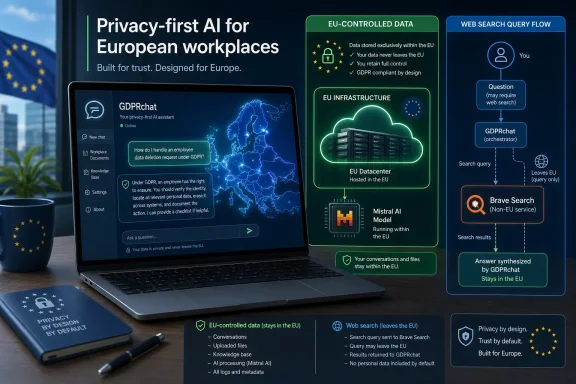 GDPRchat Turns Privacy Into the Product, Not the Footnote
GDPRchat arrives with a name that sounds less like consumer software than a legal position. That is the point. As Mezha reported, citing CyberNews, the service is being marketed as a “European counterpart to ChatGPT” with privacy as its defining feature, not as a checkbox tucked into a settings page.The core claim is easy to understand: user information stays exclusively within the EU, the chatbot is developed in accordance with the EU General Data Protection Regulation, and the service is presented as complying with local personal-data protection standards. In a market where most users judge AI tools by speed, fluency, and brand familiarity, GDPRchat is betting that a meaningful group of European users will also judge them by jurisdiction, data handling, and procurement defensibility.
That is a difficult position to hold against larger platforms. ChatGPT remains the most visible general-purpose chatbot, while Google Gemini and Microsoft Copilot benefit from distribution through Google’s and Microsoft’s existing ecosystems. Copilot in particular matters to WindowsForum.com readers because it sits close to the Microsoft environment many organizations already manage: Windows, Edge, Microsoft 365, Entra ID, Intune, Teams, and the broader productivity stack.
GDPRchat cannot out-distribute those platforms on day one. It is instead trying to out-position them. The message from FRITS AI Aps, the Copenhagen-based company behind the service, is that the most important feature of an AI assistant may be where the data goes after the user presses Enter.
That framing fits the current enterprise problem. Generative AI has moved from novelty to workplace utility faster than many compliance teams could react. Employees paste customer correspondence into chatbots, summarize contracts, draft HR messages, troubleshoot code, translate documents, and ask systems to reason over fragments of internal data. The privacy risk is not theoretical; it is built into the convenience.
The old software question was whether a vendor stored files securely. The newer AI question is broader: what happens to a user’s questions, drafts, corrections, uploaded context, search requests, device metadata, and account history when the assistant becomes part of the workflow? GDPRchat’s answer is deliberately European: keep the data in the EU, disclose the design, avoid third-party analytics and advertising systems, and make user rights visible.
That does not automatically make GDPRchat better than ChatGPT, Gemini, or Copilot at reasoning, coding, summarizing, or research. It does make it a useful marker of where the AI market is splitting. One path optimizes for model capability and platform integration. The other optimizes for trust boundaries, procurement defensibility, and legal comfort.
The uncomfortable truth for IT leaders is that both paths matter. A privacy-first chatbot that cannot meet user expectations will struggle to escape niche status. A powerful chatbot with unclear or unsuitable data flows will remain a governance problem. GDPRchat is entering precisely that gap.
The Stack Is a Compliance Argument in Technical Form
The most important thing about GDPRchat is not only that it uses European infrastructure. It is that every named component has been chosen to support a claim about European control.According to the source material, GDPRchat is based on a large language model from the French company Mistral AI. Its infrastructure is hosted by the German cloud provider Hetzner. The company developing the service, FRITS AI Aps, is based in Copenhagen. The service therefore presents itself as Danish product design around a French model, running on German hosting, for European users.
That combination answers a procurement question that is increasingly common in privacy-sensitive environments: can an organization use generative AI without routing sensitive work through a consumer service or a stack it does not understand?
GDPRchat’s answer is yes, provided the buyer accepts its European-hosted design, data-handling commitments, and current product limits. That is not the same as saying the product is risk-free. It is saying the risk profile is different. For some buyers, that difference will matter more than the difference between one chatbot’s tone and another’s.
The use of Mistral AI is especially important. Europe has produced credible AI companies, but the market for everyday chat assistants is still dominated by larger global platforms. GDPRchat is not trying to invent the model layer from scratch. It is building a privacy and product wrapper around a European model provider.
That may be a realistic path for many AI tools. Training frontier models is expensive, talent-intensive, and difficult to sustain. Building controlled interfaces, enterprise policies, data-handling guarantees, and localized user experiences around existing models is a different business. It is less glamorous than announcing a new foundation model, but it may be closer to what many organizations actually need.
Hetzner’s role also matters because hosting is where privacy and sovereignty claims become concrete. A model may be European in origin, but if prompts, logs, or backups flow through infrastructure that does not match the vendor’s privacy promises, the procurement argument weakens. GDPRchat’s claim that user information is stored exclusively within the EU is therefore central to its identity.
For Windows users and IT administrators, this is where the story intersects with daily reality. Copilot is familiar because it is Microsoft’s AI layer across products many organizations already use. GDPRchat is the opposite kind of tool: not native to Windows, not bundled with Office, not pushed through an operating-system experience, but intentionally separated from the largest American platform stacks.
That separation can be a disadvantage in usability. It can also be the feature that makes the tool interesting to risk officers. A standalone AI assistant with European hosting may be easier to explain in a data-protection impact assessment than a deeply integrated assistant whose convenience depends on broad access to a user’s productivity environment.
This is the trade-off GDPRchat asks buyers to consider. Integration creates power. Separation can create control.
Brave Search Is the One Non-European Thread in the Privacy Pitch
GDPRchat’s privacy story is strong, but it is not perfectly self-contained. The service relies on the US-based Brave search engine for web search, according to the source material. That detail matters because web search is one of the places where AI assistants can leak intent.A chatbot query is often more revealing than a traditional search. A user may not just type “contract renewal clause”; they may paste a paragraph, describe a dispute, identify a customer, or ask for a negotiation strategy. When AI tools use external search, the privacy question becomes not only where the chat is stored, but what leaves the system during retrieval.
The developers’ answer is that Brave receives only the text of the query, without identifying data such as IP address or account information. All queries, they say, are sent from European servers. In other words, GDPRchat is trying to separate query content from user identity before it reaches Brave.
That is an important architectural claim. If implemented as described, Brave would receive the search text but not the user’s account details or IP address. GDPRchat would be acting as the intermediary, keeping the user-facing identity layer inside its European-controlled service.
But the distinction is still worth spelling out for IT buyers. A query can be personal even when the sender is not identified by IP address or account name. If a user searches for a rare legal matter, a company-specific incident, a customer name, or an internal project phrase, the text itself can carry sensitive information.
That does not invalidate GDPRchat’s design. It does mean administrators should not treat “no identifying data” as equivalent to “no sensitive data.” The safest deployment of any AI search assistant still requires user training, input classification, and guardrails around what employees may paste into prompts.
GDPRchat’s reliance on Brave also demonstrates the difficulty of building a fully European AI assistant in practice. Even a service designed around EU storage and European infrastructure may still depend on a non-European component for web retrieval. The developers appear to have described a minimization approach. But the dependency complicates the cleanest version of the privacy message.
That complication is useful, not fatal. It reminds buyers that “European AI” is not a magic state achieved by choosing a domain name and a hosting region. It is a chain of design decisions: model provider, hosting provider, logging policy, analytics policy, search routing, account management, support tooling, payment systems, app distribution, support access, and deletion processes.
GDPRchat’s strongest claim is not that every part of the internet becomes European when a user opens the app. It is that the service is designed to reduce exposure, concentrate control in Europe, and explain the remaining flows more openly than many default consumer AI experiences.
For privacy-conscious users, that may be enough to try it. For enterprise administrators, it is the start of due diligence, not the end.
The Cloud Act Is Part of the Context, But Procurement Still Comes Down to Data Flows
The launch of GDPRchat reflects Europe’s concern about data protection, and the source material explicitly connects that concern to the US Cloud Act. Passed in 2018, the Cloud Act allows US law enforcement agencies to seek data from American companies under defined legal processes, including data that may be stored outside the United States.That legal backdrop is one reason some European buyers scrutinize where AI services are operated, who controls them, and what legal regimes may apply. The concern is not simply that an American company might mishandle data. It is that a company subject to US jurisdiction may face legal demands that European customers want to understand before they send sensitive information into a service.
GDPRchat is built for that concern. Lars Kolind, identified in the source material as the head of FRITS AI Aps, framed the matter in personal terms: “My data is mine, and mine alone. That's why I use European instead of American AI.” It is a concise expression of the product’s market position: privacy, jurisdiction, and user control are not secondary features.
The problem is that slogans are easier than implementation. Data control is not merely about where a server sits. It is about who operates the service, who can access the data, which subprocessors are involved, where backups live, what logs are retained, how support staff authenticate, whether telemetry exists, how deletion works, what happens during abuse investigations, and what legal regimes can compel disclosure.
GDPRchat addresses some of those questions directly. It says information is stored exclusively within the EU. It says it follows GDPR. It says it does not use third-party analytics, tracking, or advertising systems. It says users can obtain information about processed data and request deletion of their account and related information.
Those are meaningful commitments because they map to real user rights and real administrative concerns. A service that does not rely on third-party analytics, tracking, or ad systems has fewer data flows to explain. A service that supports access and deletion requests is at least aligning its user-facing posture with GDPR expectations.
But enterprises should still ask for documentation before treating any AI assistant as approved for sensitive work. The questions should be specific:
| Procurement question | Why it matters for a Windows shop |
|---|---|
| What exact data is stored: prompts, responses, uploads, account metadata, search queries, telemetry, billing records, or support tickets? | Admins need to classify the service against internal data-handling rules and acceptable-use policies. |
| How long is each data category retained? | “Stored in the EU” is not enough if prompts or logs remain longer than the organization allows. |
| Can an organization configure shorter retention or disable conversation history? | Enterprise controls may be necessary for regulated or confidential work. |
| Are prompts, uploaded documents, or outputs used to train or improve models? | Many organizations prohibit model training on business content unless explicitly contracted and controlled. |
| Are conversations reviewed by humans for safety, debugging, support, or abuse prevention? | Human access changes the risk profile and may require additional disclosure or contractual terms. |
| What logs are created for security, rate limiting, search, errors, or abuse detection? | Logs often contain sensitive fragments even when the main conversation is deleted. |
| Who can access logs, and from which countries? | Access location and administrator privileges matter as much as storage location. |
| Which subprocessors are used, including hosting, search, payments, email, support, analytics, monitoring, and app distribution? | A privacy review must cover the whole service chain, not only the model and hosting provider. |
| What exactly happens when a user deletes an account? | Deletion should address prompts, responses, uploads, search history, account data, backups, and support records where applicable. |
| Are backups encrypted, where are they stored, and when do deleted records age out? | Backup retention can quietly undermine deletion expectations. |
| Is there a data-processing agreement for organizations? | Consumer privacy language may not be enough for business procurement. |
| Can the vendor support a data-protection impact assessment? | The burden often falls on the customer, but vendor documentation can make or break approval. |
| How are Brave Search queries minimized, transmitted, and logged? | Search is the non-European dependency in the stated design and deserves its own review. |
| What identity, SSO, admin, audit, and policy controls exist? | Windows and Microsoft 365 administrators need operational control, not just a privacy promise. |
GDPR is not a badge a vendor pins to a product and never revisits. It is an operating obligation. GDPRchat’s name raises expectations accordingly.
ChatGPT, Gemini, and Copilot Are the Practical Comparisons
GDPRchat’s competitive problem is visible without needing grand claims about the market. ChatGPT, Gemini, and Copilot are already familiar to many users. That means GDPRchat is not competing against a blank slate. It is competing against habits already formed.For consumers, the privacy argument may be persuasive but fragile. Many users say they want privacy until the private product is slower, weaker, waitlisted, less integrated, or less familiar. The fact that GDPRchat has a waiting list due to demand is a positive signal, but waiting lists can measure curiosity as much as durable adoption.
For companies, the calculation is different. A less integrated but more governable assistant may be preferable to an unmanaged consumer tool, especially if employees are otherwise pasting sensitive material into whatever chatbot is easiest to reach. The relevant question is not always “Is this the most capable chatbot?” It is often “Can this chatbot reduce the risk of unsanctioned AI use?”
That is where GDPRchat could find a role. Organizations do not need every employee to use the most capable general-purpose AI system available for every task. They need a defensible default for approved categories of work. If a privacy-focused assistant is good enough for drafting, summarization, translation, brainstorming, and routine research, it may absorb everyday usage that would otherwise go to consumer-grade tools.
Windows environments make this tension sharper. Microsoft Copilot’s advantage is proximity. For many users, Copilot is not a destination; it is part of the software environment around them. GDPRchat has to be chosen deliberately.
That deliberate choice can be a strength in regulated settings. A company that rolls out GDPRchat as an approved assistant is making an explicit policy statement. It can train users around a specific tool, define acceptable-use categories, and monitor adoption against shadow AI use. Copilot, by contrast, may require organizations to think carefully about which Microsoft surfaces are enabled, which accounts are in scope, and how AI features interact with existing productivity data.
This is not an argument that GDPRchat is inherently safer than every Microsoft, Google, or OpenAI offering in every configuration. Enterprise versions of major platforms may include contractual protections, admin controls, regional processing options, retention settings, audit capabilities, and identity integration that a newer tool may not yet match. The correct comparison is not “European good, American bad.” It is: which service has the right model quality, controls, documentation, contracts, retention settings, subprocessors, and administrative fit for the work being done?
A tight market comparison looks like this:
| Tool category | Practical strength | Practical concern | Best evaluation question |
|---|---|---|---|
| GDPRchat | European-hosted privacy-first positioning, Mistral model, Hetzner infrastructure, no third-party analytics or advertising systems as described | Newer service, waitlist access, Brave Search dependency, enterprise controls not fully established in the source material | Does the vendor provide enough documentation and contractual control for your approved use cases? |
| Microsoft Copilot | Close fit for Microsoft and Windows environments, familiar to users already working in Microsoft products | Deep integration requires careful policy, licensing, data-boundary, and tenant review | Which Copilot experiences are enabled, and what organizational data can each one access? |
| ChatGPT | Strong general-purpose assistant experience and broad user familiarity | Consumer use can create shadow AI risk if unmanaged | Are users on an approved business plan with clear data controls, or are they using personal accounts? |
| Google Gemini | Familiar to users in Google-centered environments | Fit depends heavily on account type, workspace controls, and data settings | Are data controls aligned with the organization’s workspace and compliance requirements? |
The Plans Are Simple; the Access Problem Is Demand
GDPRchat is available through its own website and applications, with apps downloadable from the Google Play Store and the App Store. The service is available to users over the age of 16, including users in Ukrainian. That gives it the shape of a mainstream consumer and professional assistant rather than a closed enterprise pilot.The commercial model is straightforward: a free plan with daily limits and a paid version with more credits and additional features. The source material does not give pricing in the verified facts, so the important point is the split between trial-like access and heavier paid usage.
| GDPRchat option | Availability | Limits | Added capacity | Intended fit |
|---|---|---|---|---|
| Free plan | Offered to users over 16 | Daily limits | Not specified in the source material | Casual testing and light use |
| Paid version | Offered alongside the free plan | Not specified in the source material | More credits and additional features | Regular users who need higher usage |
A waiting list creates scarcity, and scarcity can reinforce the idea that the service has struck a nerve. It also gives the company time to scale infrastructure, observe usage patterns, tune moderation, and avoid a launch-day collapse. For a privacy-focused service, controlled onboarding may be preferable to explosive growth that forces hurried compromises.
But AI markets move quickly. If interested users cannot try GDPRchat when their motivation is highest, some will return to the tools they already know. ChatGPT, Gemini, and Copilot do not need to win every argument about privacy if they win the moment of need.
For business buyers, delayed access can also slow evaluation. Security teams, data-protection officers, and IT administrators need test accounts, documentation, contractual terms, and predictable onboarding. A waitlist is acceptable for a new consumer app; it is less convenient for a procurement process.
Still, demand is the better launch problem to have. Europe has seen many privacy-oriented products fail not because their values were wrong, but because users did not care enough to switch. GDPRchat’s early pressure suggests at least some users are ready to treat privacy as a primary AI feature.
The more difficult question is what happens after they get in. Privacy may persuade users to register. Quality, speed, reliability, language support, app polish, and useful search will decide whether they stay.
No Trackers Is a Bigger Deal Than It Sounds
The developers emphasize that GDPRchat does not use third-party analytics, tracking, or advertising systems. In ordinary app marketing, that might sound like a generic privacy line. In AI, it is more substantial.Generative AI services already collect unusually sensitive interaction data by design. Users reveal intentions, uncertainties, drafts, work problems, personal questions, legal concerns, business plans, code, and internal language. Adding third-party analytics or advertising systems to that environment creates additional surfaces for profiling and leakage.
By rejecting those systems, GDPRchat is making an architectural and commercial choice. It is reducing the number of outside parties that need to be explained to users and auditors. It is also giving up some of the measurement and monetization machinery that consumer software companies often rely on.
That choice aligns with the service’s broader identity. A chatbot cannot credibly claim “your data stays yours” while quietly loading a dense web of behavioral trackers. Users increasingly understand that privacy is not only about the primary database; it is also about the invisible ecosystem around the product.
For administrators, the lack of third-party analytics and advertising systems simplifies—but does not eliminate—risk review. It reduces questions about marketing pixels, cross-site profiling, ad identifiers, and behavioral data sharing. The remaining questions shift to core service operation: prompt handling, search routing, logging, retention, account data, deletion, and model interaction.
The user-rights piece is equally important. The source material says compliance with European laws allows users to obtain information about the data processed by the platform and request deletion of their account and related information. Those rights are familiar under GDPR, but AI makes them newly salient.
In a traditional app, account deletion might remove a profile, settings, and stored files. In an AI assistant, users may wonder whether deletion covers prompts, conversations, generated outputs, search queries, derived metadata, and support logs. GDPRchat’s promise is meaningful only if those categories are clearly handled.
The service’s name invites scrutiny here. A generic chatbot can bury complexity in a privacy policy and hope users do not ask hard questions. A product called GDPRchat is effectively inviting users, regulators, and competitors to ask them.
That is good for the market. AI vendors should have to compete on data handling in plain language. If GDPRchat pressures larger platforms to explain data flows more clearly, its impact may exceed its user count.
Where Windows Shops Should Be Interested—and Where They Should Be Skeptical
For WindowsForum.com readers, GDPRchat is not just another European startup story. It is part of the same shift that has made AI governance a Windows administration issue.In many organizations, Windows is the work surface. Users access browsers, Office documents, Teams conversations, cloud drives, line-of-business apps, and identity-managed services from Windows PCs. If AI becomes the new front end for knowledge work, then the question of which AI assistant employees use becomes a device-management and policy problem, not merely a software preference.
GDPRchat could be attractive as an approved external assistant for organizations that are not ready to expose broad internal data to AI features, or that want a privacy-first option for lower-risk tasks. It could also serve as a sanctioned alternative to employees using free consumer chatbots without oversight.
But admins should resist the temptation to treat GDPRchat as a universal answer. Its privacy posture is the start of a policy, not a policy by itself. Even a European-hosted chatbot can receive inappropriate inputs if employees paste payroll data, medical details, confidential legal documents, source code, credentials, customer records, or regulated information without authorization.
The right way to evaluate GDPRchat is alongside use cases. Drafting a public blog post is different from summarizing a disciplinary record. Translating a marketing email is different from analyzing a customer database. Brainstorming a PowerShell script is different from pasting proprietary source code or authentication logs into a third-party service.
A practical Windows admin checklist should look like this:
| Admin step | Action |
|---|---|
| Define approved use cases | Start with low-risk tasks such as public-content drafting, grammar improvement, translation of non-sensitive text, summarization of public material, and general research. |
| Define prohibited inputs | Ban credentials, secrets, private keys, regulated personal data, customer records, confidential legal material, non-public financial data, and sensitive HR content unless separately approved. |
| Review vendor documentation | Ask for retention, deletion, logging, model-training, subprocessors, security, and support-access details before wider rollout. |
| Test web search behavior | Verify how Brave Search is used, what query text leaves GDPRchat, and whether users understand the risk of sensitive query content. |
| Compare against existing Microsoft controls | If Copilot is already licensed or planned, compare GDPRchat against tenant-level controls, data boundaries, audit needs, and user workflows. |
| Pilot with a small group | Include IT, legal, compliance, and a few business users. Test quality as well as privacy. |
| Train users with examples | Provide “allowed” and “not allowed” prompt examples. Do not rely on policy language alone. |
| Monitor shadow AI pressure | If users still prefer other tools, find out whether the issue is quality, speed, access, integrations, or awareness. |
| Revisit approval periodically | AI services change quickly. Review the tool again when features, contracts, model providers, or subprocessors change. |
Appropriate and Inappropriate Uses
The cleanest way to think about GDPRchat is not “private enough for everything” but “possibly appropriate for defined categories of work after review.”GDPRchat is a reasonable candidate for:
- Drafting public-facing text, such as blog posts, announcements, FAQs, and general documentation.
- Rewriting or improving non-sensitive internal text.
- Translating content that does not contain confidential, regulated, or customer-identifiable information.
- Summarizing public articles, public documentation, and non-sensitive meeting notes.
- Brainstorming ideas, outlines, checklists, training material, and policy drafts.
- Producing first-pass explanations of technical concepts for help desk or user education.
- Researching general topics through web-assisted queries, provided users do not include sensitive details.
- Acting as a sanctioned alternative for employees who would otherwise use unmanaged consumer AI tools for low-risk work.
- Customer records, health information, payroll data, disciplinary records, or other regulated personal data.
- Confidential legal analysis, litigation strategy, merger activity, contract disputes, or privileged material.
- Source code, proprietary algorithms, infrastructure diagrams, incident reports, credentials, tokens, private keys, or security logs unless explicitly approved.
- Material covered by strict contractual confidentiality obligations.
- Any workflow requiring guaranteed enterprise audit, eDiscovery, legal hold, retention control, or role-based administrative review unless the vendor can support those requirements.
- Automated decision-making about people, including hiring, discipline, credit, benefits, access, or eligibility.
- Replacing a formal knowledge-management, records-management, or document-review system.
- Treating search results or generated answers as authoritative without human verification.
GDPRchat’s best early role is therefore likely to be controlled substitution: give users a better default than unmanaged consumer AI for tasks that do not require deep integration with internal systems. If the tool performs well, organizations can expand carefully. If it performs poorly, the privacy story will not be enough.
Timeline for Evaluation
GDPRchat is new enough that organizations should treat adoption as a staged process rather than a single approval decision.| Stage | What to do | Decision point |
|---|---|---|
| Awareness | Track GDPRchat’s availability, waitlist status, apps, and stated privacy claims. | Is there enough interest or risk from shadow AI to justify evaluation? |
| Intake | Request documentation on retention, deletion, logging, training, subprocessors, search, security, and business terms. | Does the vendor provide enough detail to proceed? |
| Technical pilot | Test quality, speed, uptime, prompt handling, web search behavior, and app experience. | Is the tool useful enough for real users? |
| Compliance review | Assess GDPR alignment, data-processing terms, deletion process, and subprocessors. | Can the tool be approved for defined data classes? |
| Policy design | Create allowed and prohibited use cases, user training, and escalation paths. | Can employees understand how to use it safely? |
| Limited rollout | Deploy to a small group with feedback from IT, legal, compliance, and business units. | Does it reduce unmanaged AI use without introducing unacceptable risk? |
| Reassessment | Review changes in features, providers, contracts, and controls. | Should approval expand, remain limited, or be withdrawn? |
The Bigger Signal
GDPRchat matters because it shows that privacy can be the headline feature in consumer-facing generative AI. That is a useful correction to a market that often treats data handling as a policy-page detail.The service’s claims are clear enough to attract attention: European user data storage, GDPR-oriented design, Mistral AI model, Hetzner hosting, no third-party analytics or advertising systems, user access and deletion rights, and Brave Search routed so that Brave receives query text without account or IP details. Those are meaningful facts for privacy-conscious users.
The open questions are just as important: enterprise contracts, administrative controls, retention defaults, log access, backup deletion, support processes, search-query handling, model-training guarantees, subprocessors beyond the named providers, and whether the product is good enough for daily use. Those are the questions that will decide whether GDPRchat becomes a serious tool for Windows shops or remains an interesting privacy-first alternative for individual users.
For now, the best answer is neither hype nor dismissal. GDPRchat should go on the evaluation list for organizations that want an EU-hosted, privacy-forward AI assistant and are willing to test it carefully. It should not be approved blindly because of its name, nor rejected simply because it lacks the platform reach of Microsoft, Google, or OpenAI.
The forward-looking point is simple: AI governance is becoming part of endpoint governance. Windows administrators, Microsoft 365 owners, security teams, and data-protection officers will increasingly have to decide not only which apps users can install, but which AI systems users can trust with their words. GDPRchat is one more sign that the next phase of AI competition will be fought not only over model intelligence, but over retention, deletion, logging, search routing, subprocessors, and the right to know where work data goes.
References
- Primary source: Mezha
Published: 2026-07-09T13:50:31.581187
Europeans have launched GDPRchat – a ChatGPT-style service with a focus on privacy • Межа
Developers from Denmark have unveiled a "European equivalent of ChatGPT" – a chatbot called GDPRchat, which focuses on privacy. It will store users' information exclusively within the EU, in compliance with local data protection standards.mezha.ua - Related coverage: cert.dk
- Related coverage: recordere.dk
Dansk selskab lancerer europæisk alternativ til ChatGPT - recordere.dk
GDPRchat er en AI chatbot der fungerer helt uden amerikanske tjenester www.recordere.dk
- Related coverage: gdprchat.eu
GDPRchat — 100% European AI · Your data stays yours
A powerful AI assistant, made in Europe. Interactive artifacts, Python, image generation, document creation, web search, and 20+ tools — all running on 100% European AI. No tracking, no ads, and your chats stay in the EU.gdprchat.eu - Related coverage: legal.mistral.ai
Privacy Policy | Mistral AI
<p dir="ltr"><strong>Welcome to Mistral AI! </strong>We know that your privacy is important, and we're committed to protecting it. This Privacy Policy explains,legal.mistral.ai - Related coverage: dk.linkedin.com
GDPRchat — 100% European AI. Your chats stay in the EU. | Bjarne Hallstrøm
Nu kom det europæiske alternativ til ChatGPT. I dag lancerer AI-guruen Frits Lyneborg og Lars Kolind 孔林德 en rent europæisk AI-assistent med navnet GDPRchat. Den kan gøre alt det du hidtil har brugt ChatGPT til, med en afgørende forskel: Dine data forbliver i Europa og de videresælges ikke...dk.linkedin.com
- Related coverage: ai.wharton.upenn.edu
- Related coverage: edpb.europa.eu
- Related coverage: brave.com
Brave.com Privacy Policy | Brave
How Brave Software uses data to operate its websites, forums, and communications.brave.com - Related coverage: safe.search.brave.com
Brave Search
Search the Web. Privately. Truly useful results, AI-powered answers, & more. All from an independent index. No profiling, no bias, no Big Tech.safe.search.brave.com - Related coverage: itpro.com
AWS says only Europeans will run its European Sovereign Cloud service | IT Pro
The firm wants to reassure customers that sovereign really does mean sovereignwww.itpro.com
