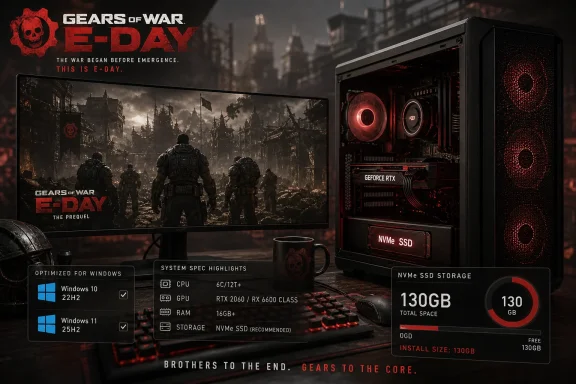
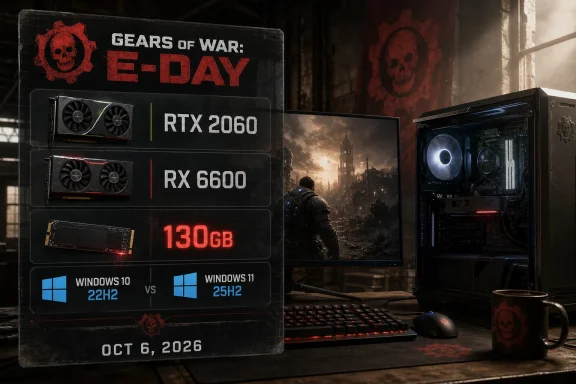
Gears of War: E-Day is scheduled to launch on October 6, 2026, for Xbox Series X/S and Windows PC via Steam and Microsoft’s PC ecosystem, with Xbox Game Pass access on day one and a published PC minimum spec that starts at an RTX 2060-class GPU. That is the factual headline; the more interesting story is what it says about Unreal Engine 5, Microsoft’s PC ambitions, and the state of mid-range gaming hardware in 2026. If The Coalition can deliver the spectacle it has promised inside these requirements, E-Day may become less a nostalgia play than a test case for whether modern AAA rendering can stop treating ordinary PCs as collateral damage.
The RTX 2060 is doing a lot of symbolic work here. Nvidia launched that card in early 2019, and by 2026 it sits in the awkward middle ground between “still usable” and “please stop asking it to run miracles.” It was the first affordable-ish entry point into Nvidia’s RTX generation, meaning it brought hardware ray tracing and DLSS to a class of machines that many PC gamers kept far longer than upgrade-cycle marketing expected.
That makes its appearance in the minimum requirements for Gears of War: E-Day notable. The Coalition is not asking for a GTX 1060, RX 580, or other beloved relic from the last great mainstream PC era. The floor has clearly moved to cards with modern API support, ray-tracing hardware, and upscaling paths.
But it has not moved as far as many Unreal Engine 5 watchers feared. The minimum list includes the RTX 2060, RTX 5050, AMD Radeon RX 6600, Radeon RX 9060, and Intel Arc A580. That is a very specific kind of inclusivity: not a promise that old hardware can brute-force the game, but a signal that the engine path assumes contemporary rendering features while still leaving room for lower-end and older RTX-era systems.
The recommended tier is more conventional for a 2026 release. The listed GPUs include the RTX 3060 Ti, RTX 5060, Radeon RX 6700 XT, Radeon RX 9060 XT, and Intel Arc B580, paired with 16GB of RAM and a Ryzen 5 5600 or Intel Core i5-11600K. In plain English, The Coalition is saying that the sweet spot is a mid-range gaming PC from the last several years, not a boutique tower built to win a benchmark screenshot contest.
That matters because PC requirements are not just technical guidance anymore. They are a market signal. They tell players whether the studio expects the average Steam machine to participate, or whether launch week is for console players and the top slice of PC enthusiasts only.
That does not mean UE5 is bad technology. It means the cost of its promise has become visible. Nanite, Lumen, virtual shadow maps, high-density worlds, and modern asset pipelines give developers enormous power, but they also increase the penalty for sloppy integration, rushed optimization, or PC configurations treated as an afterthought.
Gears of War is an especially important franchise in that context. Epic’s original series was once inseparable from Unreal Engine as a showcase for what the technology could do. The 2006 game was not merely a cover shooter; it was a hardware argument in the shape of a chainsaw bayonet. It sold the texture, weight, and lighting language of a console generation.
Now Microsoft owns the franchise, The Coalition owns its stewardship, and Unreal Engine 5 is the stage. If E-Day runs well, it will not magically fix every UE5 complaint. But it would give the engine something it badly needs: a large, mainstream, visually ambitious release that lands without becoming a cautionary tale for PC owners.
The published requirements suggest The Coalition understands this pressure. The studio is not presenting E-Day as an experiment for $1,500 GPUs. It is presenting it as a mass-market Xbox and PC game whose most important technical claim is not merely how it looks, but how many machines it can reasonably support.
That aligns with what Microsoft and The Coalition have been saying about the game’s technology. E-Day is described as a from-scratch Unreal Engine 5 project rather than an upgraded version of previous Gears work. The studio has talked about rebuilding assets and systems for the new game rather than dragging forward the old production base.
The more aggressive claim is lighting. The Coalition is leaning into UE5’s newer lighting capabilities, including MegaLights, to give the campaign a more dynamic and cinematic presentation. The practical translation is that lighting is not just a garnish on top of the art direction. It is part of the game’s technical identity.
That choice explains why older non-RT cards are absent. Even if a GTX-era card could theoretically launch the game, supporting that path may have forced compromises the studio was unwilling to make. In modern AAA development, the question is not only whether hardware can draw frames. It is whether the renderer, content pipeline, QA matrix, and performance targets can survive supporting it.
This is where many PC players will split. Some will see the RTX 2060 minimum as generous. Others will see the absence of GTX support as another reminder that “minimum” now means owning hardware that was once a premium feature tier. Both readings are fair, but the industry direction is unmistakable: ray tracing is moving from optional eye candy to an architectural assumption.
This is the post-HDD reality of AAA development. Developers are building around fast asset streaming, dense environments, and reduced loading friction because the Xbox Series X/S and PlayStation 5 made SSDs baseline console assumptions. Once that becomes the common denominator on console, PC hard drives become a support liability rather than a budget-friendly fallback.
The 130GB number also speaks to the scale of modern blockbuster production. High-resolution textures, multiple language packs, cinematic assets, multiplayer components, and patch overhead can turn a single game into a storage planning problem. For users with 512GB boot drives, E-Day is not just a download; it is a negotiation with everything else installed on the machine.
That is particularly relevant to WindowsForum readers because many gaming PCs double as work machines, media boxes, development rigs, or family desktops. A GPU upgrade is obvious and expensive. Storage pressure is quieter. It shows up as failed updates, cramped system partitions, and the ritual deletion of games that still might be played someday.
The Coalition’s SSD requirement is defensible. It may even be necessary. But it moves the practical upgrade question away from “Can my graphics card launch this?” toward “Is my whole PC organized for the way modern games stream data?”
By October 2026, Windows 10 will already be well past its mainstream consumer support deadline unless users are relying on paid or special extended options. Yet games are not enterprise endpoint policies. Publishers often support older operating systems longer than Microsoft would prefer because players do not upgrade in neat calendar-aligned waves.
The presence of Windows 10 at minimum therefore reads less like a long-term endorsement and more like a launch-window practicality. Microsoft wants the game to reach PC players, Steam users, and Game Pass subscribers. Cutting off Windows 10 entirely would narrow that audience at exactly the moment Xbox needs its biggest franchises to prove they can travel across storefronts and subscription models.
Still, the recommended Windows 11 line is a nudge. It tells users where testing, driver expectations, and future support will likely be most comfortable. Windows 10 users may get in the door, but the velvet rope has already shifted.
For sysadmins and technically minded players, the bigger lesson is lifecycle planning. Gaming requirements increasingly mirror broader Windows platform pressure: newer graphics stacks, newer drivers, newer security models, and newer storage assumptions all converge. A game like E-Day does not force an OS migration by itself, but it becomes one more weight on the scale.
But Game Pass does not make the hardware requirements disappear. In some ways, it makes them more visible. A player may be willing to try a game because it is included, only to discover that the download is massive, the SSD space is scarce, or the GPU support line stops just above their machine.
That has always been the double edge of subscription gaming on PC. It lowers the transaction barrier, but it cannot standardize the hardware the way a console does. Microsoft can sell E-Day as an Xbox ecosystem title, but on Windows the ecosystem includes every combination of CPU, GPU, driver version, storage device, overlay, monitor, and background process imaginable.
This is why modest requirements matter so much. Game Pass works best when curiosity turns into installation and installation turns into play. If the technical floor is too high, the subscription pitch becomes abstract. Users can “have” the game without being able to enjoy it.
E-Day’s requirements suggest Microsoft understands that its PC strategy needs breadth. Steam matters. Game Pass matters. But neither can overcome a reputation for ugly PC launches, especially when players have become quick to punish stutter and poor scaling in reviews.
E-Day is being positioned as an Xbox console exclusive with a simultaneous PC release. In practical terms, that means Xbox Series X/S and Windows PC at launch, not PlayStation 5. The wording matters because “exclusive” no longer means what it meant in the Xbox 360 era. It now usually means “not on rival consoles at launch,” while PC is treated as part of Microsoft’s home field.
That is the only interpretation that makes strategic sense. Microsoft owns Windows, operates the Xbox app, sells through the Microsoft Store, and still needs Steam for PC reach. A first-party Xbox game skipping PC in 2026 would be stranger than one skipping PlayStation.
For E-Day, the exclusivity stance is also brand management. Gears of War remains one of the few franchises that still feels culturally Xbox-native. Keeping the new prequel off PlayStation at launch preserves that identity, even as Microsoft’s broader business model becomes more platform-agnostic.
The risk is confusion. Players now have to decode whether a given Xbox game is console exclusive, timed exclusive, multiplatform, Play Anywhere, Game Pass day one, Steam day one, or some combination of the above. E-Day’s PC specs help cut through that fog for one audience at least: Windows players are not peripheral to this launch. They are part of the main plan.
This is obviously nostalgic. Microsoft would not return to Marcus and Dom by accident. The original trilogy remains the franchise’s strongest identity, and the later games never fully escaped the gravitational pull of those characters.
But a prequel set on Emergence Day is not merely a retreat. It gives The Coalition permission to make the world frightening again. By the time players meet the Locust in the first game, the war has already hardened everyone and everything. E-Day can return the setting to shock, confusion, urban collapse, and the horror of an enemy that does not yet fit into a familiar shooter vocabulary.
That has technical implications too. The more intimate and apocalyptic the campaign, the more lighting, destruction, animation, and environmental density matter. If the game wants to sell panic rather than just scale, it needs visual systems that can make streets feel unstable and interiors feel dangerous.
This is where UE5 could serve the fiction rather than simply decorate it. The best version of E-Day is not the most reflective or particle-heavy one. It is the version where the technology makes the Locust invasion feel immediate, physical, and cruel.
E-Day is a harder assignment. UE5 carries heavier baggage than the older technology stack. Modern PC players are less forgiving. And the hardware range has become more fragmented, with Nvidia, AMD, and Intel all represented in the official requirements.
Including Intel Arc GPUs is especially important. Arc support has improved over time, but it still depends heavily on driver maturity and game-specific behavior. Listing the A580 at minimum and B580 at recommended suggests the studio is at least acknowledging Intel as a real PC gaming participant rather than a compatibility afterthought.
The CPU requirements also look sane. A Ryzen 5 2600X, Core i7-6850K, or Core i5-10400 at minimum means the game is asking for a six-core-class processor rather than pretending four-core gaming PCs are still the center of the market. Recommended chips like the Ryzen 5 5600 and Core i5-11600K are mainstream parts, not exotic ones.
That balance is what makes the spec sheet interesting. It is not low-end. It is not retro-friendly. But it does look designed around machines real players might own, especially those who upgraded once during the pandemic-era GPU mess and then stopped.
That is not inherently bad. Good upscaling can produce excellent results, and in many games a quality-mode reconstruction path is hard to distinguish from native rendering during real play. The problem is expectation management. A minimum requirement that silently assumes upscaling is not the same as a minimum requirement built around native resolution.
Frame generation complicates the story further. It can make motion look smoother, but it does not replace a solid base frame rate, and it can introduce latency or artifacts depending on implementation and hardware. For a cover shooter where input response and visual clarity matter, frame generation should be treated as a tool, not a miracle cure.
The key question The Coalition still needs to answer is performance target. Minimum and recommended specs are incomplete without resolution, settings, and frame-rate expectations. Is the RTX 2060 minimum meant for 1080p low at 30 frames per second with upscaling? Is recommended targeting 1440p 60? Does ray tracing have multiple modes, or is the entire lighting model built around a fixed assumption?
Until those answers arrive, the requirements should be read as encouraging but not definitive. The difference between “runs” and “runs well” has swallowed many PC launches.
Microsoft can argue that blockbuster games are large because players demand rich assets, cinematic campaigns, multiplayer support, and fast loading. That is true. It is also true that storage bloat has become one of the least user-friendly trends in modern gaming.
The issue is not only disk capacity. It is bandwidth, patching, backup behavior, and the friction of reinstalling. A player on a data-capped connection or slower broadband link experiences a 130GB game differently from someone with fiber and a 4TB NVMe drive.
Windows users also know that “130GB required” rarely means the end of the story. Games need patch staging space. Launchers cache data. Shader caches grow. Screenshots, captures, and mods can add more. The practical advice is simple: if you are planning for E-Day, do not reserve exactly 130GB and declare victory.
This is where the PC spec sheet becomes less modest than it first appears. The GPU floor is friendly by 2026 standards. The storage requirement is not.
That last point matters because the RTX 2060 commonly shipped with 6GB of VRAM, and UE5 titles can be memory-sensitive. If E-Day’s texture system scales gracefully, the minimum card may be a good experience. If it does not, players could see the familiar modern pattern: average frame rates that look acceptable in benchmarks, paired with stutters and texture compromises that make actual play feel uneven.
The Windows 10 minimum also invites driver questions. By late 2026, GPU vendors will still support Windows 10 in some form, but the center of gravity will be newer drivers, newer OS builds, and newer platform assumptions. Minimum support is not the same as equal support.
There is also the question of anti-cheat, account requirements, cross-play behavior, and online services. Steam listings often include broad feature notes, but the lived experience can depend on sign-in flows, Xbox services, multiplayer requirements, and regional support. PC players have learned to look beyond the GPU line.
None of this negates the good news. It simply keeps the good news in proportion. A reasonable spec sheet is the beginning of trust, not the completion of it.
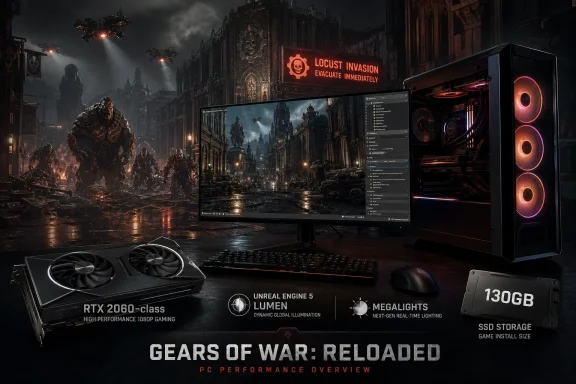 The RTX 2060 Is Not a Throwaway Detail
The RTX 2060 is doing a lot of symbolic work here. Nvidia launched that card in early 2019, and by 2026 it sits in the awkward middle ground between “still usable” and “please stop asking it to run miracles.” It was the first affordable-ish entry point into Nvidia’s RTX generation, meaning it brought hardware ray tracing and DLSS to a class of machines that many PC gamers kept far longer than upgrade-cycle marketing expected.That makes its appearance in the minimum requirements for Gears of War: E-Day notable. The Coalition is not asking for a GTX 1060, RX 580, or other beloved relic from the last great mainstream PC era. The floor has clearly moved to cards with modern API support, ray-tracing hardware, and upscaling paths.
But it has not moved as far as many Unreal Engine 5 watchers feared. The minimum list includes the RTX 2060, RTX 5050, AMD Radeon RX 6600, Radeon RX 9060, and Intel Arc A580. That is a very specific kind of inclusivity: not a promise that old hardware can brute-force the game, but a signal that the engine path assumes contemporary rendering features while still leaving room for lower-end and older RTX-era systems.
The recommended tier is more conventional for a 2026 release. The listed GPUs include the RTX 3060 Ti, RTX 5060, Radeon RX 6700 XT, Radeon RX 9060 XT, and Intel Arc B580, paired with 16GB of RAM and a Ryzen 5 5600 or Intel Core i5-11600K. In plain English, The Coalition is saying that the sweet spot is a mid-range gaming PC from the last several years, not a boutique tower built to win a benchmark screenshot contest.
That matters because PC requirements are not just technical guidance anymore. They are a market signal. They tell players whether the studio expects the average Steam machine to participate, or whether launch week is for console players and the top slice of PC enthusiasts only.
Unreal Engine 5 Needed a Competent Showpiece More Than Another Trailer
Unreal Engine 5 has been marketed for years as the future of blockbuster game production, but many PC players have experienced that future as shader compilation stutter, traversal hitching, VRAM spikes, and settings menus that behave less like tools than apology letters. The engine’s best demos have often run ahead of the shipping reality.That does not mean UE5 is bad technology. It means the cost of its promise has become visible. Nanite, Lumen, virtual shadow maps, high-density worlds, and modern asset pipelines give developers enormous power, but they also increase the penalty for sloppy integration, rushed optimization, or PC configurations treated as an afterthought.
Gears of War is an especially important franchise in that context. Epic’s original series was once inseparable from Unreal Engine as a showcase for what the technology could do. The 2006 game was not merely a cover shooter; it was a hardware argument in the shape of a chainsaw bayonet. It sold the texture, weight, and lighting language of a console generation.
Now Microsoft owns the franchise, The Coalition owns its stewardship, and Unreal Engine 5 is the stage. If E-Day runs well, it will not magically fix every UE5 complaint. But it would give the engine something it badly needs: a large, mainstream, visually ambitious release that lands without becoming a cautionary tale for PC owners.
The published requirements suggest The Coalition understands this pressure. The studio is not presenting E-Day as an experiment for $1,500 GPUs. It is presenting it as a mass-market Xbox and PC game whose most important technical claim is not merely how it looks, but how many machines it can reasonably support.
Ray Tracing Has Quietly Become the New Baseline
The most revealing thing about the GPU list is not the RTX 2060 by itself. It is that every listed graphics card sits in a hardware generation where ray tracing is part of the expected feature set. The floor is not “any GPU with enough raster performance.” The floor is “a GPU that belongs to the ray-tracing era.”That aligns with what Microsoft and The Coalition have been saying about the game’s technology. E-Day is described as a from-scratch Unreal Engine 5 project rather than an upgraded version of previous Gears work. The studio has talked about rebuilding assets and systems for the new game rather than dragging forward the old production base.
The more aggressive claim is lighting. The Coalition is leaning into UE5’s newer lighting capabilities, including MegaLights, to give the campaign a more dynamic and cinematic presentation. The practical translation is that lighting is not just a garnish on top of the art direction. It is part of the game’s technical identity.
That choice explains why older non-RT cards are absent. Even if a GTX-era card could theoretically launch the game, supporting that path may have forced compromises the studio was unwilling to make. In modern AAA development, the question is not only whether hardware can draw frames. It is whether the renderer, content pipeline, QA matrix, and performance targets can survive supporting it.
This is where many PC players will split. Some will see the RTX 2060 minimum as generous. Others will see the absence of GTX support as another reminder that “minimum” now means owning hardware that was once a premium feature tier. Both readings are fair, but the industry direction is unmistakable: ray tracing is moving from optional eye candy to an architectural assumption.
The SSD Requirement Is the Real Upgrade Tax
For all the attention the RTX 2060 will receive, the 130GB SSD requirement may be the more meaningful barrier. The Steam listing makes solid-state storage mandatory, and that has become one of the defining divides between PCs that can technically run modern games and PCs that can run them without turning the experience into hitching, streaming, and loading pain.This is the post-HDD reality of AAA development. Developers are building around fast asset streaming, dense environments, and reduced loading friction because the Xbox Series X/S and PlayStation 5 made SSDs baseline console assumptions. Once that becomes the common denominator on console, PC hard drives become a support liability rather than a budget-friendly fallback.
The 130GB number also speaks to the scale of modern blockbuster production. High-resolution textures, multiple language packs, cinematic assets, multiplayer components, and patch overhead can turn a single game into a storage planning problem. For users with 512GB boot drives, E-Day is not just a download; it is a negotiation with everything else installed on the machine.
That is particularly relevant to WindowsForum readers because many gaming PCs double as work machines, media boxes, development rigs, or family desktops. A GPU upgrade is obvious and expensive. Storage pressure is quieter. It shows up as failed updates, cramped system partitions, and the ritual deletion of games that still might be played someday.
The Coalition’s SSD requirement is defensible. It may even be necessary. But it moves the practical upgrade question away from “Can my graphics card launch this?” toward “Is my whole PC organized for the way modern games stream data?”
Windows 10 Gets a Foot in the Door, Windows 11 Gets the Recommended Seat
The operating system split is another small but telling detail. Minimum requirements list Windows 10 64-bit, while recommended requirements move to Windows 11 64-bit. That is exactly the kind of compromise one would expect in 2026: Microsoft’s platform strategy wants Windows 11 normalized, but the PC gaming market still contains a large installed base that has not moved.By October 2026, Windows 10 will already be well past its mainstream consumer support deadline unless users are relying on paid or special extended options. Yet games are not enterprise endpoint policies. Publishers often support older operating systems longer than Microsoft would prefer because players do not upgrade in neat calendar-aligned waves.
The presence of Windows 10 at minimum therefore reads less like a long-term endorsement and more like a launch-window practicality. Microsoft wants the game to reach PC players, Steam users, and Game Pass subscribers. Cutting off Windows 10 entirely would narrow that audience at exactly the moment Xbox needs its biggest franchises to prove they can travel across storefronts and subscription models.
Still, the recommended Windows 11 line is a nudge. It tells users where testing, driver expectations, and future support will likely be most comfortable. Windows 10 users may get in the door, but the velvet rope has already shifted.
For sysadmins and technically minded players, the bigger lesson is lifecycle planning. Gaming requirements increasingly mirror broader Windows platform pressure: newer graphics stacks, newer drivers, newer security models, and newer storage assumptions all converge. A game like E-Day does not force an OS migration by itself, but it becomes one more weight on the scale.
Game Pass Changes the Price Conversation, Not the Hardware Conversation
Day-one Game Pass access is now part of the way Microsoft frames first-party releases, and E-Day is no exception. For subscribers, that changes the purchase calculation immediately. A full-price premium game becomes something closer to an access decision, especially for players already paying for the service on console or PC.But Game Pass does not make the hardware requirements disappear. In some ways, it makes them more visible. A player may be willing to try a game because it is included, only to discover that the download is massive, the SSD space is scarce, or the GPU support line stops just above their machine.
That has always been the double edge of subscription gaming on PC. It lowers the transaction barrier, but it cannot standardize the hardware the way a console does. Microsoft can sell E-Day as an Xbox ecosystem title, but on Windows the ecosystem includes every combination of CPU, GPU, driver version, storage device, overlay, monitor, and background process imaginable.
This is why modest requirements matter so much. Game Pass works best when curiosity turns into installation and installation turns into play. If the technical floor is too high, the subscription pitch becomes abstract. Users can “have” the game without being able to enjoy it.
E-Day’s requirements suggest Microsoft understands that its PC strategy needs breadth. Steam matters. Game Pass matters. But neither can overcome a reputation for ugly PC launches, especially when players have become quick to punish stutter and poor scaling in reviews.
Xbox Exclusivity Now Means Something Narrower Than It Used To
The platform language around E-Day is also worth parsing carefully. Microsoft has spent the last few years loosening old assumptions about Xbox exclusivity, bringing some former Xbox-associated titles to PlayStation and Nintendo platforms while insisting that decisions will vary by game. That has made every first-party announcement a minor constitutional crisis for console warriors.E-Day is being positioned as an Xbox console exclusive with a simultaneous PC release. In practical terms, that means Xbox Series X/S and Windows PC at launch, not PlayStation 5. The wording matters because “exclusive” no longer means what it meant in the Xbox 360 era. It now usually means “not on rival consoles at launch,” while PC is treated as part of Microsoft’s home field.
That is the only interpretation that makes strategic sense. Microsoft owns Windows, operates the Xbox app, sells through the Microsoft Store, and still needs Steam for PC reach. A first-party Xbox game skipping PC in 2026 would be stranger than one skipping PlayStation.
For E-Day, the exclusivity stance is also brand management. Gears of War remains one of the few franchises that still feels culturally Xbox-native. Keeping the new prequel off PlayStation at launch preserves that identity, even as Microsoft’s broader business model becomes more platform-agnostic.
The risk is confusion. Players now have to decode whether a given Xbox game is console exclusive, timed exclusive, multiplatform, Play Anywhere, Game Pass day one, Steam day one, or some combination of the above. E-Day’s PC specs help cut through that fog for one audience at least: Windows players are not peripheral to this launch. They are part of the main plan.
The Prequel Setting Is More Than Fan Service
The story premise gives The Coalition a rare opportunity. E-Day takes place 14 years before the original Gears of War, during the first catastrophic hours of the Locust invasion. Marcus Fenix and Dom Santiago return, with John DiMaggio and Carlos Ferro reprising the roles that anchored the series’ emotional core.This is obviously nostalgic. Microsoft would not return to Marcus and Dom by accident. The original trilogy remains the franchise’s strongest identity, and the later games never fully escaped the gravitational pull of those characters.
But a prequel set on Emergence Day is not merely a retreat. It gives The Coalition permission to make the world frightening again. By the time players meet the Locust in the first game, the war has already hardened everyone and everything. E-Day can return the setting to shock, confusion, urban collapse, and the horror of an enemy that does not yet fit into a familiar shooter vocabulary.
That has technical implications too. The more intimate and apocalyptic the campaign, the more lighting, destruction, animation, and environmental density matter. If the game wants to sell panic rather than just scale, it needs visual systems that can make streets feel unstable and interiors feel dangerous.
This is where UE5 could serve the fiction rather than simply decorate it. The best version of E-Day is not the most reflective or particle-heavy one. It is the version where the technology makes the Locust invasion feel immediate, physical, and cruel.
The Coalition Is Betting Its Reputation on Optimization, Not Just Fidelity
The Coalition has generally enjoyed a stronger PC reputation than many AAA studios. Gears 5 in particular was often praised for its PC options, scalability, and technical polish. That history raises expectations rather than lowering them.E-Day is a harder assignment. UE5 carries heavier baggage than the older technology stack. Modern PC players are less forgiving. And the hardware range has become more fragmented, with Nvidia, AMD, and Intel all represented in the official requirements.
Including Intel Arc GPUs is especially important. Arc support has improved over time, but it still depends heavily on driver maturity and game-specific behavior. Listing the A580 at minimum and B580 at recommended suggests the studio is at least acknowledging Intel as a real PC gaming participant rather than a compatibility afterthought.
The CPU requirements also look sane. A Ryzen 5 2600X, Core i7-6850K, or Core i5-10400 at minimum means the game is asking for a six-core-class processor rather than pretending four-core gaming PCs are still the center of the market. Recommended chips like the Ryzen 5 5600 and Core i5-11600K are mainstream parts, not exotic ones.
That balance is what makes the spec sheet interesting. It is not low-end. It is not retro-friendly. But it does look designed around machines real players might own, especially those who upgraded once during the pandemic-era GPU mess and then stopped.
Upscaling Is No Longer a Bonus Feature
The uncomfortable truth behind “modest” modern requirements is that upscaling is now part of the bargain. DLSS, FSR, and XeSS are not listed as luxury toggles for people chasing 4K. They are increasingly the reason lower-end cards remain viable at all.That is not inherently bad. Good upscaling can produce excellent results, and in many games a quality-mode reconstruction path is hard to distinguish from native rendering during real play. The problem is expectation management. A minimum requirement that silently assumes upscaling is not the same as a minimum requirement built around native resolution.
Frame generation complicates the story further. It can make motion look smoother, but it does not replace a solid base frame rate, and it can introduce latency or artifacts depending on implementation and hardware. For a cover shooter where input response and visual clarity matter, frame generation should be treated as a tool, not a miracle cure.
The key question The Coalition still needs to answer is performance target. Minimum and recommended specs are incomplete without resolution, settings, and frame-rate expectations. Is the RTX 2060 minimum meant for 1080p low at 30 frames per second with upscaling? Is recommended targeting 1440p 60? Does ray tracing have multiple modes, or is the entire lighting model built around a fixed assumption?
Until those answers arrive, the requirements should be read as encouraging but not definitive. The difference between “runs” and “runs well” has swallowed many PC launches.
The 130GB Download Is the Part Microsoft Cannot Spin Away
The storage footprint deserves its own skepticism because it affects every platform promise around the game. Steam users care. Game Pass users care. Xbox Series S owners care, even if their storage math differs from PC. A 130GB install is a serious commitment on any consumer device.Microsoft can argue that blockbuster games are large because players demand rich assets, cinematic campaigns, multiplayer support, and fast loading. That is true. It is also true that storage bloat has become one of the least user-friendly trends in modern gaming.
The issue is not only disk capacity. It is bandwidth, patching, backup behavior, and the friction of reinstalling. A player on a data-capped connection or slower broadband link experiences a 130GB game differently from someone with fiber and a 4TB NVMe drive.
Windows users also know that “130GB required” rarely means the end of the story. Games need patch staging space. Launchers cache data. Shader caches grow. Screenshots, captures, and mods can add more. The practical advice is simple: if you are planning for E-Day, do not reserve exactly 130GB and declare victory.
This is where the PC spec sheet becomes less modest than it first appears. The GPU floor is friendly by 2026 standards. The storage requirement is not.
A Modest Spec Sheet Still Has Missing Fine Print
The requirements are useful, but they are not a performance review. They do not tell us whether traversal stutter is solved. They do not tell us how shader compilation is handled. They do not tell us how the game behaves on 6GB VRAM cards under real campaign stress.That last point matters because the RTX 2060 commonly shipped with 6GB of VRAM, and UE5 titles can be memory-sensitive. If E-Day’s texture system scales gracefully, the minimum card may be a good experience. If it does not, players could see the familiar modern pattern: average frame rates that look acceptable in benchmarks, paired with stutters and texture compromises that make actual play feel uneven.
The Windows 10 minimum also invites driver questions. By late 2026, GPU vendors will still support Windows 10 in some form, but the center of gravity will be newer drivers, newer OS builds, and newer platform assumptions. Minimum support is not the same as equal support.
There is also the question of anti-cheat, account requirements, cross-play behavior, and online services. Steam listings often include broad feature notes, but the lived experience can depend on sign-in flows, Xbox services, multiplayer requirements, and regional support. PC players have learned to look beyond the GPU line.
None of this negates the good news. It simply keeps the good news in proportion. A reasonable spec sheet is the beginning of trust, not the completion of it.
The Numbers That Should Actually Shape Your Upgrade Plan
E-Day’s PC requirements are encouraging because they suggest a modern AAA game that knows the mainstream still exists. But the smartest reading is practical rather than celebratory: this is a game built for the ray-tracing and SSD era, with enough scalability to keep older RTX-class machines in play.- You should treat the RTX 2060-class minimum as a modern feature baseline, not proof that any older gaming GPU will be supported.
- You should check SSD capacity before worrying about a GPU upgrade, because 130GB of required solid-state storage is the most immediate friction point for many PCs.
- You should expect upscaling to be part of the intended experience on lower-end hardware, not merely an optional performance bonus.
- You should read Windows 10 support as a launch-access concession while assuming Windows 11 will be the safer long-term platform.
- You should wait for resolution and frame-rate targets before declaring the PC version optimized, because minimum and recommended specs without targets leave too much unsaid.
- You should view Game Pass as lowering the cost of trying E-Day, not as reducing the hardware standard required to enjoy it.
References
- Primary source: gagadget.com
Published: 2026-06-15T13:20:19.462461
Gears of War: E-Day PC specs revealed — RTX 2060 minimum on Unreal Engine 5
Gears of War: E-Day launches October 6, 2026 on Xbox Series X/S, Steam, and Game Pass Day One — and its PC requirements are notably modest for a game built entigagadget.com - Related coverage: gamesradar.com
Gears of War: E-Day makes up for a 7-year wait with the longest campaign in the entire series | GamesRadar+
Xbox's prequel will have much more Marcus Fenix to showwww.gamesradar.com - Related coverage: windowscentral.com
Gears of War: E-Day ranks among the top five “most covered, watched, and discussed games” of showcase season | Windows Central
Gears of War: E-Day ranked among the five most covered, watched, and discussed games of showcase season, according to new data.www.windowscentral.com - Related coverage: news.xbox.com
Discover the Gears of War: E-Day Collector’s Edition - XBOX Wire
The Gears of War: E-Day Collector’s Edition is available to pre-order now, including the Premium Edition of the game alongside a curated set of physical items. Find out more inside.news.xbox.com - Related coverage: gematsu.com
Gears of War: E-Day launches October 6 - Gematsu
Gears of War: E-Day will launch for Xbox Series and PC via Steam and Microsoft Store on October 6, publisher Xbox Game Studios and developer The Coalition…www.gematsu.com - Related coverage: gameinformer.com
Gears Of War: E-Day Launches As A Console Exclusive On Xbox Series X/S And PC This October
Surive Emergence Day.gameinformer.com
- Related coverage: techradar.com
'It's only fitting' — Sorry PS5 owners, Gears of War: E-Day will be an Xbox console exclusive when it launches in October | TechRadar
Microsoft has officially confirmed a release date for Gears of War: E-Day and confirmed that it will be an Xbox console launch exclusive.www.techradar.com - Related coverage: purexbox.com
- Related coverage: store.steampowered.com
Forhåndskjøp Gears of War: E-Day på Steam
Opplev Emergence Day – den brutale opprinnelseshistorien til en av spilleverdenens mest kritikerroste tredjepersons skytespillfranchiser.store.steampowered.com
- Related coverage: gadgets360.com
- Related coverage: as.com
- Related coverage: tweaktown.com
Gears of War: E-Day PC requirements detailed with GeForce RTX 2060 minimum and RTX 5060 recommended
Gears of War: E-Day's PC hardware requirements are here, the Minimum spec calls for a GeForce RTX 2060, while the Recommended calls for an RTX 5060 GPU. www.tweaktown.com
- Related coverage: twistedvoxel.com
Gears of War: E-Day PC Requirements Revealed, Requiring Up to 16 GB RAM and 130 GB SSD Storage
The Coalition has revealed the official PC requirements for Gears of War: E-Day, requiring up to 16 GB RAM and 130 GB of SSD storage.twistedvoxel.com - Related coverage: systemrequirementslab.com
Gears of War: E-Day system requirements | Can I Run Gears of War: E-Day
Check the system requirements. Can I Run it? Test your specs and rate your gaming PC.www.systemrequirementslab.com
- Related coverage: otakupt.com
O teu PC é capaz de correr Gears of War: E-Day? | OtakuPT
A The Coalition revelou os requisitos mínimos e recomendados oficiais para a versão PC do Jogo Gears of War: E-Day, que vai receber lançamento para XBOX Series, XBOX Game Pass, e PC (Steam e Microsoft Store) no dia 6 de outubro de 2026. Para correr o jogo, os jogadores de PC precisarão, no...www.otakupt.com - Related coverage: pc-builds.com

Gears of War: E-Day FPS Calculator & System Requirements | Can You Run It
Details about Gears of War: E-Day: check system requirements, try our Can You Run It calculator, and discover how many frames per second (FPS) you can expect from your hardware in this game.
pc-builds.com
- Related coverage: wccftech.com
Gears of War: E-Day Demands just 12GB RAM and an RTX 2060, Defying PC Players' Worst Fears
Gears of War: E-Day’s PC requirements are lighter than many feared, with just 12GB RAM and an RTX 2060 listed for the minimum specs.wccftech.com