

Nvidia’s GeForce RTX 4070 launched for desktop PCs on April 13, 2023, at a $599 U.S. starting price, bringing Ada Lovelace, DLSS 3 frame generation, AV1 encoding, 12GB of GDDR6X memory, and a 200-watt board-power target to the company’s upper-midrange gaming lineup. Three years later, its importance is not that it was the fastest graphics card of its generation. It is that it became one of the clearest examples of Nvidia’s modern GPU strategy: sell efficiency, software leverage, and ecosystem lock-in as much as silicon. For Windows gamers, streamers, and workstation-adjacent creators, the RTX 4070 remains a useful lens for understanding how the graphics card market stopped being only about frames per dollar.
The RTX 4070 arrived at an awkward moment for PC builders. The pandemic-era GPU shortage had ended, but the trust damage had not. Buyers who remembered $499-class cards with wider memory buses and aggressive generational gains looked at $599 and saw a price hike disguised as progress.
Nvidia’s counterargument was straightforward: Ada Lovelace was not merely a faster Ampere. The RTX 4070 brought the same architectural playbook as the RTX 4090 and RTX 4080 into a card that normal high-end hobbyists could at least consider. It had fourth-generation Tensor cores, third-generation RT cores, DLSS 3 frame generation, AV1-capable NVENC, and dramatically better power behavior than the RTX 3070 Ti.
That made the card less of a traditional midrange product and more of a gateway into Nvidia’s current software stack. The RTX 4070 was not pitched simply as “more rasterization for less money.” It was pitched as the card that made 1440p high-refresh gaming feel modern without forcing users into a flagship GPU, a giant power supply, or a case designed around heat exhaust.
That distinction matters because the Windows desktop GPU has become an ecosystem device. A GeForce card is now a gaming accelerator, video encoder, AI inference device, noise remover, upscaler, latency-management tool, and driver-supported creative engine. The RTX 4070 succeeded where it did because it sat at the intersection of all those identities.
That restraint had practical consequences. A 200-watt graphics card fits into more existing Windows gaming PCs than a 300-watt-plus board. It is easier to cool, less likely to force a power supply upgrade, and more forgiving in compact cases. For sysadmins and small business IT buyers maintaining mixed-use creative workstations, lower power draw also means fewer support headaches.
The comparison with the RTX 3070 Ti was particularly flattering. Nvidia’s previous-generation card carried a much higher power rating while often losing to the RTX 4070 in real-world gaming. In a market where electricity costs, thermals, acoustic comfort, and component longevity all matter, efficiency is not a side note. It is a form of performance.
This is where the RTX 4070 quietly changed the upgrade math. A user moving from an RTX 2070 Super, RTX 3060 Ti, or older Radeon card was not only buying higher frame rates. They were buying a cooler, quieter, more feature-rich system that could often keep the same case, motherboard, and power supply. For WindowsForum’s audience, that is often the difference between a weekend upgrade and a full rebuild.
In supported games, that can produce a dramatic uplift in perceived smoothness, especially when paired with DLSS upscaling and Nvidia Reflex. Titles such as Cyberpunk 2077 and Microsoft Flight Simulator became showcase examples because they stress GPUs, CPUs, or both. In CPU-limited scenarios, frame generation can make a game feel substantially smoother even when the underlying simulation rate has not increased in the same way.
The caveat is that generated frames are not the same thing as traditionally rendered frames. Latency, input feel, UI artifacts, and visual consistency still matter. Nvidia has improved the technology over time, and many players find it compelling, but it changed the language of benchmarking in ways that favored Nvidia’s software stack.
That was not an accident. The RTX 4070 gave Nvidia a way to make its mid-to-upper buyers care about Tensor cores and optical flow hardware, not just shader throughput. Once a gamer starts choosing settings around DLSS, Reflex, ray tracing, and frame generation, the GPU purchase becomes less comparable to a rival card on raw raster numbers alone.
For many games, that worked. At 1440p, 12GB remains enough for a large portion of the Windows gaming library, especially when users are not maxing every texture pack or running extreme ray-tracing modes. The RTX 4070 was never a bad 1440p card because of its memory subsystem.
But enthusiast anxiety around VRAM was not imaginary. Modern PC ports have grown heavier, texture packages have become more aggressive, and poorly optimized releases can punish cards with narrower buses or limited memory headroom. The RTX 4070’s 12GB capacity sits in the uncomfortable middle: much better than 8GB, less reassuring than 16GB.
That tension is one reason the card aged as a recommendation rather than a universal answer. For gamers who value Nvidia’s ray tracing, DLSS, power efficiency, and creator features, the RTX 4070 remains coherent. For buyers who prioritize long-term texture headroom above all else, competing cards with larger VRAM pools have always had an argument.
AV1 support gave the RTX 4070 a stronger role in creator PCs than its place in the gaming hierarchy might suggest. A YouTuber, Twitch streamer, educator, or small studio editor could use the card for accelerated encoding while still getting strong 1440p gaming performance after hours. Nvidia Studio drivers further strengthened that pitch by emphasizing stability and application support across tools such as Adobe Premiere Pro, DaVinci Resolve, and Blender.
This is the part of the market where Nvidia’s platform strategy looks most durable. AMD and Intel can compete on price, memory, and open standards, but Nvidia’s long-standing relationships with creative software vendors remain a major advantage. For many Windows creators, CUDA and NVENC are not abstract brand names. They are workflow dependencies.
The RTX 4070 therefore became a safe default for a specific kind of PC: not a monster workstation, not a budget gaming rig, but a quiet, efficient, multipurpose Windows box that can game, encode, stream, and render without drama. That is a more valuable niche than the word “midrange” implies.
Even so, the card found a market because it solved enough real problems. It was much faster and more efficient than older xx70-class cards. It offered better ray tracing than many prior-generation alternatives. It had enough memory for mainstream 1440p use. It supported Nvidia’s most visible software features. And it avoided the physical excesses of the highest-end Ada boards.
The RTX 4070 also benefited from the reality that GPU pricing is relative. Once RTX 4080 and RTX 4090 prices normalized expectations upward, the RTX 4070 looked like the point where Ada stopped being absurd and started being attainable. That does not mean it was generous. It means it was the first model in the stack many serious buyers could justify.
By 2026, the market context has shifted again. RTX 50-series cards exist, rumors continue around potential refreshes, and used RTX 40-series inventory has become part of the value conversation. Yet the RTX 4070’s appeal remains legible: it is powerful enough for high-refresh 1440p, efficient enough for normal PCs, and modern enough to run Nvidia’s software stack without feeling stranded.
At 1080p, the card can be overkill unless the goal is esports frame rates or heavy ray tracing. At 4K, it can perform well in many titles, but usually with compromises, upscaling, or settings discipline. At 1440p, the product positioning finally clicks.
That matters because Windows gaming is increasingly display-led. Users do not simply ask what GPU is fastest; they ask what GPU makes sense for the monitor on their desk. The RTX 4070 was tuned for the moment when 1440p became the practical enthusiast default.
It also fit the psychology of incremental upgrading. A gamer with a Ryzen 5 or Core i5 system, 32GB of RAM, and a good 650-watt power supply could drop in an RTX 4070 and immediately feel the difference. For builders who do not want every upgrade to become a platform migration, that kind of compatibility is a feature.
That does not make Nvidia unbeatable, and it does not make every GeForce card the best value. It does explain why products like the RTX 4070 can command pricing that frustrates spec-sheet shoppers. Nvidia is not only selling the GPU. It is selling reduced uncertainty.
For IT pros, that reduced uncertainty can matter more than theoretical value. A small office that builds video-editing PCs does not want to debug obscure encoder issues. A school esports lab does not want to tune around unstable drivers. A streamer does not want a bargain card that behaves unpredictably in their production chain. Nvidia’s premium is partly a tax on convenience, but convenience has a market.
The danger for buyers is that convenience can become complacency. The RTX 4070’s 12GB memory pool, 192-bit bus, and launch price all deserved scrutiny. Nvidia’s ecosystem strengths should not exempt its hardware choices from criticism. They simply explain why many buyers accepted those compromises anyway.
The RTX 4070 sits awkwardly but usefully in that transition. It is not a professional AI accelerator, and its 12GB memory pool limits the size of local models it can comfortably run. But it has enough CUDA performance and software compatibility to experiment with AI-enhanced creative tools, image workflows, local inference projects, and GPU-accelerated applications.
That makes it more relevant to Windows enthusiasts than a pure gaming analysis would suggest. A GPU that can play games, accelerate video exports, clean up audio, upscale streams, and run hobbyist AI workloads is not a single-purpose accessory. It is a general-purpose accelerator in a consumer shell.
This is why Nvidia’s gaming cards keep mattering even as the company’s data-center business dominates headlines. The same brand gravity that sells AI servers also reinforces CUDA and GeForce on the desktop. The RTX 4070 may not be the card investors talk about, but it is one of the cards that keeps Nvidia’s platform present in millions of Windows PCs.
That is a boring kind of excellence, but boring is underrated in PC hardware. Many enthusiasts enjoy tuning, but most users want a machine that works. The RTX 4070’s efficiency gave it a quality-of-life advantage that benchmark charts often understate.
This also made the card attractive to prebuilt vendors. A 200-watt graphics card is easier to integrate across multiple chassis designs, easier to cool consistently, and easier to pair with mainstream CPUs. That helped the RTX 4070 become a familiar ingredient in gaming desktops advertised for 1440p play and content creation.
The best criticism is that Nvidia charged handsomely for that convenience. The best defense is that convenience was real. Both things can be true, and with the RTX 4070 they usually were.
At the right price, the RTX 4070 remains a strong 1440p Windows gaming and creator card. At the wrong price, it is easy to talk yourself into a newer model, a Super variant, or a card with more memory. The product has aged well technically, but not magically.
The smartest buyers should treat it as a known quantity. Its strengths are efficiency, DLSS 3 support, ray tracing competence, AV1 encoding, and broad software compatibility. Its weaknesses are the original price class, the finite 12GB memory pool, and the reality that Nvidia’s best feature claims depend heavily on supported software.
That makes the RTX 4070 less of an impulse buy and more of a conditional recommendation. If a listing, prebuilt configuration, or used-market deal prices it like a mature product, it can still be excellent. If it is priced too close to newer or higher-tier alternatives, nostalgia for Ada efficiency should not override arithmetic.
That combination makes it one of the more revealing GPUs of the last several years. It was neither a budget hero nor a halo monster. It was a polished, controlled, strategically priced product that showed exactly where Nvidia believed the upper-middle market was going.
The RTX 4070 told buyers that the future of PC graphics would be less about brute force alone and more about assisted rendering, specialized silicon, encoder quality, and platform trust. Some users loved that future. Some resented paying for it. Most ended up living with it.
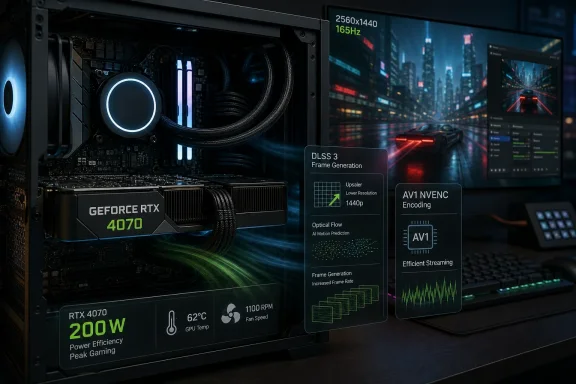 Nvidia Turned the Middle of the Stack Into a Software Platform
The RTX 4070 arrived at an awkward moment for PC builders. The pandemic-era GPU shortage had ended, but the trust damage had not. Buyers who remembered $499-class cards with wider memory buses and aggressive generational gains looked at $599 and saw a price hike disguised as progress.Nvidia’s counterargument was straightforward: Ada Lovelace was not merely a faster Ampere. The RTX 4070 brought the same architectural playbook as the RTX 4090 and RTX 4080 into a card that normal high-end hobbyists could at least consider. It had fourth-generation Tensor cores, third-generation RT cores, DLSS 3 frame generation, AV1-capable NVENC, and dramatically better power behavior than the RTX 3070 Ti.
That made the card less of a traditional midrange product and more of a gateway into Nvidia’s current software stack. The RTX 4070 was not pitched simply as “more rasterization for less money.” It was pitched as the card that made 1440p high-refresh gaming feel modern without forcing users into a flagship GPU, a giant power supply, or a case designed around heat exhaust.
That distinction matters because the Windows desktop GPU has become an ecosystem device. A GeForce card is now a gaming accelerator, video encoder, AI inference device, noise remover, upscaler, latency-management tool, and driver-supported creative engine. The RTX 4070 succeeded where it did because it sat at the intersection of all those identities.
The 200-Watt Number Was the Real Product Feature
The RTX 4070’s most underrated specification was not its 5,888 CUDA cores or its 12GB of GDDR6X memory. It was the 200-watt total graphics power rating. In a generation where the top of Nvidia’s lineup could look physically and electrically absurd, the RTX 4070 felt almost restrained.That restraint had practical consequences. A 200-watt graphics card fits into more existing Windows gaming PCs than a 300-watt-plus board. It is easier to cool, less likely to force a power supply upgrade, and more forgiving in compact cases. For sysadmins and small business IT buyers maintaining mixed-use creative workstations, lower power draw also means fewer support headaches.
The comparison with the RTX 3070 Ti was particularly flattering. Nvidia’s previous-generation card carried a much higher power rating while often losing to the RTX 4070 in real-world gaming. In a market where electricity costs, thermals, acoustic comfort, and component longevity all matter, efficiency is not a side note. It is a form of performance.
This is where the RTX 4070 quietly changed the upgrade math. A user moving from an RTX 2070 Super, RTX 3060 Ti, or older Radeon card was not only buying higher frame rates. They were buying a cooler, quieter, more feature-rich system that could often keep the same case, motherboard, and power supply. For WindowsForum’s audience, that is often the difference between a weekend upgrade and a full rebuild.
DLSS 3 Made the Frame Rate Debate Messier
DLSS 3 frame generation was the RTX 4070’s most marketable Ada feature, and also its most controversial. Traditional rendering performance is easy to explain: the GPU draws more frames. Frame generation complicates the picture by inserting AI-generated intermediate frames between conventionally rendered ones.In supported games, that can produce a dramatic uplift in perceived smoothness, especially when paired with DLSS upscaling and Nvidia Reflex. Titles such as Cyberpunk 2077 and Microsoft Flight Simulator became showcase examples because they stress GPUs, CPUs, or both. In CPU-limited scenarios, frame generation can make a game feel substantially smoother even when the underlying simulation rate has not increased in the same way.
The caveat is that generated frames are not the same thing as traditionally rendered frames. Latency, input feel, UI artifacts, and visual consistency still matter. Nvidia has improved the technology over time, and many players find it compelling, but it changed the language of benchmarking in ways that favored Nvidia’s software stack.
That was not an accident. The RTX 4070 gave Nvidia a way to make its mid-to-upper buyers care about Tensor cores and optical flow hardware, not just shader throughput. Once a gamer starts choosing settings around DLSS, Reflex, ray tracing, and frame generation, the GPU purchase becomes less comparable to a rival card on raw raster numbers alone.
The 12GB Question Never Went Away
The RTX 4070’s 12GB memory configuration was defensible in 2023 and still usable in 2026, but it was also the card’s most obvious long-term compromise. Nvidia paired that memory pool with a 192-bit bus, leaning on cache, high-speed GDDR6X, and upscaling to keep the card comfortably positioned for 1440p.For many games, that worked. At 1440p, 12GB remains enough for a large portion of the Windows gaming library, especially when users are not maxing every texture pack or running extreme ray-tracing modes. The RTX 4070 was never a bad 1440p card because of its memory subsystem.
But enthusiast anxiety around VRAM was not imaginary. Modern PC ports have grown heavier, texture packages have become more aggressive, and poorly optimized releases can punish cards with narrower buses or limited memory headroom. The RTX 4070’s 12GB capacity sits in the uncomfortable middle: much better than 8GB, less reassuring than 16GB.
That tension is one reason the card aged as a recommendation rather than a universal answer. For gamers who value Nvidia’s ray tracing, DLSS, power efficiency, and creator features, the RTX 4070 remains coherent. For buyers who prioritize long-term texture headroom above all else, competing cards with larger VRAM pools have always had an argument.
AV1 Was the Creator Feature That Deserved More Attention
Gaming dominated the RTX 4070 discussion, but the card’s AV1-capable eighth-generation NVENC encoder was one of its most important practical upgrades. For streamers and video creators, encoding quality at a given bitrate is not a benchmark vanity metric. It affects upload time, storage, platform quality, and the professional polish of a channel or client deliverable.AV1 support gave the RTX 4070 a stronger role in creator PCs than its place in the gaming hierarchy might suggest. A YouTuber, Twitch streamer, educator, or small studio editor could use the card for accelerated encoding while still getting strong 1440p gaming performance after hours. Nvidia Studio drivers further strengthened that pitch by emphasizing stability and application support across tools such as Adobe Premiere Pro, DaVinci Resolve, and Blender.
This is the part of the market where Nvidia’s platform strategy looks most durable. AMD and Intel can compete on price, memory, and open standards, but Nvidia’s long-standing relationships with creative software vendors remain a major advantage. For many Windows creators, CUDA and NVENC are not abstract brand names. They are workflow dependencies.
The RTX 4070 therefore became a safe default for a specific kind of PC: not a monster workstation, not a budget gaming rig, but a quiet, efficient, multipurpose Windows box that can game, encode, stream, and render without drama. That is a more valuable niche than the word “midrange” implies.
The RTX 4070 Was Never Cheap, but It Was Often Sensible
The original $599 price was the hardest part of the RTX 4070 to defend. Nvidia called it a mainstream Ada card, but a $599 GPU is not mainstream in the ordinary sense of the word. It is mainstream only inside the inflated economics of enthusiast PC gaming.Even so, the card found a market because it solved enough real problems. It was much faster and more efficient than older xx70-class cards. It offered better ray tracing than many prior-generation alternatives. It had enough memory for mainstream 1440p use. It supported Nvidia’s most visible software features. And it avoided the physical excesses of the highest-end Ada boards.
The RTX 4070 also benefited from the reality that GPU pricing is relative. Once RTX 4080 and RTX 4090 prices normalized expectations upward, the RTX 4070 looked like the point where Ada stopped being absurd and started being attainable. That does not mean it was generous. It means it was the first model in the stack many serious buyers could justify.
By 2026, the market context has shifted again. RTX 50-series cards exist, rumors continue around potential refreshes, and used RTX 40-series inventory has become part of the value conversation. Yet the RTX 4070’s appeal remains legible: it is powerful enough for high-refresh 1440p, efficient enough for normal PCs, and modern enough to run Nvidia’s software stack without feeling stranded.
Windows Gamers Got a Card Built for the Monitor They Actually Own
The RTX 4070 made the most sense when paired with a 1440p high-refresh monitor. That is the resolution where it could stretch its legs without constantly running into the brutal demands of native 4K. It is also the resolution that many serious PC gamers moved to as 144Hz, 165Hz, and 240Hz displays became affordable.At 1080p, the card can be overkill unless the goal is esports frame rates or heavy ray tracing. At 4K, it can perform well in many titles, but usually with compromises, upscaling, or settings discipline. At 1440p, the product positioning finally clicks.
That matters because Windows gaming is increasingly display-led. Users do not simply ask what GPU is fastest; they ask what GPU makes sense for the monitor on their desk. The RTX 4070 was tuned for the moment when 1440p became the practical enthusiast default.
It also fit the psychology of incremental upgrading. A gamer with a Ryzen 5 or Core i5 system, 32GB of RAM, and a good 650-watt power supply could drop in an RTX 4070 and immediately feel the difference. For builders who do not want every upgrade to become a platform migration, that kind of compatibility is a feature.
Nvidia’s Moat Is Now Made of Defaults
The RTX 4070’s broader lesson is that Nvidia has turned defaults into a competitive weapon. Game developers default to DLSS support because GeForce has a large installed base. Streamers default to NVENC because it is reliable and widely supported. Creators default to CUDA because application ecosystems have been built around it for years.That does not make Nvidia unbeatable, and it does not make every GeForce card the best value. It does explain why products like the RTX 4070 can command pricing that frustrates spec-sheet shoppers. Nvidia is not only selling the GPU. It is selling reduced uncertainty.
For IT pros, that reduced uncertainty can matter more than theoretical value. A small office that builds video-editing PCs does not want to debug obscure encoder issues. A school esports lab does not want to tune around unstable drivers. A streamer does not want a bargain card that behaves unpredictably in their production chain. Nvidia’s premium is partly a tax on convenience, but convenience has a market.
The danger for buyers is that convenience can become complacency. The RTX 4070’s 12GB memory pool, 192-bit bus, and launch price all deserved scrutiny. Nvidia’s ecosystem strengths should not exempt its hardware choices from criticism. They simply explain why many buyers accepted those compromises anyway.
The Ada Midrange Became a Preview of the AI PC Era
The RTX 4070 also foreshadowed a larger shift in Windows hardware marketing. In 2023, AI on consumer GPUs mostly meant DLSS, Broadcast, background effects, and creator acceleration. By 2026, “AI PC” has become a much broader industry label, spanning NPUs, Copilot-branded features, local inference, and workstation-class GPU workloads.The RTX 4070 sits awkwardly but usefully in that transition. It is not a professional AI accelerator, and its 12GB memory pool limits the size of local models it can comfortably run. But it has enough CUDA performance and software compatibility to experiment with AI-enhanced creative tools, image workflows, local inference projects, and GPU-accelerated applications.
That makes it more relevant to Windows enthusiasts than a pure gaming analysis would suggest. A GPU that can play games, accelerate video exports, clean up audio, upscale streams, and run hobbyist AI workloads is not a single-purpose accessory. It is a general-purpose accelerator in a consumer shell.
This is why Nvidia’s gaming cards keep mattering even as the company’s data-center business dominates headlines. The same brand gravity that sells AI servers also reinforces CUDA and GeForce on the desktop. The RTX 4070 may not be the card investors talk about, but it is one of the cards that keeps Nvidia’s platform present in millions of Windows PCs.
The Card’s Best Argument Is Still the Upgrade It Avoids
The RTX 4070 is easiest to appreciate not as a dream GPU, but as an anti-hassle GPU. It usually does not demand a new case. It usually does not demand an extreme power supply. It usually does not sound like a space heater. It usually does not require elaborate undervolting to behave sensibly.That is a boring kind of excellence, but boring is underrated in PC hardware. Many enthusiasts enjoy tuning, but most users want a machine that works. The RTX 4070’s efficiency gave it a quality-of-life advantage that benchmark charts often understate.
This also made the card attractive to prebuilt vendors. A 200-watt graphics card is easier to integrate across multiple chassis designs, easier to cool consistently, and easier to pair with mainstream CPUs. That helped the RTX 4070 become a familiar ingredient in gaming desktops advertised for 1440p play and content creation.
The best criticism is that Nvidia charged handsomely for that convenience. The best defense is that convenience was real. Both things can be true, and with the RTX 4070 they usually were.
The Practical Reading for 2026 Buyers Is Narrower but Still Strong
The RTX 4070 is no longer a fresh launch, so the buying question in 2026 is not the same as it was in 2023. Newer GPUs, discounted RTX 40-series alternatives, used cards, and competing Radeon models all change the calculation. Price matters more than brand positioning now.At the right price, the RTX 4070 remains a strong 1440p Windows gaming and creator card. At the wrong price, it is easy to talk yourself into a newer model, a Super variant, or a card with more memory. The product has aged well technically, but not magically.
The smartest buyers should treat it as a known quantity. Its strengths are efficiency, DLSS 3 support, ray tracing competence, AV1 encoding, and broad software compatibility. Its weaknesses are the original price class, the finite 12GB memory pool, and the reality that Nvidia’s best feature claims depend heavily on supported software.
That makes the RTX 4070 less of an impulse buy and more of a conditional recommendation. If a listing, prebuilt configuration, or used-market deal prices it like a mature product, it can still be excellent. If it is priced too close to newer or higher-tier alternatives, nostalgia for Ada efficiency should not override arithmetic.
The 4070’s Legacy Is Written in Power Draw, Not Hype
The cleanest way to understand the RTX 4070 is to ignore the launch arguments for a moment and look at what endured. Its efficiency endured. Its 1440p competence endured. Its DLSS and AV1 feature set endured. The debate over whether $599 was too much also endured.That combination makes it one of the more revealing GPUs of the last several years. It was neither a budget hero nor a halo monster. It was a polished, controlled, strategically priced product that showed exactly where Nvidia believed the upper-middle market was going.
The RTX 4070 told buyers that the future of PC graphics would be less about brute force alone and more about assisted rendering, specialized silicon, encoder quality, and platform trust. Some users loved that future. Some resented paying for it. Most ended up living with it.
The Short Version for a Long-Lived Ada Card
The RTX 4070 deserves a practical reading rather than a nostalgic one. It is a mature product now, and that makes its strengths and compromises easier to separate from launch-day noise.- The RTX 4070 remains best understood as a high-refresh 1440p card rather than a no-compromise 4K GPU.
- Its 200-watt power target is one of its strongest real-world advantages for upgrades, prebuilts, and quieter Windows desktops.
- DLSS 3 and frame generation can materially improve smoothness in supported games, but they should not be treated as identical to native rendering performance.
- The 12GB memory pool is still workable for many 1440p users, but it is the specification most likely to age the card unevenly.
- AV1 encoding, CUDA support, and Nvidia Studio drivers make the card more useful for creators than a gaming-only comparison suggests.
- In 2026, the RTX 4070 is attractive only when priced like a previous-generation product, not when it overlaps too closely with newer or higher-tier cards.
References
- Primary source: AD HOC NEWS
Published: 2026-06-13T16:20:17.350143
GeForce RTX 4070: Nvidia’s mainstream Ada GPU for high-refresh 1440p gaming
Nvidia’s GeForce RTX 4070 brings Ada Lovelace features like DLSS 3 frame generation, AV1 encoding, and improved power efficiency to the upper-midrange, targeting smooth 1440p gaming at a $599 launch price for PC builders and upgraders in the U.S.www.ad-hoc-news.de - Related coverage: pcgamer.com
Tech leaker claims that the RTX 50 Super refresh is still on, despite the RAMpocalypse, and it'll be joined by a 12 GB RTX 5060 | PC Gamer
Gotta use all them Blackwell dies somehow.www.pcgamer.com - Related coverage: pcworld.com
Nvidia GeForce RTX 4070 review: Highly efficient 1440p gaming | PCWorld
Nvidia's $599 GeForce RTX 4070 delivers superb 1440p gaming performance backed by excellent features. It's less well-suited for 4K gaming.www.pcworld.com - Related coverage: nvidia.com
Introducing GeForce RTX 4070: NVIDIA Ada Lovelace & DLSS 3, Starting At $599
Max out your favorite games at 1440p. Plus, RTX Remix runtime open source is now available, and RTX Video Super Resolution integrated into the popular VLC video player.www.nvidia.com - Related coverage: tomshardware.com
GeForce RTX 4070: Power, Clocks, Temps, Fans, and Noise - Nvidia GeForce RTX 4070 Review: Mainstream Ada Arrives - Page 9 | Tom's Hardware
Roughly matching the RTX 3080 for $100 less and with DLSS 3.www.tomshardware.com - Related coverage: techradar.com
Nvidia GeForce RTX 4070 review | TechRadar
The Nvidia GeForce RTX 4070 brings Lovelace under $600www.techradar.com
- Related coverage: makeuseof.com
Nvidia Launches Its New RTX 4070 GPU With Specs to Rival the RTX 3080
The RTX 4070 becomes the "budget" option in Nvidia's 40-Series, but how does it stack up? www.makeuseof.com
- Related coverage: hardwarepedia.com

NVIDIA GeForce RTX 4070 Specs, Benchmarks & Price | Hardwarepedia
NVIDIA GeForce RTX 4070 specs, benchmarks, and best prices. 12GB GDDR6X, 5888 CUDA cores. Solid 1440p Ada Lovelace GPU.
hardwarepedia.com
- Related coverage: techspot.com
Nvidia GeForce RTX 4070 vs. 4070 Ti: Is the Ti Worth It? | TechSpot
Here's an extensive benchmark session comparing the new GeForce RTX 4070 with its more formal tie-wearing sibling, the RTX 4070 Ti, to determine whether the Ti is...www.techspot.com - Related coverage: nvidianews.nvidia.com
- Related coverage: rxelectronics.nl
